Recognition: unknown
WavAlign: Enhancing Intelligence and Expressiveness in Spoken Dialogue Models via Adaptive Hybrid Post-Training
Pith reviewed 2026-05-10 11:02 UTC · model grok-4.3
The pith
A modality-aware adaptive post-training approach makes reinforcement learning practical for spoken dialogue models by separating semantic preference updates from acoustic anchoring.
A machine-rendered reading of the paper's core claim, the machinery that carries it, and where it could break.
Core claim
The central claim is that the modality-aware adaptive post-training recipe makes RL practical for spoken dialogue models by constraining preference updates to the semantic channel, improving acoustic behavior via explicit anchoring, and dynamically regulating their mixture from rollout statistics to avoid unreliable preference gradients, yielding consistent gains in semantic quality and speech expressiveness.
What carries the argument
The modality-aware adaptive post-training recipe, which separates and dynamically balances semantic preference optimization and acoustic anchoring based on rollout statistics.
If this is right
- Preference optimization can be applied without compromising acoustic generation quality.
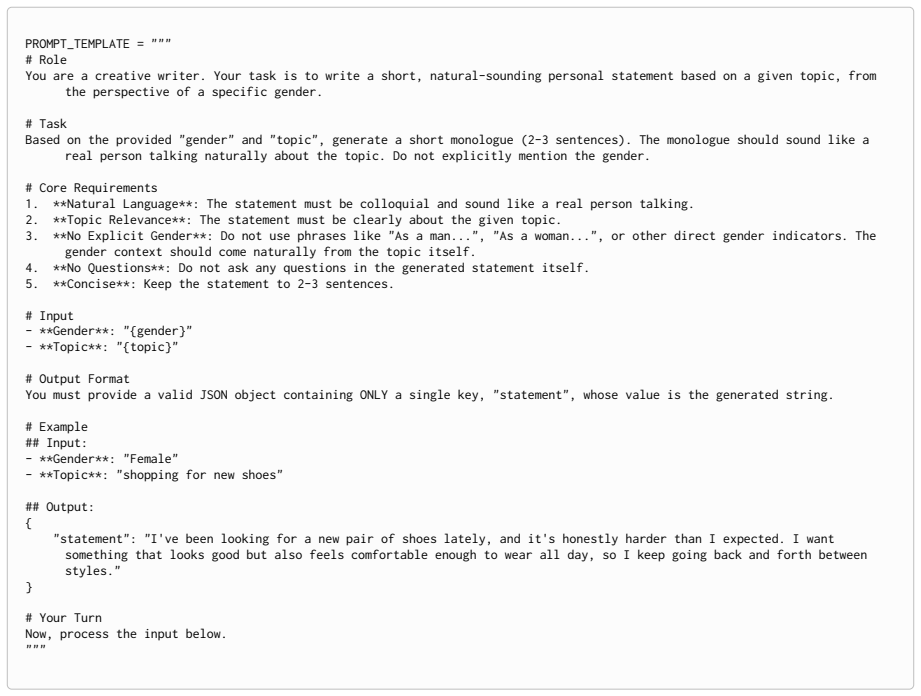
- Both semantic intelligence and acoustic expressiveness improve across tested models and benchmarks.
- Dynamic regulation from rollout statistics prevents issues from unreliable gradients.
- The method applies successfully to representative architectures in spoken dialogue.
Where Pith is reading between the lines
- This separation of concerns could be generalized to other multimodal generation tasks where different modalities have different optimization needs.
- Anchoring techniques might stabilize training in other settings with dense outputs and sparse rewards.
- Analyzing rollout statistics for adaptation could inspire similar adaptive strategies in other RL applications.
Load-bearing premise
The analysis accurately pinpoints the main problems in reward modeling and rollout sampling, and the new constraints and anchoring do not introduce instabilities in the training process.
What would settle it
Testing the proposed recipe on a spoken dialogue model and finding no gains in semantic quality or speech expressiveness metrics compared to direct preference optimization would falsify the claim.
Figures




read the original abstract
End-to-end spoken dialogue models have garnered significant attention because they offer a higher potential ceiling in expressiveness and perceptual ability than cascaded systems. However, the intelligence and expressiveness of current open-source spoken dialogue models often remain below expectations. Motivated by the success of online reinforcement learning(RL) in other domains, one might attempt to directly apply preference optimization to spoken dialogue models, yet this transfer is non-trivial. We analyze these obstacles from the perspectives of reward modeling and rollout sampling, focusing on how sparse preference supervision interacts with dense speech generation under shared-parameter updates. Based on the analysis, we propose a modality-aware adaptive post-training recipe that makes RL practical for spoken dialogue: it constrains preference updates to the semantic channel and improves acoustic behavior via explicit anchoring, while dynamically regulating their mixture from rollout statistics to avoid unreliable preference gradients. We evaluate the method across multiple spoken dialogue benchmarks and representative architectures, and observe consistent improvements in semantic quality and speech expressiveness.
Editorial analysis
A structured set of objections, weighed in public.
Referee Report
Summary. The paper claims that direct application of preference optimization to spoken dialogue models is hindered by challenges in reward modeling and rollout sampling, particularly sparse supervision with dense generation under shared parameters. It introduces WavAlign, a modality-aware adaptive post-training recipe that restricts preference updates to the semantic channel, employs explicit anchoring for acoustics, and dynamically mixes them based on rollout statistics. Evaluations on spoken dialogue benchmarks and various architectures show consistent improvements in semantic quality and expressiveness.
Significance. If the results hold, the work offers a practical solution to applying RL in spoken dialogue, potentially elevating open-source models' performance in intelligence and expressiveness. The focus on modality-specific adaptations addresses a gap in current post-training methods for multimodal systems.
major comments (2)
- [§3] §3: The proposed constraints on semantic-channel updates and acoustic anchoring are motivated by the analysis but the manuscript does not provide a formal derivation or proof that these prevent the identified instabilities, relying instead on empirical validation.
- [§4.3] §4.3: The dynamic regulation from rollout statistics is described at a high level; without the exact formula or pseudocode for computing the mixture weights, reproducibility of the adaptive component is limited.
minor comments (2)
- The title uses 'WavAlign' but the abstract and method section do not explain the name or its relation to waveform alignment.
- [References] References: Several recent works on RL for dialogue (e.g., from 2023-2024) appear missing from the related work section.
Simulated Author's Rebuttal
We thank the referee for the constructive feedback on our manuscript. We address the major comments point by point below, providing clarifications and committing to revisions that strengthen the presentation without altering the core contributions.
read point-by-point responses
-
Referee: [§3] The proposed constraints on semantic-channel updates and acoustic anchoring are motivated by the analysis but the manuscript does not provide a formal derivation or proof that these prevent the identified instabilities, relying instead on empirical validation.
Authors: We acknowledge that §3 presents a motivation grounded in the analysis of sparse preference supervision interacting with dense speech generation under shared parameters, rather than a formal derivation or proof of stability. The constraints on semantic-channel updates and acoustic anchoring follow directly from this analysis to isolate unreliable gradients. While a rigorous theoretical proof of instability prevention is not provided (and may lie outside the paper's scope), the empirical validation across multiple benchmarks and architectures consistently shows improved semantic quality and expressiveness without observed instabilities. In revision, we will expand §3 with additional intuitive explanations of the mechanism and a brief discussion of the empirical evidence supporting stability. revision: partial
-
Referee: [§4.3] The dynamic regulation from rollout statistics is described at a high level; without the exact formula or pseudocode for computing the mixture weights, reproducibility of the adaptive component is limited.
Authors: We agree that the description of the dynamic mixture regulation in §4.3 is at a high level and that including the exact formula and pseudocode would enhance reproducibility. The mixture weights are computed from rollout statistics to balance semantic preference updates and acoustic anchoring. In the revised manuscript, we will add the precise mathematical formulation for the mixture weights and include pseudocode for the adaptive regulation procedure, either in §4.3 or an appendix. revision: yes
Circularity Check
No significant circularity detected
full rationale
The paper's core contribution is an empirical recipe for post-training spoken dialogue models, derived from an analysis of reward modeling and rollout obstacles. It constrains updates to the semantic channel, adds explicit acoustic anchoring, and regulates mixtures from rollout statistics. No equations, fitted parameters renamed as predictions, or self-referential definitions appear in the abstract or described claims. The method is justified by benchmark evaluations showing consistent gains, not by any reduction of outputs to inputs by construction. Self-citations, if present in the full text, are not load-bearing for the central claim.
Axiom & Free-Parameter Ledger
axioms (1)
- domain assumption Sparse preference supervision interacts with dense speech generation under shared-parameter updates in a way that creates unreliable gradients.
Reference graph
Works this paper leans on
-
[1]
Training Verifiers to Solve Math Word Problems
Training verifiers to solve math word prob- lems.arXiv preprint arXiv:2110.14168. Ding Ding, Zeqian Ju, Yichong Leng, Songxiang Liu, Tong Liu, Zeyu Shang, Kai Shen, Wei Song, Xu Tan, Heyi Tang, and 1 others. 2025. Kimi-audio technical report.arXiv preprint arXiv:2504.18425. Ning Ding, Yulin Chen, Bokai Xu, Yujia Qin, Zhi Zheng, Shengding Hu, Zhiyuan Liu, ...
work page internal anchor Pith review Pith/arXiv arXiv 2025
-
[2]
Step-audio-aqaa: a fully end-to- end expressive large audio language model,
Step-audio-aqaa: a fully end-to-end expres- sive large audio language model.arXiv preprint arXiv:2506.08967. Jiaming Ji, Donghai Hong, Borong Zhang, Boyuan Chen, Josef Dai, Boren Zheng, Tianyi Qiu, Boxun Li, and Yaodong Yang. 2024a. Pku-saferlhf: Towards multi-level safety alignment for llms with human preference.arXiv preprint arXiv:2406.15513. Shengpeng...
-
[3]
UFT: Unifying supervised and reinforcement fine-tuning
Uft: Unifying supervised and reinforcement fine-tuning.arXiv preprint arXiv:2505.16984. Zuwei Long, Yunhang Shen, Chaoyou Fu, Heting Gao, Lijiang Li, Peixian Chen, Mengdan Zhang, Hang Shao, Jian Li, Jinlong Peng, Haoyu Cao, Ke Li, Rongrong Ji, and Xing Sun. 2025. Vita-audio: Fast interleaved cross-modal token generation for efficient large speech-language...
-
[4]
Paras2s: Benchmarking and aligning spoken language models for paralinguistic-aware speech-to- speech interaction.arXiv preprint arXiv:2511.08723. Xiangchi Yuan, Xiang Chen, Tong Yu, Dachuan Shi, Can Jin, Wenke Lee, and Saayan Mitra. 2025. Miti- gating forgetting between supervised and reinforce- ment learning yields stronger reasoners.arXiv preprint arXiv...
-
[5]
Zero gradients and backpropagate Ltext to ob- taing text
-
[6]
This yields clean modality-separated gradients rather than mixing both losses in a single backward pass
Zero gradients and backpropagate Lspeech to obtaing speech. This yields clean modality-separated gradients rather than mixing both losses in a single backward pass. Judge Pearson sem Pearsonacous Intra-ID Spearmansem Intra-ID Spearmanacous MAEsem MAEacous ≤1 Passsem ≤1 Passacous Biassem Biasacous Gemini-3-Flash 0.757 0.430 0.699 0.294 0.553 0.890 0.909 0....
-
[7]
**Six Distinct Statements**: You must generate six unique statements
-
[8]
The tone should be calm and observational
**Emotionally Neutral**: All statements must be objective and avoid conveying any strong emotions like happiness, sadness, anger, fear, or anxiety. The tone should be calm and observational
-
[9]
**First-Person Narrative**: Write from an "I" perspective
-
[10]
**Word Count**: Each statement must be a minimum of 50 words
-
[11]
{topic}" # Output Format You must provide a valid JSON object containing ONLY a single key,
**Descriptive Content**: Focus on sensory details and factual observations related to the topic. # Input - **Topic**: "{topic}" # Output Format You must provide a valid JSON object containing ONLY a single key, "statements", whose value is a list of six generated strings. # Example ## Input: - **Topic**: "A quiet morning with a cup of coffee and a good bo...
-
[12]
**Natural Language**: The statement must be colloquial and sound like a real person talking
-
[13]
**Topic Relevance**: The statement must be clearly about the given topic
-
[14]
As a man
**No Explicit Gender**: Do not use phrases like "As a man...", "As a woman...", or other direct gender indicators. The gender context should come naturally from the topic itself
-
[15]
**No Questions**: Do not ask any questions in the generated statement itself
-
[16]
{gender}
**Concise**: Keep the statement to 2-3 sentences. # Input - **Gender**: "{gender}" - **Topic**: "{topic}" # Output Format You must provide a valid JSON object containing ONLY a single key, "statement", whose value is the generated string. # Example ## Input: - **Gender**: "Female" - **Topic**: "shopping for new shoes" ## Output: { "statement": "I've been ...
2012
-
[18]
**Descriptive Expansion**: Elaborate on the topic, adding sensory details or a short narrative to make it more vivid
-
[21]
{topic}" # Output Format You must provide a valid JSON object containing ONLY a single key,
**Distinct Content**: The three paragraphs must be different from each other. # Input - **Topic**: "{topic}" # Output Format You must provide a valid JSON object containing ONLY a single key, "paragraphs", whose value is a list of **three** generated strings. # Example ## Input: - **Topic**: "A quiet morning with a cup of coffee and a good book" ## Output...
-
[22]
**Natural Language**: The text must be fluent, colloquial, and sound like a person speaking naturally
-
[23]
fast," "slow,
**Pace Neutrality**: The generated text must be completely neutral regarding the speed of events or speech. Avoid words like "fast," "slow," "quick," "rapid," "leisurely," "gradual," "sudden," etc. The pace will be conveyed through audio, not text
-
[24]
**Word Count**: Each paragraph should be around 45 words
-
[25]
**No Questions**: Do not ask any questions in the generated paragraphs
-
[26]
{topic}" # Output Format You must provide a valid JSON object containing ONLY a single key,
**Distinct Content**: The three paragraphs must be different from each other. # Input - **Topic**: "{topic}" # Output Format You must provide a valid JSON object containing ONLY a single key, "paragraphs", whose value is a list of **three** generated strings. # Example ## Input: - **Topic**: "A quiet morning with a cup of coffee and a good book" ## Output...
-
[27]
Be creative and vary the sentence structure and tone
**Natural Language**: The commands must be colloquial and natural, not robotic. Be creative and vary the sentence structure and tone
-
[28]
say it loudly,
**Explicit Volume**: Each command must clearly or strongly imply that the voice assistant should respond with the specified volume. Use phrases like "say it loudly," "whisper it," "in a normal voice," "shout it," etc
-
[29]
**Scenario Relevance**: The commands must be closely related to the provided scenario, giving a logical context for the volume request
-
[30]
give me a smile
**Voice-Only Constraints**: This is for a voice system, so the commands must NOT include any requests for visual cues (e. g., "give me a smile"), physical actions (e.g., "jump for joy"), or any other non-verbal output. All requests must be conveyable through voice and tone
-
[31]
{volume}
**Word Count**: Each command must be between 30 and 60 words long. # Input - **Volume**: "{volume}" - **Scenario**: "{scenario}" # Output Format You must provide a valid JSON object containing ONLY a single key, "instructions", whose value is a list of two instruction strings. # Example ## Input: - **Volume**: "Loud" - **Scenario**: "A drill sergeant yell...
-
[32]
**Natural & Immersive Language**: Commands must sound like a real, expressive person setting a scene, not just giving a brief order
-
[33]
read this at a rapid-fire pace,
**Explicit Pace Request**: Each command must clearly instruct the AI to use the specified speech pace in its response (e. g., "read this at a rapid-fire pace," "tell me the story very slowly," "at a normal conversational speed")
-
[34]
The AI does not know the input'scenario'; your generated command is its only source of information
**THE MOST CRITICAL RULE: Provide SELF-CONTAINED CONTEXT**: The user's command must *itself* describe the full scenario to the AI. The AI does not know the input'scenario'; your generated command is its only source of information. It must be completely clear from the command *why* the specific pace is needed
-
[35]
This script must be more than 25 words long
**Two Distinct Styles**: You MUST generate one command of each style: - **Style A (Scripted Performance)**: The user provides a specific script or text (enclosed in quotes) for the AI to read. This script must be more than 25 words long. The command should ask the AI to perform it at the specified pace. - **Style B (Improvised Response)**: The user descri...
-
[36]
{pace}" - **Scenario**:
**Word Count**: Each command must be between 40 and 80 words long. # Input - **Pace**: "{pace}" - **Scenario**: "{scenario}" # Output Format You must provide a valid JSON object containing ONLY a single key, "instructions", whose value is a list of two instruction strings in the order: [Style A, Style B]. # Example ## Input: - **Pace**: "Fast" - **Scenari...
-
[37]
A spoken USER QUESTION
-
[38]
A spoken MODEL ANSWER Your task is to evaluate the MODEL ANSWER from two independent perspectives:
-
[39]
**Semantic Content Quality** — what is said
-
[40]
--- ## Part 1: Semantic Content Evaluation (Meaning Only)
**Paralinguistic Voice Quality** — how it is spoken Evaluate each aspect separately and independently. --- ## Part 1: Semantic Content Evaluation (Meaning Only) ... --- ## Output Format (STRICT) Return ONLY the following XML format. Do NOT include any extra text. <justification> Briefly explain:
-
[41]
how well the answer performed semantically,
-
[42]
"" Figure 13:DPO scoring prompt (verbatim) used for semantic and paralinguistic scoring of repeated samples. EVALUATION_PROMPT =
how well the voice quality performed. </justification> <score-semantic>[1–5]</score-semantic> <score-paralinguistic>[1–5]</score-paralinguistic>""" Figure 13:DPO scoring prompt (verbatim) used for semantic and paralinguistic scoring of repeated samples. EVALUATION_PROMPT = """ **Task: Evaluate the Quality of a Spoken Answer** You will be provided with a s...
-
[43]
**Consider the Question's Intent:** First, ask yourself what the question is truly asking for. Is it a request for a specific fact (requiring accuracy), a detailed explanation (requiring clarity and structure), a personal opinion ( requiring good reasoning), or a creative idea (requiring originality)?
-
[44]
"" Figure 14:Reward prompt: overall answer quality. ACOUSTIC_EVALUATION_PROMPT =
**Holistic speech quality Assessment:** With that in mind, evaluate the answer as a whole. A great answer not only sounds clear and natural but also effectively *fulfills the specific purpose* of the question. **Scoring Guidelines (1-5):** * **5 (Excellent):** Perfectly understands and fulfills the question's intent with outstanding content and delivery. ...
-
[45]
**Clarity & Intelligibility** Are syllables distinct? Is the signal free of strong noise, muffling, clipping, or distortion?
-
[46]
**Fluency & Flow** Is the speech smooth and continuous, with minimal stutters, filler words, or awkward pauses?
-
[47]
**Accent & Pronunciation** Does any accent hinder intelligibility? Minor accent is acceptable if words remain easy to follow
-
[48]
**Emotion & Expressiveness (Context-Aware)** Does the emotional tone (e.g., neutral, cheerful, calm) fit the dialogue scene? Synthetic timbre is fine as long as emotional cues align with context
-
[49]
"" Figure 15:Reward prompt: acoustic-only (paralinguistic) evaluation. SEMANTIC_EVALUATION_PROMPT =
**Pace & Prosody** Is the speaking rate comfortable? Are intonation and rhythm varied enough to avoid monotony? > **Important:** > **Do NOT** penalize the voice merely for sounding synthetic. > Minor robotic artifacts are acceptable **if** they do not obscure clarity, fluency, accent, or pacing. > Only the five criteria above influence the score—ignore fa...
-
[50]
**Accuracy & Relevance:** Is the information factually correct and directly relevant to the question? Does it directly answer what was asked, or does it evade the question?
-
[51]
**Depth & Completeness:** Does the answer provide sufficient detail and insight? Is it well-reasoned and comprehensive, or is it superficial and incomplete?
-
[52]
A brilliant answer
**Structure & Coherence:** Is the argument or explanation logically structured and easy to follow? Is the language clear and articulate? **Scoring Guidelines (1-5 for Content):** * **5 (Excellent):** The content is accurate, deeply insightful, highly relevant, and perfectly structured. A brilliant answer. * **4 (Good):** The content is strong and correct ...
discussion (0)
Sign in with ORCID, Apple, or X to comment. Anyone can read and Pith papers without signing in.