Recognition: unknown
What if we have 90 minutes only to teach programming?
Pith reviewed 2026-05-10 08:33 UTC · model grok-4.3
The pith
A concatenative language from category theory lets novices learn recursion and Gödel-encoding in 90 minutes.
A machine-rendered reading of the paper's core claim, the machinery that carries it, and where it could break.
Core claim
A 90-minute teaching session built around CON-CAT introduces programming and computing fundamentals to novices by giving direct access to recursion and Gödel-encoding through an entertaining, puzzle-oriented approach that requires no prior programming experience.
What carries the argument
CON-CAT, the functional concatenative language that strips away accidental complexity so recursion and Gödel-encoding appear as immediate operations in a stack-based, category-theoretic setting.
If this is right
- Programming education can reach core theoretical ideas without first teaching extensive syntax or toolchains.
- Short workshops become viable for conveying computational thinking even when time is limited.
- The incentive to learn programming remains even if routine coding tasks are automated.
- Puzzle-style exercises can serve as entry points to advanced concepts such as encoding and self-reference.
Where Pith is reading between the lines
- Similar minimal languages could be designed to accelerate entry into other theoretical areas of computer science.
- Learning outcomes from the session could be measured against those from standard introductory languages to quantify the time savings.
- The approach might generalize to short modules on related topics like computability or formal systems.
Load-bearing premise
That a language with reduced accidental complexity will let novices with only basic math background grasp recursion and Gödel-encoding inside a single 90-minute session.
What would settle it
Conduct the described 90-minute session with a group of novices and test whether they can correctly explain or apply recursion and Gödel-encoding to new examples.
Figures
read the original abstract
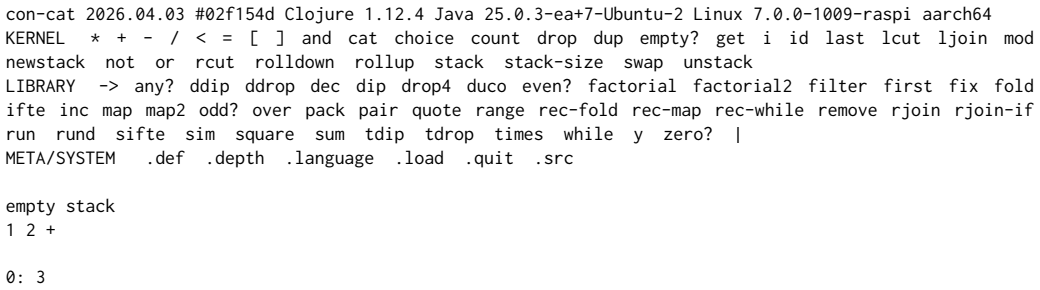
Programming is about automation in a wide variety of domains. Developing itself is one of those. As a side-effect, progress in automated coding may make people less willing to learn computer programming. This could become an issue, if the skill of computational problem solving is not only for the immediate economic benefit, but an important part of our knowledge about the world. We suggest that weakened incentives can be countered by lowering the entry barrier. We plan to shorten learning time by reducing the accidental complexity of the programming language and its runtime system. We describe a session plan that introduces programming and computing fundamentals for novices, assuming only basic mathematical background. This requires a non-mainstream, functional and concatenative language. This language, CON-CAT, is a by-product of research in category theory. It provides direct access to fundamental ideas like recursion and advanced ones like G\"odel-encoding in an entertaining puzzle-like manner.
Editorial analysis
A structured set of objections, weighed in public.
Axiom & Free-Parameter Ledger
invented entities (1)
-
CON-CAT language
no independent evidence
Reference graph
Works this paper leans on
-
[1]
E. W. Dijkstra, “The humble programmer,”Commun. ACM, vol. 15, no. 10, p. 859–866, Oct. 1972. [Online]. Available: https://doi.org/10. 1145/355604.361591
-
[2]
M. Welsh, “The end of programming,”Commun. ACM, vol. 66, no. 1, p. 34–35, Dec. 2022. [Online]. Available: https://doi.org/10.1145/3570220
-
[3]
Zinsser and W
W. Zinsser and W. Zinsser,Writing to Learn, ser. Perennial Library. Harper & Row, 1988
1988
-
[4]
Writes and write-nots,
P. Graham, “Writes and write-nots,” https://paulgraham.com/writes.html, accessed: 2026-04-08
2026
-
[5]
C. M. Kirsch, “Selfie and the basics,” inProceedings of the 2017 ACM SIGPLAN International Symposium on New Ideas, New Paradigms, and Reflections on Programming and Software, ser. Onward! 2017. New York, NY , USA: Association for Computing Machinery, 2017, p. 198–213. [Online]. Available: https://doi.org/10.1145/3133850.3133857
-
[6]
Nand to tetris: Building a modern computer system from first principles,
S. Schocken, “Nand to tetris: Building a modern computer system from first principles,”Commun. ACM, vol. 67, no. 5, p. 76–85, May 2024. [Online]. Available: https://doi.org/10.1145/3626513 con-cat 2026.04.03 #02f154d Clojure 1.12.4 Java 25.0.3-ea+7-Ubuntu-2 Linux 7.0.0-1009-raspi aarch64 KERNEL * + - / < = [ ] and cat choice count drop dup empty? get i id...
-
[7]
M. Resnick, J. Maloney, A. Monroy-Hern ´andez, N. Rusk, E. Eastmond, K. Brennan, A. Millner, E. Rosenbaum, J. Silver, B. Silverman, and Y . Kafai, “Scratch: programming for all,”Commun. ACM, vol. 52, no. 11, p. 60–67, Nov. 2009. [Online]. Available: https: //doi.org/10.1145/1592761.1592779
-
[8]
Representation independent decompositions of computation,
A. Egri-Nagy and C. L. Nehaniv, “Representation independent decompositions of computation,” 2025. [Online]. Available: https: //arxiv.org/abs/2504.04660
-
[9]
Bringing algebraic hierarchical decompositions to con- catenative functional languages,
A. Egri-Nagy, “Bringing algebraic hierarchical decompositions to con- catenative functional languages,” in2025 Thirteenth International Sym- posium on Computing and Networking Workshops (CANDARW), 2025, pp. 1–7
2025
-
[10]
Joy: Forth’s functional cousin,
M. V on Thun and R. Thomas, “Joy: Forth’s functional cousin,” in Proceedings of the 17th EuroForth Conference, 2001
2001
-
[11]
No silver bullet: Essence and accidents of software engineering. information processing 1986,
F. P. Brooks Jr, “No silver bullet: Essence and accidents of software engineering. information processing 1986,” inProceedings of the Tenth World Computing Conference, H.-J. Kugler, ed, 1986, pp. 1069–76
1986
-
[12]
Csikszentmihalyi,Flow: the psychology of optimal experience
M. Csikszentmihalyi,Flow: the psychology of optimal experience. Harper & Row, 1990
1990
-
[13]
Felleisen, R
M. Felleisen, R. Findler, M. Flatt, and S. Krishnamurthi,How to Design Programs, second edition: An Introduction to Programming and Computing. MIT Press, 2018
2018
-
[14]
Sakurai and G
S. Sakurai and G. Sekimori,Wasan: The Fascination of Traditional Japanese Mathematics, ser. Japan library. Japanese Publishing Industry Foundation for Culture, 2018
2018
-
[15]
The theory of concatenative combinators,
B. Kerby, “The theory of concatenative combinators,” 2007, unpub- lished, available at https://codeberg.org/egri-nagy/con-cat/src/branch/ main/doc/JOY MIRROR
2007
-
[16]
V .-M. H. Marloes de Valk, “Permacomputing,”Counter-N, 2022. [Online]. Available: https://doi.org/10.18452/25609
-
[17]
Computing, mathematics and Project Euler,
R. Bridges, “Computing, mathematics and Project Euler,”Mathematics in School, vol. 47, no. 5, pp. pp. 22–23, 2018. [Online]. Available: https://www.jstor.org/stable/26608730
-
[18]
Electronic calculators: which notation is the better?
S. Agate and C. Drury, “Electronic calculators: which notation is the better?”Applied Ergonomics, vol. 11, no. 1, pp. 2–6, 1980
1980
-
[19]
Hindley and J
J. Hindley and J. Seldin,Lambda-Calculus and Combinators: An Intro- duction. Cambridge University Press, 2008
2008
-
[20]
Smullyan,To Mock a Mocking Bird and Other Logic Puzzles: Including an Amazing Adventure in Combinatory Logic, ser
R. Smullyan,To Mock a Mocking Bird and Other Logic Puzzles: Including an Amazing Adventure in Combinatory Logic, ser. A Borzoi book. Knopf, 1985
1985
-
[21]
D. R. Hofstadter,G ¨odel, Escher, Bach: an Eternal Golden Brain. The Harvester Press Ltd, 1979
1979
-
[22]
Recursion theory and joy,
M. von Thun, “Recursion theory and joy,” unpublished, available at https://codeberg.org/egri-nagy/con-cat/src/branch/main/doc/JOY MIRROR
-
[23]
Brodie,Thinking Forth
L. Brodie,Thinking Forth. Punchy Publishing, 2004. [Online]. Available: https://www.forth.com/forth-books/
2004
-
[24]
R. Hickey, “A history of Clojure,”Proc. ACM Program. Lang., vol. 4, no. HOPL, Jun. 2020. [Online]. Available: https://doi.org/10.1145/3386321
-
[25]
Nystrom,Crafting Interpreters
R. Nystrom,Crafting Interpreters. Genever Benning, 2021
2021
-
[26]
Egri-Nagy,CON-CATfunctional concatenative programming language with an explicit semigroupoid representations, 2025, codeberg.org/egri-nagy/con-cat
A. Egri-Nagy,CON-CATfunctional concatenative programming language with an explicit semigroupoid representations, 2025, codeberg.org/egri-nagy/con-cat
2025
-
[27]
On designing programming error messages for novices: Readability and its constituent factors,
P. Denny, J. Prather, B. A. Becker, C. Mooney, J. Homer, Z. C. Albrecht, and G. B. Powell, “On designing programming error messages for novices: Readability and its constituent factors,” inProceedings of the 2021 CHI Conference on Human Factors in Computing Systems, ser. CHI ’21. New York, NY , USA: Association for Computing Machinery,
2021
-
[28]
Available: https://doi.org/10.1145/3411764.3445696
[Online]. Available: https://doi.org/10.1145/3411764.3445696
-
[29]
Typst: A modern typesetting engine for science,
A. V oynov, A. Corbi, P. L ´opez-Oliver, and D. Gil, “Typst: A modern typesetting engine for science,”International Journal of Interactive Multimedia and Artificial Intelligence, p. 1–13, Feb. 2026. [Online]. Available: https://doi.org/10.9781/ijimai.2026.2269
-
[30]
Abelson, G
H. Abelson, G. Sussman, and J. Sussman,Structure and Interpretation of Computer Programs, ser. Electrical engineering and computer science series. MIT Press, 1996, https://github.com/sarabander/sicp-pdf
1996
-
[31]
Juul,Too Much Fun: The Five Lives of the Commodore 64 Computer, ser
J. Juul,Too Much Fun: The Five Lives of the Commodore 64 Computer, ser. Platform Studies. MIT Press, 2024
2024
discussion (0)
Sign in with ORCID, Apple, or X to comment. Anyone can read and Pith papers without signing in.