Recognition: unknown
Prompt-to-Gesture: Measuring the Capabilities of Image-to-Video Deictic Gesture Generation
Pith reviewed 2026-05-10 11:17 UTC · model grok-4.3
The pith
Image-to-video models generate deictic gestures from text prompts that match real recordings and raise accuracy when mixed into training sets.
A machine-rendered reading of the paper's core claim, the machinery that carries it, and where it could break.
Core claim
A pipeline that starts from a small set of human-recorded deictic gestures and uses prompt-guided image-to-video models to synthesize new gesture videos produces output that aligns closely with real gestures in visual fidelity, introduces meaningful variability and novelty, and yields higher downstream recognition accuracy when the synthetic clips are mixed with the original human data.
What carries the argument
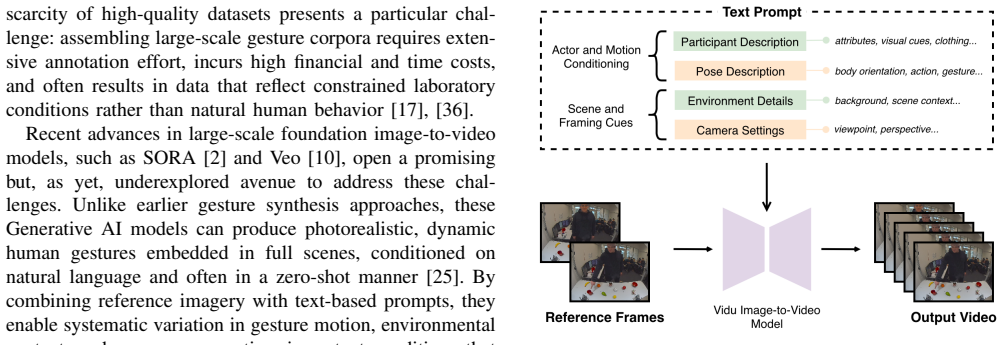
A prompt-based video generation pipeline that converts a small number of reference human deictic gesture samples into additional synthetic videos via natural-language instructions.
If this is right
- Synthetic gesture data can reduce reliance on expensive human recordings for dataset creation.
- Mixed real-synthetic training improves generalization for multiple deep gesture recognition architectures.
- The method supplies an accessible, zero-shot way to augment deictic gesture datasets for both ML and non-ML users.
- Early-stage image-to-video models already deliver measurable benefits for gesture synthesis tasks.
Where Pith is reading between the lines
- The same prompt-to-video approach could be tested on other gesture categories such as iconic or metaphoric gestures.
- Refining the prompts or reference selection process might further increase the novelty introduced by each synthetic sample.
- Combining this generation step with existing video augmentation techniques could produce even larger effective training sets.
Load-bearing premise
Performance gains on mixed datasets result from genuine, useful variability in the generated gestures rather than from artifacts, limited diversity, or unrelated experimental factors.
What would settle it
Re-train the same deep models on real-only versus mixed real-synthetic sets and measure whether accuracy or F1 scores show no consistent improvement, or compute motion-variance and semantic-distance statistics showing the synthetic set adds negligible new diversity.
Figures



read the original abstract
Gesture recognition research, unlike NLP, continues to face acute data scarcity, with progress constrained by the need for costly human recordings or image processing approaches that cannot generate authentic variability in the gestures themselves. Recent advancements in image-to-video foundation models have enabled the generation of photorealistic, semantically rich videos guided by natural language. These capabilities open up new possibilities for creating effort-free synthetic data, raising the critical question of whether video Generative AI models can augment and complement traditional human-generated gesture data. In this paper, we introduce and analyze prompt-based video generation to construct a realistic deictic gestures dataset and rigorously evaluate its effectiveness for downstream tasks. We propose a data generation pipeline that produces deictic gestures from a small number of reference samples collected from human participants, providing an accessible approach that can be leveraged both within and beyond the machine learning community. Our results demonstrate that the synthetic gestures not only align closely with real ones in terms of visual fidelity but also introduce meaningful variability and novelty that enrich the original data, further supported by superior performance of various deep models using a mixed dataset. These findings highlight that image-to-video techniques, even in their early stages, offer a powerful zero-shot approach to gesture synthesis with clear benefits for downstream tasks.
Editorial analysis
A structured set of objections, weighed in public.
Referee Report
Summary. The paper introduces a prompt-based pipeline using image-to-video foundation models to synthesize deictic gesture videos from a small set of human reference samples. It claims these synthetic gestures achieve close visual alignment with real data, introduce meaningful variability and novelty that enrich the original dataset, and yield superior downstream performance for deep models trained on mixed real+synthetic gesture data.
Significance. If the empirical claims are substantiated with quantitative metrics and controls, the work could provide a scalable zero-shot approach to address data scarcity in gesture recognition, reducing reliance on costly human recordings and enabling broader use of generative video models for data augmentation in computer vision.
major comments (3)
- [Abstract] Abstract: The assertions of 'visual fidelity,' 'meaningful variability and novelty,' and 'superior performance of various deep models using a mixed dataset' are presented without any quantitative metrics (e.g., FID, keypoint variance, trajectory entropy), baselines, statistical tests, or measurement details, preventing verification of the central empirical claims.
- [Evaluation section] Evaluation (downstream tasks): Performance gains on mixed datasets lack size-matched ablations (e.g., mixed vs. doubled real-only data) and controls for training procedure, leaving open that improvements arise from increased sample volume or confounds rather than genuine synthetic variability.
- [Data generation pipeline] Data generation pipeline: No independent diversity metrics (e.g., prompt-conditioned pose distributions or hand-keypoint variance) are reported to demonstrate that synthetic gestures add useful novelty rather than artifacts or limited modes from the generative model.
minor comments (2)
- [Abstract] Abstract: 'Various deep models' is unspecified; naming the architectures and providing implementation details would improve reproducibility.
- [Introduction] Introduction: Additional citations to prior synthetic data augmentation work in gesture recognition or video generation would better contextualize the contribution.
Simulated Author's Rebuttal
We thank the referee for their constructive feedback, which highlights important areas for strengthening the empirical support in our work. We address each major comment point by point below and have revised the manuscript to incorporate the requested quantitative metrics, ablations, and controls.
read point-by-point responses
-
Referee: [Abstract] The assertions of 'visual fidelity,' 'meaningful variability and novelty,' and 'superior performance of various deep models using a mixed dataset' are presented without any quantitative metrics (e.g., FID, keypoint variance, trajectory entropy), baselines, statistical tests, or measurement details, preventing verification of the central empirical claims.
Authors: We agree that the abstract would be strengthened by referencing specific quantitative metrics. The body of the paper includes visual comparisons, example-based variability, and downstream accuracy numbers, but we will revise the abstract to cite key results such as FID scores for fidelity, keypoint variance and trajectory entropy for novelty, and performance deltas with statistical tests. This change will be made in the revised version. revision: yes
-
Referee: [Evaluation section] Performance gains on mixed datasets lack size-matched ablations (e.g., mixed vs. doubled real-only data) and controls for training procedure, leaving open that improvements arise from increased sample volume or confounds rather than genuine synthetic variability.
Authors: The referee correctly identifies the need for size-matched controls. We will add new experiments in the revised evaluation section that compare the mixed real+synthetic dataset against a doubled real-only dataset of matched size, while holding training procedures, hyperparameters, and random seeds fixed. This will help isolate the contribution of synthetic variability. revision: yes
-
Referee: [Data generation pipeline] No independent diversity metrics (e.g., prompt-conditioned pose distributions or hand-keypoint variance) are reported to demonstrate that synthetic gestures add useful novelty rather than artifacts or limited modes from the generative model.
Authors: We acknowledge that explicit diversity metrics were not reported. To quantify the novelty introduced by the prompt-based generation, we will compute and add independent metrics including prompt-conditioned pose distributions, hand-keypoint variance, and trajectory entropy in the data generation pipeline section of the revised manuscript. revision: yes
Circularity Check
No circularity: empirical evaluation of synthetic data augmentation
full rationale
The paper describes an empirical pipeline for generating deictic gestures via image-to-video models from a small set of human reference samples, followed by visual fidelity comparisons and downstream deep model training on real, synthetic, and mixed datasets. No equations, fitted parameters, or predictions are presented that reduce by construction to the inputs; claims rest on reported experimental outcomes rather than self-definitional loops or self-citation chains. The work is self-contained as a standard data-augmentation study without load-bearing reductions to prior author results or ansatzes.
Axiom & Free-Parameter Ledger
axioms (1)
- domain assumption Recent image-to-video foundation models can generate photorealistic, semantically rich videos guided by natural language prompts.
Reference graph
Works this paper leans on
-
[1]
F. Bao, C. Xiang, G. Yue, G. He, H. Zhu, K. Zheng, M. Zhao, S. Liu, Y . Wang, and J. Zhu. Vidu: a Highly Consistent, Dynamic and Skilled Text-to-Video Generator with Diffusion Models.CoRR, 2024
2024
-
[2]
Brooks, B
T. Brooks, B. Peebles, C. Holmes, W. DePue, Y . Guo, L. Jing, D. Schnurr, J. Taylor, T. Luhman, E. Luhman, C. Ng, R. Wang, and A. Ramesh. Video Generation Models as World simulators, 2024
2024
-
[3]
M. C. Corballis. Language as Gesture.Human Movement Science, 28(5):556–565, Oct. 2009
2009
-
[4]
J. Dai, T. Chen, X. Wang, Z. Yang, T. Chen, J. Ji, and Y . Yang. SafeSora: Towards Safety Alignment of Text2Video Generation via a Human Preference Dataset. InThe Thirty-eight Conference on Neural Information Processing Systems Datasets and Benchmarks Track, 2024
2024
-
[5]
S. S. Das. A Data-Set and a Method for Pointing Direction Es- timation from Depth Images for Human-Robot Interaction and VR Applications. In2021 IEEE International Conference on Robotics and Automation (ICRA), pages 11485–11491. IEEE, 2021
2021
-
[6]
Deichler, S
A. Deichler, S. Mehta, S. Alexanderson, and J. Beskow. Diffusion- Based Co-Speech Gesture Generation Using Joint Text and Audio Representation. InProceedings of the 25th International Conference on Multimodal Interaction, ICMI ’23, page 755–762, New York, NY , USA, 2023. Association for Computing Machinery
2023
-
[7]
A. S. Dick, S. Goldin-Meadow, A. Solodkin, and S. L. Small. Gesture in the Developing Brain.Developmental Science, 15(2):165–180, 2012
2012
-
[8]
K. Foteinos, J. Cani, M. Linardakis, P. Radoglou Grammatikis, V . Ar- gyriou, P. Sarigiannidis, I. Varlamis, and G. Papadopoulos. Visual Hand Gesture Recognition with Deep Learning: A Comprehensive Review of Methods, Datasets, Challenges and Future Research Di- rections.arXiv, 2507.04465, 07 2025
work page internal anchor Pith review arXiv 2025
-
[9]
K. Gao, H. Zhang, X. Liu, X. Wang, L. Xie, B. Ji, Y . Yan, and E. Yin. Challenges and Solutions for Vision-Based Hand Gesture Interpretation: A Review.Computer Vision and Image Understanding, 248:104095, 2024
2024
-
[10]
Veo: Generative Video Model, 2024
Google DeepMind. Veo: Generative Video Model, 2024
2024
-
[11]
T. T. Hai, D. T. T. Mai, and N. V . Hanh. A Rapid Review of Using AI-Generated Instructional Videos in Higher Education.Frontiers in Computer Science, V olume 7 - 2025, 2026
2025
-
[12]
Hashi, S
A. Hashi, S. Mohd Hashim, and A. Asamah. A Systematic Review of Hand Gesture Recognition: An Update From 2018 to 2024.IEEE Access, PP:1–1, 01 2024
2018
-
[13]
Heusel, H
M. Heusel, H. Ramsauer, T. Unterthiner, B. Nessler, and S. Hochreiter. GANs Trained by a Two Time-Scale Update Rule Converge to a Local Nash Equilibrium. NIPS’17, page 6629–6640, Red Hook, NY , USA,
-
[14]
Curran Associates Inc
-
[15]
J. Ho, W. Chan, C. Saharia, J. Whang, R. Gao, A. Gritsenko, D. P. Kingma, B. Poole, M. Norouzi, D. J. Fleet, and T. Salimans. Imagen Video: High Definition Video Generation with Diffusion Models. arXiv, 2210.02303, 2022
work page internal anchor Pith review arXiv 2022
-
[16]
Huang, X
Y . Huang, X. Liu, X. Zhang, and L. Jin. A Pointing Gesture Based Egocentric Interaction System: Dataset, Approach and Application. In Proceedings of the IEEE conference on computer vision and pattern recognition workshops, pages 16–23, 2016
2016
-
[17]
Jirak, D
D. Jirak, D. Biertimpel, M. Kerzel, and S. Wermter. Solving Visual Object Ambiguities when Pointing: An Unsupervised Learning Ap- proach.Neural Computing and Applications, 33(7):2297–2319, 2021
2021
-
[18]
I.-T. Jung, S. Ahn, J. Seo, and J.-H. Hong. Exploring the Potentials of Crowdsourcing for Gesture Data Collection.International Journal of Human–Computer Interaction, 40(12):3112–3121, 2024
2024
-
[19]
Kerzel, P
M. Kerzel, P. Allgeuer, E. Strahl, N. Frick, J. Habekost, M. Eppe, and S. Wermter. NICOL: A Neuro-Inspired Collaborative Semi-Humanoid Robot That Bridges Social Interaction and Reliable Manipulation. IEEE Access, 11:123531–123542, 2023
2023
-
[20]
Khachatryan, A
L. Khachatryan, A. Movsisyan, V . Tadevosyan, R. Henschel, Z. Wang, S. Navasardyan, and H. Shi. Text2Video-Zero: Text-to-Image Diffu- sion Models are Zero-Shot Video Generators. In2023 IEEE/CVF International Conference on Computer Vision (ICCV), pages 15908– 15918, 2023
2023
-
[21]
M. A. I. Khan, M. S. Sarowar, M. Islam, N. FARJANA, and S. IS- LAM. Hand Gesture Recognition Systems: A Review of Methods, Datasets, and Emerging Trends.International Journal of Computer Applications, 187:33, 05 2025
2025
-
[22]
S. Kim, M. Chang, Y . Kim, and J. Lee. Body Gesture Generation for Multimodal Conversational Agents. InSIGGRAPH Asia 2024 Conference Papers, pages 1–11, 2024
2024
-
[23]
Kucherenko, R
T. Kucherenko, R. Nagy, Y . Yoon, J. Woo, T. Nikolov, M. Tsakov, and G. E. Henter. The GENEA Challenge 2023: A Large-Scale Evaluation of Gesture Generation Models in Monadic and Dyadic Settings. InProceedings of the 25th International Conference on Multimodal Interaction, pages 792–801, 2023
2023
-
[24]
Kucherenko, P
T. Kucherenko, P. Wolfert, Y . Yoon, C. Viegas, T. Nikolov, M. Tsakov, and G. E. Henter. Evaluating Gesture Generation in a Large-Scale Open Challenge: The GENEA Challenge 2022.ACM Transactions on Graphics, 43(3):1–28, 2024
2022
-
[25]
T. Kwon, B. Tekin, J. St ¨uhmer, F. Bogo, and M. Pollefeys. H2O: Two Hands Manipulating Objects for First Person Interaction Recog- nition. InProceedings of the IEEE/CVF International Conference on Computer Vision (ICCV), pages 10138–10148, October 2021
2021
-
[26]
Zerohsi: Zero-shot 4d human-scene interaction by video generation
H. Li, H.-X. Yu, J. Li, and J. Wu. ZeroHSI: Zero-Shot 4D Human- Scene Interaction by Video Generation.arXiv, 2412.18600, 2025
-
[27]
L. Li, L. Tian, X. Zhang, Q. Wang, B. Zhang, L. Bo, M. Liu, and C. Chen. RenderIH: A Large-scale Synthetic Dataset for 3D Interacting Hand Pose Estimation.2023 IEEE/CVF International Conference on Computer Vision (ICCV), pages 20338–20348, 2023
2023
-
[28]
Linardakis, I
M. Linardakis, I. Varlamis, and G. T. Papadopoulos. Survey on Hand Gesture Recognition from Visual Input.IEEE Access, 13:135373– 135406, 2025
2025
-
[29]
H. Liu, Z. Zhu, G. Becherini, Y . Peng, M. Su, Y . Zhou, X. Zhe, N. Iwamoto, B. Zheng, and M. J. Black. EMAGE: Towards Unified Holistic Co-Speech Gesture Generation via Expressive Masked Audio Gesture Modeling. InProceedings of the IEEE/CVF Conference on Computer Vision and Pattern Recognition (CVPR), pages 1144–1154, June 2024
2024
-
[30]
P. Liu, L. Song, J. Huang, and C. Xu. GestureLSM: Latent Shortcut based Co-Speech Gesture Generation with Spatial-Temporal Model- ing. InIEEE/CVF International Conference on Computer Vision, 2025
2025
-
[31]
Y . Liu, K. Zhang, Y . Li, Z. Yan, C. Gao, R. Chen, Z. Yuan, Y . Huang, H. Sun, J. Gao, L. He, and L. Sun. Sora: A Review on Background, Technology, Limitations, and Opportunities of Large Vision Models. arXiv, 2402.17177, 2024
work page internal anchor Pith review arXiv 2024
-
[32]
Motamed, L
S. Motamed, L. Culp, K. Swersky, P. Jaini, and R. Geirhos. Do Generative Video Models Understand Physical Principles?arXiv, arXiv, 2025
2025
-
[33]
M ¨oller, H
L. M ¨oller, H. Ali, P. Allgeuer, and S. Wermter. Pointing-Guided Target Estimation via Transformer-Based Attention.Artificial Neural Networks and Machine Learning – ICANN 2025, 2025
2025
-
[34]
Patel, S
S. Patel, S. Mohan, H. Mai, U. Jain, S. Lazebnik, and Y . Li. Robotic Manipulation by Imitating Generated Videos Without Physical Demonstrations. InWorkshop on Foundation Models Meet Embodied Agents at CVPR 2025, 2025
2025
-
[35]
Peral, A
M. Peral, A. Sanfeliu, and A. Garrell. Efficient Hand Gesture Recog- nition for Human-Robot Interaction.IEEE Robotics and Automation Letters, 7(4):10272–10279, 2022
2022
-
[36]
Pozzi, M
L. Pozzi, M. Gandolla, and L. Roveda. Pointing Gestures for Human- Robot Interaction in Service Robotics: A Feasibility Study. In International Conference on Computers Helping People with Special Needs, pages 461–468. Springer, 2022
2022
-
[37]
J. Qi, L. Ma, Z. Cui, and Y . Yu. Computer Vision-Based Hand Gesture Recognition for Human-Robot Interaction: A Review.Complex & Intelligent Systems, 10(1):1581–1606, Feb 2024
2024
-
[38]
Radford, J
A. Radford, J. W. Kim, C. Hallacy, A. Ramesh, G. Goh, S. Agarwal, G. Sastry, et al. Learning Transferable Visual Models from Natural Language Supervision. InInternational Conference on Machine Learning. PMLR, 2021
2021
-
[39]
Singer, A
U. Singer, A. Polyak, T. Hayes, X. Yin, J. An, S. Zhang, Q. Hu, H. Yang, O. Ashual, O. Gafni, D. Parikh, S. Gupta, and Y . Taigman. Make-A-Video: Text-to-Video Generation without Text-Video Data. In The Eleventh International Conference on Learning Representations, 2023
2023
-
[40]
Z. Tong, Y . Song, J. Wang, and L. Wang. VideoMAE: Masked Autoencoders are Data-Efficient Learners for Self-Supervised Video Pre-Training. InProceedings of the 36th International Conference on Neural Information Processing Systems, NIPS ’22, Red Hook, NY , USA, 2022. Curran Associates Inc
2022
-
[41]
Towards Accurate Generative Models of Video: A New Metric & Challenges
T. Unterthiner, S. van Steenkiste, K. Kurach, R. Marinier, M. Michal- ski, and S. Gelly. Towards Accurate Generative Models of Video: A New Metric & Challenges.arXiv, 1812.01717, 2019
work page internal anchor Pith review arXiv 2019
-
[42]
Urakami and K
J. Urakami and K. Seaborn. Nonverbal Cues in Human–Robot Interaction: A Communication Studies Perspective.ACM Transactions on Human-Robot Interaction, 12(2):1–21, 2023
2023
-
[43]
J. Wan, C. Lin, L. Wen, Y . Li, Q. Miao, S. Escalera, G. Anbarjafari, I. Guyon, G. Guo, and S. Z. Li. ChaLearn Looking at People: IsoGD and ConGD Large-Scale RGB-D Gesture Recognition.IEEE 9 Transactions on Cybernetics, 52(5):3422–3433, 2022
2022
-
[44]
B. Wang, N. Sridhar, C. Feng, M. Van der Merwe, A. Fishman, N. Fazeli, and J. J. Park. This&That: Language-Gesture Controlled Video Generation for Robot Planning. In2025 IEEE International Conference on Robotics and Automation (ICRA), pages 12842–12849. IEEE, 2025
2025
-
[45]
J. Z. Wu, Y . Ge, X. Wang, S. W. Lei, Y . Gu, Y . Shi, W. Hsu, Y . Shan, X. Qie, and M. Z. Shou. Tune-A-Video: One-Shot Tuning of Image Diffusion Models for Text-to-Video Generation. In2023 IEEE/CVF International Conference on Computer Vision (ICCV), pages 7589– 7599, 2023
2023
-
[46]
”Mediapipe hands: On-device real-ti me hand track- ing.” arXiv preprint arXiv:2006.10214 (2020)
F. Zhang, V . Bazarevsky, A. Vakunov, A. Tkachenka, G. Sung, C.-L. Chang, and M. Grundmann. MediaPipe Hands: On-Device Real-time Hand Tracking.arXiv, 2006.10214, 2020
-
[47]
W. Zhao, L. Hu, and S. Zhang. DiffuGesture: Generating Human Gesture From Two-person Dialogue With Diffusion Models. In Companion Publication of the 25th International Conference on Multimodal Interaction, ICMI ’23 Companion, page 179–185, New York, NY , USA, 2023. Association for Computing Machinery
2023
-
[48]
Zimmermann, D
C. Zimmermann, D. Ceylan, J. Yang, B. Russell, M. Argus, and T. Brox. FreiHAND: A Dataset for Markerless Capture of Hand Pose and Shape from Single RGB Images. InIEEE International Conference on Computer Vision (ICCV), 2019. 10
2019
discussion (0)
Sign in with ORCID, Apple, or X to comment. Anyone can read and Pith papers without signing in.