Recognition: unknown
Source Distance Estimation in Turbulent Airflow: Exploiting Molecule Degradation Diversity
Pith reviewed 2026-05-10 09:23 UTC · model grok-4.3
The pith
Relative abundances of differently degrading molecules enable low-complexity source distance estimation in turbulent airflow.
A machine-rendered reading of the paper's core claim, the machinery that carries it, and where it could break.
Core claim
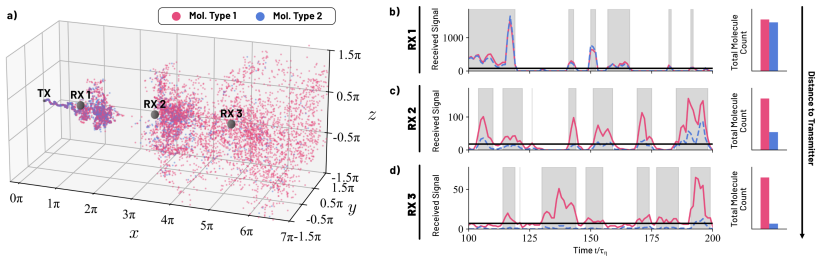
When different molecule types in a mixture are subject to atmospheric degradation with different degradation rates, the relative abundance of the different species observed at the receiver enables low-complexity estimation of the source distance. This feature can be combined with already established concentration-based and temporal features of observed molecular signals to further increase estimation accuracy, even in turbulent airflow.
What carries the argument
Molecule degradation diversity: the use of multiple molecule species that degrade at measurably different rates, so that their concentration ratio at the receiver becomes a distance-dependent signature largely decoupled from turbulence-induced concentration fluctuations.
If this is right
- Distance estimation becomes possible with a simple ratio calculation rather than full concentration or timing reconstruction.
- Estimation accuracy improves when the degradation ratio is fused with existing concentration and temporal features.
- Practical synthetic molecular communication applications such as leak detection become feasible in realistic turbulent environments.
- New opportunities arise for using molecule mixtures to solve real-world source-localization problems.
Where Pith is reading between the lines
- The ratio-based feature should remain usable even when turbulence causes large variations in total molecule arrival, because only relative proportions matter.
- Molecule types could be engineered with tailored degradation rates to optimize distance resolution over specific ranges of interest.
- The same principle might apply to other propagation media if their degradation or loss mechanisms differ across species.
Load-bearing premise
Degradation rates are known in advance, sufficiently diverse, and act independently of concentration and timing effects, while the simulations faithfully represent real turbulent airflow.
What would settle it
Collect relative-abundance measurements at several known distances in a controlled turbulent-air experiment; if the observed ratios deviate systematically from the predictions based on the known degradation rates, the distance-estimation method does not hold.
Figures


read the original abstract
In nature, estimating the location of a molecule source in turbulent airflow is a central, and yet highly challenging problem for mate search and foraging. Recently, it has also received increasing attention in synthetic molecular communication (SMC), e.g., for leakage detection. One important aspect of source localization is to estimate the distance to the molecule source, e.g., to determine whether it is worth to travel to a potential mating partner or food source, or to decide whether a leak is close enough for inspection. In this study, based on realistic simulations, we show that the diversity induced by molecule mixtures can aid source localization. In particular, when different molecule types in a mixture are subject to atmospheric degradation with different degradation rates, the relative abundance of the different species observed at the receiver enables low-complexity estimation of the source distance. Furthermore, this feature can be combined with already established concentration-based and temporal features of observed molecular signals to further increase estimation accuracy. Thereby, we show that molecule degradation diversity of molecule mixtures can help to realize one of the important envisioned SMC applications, namely source localization, even in turbulent airflow, opening new opportunities for the exploitation of SMC to solve real-world problems.
Editorial analysis
A structured set of objections, weighed in public.
Referee Report
Summary. The paper claims that mixtures of molecules subject to different atmospheric degradation rates in turbulent airflow produce distinguishable relative abundances at a receiver that enable low-complexity source-distance estimation; this feature can be fused with concentration and temporal signal characteristics to improve accuracy, as demonstrated via simulations of advection, diffusion, and time-dependent degradation.
Significance. If the simulation results transfer to physical systems, the work supplies a practical, low-complexity distance estimator for source localization in turbulent environments—an important open problem for both natural chemosensory systems and synthetic molecular communication. The approach exploits an under-utilized degree of freedom (molecule-specific degradation diversity) and is positioned for real-world SMC applications such as leakage detection. The use of realistic turbulent-flow simulations is a positive step toward bridging theory and practice.
major comments (2)
- [§4 and §5] §4 (Simulation Setup) and §5 (Results): The load-bearing claim that relative-abundance curves versus distance remain distinguishable and useful for estimation rests on the unvalidated fidelity of the chosen turbulence model (Reynolds number, eddy diffusivity, boundary conditions) and molecule-specific parameters (diffusion coefficients, degradation kinetics). No sensitivity analysis isolating degradation diversity from transport stochasticity is reported, nor are analytical bounds or experimental validation provided; deviations in these joint statistics would directly alter the observed relative-abundance signatures and undermine the practical claim for turbulent airflow.
- [§3.2] §3.2 (Signal Model): The assertion that relative abundances enable distance estimation “independent of concentration and timing effects” is not supported by any derivation or ablation study; the simulations may embed confounding interactions between advection time, diffusion, and degradation that are not quantified, leaving the weakest assumption untested.
minor comments (2)
- [Figure 3] Figure 3 and accompanying text: axis labels and legend entries for relative abundance should explicitly state the normalization (e.g., to total molecules or to a reference species) to avoid ambiguity when readers compare curves across distances.
- [Abstract and §1] The abstract and introduction cite “realistic simulations” without naming the specific turbulence closure or software package; adding this detail would improve reproducibility.
Simulated Author's Rebuttal
We thank the referee for the constructive feedback and for acknowledging the potential significance of exploiting molecule degradation diversity for source-distance estimation in turbulent airflow. We address each major comment below with clarifications and indicate planned revisions.
read point-by-point responses
-
Referee: [§4 and §5] §4 (Simulation Setup) and §5 (Results): The load-bearing claim that relative-abundance curves versus distance remain distinguishable and useful for estimation rests on the unvalidated fidelity of the chosen turbulence model (Reynolds number, eddy diffusivity, boundary conditions) and molecule-specific parameters (diffusion coefficients, degradation kinetics). No sensitivity analysis isolating degradation diversity from transport stochasticity is reported, nor are analytical bounds or experimental validation provided; deviations in these joint statistics would directly alter the observed relative-abundance signatures and undermine the practical claim for turbulent airflow.
Authors: We acknowledge that the work is simulation-based and does not provide experimental validation or analytical bounds, which limits the strength of practical claims. The turbulence model and parameters were chosen from established literature to represent realistic atmospheric conditions (e.g., typical Reynolds numbers and degradation kinetics for volatile organic compounds). To strengthen the manuscript, we will add a sensitivity analysis subsection that varies Reynolds number, eddy diffusivity, and degradation rates while holding other factors fixed, thereby isolating the contribution of degradation diversity. We will also expand the discussion section to explicitly note the absence of closed-form bounds due to turbulence stochasticity and the need for future physical experiments. revision: partial
-
Referee: [§3.2] §3.2 (Signal Model): The assertion that relative abundances enable distance estimation “independent of concentration and timing effects” is not supported by any derivation or ablation study; the simulations may embed confounding interactions between advection time, diffusion, and degradation that are not quantified, leaving the weakest assumption untested.
Authors: Section 3.2 derives relative abundance as the ratio of two exponentially decaying concentrations whose decay rates differ; because the ratio is invariant to a common scaling factor, it is independent of absolute concentration. Travel time (and thus distance via advection) enters through the differential degradation, while diffusion is modeled separately in the full simulator. We agree that explicit quantification of confounding interactions is missing. In the revision we will expand §3.2 with a step-by-step derivation showing the normalization property and add an ablation study in §5 that compares distance-estimation error with and without the relative-abundance feature, thereby quantifying its contribution beyond concentration and timing cues. revision: yes
- Experimental validation of the simulation results in physical turbulent airflow systems
- Closed-form analytical bounds on estimation performance under stochastic turbulence
Circularity Check
No circularity; simulation-driven demonstration is self-contained
full rationale
The paper's core contribution is a simulation-based demonstration that relative abundances of molecules with differing degradation rates can be used for source-distance estimation in turbulent flow. No load-bearing step reduces to a fitted parameter renamed as prediction, a self-definitional equation, or a uniqueness theorem imported from the authors' prior work. The derivation chain consists of forward physical modeling (advection, diffusion, time-dependent degradation) whose outputs are then inspected for an observable feature; this feature is not presupposed in the model definition. External benchmarks (turbulence statistics, degradation kinetics) are treated as inputs rather than outputs of the claimed result, satisfying the self-contained criterion.
Axiom & Free-Parameter Ledger
axioms (1)
- domain assumption Turbulent airflow can be realistically simulated
Reference graph
Works this paper leans on
-
[1]
Experimental research in synthetic molecular commu- nications – Part ii,
S. Lotteret al., “Experimental research in synthetic molecular commu- nications – Part ii,”IEEE Nanotechnol. Mag., vol. 17, no. 3, pp. 54–65, 2023
2023
-
[2]
Olfaction-inspired MCs: Molecule mixture shift keying and cross-reactive receptor arrays,
V . Jamaliet al., “Olfaction-inspired MCs: Molecule mixture shift keying and cross-reactive receptor arrays,”IEEE Trans. Commun., vol. 71, no. 4, pp. 1894–1911, 2023
1911
-
[3]
Experimental and analytical analysis of macro- scale molecular communications within closed boundaries,
D. T. Mcguinesset al., “Experimental and analytical analysis of macro- scale molecular communications within closed boundaries,”IEEE Trans. Mol. Biol. Multi-Scale Commun., vol. 5, no. 1, pp. 44–55, 2019
2019
-
[4]
A molecular communication link for monitoring in confined environments,
S. Qiuet al., “A molecular communication link for monitoring in confined environments,” inProc. IEEE Int. Conf. Commun. Workshops, pp. 718–723, 2014
2014
-
[5]
Kolmogorov turbulence and information dissipa- tion in molecular communication,
M. Abbaszadehet al., “Kolmogorov turbulence and information dissipa- tion in molecular communication,”IEEE Trans. Mol. Biol. Multi-Scale Commun., vol. 7, no. 4, pp. 262–270, 2021
2021
-
[6]
Mutual information and noise distributions of molecular signals using laser induced fluorescence,
M. Abbaszadehet al., “Mutual information and noise distributions of molecular signals using laser induced fluorescence,” inProc. IEEE Glob. Commun. Conf., pp. 1–6, 2019
2019
-
[7]
A computational approach for the characterization of airborne pathogen transmission in turbulent molecular communication channels,
F. Gulec, F. Dressler, and A. W. Eckford, “A computational approach for the characterization of airborne pathogen transmission in turbulent molecular communication channels,”IEEE Trans. Mol. Biol. Multi-Scale Commun., vol. 9, no. 2, pp. 124–134, 2023
2023
-
[8]
High speed chemical vapor communication using photoionization detectors in turbulent flow,
M. Ozmenet al., “High speed chemical vapor communication using photoionization detectors in turbulent flow,”IEEE Trans. Mol. Biol. Multi-Scale Commun., vol. 4, no. 3, pp. 160–170, 2018
2018
-
[9]
Finding of a sex pheromone source by gypsy moths released in the field,
C. T. David, J. Kennedy, and A. Ludlow, “Finding of a sex pheromone source by gypsy moths released in the field,”Nature, vol. 303, no. 5920, pp. 804–806, 1983
1983
-
[10]
Osmotropotaxis in the honey-bee,
H. Martin, “Osmotropotaxis in the honey-bee,”Nature, vol. 208, no. 5005, pp. 59–63, 1965
1965
-
[11]
‘Infotaxis’ as a strategy for searching without gradients,
M. Vergassola, E. Villermaux, and B. I. Shraiman, “‘Infotaxis’ as a strategy for searching without gradients,”Nature, vol. 445, no. 7126, pp. 406–409, 2007
2007
-
[12]
Searching for a source without gradients: how good is infotaxis and how to beat it,
A. Loisy and C. Eloy, “Searching for a source without gradients: how good is infotaxis and how to beat it,”Proc. R. Soc. A, vol. 478, no. 2262, 2022
2022
-
[13]
Guiding drones by information gain,
A. van Hove, K. Aalstad, and N. Pirk, “Guiding drones by information gain,” inNorth. Lights Deep Learn. Conf., pp. 89–96, 2024
2024
-
[14]
Localization of a passive source with a sensor network-based experimental molecular communication platform,
F. Gulec, D. Y . Koda, B. Atakan, and A. W. Eckford, “Localization of a passive source with a sensor network-based experimental molecular communication platform,”IEEE Trans. Mol. Biol. Multi-Scale Commun., vol. 10, no. 2, pp. 223–235, 2024
2024
-
[15]
Enhanced gas source localization using distributed internet of things sensors and bayesian inference,
L. Balocchiet al., “Enhanced gas source localization using distributed internet of things sensors and bayesian inference,”Physics of Fluids, vol. 37, no. 6, 2025
2025
-
[16]
Learning to predict target location with turbulent odor plumes,
N. Rigolli, N. Magnoli, L. Rosasco, and A. Seminara, “Learning to predict target location with turbulent odor plumes,”eLife, vol. 11, p. e72196, 2022
2022
-
[17]
Distance estimation methods for a practical macroscale molecular communication system,
F. Gulec and B. Atakan, “Distance estimation methods for a practical macroscale molecular communication system,”Nano Commun. Netw., vol. 24, p. 100300, 2020
2020
-
[18]
Fluid dynamics-based distance estimation algorithm for macroscale molecular communication,
F. Gulec and B. Atakan, “Fluid dynamics-based distance estimation algorithm for macroscale molecular communication,”Nano Commun. Netw., vol. 28, p. 100351, 2021
2021
-
[19]
Ratio shift keying modulation for time-varying molecular communication channels,
M. O. Arazet al., “Ratio shift keying modulation for time-varying molecular communication channels,”IEEE Trans. Nanobiosci., vol. 23, no. 1, pp. 176–189, 2024
2024
-
[20]
Improving receiver per- formance of diffusive molecular communication with enzymes,
A. Noel, K. C. Cheung, and R. Schober, “Improving receiver per- formance of diffusive molecular communication with enzymes,”IEEE Trans. NanoBiosci., vol. 13, no. 1, pp. 31–43, 2014
2014
-
[21]
Human odour thresholds are tuned to atmospheric chemical lifetimes,
J. Williams and A. Ringsdorf, “Human odour thresholds are tuned to atmospheric chemical lifetimes,”Phil. Trans. Royal Soc. B, vol. 375, no. 1800, p. 20190274, 2020
2020
-
[22]
Where, when, and why do plant volatiles mediate ecological signaling? The answer is blowing in the wind,
M. C. Schuman, “Where, when, and why do plant volatiles mediate ecological signaling? The answer is blowing in the wind,”Annu. Rev. Plant Biol., vol. 74, pp. 609–633, 2023
2023
-
[23]
Turb-smoke. a database of Lagrangian pollutants emitted from point sources in turbulent flows with a mean wind,
L. Biferale, F. Bonaccorso, N. Cocciaglia, R. A. Heinonen, and L. Piro, “Turb-smoke. a database of Lagrangian pollutants emitted from point sources in turbulent flows with a mean wind,”Scientific Data, 2026
2026
-
[24]
Koppmann,Chemistry of Volatile Organic Compounds in the Atmo- sphere
R. Koppmann,Chemistry of Volatile Organic Compounds in the Atmo- sphere. Springer, 2020
2020
-
[25]
Atmospheric degradation of volatile organic compounds,
R. Atkinson and J. Arey, “Atmospheric degradation of volatile organic compounds,”Chem. Rev., vol. 103, no. 12, pp. 4605–4638, 2003
2003
-
[26]
Exact stochastic simulation of coupled chemical reactions,
D. T. Gillespie, “Exact stochastic simulation of coupled chemical reactions,”J. Phys. Chem., vol. 81, no. 25, pp. 2340–2361, 1977
1977
-
[27]
Monitoring of gas composition in a laboratory biogas plant using cavity enhanced Raman spectroscopy,
A. Sieburg, S. Schneider, D. Yan, J. Popp, and T. Frosch, “Monitoring of gas composition in a laboratory biogas plant using cavity enhanced Raman spectroscopy,”Analyst, vol. 143, no. 6, pp. 1358–1366, 2018
2018
-
[28]
Proton-transfer-reaction mass spectrometry: applications in atmospheric sciences,
B. Yuanet al., “Proton-transfer-reaction mass spectrometry: applications in atmospheric sciences,”Chem. Rev., vol. 117, no. 21, pp. 13187–13229, 2017
2017
-
[29]
Joint channel parameter estimation via diffusive molecular communication,
A. Noel, K. C. Cheung, and R. Schober, “Joint channel parameter estimation via diffusive molecular communication,”IEEE Trans. Mol. Biol. Multi-Scale Commun., vol. 1, no. 1, pp. 4–17, 2015
2015
-
[30]
Channel parameter estimation in a molec- ular communication system with independent and correlated arrival times,
S. K. Sahoo and S. P. Dash, “Channel parameter estimation in a molec- ular communication system with independent and correlated arrival times,”IEEE Wirel. Commun. Lett., vol. 10, no. 12, pp. 2654–2658, 2021
2021
discussion (0)
Sign in with ORCID, Apple, or X to comment. Anyone can read and Pith papers without signing in.