Recognition: unknown
3D Finite Element-Based Multiphysics Simulation of a Shape Memory Alloy Hybrid Composite Module
Pith reviewed 2026-05-10 08:27 UTC · model grok-4.3
The pith
A multiphysics 3D finite element model reproduces the hysteresis of deflection with temperature in shape memory alloy hybrid composite actuators.
A machine-rendered reading of the paper's core claim, the machinery that carries it, and where it could break.
Core claim
The coupled multiphysics 3D finite element approach employs a micromechanical constitutive model to capture the complex thermomechanical phase transformation of the shape memory alloys. A preceding simulation step prescribes a defined martensitic pre-strain by mechanically loading and stretching an initially scaled wire to its nominal length. This enables partial detwinning and provides a physically motivated initialization. The simulation explicitly accounts for Joule heating, varying mechanical loads, and ambient temperature. Validation shows good qualitative agreement with experiments in reproducing the characteristic hysteresis of actuator deflection as a function of temperature, with a
What carries the argument
Coupled multiphysics 3D finite element model that integrates mechanical, thermal, and electromagnetic effects using a micromechanical constitutive model initialized through a pre-strain simulation step.
If this is right
- Explicit modeling of Joule heating and ambient conditions allows prediction of transient actuation under realistic operating environments.
- The pre-strain initialization step provides a physically based starting state for the phase transformation behavior.
- Qualitative reproduction of hysteresis supports application to design and analysis of more complex shape memory alloy hybrid composite systems.
- Consistent trends with experimental data indicate the method's potential for reducing reliance on extensive physical prototyping.
Where Pith is reading between the lines
- Extensions of this approach might enable optimization of wire arrangement and composite layup for targeted actuation responses in engineering applications.
- Similar multiphysics simulations could be adapted to study fatigue or long-term reliability in these hybrid materials under repeated cycling.
- Quantitative improvements could come from incorporating more detailed material variability or advanced meshing techniques.
Load-bearing premise
The micromechanical constitutive model, together with the pre-strain simulation step, accurately captures the real thermomechanical phase transformation behavior of the shape memory alloy wires under the tested conditions.
What would settle it
Conducting temperature cycling experiments on the actuator module and comparing the measured deflection-temperature hysteresis loops directly to the simulated results for both shape and magnitude of deflection.
Figures



read the original abstract
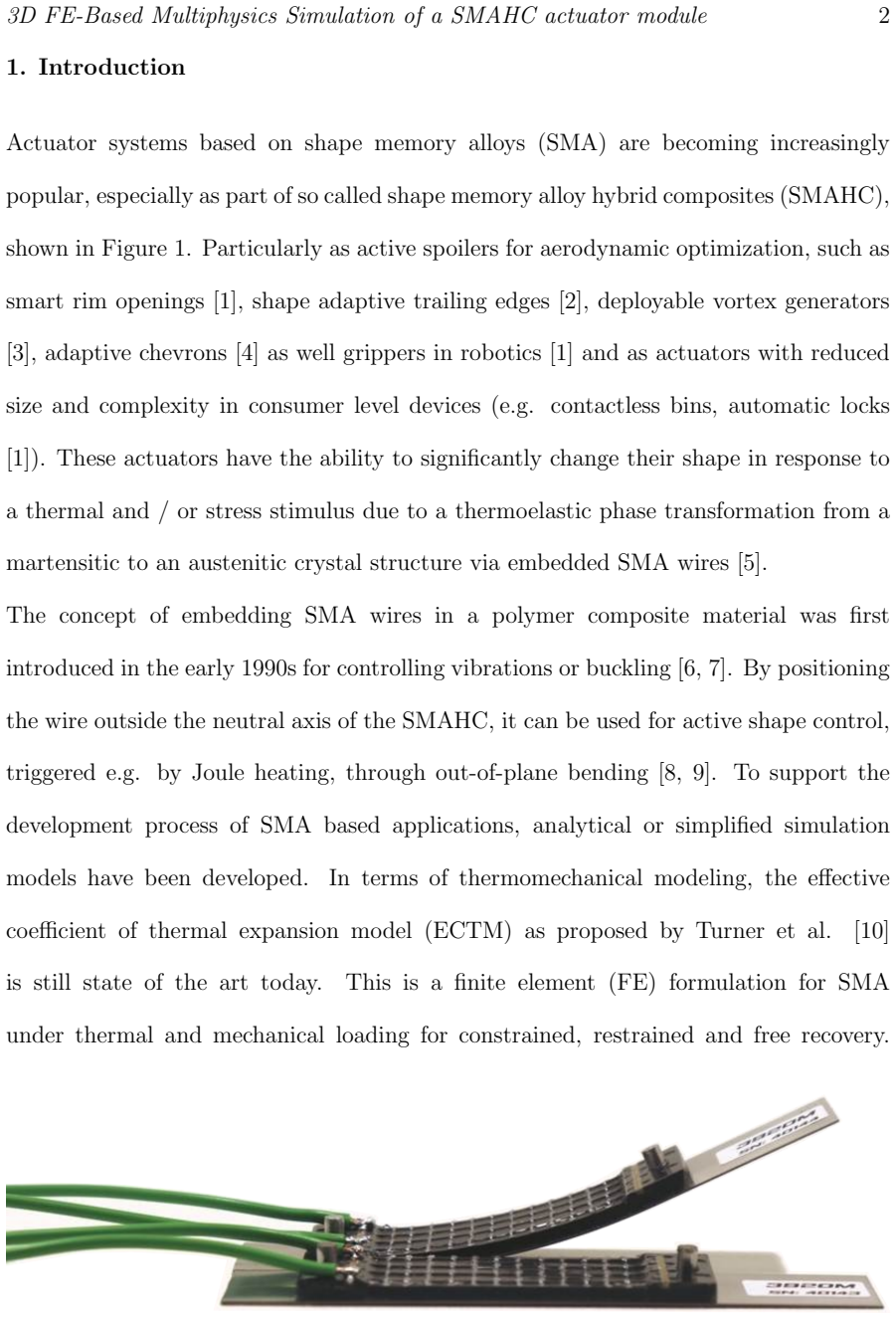
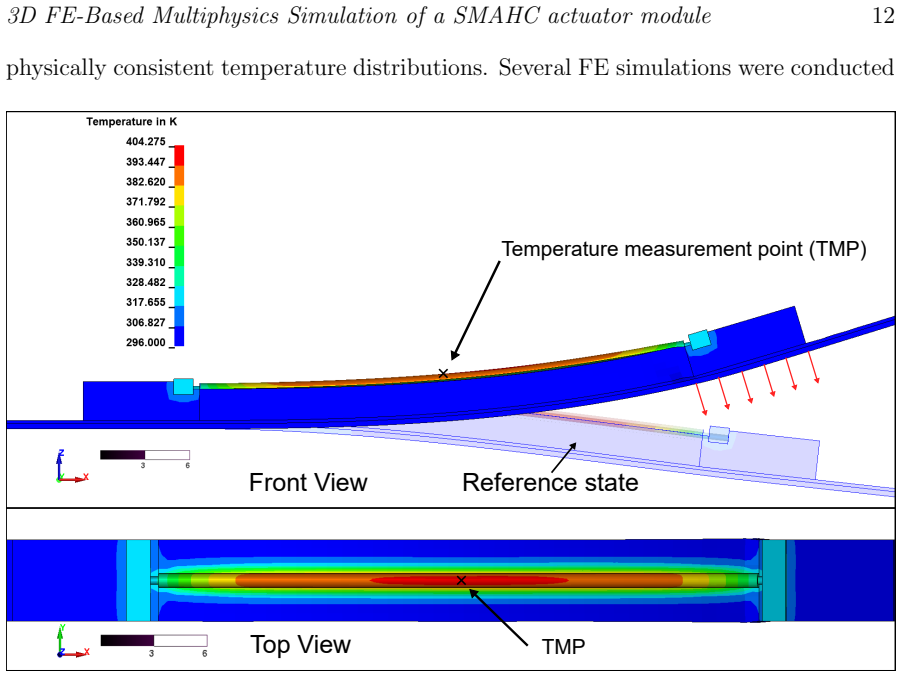
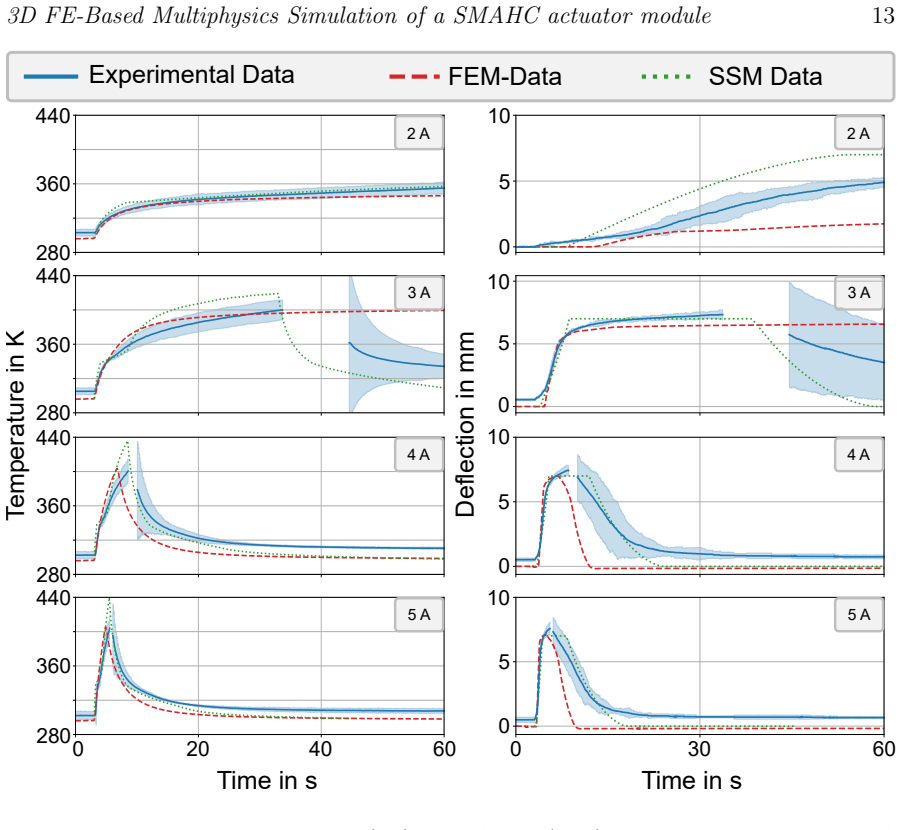
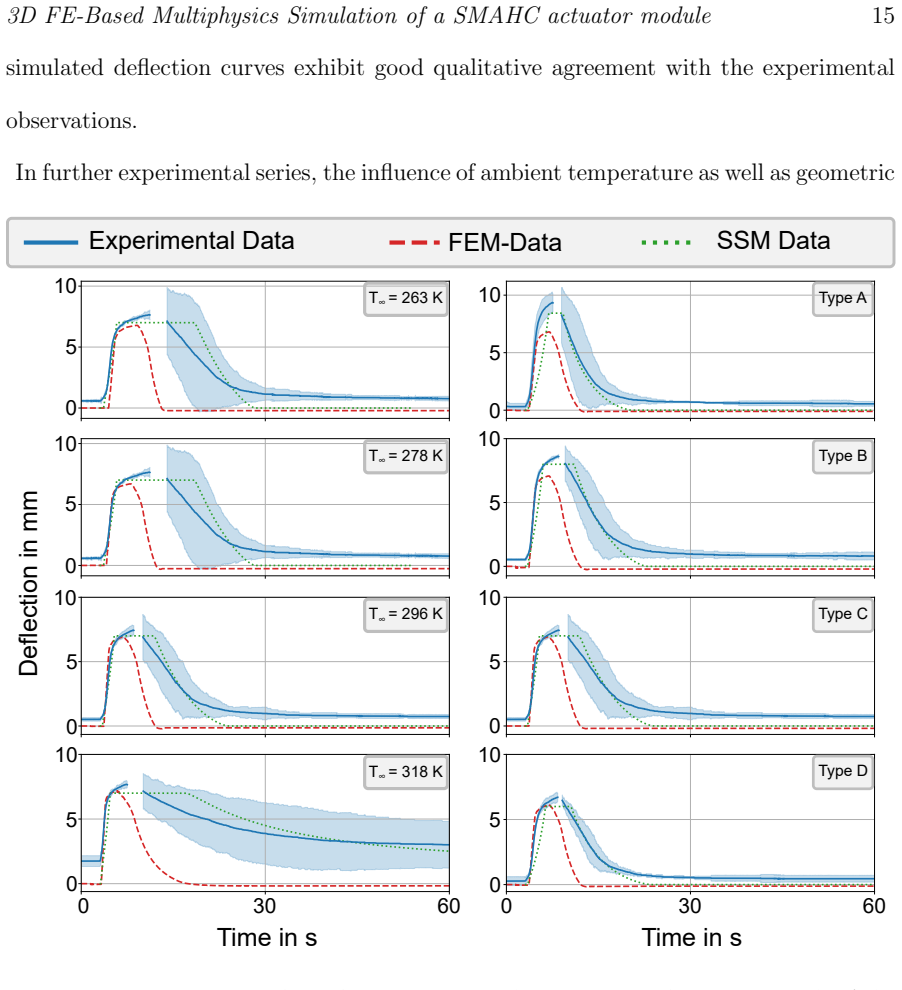
Shape adaptive shape memory alloy hybrid composites (SMAHCs) are composites that incorporate shape memory alloys (SMAs) to realize shape transformation. Despite the availability of numerous analytical and finite element models for predicting the transient response of SMAHCs, many approaches exhibit limitations with respect to the thermomechanical coupling and comprehensive experimental validation. Therefore, this paper presents a coupled, multiphysics, 3D finite element approach for the simulation of a SMAHC actuator, integrating mechanical, thermal and electromagnetic solvers in the Finite Element Code ANSYS LS-DYNA. The proposed approach employs a micromechanical constitutive model implemented in ANSYS LS-DYNA, to accurately capture the complex thermomechanical phase transformation of SMAs. A key feature of the model is the ability to prescribe a defined martensitic pre-strain through a preceding simulation step, in which an initially scaled SMA wire is mechanically loaded and stretched to its nominal length. This procedure enables partial detwinning of the martensitic microstructure and provides a physically motivated initialization of the material state. Joule heating of the SMA wires, as well as varying mechanical loads and ambient temperature conditions, are explicitly considered. The simulation results are validated against experimental data and a fully coupled transient staggered scheme model to assess the predictive capability of the 3D approach. The results show good qualitative agreement, reproducing the characteristic hysteresis of actuator deflection as a function of temperature. Quantitatively, the predicted deflections are of the correct order of magnitude, although marginally outside the 95 % experimental confidence interval. Overall, a consistent trend between simulation and experiment is observed, giving rise to possibility of simulating more complex SMAHC systems.
Editorial analysis
A structured set of objections, weighed in public.
Referee Report
Summary. The manuscript presents a coupled multiphysics 3D finite element approach in ANSYS LS-DYNA for simulating a shape memory alloy hybrid composite (SMAHC) actuator. It integrates mechanical, thermal, and electromagnetic solvers with a micromechanical constitutive model for SMAs, employs a preceding pre-strain simulation step to initialize martensitic detwinning, accounts for Joule heating and varying loads/ambient conditions, and validates the results against experimental data and a staggered-scheme model. The central claim is that the model reproduces the characteristic hysteresis of actuator deflection versus temperature with good qualitative agreement and deflections of the correct order of magnitude, though marginally outside the 95% experimental confidence interval.
Significance. If the modeling choices hold under scrutiny, the work offers a comprehensive 3D framework that addresses thermomechanical coupling limitations in prior analytical and FE models for SMAHCs. The physically motivated pre-strain initialization and explicit multiphysics integration represent strengths that could support simulation of more complex shape-adaptive systems. Dual validation against independent experiment and another numerical scheme is a positive feature for assessing predictive capability.
major comments (2)
- [Methods] Methods section (description of constitutive model and pre-strain step): The micromechanical constitutive model and the preceding simulation step used to prescribe martensitic pre-strain (initially scaled wire mechanically loaded to nominal length for partial detwinning) are load-bearing for initializing the phase transformation state. The manuscript provides insufficient detail on the specific scaling factors, loading parameters, and how they are chosen to match experimental SMA wire conditions, making it difficult to confirm that this procedure accurately captures the real thermomechanical behavior under the tested conditions.
- [Results] Results section (validation against experiment): The reported deflections are of the correct order of magnitude and reproduce hysteresis qualitatively, but lie marginally outside the 95% experimental confidence interval. This quantitative offset is load-bearing for the predictive capability claim; without accompanying mesh convergence studies, parameter sensitivity analysis, or breakdown of possible sources (e.g., boundary conditions or constitutive assumptions), it is not possible to determine whether the discrepancy can be resolved within the model's scope.
minor comments (1)
- [Abstract] The abstract could more explicitly quantify the temperature range and mechanical load conditions over which the hysteresis agreement holds to provide better context for the validation claims.
Simulated Author's Rebuttal
We thank the referee for the detailed and constructive comments on our manuscript. We address each of the major comments point by point below, and indicate where revisions will be made to improve the paper.
read point-by-point responses
-
Referee: [Methods] Methods section (description of constitutive model and pre-strain step): The micromechanical constitutive model and the preceding simulation step used to prescribe martensitic pre-strain (initially scaled wire mechanically loaded to nominal length for partial detwinning) are load-bearing for initializing the phase transformation state. The manuscript provides insufficient detail on the specific scaling factors, loading parameters, and how they are chosen to match experimental SMA wire conditions, making it difficult to confirm that this procedure accurately captures the real thermomechanical behavior under the tested conditions.
Authors: We agree that more specific details on the pre-strain initialization are necessary for reproducibility and to fully validate the initialization of the martensitic state. The current manuscript outlines the procedure but does not specify the exact scaling factor applied to the wire length or the precise loading parameters used in the preceding step. In the revised manuscript, we will provide these details, including the scaling factor (which was chosen to achieve approximately 4% pre-strain consistent with experimental wire preparation), the applied mechanical load corresponding to the detwinning stress, and the rationale linking these to the experimental conditions. We will also clarify the integration with the micromechanical constitutive model parameters. revision: yes
-
Referee: [Results] Results section (validation against experiment): The reported deflections are of the correct order of magnitude and reproduce hysteresis qualitatively, but lie marginally outside the 95% experimental confidence interval. This quantitative offset is load-bearing for the predictive capability claim; without accompanying mesh convergence studies, parameter sensitivity analysis, or breakdown of possible sources (e.g., boundary conditions or constitutive assumptions), it is not possible to determine whether the discrepancy can be resolved within the model's scope.
Authors: We acknowledge the referee's point regarding the quantitative discrepancy and the need for additional analyses to support the predictive claims. While the manuscript demonstrates qualitative agreement with the experimental hysteresis and deflections of the correct order of magnitude, and includes validation against both experiment and a staggered numerical scheme, we did not include explicit mesh convergence or sensitivity studies in the original submission. In the revised version, we will incorporate a mesh convergence study to confirm that the reported results are independent of mesh density, along with a sensitivity analysis on key parameters such as the SMA transformation temperatures and the pre-strain level. This will allow us to discuss potential sources of the offset, such as idealized boundary conditions or constitutive model assumptions, and assess whether adjustments within the model framework can bring predictions within the experimental confidence interval. We believe these additions will strengthen the evidence for the model's utility. revision: yes
Circularity Check
No significant circularity; validation rests on independent experiments
full rationale
The paper's derivation consists of implementing a micromechanical SMA constitutive model inside ANSYS LS-DYNA, initializing martensitic pre-strain via an explicit preceding mechanical loading simulation step, and then running coupled multiphysics transient simulations. The central claim (reproduction of actuator deflection hysteresis) is checked against separate experimental measurements and a staggered-scheme reference model; neither the pre-strain step nor the constitutive model is defined in terms of the final deflection outputs. No equations, fitted parameters, or self-citations are shown to reduce the reported predictions to the inputs by construction.
Axiom & Free-Parameter Ledger
axioms (2)
- domain assumption The micromechanical constitutive model accurately represents SMA phase transformation under combined thermal and mechanical loading
- domain assumption Joule heating and ambient temperature boundary conditions can be directly prescribed in the coupled solver
Reference graph
Works this paper leans on
-
[1]
CompActive GmbH.Homepage. de. Neustadt an der Weinstraße, 2026.url: https://www.compactive.de/(visited on 03/23/2026)
2026
-
[2]
Max Kaiser, Martin Gurka, and Manuel Kunzler. “Airfoil trailing edge morphing based on modified SMAHC concept: design, implementation, and experimental studies”. en. In:Active and Passive Smart Structures and Integrated Systems XVI. Ed. by Jae-Hung Han, Shima Shahab, and Jinkyu Yang. Fachkonferenz. Long Beach, United States: SPIE, Apr. 2022, p. 70.isbn: 9...
-
[3]
S. Nissle et al. “Adaptive vortex generators based on active hybrid composites: from idea to flight test”. en. In:CEAS Aeronautical Journal9.4 (Dec. 2018), pp. 661–670.issn: 1869-5582, 1869-5590.doi:10.1007/s13272- 018- 0316- 1. url:http://link.springer.com/10.1007/s13272- 018- 0316- 1(visited on 03/11/2021)
-
[4]
Design, fabrication, and testing of a SMA hybrid composite jet engine chevron
Travis L. Turner et al. “Design, fabrication, and testing of a SMA hybrid composite jet engine chevron”. In:Smart Structures and Materials 2006: Smart Structures and Integrated Systems. Vol. 6173. International Society for Optics and Photonics, Apr. 2006, 61731B.doi:10 . 1117 / 12 . 660844.url:https : //www.spiedigitallibrary.org/conference- proceedings- ...
-
[5]
D. C. Lagoudas.Shape Memory Alloys. en. Vol. 1. Boston, MA: Springer US, 2008. isbn: 978-0-387-47684-1 978-0-387-47685-8.doi:10.1007/978-0-387-47685-8. url:http://link.springer.com/10.1007/978- 0- 387- 47685- 8(visited on 09/29/2020)
-
[6]
Active vibration control of flexible beams using shape memory actuators
A. Baz, K. Imam, and J. McCoy. “Active vibration control of flexible beams using shape memory actuators”. In:Journal of Sound Vibration140 (Aug. 1990). ADS Bibcode: 1990JSV...140..437B, pp. 437–456.issn: 0022-460X.doi:10.1016/ 0022-460X(90)90760-W.url:https://ui.adsabs.harvard.edu/abs/1990JSV. ..140..437B(visited on 01/14/2022)
1990
-
[7]
C. Rogers. “Active vibration and structural acoustic control of shape memory alloy hybrid composites: Experimental results”. In:J. Acoust. Soc. Am.(1990). doi:10.1121/1.399683
-
[8]
Bending and Shape Control of Beams Using SMA Actuators
Z. Chaudhry and Craig A. Rogers. “Bending and Shape Control of Beams Using SMA Actuators”. en. In:Journal of Intelligent Material Systems and Structures 2.4 (1991), pp. 581–602.issn: 1045-389X.doi:10.1177/1045389X9100200410. url:https://doi.org/10.1177/1045389X9100200410(visited on 01/14/2022)
-
[9]
Shape Memory Alloy Hybrid Composite Plates for Shape and Stiffness Control
Federica Daghia et al. “Shape Memory Alloy Hybrid Composite Plates for Shape and Stiffness Control”. en. In:Journal of Intelligent Material Systems and Structures19.5 (May 2008), pp. 609–619.issn: 1045-389X, 1530-8138.doi: 10.1177/1045389X07077901.url:http://journals.sagepub.com/doi/10. 1177/1045389X07077901(visited on 10/25/2022)
work page doi:10.1177/1045389x07077901.url:http://journals.sagepub.com/doi/10 2008
-
[10]
A New Thermoelastic Model for Analysis of Shape Memory Alloy Hybrid Composites
Travis L. Turner. “A New Thermoelastic Model for Analysis of Shape Memory Alloy Hybrid Composites”. en. In:Journal of Intelligent Material Systems and Structures11.5 (May 2000), pp. 382–394.issn: 1045-389X, 1530-8138.doi:10. REFERENCES22 1106/DTFJ- UFL3- XV0U- WJNA.url:http://journals.sagepub.com/doi/10. 1106/DTFJ-UFL3-XV0U-WJNA(visited on 01/11/2022)
2000
-
[11]
Analysis of SMA Hybrid Composite Structures in MSC.Nastran and ABAQUS
Travis L. Turner and Hemant D. Patel. “Analysis of SMA Hybrid Composite Structures in MSC.Nastran and ABAQUS”. en. In:Journal of Intelligent Material Systems and Structures18.5 (May 2007), pp. 435–447.issn: 1045-389X, 1530-8138. doi:10.1177/1045389X06066699.url:http://journals.sagepub.com/doi/ 10.1177/1045389X06066699(visited on 08/19/2022)
work page doi:10.1177/1045389x06066699.url:http://journals.sagepub.com/doi/ 2007
-
[12]
Bingfei Liu et al. “On thermomechanical behaviors of the functional graded shape memory alloy composite for jet engine chevron”. en. In:Journal of Intelligent Material Systems and Structures29.14 (Aug. 2018), pp. 2986–3005.issn: 1045- 389X, 1530-8138.doi:10 . 1177 / 1045389X18781257.url:http : / / journals . sagepub.com/doi/10.1177/1045389X18781257(visite...
-
[13]
Finite element analysis of SMA beam bending using COMSOL
Shibin Yang, Stefan S. Seelecke, and Qifu Li. “Finite element analysis of SMA beam bending using COMSOL”. en. In:Behavior and Mechanics of Multifunctional Materials and Composites 2009. Ed. by Zoubeida Ounaies and Jiangyu Li. Vol. 7289. San Diego, California, USA, Mar. 2009, 72890S.doi: 10.1117/12.816714.url:http://proceedings.spiedigitallibrary.org/ proc...
work page doi:10.1117/12.816714.url:http://proceedings.spiedigitallibrary.org/ 2009
-
[14]
Improving hydrodynamic efficiency of composite marine propellers in off-design conditions using shape memory alloy composite actuators
S. Kapuria and H. N. Das. “Improving hydrodynamic efficiency of composite marine propellers in off-design conditions using shape memory alloy composite actuators”. en. In:Ocean Engineering168 (Nov. 2018), pp. 185–203.issn: 0029- 8018.doi:10 . 1016 / j . oceaneng . 2018 . 09 . 001.url:https : / / www . sciencedirect . com / science / article / pii / S00298...
2018
-
[15]
Mathematical Modeling of Fiber- Elastomer Composites with Embedded Shape Memory Alloys
Najmeh Keshtkar and Klaus R¨ obenack. “Mathematical Modeling of Fiber- Elastomer Composites with Embedded Shape Memory Alloys”. In:2020 24th International Conference on System Theory, Control and Computing (ICSTCC). Oct. 2020, pp. 477–482.doi:10.1109/ICSTCC50638.2020.9259736
-
[16]
Active hybrid structures made of shape memory alloys and fiber-reinforced composites
Max Kaiser and Martin Gurka. “Active hybrid structures made of shape memory alloys and fiber-reinforced composites”. en. In:Multifunctionality of Polymer Composites. Elsevier, 2026, pp. 851–878.isbn: 978-0-443-28872-2.doi:10.1016/ B978- 0- 443- 28872- 2.00026- 7.url:https://linkinghub.elsevier.com/ retrieve/pii/B9780443288722000267(visited on 10/08/2025)
2026
-
[17]
THERMOMECHANICAL SKETCH OF SHAPE MEMORY EFFECT: ONE-DIMENSIONAL TENSILE BEHAVIOR
Kikuaki Tanaka. “THERMOMECHANICAL SKETCH OF SHAPE MEMORY EFFECT: ONE-DIMENSIONAL TENSILE BEHAVIOR.” In:Res Mechanica: International Journal of Structural Mechanics and Materials Science18.3 (1986), pp. 251–263
1986
-
[18]
Finite element analysis of adaptive-stiffening and shape-control SMA hybrid composites
L. Brinson. “Finite element analysis of adaptive-stiffening and shape-control SMA hybrid composites”. In:Smart Structures and Materials 2005: Active Materials: Behavior and Mechanics.SPIE (2005), S. 406–416.url:https://www.academia. edu / 55158818 / Finite _ element _ analysis _ of _ adaptive _ stiffening _ and _ shape_control_SMA_hybrid_composites(visite...
2005
-
[19]
Experimental and Numerical Analysis of the Deformation Behavior of Adaptive Fiber-Rubber Composites with Integrated Shape Memory Alloys
Felix Lohse et al. “Experimental and Numerical Analysis of the Deformation Behavior of Adaptive Fiber-Rubber Composites with Integrated Shape Memory Alloys”. en. In:Materials15.2 (Jan. 2022), p. 582.issn: 1996-1944.doi:10.3390/ ma15020582.url:https://www.mdpi.com/1996- 1944/15/2/582(visited on 01/17/2023)
2022
-
[20]
Simulation and control of SMA actuators
Norbert Papenfuss and Stefan Seelecke. “Simulation and control of SMA actuators”. en. In:Smart Structures and Materials 1999: Mathematics and Control REFERENCES24 in Smart Structures. Ed. by Vasundara V. Varadan. Vol. 3667. Newport Beach, CA, June 1999, p. 586.doi:10.1117/12.350108.url:http://proceedings. spiedigitallibrary.org/proceeding.aspx?doi=10.1117...
-
[21]
Numerical simulation and verification of a curved morphing composite structure with embedded shape memory alloy wire actuators
Beom-Seok Jung et al. “Numerical simulation and verification of a curved morphing composite structure with embedded shape memory alloy wire actuators”. en. In:Journal of Intelligent Material Systems and Structures 24.1 (Jan. 2013), pp. 89–98.issn: 1045-389X, 1530-8138.doi:10 . 1177 / 1045389X12459588.url:http : / / journals . sagepub . com / doi / 10 . 11...
2013
-
[22]
Max Kaiser, Manuel Kunzler, and Martin Gurka. “Experimentally characteriza- tion and theoretical modeling of the electro-thermomechanical coupling of uni- morph Shape Memory Active Hybrid composites”. In:Composites Science and Technology242 (Sept. 2023), p. 110186.issn: 0266-3538.doi:10 . 1016 / j . compscitech.2023.110186.url:https://www.sciencedirect.co...
-
[23]
Multiphysics modeling and optimization of an innovative shape memory alloy-polymer active composite
Stefano Rodin` o and Carmine Maletta. “Multiphysics modeling and optimization of an innovative shape memory alloy-polymer active composite”. en. In:Polymer307 (July 2024), p. 127316.issn: 00323861.doi:10.1016/j.polymer.2024.127316. url:https://linkinghub.elsevier.com/retrieve/pii/S0032386124006529 (visited on 08/14/2025)
-
[24]
A Thermodynamical Constitutive Model for Shape Memory Materials. Part I. The Monolithic Shape Memory Alloy
J. G. Boyd and D. C. Lagoudas. “A Thermodynamical Constitutive Model for Shape Memory Materials. Part I. The Monolithic Shape Memory Alloy”. In:International Journal of Plasticity12.6 (Jan. 1, 1996), pp. 805–842.issn: 0749-6419.doi:10 . 1016 / S0749 - 6419(96 ) 00030 - 7.url:https : / / www . REFERENCES25 sciencedirect . com / science / article / pii / S0...
1996
-
[25]
Alex Kelly, Aaron P. Stebner, and Kaushik Bhattacharya. “A micromechanics- inspired constitutive model for shape-memory alloys that accounts for initiation and saturation of phase transformation”. In:Journal of the Mechanics and Physics of Solids. SI:Pierre Suquet Symposium 97 (Dec. 2016), pp. 197–224.issn: 0022- 5096.doi:10.1016/j.jmps.2016.02.007.url:ht...
work page doi:10.1016/j.jmps.2016.02.007.url:https://www.sciencedirect 2016
-
[26]
[Online], URL: https://lsdyna.ansys.com/ (accessed: March 23, 2026)
ANSYS, Inc.Homepage. [Online], URL: https://lsdyna.ansys.com/ (accessed: March 23, 2026). 2026.url:https : / / lsdyna . ansys . com/(visited on 03/23/2026)
2026
-
[27]
Kaiserslautern, Feb
Max Kaiser and KaiMa92/sa smahc py.Shape adaptive shape memory alloy hybrid composite model implemented in python. Kaiserslautern, Feb. 2023.url:https: //github.com/KaiMa92/sa_smahc_py(visited on 03/23/2026)
2023
-
[28]
[Online], URL: https://zenodo.org/records/7762702 (accessed: March 24, 2026)
Max Kaiser.SMAHC characterization under influence of external load and ambient temperature. [Online], URL: https://zenodo.org/records/7762702 (accessed: March 24, 2026). Mar. 2023.doi:10 . 5281 / zenodo . 7762702.url: https://zenodo.org/records/7762702(visited on 03/09/2026)
-
[29]
CompActive GmbH.”Datenblaetter”. de. [Online], URL: https://www.compactive.de/datenblaetter (accessed: March 23, 2026). 2026.url:https : / / www . compactive . de / datenblaetter(visited on 03/23/2026)
2026
-
[30]
*MAT 291: A new micromechanics-inspired model for shape memory alloys
Jesper Karlsson et al. “*MAT 291: A new micromechanics-inspired model for shape memory alloys”. en. In:12th European LS-DYNA Conference 2019, Koblenz, Germany(2019). REFERENCES26
2019
-
[31]
A Large-Scale Comparison of Tetrahedral and Hexahedral Elements for Solving Elliptic PDEs with the Finite Element Method
Teseo Schneider et al. “A Large-Scale Comparison of Tetrahedral and Hexahedral Elements for Solving Elliptic PDEs with the Finite Element Method”. en. In:ACM Transactions on Graphics41.3 (June 2022), pp. 1–14.issn: 0730-0301, 1557-7368. doi:10 . 1145 / 3508372.url:https : / / dl . acm . org / doi / 10 . 1145 / 3508372 (visited on 11/06/2025)
2022
-
[32]
Transient Electro-Thermomechanical Modeling of Shape Adaptive Shape Memory Alloy Hybrid Composites under Influence of Ambient Temperature and Static External Load
Max Kaiser. “Transient Electro-Thermomechanical Modeling of Shape Adaptive Shape Memory Alloy Hybrid Composites under Influence of Ambient Temperature and Static External Load”. PhD thesis. Rheinland-Pf¨ alzische Technische Universit¨ at Kaiserslautern-Landau, Oct. 2023.isbn: 978-3-944440-55-2.doi:10. 26204/KLUEDO/7520. (Visited on 03/24/2026)
2023
-
[33]
Alex Kelly, Aaron P. Stebner, and Kaushik Bhattacharya. “A micromechanics- inspired constitutive model for shape-memory alloys that accounts for initiation and saturation of phase transformation”. en. In:Journal of the Mechanics and Physics of Solids97 (Dec. 2016), pp. 197–224.issn: 00225096.doi:10.1016/j. jmps.2016.02.007.url:https://linkinghub.elsevier....
work page doi:10.1016/j 2016
discussion (0)
Sign in with ORCID, Apple, or X to comment. Anyone can read and Pith papers without signing in.