Restoration, Exploration and Transformation: How Youth Engage Character.AI Chatbots for Feels, Fun and Finding themselves
Pith reviewed 2026-05-15 12:40 UTC · model grok-4.3
The pith
Youth use Character.AI chatbots for emotional restoration, creative exploration, and identity transformation through self-created characters.
A machine-rendered reading of the paper's core claim, the machinery that carries it, and where it could break.
Core claim
The central claim is that the most engaged youth on Character.AI employ the platform through three distinct intents—Restoration for emotional regulation, Exploration for creative experimentation, and Transformation for identity development—backed by a taxonomy of seven youth-created character archetypes, which together demonstrate novel AI roles that diverge from existing design assumptions.
What carries the argument
The three-intent framework of Restoration, Exploration, and Transformation together with the taxonomy of seven youth-created character archetypes.
If this is right
- Youth are actively inventing emotional, creative, and developmental uses for AI chatbots that extend past entertainment.
- Current AI interfaces and safety features misalign with how adolescents actually employ these tools.
- Designers could build features that better accommodate user-created character archetypes and the three intents.
- This usage pattern suggests AI platforms could serve as informal spaces for adolescent emotional and identity work.
- The findings call for youth-centered design approaches that treat young users as active creators rather than passive consumers.
Where Pith is reading between the lines
- Platforms might add tools for tracking emotional patterns or safe identity play based on these observed intents.
- The pattern connects to wider questions about how generative AI affects adolescent development outside supervised settings.
- Testing whether the same intents appear on other chatbot services would clarify if this is specific to Character.AI or general to youth AI use.
Load-bearing premise
The discourse from 4,172 users in the official Character.AI Discord accurately represents the full range of youth engagement without major selection or self-presentation bias.
What would settle it
A direct study of youth Character.AI use outside the Discord community that finds substantially different intents or character types would disprove the generalizability of the three-intent framework.
Figures

read the original abstract
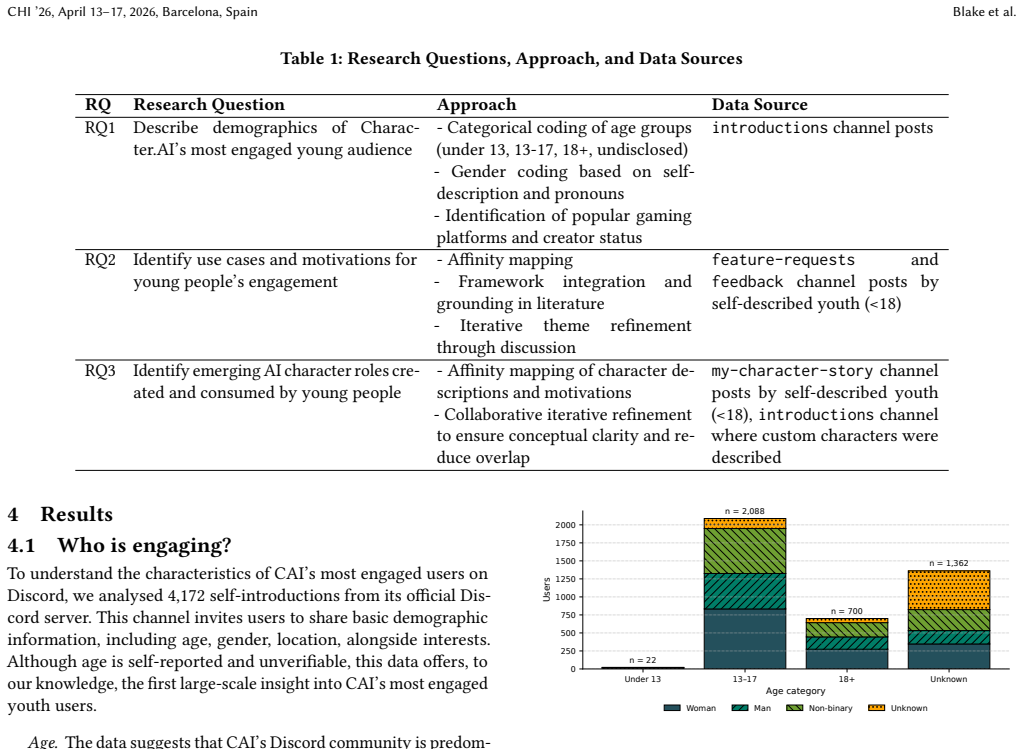
Young people are among the fastest adopters of generative AI, yet research emphasises adult-designed tools and experiments rather than playful, self-directed youth use. We analysed discourse from 4,172 users in Character.AI's official Discord, finding that the most engaged users were predominantly adolescents (50% aged 13-17), female or non-binary (61.9%), with most (59%) creating their own characters. We contribute (1) a descriptive account of how highly-engaged youth on Character.AI's Discord use AI for playful, emotional, and creative practices that push the platform limits; (2) a framework of three engagement intents -- Restoration (emotional regulation), Exploration (creative experimentation), and Transformation (identity development); and (3) a taxonomy of seven youth-created character archetypes. Together, these findings reveal how youth invent novel roles for AI, expose critical misalignments between youth use and current AI experiences, and provide frameworks for researchers and practitioners to design youth-centred AI futures.
Editorial analysis
A structured set of objections, weighed in public.
Referee Report
Summary. The paper analyzes discourse from 4,172 users in Character.AI's official Discord, reporting that highly-engaged youth (predominantly adolescents aged 13-17, 61.9% female or non-binary, 59% creating their own characters) engage the platform through three intents—Restoration (emotional regulation), Exploration (creative experimentation), and Transformation (identity development)—instantiated in a taxonomy of seven youth-created character archetypes. These findings are positioned as revealing novel youth-invented roles for AI that misalign with current platform designs, with contributions including a descriptive account of playful/emotional/creative practices and frameworks for youth-centered AI.
Significance. If the taxonomy and three-intent framework hold beyond the sampled Discord corpus, the work would offer a useful empirical grounding for HCI and AI design research on youth generative-AI practices, highlighting self-directed emotional and identity uses that differ from adult-centric tool assumptions. The explicit reporting of sample demographics and the emergence of the framework from discourse analysis are strengths that could support follow-on design work.
major comments (3)
- [Methods] Methods section: the account of the discourse analysis provides no details on the coding process, inter-coder reliability metrics, data exclusion criteria, or how the three-intent framework and seven-archetype taxonomy were validated or derived from the full 4,172-user corpus; without these, the link between raw posts and the central claims cannot be assessed.
- [Discussion] Sampling and generalizability discussion: the paper relies exclusively on public posts from the official Character.AI Discord without external validation (e.g., platform logs, cross-platform surveys, or private-chat samples), leaving the three-intent structure and archetype frequencies vulnerable to self-selection bias among community-oriented, disclosure-comfortable users.
- [Implications for Design] Findings on misalignment: the claim that youth practices 'misalign with current AI experiences' is asserted without a systematic comparison to platform features, adult-user patterns, or alternative AI systems, making the design-implication section rest on an unanchored contrast.
minor comments (2)
- [Abstract] Abstract and §4: the reported percentages (50% aged 13-17, 61.9% female/non-binary, 59% creating characters) should be accompanied by exact sample sizes or confidence intervals for each demographic breakdown.
- [Findings] Figure 1 or archetype table: the seven archetypes would benefit from explicit example quotes or frequency counts to allow readers to judge their distinctiveness and prevalence.
Simulated Author's Rebuttal
We thank the referee for their constructive feedback, which has strengthened our manuscript. We address each major comment below and have made targeted revisions to improve methodological transparency, acknowledge sampling limitations, and ground our design implications more firmly.
read point-by-point responses
-
Referee: [Methods] Methods section: the account of the discourse analysis provides no details on the coding process, inter-coder reliability metrics, data exclusion criteria, or how the three-intent framework and seven-archetype taxonomy were validated or derived from the full 4,172-user corpus; without these, the link between raw posts and the central claims cannot be assessed.
Authors: We agree that the original Methods section lacked sufficient detail. In the revised manuscript we have expanded this section to describe the full inductive discourse analysis process: two researchers independently coded a 20% subsample to develop the initial codebook for intents and archetypes, followed by iterative refinement on the full corpus through weekly team discussions. We now report inter-coder reliability (Cohen’s κ = 0.84 for the three intents; κ = 0.77 for the seven archetypes) calculated on a 15% overlap sample, explicit exclusion criteria (removal of spam, non-youth accounts where age could be inferred, duplicate posts, and off-topic threads), and the validation steps (member-checking with three Discord moderators and negative-case analysis). These additions directly link the raw posts to the reported framework and taxonomy. revision: yes
-
Referee: [Discussion] Sampling and generalizability discussion: the paper relies exclusively on public posts from the official Character.AI Discord without external validation (e.g., platform logs, cross-platform surveys, or private-chat samples), leaving the three-intent structure and archetype frequencies vulnerable to self-selection bias among community-oriented, disclosure-comfortable users.
Authors: We acknowledge this is a genuine limitation of the study design. The revised Discussion now contains an expanded limitations paragraph that explicitly discusses self-selection bias among publicly active, disclosure-comfortable users and its possible effects on archetype frequencies. We also note that the sample captures highly engaged youth who voluntarily participate in the official server, which aligns with our focus on self-directed practices. While we lacked access to private logs or platform-wide data for external validation, we have added concrete suggestions for future mixed-methods work (e.g., surveys and private-chat sampling) to test generalizability. This constitutes a partial revision because we can strengthen the caveats but cannot retroactively add external data. revision: partial
-
Referee: [Implications for Design] Findings on misalignment: the claim that youth practices 'misalign with current AI experiences' is asserted without a systematic comparison to platform features, adult-user patterns, or alternative AI systems, making the design-implication section rest on an unanchored contrast.
Authors: We have revised the Implications for Design section to include a systematic comparison table and accompanying text. The updated section now contrasts the observed youth intents and archetypes against (1) Character.AI’s documented features (character memory limits, content filters, and creation tools), (2) adult usage patterns reported in prior generative-AI studies, and (3) design affordances of alternative systems such as Replika and general-purpose LLMs. This grounds the misalignment claims in specific evidence while preserving the core observation that youth are inventing roles (especially around identity transformation) that current platforms do not fully support. revision: yes
Circularity Check
No circularity: qualitative framework emerges from discourse analysis
full rationale
This paper is a descriptive qualitative study of 4,172 Discord posts. The three intents (Restoration, Exploration, Transformation) and seven archetypes are explicitly presented as outputs of the authors' thematic analysis of the sampled discourse rather than inputs, fitted parameters, or results derived from prior self-citations. No equations, predictions, or mathematical reductions exist. No load-bearing self-citation chains or ansatzes are invoked to justify the taxonomy. The central claims rest on direct observation within the chosen sample; any limitations (e.g., self-selection) concern external validity, not internal circularity of the derivation.
Axiom & Free-Parameter Ledger
axioms (1)
- domain assumption Public Discord posts by Character.AI users reflect authentic youth engagement practices and intents
Reference graph
Works this paper leans on
-
[1]
2025.Artificial Intelligence and Adolescent Well-being: An APA Health Advisory
American Psychological Association. 2025.Artificial Intelligence and Adolescent Well-being: An APA Health Advisory. Technical Report. American Psychological Association. https://www.apa.org/
work page 2025
-
[2]
Richard Bartle. 2003.Designing Virtual Worlds. New Riders Games
work page 2003
-
[3]
Annabel Blake, Marcus Carter, and Eduardo Velloso. 2025. Are Measures of Children’s Parasocial Relationships Ready for Conversational AI?. InProceedings of the 2025 ACM Conference on Fairness, Accountability, and Transparency (FAccT ’25). Association for Computing Machinery, New York, NY, USA, 1145–1158. https://doi.org/10.1145/3715275.3732075
-
[4]
Bradley J. Bond and Sandra L. Calvert. 2014. A Model and Measure of US Parents’ Perceptions of Young Children’s Parasocial Relationships.Journal of Children and Media8, 3 (July 2014), 286–304. https://doi.org/10.1080/17482798.2014.890948
-
[5]
Lorelle Bowditch, Janine Chapman, and Anjum Naweed. 2018. Do coping strate- gies moderate the relationship between escapism and negative gaming outcomes in World of Warcraft (MMORPG) players?Computers in Human Behavior86 (Sept. 2018), 69–76. https://doi.org/10.1016/j.chb.2018.04.030
-
[6]
Virginia Braun and Victoria Clarke. 2024. Toward Good Practice in Thematic Analysis: Avoiding Common Problems and Becoming a Knowing Researcher. International Journal of Transgender Health25, 2 (2024), 190–203. https://doi.org/ 10.1080/26895269.2023.2269533
-
[7]
Amy Bruckman, Alisa Bandlow, and Andrea Forte. 2009. HCI for Kids. InHuman- Computer Interaction: Designing for Diverse Users and Domains(1st ed.), Julie A. Jacko and Andrew Sears (Eds.). CRC Press, Boca Raton, FL
work page 2009
-
[8]
David Byrne. 2022. A worked example of Braun and Clarke’s approach to reflexive thematic analysis.Quality & Quantity56 (2022), 1391–1412. https://doi.org/10. 1007/s11135-021-01182-y 53https://www.turing.ac.uk/news/publications/ai-childrens-rights-wellbeing- transnational-frameworks 54https://a16z.com/100-gen-ai-apps/ 55https://www.wired.com/story/characte...
work page 2022
-
[9]
Roger Caillois and Meyer Barash. 2001.Man, play, and games. University of Illinois Press, Urbana
work page 2001
-
[10]
2024.Fake Friend: How Snapchat’s AI Fails to Protect Kids
Center for Countering Digital Hate. 2024.Fake Friend: How Snapchat’s AI Fails to Protect Kids. Technical Report. Center for Countering Digital Hate. https: //counterhate.com/research/fake-friend/
work page 2024
-
[11]
Jenna H Chin, Seungwook Lee, Mohsena Ashraf, Matt Zago, Yun Xie, Elizabeth A Wolfgram, Tom Yeh, and Pilyoung Kim. 2024. Young Children’s Creative Sto- rytelling with ChatGPT vs. Parent: Comparing Interactive Styles. InExtended Abstracts of the CHI Conference on Human Factors in Computing Systems. ACM, Honolulu HI USA, 1–7. https://doi.org/10.1145/3613905.3650770
-
[12]
2025.The 1,000 Best Character AI Bots of 2024 (and my favourites)
Dario Chincha. 2025.The 1,000 Best Character AI Bots of 2024 (and my favourites). WhatPlugin.ai. Last reviewed 23 April 2025
work page 2025
-
[13]
D’Mello, Nicholas Duran, Amanda Michaels, and Angela E
Sidney K. D’Mello, Nicholas Duran, Amanda Michaels, and Angela E. B. Stewart
-
[14]
Improving collaborative problem-solving skills via automated feedback and scaffolding: a quasi-experimental study with CPSCoach 2.0.User Modeling and User-Adapted Interaction34, 4 (Sept. 2024), 1087–1125. https://doi.org/10. 1007/s11257-023-09387-6
work page 2024
-
[15]
Cathy Mengying Fang, Phoebe Chua, Samantha Chan, Joanne Leong, Andria Bao, and Pattie Maes. 2025. Leveraging AI-Generated Emotional Self-Voice to Nudge People towards their Ideal Selves. InProceedings of the CHI Conference on Human Factors in Computing Systems (CHI ’25)(Yokohama, Japan). Association for Computing Machinery, New York, NY, USA, 1–20. https:...
-
[16]
Cathy Mengying Fang, Auren R. Liu, Valdemar Danry, Eunhae Lee, Samantha W. T. Chan, Pat Pataranutaporn, Pattie Maes, Jason Phang, Michael Lampe, Lama Ahmad, and Sandhini Agarwal. 2025. How AI and Human Behaviors Shape Psychosocial Effects of Chatbot Use: A Longitudinal Randomized Controlled Study. arXiv:2503.17473 [cs.HC] https://arxiv.org/abs/2503.17473
work page internal anchor Pith review arXiv 2025
-
[17]
Aidan Z. Fitzsimons, Elizabeth M. Gerber, and Duri Long. 2025. AI constructs gen- dered struggle narratives: Implications for self-concept and systems design. InPro- ceedings of the 2025 ACM Conference on Fairness, Accountability, and Transparency. ACM, Athens Greece, 2290–2301. https://doi.org/10.1145/3715275.3732156
- [18]
-
[19]
Ariel Han and Zhenyao Cai. 2023. Design implications of generative AI systems for visual storytelling for young learners. InProceedings of the 22nd Annual ACM Interaction Design and Children Conference. ACM, Chicago IL USA, 470–474. https://doi.org/10.1145/3585088.3593867
-
[20]
Tilo Hartmann and Charlotte Goldhoorn. 2011. Horton and Wohl Revisited: Ex- ploring Viewers’ Experience of Parasocial Interaction.Journal of Communication 61, 6 (Dec. 2011), 1104–1121. https://doi.org/10.1111/j.1460-2466.2011.01595.x
-
[21]
2025.Understanding the Impacts of Gener- ative AI Use on Children
Prepared Youmna Hashem, Saba Esnaashari, Kate Onslow, Sukankana Chakraborty, and John Francis. 2025.Understanding the Impacts of Gener- ative AI Use on Children. Technical Report. Alan Turing Institute & LEGO group. https://www.turing.ac.uk/research/research-projects/understanding- impacts-generative-ai-use-children
work page 2025
-
[22]
2024.The Dawn of the AI Era: Teens, Parents, and the Adoption of Generative AI at Home and School
Alexa Hasse, Mary Madden, Angela Calvin, and Amanda Lenhart. 2024.The Dawn of the AI Era: Teens, Parents, and the Adoption of Generative AI at Home and School. Research Report. Common Sense Media, San Francisco, CA. https://www.commonsensemedia.org/research/the-dawn-of-the-ai-era- teens-parents-and-the-adoption-of-generative-ai-at-home-and-school
work page 2024
-
[23]
Dagmar Mercedes Heeg and Lucy Avraamidou. 2025. Young children’s un- derstanding of AI.Education and Information Technologies30, 8 (June 2025), 10207–10230. https://doi.org/10.1007/s10639-024-13169-x
-
[24]
Arthur Bran Herbener and Malene Flensborg Damholdt. 2025. Are lonely youngsters turning to chatbots for companionship? The relationship between chatbot usage and social connectedness in Danish high-school students.In- ternational Journal of Human-Computer Studies196 (Feb. 2025), 103409. https: //doi.org/10.1016/j.ijhcs.2024.103409
-
[25]
Shunsen Huang, Xiaoxiong Lai, Li Ke, Yajun Li, Huanlei Wang, Xinmei Zhao, Xinran Dai, and Yun Wang. 2024. AI Technology panic—is AI Dependence Bad for Mental Health? A Cross-Lagged Panel Model and the Mediating Roles of Motivations for AI Use Among Adolescents.Psychology Research and Behavior ManagementVolume 17 (March 2024), 1087–1102. https://doi.org/10...
-
[26]
Mizuko It¯o, Sonja Baumer, and Matteo Bittanti. 2019.Hanging out, messing around, and geeking out: kids living and learning with new media(tenth anniversary edition ed.). The MIT Press, Cambridge, MA
work page 2019
-
[27]
Jiaming Ji, Tianyi Qiu, Boyuan Chen, Borong Zhang, Hantao Lou, Kaile Wang, Yawen Duan, Zhonghao He, Lukas Vierling, Donghai Hong, Jiayi Zhou, Zhaowei Zhang, Fanzhi Zeng, Juntao Dai, Xuehai Pan, Kwan Yee Ng, Aidan O’Gara, Hua Xu, Brian Tse, Jie Fu, Stephen McAleer, Yaodong Yang, Yizhou Wang, Song-Chun Zhu, Yike Guo, and Wen Gao. 2025. AI Alignment: A Compr...
work page internal anchor Pith review doi:10.48550/arxiv.2310.19852 2025
-
[28]
Binny Jose, Jaya Cherian, Alie Molly Verghis, Sony Mary Varghise, Mumthas S, and Sibichan Joseph. 2025. The cognitive paradox of AI in education: between enhancement and erosion.Frontiers in Psychology16 (April 2025), 1550621. https://doi.org/10.3389/fpsyg.2025.1550621
-
[29]
Blumler, and Michael Gurevitch
Elihu Katz, Jay G. Blumler, and Michael Gurevitch. 1973. Uses and Gratifications Research.Public Opinion Quarterly37, 4 (1973), 509–523. https://www.jstor.org/ stable/2747854
-
[31]
Hannah Rose Kirk, Iason Gabriel, Chris Summerfield, Bertie Vidgen, and Scott A. Hale. 2025. Why human–AI relationships need socioaffective alignment.Hu- manities and Social Sciences Communications12, 1 (May 2025), 728. https: //doi.org/10.1057/s41599-025-04532-5
-
[32]
Hannah Rose Kirk, Alexander Whitefield, Paul Röttger, Andrew Bean, Katerina Margatina, Juan Ciro, Rafael Mosquera, Max Bartolo, Adina Williams, He He, Bertie Vidgen, and Scott A. Hale. 2025. The PRISM alignment dataset: what participatory, representative and individualised human feedback reveals about the subjective and multicultural alignment of large la...
work page 2025
-
[33]
Kami A Kosenko, Bradley J Bond, and Robert J Hurley. 2018. An exploration into the uses and gratifications of media for transgender individuals.Psychology of Popular Media Culture7, 3 (2018), 274–288. https://doi.org/10.1037/ppm0000135
-
[34]
Eliza Kosoy, Soojin Jeong, Anoop Sinha, Alison Gopnik, and Tanya Kraljic
-
[35]
arXiv:2405.13081 [cs.HC] https://arxiv.org/abs/2405.13081
Children’s Mental Models of Generative Visual and Text Based AI Models. arXiv:2405.13081 [cs.HC] https://arxiv.org/abs/2405.13081
-
[36]
Nomisha Kurian. 2025. AI’s empathy gap: The risks of conversational Artificial Intelligence for young children’s well-being and key ethical considerations for early childhood education and care.Contemporary Issues in Early Childhood26, 1 (March 2025), 132–139. https://doi.org/10.1177/14639491231206004
-
[37]
Nomisha Kurian. 2025. Developmentally aligned AI: a framework for translating the science of child development into AI design.AI, Brain and Child1, 1 (Aug. 2025), 9. https://doi.org/10.1007/s44436-025-00009-z
-
[38]
Karolina La Fors. 2024. Toward children-centric AI: a case for a growth model in children-AI interactions.AI & SOCIETY39, 3 (June 2024), 1303–1315. https: //doi.org/10.1007/s00146-022-01579-9
-
[39]
Samuli Laato, Bastian Kordyaka, and Juho Hamari. 2024. Traumatizing or Just An- noying? Unveiling the Spectrum of Gamer Toxicity in the StarCraft II Community. InProceedings of the 2024 CHI Conference on Human Factors in Computing Systems (Honolulu, HI, USA)(CHI ’24). Association for Computing Machinery, New York, NY, USA, Article 758, 18 pages. https://d...
-
[40]
Bjarke Alexander Larsen and Elin Carstensdottir. 2024. Community, Storytelling, and Play: Making and Breaking Rituals in Destiny 2. InProceedings of the CHI Conference on Human Factors in Computing Systems. ACM, Honolulu HI USA, 1–18. https://doi.org/10.1145/3613904.3642679
-
[41]
Nicole Lazzaro. 2008. Why We Play: Affect and the Fun of Games. InGame Usability: Advancing the Player Experience, Kris L. Desurvire (Ed.). CRC Press, Boca Raton, FL, 3–31. Designing Emotions for Games, Entertainment Interfaces, and Interactive Products
work page 2008
-
[42]
Antonios Liapis, Christian Guckelsberger, Jichen Zhu, Casper Harteveld, Simone Kriglstein, Alena Denisova, Jeremy Gow, and Mike Preuss. 2023. Designing for Playfulness in Human-AI Authoring Tools. InProceedings of the 18th International Conference on the Foundations of Digital Games (FDG 2023). ACM, New York, NY, USA, 1–4. https://doi.org/10.1145/3582437....
-
[43]
Zhihuai Lin and Yu-Leung Ng. 2025. Unraveling Gratifications, Concerns, and Acceptance of Generative Artificial Intelligence.International Journal of Human– Computer Interaction41, 17 (2025), 10725–10742. https://doi.org/10.1080/10447318. 2024.2436749
-
[44]
Kristen Lucas and John Sherry. 2004. Sex Differences in Video Game Play:. Communication Research31 (10 2004), 499–523. https://doi.org/10.1177/ 0093650204267930
work page 2004
-
[45]
Andrés Lucero. 2022. Using Affinity Diagrams to Evaluate Interactive Proto- types. InHuman-Computer Interaction – INTERACT 2015. Springer-Verlag, Berlin, Heidelberg, 231–248. https://doi.org/10.1007/978-3-319-22668-2_19
-
[46]
Andrés Lucero, Jussi Holopainen, Elina Ollila, Riku Suomela, and Evangelos Karapanos. 2013. The playful experiences (PLEX) framework as a guide for expert evaluation. InProceedings of the 6th International Conference on Designing Pleasurable Products and Interfaces. ACM, Newcastle upon Tyne United Kingdom, 221–230. https://doi.org/10.1145/2513506.2513530
-
[47]
Maria Luce Lupetti and Dave Murray-Rust. 2024. (Un)making AI Magic: A Design Taxonomy. InProceedings of the CHI Conference on Human Factors in Computing Systems. ACM, Honolulu HI USA, 1–21. https://doi.org/10.1145/3613904.3641954
-
[48]
2023.AI, Children’s Rights, & Wellbeing: Transnational Frameworks
Sabeehah Mahomed, Mhairi Aitken, Ayça Atabey, Janis Wong, and Morgan Briggs. 2023.AI, Children’s Rights, & Wellbeing: Transnational Frameworks. Technical Report. The Alan Turing Institute
work page 2023
-
[49]
Karen L Mansfield, Sakshi Ghai, Thomas Hakman, Nick Ballou, Matti Vuorre, and Andrew K Przybylski. 2025. From social media to artificial intelligence: improving research on digital harms in youth.The Lancet Child & Adolescent Health9, 3 CHI ’26, April 13–17, 2026, Barcelona, Spain Blake et al. (March 2025), 194–204. https://doi.org/10.1016/S2352-4642(24)00332-8
-
[50]
Masab Mansoor, Ali Hamide, and Tyler Tran. 2025. Conversational AI in Pediatric Mental Health: A Narrative Review.Children12, 3 (March 2025), 359. https: //doi.org/10.3390/children12030359
-
[51]
Jackie Marsh, Lydia Plowman, Dylan Yamada-Rice, Julia Bishop, and Fiona Scott
-
[52]
https://doi.org/10.1080/09575146.2016.1167675
Digital play: a new classification.Early Years36, 3 (July 2016), 242–253. https://doi.org/10.1080/09575146.2016.1167675
-
[53]
Mauriello, Napat Tantivasadakarn, Maria A
Matthew L. Mauriello, Napat Tantivasadakarn, Maria A. Mora-Mendoza, Eliza- beth T. Lincoln, Grace Hon, Paria Nowruzi, Daniel Simon, Lars Hansen, Niko H. Goenawan, Jaewook Kim, Nikhil Gowda, Dan Jurafsky, and Pablo E. Paredes
-
[54]
A Suite of Mobile Conversational Agents for Daily Stress Management (Popbots): Mixed Methods Exploratory Study.JMIR Formative Research5, 9 (Sept. 2021), e25294. https://doi.org/10.2196/25294
-
[55]
Sometimes I Like Killing as a Treat
Jane Mavoa, Martin Gibbs, and Bjorn Nansen. 2020. “Sometimes I Like Killing as a Treat”: Children’s Transgressive Play in Minecraft. InProceedings of the 2020 DiGRA International Conference: Play Everywhere. Digital Games Research Association (DiGRA), Tampere, Finland, 17 pages. https://doi.org/10.26503/dl. v2020i1.1255
work page doi:10.26503/dl 2020
-
[56]
Josh Aaron Miller, Kutub Gandhi, Matthew Alexander Whitby, Mehmet Kosa, Seth Cooper, Elisa D. Mekler, and Ioanna Iacovides. 2024. A Design Framework for Reflective Play. InProceedings of the CHI Conference on Human Factors in Computing Systems. ACM, Honolulu HI USA, 1–21. https://doi.org/10.1145/ 3613904.3642455
-
[57]
Sahar Mirhadi, Ioanna Iacovides, and Alena Denisova. 2024. Playing Through Tough Times: Exploring the Relationship between Game Aspects and Coping Strategies during Difficult Life Challenges.Proceedings of the ACM on Human- Computer Interaction8, CHI PLAY (oct 2024), Article 332, 25 pages. https://doi.org/ 10.1145/3677097 Licensed under Creative Commons A...
-
[58]
Cecily Morrison, Edward Cutrell, Martin Grayson, Anja Thieme, Alex Taylor, Geert Roumen, Camilla Longden, Sebastian Tschiatschek, Rita Faia Marques, and Abigail Sellen. 2021. Social Sensemaking with AI: Designing an Open-ended AI Experience with a Blind Child. InProceedings of the 2021 CHI Conference on Human Factors in Computing Systems. ACM, Yokohama Ja...
-
[59]
Nacke, Chris Bateman, and Regan L
Lennart E. Nacke, Chris Bateman, and Regan L. Mandryk. 2014. BrainHex: A neurobiological gamer typology survey.Entertainment Computing5, 1 (Jan. 2014), 55–62. https://doi.org/10.1016/j.entcom.2013.06.002
-
[60]
I want it to talk like Darth Vader
Michele Newman, Kaiwen Sun, Ilena B Dalla Gasperina, Grace Y. Shin, Matthew Kyle Pedraja, Ritesh Kanchi, Maia B. Song, Rannie Li, Jin Ha Lee, and Jason Yip. 2024. "I want it to talk like Darth Vader": Helping Children Construct Creative Self-Efficacy with Generative AI. InProceedings of the CHI Conference on Human Factors in Computing Systems. ACM, Honolu...
-
[61]
Trisha M Nguyen, Mohammed Khadadeh, and David C Jeong. 2023. Shippers and Kinnies: Re-conceptualizing Parasocial Relationships with Fictional Characters in Contemporary Fandom. InProceedings of the 18th International Conference on the Foundations of Digital Games. ACM, Lisbon Portugal, 1–12. https://doi.org/ 10.1145/3582437.3582476
-
[62]
Ofcom. 2024.Online Nation 2024. Technical Report. Ofcom. https://www.ofcom. org.uk/
work page 2024
- [63]
-
[64]
Alexander Pan, Jun Shern Chan, Andy Zou, Nathaniel Li, Steven Basart, Thomas Woodside, Jonathan Ng, Hanlin Zhang, Scott Emmons, and Dan Hendrycks. 2023. Do the Rewards Justify the Means? Measuring Trade-Offs Between Rewards and Ethical Behavior in the MACHIAVELLI Benchmark. https://doi.org/10.48550/ arXiv.2304.03279 arXiv:2304.03279 [cs]
-
[65]
O’Brien, Carrie Jun Cai, Meredith Ringel Morris, Percy Liang, and Michael S
Joon Sung Park, Joseph O’Brien, Carrie Jun Cai, Meredith Ringel Morris, Percy Liang, and Michael S. Bernstein. 2023. Generative Agents: Interactive Simulacra of Human Behavior. InProceedings of the 36th Annual ACM Symposium on User Interface Software and Technology(San Francisco, CA, USA)(UIST ’23). Association for Computing Machinery, New York, NY, USA, ...
-
[66]
Investigating Affective Use and Emotional Well-being on ChatGPT2025
Jason Phang, Michael Lampe, Lama Ahmad, Sandhini Agarwal, Cathy Mengying Fang, Auren R. Liu, Valdemar Danry, Eunhae Lee, Samantha W. T. Chan, Pat Pataranutaporn, and Pattie Maes. 2025. Investigating Affective Use and Emotional Well-being on ChatGPT. arXiv:2504.03888 [cs.HC] https://arxiv.org/abs/2504. 03888
-
[67]
2024.Children, young people and teachers’ use of generative AI to support literacy in 2024
Irene Picton and Christina Clark. 2024.Children, young people and teachers’ use of generative AI to support literacy in 2024. Technical Report. National Literacy Trust
work page 2024
-
[68]
Grazia Ragone, Paolo Buono, and Rosa Lanzilotti. 2024. Designing Safe and Engaging AI Experiences for Children: Towards the Definition of Best Practices in UI/UX Design
work page 2024
- [69]
-
[70]
Michael B. Robb and Supreet Mann. 2025.Talk, Trust and Trade-Offs: How and Why Teens Use AI Companions. Industry Report. Common Sense Media, San Francisco, CA. https://www.commonsensemedia.org/sites/default/files/research/ report/talk-trust-and-trade-offs_2025_web.pdf
work page 2025
-
[71]
2024.How We Spent $2M to Train a Single AI Model and Grew Character.ai to 20M Users
Noam Shazeer. 2024.How We Spent $2M to Train a Single AI Model and Grew Character.ai to 20M Users. YouTube. Video, E1055 in title
work page 2024
-
[72]
Aneesha Singh, Martin Johannes Dechant, Dilisha Patel, Ewan Soubutts, Giulia Barbareschi, Amid Ayobi, and Nikki Newhouse. 2025. Exploring Positionality in HCI: Perspectives, Trends, and Challenges. InProceedings of the 2025 CHI Conference on Human Factors in Computing Systems. ACM, Yokohama Japan, 1–18. https://doi.org/10.1145/3706598.3713280
- [73]
-
[74]
S. Shyam Sundar and Anthony M. Limperos. 2013. Uses and Grats 2.0: New Gratifications for New Media.Journal of Broadcasting & Electronic Media57, 4 (2013), 504–525. https://doi.org/10.1080/08838151.2013.845827
-
[75]
Clio: Privacy-preserving insights into real-world ai use
Alex Tamkin, Miles McCain, Kunal Handa, Esin Durmus, Liane Lovitt, Ankur Rathi, Saffron Huang, Alfred Mountfield, Jerry Hong, Stuart Ritchie, Michael Stern, Brian Clarke, Landon Goldberg, Theodore R. Sumers, Jared Mueller, William McEachen, Wes Mitchell, Shan Carter, Jack Clark, Jared Kaplan, and Deep Ganguli. 2024. Clio: Privacy-Preserving Insights into ...
-
[76]
Jordan Taylor, Joel Mire, Franchesca Spektor, Alicia DeVrio, Maarten Sap, Haiyi Zhu, and Sarah E Fox. 2025. Un-Straightening Generative AI: How Queer Artists Surface and Challenge Model Normativity. InProceedings of the 2025 ACM Confer- ence on Fairness, Accountability, and Transparency. ACM, Athens Greece, 951–963. https://doi.org/10.1145/3715275.3732061
-
[77]
Tom Tucek. 2024. Enhancing Empathy Through Personalized AI-Driven Experi- ences and Conversations with Digital Humans in Video Games. InCompanion Proceedings of the 2024 Annual Symposium on Computer-Human Interaction in Play. ACM, Tampere Finland, 446–449. https://doi.org/10.1145/3665463.3678856
-
[78]
Rob van Roy, Sebastian Deterding, and Bieke Zaman. 2018. Uses and Gratifications of Initiating Use of Gamified Learning Platforms. InExtended Abstracts of the 2018 CHI Conference on Human Factors in Computing Systems(Montreal QC, Canada) (CHI EA ’18). Association for Computing Machinery, New York, NY, USA, 1–6. https://doi.org/10.1145/3170427.3188458
-
[79]
Eric von Hippel. 1986. Lead Users: A Source of Novel Product Concepts.Manage- ment Science32, 7 (1986), 791–805. https://doi.org/10.1287/mnsc.32.7.791 Open Access under CC BY-ND 4.0 License
-
[80]
Ge Wang, Jun Zhao, Max Van Kleek, and Nigel Shadbolt. 2022. Informing Age- Appropriate AI: Examining Principles and Practices of AI for Children. InCHI Conference on Human Factors in Computing Systems. ACM, New Orleans LA USA, 1–29. https://doi.org/10.1145/3491102.3502057
-
[81]
Iain Weissburg, Sathvika Anand, Sharon Levy, and Haewon Jeong. 2025. LLMs are Biased Teachers: Evaluating LLM Bias in Personalized Education. https: //doi.org/10.48550/arXiv.2410.14012 arXiv:2410.14012 [cs]
discussion (0)
Sign in with ORCID, Apple, or X to comment. Anyone can read and Pith papers without signing in.