Recognition: unknown
The Z₃ soft breaking in the I(2+1)HDM and its cosmological probes
Pith reviewed 2026-05-10 10:20 UTC · model grok-4.3
The pith
A small Z3 soft-breaking term in the I(2+1)HDM lets a long-lived neutral scalar act as a second dark matter candidate when its lifetime reaches the age of the universe.
A machine-rendered reading of the paper's core claim, the machinery that carries it, and where it could break.
Core claim
In the I(2+1)HDM, the lightest Z3-charged neutral scalar is a dark matter candidate. A small Z3 soft-breaking term produces a long-lived neutral scalar with opposite CP parity. When the lifetime of this state is comparable to the age of the universe, it serves as an additional effective dark matter candidate. The model then yields a two-component relic density that must satisfy current direct detection bounds, while the decaying case produces testable signatures with displaced vertices at the ILC.
What carries the argument
The Z3 soft-breaking term, which controls the mass splitting and CP properties between the neutral scalars and thereby sets the lifetime of the opposite-CP state relative to the stable DM candidate.
If this is right
- When the breaking scale is small enough, the long-lived particle contributes to the total relic density alongside the stable Z3-charged DM state.
- Direct detection experiments impose upper limits on the couplings and masses in this two-component DM setup.
- At the ILC the long-lived particle can decay inside the detector, producing observable displaced vertices together with missing energy and multiple leptons or jets.
- The same small-breaking regime must still keep the scalar potential stable and respect all electroweak precision observables.
Where Pith is reading between the lines
- Future collider runs could search for the displaced-vertex signatures even if the ILC is not built, by adapting the same analysis to hadron-collider data.
- The two-component DM picture may alter the expected indirect detection signals compared with single-component models.
- Cosmological evolution of the long-lived state could leave imprints on large-scale structure if its decay products affect the early universe expansion rate.
Load-bearing premise
The soft-breaking scale can be chosen small enough to give the long-lived neutral scalar a lifetime comparable to the age of the universe while still satisfying vacuum stability, electroweak precision data, and all other model constraints.
What would settle it
A parameter scan showing that no soft-breaking scale simultaneously produces the required lifetime, satisfies vacuum stability and precision constraints, and matches the observed relic density would rule out the two-component DM scenario.
Figures





read the original abstract
A $ Z_3 $ symmetric 3-Higgs Doublet Model (3HDM) with two inert doublets and one active doublet (which plays the role of the Higgs doublet), the so-called I(2+1)HDM, is studied. We discuss the behaviour of this 3HDM realisation when one allows for a $ Z_3 $ soft-breaking term. In this setup, the lightest $Z_3$ charged neutral scalar can be a Dark Matter (DM) candidate. If the breaking scale is small enough, this model provides a long-lived neutral state with the opposite CP parity to the DM state. This long-lived particle could then be another effective DM candidate when its lifetime is comparable to the age of the universe. In this case, we have studied the properties of the ensuing relic density in the presence of the most recent limits from direct searches for DM. Conversely, the case in which the long-lived particle actually decays into the DM particle and Standard Model particles in a detector at a collider experiment is very attractive from the viewpoint of phenomenology. Under such conditions, we have studied signatures involving missing transverse energy and multiple leptons (and jets) at the International Linear Collider (ILC) in the presence of displaced vertices.
Editorial analysis
A structured set of objections, weighed in public.
Referee Report
Summary. The manuscript studies the I(2+1)HDM with a soft Z_3-breaking term. The lightest Z_3-charged neutral scalar is a DM candidate. For sufficiently small breaking scales, a long-lived neutral scalar of opposite CP parity appears; if its lifetime reaches the age of the universe it can act as a second effective DM component. The paper examines the resulting relic density under current direct-detection bounds and, for the case of in-detector decay, displaced-vertex signatures (MET + leptons/jets) at the ILC.
Significance. If the central claims hold, the work supplies a concrete mechanism for multi-component DM in 3HDMs together with falsifiable collider predictions at a future linear collider. The numerical exploration of relic density and displaced-vertex phenomenology adds value beyond standard inert-doublet constructions, provided the viable parameter space is explicitly demonstrated.
major comments (1)
- [sections discussing the soft-breaking scale, parameter scans and constraints] The central claim that a sufficiently small Z_3 soft-breaking scale yields a long-lived neutral scalar whose lifetime can reach the age of the universe while still satisfying vacuum stability, electroweak precision observables and direct-detection limits is load-bearing. Explicit scans or benchmark points demonstrating that such points exist in the allowed parameter space are required; without them the weakest assumption remains unverified.
Simulated Author's Rebuttal
We thank the referee for the careful reading of our manuscript and for the constructive feedback. We appreciate the recognition of the potential value of our study on multi-component dark matter in the I(2+1)HDM. Below we respond point-by-point to the major comment and describe the revisions made to address it.
read point-by-point responses
-
Referee: The central claim that a sufficiently small Z_3 soft-breaking scale yields a long-lived neutral scalar whose lifetime can reach the age of the universe while still satisfying vacuum stability, electroweak precision observables and direct-detection limits is load-bearing. Explicit scans or benchmark points demonstrating that such points exist in the allowed parameter space are required; without them the weakest assumption remains unverified.
Authors: We agree that the central claim requires explicit verification through concrete examples. While the original manuscript presented numerical explorations of relic density and collider signatures across the scanned parameter space, we acknowledge that dedicated benchmark points explicitly demonstrating the long-lived regime (lifetime comparable to or exceeding the age of the universe) were not isolated and tabulated. In the revised manuscript we have added a new subsection with a table of five benchmark points and an accompanying plot of lifetime versus soft-breaking scale. These points are drawn from the previously scanned regions and satisfy vacuum stability, electroweak precision observables, and current direct-detection limits while achieving the required lifetimes for sufficiently small breaking scales. The relic-density contributions and ILC displaced-vertex signatures are also recomputed for these points to ensure consistency. revision: yes
Circularity Check
No significant circularity detected
full rationale
The paper's central construction introduces a tunable Z3 soft-breaking parameter into the I(2+1)HDM scalar potential, then applies standard relic-density and lifetime calculations (Boltzmann equations, decay widths) to the resulting spectrum. These steps use external inputs (Higgs mass, electroweak precision observables, direct-detection bounds) that are not defined by the paper's own fitted quantities. No equation equates a derived prediction to a parameter that was itself fitted from the target observable, and no load-bearing uniqueness claim rests on prior self-citation. The derivation chain therefore remains self-contained against independent experimental constraints.
Axiom & Free-Parameter Ledger
free parameters (1)
- Z3 soft-breaking scale
axioms (2)
- domain assumption The I(2+1)HDM with exact Z3 symmetry on the inert doublets is a valid extension of the Standard Model
- standard math Standard Model gauge interactions and particle content remain unchanged
invented entities (1)
-
long-lived neutral scalar with opposite CP parity
no independent evidence
Reference graph
Works this paper leans on
-
[1]
+m 4 Z −m 2 Z(2δ++ H1 −δ −+ h + 4µ2 12)] +2 ∆− 12m2 h −m 4 Z +m 2 Z(2δ− 12 + ∆+− h ) i ChH2Z o ,(54) and kf = iev2g1g2 128π2sW cW [(m2 12 −2µ 2 12)2 −4m 2 H1 m2 12] n 2∆BH1,h,H2 A1,A1,h +R12 ∆Bm12,A1,H2 H1,h,H2 + ∆Bm12,A1,H2 A1,A1,h + m2 12R12 −R12(δ+ 12 + 4µ2 12 −2m 2 h + 2m2 H1) + 2∆− 12 CH2hA1 ,(55) 10 where ∆Ba,b,c d,e,f =B 0[m2 a, m2 b, m2 c]−B 0[m2 ...
-
[2]
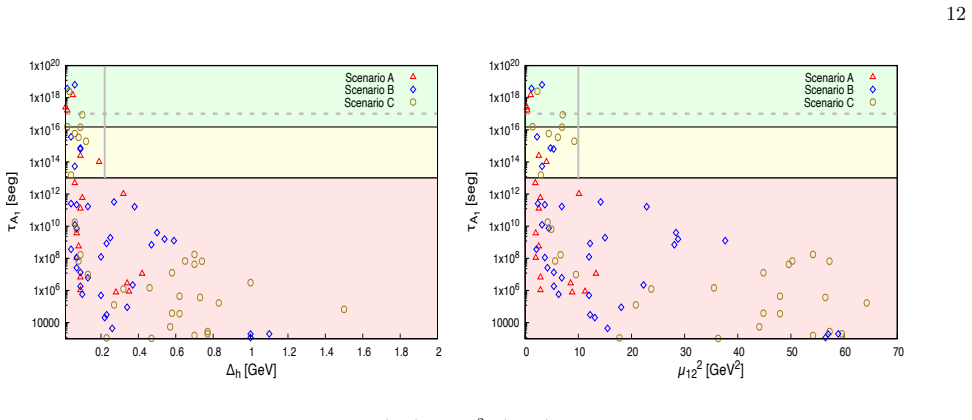
In short, the decay width Γ(A 1 →H 1f ¯f) (computed at one-loop level) could be associated to a very long lifetime (even around the universe age) whenµ 2 12 is small enough
and the kinematic variable m2 12 = (PA −P 1)2. In short, the decay width Γ(A 1 →H 1f ¯f) (computed at one-loop level) could be associated to a very long lifetime (even around the universe age) whenµ 2 12 is small enough. Parameter scan and benchmark points As we discussed previously, for theH 1 andA 1 particles to qualify as viable DM candidates, theH 1A1...
2023
-
[3]
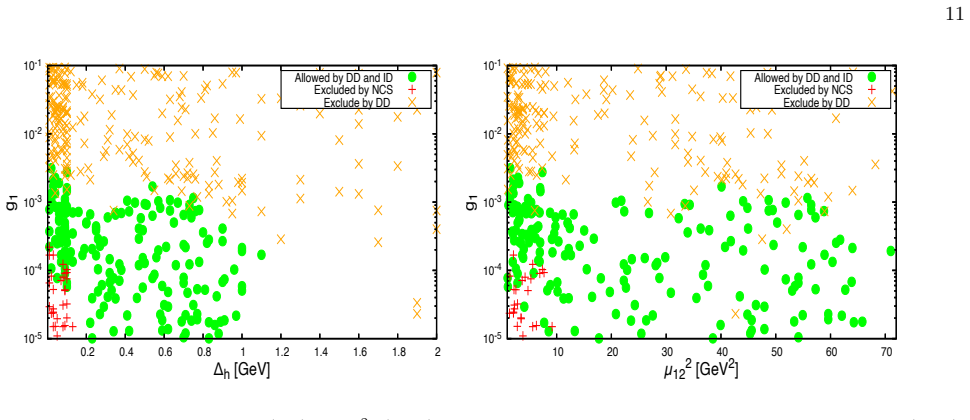
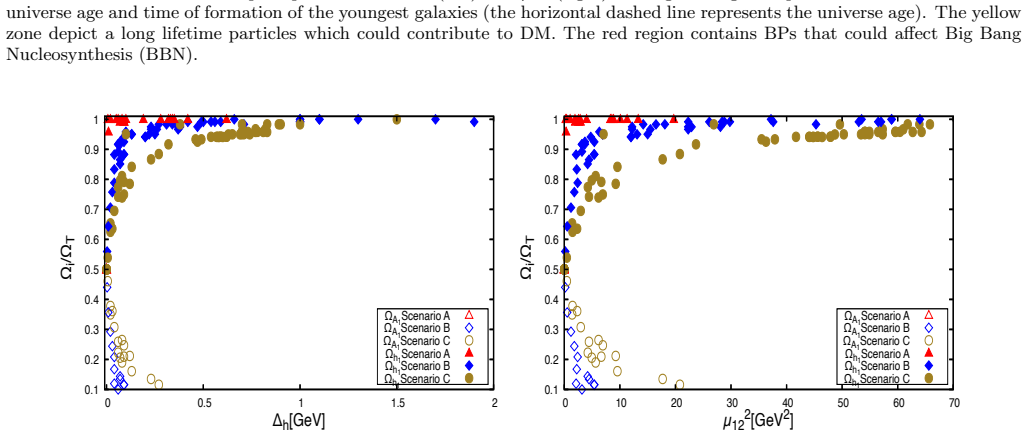
One can get a feasible two-component DM scenario whenµ 2 12 is smaller thanO(0.1) GeV 2, when one inert state is stable DM (H 1) and another inert particle (A 1) could be considered a second DM candidate due to its long lifetime
-
[4]
Considering DM constraints for stage 1, the prediction of the total relic density due to the presence of bothH 1 and A1 is given by Ω DMh2 = Ω H1 h2 + ΩA1 h2
We have only one-component DM,H 1, andA 1 is unstable, but then it can decay inside the detector for 3 GeV <∼ ∆h <∼ 6 GeV. Considering DM constraints for stage 1, the prediction of the total relic density due to the presence of bothH 1 and A1 is given by Ω DMh2 = Ω H1 h2 + ΩA1 h2. In stage 2, Ω DMh2 = Ω H1 h2. Considering the aforementioned scenarios, we ...
-
[5]
Phenomenological study of new physics models with extended Higgs sector
As for collider studies, in this case, signatures are just like those in the I(2+1)HDM, theZ 2 ×Z ′ 2 symmetry [25, 26]. B. DecayingA 1 with displaced vertex inside a collider detector Now, we study the case when the particleA 1 is not cosmologically stable, but it is stable enough to decay inside the detector with a displaced vertex. Specifically, we con...
2025
-
[6]
G. Aadet al.(ATLAS), Phys. Lett. B716, 1 (2012), arXiv:1207.7214 [hep-ex]
work page internal anchor Pith review arXiv 2012
-
[7]
Observation of a new boson at a mass of 125 GeV with the CMS experiment at the LHC
S. Chatrchyanet al.(CMS), Phys. Lett. B716, 30 (2012), arXiv:1207.7235 [hep-ex]
work page Pith review arXiv 2012
-
[8]
V. D. Barger, J. L. Hewett, and R. J. N. Phillips, Phys. Rev. D41, 3421 (1990)
1990
- [9]
- [10]
-
[11]
N. G. Deshpande and E. Ma, Phys. Rev. D18, 2574 (1978)
1978
- [12]
-
[13]
I. P. Ivanov, V. Keus, and E. Vdovin, Journal of Physics A: Mathematical and Theoretical45, 215201 (2012)
2012
- [14]
-
[15]
Q.-H. Cao, E. Ma, and G. Rajasekaran, Phys. Rev. D76, 095011 (2007), arXiv:0708.2939 [hep-ph]
work page Pith review arXiv 2007
-
[16]
Inert Doublet Model and LEP II Limits
E. Lundstrom, M. Gustafsson, and J. Edsjo, Phys. Rev. D79, 035013 (2009), arXiv:0810.3924 [hep-ph]
work page Pith review arXiv 2009
-
[17]
M. Aaboudet al.(ATLAS), Phys. Rev. Lett.122, 231801 (2019), arXiv:1904.05105 [hep-ex]
-
[18]
A. Cordero-Cid, J. Hern´ andez-S´ anchez, V. Keus, S. Moretti, D. Rojas, and D. Soko lowska, Eur. Phys. J. C80, 135 (2020), arXiv:1812.00820 [hep-ph]
-
[19]
Planck 2018 results. VI. Cosmological parameters
N. Aghanimet al.(Planck), Astron. Astrophys.641, A6 (2020), [Erratum: Astron.Astrophys. 652, C4 (2021)], arXiv:1807.06209 [astro-ph.CO]
work page Pith review arXiv 2020
-
[20]
Dark Matter Search Results from a One Ton-Year Exposure of XENON1T,
E. Aprileet al.(XENON), Phys. Rev. Lett.121, 111302 (2018), arXiv:1805.12562 [astro-ph.CO]
-
[21]
J. Aalberset al.(LZ), Phys. Rev. Lett.131, 041002 (2023), arXiv:2207.03764 [hep-ex]
- [22]
-
[23]
A. Cordero, J. Hernandez-Sanchez, V. Keus, S. F. King, S. Moretti, D. Rojas, and D. Sokolowska, JHEP05, 030, arXiv:1712.09598 [hep-ph]
-
[24]
Mertig, M
R. Mertig, M. B¨ ohm, and A. Denner, Computer Physics Communications64, 345 (1991)
1991
-
[25]
T. Hahn and M. Perez-Victoria, Comput. Phys. Commun.118, 153 (1999), arXiv:hep-ph/9807565
-
[26]
Passarino and M
G. Passarino and M. J. G. Veltman, Nucl. Phys. B160, 151 (1979)
1979
-
[27]
G. B´ elanger, F. Boudjema, A. Pukhov, and A. Semenov, Comput. Phys. Commun.192, 322 (2015), arXiv:1407.6129 [hep-ph]
-
[28]
CalcHEP 3.4 for collider physics within and beyond the Standard Model
A. Belyaev, N. D. Christensen, and A. Pukhov, Comput. Phys. Commun.184, 1729 (2013), arXiv:1207.6082 [hep-ph]
work page Pith review arXiv 2013
-
[29]
A. Aryshevet al.(ILC International Development Team) 10.2172/1873702 (2022), arXiv:2203.07622 [physics.acc-ph]
-
[30]
J. Hernandez-Sanchez, V. Keus, S. Moretti, and D. Sokolowska, JHEP03, 045, arXiv:2202.10514 [hep-ph]
-
[31]
J. Hernandez-Sanchez, V. Keus, S. Moretti, D. Rojas-Ciofalo, and D. Sokolowska, (2020), arXiv:2012.11621 [hep-ph]
-
[32]
E. Accomando, L. Delle Rose, S. Moretti, E. Olaiya, and C. H. Shepherd-Themistocleous, JHEP04, 081, arXiv:1612.05977 [hep-ph]
-
[33]
Note that, here, we neglect considering the casee +e− →2l+4j+ E T , as it will be polluted by significant QCD backgrounds
-
[34]
J. Alwall, R. Frederix, S. Frixione, V. Hirschi, F. Maltoni, O. Mattelaer, H. S. Shao, T. Stelzer, P. Torrielli, and M. Zaro, JHEP07, 079, arXiv:1405.0301 [hep-ph]
work page internal anchor Pith review arXiv
- [35]
discussion (0)
Sign in with ORCID, Apple, or X to comment. Anyone can read and Pith papers without signing in.