Recognition: unknown
Highly eccentric non-spinning binary black hole mergers: quadrupolar post-merger waveforms
Pith reviewed 2026-05-10 10:13 UTC · model grok-4.3
The pith
Polynomial expressions accurately capture the post-merger (2,2) waves from highly eccentric black hole mergers.
A machine-rendered reading of the paper's core claim, the machinery that carries it, and where it could break.
Core claim
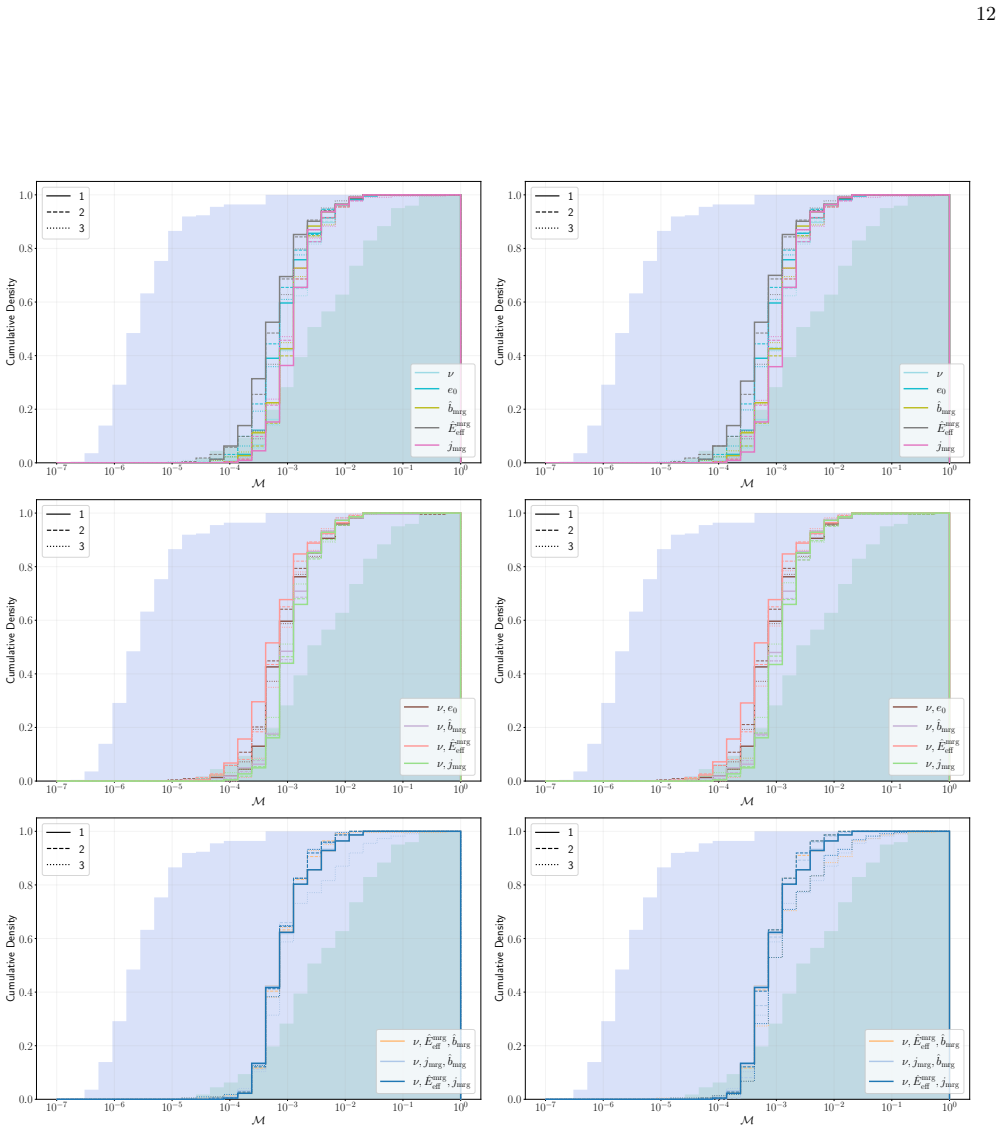
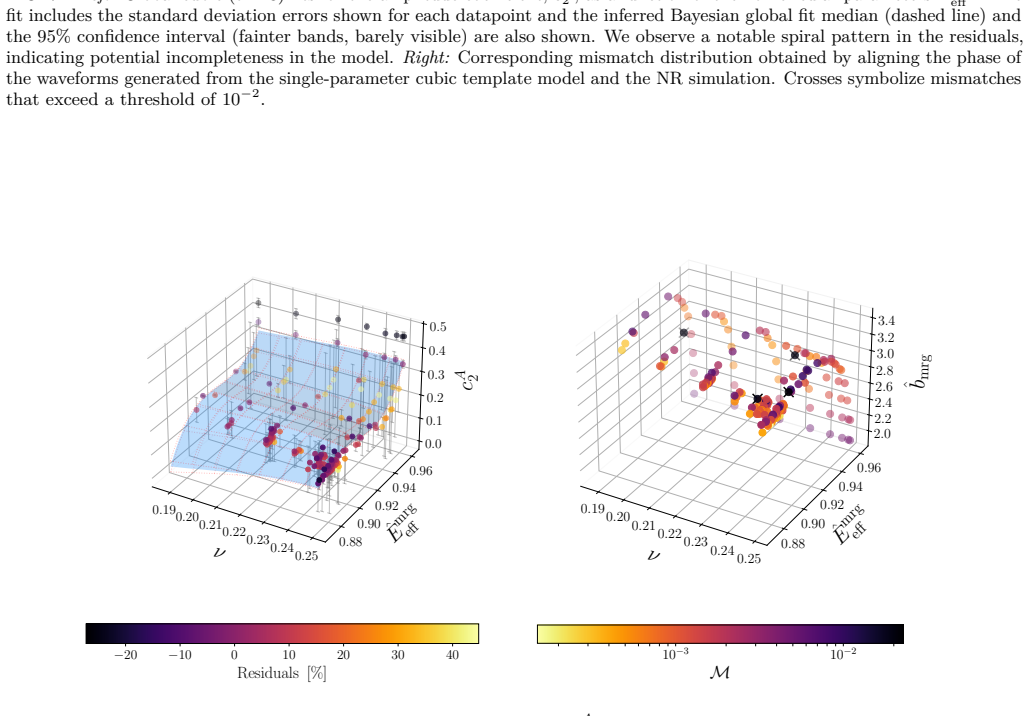
Using data from 233 non-spinning eccentric binary black hole simulations, the authors construct time-dependent complex amplitudes for the dominant (2,2) quasinormal mode via a Bayesian procedure and represent them as multivariate polynomials in the symmetric mass ratio and two merger parameters: the mass-rescaled effective energy and angular momentum. These closed-form expressions achieve mismatches of about 10^{-3} when compared to the numerical waveforms, including for near-extreme eccentricities, and can be combined with inspiral models to produce full inspiral-merger-ringdown waveforms.
What carries the argument
Multivariate polynomial models of the complex quasinormal mode amplitudes as functions of symmetric mass ratio ν, effective energy Ê_eff^mrg, and angular momentum j_mrg at merger.
If this is right
- The models can be directly combined with effective-one-body and phenomenological inspiral waveforms to produce accurate full inspiral-merger-ringdown templates.
- The expressions remain accurate for near-extreme eccentricities with mismatches around 10^{-3}.
- Validation against an independent catalog of simulations confirms the robustness of the polynomial fits.
- These waveforms enable improved parameter estimation for both astrophysical and fundamental physics properties of eccentric binary sources.
Where Pith is reading between the lines
- Extending this polynomial approach to include black hole spin might yield templates for more realistic astrophysical mergers.
- These models could reduce computational cost in parameter estimation pipelines for eccentric binary searches.
- Discrepancies in new simulations could reveal limitations in the assumed low-order polynomial dependence.
Load-bearing premise
The post-merger (2,2) amplitudes are adequately captured by a low-order multivariate polynomial in only three variables and that this form remains accurate across different numerical relativity data sets.
What would settle it
A new numerical simulation of a highly eccentric merger outside the training set that produces a mismatch substantially larger than 10^{-3} with the polynomial model.
Figures





read the original abstract
We present numerically-informed closed-form expressions for the dominant $(\ell,m)=(2,2)$ waveform harmonic of the post-merger emission from mergers of non-spinning binary black holes with comparable masses on highly eccentric orbits. Using 233 non-spinning eccentric simulations from the RIT catalog, we construct time-dependent complex quasinormal mode amplitudes via a Bayesian procedure. We build multivariate polynomial models, represented as functions of the symmetric mass ratio $\nu$ and two dynamics parameters evaluated at merger: the mass-rescaled effective energy $\hat{E}_{\mathrm{eff}}^{\mathrm{mrg}}$ and angular momentum $j_{\mathrm{mrg}}$. We further validate the post-merger non-circular waveform model by comparing it against simulations from the SXS catalog. Our models achieve mismatches around $\sim10^{-3}$, including for near-extreme eccentricities. The model can be directly combined with effective-one-body and phenomenological inspiral waveforms to produce accurate inspiral-merger-ringdown waveforms, essential for parameter estimation of both astrophysical and fundamental physics properties of the signals' sources.
Editorial analysis
A structured set of objections, weighed in public.
Referee Report
Summary. The paper claims to provide closed-form expressions for the dominant (ℓ,m)=(2,2) post-merger waveform harmonic from non-spinning, comparable-mass binary black hole mergers on highly eccentric orbits. Using 233 RIT NR simulations, complex amplitudes are extracted via a Bayesian procedure and modeled as multivariate polynomials in the symmetric mass ratio ν together with the merger values of the mass-rescaled effective energy Ê_eff^mrg and angular momentum j_mrg. The resulting model is validated against SXS simulations, yielding mismatches of order 10^{-3} even at near-extreme eccentricities, and is intended for direct combination with inspiral waveforms to produce full IMR models.
Significance. If the polynomial representation proves robust, the work supplies a practical, low-cost post-merger module for eccentric mergers, a regime relevant to certain formation channels and to tests of general relativity. The use of two independent NR catalogs, Bayesian amplitude extraction, and explicit mismatch quantification on held-out data are constructive features that support reproducibility and uncertainty handling.
major comments (2)
- [Abstract] Abstract and model-construction paragraph: the central claim that a low-order multivariate polynomial in only the three variables ν, Ê_eff^mrg and j_mrg suffices for the (2,2) amplitudes is load-bearing. For highly eccentric orbits the ringdown excitation can retain sensitivity to radial momentum at merger or orbital phase, quantities that are not functions of the chosen three variables alone; the reported agreement between RIT training and SXS validation sets does not yet demonstrate that the functional form is complete rather than adequate for the particular correlations present in both catalogs.
- [Validation] Validation discussion: the mismatches ∼10^{-3} are encouraging, but the manuscript does not report explicit tests that vary initial eccentricity, radial velocity, or numerical resolution while holding the three fitting variables fixed. Without such checks it remains unclear whether the polynomial degree and variable choice generalize when the underlying NR data change.
minor comments (2)
- The notation Ê_eff^mrg and j_mrg should be defined at first use in the abstract and again in the main text for readers who encounter the paper in isolation.
- A brief statement of the polynomial degree(s) retained and the criterion used to select them would improve reproducibility of the fitting procedure.
Simulated Author's Rebuttal
We thank the referee for the positive assessment of our work and the constructive major comments. We address each point below and indicate the revisions we will make.
read point-by-point responses
-
Referee: [Abstract] Abstract and model-construction paragraph: the central claim that a low-order multivariate polynomial in only the three variables ν, Ê_eff^mrg and j_mrg suffices for the (2,2) amplitudes is load-bearing. For highly eccentric orbits the ringdown excitation can retain sensitivity to radial momentum at merger or orbital phase, quantities that are not functions of the chosen three variables alone; the reported agreement between RIT training and SXS validation sets does not yet demonstrate that the functional form is complete rather than adequate for the particular correlations present in both catalogs.
Authors: We agree that the variable choice is central to the claim. The post-merger (2,2) amplitudes are modeled using the symmetric mass ratio together with the effective energy and angular momentum evaluated at merger because these quantities determine the remnant black-hole mass and spin (via the final-state relations) and provide the dominant information about the plunge and merger dynamics that excite the ringdown. While radial momentum and orbital phase at merger are not explicit functions of these three variables, the Bayesian amplitude extraction performed on the full RIT catalog (spanning a broad range of eccentricities and initial conditions) yields polynomials that reproduce the data to high accuracy. The independent validation against SXS simulations, which employ different initial-data constructions, numerical resolutions, and thus different correlations between merger parameters and phase/radial velocity, provides evidence that the model is not merely fitting catalog-specific artifacts. In the revised manuscript we will expand the model-construction section with a physical motivation for the variable selection (drawing on EOB expectations for the merger state) and add an explicit discussion of possible residual sensitivities to unmodeled quantities together with the empirical evidence that they remain sub-dominant at the reported mismatch level. revision: partial
-
Referee: [Validation] Validation discussion: the mismatches ∼10^{-3} are encouraging, but the manuscript does not report explicit tests that vary initial eccentricity, radial velocity, or numerical resolution while holding the three fitting variables fixed. Without such checks it remains unclear whether the polynomial degree and variable choice generalize when the underlying NR data change.
Authors: We concur that controlled tests holding Ê_eff^mrg, j_mrg and ν fixed while varying initial eccentricity, radial velocity or resolution would constitute the most direct check of generalization. Generating such targeted NR data sets is, however, computationally expensive because it requires iterative fine-tuning of initial conditions to reach identical merger-state values from different trajectories. Within the present study we instead relied on the cross-catalog validation: the SXS simulations use independent initial-data methods, different grid resolutions, and distinct numerical evolutions, yet produce mismatches of order 10^{-3} when evaluated with the RIT-trained polynomials. This already constitutes a non-trivial robustness test. In the revised manuscript we will add a dedicated paragraph in the validation section acknowledging the absence of fixed-merger-parameter scans, explaining the practical difficulties, and reiterating that the existing cross-catalog agreement supports the claimed applicability of the model. revision: partial
Circularity Check
No significant circularity: empirical polynomial fits to external NR data
full rationale
The paper extracts complex QNM amplitudes from 233 RIT NR simulations via a Bayesian procedure, then fits explicit low-order multivariate polynomials in three external variables (ν, Ê_eff^mrg, j_mrg) evaluated at merger. These fitted expressions are validated by direct comparison to independent SXS simulations, yielding reported mismatches of ~10^{-3}. No step reduces the target waveform to a self-definition, a fitted parameter renamed as prediction, or a load-bearing self-citation; the derivation remains self-contained against external benchmarks.
Axiom & Free-Parameter Ledger
free parameters (1)
- polynomial coefficients for complex amplitudes
axioms (1)
- domain assumption Post-merger gravitational-wave emission is dominated by quasinormal modes whose time-dependent amplitudes can be extracted from numerical-relativity waveforms via a Bayesian procedure.
Reference graph
Works this paper leans on
-
[1]
A. G. Abacet al.(LIGO Scientific, VIRGO, KAGRA), (2025), arXiv:2508.18082 [gr-qc]
work page internal anchor Pith review arXiv 2025
-
[2]
J. Aasiet al.(LIGO Scientific), Class. Quant. Grav.32, 074001 (2015), arXiv:1411.4547 [gr-qc]
work page internal anchor Pith review arXiv 2015
-
[3]
Advanced Virgo: a 2nd generation interferometric gravitational wave detector
F. Acerneseet al.(VIRGO), Class. Quant. Grav.32, 024001 (2015), arXiv:1408.3978 [gr-qc]
work page internal anchor Pith review arXiv 2015
-
[4]
T. Akutsuet al.(KAGRA), Nature Astron.3, 35 (2019), arXiv:1811.08079 [gr-qc]
-
[5]
A. G. Abacet al.(LIGO Scientific, VIRGO, KAGRA), (2025), arXiv:2508.18083 [astro-ph.HE]
work page internal anchor Pith review Pith/arXiv arXiv 2025
- [6]
- [7]
- [8]
- [9]
-
[10]
C. V. Vishveshwara, Phys. Rev. D1, 2870 (1970)
1970
-
[11]
W. H. Press, Astrophys. J. Lett.170, L105 (1971)
1971
-
[12]
S. A. Teukolsky, Astrophys. J.185, 635 (1973)
1973
-
[13]
W. H. Press and S. A. Teukolsky, Astrophys. J.185, 649 (1973)
1973
-
[14]
Chandrasekhar and S
S. Chandrasekhar and S. L. Detweiler, Proc. Roy. Soc. Lond. A344, 441 (1975)
1975
-
[15]
Chandrasekhar and S
S. Chandrasekhar and S. L. Detweiler, Proc. Roy. Soc. Lond. A345, 145 (1975)
1975
-
[16]
Chandrasekhar and S
S. Chandrasekhar and S. L. Detweiler, Proc. Roy. Soc. Lond. A350, 165 (1976)
1976
-
[17]
Regge and J
T. Regge and J. A. Wheeler, Phys. Rev.108, 1063 (1957)
1957
-
[18]
F. J. Zerilli, Phys. Rev. D2, 2141 (1970)
1970
-
[19]
F. J. Zerilli, Phys. Rev. Lett.24, 737 (1970)
1970
-
[20]
S. A. Teukolsky, Phys. Rev. Lett.29, 1114 (1972)
1972
-
[21]
S. A. Teukolsky and W. H. Press, Astrophys. J.193, 443 (1974)
1974
-
[22]
Nollert, Class
H.-P. Nollert, Class. Quant. Grav.16, R159 (1999)
1999
-
[23]
V. Ferrari and L. Gualtieri, Gen. Rel. Grav.40, 945 (2008), arXiv:0709.0657 [gr-qc]
-
[24]
Quasinormal modes of black holes and black branes
E. Berti, V. Cardoso, and A. O. Starinets, Class. Quant. Grav.26, 163001 (2009), arXiv:0905.2975 [gr-qc]
work page internal anchor Pith review arXiv 2009
-
[25]
Black hole spectroscopy: from theory to experiment
E. Bertiet al., (2025), arXiv:2505.23895 [gr-qc]
work page internal anchor Pith review arXiv 2025
-
[26]
G. Carullo, D. Laghi, N. K. Johnson-McDaniel, W. Del Pozzo, O. J. C. Dias, M. Godazgar, and J. E. San- tos, Phys. Rev. D105, 062009 (2022), arXiv:2109.13961 [gr-qc]
- [27]
-
[28]
Echeverria, Phys
F. Echeverria, Phys. Rev. D40, 3194 (1989)
1989
-
[29]
Black Hole Spectroscopy: Testing General Relativity through Gravitational Wave Observations
O. Dreyer, B. J. Kelly, B. Krishnan, L. S. Finn, D. Gar- rison, and R. Lopez-Aleman, Class. Quant. Grav.21, 787 (2004), arXiv:gr-qc/0309007
work page Pith review arXiv 2004
-
[30]
On gravitational-wave spectroscopy of massive black holes with the space interferometer LISA
E. Berti, V. Cardoso, and C. M. Will, Phys. Rev. D73, 064030 (2006), arXiv:gr-qc/0512160
work page Pith review arXiv 2006
-
[31]
Bayesian model selection for testing the no-hair theorem with black hole ringdowns
S. Gossan, J. Veitch, and B. S. Sathyaprakash, Phys. Rev. D85, 124056 (2012), arXiv:1111.5819 [gr-qc]
work page Pith review arXiv 2012
-
[32]
Testing General Relativity with Present and Future Astrophysical Observations
E. Bertiet al., Class. Quant. Grav.32, 243001 (2015), arXiv:1501.07274 [gr-qc]
work page internal anchor Pith review arXiv 2015
-
[33]
Spectroscopy of Kerr black holes with Earth- and space-based interferometers
E. Berti, A. Sesana, E. Barausse, V. Cardoso, and K. Belczynski, Phys. Rev. Lett.117, 101102 (2016), arXiv:1605.09286 [gr-qc]
work page Pith review arXiv 2016
-
[34]
V. Baibhav, E. Berti, V. Cardoso, and G. Khanna, Phys. Rev. D97, 044048 (2018), arXiv:1710.02156 [gr-qc]
-
[35]
V. Baibhav and E. Berti, Phys. Rev. D99, 024005 (2019), arXiv:1809.03500 [gr-qc]
-
[36]
Carullo,Black Hole Spectroscopy: from a mathemati- cal problem to an observational reality, Ph.D
G. Carullo,Black Hole Spectroscopy: from a mathemati- cal problem to an observational reality, Ph.D. thesis, U. Pisa (main) (2022)
2022
-
[37]
Carullo, Gen
G. Carullo, Gen. Rel. Grav.57, 76 (2025)
2025
-
[38]
A. G. Abacet al.(LIGO Scientific, Virgo, KAGRA), Phys. Rev. Lett.135, 111403 (2025), arXiv:2509.08054 [gr-qc]
work page internal anchor Pith review arXiv 2025
-
[39]
P. C. Peters and J. Mathews, Phys. Rev.131, 435 (1963)
1963
-
[40]
P. C. Peters, Phys. Rev.136, B1224 (1964)
1964
-
[41]
I. Mandel and A. Farmer, Phys. Rept.955, 1 (2022), arXiv:1806.05820 [astro-ph.HE]
-
[42]
M. Mapelli, Formation Channels of Single and Binary Stellar-Mass Black Holes (2021) arXiv:2106.00699 [astro- ph.HE]
-
[43]
S. Stevenson, A. Vigna-G´ omez, I. Mandel, J. W. Bar- rett, C. J. Neijssel, D. Perkins, and S. E. de Mink, Na- ture Commun.8, 14906 (2017), arXiv:1704.01352 [astro- ph.HE]
-
[44]
J. Samsing, M. MacLeod, and E. Ramirez-Ruiz, Astro- phys. J.784, 71 (2014), arXiv:1308.2964 [astro-ph.HE]
- [45]
-
[46]
D. Chattopadhyay, J. Stegmann, F. Antonini, J. Barber, and I. M. Romero-Shaw, Mon. Not. Roy. Astron. Soc. 526, 4908 (2023), arXiv:2308.10884 [astro-ph.HE]
-
[47]
F. Antonini, N. Murray, and S. Mikkola, Astrophys. J. 781, 45 (2014), arXiv:1308.3674 [astro-ph.HE]
-
[48]
Eccentric Black Hole Mergers Forming in Globular Clusters
J. Samsing, Phys. Rev. D97, 103014 (2018), arXiv:1711.07452 [astro-ph.HE]
work page Pith review arXiv 2018
-
[49]
C. L. Rodriguez, P. Amaro-Seoane, S. Chatterjee, K. Kre- mer, F. A. Rasio, J. Samsing, C. S. Ye, and M. Zevin, Phys. Rev. D98, 123005 (2018), arXiv:1811.04926 [astro- ph.HE]
work page Pith review arXiv 2018
-
[50]
Eccentric Black Hole Mergers in Dense Star Clusters: The Role of Binary-Binary Encounters
M. Zevin, J. Samsing, C. Rodriguez, C.-J. Haster, and E. Ramirez-Ruiz, Astrophys. J.871, 91 (2019), arXiv:1810.00901 [astro-ph.HE]
work page Pith review arXiv 2019
-
[51]
M. Dall’Amico, M. Mapelli, S. Torniamenti, and M. A. Sedda, Astron. Astrophys.683, A186 (2024), arXiv:2303.07421 [astro-ph.HE]
-
[52]
Abbottet al.(LIGO Scientific and Virgo Collaboration), Phys
R. Abbottet al.(LIGO Scientific, Virgo), Phys. Rev. Lett.125, 101102 (2020), arXiv:2009.01075 [gr-qc]
-
[53]
Abbottet al.(LIGO Scientific and Virgo Collaboration), Astrophys
R. Abbottet al.(LIGO Scientific, Virgo), Astrophys. J. Lett.900, L13 (2020), arXiv:2009.01190 [astro-ph.HE]
- [54]
-
[55]
2025, arXiv e-prints, arXiv:2511.13820, doi:10.48550/arXiv.2511.13820
B. Liu and D. Lai, (2025), arXiv:2511.13820 [astro- ph.HE]
-
[56]
T. Islam, D. Wadekar, and K. Kritos, (2026), arXiv:2603.10170 [astro-ph.HE]
- [57]
- [58]
- [59]
-
[60]
GW231123: Binary black hole merger or cosmic string?
I. Cuceu, M. A. Bizouard, N. Christensen, and M. Sakellariadou, Phys. Rev. D113, L021302 (2026), arXiv:2507.20778 [gr-qc]
- [61]
-
[62]
A. Chakraborty and S. Mukherjee, (2025), arXiv:2512.19077 [gr-qc]
work page internal anchor Pith review Pith/arXiv arXiv 2025
-
[63]
GW231123: A Possible Primordial Black Hole Origin
V. De Luca, G. Franciolini, and A. Riotto, (2025), arXiv:2508.09965 [astro-ph.CO]
work page internal anchor Pith review arXiv 2025
-
[64]
J. Stegmann, A. Olejak, and S. E. de Mink, Astrophys. J. Lett.992, L26 (2025), arXiv:2507.15967 [astro-ph.HE]
- [65]
- [66]
- [67]
- [68]
- [69]
- [70]
-
[71]
2025, arXiv e-prints, arXiv:2510.14363, doi:10.48550/arXiv.2510.14363
L. Passenger, S. Banagiri, E. Thrane, P. D. Lasky, A. Borchers, M. Fishbach, and C. S. Ye, Astrophys. J.999, 236 (2026), arXiv:2510.14363 [astro-ph.HE]
-
[72]
C. Chatterjee, K. McGowan, S. Deshmukh, N. Tyler- Howard, and K. Jani, Astrophys. J. Lett.995, L6 (2025), arXiv:2509.09161 [astro-ph.HE]
-
[73]
2025, arXiv e-prints, arXiv:2509.08298, doi:10.48550/arXiv.2509.08298
G.-P. Li and X.-L. Fan, (2025), arXiv:2509.08298 [astro- ph.HE]
- [74]
- [75]
-
[76]
J. Calder´ on Bustillo, N. Sanchis-Gual, A. Torres-Forn´ e, and J. A. Font, Phys. Rev. Lett.126, 201101 (2021), arXiv:2009.01066 [gr-qc]
-
[77]
2020, NatAs, doi: 10.48550/arXiv.2009.05461 Gond´an, L., & Kocsis, B
V. Gayathri, J. Healy, J. Lange, B. O’Brien, M. Szczep- anczyk, I. Bartos, M. Campanelli, S. Klimenko, C. O. Lousto, and R. O’Shaughnessy, Nature Astron.6, 344 (2022), arXiv:2009.05461 [astro-ph.HE]
- [78]
- [79]
- [80]
discussion (0)
Sign in with ORCID, Apple, or X to comment. Anyone can read and Pith papers without signing in.