Recognition: unknown
PySCo-EFT and ECOSMOG-EFT: a tandem of N-body simulation codes for the Effective Field Theory of Dark Energy
Pith reviewed 2026-05-10 09:30 UTC · model grok-4.3
The pith
Two N-body codes solve the scalar field equation with non-linear Vainshtein screening for effective dark energy models.
A machine-rendered reading of the paper's core claim, the machinery that carries it, and where it could break.
Core claim
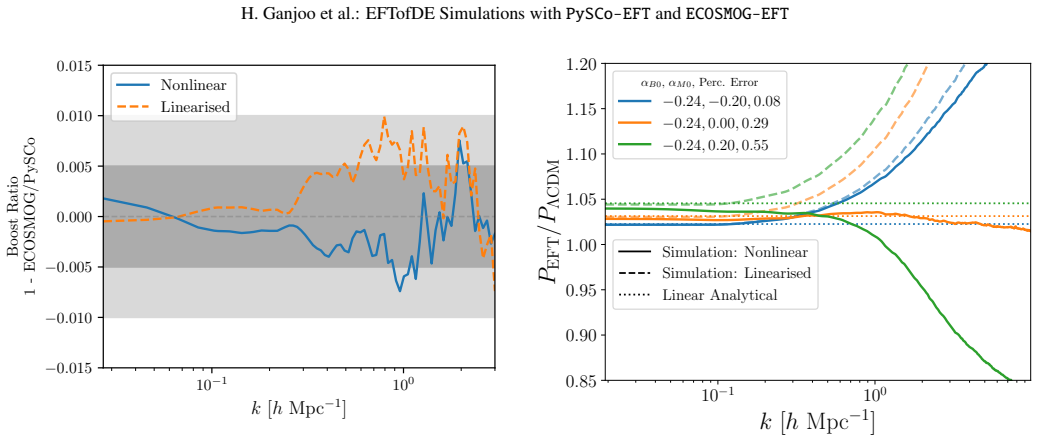
The paper claims that PySCo-EFT and ECOSMOG-EFT can accurately evolve Horndeski models with luminal gravitational wave speed by solving the scalar field equation that incorporates the full non-linear Vainshtein screening. Validation tests show sub-0.5 percent agreement with linear theory on large scales, similar agreement between the two independent codes on non-linear scales, and controlled numerical errors below 2 percent at k=10 h/Mpc. The codes demonstrate that screening can be either negligible or dominant depending on the EFTofDE parameter values, enabling reliable computation of matter power spectrum ratios relative to LambdaCDM.
What carries the argument
Iterative solvers and multigrid schemes that solve the scalar field equation while capturing the full non-linear Vainshtein screening mechanism.
If this is right
- Matter power spectrum ratios between EFTofDE and LambdaCDM cases can be predicted with controlled accuracy, revealing when screening dominates over linear effects.
- Numerical effects from mass resolution, finite volume, refinement threshold, and starting redshift remain below 2 percent at the largest tested wavenumbers.
- The codes generate fast predictions of how EFTofDE parameters alter the clustering of matter on non-linear scales.
- Screening plays a parameter-dependent role that can be quantified for comparison with clustering and weak lensing data.
Where Pith is reading between the lines
- These validated codes could tighten constraints on dark energy parameters once applied to mock catalogs from upcoming surveys.
- Running both a simple particle-mesh code and an AMR code in tandem reduces the chance that results depend on a single numerical method.
- The same solver approach could be adapted to other scalar-tensor theories to test a wider set of screening mechanisms.
Load-bearing premise
The iterative solvers and multigrid schemes correctly capture the full non-linear Vainshtein screening without numerical artifacts or missed solutions in the scalar field equation.
What would settle it
Comparison of the two codes' matter power spectra at wavenumbers near 1 h/Mpc with results from an independent higher-resolution simulation or analytic non-linear approximation would reveal discrepancies larger than 0.5 percent if the screening is not captured accurately.
Figures



read the original abstract
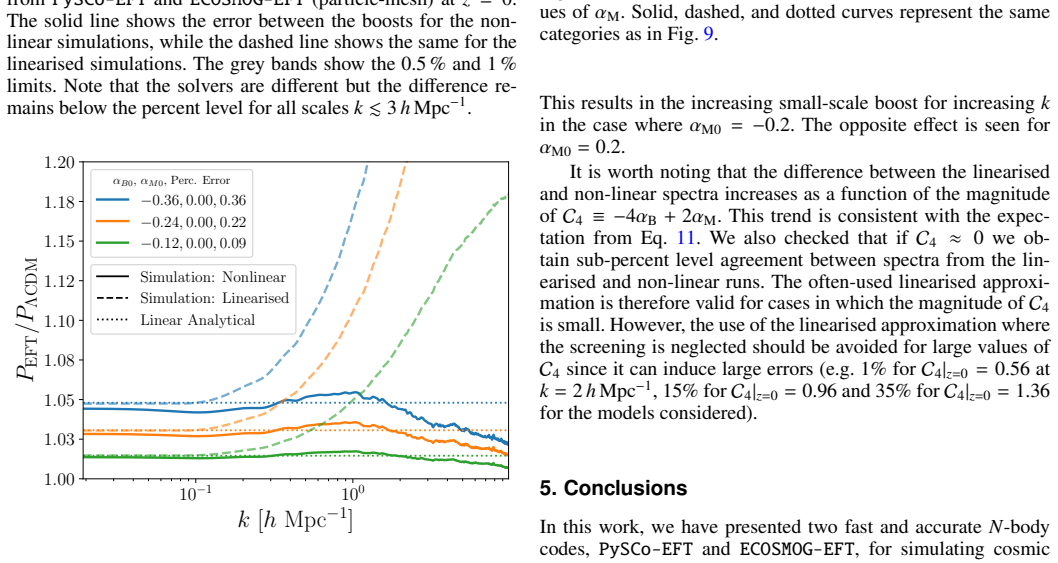
Modified gravity theories constitute viable alternatives to the standard cosmological model for explaining the observed late-time accelerated expansion of the Universe. The Effective Field Theory of Dark Energy (EFTofDE) is an efficient framework to describe a wide range of such theories with a limited number of parameters. To robustly constrain them by comparison with clustering and weak lensing data from upcoming large-scale structure surveys, high-resolution cosmological N-body simulations are required to obtain accurate predictions for the matter distribution on non-linear scales. We introduce two new N-body simulation codes for EFTofDE cosmologies: PySCo-EFT, a Python-based particle mesh code, and ECOSMOG-EFT, a RAMSES-based code with adaptive mesh refinement. We consider Horndeski models with a luminal gravitational wave speed. We use iterative solvers and multigrid schemes to solve for the additional scalar field equation in both codes, incorporating the non-linear Vainshtein screening mechanism. We present validation and convergence tests of the codes. We obtain a sub-0.5 percent agreement with linear theory on large scales and a similar agreement between the two codes on non-linear scales. The dominant numerical effects on the matter-power-spectrum boost are mass resolution, finite-volume effects, refinement threshold, and starting redshift, but they are limited to below 2% at the largest wavenumbers (k=10 h/Mpc) for the range of tested values. We investigate the impact of the EFTofDE parameters on the matter-power-spectrum ratios between EFTofDE and $\Lambda$CDM cases. Depending on the EFTofDE parameters, the screening plays a negligible or dominant role compared to the linearised field equations. Our codes provide tools for generating fast and accurate predictions of the impact of the EFTofDE on the clustering of matter, incorporating non-linear screening.
Editorial analysis
A structured set of objections, weighed in public.
Referee Report
Summary. The paper introduces two new N-body simulation codes for Effective Field Theory of Dark Energy (EFTofDE) cosmologies in Horndeski models with luminal gravitational wave speed: PySCo-EFT, a Python-based particle-mesh code, and ECOSMOG-EFT, a RAMSES-based adaptive mesh refinement code. Both incorporate iterative solvers and multigrid schemes to solve the additional scalar field equation with the non-linear Vainshtein screening mechanism. Validation shows sub-0.5% agreement with linear theory on large scales and comparable agreement between the codes on non-linear scales up to k=10 h/Mpc, with numerical systematics (mass resolution, finite volume, refinement threshold, starting redshift) quantified below 2%. The work also examines how EFTofDE parameters affect matter power spectrum ratios relative to ΛCDM, with screening sometimes negligible and sometimes dominant.
Significance. If the non-linear solvers prove reliable, the tandem of independent codes would provide a useful resource for generating accurate non-linear predictions of matter clustering in EFTofDE models, aiding constraints from upcoming surveys. A strength is the cross-validation between particle-mesh and AMR implementations plus explicit quantification of numerical effects; this reduces reliance on a single code. The parameter study illustrates when screening matters, which is relevant for model building.
major comments (2)
- [Validation and convergence tests] Validation and convergence tests section: The central claim of accurate incorporation of non-linear Vainshtein screening rests on internal consistency (sub-0.5% agreement with linear theory and between PySCo-EFT and ECOSMOG-EFT) plus convergence studies, but lacks external benchmarks against known analytic solutions such as the static spherically symmetric screened scalar-field profile around a point mass. Internal tests alone leave open the possibility of correlated numerical artifacts in the multigrid iterative solver for the non-linear equation.
- [Impact of EFTofDE parameters] Section on the impact of EFTofDE parameters: The statement that 'screening plays a negligible or dominant role compared to the linearised field equations' depending on parameters is presented without quantitative thresholds or explicit comparison of the full non-linear solution versus the linearised one for the specific parameter values shown in the power-spectrum ratios; this weakens the interpretation of when non-linear effects become important.
minor comments (2)
- [Abstract] Abstract: The claim of 'similar agreement between the two codes on non-linear scales' would be clearer if the precise k-range and redshift of the comparison were stated.
- The paper would benefit from a brief table or explicit list of the EFTofDE parameter values used in the power-spectrum ratio figures to allow readers to reproduce the 'negligible or dominant' screening regimes.
Simulated Author's Rebuttal
We thank the referee for their careful reading of the manuscript and for the constructive comments. We address each major comment below and indicate the revisions made to the manuscript.
read point-by-point responses
-
Referee: [Validation and convergence tests] Validation and convergence tests section: The central claim of accurate incorporation of non-linear Vainshtein screening rests on internal consistency (sub-0.5% agreement with linear theory and between PySCo-EFT and ECOSMOG-EFT) plus convergence studies, but lacks external benchmarks against known analytic solutions such as the static spherically symmetric screened scalar-field profile around a point mass. Internal tests alone leave open the possibility of correlated numerical artifacts in the multigrid iterative solver for the non-linear equation.
Authors: We appreciate the referee's emphasis on external validation. The two codes employ fully independent implementations of the multigrid solver (a custom Python-based iterative solver in PySCo-EFT versus the established RAMSES multigrid infrastructure in ECOSMOG-EFT), which substantially reduces the likelihood of shared numerical artifacts. Their agreement to sub-0.5% on non-linear scales up to k=10 h/Mpc, together with the recovery of linear theory on large scales, provides robust internal evidence for the correct implementation of Vainshtein screening in a cosmological setting. We have added a clarifying paragraph in the validation section highlighting the independence of the numerical methods. We do not believe an additional static analytic test is required for the claims of this work, as the cosmological application and cross-code consistency constitute the relevant benchmarks. revision: partial
-
Referee: [Impact of EFTofDE parameters] Section on the impact of EFTofDE parameters: The statement that 'screening plays a negligible or dominant role compared to the linearised field equations' depending on parameters is presented without quantitative thresholds or explicit comparison of the full non-linear solution versus the linearised one for the specific parameter values shown in the power-spectrum ratios; this weakens the interpretation of when non-linear effects become important.
Authors: We agree that the original presentation would benefit from greater quantitative support. In the revised manuscript we now include, for each set of EFTofDE parameters shown in the power-spectrum figures, an explicit comparison of the matter power spectrum obtained with the full non-linear scalar-field solver versus the linearised solver. We have also added text specifying approximate thresholds (e.g., the parameter values at which the non-linear Vainshtein term contributes more than 5% to the scalar-field solution on the scales of interest). These additions appear in the updated Section on the impact of EFTofDE parameters and the associated figures. revision: yes
Circularity Check
No significant circularity: paper presents code implementation and numerical validation without reducing claims to fitted inputs or self-referential derivations.
full rationale
The manuscript introduces two N-body codes (PySCo-EFT and ECOSMOG-EFT) for EFTofDE models incorporating Vainshtein screening, then reports convergence tests and inter-code comparisons against linear theory. No equations or results are derived from parameters fitted to the same simulation outputs; the validation consists of direct numerical agreement metrics (sub-0.5% on large scales) rather than any self-definitional loop or renamed prediction. Self-citations, if present for prior code frameworks, are not load-bearing for the central claims of implementation accuracy, which rest on explicit solver descriptions and resolution studies. The derivation chain is therefore self-contained as software development and benchmarking.
Axiom & Free-Parameter Ledger
free parameters (2)
- refinement threshold
- starting redshift
axioms (2)
- domain assumption Horndeski models with luminal gravitational wave speed are adequately described by the EFTofDE action used in the codes
- domain assumption The Vainshtein screening mechanism is the dominant non-linear effect that must be captured by the scalar field solver
Forward citations
Cited by 1 Pith paper
-
A Master Equation for Screening in Luminal Horndeski Gravity
A master screening equation is derived for luminal Horndeski gravity that recovers Vainshtein and Chameleon mechanisms and introduces Phaedrus screening with screening radius scaling linearly with source mass.
Reference graph
Works this paper leans on
-
[1]
Abbott, B. P. et al. 2017, Astrophys. J. Lett., 848, L13 Abbott, T. M. C. et al. 2025 [arXiv:2503.06712] Abdul Karim, M. et al. 2025, Phys. Rev. D, 112, 083515 Aghanim, N. et al. 2020, Astron. Astrophys., 641, A6, [Erratum: As- tron.Astrophys. 652, C4 (2021)] Alimi, J.-M., Füzfa, A., Boucher, V ., et al. 2010, MNRAS, 401, 775 Baker, T., Bellini, E., Ferre...
-
[2]
for all tests, which is specified in Table A.1. We start all the simulations atz ini =56.88 (unless otherwise specified) and run a pair of simulations (EFTofDE andΛCDM) for each run, with 6 refinement levels for both, with a mass re- finement threshold ofm ref =14 times the particle mass (unless otherwise specified). Between each pair of simulation runs, ...
2048
-
[3]
Article number, page 16 H
We then ran four simulation pairs in boxes of side 328.125h −1 Mpc, each with 2563 particles and 6 refinement lev- els and (Npre,N post)=(6,6) andm ref =14. Article number, page 16 H. Ganjoo et al.: EFTofDE Simulations withPySCo-EFTandECOSMOG-EFT Appendix B: Convergence test results We performed convergence tests for theECOSMOG-EFTcode with respect to six...
2014
discussion (0)
Sign in with ORCID, Apple, or X to comment. Anyone can read and Pith papers without signing in.