Recognition: 3 theorem links
· Lean TheoremA Master Equation for Screening in Luminal Horndeski Gravity
Pith reviewed 2026-05-08 18:45 UTC · model grok-4.3
The pith
In luminal Horndeski theories a single master screening equation governs the scalar field around static spherical sources and recovers both Vainshtein and Chameleon behavior while revealing a new regime with linear mass scaling.
A machine-rendered reading of the paper's core claim, the machinery that carries it, and where it could break.
Core claim
For static and spherically symmetric configurations, the scalar-field equation reduces to a master screening equation that recovers the Vainshtein and Chameleon mechanisms. A novel regime appears in which the screening radius scales linearly with the source mass; the authors term this Phaedrus screening. Analytical and numerical solutions are obtained for each mechanism together with the conditions under which each activates.
What carries the argument
The master screening equation obtained by imposing the quasi-static and weak-field limits on the second-order scalar perturbation equation in the alpha-basis.
If this is right
- The active screening mechanism can be identified from the Lagrangian coefficients without solving the full nonlinear system in many models.
- Analytical and numerical solutions exist for each regime once the master equation is known.
- The conditions that switch one mechanism on or off are fixed by the relative sizes of the nonlinear terms.
- The same equation applies uniformly across the family of luminal Horndeski models.
Where Pith is reading between the lines
- The linear scaling of the Phaedrus radius could produce observable differences in the outskirts of galaxy clusters compared with the other two regimes.
- The master equation may serve as a template for checking whether time-dependent or non-spherical configurations still admit a similar reduction.
- If the new regime survives in more general backgrounds it would enlarge the set of allowed scalar-tensor Lagrangians that pass local gravity tests.
Load-bearing premise
The quasi-static and weak-field limits applied to the second-order perturbation equations remain valid for static spherically symmetric configurations on an exactly flat FLRW background.
What would settle it
A direct measurement of the screening radius around a known mass that scales neither with the square root of mass (Vainshtein), with the strength of the fifth force (Chameleon), nor linearly with mass (Phaedrus) would show the master equation does not capture the dynamics.
Figures

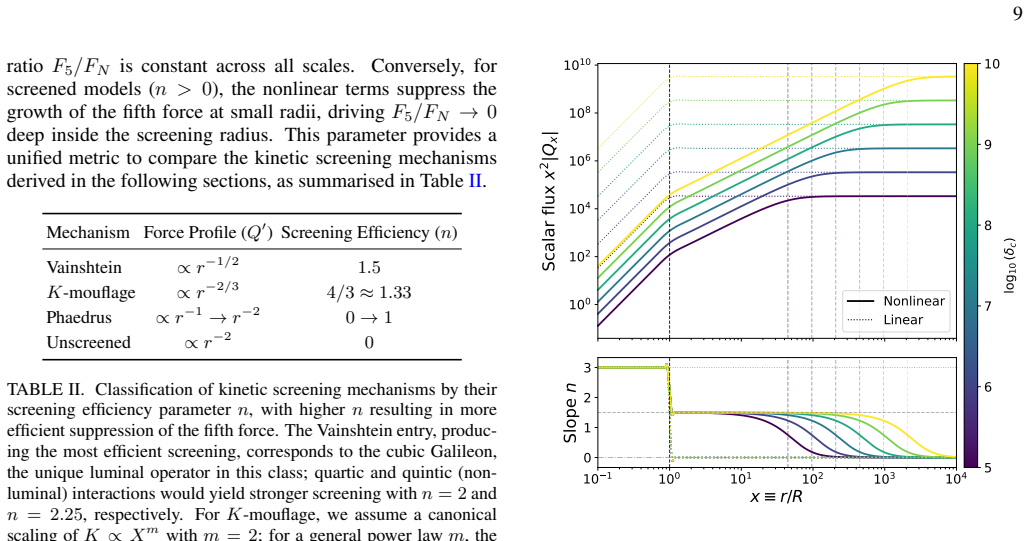


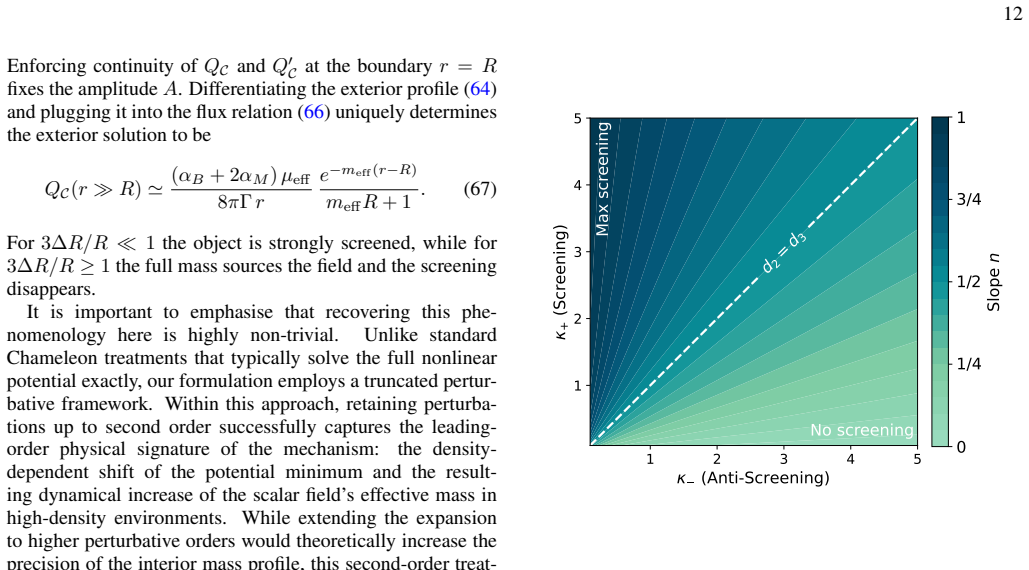

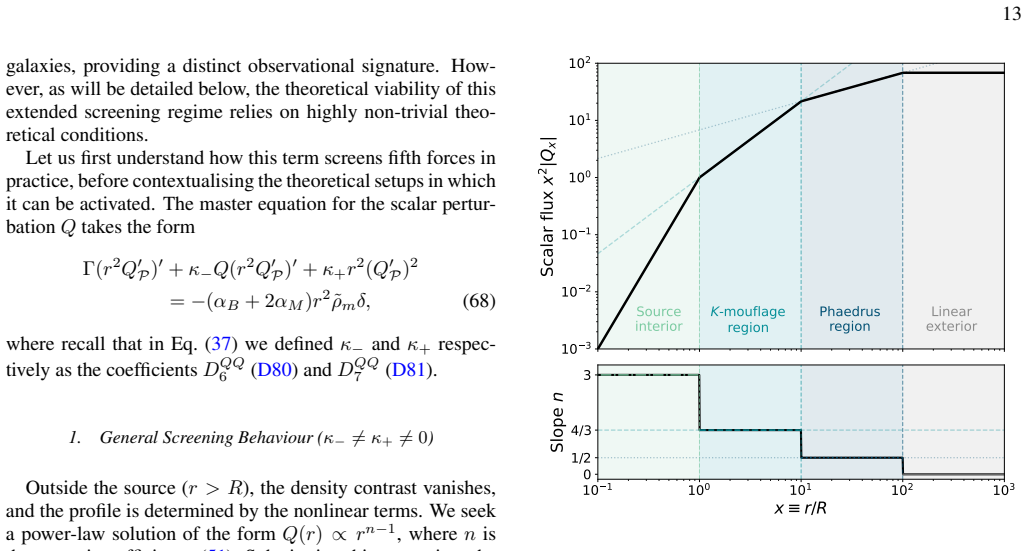

read the original abstract
Determining the active screening mechanism from a general scalar-tensor Lagrangian remains a challenging problem. As a diagnostic tool, we present a systematic study of nonlinear cosmological perturbations in luminal Horndeski theories. Working in the $\alpha$-basis on a flat FLRW background, we derive and organise the full set of unapproximated second-order perturbation equations, and systematically apply the quasi-static and weak-field limits. We find that second-order effects modify only the scalar field equation. We derive, for static and spherically symmetric configurations, a master screening equation recovering the Vainshtein and Chameleon mechanisms. We also identify a novel regime, which we term Phaedrus screening, characterised by a screening radius that scales linearly with the source mass. For each mechanism, we derive analytical and numerical solutions and clarify the conditions under which they activate. Finally, we introduce two new publicly available software packages: (i) xAlpha, a Mathematica package to compute and organise perturbation equations in scalar-tensor theories, and (ii) escut, a Python module to solve the nonlinear scalar equation. In many cases, these tools enable the identification of the active screening type directly from a luminal Horndeski Lagrangian.
Editorial analysis
A structured set of objections, weighed in public.
Referee Report
Summary. The paper derives the complete set of second-order perturbation equations for luminal Horndeski theories in the α-basis on a flat FLRW background, then imposes quasi-static and weak-field limits to obtain a master screening equation for static spherically symmetric configurations. This equation is shown to recover the Vainshtein and Chameleon mechanisms under appropriate parameter choices and to admit a new regime (termed Phaedrus screening) in which the screening radius scales linearly with source mass. Analytical and numerical solutions are presented for each case, together with two new open-source packages (xAlpha for organising perturbation equations and escut for solving the nonlinear scalar equation).
Significance. If the quasi-static and weak-field truncations remain self-consistent inside the nonlinear region, the master equation supplies a practical diagnostic for identifying which screening mechanism is active directly from a given luminal Horndeski Lagrangian. The accompanying software packages constitute a concrete, reproducible contribution that lowers the barrier to further analytic and numerical work in scalar-tensor gravity.
major comments (2)
- [§4] §4 (master screening equation): the derivation obtains the master equation by discarding all time derivatives and linearising the Einstein equations while retaining nonlinear scalar self-interactions. However, inside the screening radius the scalar gradient is order-one by construction; it is not demonstrated that the metric perturbations remain perturbatively small enough for the weak-field truncation to be self-consistent. A quantitative check (e.g., evaluating the size of the neglected metric-scalar cross terms for the Phaedrus solution) is required to confirm that the reported linear mass scaling of the screening radius is not an artifact of the approximation.
- [§3.2] §3.2 (background and matching): the analysis assumes an exactly flat FLRW background that can be matched to an asymptotically flat exterior. For a static spherically symmetric source the local geometry is closer to Schwarzschild; the paper does not quantify the error incurred by retaining the flat-FLRW background when the screening radius is comparable to or larger than the Hubble radius.
minor comments (2)
- [Abstract] The abstract states that 'second-order effects modify only the scalar field equation' but does not cite the explicit equation number where this is shown; adding the reference would improve traceability.
- [Figure 3] Figure captions for the numerical solutions of the Phaedrus regime should explicitly state the parameter values (α_i, source mass) used, to allow direct reproduction with the escut package.
Simulated Author's Rebuttal
We thank the referee for the careful reading of our manuscript and for the constructive comments, which help clarify the regime of validity of our approximations. We address each major comment below and will revise the manuscript accordingly to strengthen the presentation of the master screening equation and its domain of applicability.
read point-by-point responses
-
Referee: [§4] §4 (master screening equation): the derivation obtains the master equation by discarding all time derivatives and linearising the Einstein equations while retaining nonlinear scalar self-interactions. However, inside the screening radius the scalar gradient is order-one by construction; it is not demonstrated that the metric perturbations remain perturbatively small enough for the weak-field truncation to be self-consistent. A quantitative check (e.g., evaluating the size of the neglected metric-scalar cross terms for the Phaedrus solution) is required to confirm that the reported linear mass scaling of the screening radius is not an artifact of the approximation.
Authors: We agree that an explicit check of the weak-field truncation inside the nonlinear region is necessary for the Phaedrus regime. In the revised manuscript we will add a quantitative assessment of the neglected metric-scalar cross terms evaluated on the Phaedrus solution. This will be performed by inserting the analytic and numerical scalar profiles into the full second-order Einstein equations and verifying that the metric perturbations remain O(10^{-2}) or smaller throughout the screened region for the parameter choices considered. We expect this to confirm that the linear mass scaling is not an artifact, but we will state the result explicitly and note the range of validity. revision: yes
-
Referee: [§3.2] §3.2 (background and matching): the analysis assumes an exactly flat FLRW background that can be matched to an asymptotically flat exterior. For a static spherically symmetric source the local geometry is closer to Schwarzschild; the paper does not quantify the error incurred by retaining the flat-FLRW background when the screening radius is comparable to or larger than the Hubble radius.
Authors: The flat FLRW background is the natural starting point for our cosmological perturbation analysis, and the subsequent static, spherically symmetric limit is taken under the assumption that the screening radius lies well inside the Hubble horizon. We acknowledge that a direct Schwarzschild matching would be more precise for purely local configurations. In the revised manuscript we will add a paragraph in §3.2 (and a brief remark in the conclusions) that quantifies the error: when r_screen ≪ H^{-1} the curvature corrections from the FLRW background are suppressed by (r_screen H)^2 and remain negligible; when r_screen approaches H^{-1} the approximation breaks down and the screening radius should instead be interpreted within a cosmological matching. This will be accompanied by an order-of-magnitude estimate of the neglected terms. revision: yes
Circularity Check
Derivation from general Lagrangian via explicit limits is self-contained
full rationale
The paper starts from the general luminal Horndeski Lagrangian expressed in the alpha-basis on a flat FLRW background, derives the complete unapproximated second-order perturbation equations, and then applies the quasi-static (neglect time derivatives) and weak-field (small perturbations, linearised Einstein equations) limits to isolate the nonlinear scalar equation. This master equation is shown to recover Vainshtein and Chameleon mechanisms as special cases and to admit a new Phaedrus regime with linear mass scaling for the screening radius. All steps are direct algebraic reductions from the starting action under stated approximations; no parameters are fitted to data and then relabeled as predictions, no load-bearing uniqueness theorems are imported from self-citations, and no ansatz is smuggled via prior work. The result is not equivalent to the inputs by construction but emerges from the truncation. The paper is therefore self-contained against external benchmarks.
Axiom & Free-Parameter Ledger
axioms (2)
- domain assumption The scalar-tensor theory belongs to the luminal Horndeski class with propagation speed equal to light.
- domain assumption Quasi-static and weak-field approximations are valid for deriving the master screening equation.
invented entities (1)
-
Phaedrus screening
no independent evidence
Reference graph
Works this paper leans on
-
[1]
We seek a power-law solution of the formQ(r)∝r n−1, wherenis the screening efficiency (51)
General Screening Behaviour (κ − ̸=κ + ̸= 0) Outside the source (r > R), the density contrast vanishes, and the profile is determined by the nonlinear terms. We seek a power-law solution of the formQ(r)∝r n−1, wherenis the screening efficiency (51). Substituting this ansatz into the exterior equation (κ−QP(r2Q′ P)′+κ+r2(Q′ P)2 = 0), we find that both term...
-
[2]
Exact Analytical Solution (κ − = 0) In the limit where the anti-screening operator vanishes (κ− = 0), the exterior equation of motion reduces to a balance between the linear kinetic term and the pure gradient-squared interaction,Γ(r 2Q′ P)′ +κ +r2(Q′ P)2 = 0. By casting this as a first-order Bernoulli differential equation forQ ′ P, one can obtain an exac...
-
[3]
Exact Analytical Solution (κ − =κ +) For the specific symmetric case whereκ − =κ + ≡κ(and hencen= 1/2), Eq. (68) allows for a first and second integral, resulting in κ 2 Q2 P + ΓQP = ΦN(r) +C,(72) whereΦ N(r)is the effective Newtonian potential generated by the source mass defined as ΦN(r)≡ −(α B + 2αM) Z r µ(˜r) ˜r2 d˜r.(73) Solving forQ P, we find the e...
-
[4]
DESI 2024 VI: Cosmological Constraints from the Measurements of Baryon Acoustic Oscillations
Physical viability To contextualise the physical viability of the Phaedrus regime, we must examine its competition with both the stan- dard linear kinetic term and higher-order kinetic nonlinear- ities. To isolate this effect, we restrict our focus to theo- ries governed by the reduced LagrangianL ϕ =G 4(ϕ)R− K(ϕ, X), strictly ensuring the absence of Vain...
work page internal anchor Pith review arXiv 2024
-
[5]
Koyama, Cosmological Tests of Modified Gravity, Rept
K. Koyama, “Cosmological Tests of Modified Gravity,”Rept. Prog. Phys.79(2016) no. 4, 046902,arXiv:1504.04623 [astro-ph.CO]
-
[6]
Cosmological Tests of Gravity,
P. G. Ferreira, “Cosmological Tests of Gravity,”Ann. Rev. Astron. Astrophys.57(2019) 335–374, arXiv:1902.10503 [astro-ph.CO]. [5]DESICollaboration, M. Abdul Karimet al., “DESI DR2 Results II: Measurements of Baryon Acoustic Oscillations and Cosmological Constraints,”arXiv:2503.14738 [astro-ph.CO]. [6]DESICollaboration, K. Lodhaet al., “Extended Dark Energ...
-
[7]
Expansion history constraints on horndeski gravity and the role of phantom crossing,
K. Naidoo, J. Hallam, T. Baker, and S. Sirera, “Expansion history constraints on horndeski gravity and the role of phantom crossing,”in preparation(2026)
2026
-
[8]
Cosmological viability of asymptotically cubic galileon gravity,
J. Hallam, T. Baker, K. Naidoo, and S. Sirera, “Cosmological viability of asymptotically cubic galileon gravity,”in preparation(2026)
2026
-
[9]
Hints of Nonminimally Coupled Gravity in DESI 2024 Baryon Acoustic Oscillation Measurements,
G. Ye, M. Martinelli, B. Hu, and A. Silvestri, “Hints of Nonminimally Coupled Gravity in DESI 2024 Baryon Acoustic Oscillation Measurements,”Phys. Rev. Lett.134 (2025) no. 18, 181002,arXiv:2407.15832 [astro-ph.CO]
-
[10]
Matching current observational constraints with nonminimally coupled dark energy,
W. J. Wolf, P. G. Ferreira, and C. García-García, “Matching current observational constraints with nonminimally coupled dark energy,”Phys. Rev. D111(2025) no. 4, L041303, arXiv:2409.17019 [astro-ph.CO]
-
[11]
Scant evidence for thawing quintessence,
W. J. Wolf, C. García-García, D. J. Bartlett, and P. G. Ferreira, “Scant evidence for thawing quintessence,”Phys. Rev. D110(2024) no. 8, 083528,arXiv:2408.17318 [astro-ph.CO]
-
[12]
G. Guet al., “Dynamical Dark Energy in light of the DESI DR2 Baryonic Acoustic Oscillations Measurements,” arXiv:2504.06118 [astro-ph.CO]
-
[13]
C. M. Will,Theory and Experiment in Gravitational Physics. mar, 1993
1993
-
[14]
A test of general relativity using radio links with the Cassini spacecraft,
B. Bertotti, L. Iess, and P. Tortora, “A test of general relativity using radio links with the Cassini spacecraft,” Nature425(2003) 374–376
2003
-
[15]
The Confrontation between General Relativity and Experiment
C. M. Will, “The Confrontation between General Relativity and Experiment,”Living Rev. Rel.17(2014) 4, arXiv:1403.7377 [gr-qc]
work page internal anchor Pith review arXiv 2014
-
[16]
C. Burrage and J. Dombrowski, “Constraining the cosmological evolution of scalar-tensor theories with local measurements of the time variation of G,”JCAP07(2020) 26 060,arXiv:2004.14260 [astro-ph.CO]
-
[17]
Screening mechanisms in modified gravity,
P. Brax, “Screening mechanisms in modified gravity,”Class. Quant. Grav.30(2013) 214005
2013
- [18]
-
[19]
An introduction to the Vainshtein mechanism
E. Babichev and C. Deffayet, “An introduction to the Vainshtein mechanism,”Class. Quant. Grav.30(2013) 184001,arXiv:1304.7240 [gr-qc]
work page Pith review arXiv 2013
-
[20]
Chameleon Fields: Awaiting Surprises for Tests of Gravity in Space
J. Khoury and A. Weltman, “Chameleon fields: Awaiting surprises for tests of gravity in space,”Phys. Rev. Lett.93 (2004) 171104,arXiv:astro-ph/0309300
work page Pith review arXiv 2004
-
[21]
K. Hinterbichler and J. Khoury, “Symmetron Fields: Screening Long-Range Forces Through Local Symmetry Restoration,”Phys. Rev. Lett.104(2010) 231301, arXiv:1001.4525 [hep-th]
-
[22]
E. Babichev, C. Deffayet, and R. Ziour, “k-Mouflage gravity,” Int. J. Mod. Phys. D18(2009) 2147–2154, arXiv:0905.2943 [hep-th]
-
[23]
To the problem of nonvanishing gravitation mass,
A. I. Vainshtein, “To the problem of nonvanishing gravitation mass,”Phys. Lett.39B(1972) 393–394
1972
-
[24]
Models of f(R) Cosmic Acceleration that Evade Solar-System Tests
W. Hu and I. Sawicki, “Models of f(R) Cosmic Acceleration that Evade Solar-System Tests,”Phys. Rev. D76(2007) 064004,arXiv:0705.1158 [astro-ph]
work page Pith review arXiv 2007
-
[25]
Cosmological simulations of normal-branch braneworld gravity,
F. Schmidt, “Cosmological simulations of normal-branch braneworld gravity,”Phys. Rev. D80(2009) 123003. https://link.aps.org/doi/10.1103/ PhysRevD.80.123003
2009
-
[26]
Nonlinear structure formation in the Cubic Galileon gravity model,
A. Barreira, B. Li, W. A. Hellwing, C. M. Baugh, and S. Pascoli, “Nonlinear structure formation in the Cubic Galileon gravity model,”JCAP10(2013) 027, arXiv:1306.3219 [astro-ph.CO]
-
[27]
K-mouflage Cosmology: Formation of Large-Scale Structures
P. Brax and P. Valageas, “K-mouflage Cosmology: Formation of Large-Scale Structures,”Phys. Rev. D90(2014) no. 2, 023508,arXiv:1403.5424 [astro-ph.CO]
work page Pith review arXiv 2014
-
[28]
Astrophysical Tests of Modified Gravity: Constraints from Distance Indicators in the Nearby Universe
B. Jain, V . Vikram, and J. Sakstein, “Astrophysical Tests of Modified Gravity: Constraints from Distance Indicators in the Nearby Universe,”Astrophys. J.779(2013) 39, arXiv:1204.6044 [astro-ph.CO]
-
[29]
Euclid Definition Study Report
R. Laureijs, J. Amiaux, S. Arduini, J.-L. Augueres, J. Brinchmann, R. Cole, M. Cropper, C. Dabin, L. Duvet, A. Ealet,et al., “Euclid Definition Study Report,”arXiv e-prints(2011) arXiv:1110.3193,arXiv:1110.3193 [astro-ph.CO]. [31]LSSTCollaboration, Ž. Ivezi ´cet al., “LSST: from Science Drivers to Reference Design and Anticipated Data Products,” Astrophys...
work page internal anchor Pith review arXiv 2011
-
[30]
Underdetermination of dark energy,
W. J. Wolf and P. G. Ferreira, “Underdetermination of dark energy,”Phys. Rev. D108(2023) no. 10, 103519, arXiv:2310.07482 [astro-ph.CO]
-
[31]
The Spectre of Underdetermination in Modern Cosmology,
P. G. Ferreira, W. J. Wolf, and J. Read, “The Spectre of Underdetermination in Modern Cosmology,”Phil. Phys.3 (2025) 1,arXiv:2501.06095 [physics.hist-ph]
-
[32]
A. De Felice, R. Kase, and S. Tsujikawa, “Matter perturbations in Galileon cosmology,”Phys. Rev. D83(2011) 043515,arXiv:1011.6132 [astro-ph.CO]
-
[33]
A. De Felice, T. Kobayashi, and S. Tsujikawa, “Effective gravitational couplings for cosmological perturbations in the most general scalar-tensor theories with second-order field equations,”Phys. Lett. B706(2011) 123–133, arXiv:1108.4242 [gr-qc]
-
[34]
The Effective Field Theory of Dark Energy,
G. Gubitosi, F. Piazza, and F. Vernizzi, “The Effective Field Theory of Dark Energy,”JCAP1302(2013) 032, arXiv:1210.0201 [hep-th]. [JCAP1302,032(2013)]
-
[35]
Maximal freedom at minimum cost: linear large-scale structure in general modifications of gravity
E. Bellini and I. Sawicki, “Maximal freedom at minimum cost: linear large-scale structure in general modifications of gravity,”JCAP1407(2014) 050,arXiv:1404.3713 [astro-ph.CO]
work page Pith review arXiv 2014
-
[36]
hi_class: Horndeski in the Cosmic Linear Anisotropy Solving System,
M. Zumalacárregui, E. Bellini, I. Sawicki, J. Lesgourgues, and P. G. Ferreira, “hi_class: Horndeski in the Cosmic Linear Anisotropy Solving System,”JCAP1708(2017) no. 08, 019, arXiv:1605.06102 [astro-ph.CO]
-
[37]
Novel Probes Project: Tests of gravity on astrophysical scales,
T. Bakeret al., “Novel Probes Project: Tests of gravity on astrophysical scales,”Rev. Mod. Phys.93(2021) no. 1, 015003,arXiv:1908.03430 [astro-ph.CO]
-
[38]
A unifying description of dark energy
J. Gleyzes, D. Langlois, and F. Vernizzi, “A unifying description of dark energy,”Int. J. Mod. Phys.D23(2015) no. 13, 1443010,arXiv:1411.3712 [hep-th]
work page Pith review arXiv 2015
-
[39]
Weakening Gravity on Redshift-Survey Scales with Kinetic Matter Mixing,
G. D’Amico, Z. Huang, M. Mancarella, and F. Vernizzi, “Weakening Gravity on Redshift-Survey Scales with Kinetic Matter Mixing,”JCAP1702(2017) 014, arXiv:1609.01272 [astro-ph.CO]
-
[40]
L. Amendola, C. Bernal, and R. Gannouji, “Nonlinear dynamics in Horndeski gravity: A renormalized approach to effective gravitational coupling,”Phys. Rev. D112(2025) no. 6, 063533,arXiv:2505.03999 [gr-qc]
-
[41]
R. Kimura, T. Kobayashi, and K. Yamamoto, “Vainshtein screening in a cosmological background in the most general second-order scalar-tensor theory,”Phys. Rev.D85(2012) 024023,arXiv:1111.6749 [astro-ph.CO]
-
[42]
Nonlinear Effective Theory of Dark Energy,
G. Cusin, M. Lewandowski, and F. Vernizzi, “Nonlinear Effective Theory of Dark Energy,”JCAP1804(2018) no. 04, 061,arXiv:1712.02782 [astro-ph.CO]
-
[43]
Non-linear interactions in a cosmological background in the DGP braneworld
K. Koyama and F. P. Silva, “Non-linear interactions in a cosmological background in the DGP braneworld,”Phys. Rev. D75(2007) 084040,arXiv:hep-th/0702169
work page Pith review arXiv 2007
-
[44]
Nonlinear evolution of the matter power spectrum in modified theories of gravity,
K. Koyama, A. Taruya, and T. Hiramatsu, “Nonlinear evolution of the matter power spectrum in modified theories of gravity,”Physical Review D79(2009) no. 12, .http: //dx.doi.org/10.1103/PhysRevD.79.123512
-
[45]
Matter bispectrum in cubic Galileon cosmologies,
N. Bartolo, E. Bellini, D. Bertacca, and S. Matarrese, “Matter bispectrum in cubic Galileon cosmologies,”JCAP03(2013) 034,arXiv:1301.4831 [astro-ph.CO]
-
[46]
W. J. Wolf and J. Read, “Navigating permanent underdetermination in dark energy and inflationary cosmology,”Phil. Phys.4(2026) 1,arXiv:2501.13521 [physics.hist-ph]
-
[47]
Testing Dark Energy with Black Hole Ringdown
L. Smulders, J. Noller, and S. Sirera, “Testing Dark Energy with Black Hole Ringdown,”arXiv:2603.23634 [gr-qc]
work page internal anchor Pith review Pith/arXiv arXiv
- [48]
-
[49]
D. Baumann, P. J. Steinhardt, K. Takahashi, and K. Ichiki, “Gravitational Wave Spectrum Induced by Primordial Scalar Perturbations,”Phys. Rev. D76(2007) 084019, arXiv:hep-th/0703290
-
[50]
Gravitational Wave Decay into Dark Energy
P. Creminelli, M. Lewandowski, G. Tambalo, and F. Vernizzi, “Gravitational Wave Decay into Dark Energy,”JCAP1812 (2018) no. 12, 025,arXiv:1809.03484 [astro-ph.CO]
work page Pith review arXiv 2018
-
[51]
P. Creminelli, G. Tambalo, F. Vernizzi, and V . Yingcharoenrat, “Dark-Energy Instabilities induced by Gravitational Waves,”JCAP05(2020) 002, arXiv:1910.14035 [gr-qc]
-
[52]
Gravitational waves induced by scalar-tensor mixing,
P. Bari, N. Bartolo, G. Domènech, and S. Matarrese, 27 “Gravitational waves induced by scalar-tensor mixing,”Phys. Rev. D109(2024) no. 2, 023509,arXiv:2307.05404 [astro-ph.CO]. [55]LSST Dark Energy ScienceCollaboration, B. S. Wright, A. Sen Gupta, T. Baker, G. Valogiannis, and B. Fiorini, “Hi-COLA: fast, approximate simulations of structure formation in H...
-
[53]
K-mouflage at high k: extending the reach of Hi-COLA,
A. S. Gupta, B. Fiorini, and T. Baker, “K-mouflage at high k: extending the reach of Hi-COLA,”JCAP11(2024) 052, arXiv:2407.00855 [astro-ph.CO]
-
[54]
H. Ganjooet al., “PySCo-EFT and ECOSMOG-EFT: a tandem of N-body simulation codes for the Effective Field Theory of Dark Energy,”arXiv:2604.15434 [astro-ph.CO]
work page internal anchor Pith review Pith/arXiv arXiv
-
[55]
M. Cataneo, L. Lombriser, C. Heymans, A. Mead, A. Barreira, S. Bose, and B. Li, “On the road to percent accuracy: non-linear reaction of the matter power spectrum to dark energy and modified gravity,”Mon. Not. Roy. Astron. Soc.488(2019) no. 2, 2121–2142,arXiv:1812.05594 [astro-ph.CO]
-
[56]
On the road to per cent accuracy IV: ReACT – computing the non-linear power spectrum beyondΛCDM,
B. Bose, M. Cataneo, T. Tröster, Q. Xia, C. Heymans, and L. Lombriser, “On the road to per cent accuracy IV: ReACT – computing the non-linear power spectrum beyondΛCDM,” Mon. Not. Roy. Astron. Soc.498(2020) no. 4, 4650–4662, arXiv:2005.12184 [astro-ph.CO]
-
[57]
B. Bose, M. Tsedrik, J. Kennedy, L. Lombriser, A. Pourtsidou, and A. Taylor, “Fast and accurate predictions of the non-linear matter power spectrum for general models of Dark Energy and Modified Gravity,”Mon. Not. Roy. Astron. Soc.519(2023) no. 3, 4780–4800, arXiv:2210.01094 [astro-ph.CO]
- [58]
-
[59]
Second-order scalar-tensor field equations in a four-dimensional space,
G. W. Horndeski, “Second-order scalar-tensor field equations in a four-dimensional space,”Int. J. Theor. Phys.10(1974) 363–384
1974
-
[60]
C. Deffayet, X. Gao, D. A. Steer, and G. Zahariade, “From k-essence to generalised Galileons,”Phys. Rev.D84(2011) 064039,arXiv:1103.3260 [hep-th]
-
[61]
Generalized G-inflation: Inflation with the most general second-order field equations
T. Kobayashi, M. Yamaguchi, and J. Yokoyama, “Generalized G-inflation: Inflation with the most general second-order field equations,”Prog. Theor. Phys.126(2011) 511–529,arXiv:1105.5723 [hep-th]
work page Pith review arXiv 2011
-
[62]
Healthy theories beyond Horndeski
J. Gleyzes, D. Langlois, F. Piazza, and F. Vernizzi, “Healthy theories beyond Horndeski,”Phys. Rev. Lett.114(2015) no. 21, 211101,arXiv:1404.6495 [hep-th]
work page Pith review arXiv 2015
-
[63]
Degenerate higher derivative theories beyond Horndeski: evading the Ostrogradski instability
D. Langlois and K. Noui, “Degenerate higher derivative theories beyond Horndeski: evading the Ostrogradski instability,”JCAP1602(2016) no. 02, 034, arXiv:1510.06930 [gr-qc]
work page Pith review arXiv 2016
-
[64]
M. Crisostomi, K. Koyama, and G. Tasinato, “Extended Scalar-Tensor Theories of Gravity,”JCAP1604(2016) no. 04, 044,arXiv:1602.03119 [hep-th]
-
[65]
J. Ben Achouret al., “Degenerate higher order scalar-tensor theories beyond Horndeski up to cubic order,”JHEP12 (2016) 100,arXiv:1608.08135 [hep-th]
-
[66]
Horndeski theory and beyond: a review
T. Kobayashi, “Horndeski theory and beyond: a review,” Rept. Prog. Phys.82(2019) no. 8, 086901, arXiv:1901.07183 [gr-qc]. [70]LIGO Scientific, Virgo, Fermi-GBM, INTEGRAL Collaboration, B. P. Abbottet al., “Gravitational Waves and Gamma-rays from a Binary Neutron Star Merger: GW170817 and GRB 170817A,”Astrophys. J. Lett.848(2017) no. 2, L13,arXiv:1710.0583...
work page Pith review arXiv 2019
-
[67]
A. Goldsteinet al., “An Ordinary Short Gamma-Ray Burst with Extraordinary Implications: Fermi-GBM Detection of GRB 170817A,”Astrophys. J.848(2017) no. 2, L14, arXiv:1710.05446 [astro-ph.HE]
work page Pith review arXiv 2017
-
[68]
V . Savchenko, C. Ferrigno, E. Kuulkers, A. Bazzano, E. Bozzo, S. Brandt, J. Chenevez, T. J.-L. Courvoisier, R. Diehl, A. Domingo, L. Hanlon, E. Jourdain, A. von Kienlin, P. Laurent, F. Lebrun, A. Lutovinov, A. Martin-Carrillo, S. Mereghetti, L. Natalucci, J. Rodi, J.-P. Roques, R. Sunyaev, and P. Ubertini, “Integral detection of the first prompt gamma-ra...
-
[69]
C. de Rham and S. Melville, “Gravitational Rainbows: LIGO and Dark Energy at its Cutoff,”Phys. Rev. Lett.121(2018) no. 22, 221101,arXiv:1806.09417 [hep-th]
-
[70]
I. Harry and J. Noller, “Probing the speed of gravity with LVK, LISA, and joint observations,”Gen. Rel. Grav.54 (2022) no. 10, 133,arXiv:2207.10096 [gr-qc]
-
[71]
T. Bakeret al., “Measuring the propagation speed of gravitational waves with LISA,”arXiv:2203.00566 [gr-qc]
- [72]
-
[73]
Testing the speed of gravity with black hole ringdowns,
S. Sirera and J. Noller, “Testing the speed of gravity with black hole ringdowns,”Phys. Rev. D107(2023) no. 12, 124054,arXiv:2301.10272 [gr-qc]
-
[74]
Novel probe of graviton dispersion relations at nanohertz frequencies,
B. Atkins, A. Malhotra, and G. Tasinato, “Novel probe of graviton dispersion relations at nanohertz frequencies,”Phys. Rev. D110(2024) no. 12, 124018,arXiv:2408.10122 [gr-qc]
-
[75]
Dark Energy after GW170817 and GRB170817A
P. Creminelli and F. Vernizzi, “Dark Energy after GW170817 and GRB170817A,”Phys. Rev. Lett.119(2017) no. 25, 251302,arXiv:1710.05877 [astro-ph.CO]
work page Pith review arXiv 2017
-
[76]
Dark Energy after GW170817: dead ends and the road ahead
J. M. Ezquiaga and M. Zumalacárregui, “Dark Energy After GW170817: Dead Ends and the Road Ahead,”Phys. Rev. Lett.119(2017) no. 25, 251304,arXiv:1710.05901 [astro-ph.CO]
work page Pith review arXiv 2017
-
[77]
Strong constraints on cosmological gravity from GW170817 and GRB 170817A
T. Baker, E. Bellini, P. G. Ferreira, M. Lagos, J. Noller, and I. Sawicki, “Strong constraints on cosmological gravity from GW170817 and GRB 170817A,”Phys. Rev. Lett.119(2017) no. 25, 251301,arXiv:1710.06394 [astro-ph.CO]
work page Pith review arXiv 2017
-
[78]
Theory of cosmological perturbations,
V . F. Mukhanov, H. A. Feldman, and R. H. Brandenberger, “Theory of cosmological perturbations,”Physics Reports215 (1992) 203–333
1992
- [79]
-
[80]
Comparison of different approaches to the quasi-static approximation in Horndeski models,
F. Pace, R. Battye, E. Bellini, L. Lombriser, F. Vernizzi, and B. Bolliet, “Comparison of different approaches to the quasi-static approximation in Horndeski models,”JCAP06 (2021) 017,arXiv:2011.05713 [astro-ph.CO]
discussion (0)
Sign in with ORCID, Apple, or X to comment. Anyone can read and Pith papers without signing in.