Recognition: unknown
Magnetic domains stabilized by symmetry-protected zero modes
Pith reviewed 2026-05-10 10:35 UTC · model grok-4.3
The pith
Symmetry-protected zero modes stabilize magnetic domains in coupled XX spin chains
A machine-rendered reading of the paper's core claim, the machinery that carries it, and where it could break.
Core claim
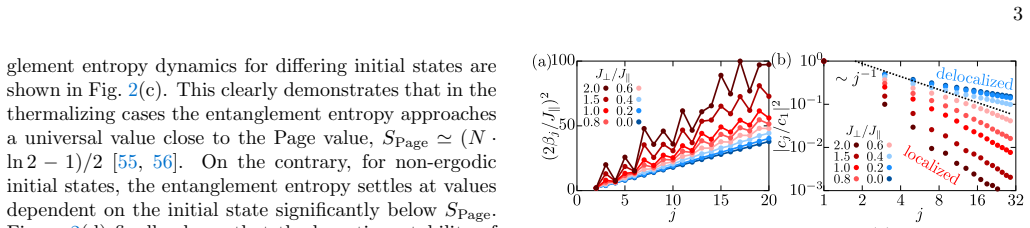
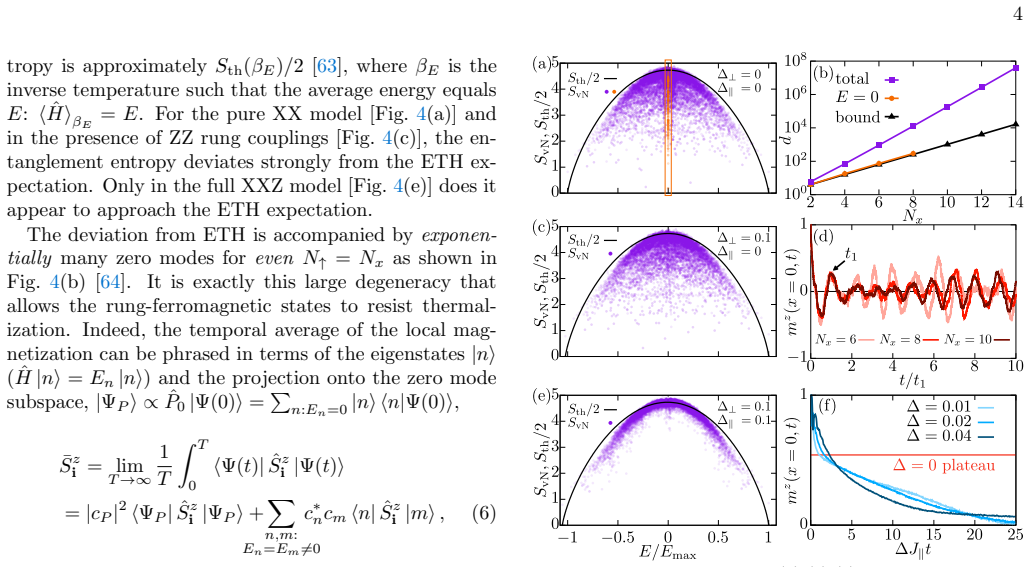
We demonstrate strong non-ergodic behavior in the XX model on coupled chains, where domain-wall initial states retain an inhomogeneous magnetization profile for arbitrarily long times. We find that this effect arises due to exponentially many zero modes protected by chiral symmetry. Using an analysis based on the Lanczos algorithm, we identify a localization transition in the thermodynamic limit at a critical coupling between the chains. We further show that antiferromagnetic defects in the initial state and symmetry-breaking perturbations restore slow thermalization, whereas it remains robust for symmetry-conserving perturbations.
What carries the argument
Exponentially many zero modes protected by chiral symmetry that form a degenerate subspace blocking ergodic thermalization of domain-wall states
If this is right
- Domain-wall states retain their magnetization inhomogeneity for arbitrarily long times.
- A localization transition occurs at a critical value of the interchain coupling in the thermodynamic limit.
- Non-ergodicity remains robust under symmetry-conserving perturbations.
- Antiferromagnetic defects or symmetry-breaking perturbations lead to slow thermalization instead.
Where Pith is reading between the lines
- This mechanism offers a route to stable magnetic domains in cold-atom or ion-trap experiments by tuning only the chain coupling and initial state.
- Similar symmetry-protected degeneracies may produce non-ergodic dynamics in other lattice models that possess chiral symmetry.
- The transition identified by Lanczos methods could be tested with exact diagonalization on larger system sizes to confirm the thermodynamic behavior.
Load-bearing premise
The Lanczos analysis accurately captures the localization transition in the thermodynamic limit and the zero modes remain protected without being lifted by interchain coupling or finite-size effects.
What would settle it
Preparing a domain-wall initial state in an experimental quantum simulator of the coupled XX model near the critical interchain coupling and checking whether the magnetization profile remains inhomogeneous after evolution times much longer than the inverse of the smallest relevant energy scale.
Figures




read the original abstract
Understanding mechanisms for the breakdown of thermalization in closed quantum systems is a central problem in quantum many-body physics. We demonstrate strong non-ergodic behavior in the XX model on coupled chains, where domain-wall initial states retain an inhomogeneous magnetization profile for arbitrarily long times. We find that this effect arises due to exponentially many zero modes protected by chiral symmetry. Using an analysis based on the Lanczos algorithm, we identify a localization transition in the thermodynamic limit at a critical coupling between the chains. We further show that antiferromagnetic defects in the initial state and symmetry-breaking perturbations restore slow thermalization, whereas it remains robust for symmetry-conserving perturbations. These results establish that degenerate, symmetry-protected subspaces can give rise to thermodynamically stable non-ergodic dynamics in experimentally accessible quantum systems.
Editorial analysis
A structured set of objections, weighed in public.
Referee Report
Summary. The paper claims that the XX model on coupled chains exhibits strong non-ergodic dynamics, with domain-wall initial states retaining inhomogeneous magnetization profiles for arbitrarily long times. This is attributed to exponentially many zero modes protected by chiral symmetry. Lanczos-based analysis identifies a localization transition at a critical interchain coupling in the thermodynamic limit. The effect is robust against symmetry-conserving perturbations but gives way to slow thermalization under antiferromagnetic defects or symmetry-breaking terms.
Significance. If the central claims are confirmed, the work supplies a symmetry-based mechanism for thermodynamically stable non-ergodicity in an experimentally relevant spin model, complementing many-body localization studies. The combination of chiral-symmetry arguments with Lanczos numerics is a positive feature; the manuscript would benefit from explicit scaling validation to strengthen the thermodynamic-limit statements.
major comments (2)
- [numerical results / Lanczos analysis] The Lanczos analysis used to locate the localization transition and confirm protection of the zero-mode subspace (described in the numerical results section) does not include finite-size scaling collapse, extrapolation of the critical coupling, or participation-ratio data versus system size. Without this, the claim that exponentially many zero modes survive interchain coupling and finite-size effects in the thermodynamic limit remains unverified.
- [results on magnetization dynamics] The statement that domain-wall states retain inhomogeneous magnetization 'for arbitrarily long times' relies on finite-system Lanczos data; the manuscript does not demonstrate that the observed non-ergodicity persists in the infinite-time, infinite-volume limit once the zero-mode subspace is lifted or hybridized by residual couplings.
minor comments (2)
- [abstract] Clarify in the abstract and introduction whether 'arbitrarily long times' refers to times exponential in system size or strictly infinite-time behavior.
- [figures and tables] Add explicit system-size labels and error-bar information to all Lanczos-derived plots and tables.
Simulated Author's Rebuttal
We thank the referee for the careful reading of our manuscript and the constructive comments. We address each major comment point by point below, indicating where revisions will be made.
read point-by-point responses
-
Referee: The Lanczos analysis used to locate the localization transition and confirm protection of the zero-mode subspace (described in the numerical results section) does not include finite-size scaling collapse, extrapolation of the critical coupling, or participation-ratio data versus system size. Without this, the claim that exponentially many zero modes survive interchain coupling and finite-size effects in the thermodynamic limit remains unverified.
Authors: We agree that additional finite-size scaling would strengthen the thermodynamic-limit claims. In the revised manuscript we will include scaling collapse of the localization indicator, extrapolation of the critical interchain coupling to infinite size, and participation-ratio data versus system size to better substantiate the survival of the zero-mode subspace. revision: yes
-
Referee: The statement that domain-wall states retain inhomogeneous magnetization 'for arbitrarily long times' relies on finite-system Lanczos data; the manuscript does not demonstrate that the observed non-ergodicity persists in the infinite-time, infinite-volume limit once the zero-mode subspace is lifted or hybridized by residual couplings.
Authors: Chiral symmetry renders the zero-mode subspace exactly degenerate and forbids hybridization by any symmetry-preserving term, including in the thermodynamic limit. The finite-size Lanczos results are therefore representative of the protected dynamics; we will add an expanded theoretical section clarifying that the symmetry argument directly implies persistence of the inhomogeneous magnetization for arbitrarily long times in the infinite-volume limit when symmetry is preserved. revision: partial
Circularity Check
No circularity; claims rest on symmetry and independent numerical diagonalization
full rationale
The derivation begins from the XX Hamiltonian on coupled chains and invokes chiral symmetry to protect an exponentially large zero-mode subspace, which is then shown via direct diagonalization and Lanczos to produce persistent domain-wall magnetization. No equation or claim reduces by construction to a fitted parameter, self-referential definition, or load-bearing self-citation whose validity depends on the present result. The localization transition is identified numerically rather than asserted as a prediction forced by prior fits; symmetry protection is an external algebraic property, not smuggled in via ansatz or renaming. The paper therefore remains self-contained against external benchmarks such as exact diagonalization on small systems and standard symmetry arguments.
Axiom & Free-Parameter Ledger
axioms (1)
- domain assumption The XX model on coupled chains possesses exact chiral symmetry that protects zero-energy modes
Reference graph
Works this paper leans on
-
[2]
Srednicki, Phys
M. Srednicki, Phys. Rev. E50, 888 (1994)
1994
-
[3]
J. R. Garrison and T. Grover, Phys. Rev. X8, 021026 (2018)
2018
-
[4]
Rigol, V
M. Rigol, V. Dunjko, and M. Olshanii, Nature452, 854 (2008)
2008
-
[5]
Rigol, Phys
M. Rigol, Phys. Rev. Lett.103, 100403 (2009)
2009
-
[6]
D’Alessio, Y
L. D’Alessio, Y. Kafri, A. Polkovnikov, and M. Rigol, Advances in Physics65, 239 (2016)
2016
-
[7]
Nandkishore and D
R. Nandkishore and D. A. Huse, Annual Review of Con- densed Matter Physics6, 15 (2015)
2015
-
[8]
J. Z. Imbrie, Phys. Rev. Lett.117, 027201 (2016)
2016
-
[9]
Bordia, H
P. Bordia, H. L¨ uschen, S. Scherg, S. Gopalakrishnan, M. Knap, U. Schneider, and I. Bloch, Phys. Rev. X7, 041047 (2017)
2017
-
[10]
R. K. Panda, A. Scardicchio, M. Schulz, S. R. Taylor, and M. ˇZnidariˇ c, Europhysics Letters128, 67003 (2020)
2020
-
[11]
Abanin, J
D. Abanin, J. Bardarson, G. De Tomasi, S. Gopalakr- ishnan, V. Khemani, S. Parameswaran, F. Pollmann, A. Potter, M. Serbyn, and R. Vasseur, Annals of Physics 427, 168415 (2021)
2021
-
[12]
Sierant and J
P. Sierant and J. Zakrzewski, Phys. Rev. B105, 224203 (2022)
2022
-
[13]
D. M. Long, P. J. D. Crowley, V. Khemani, and A. Chan- dran, Phys. Rev. Lett.131, 106301 (2023)
2023
-
[14]
Evers, I
F. Evers, I. Modak, and S. Bera, Phys. Rev. B108, 134204 (2023)
2023
-
[15]
De Roeck, F
W. De Roeck, F. Huveneers, M. M¨ uller, and M. Schiulaz, Phys. Rev. B93, 014203 (2016)
2016
-
[16]
Sels and A
D. Sels and A. Polkovnikov, Phys. Rev. E104, 054105 (2021)
2021
-
[17]
Morningstar, L
A. Morningstar, L. Colmenarez, V. Khemani, D. J. Luitz, and D. A. Huse, Phys. Rev. B105, 174205 (2022)
2022
-
[18]
ˇSuntajs, J
J. ˇSuntajs, J. Bonˇ ca, T. Prosen, and L. Vidmar, Phys. Rev. B102, 064207 (2020)
2020
-
[19]
P. Sala, T. Rakovszky, R. Verresen, M. Knap, and F. Poll- mann, Phys. Rev. X10, 011047 (2020)
2020
-
[20]
Moudgalya and O
S. Moudgalya and O. I. Motrunich, Phys. Rev. X12, 011050 (2022). 6
2022
-
[21]
Brighi, M
P. Brighi, M. Ljubotina, and M. Serbyn, SciPost Phys. 15, 093 (2023)
2023
-
[22]
Adler, D
D. Adler, D. Wei, M. Will, K. Srakaew, S. Agrawal, P. Weckesser, R. Moessner, F. Pollmann, I. Bloch, and J. Zeiher, Nature636, 80 (2024)
2024
-
[23]
L. Zhao, P. R. Datla, W. Tian, M. M. Aliyu, and H. Loh, Phys. Rev. X15, 011035 (2025)
2025
-
[24]
F. Yang, H. Yarloo, H.-C. Zhang, K. Mølmer, and A. E. B. Nielsen, Phys. Rev. B111, 144313 (2025)
2025
- [25]
-
[26]
Bernien, S
H. Bernien, S. Schwartz, A. Keesling, H. Levine, A. Om- ran, H. Pichler, S. Choi, A. S. Zibrov, M. Endres, M. Greiner, V. Vuleti´ c, and M. D. Lukin, Nature551, 579 (2017)
2017
-
[27]
C. J. Turner, A. A. Michailidis, D. A. Abanin, M. Serbyn, and Z. Papi´ c, Nature Physics14, 745 (2018)
2018
-
[29]
Bluvstein, A
D. Bluvstein, A. Omran, H. Levine, A. Keesling, G. Se- meghini, S. Ebadi, T. T. Wang, A. A. Michailidis, N. Maskara, W. W. Ho, S. Choi, M. Serbyn, M. Greiner, V. Vuleti´ c, and M. D. Lukin, Science371, 1355 (2021)
2021
-
[30]
Maskara, A
N. Maskara, A. A. Michailidis, W. W. Ho, D. Bluvstein, S. Choi, M. D. Lukin, and M. Serbyn, Phys. Rev. Lett. 127, 090602 (2021)
2021
-
[31]
Moudgalya, B
S. Moudgalya, B. A. Bernevig, and N. Regnault, Reports on Progress in Physics85, 086501 (2022)
2022
-
[32]
Desaules, F
J.-Y. Desaules, F. Pietracaprina, Z. Papi´ c, J. Goold, and S. Pappalardi, Phys. Rev. Lett.129, 020601 (2022)
2022
-
[33]
Zhang, D
S.-Y. Zhang, D. Yuan, T. Iadecola, S. Xu, and D.-L. Deng, Phys. Rev. Lett.131, 020402 (2023)
2023
-
[34]
H.-R. Wang, D. Yuan, S.-Y. Zhang, Z. Wang, D.-L. Deng, and L.-M. Duan, Phys. Rev. Lett.132, 150401 (2024)
2024
-
[35]
Kerschbaumer, M
A. Kerschbaumer, M. Ljubotina, M. Serbyn, and J.-Y. Desaules, Phys. Rev. Lett.134, 160401 (2025)
2025
-
[36]
E. J. Weinberg, Phys. Rev. D24, 2669 (1981)
1981
-
[37]
Witten, Nuclear Physics B202, 253 (1982)
E. Witten, Nuclear Physics B202, 253 (1982)
1982
-
[38]
Schecter and T
M. Schecter and T. Iadecola, Phys. Rev. B98, 035139 (2018)
2018
-
[39]
Greiner, O
M. Greiner, O. Mandel, T. Esslinger, T. W. H¨ ansch, and I. Bloch, Nature415, 39 (2002)
2002
-
[40]
Roushan, C
P. Roushan, C. Neill, J. Tangpanitanon, V. M. Bastidas, A. Megrant, R. Barends, Y. Chen, Z. Chen, B. Chiaro, A. Dunsworth, A. Fowler, B. Foxen, M. Giustina, E. Jef- frey, J. Kelly, E. Lucero, J. Mutus, M. Neeley, C. Quin- tana, D. Sank, A. Vainsencher, J. Wenner, T. White, H. Neven, D. G. Angelakis, and J. Martinis, Science358, 1175 (2017)
2017
-
[41]
Yan, Y.-R
Z. Yan, Y.-R. Zhang, M. Gong, Y. Wu, Y. Zheng, S. Li, C. Wang, F. Liang, J. Lin, Y. Xu, C. Guo, L. Sun, C.-Z. Peng, K. Xia, H. Deng, H. Rong, J. Q. You, F. Nori, H. Fan, X. Zhu, and J.-W. Pan, Science364, 753 (2019)
2019
-
[42]
Zhu, Z.-H
Q. Zhu, Z.-H. Sun, M. Gong, F. Chen, Y.-R. Zhang, Y. Wu, Y. Ye, C. Zha, S. Li, S. Guo, H. Qian, H.-L. Huang, J. Yu, H. Deng, H. Rong, J. Lin, Y. Xu, L. Sun, C. Guo, N. Li, F. Liang, C.-Z. Peng, H. Fan, X. Zhu, and J.-W. Pan, Phys. Rev. Lett.128, 160502 (2022)
2022
-
[43]
Barredo, H
D. Barredo, H. Labuhn, S. Ravets, T. Lahaye, A. Browaeys, and C. S. Adams, Phys. Rev. Lett.114, 113002 (2015)
2015
-
[44]
Steinigeweg, F
R. Steinigeweg, F. Heidrich-Meisner, J. Gemmer, K. Michielsen, and H. De Raedt, Phys. Rev. B90, 094417 (2014)
2014
-
[45]
Karrasch, D
C. Karrasch, D. M. Kennes, and F. Heidrich-Meisner, Phys. Rev. B91, 115130 (2015)
2015
-
[46]
Kloss, Y
B. Kloss, Y. B. Lev, and D. Reichman, Phys. Rev. B97, 024307 (2018)
2018
-
[47]
Rakovszky, C
T. Rakovszky, C. W. von Keyserlingk, and F. Pollmann, Phys. Rev. B105, 075131 (2022)
2022
-
[48]
Jaksch, C
D. Jaksch, C. Bruder, J. I. Cirac, C. W. Gardiner, and P. Zoller, Phys. Rev. Lett.81, 3108 (1998)
1998
-
[49]
A. V. Gorshkov, S. R. Manmana, G. Chen, E. Demler, M. D. Lukin, and A. M. Rey, Phys. Rev. A84, 033619 (2011)
2011
-
[50]
K. R. A. Hazzard, S. R. Manmana, M. Foss-Feig, and A. M. Rey, Phys. Rev. Lett.110, 075301 (2013)
2013
- [51]
-
[52]
Z. Ding, R. Verresen, and Z. Z. Yan, Exact quantum scars of frustrated hardcore bosons for cross-platform realiza- tions (2026), arXiv:2603.11191 [quant-ph]
work page internal anchor Pith review Pith/arXiv arXiv 2026
-
[53]
This leads to delo- calization as demonstrated in Fig
WhenN x is odd and at zero total magnetization, we need to insert at least a single antiferromagnetic rung| ↑ ↓⟩ between the ferromagnetic domains. This leads to delo- calization as demonstrated in Fig. 2
-
[54]
Jordan and E
P. Jordan and E. Wigner, Zeitschrift f¨ ur Physik47, 631 (1928)
1928
-
[55]
D. N. Page, Phys. Rev. Lett.71, 1291 (1993)
1993
-
[56]
S. K. Foong and S. Kanno, Phys. Rev. Lett.72, 1148 (1994)
1994
-
[57]
Lanczos, Journal of Research of the National Bureau of Standards45, 255 (1950)
C. Lanczos, Journal of Research of the National Bureau of Standards45, 255 (1950)
1950
-
[58]
C. C. Paige, IMA Journal of Applied Mathematics10, 373 (1972)
1972
-
[59]
In the borderline case ofJ ⊥ =J c ⊥, the sumdivergesas ln(n)
-
[60]
See Supplemental Material online for details on the lower bound on the number of zero modes, the linear scaling of the Lanczos coefficients forJ ⊥ = 0, finite size corrections to the Lanczos coefficients, exact many-body scars, the behavior forN y = 3,4 legs, and the behavior of free fermions
-
[61]
J. C. Peacock, V. Oganesyan, and D. Sels, Phys. Rev. B 113, 064204 (2026)
2026
-
[62]
The eigenstates are constructed such that they are also eigenstates of 3 additional commuting symmetries of the system: the point group reflection symmetries along the horizontal and vertical axes, ˆσ h,ˆσv, as well as the to- tal spin-flip symmetry ˆX= Q i(2 ˆSx i ) present in the zero magnetization sectorS z = 0
-
[63]
The factor of 1/2 appears because the entanglement en- tropy is for a bipartition of the system into two equally sized subsystems
-
[64]
For oddN ↑ =N x, there, on the contrary, extremely few E= 0 states
-
[65]
Note that by construction|Ψ P ⟩is an eigenstate of the XX model with energyE= 0
-
[66]
Fendley, K
P. Fendley, K. Sengupta, and S. Sachdev, Phys. Rev. B 69, 075106 (2004)
2004
-
[67]
Lesanovsky and H
I. Lesanovsky and H. Katsura, Phys. Rev. A86, 041601 (2012)
2012
-
[69]
T. Ben-Ami, M. Heyl, and R. Moessner, Many-body cages: disorder-free glassiness from flat bands in fock space, and many-body rabi oscillations (2025), arXiv:2504.13086 [cond-mat.quant-gas]
-
[70]
T.-L. Tan and Y.-P. Huang, Interference-caged quantum many-body scars: the fock space topological localization and interference zeros (2025), arXiv:2504.07780 [cond- mat.str-el]
-
[72]
Loizeau, J
N. Loizeau, J. C. Peacock, and D. Sels, SciPost Phys. Codebases , 54 (2025)
2025
-
[73]
K. K. Nielsen, kristianknakkergaard/nonergodic magne- tic domains: ver1 (2026). END MA TTER In this End Matter, we describe: (A) the implemented Lanczos algorithm and why the diagonal terms in the obtained tri-diagonal matrix vanishes, (B) How this allows us to determine the asymptotic scaling of the coefficients of theE= 0 state in the Krylov basis withi...
2026
-
[74]
Start from some initial state|K 1⟩
-
[75]
(b) Letα 1 =⟨w ′ 1|v1⟩
Initial step: (a) Let|w ′ 1⟩= ˆH|K 1⟩. (b) Letα 1 =⟨w ′ 1|v1⟩. (c) Let|w 1⟩=|w ′ 1⟩ −α 1 |K1⟩
-
[76]
back propagating
forj= 2, . . . , m: (a) Letβ j = [⟨wj−1|wj−1⟩]1/2. (b) Ifβ j ̸= 0, let|K j⟩=|w j−1⟩/β j. (c) Let|w ′ j⟩= ˆH|K j⟩ −β j |Kj−1⟩. (d) Letα j =⟨w ′ j|Kj⟩. (e) Let|w j⟩=|w ′ j⟩ −α j |Kj⟩. This results in the tri-diagonal matrix in Eq. (3). Now, suppose that the initial state is an eigenstate of the sublattice symmetry: ˆS |K1⟩=c 1 |K1⟩, withc 1 =±1. Our claim i...
-
[77]
Nx−1X x=0 (−1)x ˆS+ (x,0) ˆS− (x,1) #n ↑...↑ ↓...↓ E , |RAo⟩= 1√ N X oddn 1 n!
or dynamical symmetry [7], for which one can find an dynamical symmetry operator ˆQsuch that [ ˆH, ˆQ] =ω ˆQ. In such cases, for a state|ψ 0⟩with energyE 0 and ˆQ|ψ 0⟩ ̸= 0, it follows that ˆH ˆQn |ψ0⟩= (E 0 +nω)|ψ 0⟩[since [ ˆH, ˆQn] =nω ˆQn. Based on Eq. (S18) it is therefore tempting to set ˆQ= PNx−1 x=0 (−1)x ˆS+ (x,0) ˆS+ (x,1). However, this operato...
-
[78]
E. Nicolau, M. Ljubotina, and M. Serbyn, Fragmentation, zero modes, and collective bound states in constrained models (2026), arXiv:2504.17627 [quant-ph]
-
[79]
R. P. Stanley,Enumerative Combinatorics, Volume 2, 2nd ed., Cambridge Studies in Advanced Mathematics, Vol. 62 (Cambridge University Press, Cambridge, 1999)
1999
-
[80]
Mohapatra, S
S. Mohapatra, S. Moudgalya, and A. C. Balram, Phys. Rev. B113, 054310 (2026)
2026
-
[81]
Localized Fock Space Cages in Kinetically Constrained Models
C. Jonay and F. Pollmann, Localized fock space cages in kinetically constrained models (2025), arXiv:2504.20987 [quant-ph]
work page internal anchor Pith review Pith/arXiv arXiv 2025
-
[82]
J. M. Deutsch, Phys. Rev. A43, 2046 (1991)
2046
-
[83]
Chandran, T
A. Chandran, T. Iadecola, V. Khemani, and R. Moessner, Annual Review of Condensed Matter Physics14, 443 (2023)
2023
-
[84]
Tindall, C
J. Tindall, C. S´ anchez Mu˜ noz, B. Buˇ ca, and D. Jaksch, New Journal of Physics22, 013026 (2020)
2020
discussion (0)
Sign in with ORCID, Apple, or X to comment. Anyone can read and Pith papers without signing in.