Recognition: unknown
On the contribution of the bow shock pulsar wind nebula PSR J0437-4715 to the observed fluxes of GeV-TeV positrons and antiprotons
Pith reviewed 2026-05-10 09:38 UTC · model grok-4.3
The pith
The bow shock around millisecond pulsar PSR J0437-4715 accelerates positrons and antiprotons to identical spectra that match observed cosmic-ray fluxes.
A machine-rendered reading of the paper's core claim, the machinery that carries it, and where it could break.
Core claim
The contribution of the bow shock pulsar wind nebula PSR J0437-4715 can explain the observed positron flux from 30 GeV to 1 TeV, and simultaneously the antiproton flux at hundreds of GeV with an almost energy-independent positron-to-antiproton flux ratio using ∼25% of the PSR J0437-4715 pulsar wind power to accelerate positrons and electrons and re-accelerate antiprotons.
What carries the argument
Fermi acceleration in the colliding flows of the bow shock, which injects positrons from the pulsar wind and antiprotons from the interstellar medium into identical power-law spectra regardless of origin.
If this is right
- The positron excess above 30 GeV arises from this single nearby source rather than from distributed or exotic origins.
- The same mechanism accounts for the antiproton flux at hundreds of GeV without separate tuning for each species.
- Only about one quarter of the pulsar's total wind power is required to reproduce both observed fluxes.
- The nearly constant positron-to-antiproton ratio is a direct consequence of the shared acceleration site and spectrum.
Where Pith is reading between the lines
- Similar bow-shock nebulae around other fast-moving pulsars could produce localized antiparticle excesses detectable by future instruments with better directional sensitivity.
- The model predicts that the local diffusion anisotropy should imprint a measurable angular pattern on the highest-energy lepton arrival directions.
- If the mechanism operates, one would expect correlated excesses in other secondary species such as deuterons or light nuclei re-accelerated in the same flows.
Load-bearing premise
Fermi acceleration in the bow shock produces exactly the same spectral shape for positrons injected from the pulsar and antiprotons re-accelerated from the interstellar medium, together with the adopted 25 percent power fraction and the parameters chosen for anisotropic diffusion.
What would settle it
A precise measurement of the positron-to-antiproton ratio that shows clear energy dependence between 100 GeV and 1 TeV, or a directional map of the TeV lepton excess that fails to align with the expected propagation path from PSR J0437-4715.
Figures



read the original abstract
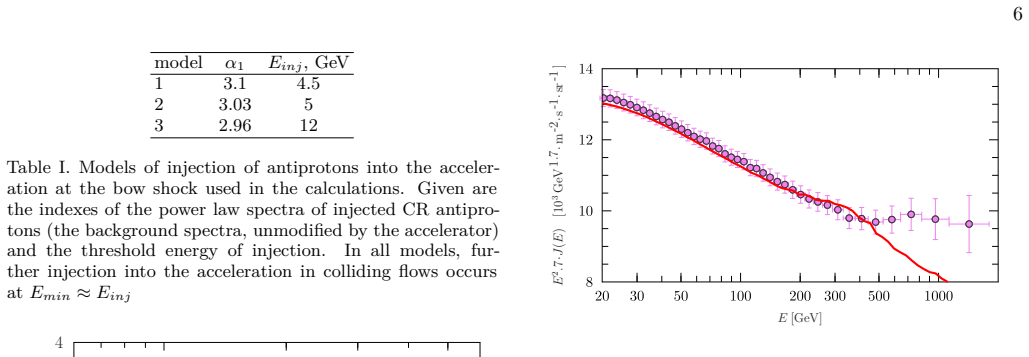
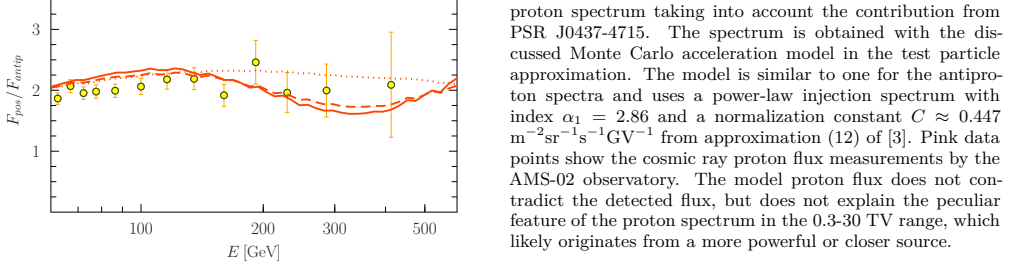
The orbital observatories PAMELA and AMS-02 have detected a significant excess in the cosmic ray (CR) positron flux at energies above several tens of GeV. The measured values exceed those expected in models of secondary origin of positrons due to inelastic collisions of CR nuclei with the interstellar matter. This excess may be due to the annihilation or decay of hypothetical dark matter particles or, alternatively, to the contribution of the nearest pulsars. The measured positron-to-antiproton flux ratio is virtually independent of energy from 60 to 400 GeV. This can be understood if the observed local spectra of positrons and antiprotons in the range of tens to hundreds of GeV are formed by the same source. Fast-moving pulsars form pulsar wind nebulae with bow shocks (BSPWNe), which accelerate both the positrons and electrons of the pulsar wind and the hadrons and leptons of galactic CRs from the interstellar medium via the Fermi acceleration mechanism in colliding flows. Such a system can produce identical particle spectra regardless of the site of particle injection. The nearest to the Earth millisecond pulsar PSR J0437-4715 forms a pulsar wind nebula (PWN) with a bow shock observable in optical and ultraviolet wavelengths. This BSPWN is a possible candidate for the main near-Earth ``factory'' of antiparticles along with the Geminga PWN. Considering PSR J0437-4715, we provide the Monte Carlo simulations of particle acceleration in its BSPWN and the analytical model of anisotropic diffusion in the local interstellar medium. We show that this pulsar's contribution can explain the observed positron flux from 30 GeV to 1 TeV, and simultaneously the antiproton flux at hundreds of GeV with an almost energy-independent positron-to-antiproton flux ratio using $\sim 25\%$ of the PSR J0437-4715 pulsar wind power to accelerate positrons and electrons and re-accelerate antiprotons.
Editorial analysis
A structured set of objections, weighed in public.
Referee Report
Summary. The manuscript claims that the bow shock pulsar wind nebula (BSPWN) of the nearby millisecond pulsar PSR J0437-4715 can account for the observed cosmic-ray positron excess from 30 GeV to 1 TeV and the antiproton flux at hundreds of GeV. Monte Carlo simulations of Fermi acceleration in the colliding flows of the bow shock, combined with an analytical model of anisotropic diffusion in the local interstellar medium, are used to show that allocating ~25% of the pulsar wind power to accelerate positrons/electrons and re-accelerate antiprotons produces matching fluxes with an energy-independent positron-to-antiproton ratio between 60 and 400 GeV, offering an astrophysical explanation alongside the Geminga PWN.
Significance. If the central assumptions hold, the result supplies a concrete nearby-source mechanism for the PAMELA/AMS-02 antiparticle data that simultaneously explains both the positron excess and the flat ratio without dark-matter annihilation. The combination of Monte Carlo acceleration modeling and analytical anisotropic diffusion is a strength that could be extended to other bow-shock systems and tested against future spectral or anisotropy measurements.
major comments (3)
- [Abstract and modeling description] Abstract and modeling description: the ~25% power fraction is chosen to reproduce the observed fluxes, and the model is constructed so that positrons and antiprotons receive identical spectra by design regardless of injection site. This makes the energy-independent ratio a direct consequence of the modeling choices rather than an independent prediction; the paper should state whether this fraction can be derived from first principles or remains a free parameter.
- [Diffusion model section] Diffusion model section: positrons experience strong radiative losses (synchrotron + inverse Compton) during propagation while antiprotons do not. The analytical anisotropic diffusion treatment must explicitly demonstrate that the propagated spectra at Earth remain identical (or that the ratio stays flat) without additional tuning of diffusion coefficients or halo size; without shown propagated spectra or error propagation, the claim that a single power fraction suffices is not fully load-bearing.
- [Monte Carlo acceleration section] Monte Carlo acceleration section: details on the injection spectra for pulsar-wind leptons versus ISM hadrons, the precise treatment of colliding-flow Fermi acceleration, and how differential energy losses are (or are not) applied at the acceleration stage are required to substantiate the identical-spectra assumption. The central quantitative fit relies on this assumption.
minor comments (2)
- Clarify the exact energy range over which the antiproton flux is reproduced and whether the model predicts any spectral features above 1 TeV that could be tested.
- Ensure all free parameters in the diffusion model (e.g., anisotropy ratios, halo height) are tabulated with their adopted values and uncertainties.
Simulated Author's Rebuttal
We thank the referee for the constructive and detailed report. We address each major comment point by point below. The manuscript has been revised to improve clarity on modeling assumptions, add explicit demonstrations of propagated spectra, and expand technical details on the acceleration simulations. We maintain that the core physical mechanism provides a robust explanation for the flat ratio, while acknowledging that the normalization fraction is observationally constrained.
read point-by-point responses
-
Referee: [Abstract and modeling description] the ~25% power fraction is chosen to reproduce the observed fluxes, and the model is constructed so that positrons and antiprotons receive identical spectra by design regardless of injection site. This makes the energy-independent ratio a direct consequence of the modeling choices rather than an independent prediction; the paper should state whether this fraction can be derived from first principles or remains a free parameter.
Authors: We agree that the ~25% allocation of pulsar wind power is a normalization parameter selected to match the absolute flux levels observed by PAMELA and AMS-02, as the acceleration efficiency in the bow-shock colliding flows is not derived from first principles within the current framework. However, the identical spectra for positrons (from the pulsar wind) and antiprotons (re-accelerated from the ISM) is a direct physical consequence of the Fermi acceleration process in the colliding flows, which operates identically on particles once they enter the acceleration region irrespective of their origin. The energy-independent ratio therefore emerges as a model prediction rather than an imposed feature. In the revised manuscript we explicitly clarify that this fraction remains a free parameter constrained by data, while the flat ratio is robust against its specific value. We have updated the abstract and modeling description accordingly. revision: partial
-
Referee: [Diffusion model section] positrons experience strong radiative losses (synchrotron + inverse Compton) during propagation while antiprotons do not. The analytical anisotropic diffusion treatment must explicitly demonstrate that the propagated spectra at Earth remain identical (or that the ratio stays flat) without additional tuning of diffusion coefficients or halo size; without shown propagated spectra or error propagation, the claim that a single power fraction suffices is not fully load-bearing.
Authors: We accept that explicit verification of the propagated spectra is necessary to substantiate the claim. Our analytical anisotropic diffusion model applies the same diffusion tensor and halo parameters to both species, with the only difference being continuous energy losses for positrons. Because the source spectra are identical by construction and the source is nearby, the propagated positron spectrum (after losses) and the antiproton spectrum (no losses) yield a ratio that remains approximately flat between 60 and 400 GeV. In the revised manuscript we have added figures displaying the individual propagated spectra at Earth for positrons and antiprotons, together with the resulting ratio versus energy. A short discussion of parameter uncertainties has also been included; no retuning of diffusion coefficients or halo size was performed. We believe this addresses the load-bearing concern. revision: yes
-
Referee: [Monte Carlo acceleration section] details on the injection spectra for pulsar-wind leptons versus ISM hadrons, the precise treatment of colliding-flow Fermi acceleration, and how differential energy losses are (or are not) applied at the acceleration stage are required to substantiate the identical-spectra assumption. The central quantitative fit relies on this assumption.
Authors: We will expand the Monte Carlo section in the revised manuscript to provide the requested details. Pulsar-wind leptons are injected with a power-law spectrum (index ~2.0) normalized to the fraction of wind power allocated to acceleration. ISM hadrons are injected according to the local galactic cosmic-ray spectrum at the bow-shock location. Particle trajectories are tracked in the colliding-flow geometry using a Monte Carlo scheme that implements first-order Fermi acceleration through repeated shock crossings. Differential energy losses are not applied during the acceleration phase because the acceleration timescale (~10^3 yr) is much shorter than the synchrotron/inverse-Compton loss timescale for the relevant energies; losses are accounted for only in the subsequent propagation stage. These clarifications substantiate the identical-spectra assumption and have been incorporated into the updated text. revision: yes
Circularity Check
25% power fraction fitted to fluxes; identical spectra assumption forces energy-independent ratio by construction
specific steps
-
fitted input called prediction
[Abstract]
"we show that this pulsar's contribution can explain the observed positron flux from 30 GeV to 1 TeV, and simultaneously the antiproton flux at hundreds of GeV with an almost energy-independent positron-to-antiproton flux ratio using ∼25% of the PSR J0437-4715 pulsar wind power to accelerate positrons and electrons and re-accelerate antiprotons."
The 25% power fraction is selected to match the measured fluxes; once this normalization is fixed, the model produces the observed ratio only because the acceleration stage is constructed to assign identical spectra to positrons and antiprotons, making the energy-independent ratio a direct output of the fitting procedure rather than a separate prediction.
-
self definitional
[Abstract]
"Such a system can produce identical particle spectra regardless of the site of particle injection."
The claim that Fermi acceleration in colliding flows yields identical spectra for pulsar-wind leptons and ISM hadrons is asserted as a property of the BSPWN model; this identity is then used to guarantee that the positron-to-antiproton ratio remains flat, reducing the ratio prediction to the modeling premise itself.
full rationale
The paper's central result—that one source simultaneously accounts for the positron excess (30 GeV–1 TeV) and the flat positron-to-antiproton ratio (60–400 GeV)—rests on two modeling choices: (1) adopting ∼25% of the pulsar wind power as a free normalization that is adjusted to reproduce the observed fluxes, and (2) the explicit claim that bow-shock Fermi acceleration yields identical spectra for pulsar-wind positrons and ISM antiprotons regardless of injection site. Because the ratio is then guaranteed to be energy-independent once the spectra are forced identical, the flatness is a direct consequence of the ansatz rather than an independent prediction. The Monte Carlo acceleration and anisotropic diffusion calculations are presented as supporting evidence, but the load-bearing step that equates the two species' spectra is internal to the model construction. This yields partial circularity (score 6) while still leaving room for independent content in the propagation treatment.
Axiom & Free-Parameter Ledger
free parameters (1)
- fraction of pulsar wind power allocated to acceleration =
~25%
axioms (2)
- domain assumption Fermi acceleration in colliding flows of the bow shock produces identical particle spectra independent of injection site
- domain assumption Anisotropic diffusion in the local interstellar medium can be modeled analytically with parameters that allow the particles to reach Earth with the observed fluxes
Reference graph
Works this paper leans on
-
[1]
Adrianiet al.(PAMELA), Nature458, 607 (2009), arXiv:0810.4995 [astro-ph]
O. Adriani, G. C. Barbarino, G. A. Bazilevskaya et al. An anomalous positron abundance in cosmic rays with en- ergies 1.5-100GeV, Nat 458, 607 (2009) , arXiv:0810.4995 [astro-ph]
-
[2]
Aguilar, D
M. Aguilar, D. Aisa, A. Alvino et al. Electron and Positron Fluxes in Primary Cosmic Rays Measured with the Alpha Magnetic Spectrometer on the International Space Station, Phys. Rev. Lett. 113, 121102 (2014)
2014
-
[3]
Aguilar, L
M. Aguilar, L. Ali Cavasonza, G. Ambrosi et al. The Al- pha Magnetic Spectrometer (AMS) on the international space station: Part II - Results from the first seven years, Phys. Reports 894, 1 (2021)
2021
-
[4]
Aguilar, G
M. Aguilar, G. Ambrosi, H. Anderson et al. Antipro- tons and Elementary Particles over a Solar Cycle: Re- sults from the Alpha Magnetic Spectrometer, Phys. Rev. Lett. 134, 051002 (2025)
2025
- [5]
-
[6]
A. E. Vladimirov, S. W. Digel, G. Jóhannesson, P. F. Michelson, I. V. Moskalenko, P. L. Nolan, E. Orlando, T. A. Porter, and A. W. Strong, GALPROP WebRun: An internet-based service for calculating galactic cos- mic ray propagation and associated photon emissions, Computer Physics Communications 182, 1156 (2011) , arXiv:1008.3642 [astro-ph.HE]
-
[7]
V. S. Berezinskii, S. V. Bulanov, V. A. Dogiel, and V. S. Ptuskin, Astrophysics of cosmic rays (1990)
1990
- [8]
-
[9]
R. Diesing and D. Caprioli, Nonsecondary origin of cos- mic ray positrons, Phys. Rev. D 101, 103030 (2020) , arXiv:2001.02240 [astro-ph.HE]
-
[10]
Z.-Q. Huang, R.-Y. Liu, J. C. Joshi, and X.-Y. Wang, Examining the Secondary Product Origin of Cosmic-Ray Positrons with the Latest AMS-02 Data, ApJ 895, 53 (2020), arXiv:2001.02973 [astro-ph.HE]
- [11]
- [12]
-
[13]
Silk and M
J. Silk and M. Srednicki, Cosmic-Ray Antiprotons as a Probe of a Photino-Dominated Universe, Phys. Rev. Lett. 53, 624 (1984)
1984
-
[14]
Particle Dark Matter: Evidence, Candidates and Constraints
G. Bertone, D. Hooper, and J. Silk, Particle dark matter: evidence, candidates and constraints, Phys. Reports 405, 279 (2005) , arXiv:hep-ph/0404175 [hep-ph]
work page Pith review arXiv 2005
-
[15]
L. Bergström, T. Bringmann, and J. Edsjö, New positron spectral features from supersymmetric dark matter: A way to explain the PAMELA data?, Phys. Rev. D 78, 103520 (2008) , arXiv:0808.3725 [astro-ph]
- [16]
-
[17]
P. Mertsch, A. Vittino, and S. Sarkar, Explaining cosmic ray antimatter with secondaries from old su- pernova remnants, Phys. Rev. D 104, 103029 (2021) , arXiv:2012.12853 [astro-ph.HE]
-
[18]
V. A. Dogiel, A. V. Gurevich, I. N. Istomin, and K. P. Zybin, On relativistic particle acceleration in molecular clouds, MNRAS 228, 843 (1987)
1987
- [19]
- [20]
- [21]
-
[22]
M. Di Mauro, F. Donato, M. Korsmeier, S. Manconi, and L. Orusa, Novel prediction for secondary positrons and electrons in the Galaxy, Phys. Rev. D 108, 063024 (2023), arXiv:2304.01261 [astro-ph.HE]
-
[23]
Aguilar, L
M. Aguilar, L. Ali Cavasonza, B. Alpat et al. Antipro- ton Flux, Antiproton-to-Proton Flux Ratio, and Prop- erties of Elementary Particle Fluxes in Primary Cosmic Rays Measured with the Alpha Magnetic Spectrometer on the International Space Station, Phys. Rev. Lett. 117, 091103 (2016)
2016
-
[24]
E. Amato and J. Arons, Heating and Nonthermal Parti- cle Acceleration in Relativistic, Transverse Magnetosonic Shock Waves in Proton-Electron-Positron Plasmas, ApJ 653, 325 (2006) , arXiv:astro-ph/0609034 [astro-ph]
-
[25]
E. Amato and B. Olmi, The Crab Pulsar and Neb- ula as Seen in Gamma-Rays, Universe 7, 448 (2021) , arXiv:2111.07712 [astro-ph.HE]
- [26]
- [27]
- [28]
- [29]
- [30]
-
[31]
E. Grimaldo, A. Reimer, R. Kissmann, F. Niederwanger, and K. Reitberger, Proton Acceleration in Colliding Stel- lar Wind Binaries, ApJ 871, 55 (2019) , arXiv:1812.02960 [astro-ph.HE]
-
[32]
M. Malkov and M. Lemoine, Particle acceleration in colliding flows: Binary star winds and other double- shock structures, Phys. Rev. E 107, 025201 (2023) , arXiv:2212.08788 [astro-ph.HE]
-
[33]
S. Aerdker, R. Habegger, L. Merten, E. Zweibel, and J. Becker Tjus, Cosmic ray transport and acceleration in an evolving shock landscape, A&A 703, A51 (2025) , arXiv:2501.14331 [astro-ph.HE]
-
[34]
K. Fang, X.-J. Bi, P.-F. Yin, and Q. Yuan, Two-zone Diffusion of Electrons and Positrons from Geminga Explains the Positron Anomaly, ApJ 863, 30 (2018) , arXiv:1803.02640 [astro-ph.HE]
-
[35]
X. Tang and T. Piran, Positron flux and γ-ray emission from Geminga pulsar and pulsar wind nebula, MNRAS 484, 3491 (2019) , arXiv:1808.02445 [astro-ph.HE]
- [36]
- [37]
- [38]
- [39]
-
[40]
B. Rangelov, G. G. Pavlov, O. Kargaltsev, M. Durant, A. M. Bykov, and A. Krassilchtchikov, First Detection of a Pulsar Bow Shock Nebula in Far-UV: PSR J0437-4715, ApJ 831, 129 (2016) , arXiv:1605.07616 [astro-ph.HE]
-
[41]
A Survey for H$\alpha$ Pulsar Bow Shocks
S. Brownsberger and R. W. Romani, A Survey for H α Pulsar Bow Shocks, ApJ 784, 154 (2014) , arXiv:1402.5465 [astro-ph.SR]
work page Pith review arXiv 2014
- [42]
- [43]
-
[44]
S. Manconi, M. Di Mauro, and F. Donato, Contribution of pulsars to cosmic-ray positrons in light of recent ob- servation of inverse-Compton halos, Phys. Rev. D 102, 023015 (2020) , arXiv:2001.09985 [astro-ph.HE]
-
[45]
S. M. Osipov, A. M. Bykov, A. E. Petrov, and V. I. Ro- mansky, Energetic positron propagation from pulsars: an analytical two-zone diffusion model, in Journal of Physics Conference Series , Journal of Physics Conference Series, Vol. 1697 (IOP, 2020) p. 012009
2020
-
[46]
K. Fang, Constraining the slow-diffusion zone size and electron injection spectral index for the Geminga pulsar halo, Phys. Rev. D 109, 043041 (2024) , arXiv:2310.16594 [astro-ph.HE]
work page internal anchor Pith review Pith/arXiv arXiv 2024
- [47]
-
[48]
A. M. Bykov, A. E. Petrov, and K. P. Levenfish, Rela- tivistic Astrospheres of Pulsars and Gamma-Ray Bina- ries: Modeling of Non-thermal Processes, Fluid Dynam- ics 59, 2377 (2024)
2024
-
[49]
A. E. Petrov and A. M. Bykov, Monte Carlo modeling of multi-PeV protons acceleration in gamma-ray bina- ries with strong stellar wind magnetic field, Advances in Space Research 77, 8391 (2026) , astrophysics of cosmic rays in the multi-messenger era
2026
-
[50]
F. P. Wilkin, Exact Analytic Solutions for Stellar Wind Bow Shocks, ApJ 459, L31 (1996)
1996
-
[51]
Arons, Pulsar Wind Nebulae as Cosmic Pevatrons: A Current Sheet’s Tale, Space Sci
J. Arons, Pulsar Wind Nebulae as Cosmic Pevatrons: A Current Sheet’s Tale, Space Sci. Rev. 173, 341 (2012) , arXiv:1208.5787 [astro-ph.HE]
- [52]
- [53]
- [54]
-
[55]
V. L. Ginzburg and S. I. Syrovatskii, The Origin of Cos- mic Rays (1964)
1964
discussion (0)
Sign in with ORCID, Apple, or X to comment. Anyone can read and Pith papers without signing in.