Recognition: unknown
Energy Correlators Within Jets in Transversely Polarized Proton-Proton Collisions at sqrt{s} = 200 GeV
Pith reviewed 2026-05-10 09:08 UTC · model grok-4.3
The pith
Energy correlators within jets show spin asymmetries sensitive to nucleon transversity in polarized collisions.
A machine-rendered reading of the paper's core claim, the machinery that carries it, and where it could break.
Core claim
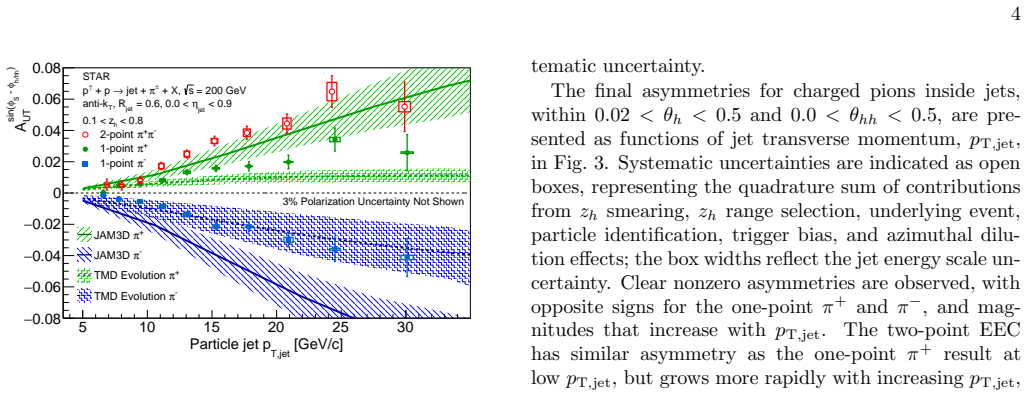
The authors report the observation of sizable spin-dependent asymmetries in one- and two-point energy correlators for π⁺, π⁻, and π⁺π⁻ pairs within jets. Projecting the fragmentation dynamics onto Mellin moments provides sensitivity to the nucleon's transversity distribution while minimizing uncertainties from nonperturbative fragmentation functions. These results establish energy correlators as a novel probe of nucleon structure.
What carries the argument
One- and two-point energy correlators that quantify energy-weighted angular distributions of hadrons and hadron pairs within jets, with projection onto Mellin moments to extract transversity information.
Load-bearing premise
The projection onto Mellin moments isolates the transversity contribution while suppressing fragmentation uncertainties, which depends on the validity of the factorization theorem at the measured scales.
What would settle it
A measurement showing no spin asymmetries or asymmetries inconsistent with transversity predictions at the identified angular scales would challenge the interpretation.
Figures



read the original abstract
We report the first measurement of one- and two-point energy correlators within jets in transversely polarized proton-proton collisions at $\sqrt{s}=200$ GeV, using the STAR detector at RHIC. These observables quantify the energy-weighted angular distribution of single hadrons and hadron pairs within jets, respectively. Sizable spin-dependent asymmetries are observed for $\pi^+$, $\pi^-$, and $\pi^+\pi^-$ pairs, revealing the onset of nonperturbative dynamics at specific angular scales. By projecting the fragmentation dynamics onto Mellin moments, these measurements provide sensitivity to the nucleon's transversity while minimizing uncertainties from nonperturbative fragmentation functions. These results establish energy correlators as a novel and precise probe of nucleon structure and open a promising avenue for three-dimensional nucleon tomography at the future Electron-Ion Collider.
Editorial analysis
A structured set of objections, weighed in public.
Referee Report
Summary. The manuscript reports the first measurement of one- and two-point energy correlators within jets in transversely polarized proton-proton collisions at √s = 200 GeV using the STAR detector at RHIC. It observes sizable spin-dependent asymmetries for π⁺, π⁻, and π⁺π⁻ pairs that indicate the onset of nonperturbative dynamics at specific angular scales. By projecting the observables onto Mellin moments, the authors claim sensitivity to the nucleon's transversity distribution while minimizing uncertainties associated with nonperturbative fragmentation functions, and they position the results as a new probe for nucleon structure relevant to future EIC studies.
Significance. If the measurement holds and the Mellin-moment interpretation is substantiated, the work introduces energy correlators as a novel experimental handle on transversity in polarized collisions. The direct observation of asymmetries at the transition to nonperturbative regimes could provide a useful test of factorization assumptions and support more precise three-dimensional nucleon tomography, complementing existing SIDIS and Drell-Yan approaches.
major comments (1)
- Abstract: The central interpretive claim that 'projecting the fragmentation dynamics onto Mellin moments... minimizes uncertainties from nonperturbative fragmentation functions' is load-bearing for the transversity sensitivity result. However, the same abstract states that sizable asymmetries appear precisely at angular scales revealing the onset of nonperturbative dynamics; this raises a consistency issue with the assumed applicability of the underlying factorization theorem (energy correlators in polarized jets) at those scales, and the manuscript must provide explicit validation or references demonstrating that higher Mellin moments systematically suppress Collins-like FF dependence without circular reliance on the data itself.
minor comments (1)
- The abstract would be clearer if it quantified the specific angular scales (e.g., in radians or as a function of jet p_T) at which the nonperturbative onset is claimed, allowing readers to assess the regime directly.
Simulated Author's Rebuttal
We thank the referee for their careful reading and insightful comments on our manuscript. We have addressed the concern regarding the consistency of the abstract's interpretive claims with the observed nonperturbative dynamics by clarifying the role of Mellin-moment projections and adding supporting references.
read point-by-point responses
-
Referee: Abstract: The central interpretive claim that 'projecting the fragmentation dynamics onto Mellin moments... minimizes uncertainties from nonperturbative fragmentation functions' is load-bearing for the transversity sensitivity result. However, the same abstract states that sizable asymmetries appear precisely at angular scales revealing the onset of nonperturbative dynamics; this raises a consistency issue with the assumed applicability of the underlying factorization theorem (energy correlators in polarized jets) at those scales, and the manuscript must provide explicit validation or references demonstrating that higher Mellin moments systematically suppress Collins-like FF dependence without circular reliance on the data itself.
Authors: We appreciate the referee drawing attention to this potential tension. The factorization framework for energy correlators in jets (as established in the theoretical literature) is applied in the regime where the angular scales allow perturbative treatment, while the data reveal the transition to nonperturbative effects. The projection onto higher Mellin moments is a theoretical operation that weights the energy correlator to suppress sensitivity to nonperturbative fragmentation functions, including Collins-like contributions; this suppression arises from the moment structure itself and is independent of the specific experimental data, as demonstrated in prior works on Mellin moments of energy-energy correlators. We will revise the abstract for greater precision on this point and insert explicit references to the relevant theoretical papers establishing the moment-based suppression. This avoids any circularity, as the suppression property is a general feature of the formalism rather than derived from our measurements. revision: partial
Circularity Check
Direct experimental measurement; no circular derivation chain
full rationale
The paper reports first measurements of one- and two-point energy correlators in jets from transversely polarized pp collisions at 200 GeV using STAR detector data. Observed spin-dependent asymmetries for pions and pairs, plus the Mellin-moment projection for transversity sensitivity, are extracted directly from recorded events. No equations or steps reduce by construction to fitted parameters, self-citations, or ansatze internal to the paper; the interpretive link to nucleon structure follows from standard factorization applied to the measured observables rather than re-deriving those observables from themselves. The result is self-contained against external benchmarks.
Axiom & Free-Parameter Ledger
Forward citations
Cited by 2 Pith papers
-
Simplified approach to extracting nucleon transversity in collinear factorization using near-side energy-energy correlators
A new method extracts the nucleon transversity PDF via near-side energy-energy correlators in dihadron fragmentation under collinear factorization, with leading-order results for SIDIS and e+e- annihilation that resem...
-
Simplified approach to extracting nucleon transversity in collinear factorization using near-side energy-energy correlators
A new approach using near-side energy-energy correlators in dihadron fragmentation enables extraction of nucleon transversity PDF in collinear factorization without modeling intrinsic transverse momentum or dihadron r...
Reference graph
Works this paper leans on
-
[1]
C. L. Basham, L. S. Brown, S. D. Ellis, and S. T. Love, Energy correlations in electron-positron annihi- lation: Testing quantum chromodynamics, Phys. Rev. Lett.41, 1585 (1978)
1978
- [2]
-
[3]
I. Moult and H. X. Zhu, Energy correlators: A jour- ney from theory to experiment (2025), arXiv:2506.09119 [hep-ph]. 6
-
[4]
A. Hayrapetyanet al.(CMS), Measurement of energy correlators inside jets and determination of the strong couplingα S(mZ), Phys. Rev. Lett.133, 071903 (2024), arXiv:2402.13864 [hep-ex]
-
[5]
Acharyaet al.(ALICE), (2024), arXiv:2409.12687 [hep-ex]
S. Acharyaet al.(ALICE), Exposing the parton-hadron transition within jets with energy-energy correlators in pp collisions at √s= 5.02 TeV (2024), arXiv:2409.12687 [hep-ex]
- [6]
- [7]
- [8]
-
[9]
Y.-K. Song, S.-Y. Wei, L. Yang, and J. Zhou, Gluon Po- larimetry with Energy-Energy Correlators, Phys. Rev. Lett.136, 131901 (2026), arXiv:2509.14960 [hep-ph]
-
[10]
G. L. Kane, J. Pumplin, and W. Repko, Transverse quark polarization in large-p T reactions,e +e− jets, and lepto- production: A test of quantum chromodynamics, Phys. Rev. Lett.41, 1689 (1978)
1978
- [11]
-
[12]
Accessing nucleon transversity with one-point energy correlators
M.-S. Gao, Z.-B. Kang, W. Li, and D. Y. Shao, Accessing nucleon transversity with one-point energy correlators, Phys. Rev. Lett.136, 151902 (2026), arXiv:2509.15809 [hep-ph]
work page internal anchor Pith review Pith/arXiv arXiv 2026
-
[13]
L. Adamczyket al.(STAR), Observation of Transverse Spin-Dependent Azimuthal Correlations of Charged Pion Pairs inp ↑ +pat √s= 200 GeV, Phys. Rev. Lett.115, 242501 (2015), arXiv:1504.00415 [hep-ex]
-
[14]
M. Abdallahet al.(STAR), Azimuthal transverse single- spin asymmetries of inclusive jets and identified hadrons within jets from polarizedppcollisions at √s= 200 GeV, Phys. Rev. D106, 072010 (2022), arXiv:2205.11800 [hep- ex]
-
[15]
W. B. Schmidkeet al.(RHIC Polarimetry Group), Re- port No. BNL-209057-2018-TECH (2018)
2018
-
[16]
The STAR Time Projection Chamber: A Unique Tool for Studying High Multiplicity Events at RHIC
M. Andersonet al.(STAR), The STAR time projection chamber: A Unique tool for studying high multiplicity events at RHIC, Nucl. Instrum. Meth. Phys. Res. A499, 659 (2003), arXiv:nucl-ex/0301015 [nucl-ex]
work page Pith review arXiv 2003
-
[17]
Beddoet al.(STAR), The STAR barrel electromag- netic calorimeter, Nucl
M. Beddoet al.(STAR), The STAR barrel electromag- netic calorimeter, Nucl. Instrum. Meth. Phys. Res. A 499, 725 (2003)
2003
-
[18]
Allgoweret al.(STAR), The STAR endcap electro- magnetic calorimeter, Nucl
C. Allgoweret al.(STAR), The STAR endcap electro- magnetic calorimeter, Nucl. Instrum. Meth. Phys. Res. A499, 740 (2003)
2003
-
[19]
W. J. Llope (STAR), The large-area time-of-flight up- grade for STAR, Nucl. Instrum. Meth. Phys. Res. B241, 306 (2005)
2005
-
[20]
J. Chenet al., Properties of the QCD matter: review of selected results from the relativistic heavy ion collider beam energy scan (RHIC BES) program, Nucl. Sci. Tech. 35, 214 (2024), arXiv:2407.02935 [nucl-ex]
- [21]
-
[22]
R. L. Jaffe, X.-m. Jin, and J. Tang, Interference frag- mentation functions and the nucleon’s transversity, Phys. Rev. Lett.80, 1166 (1998), arXiv:hep-ph/9709322
work page Pith review arXiv 1998
-
[23]
The anti-k_t jet clustering algorithm
M. Cacciari, G. P. Salam, and G. Soyez, The Anti-k T jet clustering algorithm, J. High Energy Phys.04, 063, arXiv:0802.1189 [hep-ph]
work page internal anchor Pith review arXiv
-
[24]
M. Cacciari, G. P. Salam, and G. Soyez, FastJet User Manual, Eur. Phys. J. C72, 1896 (2012), arXiv:1111.6097 [hep-ph]
work page internal anchor Pith review arXiv 2012
-
[25]
Bichsel, A method to improve tracking and particle identification in TPCs and silicon detectors, Nucl
H. Bichsel, A method to improve tracking and particle identification in TPCs and silicon detectors, Nucl. In- strum. Meth. Phys. Res. A562, 154 (2006)
2006
-
[26]
Xuet al., Improving thedE/dxcalibration of the STAR TPC for the high-p T hadron identification, Nucl
Y. Xuet al., Improving thedE/dxcalibration of the STAR TPC for the high-p T hadron identification, Nucl. Instrum. Meth. Phys. Res. A614, 28 (2010), arXiv:0807.4303 [physics.ins-det]
-
[27]
Shaoet al., Extensive particle identification with TPC and TOF at the STAR experiment, Nucl
M. Shaoet al., Extensive particle identification with TPC and TOF at the STAR experiment, Nucl. Instrum. Meth. Phys. Res. A558, 419 (2006), arXiv:nucl-ex/0505026 [nucl-ex]
-
[28]
G. G. Ohlsen and P. W. Keaton, Techniques for mea- surement of spin-1/2 and spin-1 polarization analyzing tensors, Nucl. Instrum. Meth.109, 41 (1973)
1973
-
[29]
T. Sjostrand, S. Mrenna, and P. Z. Skands, PYTHIA 6.4 Physics and Manual, J. High Energy Phys.05, 026, arXiv:hep-ph/0603175 [hep-ph]
- [30]
-
[31]
R. Brun, F. Bruyant, M. Maire, A. C. McPherson, and P. Zanarini, GEANT3, GEANT3 Report No. CERN-DD- EE-84-1 (1987), http://inspirehep.net/record/252007
1987
-
[32]
Systematic errors: facts and fictions,
R. Barlow, Systematic errors: Facts and fictions, inCon- ference on Advanced Statistical Techniques in Particle Physics(2002) pp. 134–144, arXiv:hep-ex/0207026
work page internal anchor Pith review arXiv 2002
discussion (0)
Sign in with ORCID, Apple, or X to comment. Anyone can read and Pith papers without signing in.