Recognition: unknown
The ubiquity of turbulence in the expanding kinematics of the ionized shells of Galactic planetary nebulae
Pith reviewed 2026-05-10 09:53 UTC · model grok-4.3
The pith
Turbulence is present throughout the ionized shells of all 105 planetary nebulae examined, appearing as transonic or slightly supersonic residual velocities.
A machine-rendered reading of the paper's core claim, the machinery that carries it, and where it could break.
Core claim
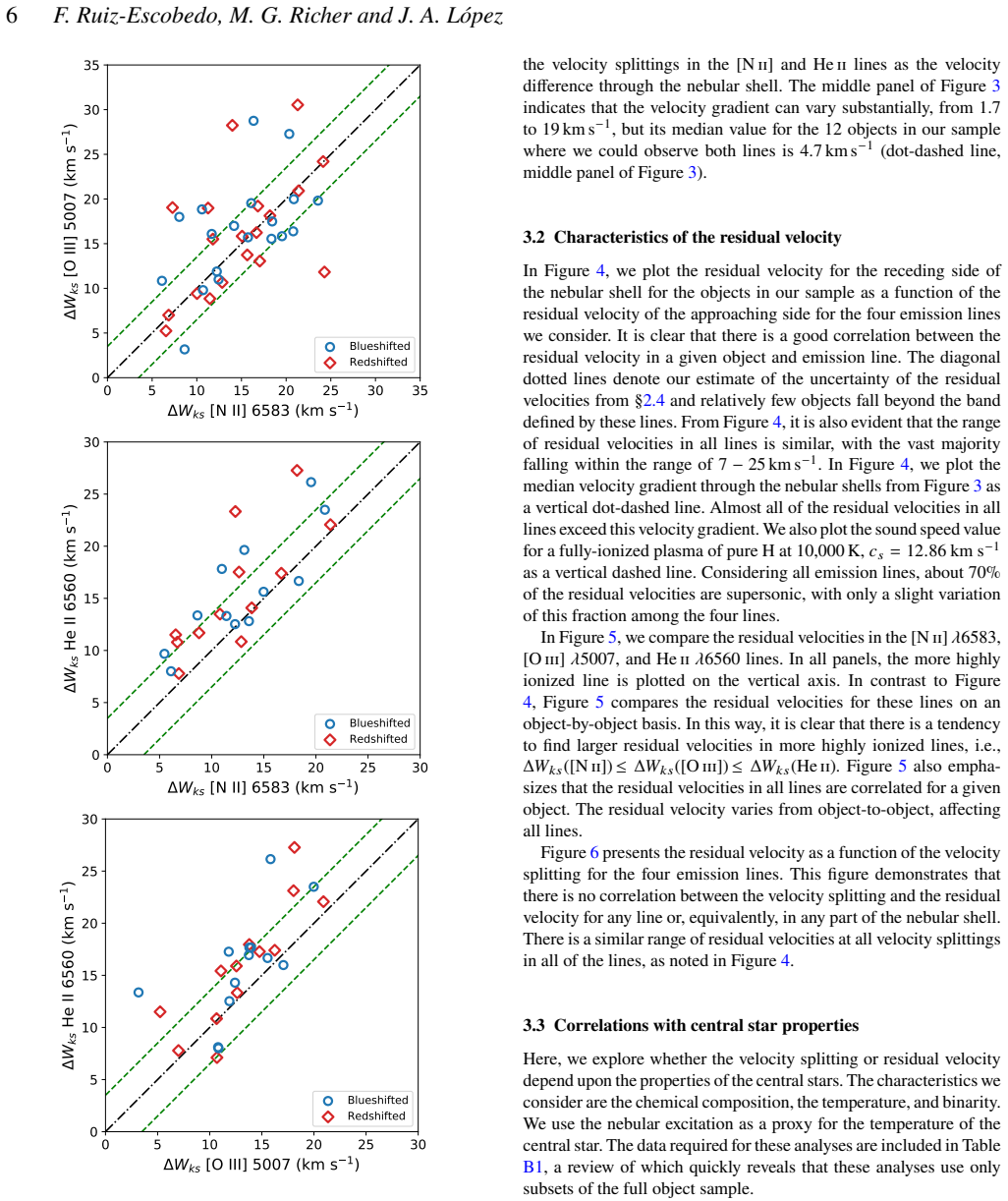
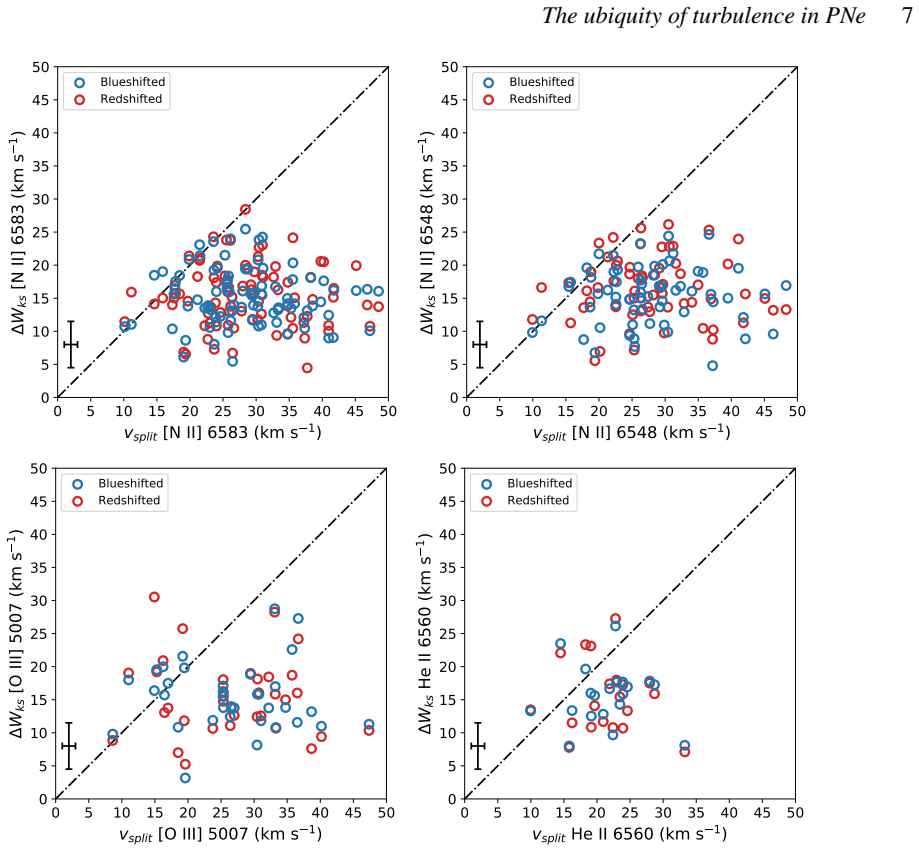
The analysis of residual velocities from a sample of 105 Galactic planetary nebulae reveals that turbulence is pervasive, with values either transonic or slightly supersonic in the ionized environment. Comparisons across ions show higher residual velocities for higher ionization species by 5-10 km s^{-1}, indicating larger turbulent structures in inner zones. No clear correlations exist with morphology, global expansion velocities, ionization degree, or binary cores, except for higher values in PNe with H-poor [WR]-type central stars. Turbulence is thus characterized as a localized, random, dissipative process in the inner sections of the shell that may affect its early evolution.
What carries the argument
The residual velocity obtained by decomposing emission line profiles into their structural contributors, which isolates the turbulent component from ordered expansion in the plasma.
If this is right
- Turbulence occurs in every planetary nebula in the sample and can influence early shell evolution.
- Inner shell zones show stronger turbulence, as higher-ionization lines consistently yield larger residual velocities.
- PNe with hydrogen-poor [WR]-type central stars exhibit higher residual velocities than those with hydrogen-rich stars.
- Turbulence acts as a localized random dissipative process without clear ties to most global nebular parameters such as morphology or expansion velocity.
Where Pith is reading between the lines
- If the inner turbulence is dissipative, it may seed small-scale instabilities that later contribute to the observed morphological complexity of mature planetary nebulae.
- Current hydrodynamic models of planetary nebula formation may need to incorporate an early turbulent energy source rather than treating turbulence as a later addition.
- The absence of correlation with binary central stars suggests that any shaping by companions operates separately from this turbulent component.
- Repeating the residual-velocity analysis on a sample of much younger or more distant planetary nebulae could test whether the turbulent signature strengthens or weakens with age.
Load-bearing premise
That decomposing the emission line profiles into structural contributors accurately isolates turbulence rather than other unresolved kinematic effects, instrumental artifacts, or fitting choices.
What would settle it
High-spatial-resolution spectroscopy or interferometry of a planetary nebula that measures small-scale velocity dispersions matching only thermal broadening plus ordered expansion, with no detectable excess random component.
Figures



read the original abstract
We present an analysis of the residual velocities from a sample of 105 Galactic planetary nebulae (PNe), the largest done to date on this subject. The analysis has been carried out with long-slit, high dispersion echelle spectra. The data were drawn from the San Pedro M\'artir Kinematic Catalogue of Galactic Planetary Nebulae. The residual velocity is identified with turbulence in the plasma and is derived by decomposing the emission line profiles into their structural contributors. Turbulence seems pervasive throughout all the PNe in the sample. We find the values for the residual velocities in the sample to be either transonic or slightly supersonic in the ionized environment. When residual velocities of [N II], [O III] and He II in the same PNe are compared, there is a tendency for the residual velocities of the higher ionized ion to be larger by about 5-10 km s$^{-1}$, indicating that the turbulent structure is larger in the inner zones of the PN. We find in general no clear correlation between the residual velocities and other nebular parameters such as morphology, global expansion velocities, ionization degree and binary cores. The only exception is the case of PNe with H-poor ([WR]-type) central stars, where we confirm previous results that have consistently shown higher residual velocities for this group of PNe as compared to those with H-rich central star atmospheres. Turbulence seems to be a localised, random, dissipative process occurring in the inner sections of the shell and may affect its early evolution.
Editorial analysis
A structured set of objections, weighed in public.
Referee Report
Summary. The manuscript analyzes residual velocities extracted from long-slit, high-dispersion echelle spectra of 105 Galactic planetary nebulae drawn from the San Pedro Mártir Kinematic Catalogue. By decomposing [N II], [O III], and He II emission-line profiles into structural contributors, the authors equate the residuals with turbulence and conclude that it is ubiquitous, with values transonic to slightly supersonic, systematically larger (by 5–10 km s⁻¹) for higher-ionization species, and elevated in PNe with [WR]-type central stars; they find no clear correlations with morphology, global expansion velocity, or ionization degree and interpret turbulence as a localized, random, dissipative process in the inner shell that may influence early evolution.
Significance. If the decomposition reliably isolates turbulent dispersion, the study would supply the largest empirical sample to date on small-scale kinematics in PNe, offering quantitative constraints on the role of turbulence in shell expansion and providing a potential explanation for observed velocity discrepancies in evolutionary models. The reported ion-to-ion trend and the [WR] exception would add useful observational anchors for hydrodynamical simulations of PN formation.
major comments (2)
- [Methods (decomposition procedure)] The central claim that residual velocities after profile decomposition represent turbulence (rather than unresolved expansion gradients, projection effects along the slit, or non-Gaussian components) is load-bearing for every subsequent conclusion. The manuscript must supply a quantitative error budget and explicit tests (e.g., Monte Carlo realizations of shell geometry or comparison with high-resolution imaging) showing that the reported 5–10 km s⁻¹ ion-to-ion differences and the transonic/supersonic regime survive these alternatives.
- [Results section] The statement of “no clear correlation” with morphology, expansion velocity, ionization degree, and binary cores is used to argue that turbulence is largely independent of global parameters. The manuscript should report the actual correlation coefficients, p-values, or rank statistics for the 105-object sample so that the strength (or absence) of these null results can be evaluated.
minor comments (3)
- Define the sound speed adopted for the “transonic/slightly supersonic” classification and state the assumed electron temperature range; this is needed to convert the numerical residual velocities into Mach numbers.
- The abstract claims the sample is “the largest done to date”; the introduction should briefly tabulate or cite the sizes of previous residual-velocity studies for context.
- Ensure that all velocity values in figures, tables, and text carry consistent units (km s⁻¹) and that error bars or uncertainties are shown for the residual-velocity measurements.
Simulated Author's Rebuttal
We thank the referee for their thorough review and insightful comments on our manuscript. We address each of the major comments below and outline the revisions we will make to strengthen the paper.
read point-by-point responses
-
Referee: [Methods (decomposition procedure)] The central claim that residual velocities after profile decomposition represent turbulence (rather than unresolved expansion gradients, projection effects along the slit, or non-Gaussian components) is load-bearing for every subsequent conclusion. The manuscript must supply a quantitative error budget and explicit tests (e.g., Monte Carlo realizations of shell geometry or comparison with high-resolution imaging) showing that the reported 5–10 km s⁻¹ ion-to-ion differences and the transonic/supersonic regime survive these alternatives.
Authors: We recognize the importance of rigorously validating that the residual velocities primarily reflect turbulence rather than other kinematic effects. While our decomposition method follows established procedures in the literature for separating bulk expansion, thermal broadening, and instrumental contributions, we agree that an explicit error analysis is needed. In the revised manuscript, we will add a quantitative error budget in the Methods section, estimating the potential contributions from unresolved expansion gradients and projection effects based on typical shell geometries. Additionally, we will conduct Monte Carlo simulations for a representative subsample of PNe that have high-resolution imaging data available, to assess the impact on the derived residuals. These tests will confirm that the 5–10 km s⁻¹ differences between ions and the transonic to slightly supersonic regime remain robust. revision: yes
-
Referee: [Results section] The statement of “no clear correlation” with morphology, expansion velocity, ionization degree, and binary cores is used to argue that turbulence is largely independent of global parameters. The manuscript should report the actual correlation coefficients, p-values, or rank statistics for the 105-object sample so that the strength (or absence) of these null results can be evaluated.
Authors: We concur that including statistical measures will better support our claim of no clear correlations. In the revised Results section, we will present Spearman rank-order correlation coefficients and corresponding p-values for the residual velocities versus morphology class, global expansion velocity, ionization degree, and the presence of binary cores. These statistics will be computed for the full sample of 105 PNe and will demonstrate the absence of significant correlations, consistent with our qualitative assessment. revision: yes
Circularity Check
No significant circularity; purely observational extraction of residuals
full rationale
The paper's core result—that residual velocities (identified with turbulence) are transonic or slightly supersonic across all 105 PNe, with a tendency for higher values in inner zones—is obtained by direct decomposition of long-slit echelle emission-line profiles into structural components. This is a data-driven measurement process with no mathematical derivation chain, no fitted parameters relabeled as predictions, no self-referential definitions, and no load-bearing self-citations or imported uniqueness theorems. The mention of confirming prior results for [WR]-type central stars is an ancillary observation, not the justification for the ubiquity claim. The analysis remains self-contained against external spectral data.
Axiom & Free-Parameter Ledger
axioms (1)
- domain assumption Residual velocity after decomposing emission line profiles into structural contributors represents turbulence in the plasma
Reference graph
Works this paper leans on
-
[1]
write newline
" write newline "" before.all 'output.state := FUNCTION fin.entry write newline FUNCTION new.block output.state before.all = 'skip after.block 'output.state := if FUNCTION new.sentence output.state after.block = 'skip output.state before.all = 'skip after.sentence 'output.state := if if FUNCTION not #0 #1 if FUNCTION and 'skip pop #0 if FUNCTION or pop #1...
-
[2]
Parts I, II
Acker A., Marcout J., Ochsenbein F., Stenholm B., Tylenda R., Schohn C., 1992, The Strasbourg-ESO Catalogue of Galactic Planetary Nebulae. Parts I, II. . European Southern Observatory, Garching, Germany
1992
-
[3]
Acker A., Gesicki K., Grosdidier Y., Durand S., 2002, @doi [ ] 10.1051/0004-6361:20020009 , https://ui.adsabs.harvard.edu/abs/2002A&A...384..620A 384, 620
-
[4]
Astropy Collaboration et al., 2013, @doi [ ] 10.1051/0004-6361/201322068 , http://adsabs.harvard.edu/abs/2013A
-
[5]
Astropy Collaboration et al., 2018, @doi [ ] 10.3847/1538-3881/aabc4f , https://ui.adsabs.harvard.edu/abs/2018AJ....156..123A 156, 123
-
[6]
Astropy Collaboration et al., 2022, @doi [ ] 10.3847/1538-4357/ac7c74 , https://ui.adsabs.harvard.edu/abs/2022ApJ...935..167A 935, 167
work page internal anchor Pith review doi:10.3847/1538-4357/ac7c74 2022
-
[7]
Basurah H. M., Ali A., Dopita M. A., Alsulami R., Amer M. A., Alruhaili A., 2016, @doi [ ] 10.1093/mnras/stw468 , https://ui.adsabs.harvard.edu/abs/2016MNRAS.458.2694B 458, 2694
-
[8]
Boffin H. M. J., Jones D., 2019, The Importance of Binaries in the Formation and Evolution of Planetary Nebulae . Springer Cham, @doi 10.1007/978-3-030-25059-1
-
[9]
Bryce M., Meaburn J., Walsh J. R., 1992, @doi [ ] 10.1093/mnras/259.4.629 , https://ui.adsabs.harvard.edu/abs/1992MNRAS.259..629B 259, 629
-
[10]
De Marco O., et al., 2022, @doi [Nature Astronomy] 10.1038/s41550-022-01845-2 , https://ui.adsabs.harvard.edu/abs/2022NatAs...6.1421D 6, 1421
-
[11]
Diego F., Charalambous A., Fish A. C., Walker D. D., 1990, in Crawford D. L., ed., Society of Photo-Optical Instrumentation Engineers (SPIE) Conference Series Vol. 1235, Instrumentation in Astronomy VII. pp 562--576, @doi 10.1117/12.19119
-
[12]
Fitzpatrick M., Placco V., Bolton A., Merino B., Ridgway S., Stanghellini L., 2025, in Jacques A., Seaman R., Gandilo N., Linder T., eds, Astronomical Society of the Pacific Conference Series Vol. 541, Astronomical Data Analysis Software and Systems XXXIII. p. 461 ( @eprint arXiv 2401.01982 ), @doi 10.26624/CETF5821
-
[13]
Garc \' a-Rojas J., Morisset C., Jones D., Wesson R., Boffin H. M. J., Monteiro H., Corradi R. L. M., Rodr \' guez-Gil P., 2022, @doi [ ] 10.1093/mnras/stab3523 , https://ui.adsabs.harvard.edu/abs/2022MNRAS.510.5444G 510, 5444
-
[14]
Garc \' a-Segura G., Taam R. E., Ricker P. M., 2022, @doi [ ] 10.1093/mnras/stac2824 , https://ui.adsabs.harvard.edu/abs/2022MNRAS.517.3822G 517, 3822
-
[15]
Garc \' a-V \'a zquez J., Henney W. J., Casta \ n eda H. O., 2023, @doi [ ] 10.1093/mnras/stad1631 , https://ui.adsabs.harvard.edu/abs/2023MNRAS.523.4202G 523, 4202
-
[16]
Gesicki K., Acker A., 1996, @doi [ ] 10.1007/BF00645502 , https://ui.adsabs.harvard.edu/abs/1996Ap&SS.238..101G 238, 101
-
[17]
Gesicki K., Acker A., Szczerba R., 1996, , https://ui.adsabs.harvard.edu/abs/1996A&A...309..907G 309, 907
1996
-
[18]
Gesicki K., Acker A., Zijlstra A. A., 2003, @doi [ ] 10.1051/0004-6361:20030079 , https://ui.adsabs.harvard.edu/abs/2003A&A...400..957G 400, 957
-
[19]
Guerrero M. A., Villaver E., Manchado A., 1998, @doi [ ] 10.1086/306368 , https://ui.adsabs.harvard.edu/abs/1998ApJ...507..889G 507, 889
-
[20]
Harris C. R., et al., 2020, @doi [Nature] 10.1038/s41586-020-2649-2 , 585, 357
-
[21]
Hora J. L., Latter W. B., Smith H. A., Marengo M., 2006, @doi [ ] 10.1086/507944 , https://ui.adsabs.harvard.edu/abs/2006ApJ...652..426H 652, 426
-
[22]
J., Frank A., 2006, in Barlow M
Huggins P. J., Frank A., 2006, in Barlow M. J., M \'e ndez R. H., eds, IAU Symposium Vol. 234, Planetary Nebulae in our Galaxy and Beyond. pp 271--276 ( @eprint arXiv astro-ph/0605307 ), @doi 10.1017/S1743921306003085
-
[23]
Computing in Science and Engineering , keywords =
Hunter J. D., 2007, @doi [Computing in Science & Engineering] 10.1109/MCSE.2007.55 , 9, 90
-
[24]
Jones D., Boffin H. M. J., 2017, @doi [Nature Astronomy] 10.1038/s41550-017-0117 , https://ui.adsabs.harvard.edu/abs/2017NatAs...1E.117J 1, 0117
-
[25]
Kahn F. D., West K. A., 1985, @doi [ ] 10.1093/mnras/212.4.837 , https://ui.adsabs.harvard.edu/abs/1985MNRAS.212..837K 212, 837
-
[26]
Ralchenko Reader J., and NIST ASD Team 2024, NIST Atomic Spectra Database (ver
Kramida A., Yu. Ralchenko Reader J., and NIST ASD Team 2024, NIST Atomic Spectra Database (ver. 5.12), [Online]. Available: https://physics.nist.gov/asd [Mar 07 2025]. National Institute of Standards and Technology, Gaithersburg, MD
2024
-
[27]
Kwok S., Purton C. R., Fitzgerald P. M., 1978, @doi [ ] 10.1086/182621 , https://ui.adsabs.harvard.edu/abs/1978ApJ...219L.125K 219, L125
-
[28]
Liu X.-W., Storey P. J., Barlow M. J., Danziger I. J., Cohen M., Bryce M., 2000, @doi [ ] 10.1046/j.1365-8711.2000.03167.x , https://ui.adsabs.harvard.edu/abs/2000MNRAS.312..585L 312, 585
-
[29]
L \'o pez J. A., 2022, @doi [Frontiers in Astronomy and Space Sciences] 10.3389/fspas.2022.925731 , https://ui.adsabs.harvard.edu/abs/2022FrASS...9.5731L 9, 925731
-
[30]
L \'o pez J. A., Richer M. G., Garc \' a-D \' az M. T., Clark D. M., Meaburn J., Riesgo H., Steffen W., Lloyd M., 2012, @doi [ ] 10.48550/arXiv.1110.4698 , https://ui.adsabs.harvard.edu/abs/2012RMxAA..48....3L 48, 3
-
[31]
Matsuura M., et al., 2025, @doi [ ] 10.1093/mnras/staf1194 , https://ui.adsabs.harvard.edu/abs/2025MNRAS.542.1287M 542, 1287
-
[32]
A., Guti \'e rrez L., Quir \'o z F., Murillo J
Meaburn J., L \'o pez J. A., Guti \'e rrez L., Quir \'o z F., Murillo J. M., Vald \'e z J., Pedrayez M., 2003, , https://ui.adsabs.harvard.edu/abs/2003RMxAA..39..185M 39, 185
2003
-
[33]
Medina S., Pe \ n a M., Morisset C., Stasi \'n ska G., 2006, @doi [ ] 10.48550/arXiv.astro-ph/0603651 , https://ui.adsabs.harvard.edu/abs/2006RMxAA..42...53M 42, 53
-
[34]
M \'e ndez-Delgado J. E., Esteban C., Garc \' a-Rojas J., Kreckel K., Peimbert M., 2023, @doi [ ] 10.1038/s41586-023-05956-2 , https://ui.adsabs.harvard.edu/abs/2023Natur.618..249M 618, 249
-
[35]
Neiner C., Acker A., Gesicki K., Szczerba R., 2000, , https://ui.adsabs.harvard.edu/abs/2000A&A...358..321N 358, 321
2000
-
[36]
Peimbert M., 1967, @doi [ ] 10.1086/149385 , https://ui.adsabs.harvard.edu/abs/1967ApJ...150..825P 150, 825
-
[37]
Perinotto M., Sch \"o nberner D., Steffen M., Calonaci C., 2004, @doi [ ] 10.1051/0004-6361:20031653 , https://ui.adsabs.harvard.edu/abs/2004A&A...414..993P 414, 993
-
[38]
G., Su \'a rez G., L \'o pez J
Richer M. G., Su \'a rez G., L \'o pez J. A., Garc \' a D \' az M. T., 2017, @doi [ ] 10.3847/1538-3881/aa5f53 , https://ui.adsabs.harvard.edu/abs/2017AJ....153..140R 153, 140
-
[39]
G., Arrieta A., Arias L., Casta \ n eda-Carlos L., Torres-Peimbert S., L \'o pez J
Richer M. G., Arrieta A., Arias L., Casta \ n eda-Carlos L., Torres-Peimbert S., L \'o pez J. A., Galindo A., 2022, @doi [ ] 10.3847/1538-3881/ac9732 , https://ui.adsabs.harvard.edu/abs/2022AJ....164..243R 164, 243
-
[40]
Richer M. G., L \'o pez J. A., Arrieta A., Arias L., Torres-Peimbert S., 2025, in De Marco O., Zijlstra R., Szczerba R., eds, IAU Symposium Vol. S384, Planetary Nebulae: a Universal Toolbox in the Era of Precision Astrophysics. p. 136–142, @doi 10.1017/S1743921324000462
-
[41]
Sabbadin F., Turatto M., Benetti S., Ragazzoni R., Cappellaro E., 2008, @doi [ ] 10.1051/0004-6361:200809429 , https://ui.adsabs.harvard.edu/abs/2008A&A...488..225S 488, 225
-
[42]
Stull R. B., 1988, An introduction to boundary layer meteorology . Kluwer Academic Publishers, Dordrecht, The Netherlands, @doi 10.1007/978-94-009-3027-8
-
[43]
The Pandas Development Team 2023, pandas-dev/pandas: Pandas , @doi 10.5281/zenodo.7549438
-
[44]
Toal \'a J. A., Arthur S. J., 2014, @doi [ ] 10.1093/mnras/stu1360 , https://ui.adsabs.harvard.edu/abs/2014MNRAS.443.3486T 443, 3486
-
[45]
Instrumentation in astronomy VI , year = 1986, editor =
Tody D., 1986, in Crawford D. L., ed., Society of Photo-Optical Instrumentation Engineers (SPIE) Conference Series Vol. 627, Instrumentation in astronomy VI. p. 733, @doi 10.1117/12.968154
-
[46]
J., Brissenden R
Tody D., 1993, in Hanisch R. J., Brissenden R. J. V., Barnes J., eds, Astronomical Society of the Pacific Conference Series Vol. 52, Astronomical Data Analysis Software and Systems II. p. 173
1993
-
[47]
Virtanen P., et al., 2020, @doi [Nature Methods] 10.1038/s41592-019-0686-2 , https://rdcu.be/b08Wh 17, 261
-
[48]
V., Jenkins C
Wall J. V., Jenkins C. R., 2003, Practical Statistics for Astronomers . Vol. 3, Cambridge University Press, Cambridge, UK
2003
-
[49]
Weidmann W. A., et al., 2020, @doi [ ] 10.1051/0004-6361/202037998 , https://ui.adsabs.harvard.edu/abs/2020A&A...640A..10W 640, A10
-
[50]
Wesson R., Jones D., Garc \' a-Rojas J., Boffin H. M. J., Corradi R. L. M., 2018, @doi [ ] 10.1093/mnras/sty1871 , https://ui.adsabs.harvard.edu/abs/2018MNRAS.480.4589W 480, 4589
-
[51]
Wesson R., et al., 2024, @doi [ ] 10.1093/mnras/stad3670 , https://ui.adsabs.harvard.edu/abs/2024MNRAS.528.3392W 528, 3392
-
[52]
C., 1950, @doi [ ] 10.1086/145264 , https://ui.adsabs.harvard.edu/abs/1950ApJ...111..279W 111, 279
Wilson O. C., 1950, @doi [ ] 10.1086/145264 , https://ui.adsabs.harvard.edu/abs/1950ApJ...111..279W 111, 279
-
[53]
van Hoof P. A. M., 2018, @doi [Galaxies] 10.3390/galaxies6020063 , https://ui.adsabs.harvard.edu/abs/2018Galax...6...63V 6, 63
discussion (0)
Sign in with ORCID, Apple, or X to comment. Anyone can read and Pith papers without signing in.