Recognition: unknown
Many-Body Amplified Nonclassical Photon Emission in Cavity-Coupled Atomic Arrays
Pith reviewed 2026-05-10 08:45 UTC · model grok-4.3
The pith
Programmable phase in cavity-coupled atomic arrays switches between high-purity single-photon and bright photon-pair emission.
A machine-rendered reading of the paper's core claim, the machinery that carries it, and where it could break.
Core claim
In a cavity-coupled atomic array with programmable relative phase φ, the cavity-mediated many-body spin-exchange interactions reshape the dressed-state manifold and enable deterministic switching between distinct quantum emission regimes. For φ=0, constructive interference yields high-purity single-photon emission with antibunching improved by four orders of magnitude while preserving strong photon flux. Conversely, for φ=π, destructive interference creates a dark single-photon manifold, resonantly activating two-photon processes to produce bright and pure photon-pair bundles.
What carries the argument
The interference-interaction mechanism from cavity-mediated many-body spin-exchange interactions controlled by the relative phase φ, which tunes collective effects to amplify spectral anharmonicity and switch emission regimes.
Load-bearing premise
The cavity-mediated many-body spin-exchange interactions can be precisely controlled via the programmable phase φ without dominant decoherence, loss, or other unmodeled effects that would prevent the predicted reshaping of the dressed-state manifold.
What would settle it
Direct measurement of the second-order correlation function showing four-order antibunching improvement for φ=0 or resonant activation of two-photon emission with suppressed single-photon output for φ=π in the cavity output spectrum.
Figures


read the original abstract
The generation of high-performance nonclassical light remains a cornerstone of quantum technologies, yet faces a fundamental trade-off between emission purity and brightness. Here, we demonstrate that cavity-mediated many-body spin-exchange interactions provide a route to overcome this constraint by collectively amplifying spectral anharmonicity. In a cavity-coupled atomic array with a programmable relative phase $\phi$, the resulting interference-interaction mechanism reshapes the dressed-state manifold and enables deterministic switching between distinct quantum emission regimes. For $\phi=0$, constructive interference yields high-purity single-photon emission with antibunching improved by four orders of magnitude while preserving strong photon flux. Conversely, for $\phi=\pi$, destructive interference creates a dark single-photon manifold, resonantly activating two-photon processes to produce bright and pure photon-pair bundles. Our work establishes interference-engineered many-body interactions as a scalable mechanism for on-demand quantum light generation and open a new avenue for harnessing collective many-body physics in quantum photonics.
Editorial analysis
A structured set of objections, weighed in public.
Referee Report
Summary. The manuscript claims that cavity-mediated many-body spin-exchange interactions in a cavity-coupled atomic array, controlled by a programmable relative phase φ, reshape the dressed-state manifold and enable deterministic switching between quantum emission regimes. For φ=0, constructive interference produces high-purity single-photon emission with antibunching improved by four orders of magnitude while preserving strong photon flux; for φ=π, destructive interference creates a dark single-photon manifold that activates bright and pure two-photon bundles.
Significance. If the results hold, the work demonstrates a scalable route to high-performance nonclassical light by leveraging collective interference effects to overcome the purity-brightness trade-off. The interference-interaction mechanism provides a clear control parameter for emission regimes and represents a strength in connecting many-body physics to practical quantum photonics applications.
major comments (1)
- [§4] §4 (numerical results): The central claim of a four-order-of-magnitude improvement in antibunching for φ=0 is load-bearing and requires explicit support. The manuscript should include the baseline g^{(2)}(0) value in the absence of the many-body interactions, the precise master-equation parameters (coupling strengths, decay rates γ and κ), and the numerical method used to obtain the quoted factor.
minor comments (2)
- [Introduction] The abstract and introduction use the term 'dark single-photon manifold' without a direct reference to the eigenstates or dressed states; a brief definition or pointer to the relevant equation would improve clarity.
- [Figures] Figure captions (e.g., those showing g^{(2)}(τ) or emission spectra) should explicitly list the parameter values (including φ, detunings, and decay rates) used in each panel to allow direct reproduction of the plotted regimes.
Circularity Check
No significant circularity detected
full rationale
The paper's central claims rest on a cavity-QED master-equation model of an atomic array with tunable phase φ that reshapes the dressed-state manifold via interference. No load-bearing step reduces by construction to a fitted parameter, self-citation chain, or renamed input; the interference mechanism and resulting single-photon versus pair-bundle regimes are derived from the explicit Hamiltonian and Lindblad terms rather than assumed. The derivation is therefore self-contained against external benchmarks.
Axiom & Free-Parameter Ledger
axioms (1)
- domain assumption Standard cavity QED model with spin-exchange interactions and dressed-state manifold
Forward citations
Cited by 1 Pith paper
-
One knob to tune them all: Phase-controlled photon statistics and linewidth in partially pumped atomic ensembles
In partially pumped atomic ensembles, a tunable relative phase between pumped and unpumped emission contributions allows control of linewidth scaling and photon statistics from antibunched to bunched.
Reference graph
Works this paper leans on
-
[1]
For two bright polariton branches, ns decreases monotoni- cally with increasing φ and is completely suppressed at φ =π
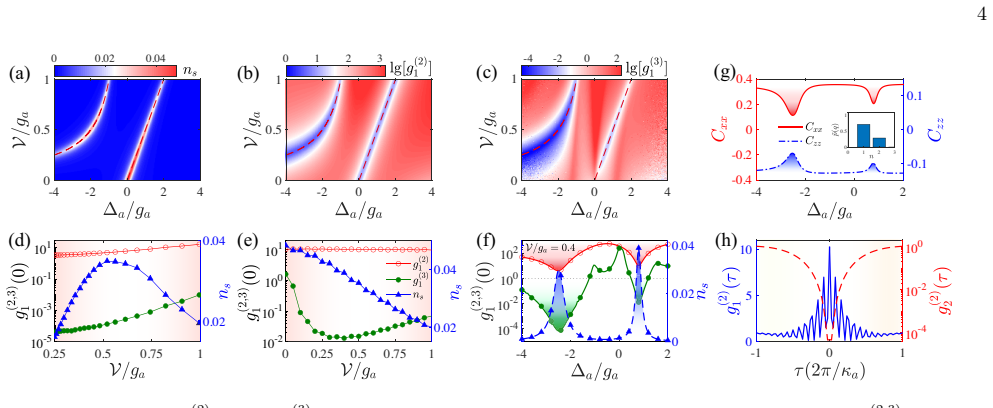
Pronounced photon emission occurs at the single- photon resonances, including the sidebands ∆ a/g a = ± √ 2(1 + cos2φ) and middle branch ∆ a/g a = 0. For two bright polariton branches, ns decreases monotoni- cally with increasing φ and is completely suppressed at φ =π . At φ = 0, the emitted field exhibits strong photon antibunching, with g(2) 1 (0) ≃ 2. 7...
-
[2]
Remarkably, photon statistics ex- hibit a sharp transition to strong bunching with g(2) 1 (0) ≃ 10 [Fig
are symmetric un- der particle exchange, leaving higher-order multiphoton excitations accessible. Remarkably, photon statistics ex- hibit a sharp transition to strong bunching with g(2) 1 (0) ≃ 10 [Fig. 2(b)], signaling multiphoton emission enabled by single-photon dark state formation. This phase- controlled antibunching-bunching transition is funda- men...
-
[3]
Many-body physics with ultracold gases,
Immanuel Bloch, Jean Dalibard, and Wilhelm Zw- erger, “Many-body physics with ultracold gases,” Rev. Mod. Phys. 80, 885–964 (2008)
2008
-
[4]
Quantum information with rydberg atoms,
M. Saffman, T. G. Walker, and K. Mølmer, “Quantum information with rydberg atoms,” Rev. Mod. Phys. 82, 2313–2363 (2010)
2010
-
[5]
Long-range interacting quantum systems,
Nicol` o Defenu, Tobias Donner, Tommaso Macr ` ı, Guido Pagano, Stefano Ruffo, and Andrea Trom- bettoni, “Long-range interacting quantum systems,” Rev. Mod. Phys. 95, 035002 (2023)
2023
-
[6]
Cold atoms in cavity-generated dynamical optical potentials,
Helmut Ritsch, Peter Domokos, Ferdinand Bren- necke, and Tilman Esslinger, “Cold atoms in cavity-generated dynamical optical potentials,” Rev. Mod. Phys. 85, 553–601 (2013)
2013
-
[7]
Ultrastrong coupling regimes of light-matter interaction,
P. Forn-D ´ ıaz, L. Lamata, E. Rico, J. Kono, and E. Solano, “Ultrastrong coupling regimes of light-matter interaction,” Rev. Mod. Phys. 91, 025005 (2019)
2019
-
[8]
Cavity qed with quantum gases: New paradigms in many-body physics,
Farokh Mivehvar, Francesco Piazza, Tobias Donner, and Helmut Ritsch, “Cavity qed with quantum gases: New paradigms in many-body physics,” Advances in Physics 70, 1–153 (2021)
2021
-
[9]
Cavity-mediated collective spin-exchange interac- tions in a strontium superradiant laser,
Matthew A Norcia, Robert J Lewis-Swan, Julia RK Cline, Bihui Zhu, Ana M Rey, and James K Thomp- son, “Cavity-mediated collective spin-exchange interac- tions in a strontium superradiant laser,” Science 361, 259–262 (2018)
2018
-
[10]
Exploring dynamical phase transi- tions with cold atoms in an optical cavity,
Juan A Muniz, Diego Barberena, Robert J Lewis-Swan, Dylan J Young, Julia RK Cline, Ana Maria Rey, and James K Thompson, “Exploring dynamical phase transi- tions with cold atoms in an optical cavity,” Nature 580, 602–607 (2020)
2020
-
[11]
Momentum-exchange interac- tions in a bragg atom interferometer suppress doppler dephasing,
Chengyi Luo, Haoqing Zhang, Vanessa PW Koh, John D Wilson, Anjun Chu, Murray J Holland, Ana Maria Rey, and James K Thompson, “Momentum-exchange interac- tions in a bragg atom interferometer suppress doppler dephasing,” Science 384, 551–556 (2024)
2024
-
[12]
Many-body gap protection against mo- tional dephasing of an optical clock transition,
Zhijing Niu, Vera M. Sch¨ afer, Haoqing Zhang, Cameron Wagner, Nathan R. Taylor, Dylan J. Young, Eric Yilun Song, Anjun Chu, Ana Maria Rey, and James K. Thompson, “Many-body gap protection against mo- tional dephasing of an optical clock transition,” 6 Phys. Rev. Lett. 134, 113403 (2025)
2025
-
[13]
Spin- momentum-mixing interactions with cavity-mediated su- persolid in spinor condensates,
Jingjun You, Su Yi, and Yuangang Deng, “Spin- momentum-mixing interactions with cavity-mediated su- persolid in spinor condensates,” Photonics Research 13, 987–994 (2025)
2025
-
[14]
Dark super- radiance in cavity-coupled polar molecular bose-einstein condensates,
Yuqi Wang, Su Yi, and Yuangang Deng, “Dark super- radiance in cavity-coupled polar molecular bose-einstein condensates,” arXiv preprint arXiv:2504.18125 (2025)
-
[15]
Quantum phases of matter on a 256-atom pro- grammable quantum simulator,
Sepehr Ebadi, Tout T Wang, Harry Levine, Alexander Keesling, Giulia Semeghini, Ahmed Omran, Dolev Blu- vstein, Rhine Samajdar, Hannes Pichler, Wen Wei Ho, et al. , “Quantum phases of matter on a 256-atom pro- grammable quantum simulator,” Nature 595, 227–232 (2021)
2021
-
[16]
An atom-by- atom assembler of defect-free arbitrary two-dimensional atomic arrays,
Daniel Barredo, Sylvain De L´ es´ eleuc, Vincent Lienhard, Thierry Lahaye, and Antoine Browaeys, “An atom-by- atom assembler of defect-free arbitrary two-dimensional atomic arrays,” Science 354, 1021–1023 (2016)
2016
-
[17]
An optical tweezer array of ultracold molecules,
Lo ¨ ıc Anderegg, Lawrence W Cheuk, Yicheng Bao, Sean Burchesky, Wolfgang Ketterle, Kang-Kuen Ni, and John M Doyle, “An optical tweezer array of ultracold molecules,” Science 365, 1156–1158 (2019)
2019
-
[18]
Supersolid for- mation in a quantum gas breaking a continuous transla- tional symmetry,
Julian L´ eonard, Andrea Morales, Philip Zupancic, Tilman Esslinger, and Tobias Donner, “Supersolid for- mation in a quantum gas breaking a continuous transla- tional symmetry,” Nature 543, 87 (2017)
2017
-
[19]
Superradiant and subradiant cavity scattering by atom arrays,
Zhenjie Yan, Jacquelyn Ho, Yue-Hui Lu, Stuart J. Mas- son, Ana Asenjo-Garcia, and Dan M. Stamper-Kurn, “Superradiant and subradiant cavity scattering by atom arrays,” Phys. Rev. Lett. 131, 253603 (2023)
2023
-
[20]
Realization of strong coupling between deterministic single-atom ar- rays and a high-finesse miniature optical cavity,
Yanxin Liu, Zhihui Wang, Pengfei Yang, Qinxia Wang, Qing Fan, Shijun Guan, Gang Li, Pengfei Zhang, and Tiancai Zhang, “Realization of strong coupling between deterministic single-atom ar- rays and a high-finesse miniature optical cavity,” Phys. Rev. Lett. 130, 173601 (2023)
2023
-
[21]
Interaction- enhanced superradiance of a rydberg-atom array,
Yiwen Han, Haowei Li, and Wei Yi, “Interaction- enhanced superradiance of a rydberg-atom array,” Phys. Rev. Lett. 133, 243401 (2024)
2024
-
[22]
Observation of a symmetry-protected topological phase of interacting bosons with rydberg atoms,
Sylvain De L´ es´ eleuc, Vincent Lienhard, Pascal Scholl, Daniel Barredo, Sebastian Weber, Nicolai Lang, Hans Pe- ter B¨ uchler, Thierry Lahaye, and Antoine Browaeys, “Observation of a symmetry-protected topological phase of interacting bosons with rydberg atoms,” Science 365, 775–780 (2019)
2019
-
[23]
Observation of average topological phase in disordered Rydberg atom array
Zongpei Yue, Yu-Feng Mao, Xinhui Liang, Zhen-Xing Hua, Peiyun Ge, Yu-Xin Chao, Kai Li, Chen Jia, Meng Khoon Tey, Yong Xu, et al. , “Observing structural disorder induced interacting topological phase in an atom array,” arXiv preprint arXiv:2505.06286 (2025)
work page internal anchor Pith review Pith/arXiv arXiv 2025
-
[24]
Optimal metrology with programmable quantum sensors,
Christian D Marciniak, Thomas Feldker, Ivan Pogorelov, Raphael Kaubruegger, Denis V Vasilyev, Rick van Bij- nen, Philipp Schindler, Peter Zoller, Rainer Blatt, and Thomas Monz, “Optimal metrology with programmable quantum sensors,” Nature 603, 604–609 (2022)
2022
-
[25]
Variational spin- squeezing algorithms on programmable quantum sen- sors,
Raphael Kaubruegger, Pietro Silvi, Christian Kokail, Rick van Bijnen, Ana Maria Rey, Jun Ye, Adam M. Kaufman, and Peter Zoller, “Variational spin- squeezing algorithms on programmable quantum sen- sors,” Phys. Rev. Lett. 123, 260505 (2019)
2019
-
[26]
Quantum sensing in tweezer arrays: Optical magnetometry on an individual- atom sensor grid,
Dominik Sch¨ affner, Tobias Schreiber, Fabian Lenz, Malte Schlosser, and Gerhard Birkl, “Quantum sensing in tweezer arrays: Optical magnetometry on an individual- atom sensor grid,” PRX Quantum 5, 010311 (2024)
2024
-
[27]
Entanglement of two individual neutral atoms using rydberg blockade,
T. Wilk, A. Ga¨ etan, C. Evellin, J. Wolters, Y. Miroshny- chenko, P. Grangier, and A. Browaeys, “Entanglement of two individual neutral atoms using rydberg blockade,” Phys. Rev. Lett. 104, 010502 (2010)
2010
-
[28]
On-demand entanglement of molecules in a reconfig- urable optical tweezer array,
Connor M Holland, Yukai Lu, and Lawrence W Cheuk, “On-demand entanglement of molecules in a reconfig- urable optical tweezer array,” Science 382, 1143–1147 (2023)
2023
-
[29]
Dipolar spin-exchange and entanglement be- tween molecules in an optical tweezer array,
Yicheng Bao, Scarlett S Yu, Lo ¨ ıc Anderegg, Eunmi Chae, Wolfgang Ketterle, Kang-Kuen Ni, and John M Doyle, “Dipolar spin-exchange and entanglement be- tween molecules in an optical tweezer array,” Science 382, 1138–1143 (2023)
2023
-
[30]
Long-lived bell states in an array of optical clock qubits,
Nathan Schine, Aaron W Young, William J Eckner, Michael J Martin, and Adam M Kaufman, “Long-lived bell states in an array of optical clock qubits,” Nat. Phys. 18, 1067–1073 (2022)
2022
-
[31]
Photon blockade in an optical cavity with one trapped atom,
Kevin M Birnbaum, Andreea Boca, Russell Miller, Allen D Boozer, Tracy E Northup, and H Jeff Kimble, “Photon blockade in an optical cavity with one trapped atom,” Nature 436, 87–90 (2005)
2005
-
[32]
A photon turnstile dynamically regulated by one atom,
Barak Dayan, AS Parkins, Takao Aoki, EP Ostby, KJ Va- hala, and HJ Kimble, “A photon turnstile dynamically regulated by one atom,” Science 319, 1062–1065 (2008)
2008
-
[33]
Two-photon blockade in an atom- driven cavity qed system,
Christoph Hamsen, Karl Nicolas Tolazzi, Tatjana Wilk, and Gerhard Rempe, “Two-photon blockade in an atom- driven cavity qed system,” Phys. Rev. Lett. 118, 133604 (2017)
2017
-
[34]
Universal photon block- ade,
Yan-Hui Zhou, Tong Liu, Qi-Ping Su, Xing-Yuan Zhang, Qi-Cheng Wu, Dong-Xu Chen, Zhi-Cheng Shi, H. Z. Shen, and Chui-Ping Yang, “Universal photon block- ade,” Phys. Rev. Lett. 134, 183601 (2025)
2025
-
[35]
Chi- ral interaction induced near-perfect photon blockade,
Zhi-Guang Lu, Ying Wu, and Xin-You L¨ u, “Chi- ral interaction induced near-perfect photon blockade,” Phys. Rev. Lett. 134, 013602 (2025)
2025
-
[36]
Emitters of n-photon bun- dles,
C S´ anchez Mu˜ noz, E Del Valle, A Gonz´ alez Tudela, K M¨ uller, S Lichtmannecker, M Kaniber, C Tejedor, JJ Finley, and FP Laussy, “Emitters of n-photon bun- dles,” Nat. photonics 8, 550–555 (2014)
2014
-
[37]
Determinis- tic generation of multi-photon bundles in a quantum rabi model,
Cheng Liu, Jin-Feng Huang, and Lin Tian, “Determinis- tic generation of multi-photon bundles in a quantum rabi model,” Science China Physics, Mechanics & Astronomy 66, 220311 (2023)
2023
-
[38]
Nonreciprocal bundle emissions of quantum entan- gled pairs,
Qian Bin, Hui Jing, Ying Wu, Franco Nori, and Xin-You L¨ u, “Nonreciprocal bundle emissions of quantum entan- gled pairs,” Phys. Rev. Lett. 133, 043601 (2024)
2024
-
[39]
An elementary quantum network of single atoms in optical cavities,
Stephan Ritter, Christian N¨ olleke, Carolin Hahn, An- dreas Reiserer, Andreas Neuzner, Manuel Uphoff, Mar- tin M¨ ucke, Eden Figueroa, Joerg Bochmann, and Ger- hard Rempe, “An elementary quantum network of single atoms in optical cavities,” Nature 484, 195–200 (2012)
2012
-
[40]
All-silicon quantum light source by embedding an atomic emissive center in a nanophotonic cavity,
Walid Redjem, Yertay Zhiyenbayev, Wayesh Qarony, Vsevolod Ivanov, Christos Papapanos, Wei Liu, Kaushalya Jhuria, ZY Al Balushi, Scott Dhuey, Adam Schwartzberg, et al. , “All-silicon quantum light source by embedding an atomic emissive center in a nanophotonic cavity,” Nat. Commun. 14, 3321 (2023)
2023
-
[41]
Long-distance quantum communication with atomic en- sembles and linear optics,
L.-M. Duan, M. D. Lukin, J. I. Cirac, and P. Zoller, “Long-distance quantum communication with atomic en- sembles and linear optics,” Nature 414, 413 (2001)
2001
-
[42]
The quantum internet,
H. J. Kimble, “The quantum internet,” Nature 453, 1023 (2008)
2008
-
[43]
Nondestructive detection of photonic 7 qubits,
Dominik Niemietz, Pau Farrera, Stefan Langenfeld, and Gerhard Rempe, “Nondestructive detection of photonic 7 qubits,” Nature 591, 570–574 (2021)
2021
-
[44]
Advances in quantum metrology,
Vittorio Giovannetti, Seth Lloyd, and Lorenzo Maccone, “Advances in quantum metrology,” Nature Photonics 5, 222 (2011)
2011
-
[45]
Highly charged ions: Op- tical clocks and applications in fundamental physics,
M. G. Kozlov, M. S. Safronova, J. R. Crespo L´ opez- Urrutia, and P. O. Schmidt, “Highly charged ions: Op- tical clocks and applications in fundamental physics,” Rev. Mod. Phys. 90, 045005 (2018)
2018
-
[46]
Quantum metrology with nonclassical states of atomic ensembles,
Luca Pezz` e, Augusto Smerzi, Markus K. Oberthaler, Roman Schmied, and Philipp Treutlein, “Quantum metrology with nonclassical states of atomic ensembles,” Rev. Mod. Phys. 90, 035005 (2018)
2018
-
[47]
Interactions mediated by atoms, photons, electrons, and excitons,
Rosario Paredes, Georg Bruun, and Ar- turo Camacho-Guardian, “Interactions mediated by atoms, photons, electrons, and excitons,” Phys. Rev. A 110, 030101 (2024)
2024
-
[48]
Mul- timode photon blockade,
Srivatsan Chakram, Kevin He, Akash V Dixit, Andrew E Oriani, Ravi K Naik, Nelson Leung, Hyeokshin Kwon, Wen-Long Ma, Liang Jiang, and David I Schuster, “Mul- timode photon blockade,” Nature Physics 18, 879–884 (2022)
2022
-
[49]
Phases, instabilities and excitations in a two-component lattice model with photon-mediated interactions,
Leon Carl, Rodrigo Rosa-Medina, Sebastian D Huber, Tilman Esslinger, Nishant Dogra, and Tena Dubcek, “Phases, instabilities and excitations in a two-component lattice model with photon-mediated interactions,” Phys- ical Review Research 5, L032003 (2023)
2023
-
[50]
Out-of-equilibrium dynamics of quantum many-body systems with long-range interactions,
Nicol` o Defenu, Alessio Lerose, and Silvia Pappalardi, “Out-of-equilibrium dynamics of quantum many-body systems with long-range interactions,” Physics Reports 1074, 1–92 (2024)
2024
-
[51]
Observing dynamical phases of bcs super- conductors in a cavity qed simulator,
Dylan J Young, Anjun Chu, Eric Yilun Song, Diego Bar- berena, David Wellnitz, Zhijing Niu, Vera M Sch¨ afer, Robert J Lewis-Swan, Ana Maria Rey, and James K Thompson, “Observing dynamical phases of bcs super- conductors in a cavity qed simulator,” Nature 625, 679– 684 (2024)
2024
-
[52]
Deterministic down-converter and continu- ous photon-pair source within the bad-cavity limit,
Yue Chang, Alejandro Gonz´ alez-Tudela, Carlos S´ anchez Mu˜ noz, Carlos Navarrete-Benlloch, and Tao Shi, “Deterministic down-converter and continu- ous photon-pair source within the bad-cavity limit,” Phys. Rev. Lett. 117, 203602 (2016)
2016
-
[53]
Motional n-phonon bundle states of a trapped atom with clock transitions photon,
Y Deng, T Shi, and S Yi, “Motional n-phonon bundle states of a trapped atom with clock transitions photon,” (2021)
2021
-
[54]
Parity- symmetry-protected multiphoton bundle emission,
Qian Bin, Ying Wu, and Xin-You L¨ u, “Parity- symmetry-protected multiphoton bundle emission,” Phys. Rev. Lett. 127, 073602 (2021)
2021
-
[55]
Interference and dynamics of light from a distance-controlled atom pair in an optical cavity,
Andreas Neuzner, Matthias K¨ orber, Olivier Morin, Stephan Ritter, and Gerhard Rempe, “Interference and dynamics of light from a distance-controlled atom pair in an optical cavity,” Nat. Photonics 10, 303–306 (2016)
2016
-
[56]
Scalable photonic quan- tum technologies,
Hui Wang, Timothy C Ralph, Jelmer J Renema, Chao- Yang Lu, and Jian-Wei Pan, “Scalable photonic quan- tum technologies,” Nature Materials , 1–15 (2025)
2025
-
[57]
Tunable multipho- ton bundles emission in a kerr-type two-photon jaynes- cummings model,
Jing Tang and Yuangang Deng, “Tunable multipho- ton bundles emission in a kerr-type two-photon jaynes- cummings model,” Phys. Rev. Res. 6, 033247 (2024)
2024
-
[58]
Magneti- cally induced optical transparency on a forbidden tran- sition in strontium for cavity-enhanced spectroscopy,
Matthew N. Winchester, Matthew A. Norcia, Julia R. K. Cline, and James K. Thompson, “Magneti- cally induced optical transparency on a forbidden tran- sition in strontium for cavity-enhanced spectroscopy,” Phys. Rev. Lett. 118, 263601 (2017)
2017
-
[59]
Cavity-enabled real-time observation of individual atomic collisions,
Matthew L. Peters, Guoqing Wang, David C. Spier- ings, Niv Drucker, Beili Hu, Meng-Wei Chen, Yu- Ting Chen, and Vladan Vuleti´ c, “Cavity-enabled real-time observation of individual atomic collisions,” Phys. Rev. Lett. 135, 093402 (2025)
2025
-
[60]
Observation of a continuous time crystal,
Phatthamon Kongkhambut, Jim Skulte, Ludwig Mathey, Jayson G Cosme, Andreas Hemmerich, and Hans Keßler, “Observation of a continuous time crystal,” Science 377, 670–673 (2022)
2022
-
[61]
Tunable single-and multiphoton bun- dles in cavity-coupled atomic arrays,
Geng Zhao, Yun Chen, Jiayuang Zhang, Jing Tang, and Yuangang Deng, “Tunable single-and multiphoton bun- dles in cavity-coupled atomic arrays,” arXiv preprint arXiv:2512.01250 (2025)
-
[62]
Confined meson excitations in rydberg-atom arrays coupled to a cavity field,
Tharnier O. Puel and Tommaso Macr ` ı, “Confined meson excitations in rydberg-atom arrays coupled to a cavity field,” Phys. Rev. Lett. 133, 106901 (2024)
2024
-
[63]
The- ory of frequency-filtered and time-resolved n-photon cor- relations,
Elena del Valle, Alejandro Gonzalez-Tudela, Fabrice P Laussy, Carlos Tejedor, and Michael J Hartmann, “The- ory of frequency-filtered and time-resolved n-photon cor- relations,” Physical review letters 109, 183601 (2012). End Matter Quantum statistics .–To characterize quantum correla- tions of the emitted nonclassical light, we describe the nonequilibrium...
2012
-
[64]
Notably, the combined control of SEI V and phase φ thus pro- vides a powerful and tunable mechanism for engineer- ing photon statistics, by shaping quantum interference between distinct atom cavity excitation pathways and modifying many-body excitation gaps, thereby suppress- ing Doppler-induced dephasing [ 9, 10]. For nonzero SEI ( V ̸ = 0), the effective...
discussion (0)
Sign in with ORCID, Apple, or X to comment. Anyone can read and Pith papers without signing in.