Recognition: unknown
One knob to tune them all: Phase-controlled photon statistics and linewidth in partially pumped atomic ensembles
Pith reviewed 2026-05-07 16:15 UTC · model grok-4.3
The pith
Introducing a relative phase between pumped and unpumped atoms lets collective emission linewidth be made size-independent or extensive while photon statistics shift from antibunched to bunched.
A machine-rendered reading of the paper's core claim, the machinery that carries it, and where it could break.
Core claim
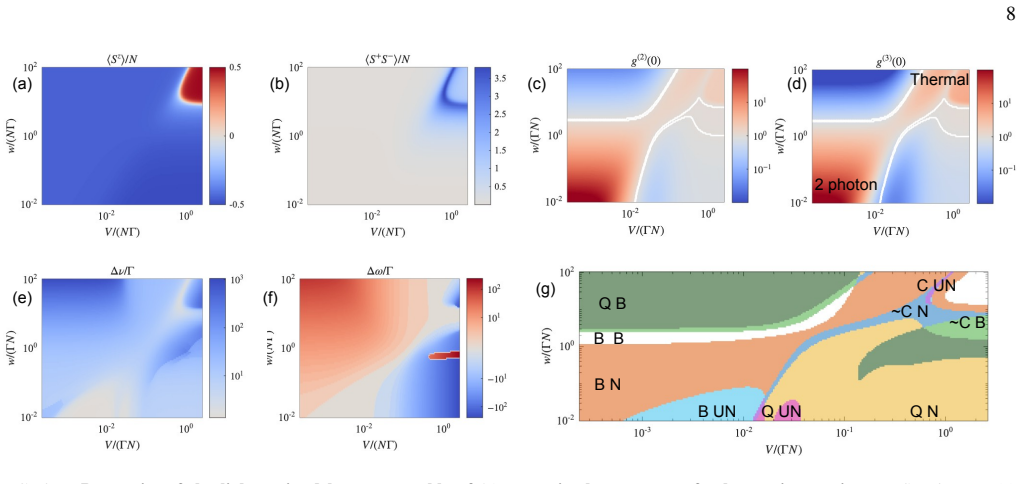
In this setting, collective dissipation induces correlations between the pumped and unpumped parts of the system, leading to interference between their emission contributions. By introducing a relative phase between these contributions and tuning the pump rate, the properties of the emitted light can be varied over a broad range. In particular, the linewidth can be made either independent of system size or scale extensively with it, while the photon statistics can be tuned from antibunched or quantum to bunched. Coherent interactions can alternatively play the role of the relative phase and stabilize regimes of coherent emission with narrow linewidth.
What carries the argument
Interference between emission contributions from the pumped and unpumped atoms, induced by collective dissipation and controlled by a relative phase or by coherent interactions.
Load-bearing premise
A relative phase can be introduced between the emission contributions of the pumped and unpumped atoms without adding decoherence that destroys the interference.
What would settle it
If the measured linewidth always grows with the number of atoms no matter what relative phase and pump rate are chosen, or if second-order photon correlations cannot be shifted from antibunched to bunched as predicted, the interference-based control fails.
Figures




read the original abstract
We study a minimal model of collective light emission from an incoherently driven ensemble of atoms where incoherent drive is applied only to a part of atoms and show that both the linewidth and the photon statistics can be controlled within a single framework. In this setting, collective dissipation induces correlations between the pumped and unpumped parts of the system, leading to interference between their emission contributions. By introducing a relative phase between these contributions and tuning the pump rate, we demonstrate that the properties of the emitted light can be varied over a broad range. In particular, the linewidth can be made either independent of system size or scale extensively with it, while the photon statistics can be tuned from antibunched or quantum to bunched. We further show that the role of the relative phase in controlling the interference can alternatively be played by the coherent interaction. By tuning the interaction strength together with the pump rate, one can access the same regimes as in the dissipation-only model. In addition, coherent interactions stabilize regimes of coherent emission with narrow linewidth, reminiscent of superradiant lasing. Our results illustrate how interference in partially driven collective systems provides a flexible mechanism for tailoring both spectral and statistical properties of light.
Editorial analysis
A structured set of objections, weighed in public.
Referee Report
Summary. The manuscript presents a minimal model of collective light emission from an atomic ensemble with incoherent driving applied only to a subset of atoms. Collective dissipation induces correlations between pumped and unpumped subspaces, enabling interference controlled by a relative phase and the pump rate. This allows the emitted light's linewidth to be tuned between size-independent and extensive scaling with atom number N, while photon statistics are tuned from antibunched to bunched. Coherent dipole-dipole interactions can substitute for the phase control and stabilize narrow-linewidth coherent emission regimes reminiscent of superradiant lasing.
Significance. If the interference-based cancellation mechanism is robust, the work offers a conceptually simple 'one-knob' control framework for tailoring both spectral and statistical properties of light from collective atomic systems. The demonstration that phase (or coherent interaction strength) plus pump rate can access distinct regimes, including stabilized coherent emission, is a useful advance for quantum optics and potential applications in superradiant lasers. The minimal-model approach with both analytical steady-state solutions and supporting numerics is a strength.
major comments (2)
- [§III B, Eq. (10)] §III B (steady-state solution of the master equation truncated at two-body correlations, Eq. (10) and following linewidth expression): The size-independent linewidth regime is obtained from exact cancellation of the N-dependent broadening term by the cross-term arising from collective dissipation between pumped and unpumped subspaces at a specific relative phase. No explicit bound is derived on the error introduced by neglected three-body (or higher) collective decay channels, which can contribute at O(1/N) or larger depending on pump rate and phase; this directly affects whether the claimed cancellation survives for macroscopic N.
- [§IV] §IV (numerical results and finite-size scaling): The distinction between size-independent and extensive linewidth regimes is shown for specific parameter choices, but the plots do not include a systematic scan or error estimate quantifying how the truncation error grows with N when the phase is detuned from the exact cancellation point; this is needed to substantiate the robustness claim.
minor comments (3)
- [§II] Notation for the relative phase φ is introduced without an explicit definition of how it is physically realized in the master equation (e.g., via an additional coherent drive or post-selection); a short clarifying sentence in §II would help.
- [Figure 3] Figure 3 (photon statistics vs. pump rate): the g^{(2)}(0) curves for different phases overlap in a way that makes it hard to distinguish the antibunched regime; consider adding inset zooms or separate panels.
- The abstract states results for both dissipation-only and coherent-interaction cases, but the main text does not explicitly compare the two models' parameter regimes side-by-side; a short summary table would improve clarity.
Simulated Author's Rebuttal
We thank the referee for the positive evaluation of our work and the constructive major comments. We address each point below, clarifying the scope of our minimal model and proposing targeted revisions to strengthen the presentation of its limitations and robustness.
read point-by-point responses
-
Referee: [§III B, Eq. (10)] The size-independent linewidth regime is obtained from exact cancellation of the N-dependent broadening term by the cross-term arising from collective dissipation between pumped and unpumped subspaces at a specific relative phase. No explicit bound is derived on the error introduced by neglected three-body (or higher) collective decay channels, which can contribute at O(1/N) or larger depending on pump rate and phase; this directly affects whether the claimed cancellation survives for macroscopic N.
Authors: We agree that the truncation at two-body correlations (second-order cumulant expansion) in the steady-state solution of Eq. (10) means the exact cancellation is obtained within the approximated equations, and higher-order collective decay channels are neglected. Our minimal model is designed to isolate the interference mechanism between pumped and unpumped subspaces; the analytical expressions and the resulting linewidth scaling are therefore exact only within this truncation. We do not claim the cancellation is exact in the full many-body master equation for arbitrary N. To address the concern, we will add a dedicated paragraph in §III B discussing the validity regime of the truncation, noting that for moderate pump rates and phases near the cancellation point, three-body contributions are expected to be suppressed relative to the retained terms, while acknowledging that a rigorous O(1/N) error bound would require a higher-order expansion or alternative methods not pursued in this work. revision: partial
-
Referee: [§IV] The distinction between size-independent and extensive linewidth regimes is shown for specific parameter choices, but the plots do not include a systematic scan or error estimate quantifying how the truncation error grows with N when the phase is detuned from the exact cancellation point; this is needed to substantiate the robustness claim.
Authors: The numerical results in §IV illustrate the two regimes for finite N using the truncated equations, with comparisons to exact diagonalization for small systems where feasible. We did not provide a systematic finite-size scan of truncation error versus phase detuning. We will revise §IV to include additional data: (i) a plot showing linewidth deviation as a function of small phase detuning for increasing N, and (ii) a brief estimate of the relative size of neglected terms obtained by computing the three-body correlation functions from the steady-state solution of the truncated model. This will better quantify the robustness window around the cancellation phase. revision: yes
Circularity Check
No circularity: derivation proceeds from explicit master-equation solution of a minimal model with tunable phase and pump parameters.
full rationale
The paper defines a minimal collective master equation for a partially pumped ensemble, introduces an explicit relative phase between pumped and unpumped subspaces (or equivalently tunes coherent interaction strength), and solves for steady-state linewidth and g^(2) as functions of those control parameters and system size N. No step equates a fitted quantity to a prediction by construction, renames an input as an output, or relies on a load-bearing self-citation whose content is itself unverified. The size-independent linewidth regime emerges directly from destructive interference in the cross-dissipation term once the phase condition is imposed; this is a calculable consequence of the chosen model rather than a tautology. The truncation to two-body correlations is an explicit modeling choice whose validity is external to the derivation itself.
Axiom & Free-Parameter Ledger
axioms (2)
- domain assumption Collective dissipation induces correlations between pumped and unpumped atoms that produce controllable interference between their emission contributions.
- domain assumption A relative phase between the two emission contributions can be introduced and maintained without additional decoherence.
Reference graph
Works this paper leans on
-
[1]
T. Gao, M. von Helversen, C. Ant´on-Solanas, C. Schneider, and T. Heindel, Atomically-thin single-photon sources for quantum communication, npj 2D Materials and Applications7, 4 (2023)
2023
-
[2]
Lounis and M
B. Lounis and M. Orrit, Single-photon sources, Reports on Progress in Physics68, 1129 (2005)
2005
-
[3]
C. H. Bennett and G. Brassard, Quantum cryptography: Public key distribution and coin tossing, Theoretical computer science 560, 7 (2014)
2014
- [4]
- [5]
-
[6]
E. B. Flagg, S. V . Polyakov, T. Thomay, and G. S. Solomon, Dy- namics of nonclassical light from a single solid-state quantum emitter, Phys. Rev. Lett.109, 163601 (2012)
2012
-
[7]
Haroche, Laser, offspring and powerful enabler of quantum science, PRX Quantum6, 010102 (2025)
S. Haroche, Laser, offspring and powerful enabler of quantum science, PRX Quantum6, 010102 (2025)
2025
-
[8]
S. Karl, A. Zmija, S. Richter, N. V ogel, D. Malyshev, A. Zink, T. Michel, G. Anton, J. von Zanthier, and S. Funk, Comparing different approaches for stellar intensity interfer- ometry, Monthly Notices of the Royal Astronomical Soci- ety512, 1722 (2022), https://academic.oup.com/mnras/article- pdf/512/2/1722/42993259/stac489.pdf
2022
-
[9]
Bromberg, Y
Y . Bromberg, Y . Lahini, E. Small, and Y . Silberberg, Hanbury brown and twiss interferometry with interacting photons, Na- ture Photonics4, 721 (2010)
2010
-
[10]
Kolkowitz, I
S. Kolkowitz, I. Pikovski, N. Langellier, M. D. Lukin, R. L. Walsworth, and J. Ye, Gravitational wave detection with optical lattice atomic clocks, Phys. Rev. D94, 124043 (2016)
2016
-
[11]
Zheng, J
X. Zheng, J. Dolde, and S. Kolkowitz, Reducing the instabil- ity of an optical lattice clock using multiple atomic ensembles, Phys. Rev. X14, 011006 (2024)
2024
-
[12]
Bothwell, C
T. Bothwell, C. J. Kennedy, A. Aeppli, D. Kedar, J. M. Robin- son, E. Oelker, A. Staron, and J. Ye, Resolving the gravitational redshift across a millimetre-scale atomic sample, Nature602, 420 (2022)
2022
-
[13]
A. D. Ludlow, M. M. Boyd, J. Ye, E. Peik, and P. O. Schmidt, Optical atomic clocks, Rev. Mod. Phys.87, 637 (2015)
2015
-
[14]
Meiser, J
D. Meiser, J. Ye, D. R. Carlson, and M. J. Holland, Prospects for a millihertz-linewidth laser, Phys. Rev. Lett.102, 163601 (2009)
2009
-
[15]
Kessler, C
T. Kessler, C. Hagemann, C. Grebing, T. Legero, U. Sterr, F. Riehle, M. Martin, L. Chen, and J. Ye, A sub-40-mhz- linewidth laser based on a silicon single-crystal optical cavity, Nature Photonics6, 687 (2012)
2012
-
[16]
S. B. J ¨ager, H. Liu, A. Shankar, J. Cooper, and M. J. Hol- land, Regular and bistable steady-state superradiant phases of an atomic beam traversing an optical cavity, Phys. Rev. A103, 013720 (2021)
2021
-
[17]
J. T. Reilly, S. B. J¨ager, J. Cooper, and M. J. Holland, Fully col- lective superradiant lasing with vanishing sensitivity to cavity length vibrations (2025), arXiv:2506.12267 [quant-ph]
work page internal anchor Pith review Pith/arXiv arXiv 2025
-
[18]
M. A. Norcia and J. K. Thompson, Cold-strontium laser in the superradiant crossover regime, Phys. Rev. X6, 011025 (2016)
2016
-
[19]
S. L. Kristensen, E. Bohr, J. Robinson-Tait, T. Zelevinsky, J. W. Thomsen, and J. H. M ¨uller, Subnatural linewidth superradi- ant lasing with cold 88Sr atoms, Phys. Rev. Lett.130, 223402 (2023)
2023
-
[20]
M. A. Norcia, J. R. K. Cline, J. A. Muniz, J. M. Robinson, R. B. Hutson, A. Goban, G. E. Marti, J. Ye, and J. K. Thompson, Frequency measurements of superradiance from the strontium clock transition, Phys. Rev. X8, 021036 (2018)
2018
-
[21]
e. a. Abbott, B P, Ligo: the laser interferometer gravitational- wave observatory, Reports on Progress in Physics72, 076901 (2009)
2009
-
[22]
Coddington, N
I. Coddington, N. Newbury, and W. Swann, Dual-comb spec- troscopy, Optica3, 414 (2016)
2016
-
[23]
Y .-H. Zhou, T. Liu, Q.-P. Su, X.-Y . Zhang, Q.-C. Wu, D.-X. Chen, Z.-C. Shi, H. Z. Shen, and C.-P. Yang, Universal photon blockade, Phys. Rev. Lett.134, 183601 (2025)
2025
-
[24]
Kim and F
S. Kim and F. Hassler, Superbunched radiation of a tunnel junc- tion due to charge quantization, Phys. Rev. Lett.133, 116301 (2024)
2024
-
[25]
C. C. Leon, A. Rosławska, A. Grewal, O. Gunnarsson, K. Kuhnke, and K. Kern, Photon superbunching from a generic tunnel junction, Science Advances5, eaav4986 (2019), https://www.science.org/doi/pdf/10.1126/sciadv.aav4986
-
[26]
D. Chen, G. R. Lander, K. S. Krowpman, G. S. Solomon, and E. B. Flagg, Characterization of the local charge environment of a single quantum dot via resonance fluorescence, Phys. Rev. B93, 115307 (2016)
2016
-
[27]
Mehringer, S
T. Mehringer, S. M ¨ahrlein, J. von Zanthier, and G. S. Agarwal, Photon statistics as an interference phenomenon, Opt. Lett.43, 2304 (2018)
2018
-
[28]
Pleinert, J
M.-O. Pleinert, J. von Zanthier, and G. S. Agarwal, Phase con- trol of the quantum statistics of collective emission, Phys. Rev. A97, 023831 (2018)
2018
-
[29]
Many-Body Amplified Nonclassical Photon Emission in Cavity-Coupled Atomic Arrays
T. Jing and Y . Deng, Many-body amplified nonclassical photon emission in cavity-coupled atomic arrays (2026), arXiv:2604.15604 [quant-ph]
work page internal anchor Pith review Pith/arXiv arXiv 2026
-
[30]
Gazzano, T
O. Gazzano, T. Huber, V . Loo, S. Polyakov, E. B. Flagg, and G. S. Solomon, Effects of resonant-laser excitation on the emis- sion properties in a single quantum dot, Optica5, 354 (2018)
2018
-
[31]
Zhang, T
J. Zhang, T. Shi, J. Miao, D. Yu, and J. Chen, An extremely bad-cavity laser, npj Quantum Information10, 87 (2024). 14
2024
-
[32]
Debnath, Y
K. Debnath, Y . Zhang, and K. Mølmer, Lasing in the superradi- ant crossover regime, Phys. Rev. A98, 063837 (2018)
2018
-
[33]
M. Du, Q. Bin, Q.-Y . Qiu, F. Nori, and X.-Y . L ¨u, Exceptional point superradiant lasing with ultranarrow linewidth, Phys. Rev. Lett.136, 063602 (2026)
2026
-
[34]
Nadolny, M
T. Nadolny, M. Brunelli, and C. Bruder, Nonreciprocal interac- tions induce frequency shifts in superradiant lasers, Phys. Rev. Lett.134, 193603 (2025)
2025
-
[35]
Bychek, R
A. Bychek, R. Holzinger, and H. Ritsch, Nanoscale mirrorless superradiant lasing, Phys. Rev. Lett.135, 143601 (2025)
2025
-
[36]
Holzinger, D
R. Holzinger, D. Plankensteiner, L. Ostermann, and H. Ritsch, Nanoscale coherent light source, Phys. Rev. Lett.124, 253603 (2020)
2020
-
[37]
Breuer and F
H.-P. Breuer and F. Petruccione,The theory of open quantum systems(OUP Oxford, 2002)
2002
-
[38]
M. Stefanini, A. A. Ziolkowska, D. Budker, U. Poschinger, F. Schmidt-Kaler, A. Browaeys, A. Imamoglu, D. Chang, and J. Marino, Is Lindblad for me? (2025), arXiv:2506.22436 [quant-ph]
work page internal anchor Pith review Pith/arXiv arXiv 2025
-
[39]
Fazio, J
R. Fazio, J. Keeling, L. Mazza, and M. Schir`o, Many-body open quantum systems, SciPost Phys. Lect. Notes , 99 (2025)
2025
-
[40]
D. F. Walls and G. J. Milburn,Quantum optics(Springer Sci- ence & Business Media, 2008)
2008
-
[41]
Thomay, S
T. Thomay, S. V . Polyakov, O. Gazzano, E. Goldschmidt, Z. D. Eldredge, T. Huber, V . Loo, and G. S. Solomon, Simultaneous, full characterization of a single-photon state, Phys. Rev. X7, 041036 (2017)
2017
-
[42]
For finite system sizes,g (2)(0) is slightly larger than 1 due to the 1/Ncorrections
-
[43]
M. D. Eisaman, J. Fan, A. Migdall, and S. V . Polyakov, Invited review article: Single-photon sources and detectors, Review of Scientific Instruments82, 071101 (2011)
2011
-
[44]
J. W. N. Los, M. Sidorova, B. Lopez-Rodriguez, P. Qualm, J. Chang, S. Steinhauer, V . Zwiller, and I. E. Zadeh, High- performance photon number resolving detectors for 850–950 nm wavelength range, APL Photonics9, 066101 (2024)
2024
-
[45]
O. S. Maga ˜na-Loaiza, R. d. J. Le ´on-Montiel, A. Perez-Leija, A. B. U’Ren, C. You, K. Busch, A. E. Lita, S. W. Nam, R. P. Mirin, and T. Gerrits, Multiphoton quantum-state engineering using conditional measurements, npj Quantum information5, 80 (2019)
2019
-
[46]
G. Xu, J. Carvalho, C. Wijesundara, and T. Thomay, Optimized higher-order photon state classification by machine learning, APL Quantum1, 036122 (2024)
2024
-
[47]
Numerically, we find∆ν≲2.5Γas a reasonable cutofffor the ultra-narrow regime
-
[48]
H. J. Carmichael,Statistical methods in quantum optics 1: mas- ter equations and Fokker-Planck equations(Springer Science & Business Media, 2013)
2013
-
[49]
Scarlatella, A
O. Scarlatella, A. A. Clerk, and M. Schir `o, Spectral functions and negative density of states of a driven-dissipative nonlinear quantum resonator, New Journal of Physics21, 043040 (2019)
2019
-
[50]
Gross and S
M. Gross and S. Haroche, Superradiance: An essay on the the- ory of collective spontaneous emission, Physics reports93, 301 (1982)
1982
-
[51]
As mentioned above, one can alternatively keep the jump op- erator in the formD[σ − +J −] but redefine the observables as S ± =e ±iϕσ± +J ±, which effectively introduces the same phase shift in the emitted field
-
[52]
The case of complex eigenvalues and exceptional points is mentioned later in the text
This choice is made for simplicity, in order to keep all eigen- values real. The case of complex eigenvalues and exceptional points is mentioned later in the text
-
[53]
Since the decay at later times is exponential, the spectral function is mainly sensitive to the small-time behavior, especially close to the dip atω=0
This is essentially a continuity argument: ⟨J+(t=0)σ −(0)⟩ <0 and⟨σ +(t=0)J −(0)⟩<0, and thus remain negative (in real part) in a neighborhood oft=0. Since the decay at later times is exponential, the spectral function is mainly sensitive to the small-time behavior, especially close to the dip atω=0
-
[54]
Here, for example, |↑↓⟩ denotes the state in which the pumped atom is excited and the unpumped atom is in the ground state
The unnormalized steady-state density matrix for the two-spin model reads ρss ∝v W 2Γ 0 0 0 0 1− W+2Γ 2Γ eiϕ 0 0− W+2Γ 2Γ e−iϕ 6WΓ+W 2+2Γ2 2Γ2 0 0 0 0 W+4Γ 2Γ vT wherev= h |↑↑⟩ , |↓↑⟩ , |↑↓⟩ , |↓↓⟩ i is the basis vector. Here, for example, |↑↓⟩ denotes the state in which the pumped atom is excited and the unpumped atom is i...
-
[55]
Y . Ashida, Z. Gong, and M. Ueda, Non-hermitian physics, Advances in Physics69, 249 (2020), https://doi.org/10.1080/00018732.2021.1876991
-
[56]
Bojer, A
M. Bojer, A. Cidrim, P. P. Abrantes, R. Bachelard, and J. von Zanthier, Light statistics from large ensembles of independent two-level emitters: Classical and nonclassical effects, Phys. Rev. A112, L061701 (2025)
2025
-
[57]
Reiter and A
F. Reiter and A. S. Sørensen, Effective operator formalism for open quantum systems, Phys. Rev. A85, 032111 (2012)
2012
-
[58]
Marino, Universality class of ising critical states with long- range losses, Phys
J. Marino, Universality class of ising critical states with long- range losses, Phys. Rev. Lett.129, 050603 (2022)
2022
-
[59]
Stefanini, Y .-F
M. Stefanini, Y .-F. Qu, T. Esslinger, S. Gopalakrishnan, E. Demler, and J. Marino, Dissipative realization of kondo mod- els, Communications Physics8, 212 (2025)
2025
-
[60]
Y .-F. Qu, M. Stefanini, T. Shi, T. Esslinger, S. Gopalakrishnan, J. Marino, and E. Demler, Variational approach to the dynam- ics of dissipative quantum impurity models, Phys. Rev. B111, 155113 (2025)
2025
-
[61]
Chelpanova, A
O. Chelpanova, A. Lerose, S. Zhang, I. Carusotto, Y . Tserkovnyak, and J. Marino, Intertwining of lasing and superradiance under spintronic pumping, Phys. Rev. B 108, 104302 (2023)
2023
-
[62]
Gribben, A
D. Gribben, A. Sanpera, R. Fazio, J. Marino, and F. Iemini, Boundary time crystals as AC sensors: Enhancements and con- straints, SciPost Phys.18, 100 (2025)
2025
-
[63]
F. Balducci and A. A. Ziolkowska, The deep hilbert space of all-to-all interacting su(3) atoms: from quantum to classical (2025), arXiv:2512.05184 [quant-ph]
-
[64]
Iemini, D
F. Iemini, D. Chang, and J. Marino, Dynamics of inhomoge- neous spin ensembles with all-to-all interactions: Breaking per- mutational invariance, Phys. Rev. A109, 032204 (2024)
2024
-
[65]
X. Li, J. Marino, D. E. Chang, and B. Flebus, Solid-state plat- form for cooperative quantum dynamics driven by correlated emission, Phys. Rev. B111, 064424 (2025)
2025
-
[66]
Many-Body Super- and Subradiance in Ordered Atomic Arrays
A. Douglas, L. Su, M. Szurek, R. Groth, S. Brandstetter, O. Markovi ´c, O. Rubies-Bigorda, S. Ostermann, S. F. Yelin, and M. Greiner, Many-body super- and subradiance in ordered atomic arrays (2026), arXiv:2604.11795 [quant-ph]
work page internal anchor Pith review Pith/arXiv arXiv 2026
-
[67]
D. Chen, G. R. Lander, G. S. Solomon, and E. B. Flagg, Polarization-dependent interference of coherent scattering from orthogonal dipole moments of a resonantly excited quantum dot, Phys. Rev. Lett.118, 037401 (2017)
2017
-
[68]
Altland and B
A. Altland and B. D. Simons,Condensed matter field theory (Cambridge university press, 2010)
2010
-
[69]
Raimond and S
J.-M. Raimond and S. Haroche,Exploring the quantum, V ol. 82 (2006) p. 17
2006
- [70]
-
[71]
M. J. Klein, Principle of detailed balance, Phys. Rev.97, 1446 (1955)
1955
-
[72]
Y . Shimshi and E. Shahmoon, Dissipative phase transition and metrology in collectively pumped superradiance (2024), arXiv:2408.12243 [quant-ph]
-
[73]
We note that this effective temperature describes a state con- fined within the Dicke manifold at a fixedJ, so it still has much more structure than the maximally mixed state extended to the whole Hilbert space
-
[74]
Mivehvar, F
F. Mivehvar, F. Piazza, T. Donner, and H. Ritsch, Cavity qed with quantum gases: New paradigms in many-body physics, Advances in Physics70, 1 (2021)
2021
discussion (0)
Sign in with ORCID, Apple, or X to comment. Anyone can read and Pith papers without signing in.