Recognition: unknown
A New Cloud-Cloud Collision Source N68 toward the G35 Molecular Cloud Complex
Pith reviewed 2026-05-10 08:31 UTC · model grok-4.3
The pith
N68 is a new cloud-cloud collision site in the G35 complex where two molecular clouds are colliding, triggering massive star formation alongside collect-and-collapse and radiation-driven implosion processes.
A machine-rendered reading of the paper's core claim, the machinery that carries it, and where it could break.
Core claim
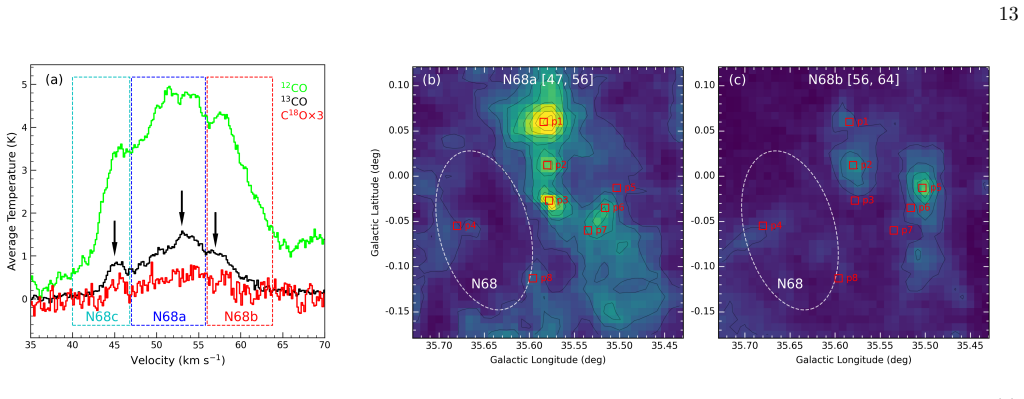
Bubble N68 shows clear cloud-cloud collision signatures with two distinct molecular clouds (N68a: 47-56 km s^{-1}; N68b: 56-64 km s^{-1}), broad bridge features, and complementary distributions; the CCC mechanism tends to trigger massive stars rather than enhance star formation efficiency.
Load-bearing premise
That the observed velocity components and morphological features unambiguously indicate a physical cloud-cloud collision rather than projection effects, internal turbulence, or unrelated overlapping clouds, and that the listed star formation tracers are causally linked to the collision.
Figures




read the original abstract
Bubble N68 in the G35 complex shows clear cloud-cloud collision (CCC) signatures. Its semi-ring-like morphology harbors many significant massive star formation tracers: 6 HII regions, 4 6.7 GHz masers, 5 Midcourse Space Experiment sources, 9 radio peaks, and nearly 10 O/B-type stars. We also identified 163 young stellar objects (45 Class I, 5 Flat, 113 Class II), indicating active star formation toward N68. Our molecular study with CO reveals two distinct molecular clouds (N68a: 47-56 km s$^{-1}$; N68b: 56-64 km s$^{-1}$), with broad bridge features and complementary distributions at their borders, indicating an ongoing CCC. Star formation in N68 is collectively driven by collect-and-collapse (CC), radiation-driven implosion (RDI), and CCC mechanisms. However, compared with the CC and RDI mechanisms, the CCC mechanism does not enhance the star formation efficiency; instead, it tends to trigger the formation of massive stars. N68, along with bubbles N65 and N61, constructs a $\sim100$ pc scale CCC system in the G35 complex.
Editorial analysis
A structured set of objections, weighed in public.
Referee Report
Summary. The manuscript identifies bubble N68 in the G35 molecular cloud complex as a new cloud-cloud collision (CCC) source. Using CO observations, it reports two distinct velocity components (N68a: 47-56 km s^{-1}; N68b: 56-64 km s^{-1}) exhibiting broad bridge features and complementary spatial distributions at their borders. The paper catalogs extensive massive star formation tracers (6 HII regions, 4 6.7 GHz masers, 5 MSX sources, 9 radio peaks, ~10 O/B stars, and 163 YSOs) and concludes that star formation is collectively driven by collect-and-collapse (CC), radiation-driven implosion (RDI), and CCC, with CCC preferentially triggering massive stars without enhancing overall star formation efficiency relative to CC/RDI. N68 is proposed as part of a ~100 pc-scale CCC system with bubbles N65 and N61.
Significance. If the kinematic interpretation is robustly supported, the work adds a well-documented case to the observational literature on CCC-triggered massive star formation in Galactic molecular complexes. The comparative assessment of CCC versus CC/RDI effects on star formation modes and the suggestion of a large-scale interconnected system could inform models of triggered star formation and cloud dynamics on ~100 pc scales.
major comments (3)
- [§3] §3 (Molecular observations and kinematics): The broad bridge features and complementary distributions are described qualitatively without quantitative support such as velocity dispersion statistics in the bridge region, intensity enhancement factors, or spatial cross-correlation metrics between the integrated intensity maps of the two velocity components. This is load-bearing for the central CCC claim, as the features remain compatible with line-of-sight overlap or internal turbulence in the G35 complex (cf. reader's weakest assumption).
- [§5] §5 (Discussion of star formation mechanisms): The claim that CCC 'does not enhance the star formation efficiency' but 'tends to trigger the formation of massive stars' lacks explicit SFE calculations (e.g., total YSO mass or number per unit gas mass, area definitions, or error estimates) and direct numerical comparison to CC/RDI in N68 or the referenced N65/N61 bubbles. This undermines the differential-effect conclusion.
- [§4] §4 (Star formation tracers): The attribution of the listed tracers (HII regions, masers, YSOs) to the CCC is asserted via positional coincidence but without quantitative analysis such as surface density contrasts at the cloud interface versus elsewhere or age estimates linking formation timing to the collision.
minor comments (2)
- [Abstract, §3] Velocity ranges in the abstract and §3 should be presented with consistent formatting and any associated uncertainties or channel widths from the CO data.
- The manuscript would benefit from a table summarizing the positions and properties of the identified star formation tracers for easier cross-reference with the molecular maps.
Circularity Check
No significant circularity in observational CCC interpretation
full rationale
The paper's claims rest on direct CO line observations identifying two velocity components (47-56 and 56-64 km/s), broad bridge features, and complementary spatial distributions at borders, interpreted via established CCC morphological/kinematic criteria. No mathematical derivations, fitted parameters, or equations are used that reduce conclusions to self-referential inputs by construction. Attributions of star formation tracers (HII regions, masers, YSOs) to CC/RDI/CCC mechanisms and the comparative statement on SFE vs. massive star triggering are based on catalog counts and qualitative morphology, without redefinition or self-citation chains that force the result. The analysis remains self-contained against external benchmarks.
Axiom & Free-Parameter Ledger
axioms (1)
- domain assumption Distinct velocity components in CO emission represent physically separate molecular clouds undergoing collision.
Reference graph
Works this paper leans on
-
[1]
Anderson, L. D., & Bania, T. M. 2009, ApJ, 690, 706, doi: 10.1088/0004-637X/690/1/706
-
[2]
Anderson, L. D., Bania, T. M., Balser, D. S., et al. 2014, ApJS, 212, 1, doi: 10.1088/0067-0049/212/1/1
-
[3]
Baug, T., Dewangan, L. K., Ojha, D. K., et al. 2018, ApJ, 852, 119, doi: 10.3847/1538-4357/aaa429
-
[4]
Benjamin, R. A., Churchwell, E., Babler, B. L., et al. 2003, PASP, 115, 953, doi: 10.1086/376696
-
[5]
G., W¨ unsch, R., Whitworth, A
Bisbas, T. G., W¨ unsch, R., Whitworth, A. P., Hubber, D. A., & Walch, S. 2011, ApJ, 736, 142, doi: 10.1088/0004-637X/736/2/142
-
[6]
Brunthaler, A., Menten, K. M., Dzib, S. A., et al. 2021, A&A, 651, A85, doi: 10.1051/0004-6361/202039856
-
[7]
J., Noriega-Crespo, A., Mizuno, D
Carey, S. J., Noriega-Crespo, A., Mizuno, D. R., et al. 2009, PASP, 121, 76, doi: 10.1086/596581
-
[8]
2024a, MNRAS, 535, 419, doi: 10.1093/mnras/stae2394
Chen, E., Chen, X., Chen, X., Fang, M., & He, Q. 2024a, MNRAS, 535, 419, doi: 10.1093/mnras/stae2394
-
[9]
2025, ApJ, 985, 120, doi: 10.3847/1538-4357/adc9a3
Chen, E., Chen, X., Fang, M., et al. 2025, ApJ, 985, 120, doi: 10.3847/1538-4357/adc9a3
-
[10]
2024b, MNRAS, 527, 4297, doi: 10.1093/mnras/stad3459
Chen, E., Gao, Y., Zhang, S., et al. 2024b, MNRAS, 527, 4297, doi: 10.1093/mnras/stad3459
-
[11]
2002, , 40, 27, 10.1146/annurev.astro.40.060401.093845
Churchwell, E. 2002, ARA&A, 40, 27, doi: 10.1146/annurev.astro.40.060401.093845
-
[12]
Churchwell, E., Povich, M. S., Allen, D., et al. 2006, ApJ, 649, 759, doi: 10.1086/507015 21
-
[13]
Condon, J. J. 1992, ARA&A, 30, 575, doi: 10.1146/annurev.aa.30.090192.003043
-
[14]
Condon, J. J., Cotton, W. D., Greisen, E. W., et al. 1998, AJ, 115, 1693, doi: 10.1086/300337
-
[15]
Ram Pressure Stripping of Disc Galaxies: The Role of the Inclination Angle , shorttitle =
Dale, J. E., Bonnell, I. A., & Whitworth, A. P. 2007a, MNRAS, 375, 1291, doi: 10.1111/j.1365-2966.2006.11368.x
-
[16]
Dale, J. E., Clark, P. C., & Bonnell, I. A. 2007b, MNRAS, 377, 535, doi: 10.1111/j.1365-2966.2007.11515.x
-
[17]
2005, A&A, 433, 565, doi: 10.1051/0004-6361:20041946
Deharveng, L., Zavagno, A., & Caplan, J. 2005, A&A, 433, 565, doi: 10.1051/0004-6361:20041946
-
[18]
Deharveng, L., Schuller, F., Anderson, L. D., et al. 2010, A&A, 523, A6, doi: 10.1051/0004-6361/201014422
-
[19]
Dewangan, L. K., Ojha, D. K., Zinchenko, I., & Baug, T. 2018, ApJ, 861, 19, doi: 10.3847/1538-4357/aac6bb
-
[20]
E., & Williams, D
Dyson, J. E., & Williams, D. A. 1980, Physics of the interstellar medium (Manchester Univ. Press, Manchester)
1980
-
[21]
Elmegreen, B. G., & Lada, C. J. 1977, ApJ, 214, 725, doi: 10.1086/155302
-
[22]
2021, PASJ, 73, S75, doi: 10.1093/pasj/psz119
Enokiya, R., Torii, K., & Fukui, Y. 2021, PASJ, 73, S75, doi: 10.1093/pasj/psz119
-
[23]
doi:10.1088/0067-0049/181/2/321 , eprint =
Evans, Neal J., I., Dunham, M. M., Jørgensen, J. K., et al. 2009, ApJS, 181, 321, doi: 10.1088/0067-0049/181/2/321
-
[24]
Fazio, G. G., Hora, J. L., Allen, L. E., et al. 2004, ApJS, 154, 10, doi: 10.1086/422843
-
[25]
Fukui, Y., Habe, A., Inoue, T., Enokiya, R., & Tachihara, K. 2021, PASJ, 73, S1, doi: 10.1093/PASJ/psaa103
-
[26]
2014, ApJ, 780, 36, doi: 10.1088/0004-637X/780/1/36
Fukui, Y., Ohama, A., Hanaoka, N., et al. 2014, ApJ, 780, 36, doi: 10.1088/0004-637X/780/1/36
-
[27]
2016, ApJ, 820, 26, doi: 10.3847/0004-637X/820/1/26
Fukui, Y., Torii, K., Ohama, A., et al. 2016, ApJ, 820, 26, doi: 10.3847/0004-637X/820/1/26
-
[28]
2018a, ApJ, 859, 166, doi: 10.3847/1538-4357/aac217
Fukui, Y., Torii, K., Hattori, Y., et al. 2018a, ApJ, 859, 166, doi: 10.3847/1538-4357/aac217
-
[29]
2018b, PASJ, 70, S601, doi: 10.1093/PASJ/psy051
Fukui, Y., Kohno, M., Yokoyama, K., et al. 2018b, PASJ, 70, S601, doi: 10.1093/PASJ/psy051
-
[30]
2007, ApJ, 654, 316, doi: 10.1086/509112
Wang, J. 2007, ApJ, 654, 316, doi: 10.1086/509112
-
[31]
2017, ApJLetters, 835, 1, doi: 10.3847/2041-8213/835/1/L14
Gong, Y., Fang, M., Mao, R., et al. 2017, ApJLetters, 835, 1, doi: 10.3847/2041-8213/835/1/L14
-
[32]
Guieu, S., Rebull, L. M., Stauffer, J. R., et al. 2010, ApJ, 720, 46, doi: 10.1088/0004-637X/720/1/46
-
[33]
Gutermuth, R. a., Megeath, S. T., Myers, P. C., et al. 2009, ApJS, 184, 18, doi: 10.1088/0067-0049/184/1/18
-
[34]
1992, PASJ, 44, 203, doi: 10.1093/pasj/44.3.203
Habe, A., & Ohta, K. 1992, PASJ, 44, 203, doi: 10.1093/pasj/44.3.203
-
[35]
Habing, H. J. 1968, BAN, 19, 421
1968
-
[36]
2019, PASJ, 71, 6, doi: 10.1093/pasj/psy126
Hanaoka, M., Kaneda, H., Suzuki, T., et al. 2019, PASJ, 71, 6, doi: 10.1093/pasj/psy126
-
[37]
Hartmann, L., Megeath, S. T., Allen, L., et al. 2005, ApJ, 629, 881, doi: 10.1086/431472
-
[38]
Haworth, T. J., Shima, K., Tasker, E. J., et al. 2015a, MNRAS, 454, 1634, doi: 10.1093/mnras/stv2068
-
[39]
Haworth, T. J., Tasker, E. J., Fukui, Y., et al. 2015b, MNRAS, 450, 10, doi: 10.1093/mnras/stv639
-
[40]
2006, AJ, 131, 2525, doi: 10.1086/503253
Tuttle, S. 2006, AJ, 131, 2525, doi: 10.1086/503253
-
[41]
Hoare, M. G., Purcell, C. R., Churchwell, E. B., et al. 2012, PASP, 124, 939, doi: 10.1086/668058
-
[42]
J., Takahashi, T., & Tielens, A
Hollenbach, D. J., Takahashi, T., & Tielens, A. G. G. M. 1991, ApJ, 377, 192, doi: 10.1086/170347
-
[43]
2013, ApJL, 774, L31, doi: 10.1088/2041-8205/774/2/L31
Inoue, T., & Fukui, Y. 2013, ApJL, 774, L31, doi: 10.1088/2041-8205/774/2/L31
-
[44]
Klaassen, P. D., & Wilson, C. D. 2007, ApJ, 663, 1092, doi: 10.1086/518760
-
[45]
2021, PASJ, 73, S129, doi: 10.1093/pasj/psaa015
Kohno, M., Tachihara, K., Torii, K., et al. 2021, PASJ, 73, S129, doi: 10.1093/pasj/psaa015
-
[46]
2008, A&A, 477, 547, doi: 10.1051/0004-6361:20077815
Kramer, C., Cubick, M., R¨ ollig, M., et al. 2008, A&A, 477, 547, doi: 10.1051/0004-6361:20077815
-
[47]
Ladeyschikov, D. A., Bayandina, O. S., & Sobolev, A. M. 2019, AJ, 158, 233, doi: 10.3847/1538-3881/ab4b4c
-
[48]
Lawrence, A., Warren, S. J., Almaini, O., et al. 2007, MNRAS, 379, 1599, doi: 10.1111/j.1365-2966.2007.12040.x
-
[49]
Lumsden, S. L., Hoare, M. G., Urquhart, J. S., et al. 2013, ApJS, 208, 11, doi: 10.1088/0067-0049/208/1/11
-
[50]
Marsh, K. A., Whitworth, A. P., Lomax, O., et al. 2017, MNRAS, 471, 2730, doi: 10.1093/mnras/stx1723 Masqu´ e, J. M., Rodr´ ıguez, L. F., Trinidad, M. A., et al. 2017, ApJ, 836, 96, doi: 10.3847/1538-4357/836/1/96
-
[51]
2010, PASP, 122, 314, doi: 10.1086/651314
Molinari, S., Swinyard, B., Bally, J., et al. 2010, PASP, 122, 314, doi: 10.1086/651314
-
[52]
Nguyen, H., Rugel, M. R., Murugeshan, C., et al. 2022, A&A, 666, A59, doi: 10.1051/0004-6361/202244115
-
[53]
Rebull, L. M., Johnson, C. H., Hoette, V., et al. 2011, AJ, 142, 25, doi: 10.1088/0004-6256/142/1/25
-
[54]
Reid, M. J., Dame, T. M., Menten, K. M., & Brunthaler, A. 2016, ApJ, 823, 77, doi: 10.3847/0004-637X/823/2/77
-
[55]
Reid, M. J., Menten, K. M., Brunthaler, A., et al. 2014, ApJ, 783, 130, doi: 10.1088/0004-637X/783/2/130 —. 2019, ApJ, 885, 131, doi: 10.3847/1538-4357/ab4a11
-
[56]
2013, A&A, 554, A6, doi: 10.1051/0004-6361/201321081
Roccatagliata, V., Preibisch, T., Ratzka, T., & Gaczkowski, B. 2013, A&A, 554, A6, doi: 10.1051/0004-6361/201321081
-
[57]
Sandford, II, M. T., Whitaker, R. W., & Klein, R. I. 1982, ApJ, 260, 183, doi: 10.1086/160245
-
[58]
Schuller, F., Menten, K. M., Contreras, Y., et al. 2009, A&A, 504, 415, doi: 10.1051/0004-6361/200811568 22
-
[59]
2012, IEEE Transactions on Terahertz Science and Technology, 2, 593, doi: 10.1109/TTHZ.2012.2213818
Shan, W., Yang, J., Shi, S., et al. 2012, IEEE Transactions on Terahertz Science and Technology, 2, 593, doi: 10.1109/TTHZ.2012.2213818
-
[60]
2024, ApJ, 974, 239, doi: 10.3847/1538-4357/ad6a5f
Shen, X., Liu, H.-L., Ren, Z., et al. 2024, ApJ, 974, 239, doi: 10.3847/1538-4357/ad6a5f
-
[61]
Smith, L. J., Norris, R. P. F., & Crowther, P. A. 2002, MNRAS, 337, 1309, doi: 10.1046/j.1365-8711.2002.06042.x
-
[62]
Spitzer, L. 1978, Physical processes in the interstellar medium (Wiley, New York), doi: 10.1002/9783527617722 Str¨ omgren, B. 1939, ApJ, 89, 526, doi: 10.1086/144074
-
[63]
2019, ApJS, 240, 9, doi: 10.3847/1538-4365/aaf1c8
Su, Y., Yang, J., Zhang, S., et al. 2019, ApJS, 240, 9, doi: 10.3847/1538-4365/aaf1c8
-
[64]
1991, ApJS, 77, 59, doi: 10.1086/191597
Sugitani, K., Fukui, Y., & Ogura, K. 1991, ApJS, 77, 59, doi: 10.1086/191597
-
[65]
Takahira, K., Shima, K., Habe, A., & Tasker, E. J. 2018, PASJ, 70, S58, doi: 10.1093/pasj/psy011
-
[66]
2011, ApJ, 738, 46, doi: 10.1088/0004-637X/738/1/46
Torii, K., Enokiya, R., Sano, H., et al. 2011, ApJ, 738, 46, doi: 10.1088/0004-637X/738/1/46
-
[67]
Torii, K., Hasegawa, K., Hattori, Y., et al. 2015, ApJ, 806, 7, doi: 10.1088/0004-637X/806/1/7
-
[68]
2017, ApJ, 835, 142, doi: 10.3847/1538-4357/835/2/142
Torii, K., Hattori, Y., Hasegawa, K., et al. 2017, ApJ, 835, 142, doi: 10.3847/1538-4357/835/2/142
-
[69]
2017, PASJ, 69, 78, doi: 10.1093/pasj/psx061 van Dishoeck, E
Umemoto, T., Minamidani, T., Kuno, N., et al. 2017, PASJ, 69, 78, doi: 10.1093/pasj/psx061
-
[70]
Urquhart, J. S., Hoare, M. G., Lumsden, S. L., Oudmaijer, R. D., & Moore, T. J. T. 2008, in Astronomical Society of the Pacific Conference Series, Vol. 387, Massive Star Formation: Observations Confront Theory, ed. H. Beuther, H. Linz, & T. Henning, 381, doi: 10.48550/arXiv.0711.4715
-
[71]
Urquhart, J. S., Moore, T. J. T., Schuller, F., et al. 2013, MNRAS, 431, 1752, doi: 10.1093/mnras/stt287
-
[72]
Whitworth, A. P., Bhattal, A. S., Chapman, S. J., Disney, M. J., & Turner, J. A. 1994, MNRAS, 268, 291, doi: 10.1093/mnras/268.1.291
-
[73]
2016, ApJ, 819, 117, doi: 10.3847/0004-637X/819/2/117
Xu, J.-L., Li, D., Zhang, C.-P., et al. 2016, ApJ, 819, 117, doi: 10.3847/0004-637X/819/2/117
-
[74]
Zhang, B., Moscadelli, L., Sato, M., et al. 2014, ApJ, 781, 89, doi: 10.1088/0004-637X/781/2/89
-
[75]
2013, Research in Astronomy and Astrophysics, 13, 47, doi: 10.1088/1674-4527/13/1/006
Zhang, C.-P., & Wang, J.-J. 2013, Research in Astronomy and Astrophysics, 13, 47, doi: 10.1088/1674-4527/13/1/006
discussion (0)
Sign in with ORCID, Apple, or X to comment. Anyone can read and Pith papers without signing in.