Recognition: unknown
Hilbert Space Fragmentation and Gauge Symmetry
Pith reviewed 2026-05-10 07:42 UTC · model grok-4.3
The pith
A non-gauge-invariant dipole spin chain Hamiltonian exactly simulates gauge theory dynamics inside its fragmented sectors via emergent non-invertible symmetries.
A machine-rendered reading of the paper's core claim, the machinery that carries it, and where it could break.
Core claim
The central claim is that the fragmented Hilbert space of the dipole-conserving S=1 spin chain contains sectors labeled by emergent non-invertible symmetries that act as gauge symmetries valid only inside those subspaces, so that time evolution under the non-gauge-invariant Hamiltonian reproduces the exact dynamics of a gauge theory within each labeled sector.
What carries the argument
Emergent non-invertible symmetries that label exponentially many fragmented sectors and enforce gauge-like constraints only inside those subspaces.
If this is right
- Exponentially many sectors of the chain become equivalent to distinct gauge-theory sectors.
- Gauge-theory simulations can be performed without enforcing gauge invariance on the full Hamiltonian.
- The same fragmentation pattern supplies a natural labeling of sectors that replaces explicit gauge fixing.
- Higher-form symmetries of lattice gauge theories appear inside the spin-chain description without additional construction.
Where Pith is reading between the lines
- The mechanism may generalize to other dipole-conserving or fragmented spin models, offering a route to embed gauge theories in systems that lack obvious local symmetries.
- Experimental platforms that naturally realize dipole conservation could implement gauge-theory dynamics by preparing states inside the relevant fragments rather than by Hamiltonian engineering.
- Connections between Hilbert-space fragmentation and the exponentially many sectors of higher-form gauge theories become directly testable in one-dimensional chains.
Load-bearing premise
The non-invertible symmetries are genuinely emergent gauge symmetries that remain valid and correctly label the sectors only inside the fragmented subspaces.
What would settle it
A concrete counterexample would be a sector identified as gauge-symmetric where the time evolution under the Hamiltonian produces states or transitions forbidden by the expected gauge constraints.
Figures

read the original abstract
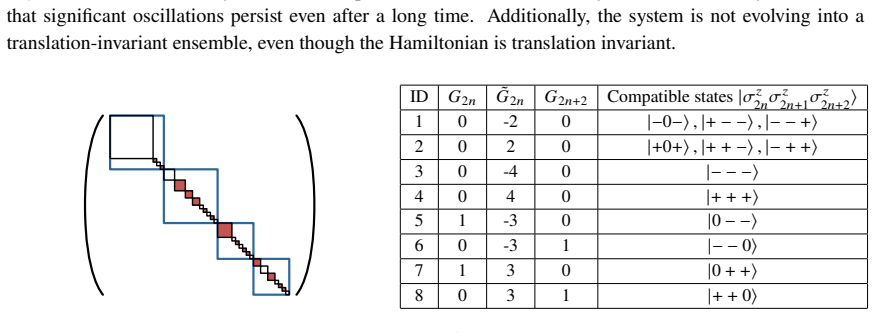
The Hamiltonian formulation of lattice gauge theories plays a central role in quantum simulations of gauge theories, and understanding their spectrum and other properties is expected to become crucial in the upcoming years. The relevant Hamiltonians in this framework possess local symmetry at each lattice site and may exhibit higher-form symmetries. There are then an exponentially large number of dynamically disconnected symmetry sectors, most of which are not translation-invariant. An exponential number of dynamically disconnected sectors, i.e., Hilbert space fragmentation, can also occur in systems in which no such symmetries have been identified. In this contribution, we describe an emergent gauge symmetry that is valid only in a subset of sectors of the fragmented $S=1$ dipole-conserving spin chain. These non-invertible symmetries can label exponentially many of the model's sectors. Simulating this Hamiltonian, which is not gauge-invariant, yields an exact quantum simulation of a gauge theory.
Editorial analysis
A structured set of objections, weighed in public.
Referee Report
Summary. The paper examines the S=1 dipole-conserving spin chain, which exhibits Hilbert space fragmentation into exponentially many sectors. It identifies emergent non-invertible symmetries that function as gauge symmetries but are valid only within a subset of these sectors, where they label the sectors. The central claim is that time evolution generated by the non-gauge-invariant Hamiltonian, when restricted to these symmetry-labeled subspaces, constitutes an exact quantum simulation of a gauge theory.
Significance. If the emergent symmetries are shown to enforce exact gauge invariance within the relevant fragmented sectors, the work establishes a direct link between Hilbert space fragmentation and lattice gauge theory dynamics. This could provide a new route to quantum simulations of gauge theories that avoids explicit gauge-invariant Hamiltonians, with potential implications for understanding constrained dynamics and non-invertible symmetries in many-body systems.
major comments (2)
- [Abstract] Abstract: The claim that 'Simulating this Hamiltonian, which is not gauge-invariant, yields an exact quantum simulation of a gauge theory' is the load-bearing assertion but is not supported by an explicit demonstration that the restricted dynamics preserve the Gauss-law-like constraints. The manuscript must provide a calculation showing that the effective Hamiltonian (or time-evolution operator) in the symmetry-labeled sectors commutes with the non-invertible symmetry generators.
- [Model and symmetries] The identification of the non-invertible symmetries and the fragmented sectors: The paper states these symmetries 'are valid only in a subset of sectors' and 'can label exponentially many,' but without an explicit operator definition or verification that [H, symmetry generator] vanishes inside those sectors (as opposed to merely labeling them), the equivalence to gauge-theory dynamics remains unestablished.
minor comments (1)
- [Abstract] The abstract would benefit from a concise statement of the specific form of the dipole-conserving Hamiltonian and the non-invertible symmetry operators to make the claim more self-contained.
Simulated Author's Rebuttal
We thank the referee for their careful reading of the manuscript and for highlighting the need for greater explicitness in the central claims. We address each major comment below and will revise the manuscript to incorporate the requested calculations and clarifications.
read point-by-point responses
-
Referee: [Abstract] Abstract: The claim that 'Simulating this Hamiltonian, which is not gauge-invariant, yields an exact quantum simulation of a gauge theory' is the load-bearing assertion but is not supported by an explicit demonstration that the restricted dynamics preserve the Gauss-law-like constraints. The manuscript must provide a calculation showing that the effective Hamiltonian (or time-evolution operator) in the symmetry-labeled sectors commutes with the non-invertible symmetry generators.
Authors: We agree that the abstract's central claim requires stronger support through explicit verification. The manuscript defines the non-invertible symmetries as operators that label the fragmented sectors arising from dipole conservation, with the Hamiltonian preserving these sectors by construction. In the revised version, we will add a new subsection that explicitly computes the action of the symmetry generators on the relevant subspaces and demonstrates that the time-evolution operator commutes with them when restricted to those sectors. This will directly address the preservation of the Gauss-law-like constraints. revision: yes
-
Referee: [Model and symmetries] The identification of the non-invertible symmetries and the fragmented sectors: The paper states these symmetries 'are valid only in a subset of sectors' and 'can label exponentially many,' but without an explicit operator definition or verification that [H, symmetry generator] vanishes inside those sectors (as opposed to merely labeling them), the equivalence to gauge-theory dynamics remains unestablished.
Authors: The manuscript constructs the non-invertible symmetry operators explicitly in the section discussing the model's symmetries, showing they are valid only in the subset of sectors where they align with the fragmentation pattern and can label an exponential number of them. Because the Hamiltonian is block-diagonal with respect to these sectors, the dynamics are confined to them. We acknowledge, however, that a direct, restricted commutator calculation [H, G] = 0 inside the sectors would make the gauge-theory equivalence more transparent. We will include this verification, along with any necessary elaboration of the operator definitions, in the revised manuscript. revision: yes
Circularity Check
No significant circularity in the derivation chain
full rationale
The paper identifies emergent non-invertible symmetries valid only in a subset of sectors of the fragmented S=1 dipole-conserving spin chain and concludes that simulating the explicitly non-gauge-invariant Hamiltonian therefore yields an exact gauge-theory simulation inside those sectors. This conclusion is presented as a direct consequence of the symmetry labeling of the fragmented subspaces rather than a redefinition of the Hamiltonian or a fitted parameter. No equations, self-citations, or ansatzes are quoted that would reduce the central claim to its inputs by construction; the argument remains self-contained on the basis of the symmetry analysis alone.
Axiom & Free-Parameter Ledger
Reference graph
Works this paper leans on
-
[1]
C. Gattringer and C.B. Lang,Quantum Chromodynamics on the Lattice: An Introductory Presentation, vol. 788 ofLecture Notes in Physics, Springer, Berlin, Heidelberg (2010), 10.1007/978-3-642-01850-3
-
[2]
J.C. Halimeh, N. Mueller, J. Knolle, Z. Papić and Z. Davoudi,Quantum simulation of out-of-equilibrium dynamics in gauge theories,2509.03586
-
[3]
Srednicki,Chaos and Quantum Thermalization,Phys
M. Srednicki,Chaos and Quantum Thermalization,Phys. Rev. E50(1994) [cond-mat/9403051]
-
[4]
Eigenstate Thermalization Hypothesis
J.M. Deutsch,Eigenstate thermalization hypothesis,Rept. Prog. Phys.81(2018) 082001 [1805.01616]
work page Pith review arXiv 2018
-
[5]
From quantum chaos and eigenstate thermalization to statistical mechanics and thermodynamics,
L. D’Alessio, Y. Kafri, A. Polkovnikov and M. Rigol,From quantum chaos and eigenstate thermalization to statistical mechanics and thermodynamics,Adv. Phys.65(2016) 239 [1509.06411]
-
[6]
C. Gogolin and J. Eisert,Equilibration, thermalisation, and the emergence of statistical mechanics in closed quantum systems,Rept. Prog. Phys.79(2016) 056001 [1503.07538]. 8 Hilbert Space Fragmentation and Gauge SymmetryThea Budde
-
[7]
A. Chandran, T. Iadecola, V. Khemani and R. Moessner,Quantum Many-Body Scars: A Quasiparticle Perspective,Ann. Rev. Condensed Matter Phys.14(2023) 443 [2206.11528]
-
[8]
S. Moudgalya, B.A. Bernevig and N. Regnault,Quantum many-body scars and Hilbert space fragmentation: areviewofexactresults,Rept.Prog.Phys.85(2022)086501[2109.00548]
- [9]
-
[10]
D. Bluvstein et al.,Controlling quantum many-body dynamics in driven Rydberg atom arrays,Science371(2021) 1355 [2012.12276]
-
[11]
Desaules, A
J.-Y. Desaules, A. Hudomal, D. Banerjee, A. Sen, Z. Papić and J.C. Halimeh,Prominent quantum many-body scars in a truncated Schwinger model,Physical Review B107(2023) 205112
2023
-
[12]
Spectrum-Generating Algebra in Higher Dimensional Gauge Theories
T. Budde, J. Dong, M. Krstić Marinković and J.C. Pinto Barros,Spectrum-Generating Algebra in Higher Dimensional Gauge Theories, in42th International Symposium on Lattice Field Theory, 4, 2026 [2604.05763]
work page internal anchor Pith review Pith/arXiv arXiv 2026
-
[13]
A.N. Ivanov and O.I. Motrunich,Many exact area-law scar eigenstates in the nonintegrable PXP and related models,2503.16327
-
[14]
D. Banerjee and A. Sen,Quantum Scars from Zero Modes in an Abelian Lattice Gauge Theory on Ladders,Phys. Rev. Lett.126(2021) 220601 [2012.08540]
- [15]
-
[16]
S. Moudgalya and O.I. Motrunich,Exhaustive Characterization of Quantum Many-Body Scars Using Commutant Algebras,Phys. Rev. X14(2024) 041069 [2209.03377]
-
[17]
K. Pakrouski, P.N. Pallegar, F.K. Popov and I.R. Klebanov,Many Body Scars as a Group Invariant Sector of Hilbert Space,Phys. Rev. Lett.125(2020) 230602 [2007.00845]
- [18]
-
[19]
Vidmar and M
L. Vidmar and M. Rigol,Generalized gibbs ensemble in integrable lattice models,Journal of Statistical Mechanics: Theory and Experiment2016(2016) 064007
2016
-
[20]
Moudgalya, B.A
S. Moudgalya, B.A. Bernevig and N. Regnault,Quantum Many-Body Scars and Hilbert Space Fragmentation: A Review of Exact Results,Rep. Prog. Phys. 85 086501 (2022)(2021)
2022
-
[21]
P. Sala, T. Rakovszky, R. Verresen, M. Knap and F. Pollmann,Ergodicity breaking arising from hilbert space fragmentation in dipole-conserving hamiltonians,Physical Review X10 (2020) . 9 Hilbert Space Fragmentation and Gauge SymmetryThea Budde
2020
-
[22]
Moudgalya and O.I
S. Moudgalya and O.I. Motrunich,Hilbert space fragmentation and commutant algebras, Physical Review X12(2022)
2022
-
[23]
B. Mukherjee, D. Banerjee, K. Sengupta and A. Sen,Minimal model for Hilbert space fragmentation with local constraints,Phys. Rev. B104(2021) 155117 [2106.14897]
-
[24]
Hilbert Space Fragmentation from Generalized Symmetries
T. Budde, M.K. Marinković and J.C. Pinto Barros,Hilbert Space Fragmentation from Generalized Symmetries,2604.12907
work page internal anchor Pith review Pith/arXiv arXiv
- [25]
-
[26]
D.Banerjee, M.Dalmonte, M.Müller, E.Rico, P.Stebler, U.-J.Wieseetal.,Atomicquantum simulation of dynamical gauge fields coupled to fermionic matter: From string breaking to evolution after a quench,Physical Review Letters109(2012)
2012
-
[27]
Horn,Finite matrix models with continuous local gauge invariance,Physics Letters B100 (1981) 149–151
D. Horn,Finite matrix models with continuous local gauge invariance,Physics Letters B100 (1981) 149–151
1981
-
[28]
Orland and D
P. Orland and D. Rohrlich,Lattice gauge magnets: Local isospin from spin,Nuclear Physics B338(1990) 647
1990
-
[29]
Quantum Link Models: A Discrete Approach to Gauge Theories
S. Chandrasekharan and U.J. Wiese,Quantum link models: A Discrete approach to gauge theories,Nucl. Phys. B492(1997) 455 [hep-lat/9609042]
work page Pith review arXiv 1997
-
[30]
Brower, S
R. Brower, S. Chandrasekharan, S. Riederer and U.-J. Wiese,D-theory: field quantization by dimensional reduction of discrete variables,Nuclear Physics B693(2004) 149–175
2004
-
[31]
E. Rico, T. Pichler, M. Dalmonte, P. Zoller and S. Montangero,Tensor Networks for Lattice Gauge Theories and Atomic Quantum Simulation,Physical Review Letters112(2014) 201601
2014
-
[32]
J.C. Pinto Barros, T. Budde and M. Krstic Marinkovic,Meron-Cluster Algorithms for Quantum Link Models,PoSLATTICE2023(2024) 024 [2402.01039]
-
[33]
Surace, P.P
F.M. Surace, P.P. Mazza, G. Giudici, A. Lerose, A. Gambassi and M. Dalmonte,Lattice gauge theories and string dynamics in rydberg atom quantum simulators,Physical Review X 10(2020)
2020
-
[34]
Bernien, S
H. Bernien, S. Schwartz, A. Keesling, H. Levine, A. Omran, H. Pichler et al.,Probing many-body dynamics on a 51-atom quantum simulator,Nature551(2017) 579
2017
-
[35]
Z.-Y. Zhou, G.-X. Su, J.C. Halimeh, R. Ott, H. Sun, P. Hauke et al.,Thermalization dynamics of a gauge theory on a quantum simulator,Science377(2022) abl6277 [2107.13563]. 10
discussion (0)
Sign in with ORCID, Apple, or X to comment. Anyone can read and Pith papers without signing in.