Recognition: unknown
Hilbert Space Fragmentation from Generalized Symmetries
Pith reviewed 2026-05-10 13:47 UTC · model grok-4.3
The pith
Generalized symmetries fragment the Hilbert space into exponentially many sectors.
A machine-rendered reading of the paper's core claim, the machinery that carries it, and where it could break.
Core claim
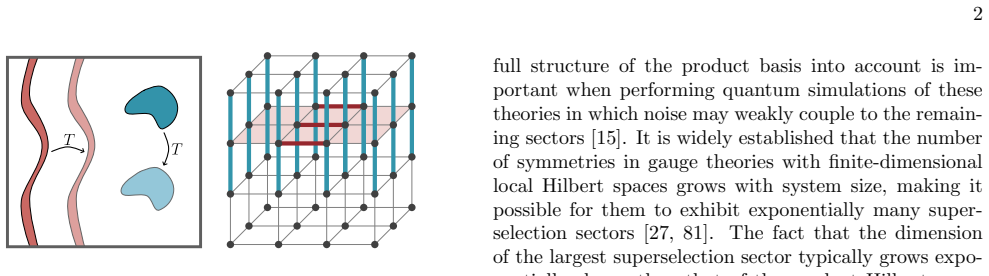
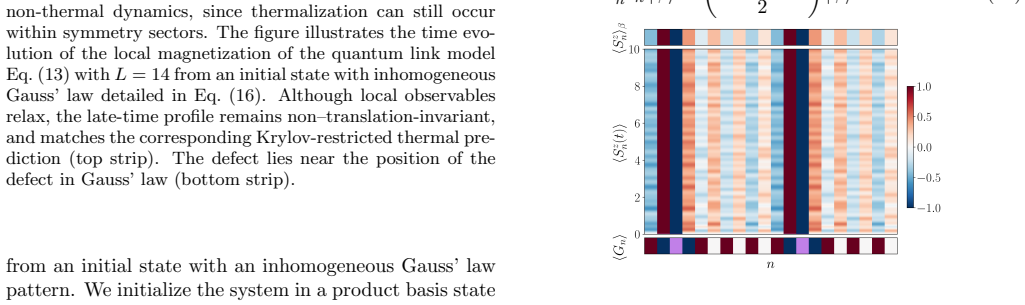
We demonstrate that generalized symmetries can fragment the Hilbert space. Models with higher-form, subsystem, and gauge symmetries can have exponentially many symmetry sectors. We further prove that non-invertible symmetries can induce additional fragmentation within individual symmetry sectors. Fragmentation in several known models arises from generalized symmetries, and the presence of exponentially many Krylov sectors therefore does not by itself imply ergodicity breaking. Finally, we show that disorder free localization arises naturally from Krylov-restricted thermalization when sectors lack translation invariance, requiring neither ergodicity breaking nor gauge symmetry.
What carries the argument
Generalized symmetries (higher-form, subsystem, gauge, and non-invertible) that produce exponentially many dynamically disconnected Krylov sectors.
If this is right
- Fragmentation observed in known models can be attributed to their generalized symmetry content instead of ergodicity breaking.
- Exponential Krylov sector growth alone is insufficient evidence for ergodicity breaking.
- Disorder-free localization can emerge from Krylov-restricted dynamics in sectors that lack translation invariance.
- Non-invertible symmetries supply an independent mechanism for fragmentation inside existing sectors.
Where Pith is reading between the lines
- Some systems previously labeled as ergodicity-broken on the basis of fragmentation may thermalize within their symmetry sectors.
- Symmetry classification could be used to identify additional hidden fragmentation mechanisms in other lattice models.
- These structures offer a route to engineer localization phenomena that rely only on symmetry rather than disorder.
Load-bearing premise
The chosen models with generalized symmetries are representative and the exponential sector count follows directly from the symmetry structure without hidden conventional symmetries or fine-tuning that would reconnect the sectors.
What would settle it
A concrete model containing higher-form or non-invertible symmetries in which the number of Krylov sectors grows only polynomially with size, or the discovery of hidden conventional symmetries in the paper's example models that reduce the apparent sector count.
Figures

read the original abstract
Hilbert space fragmentation refers to exponential growth in the number of dynamically disconnected Krylov sectors with system size. It is taken as evidence of ergodicity breaking, since conventional symmetries generate at most a polynomial number of sectors. However, we demonstrate that generalized symmetries can fragment the Hilbert space. Models with higher-form, subsystem, and gauge symmetries can have exponentially many symmetry sectors. We further prove that non-invertible symmetries can induce additional fragmentation within individual symmetry sectors. Fragmentation in several known models arises from generalized symmetries, and the presence of exponentially many Krylov sectors therefore does not by itself imply ergodicity breaking. Finally, we show that disorder free localization arises naturally from Krylov-restricted thermalization when sectors lack translation invariance, requiring neither ergodicity breaking nor gauge symmetry.
Editorial analysis
A structured set of objections, weighed in public.
Referee Report
Summary. The manuscript claims that generalized symmetries—including higher-form, subsystem, gauge, and non-invertible symmetries—can induce Hilbert space fragmentation, producing exponentially many dynamically disconnected Krylov sectors with system size, in contrast to conventional symmetries that generate only polynomially many sectors. It demonstrates this in several known models, proves that non-invertible symmetries can cause additional fragmentation within individual sectors, and concludes that exponentially many sectors do not by themselves imply ergodicity breaking. It further shows that disorder-free localization arises from Krylov-restricted thermalization in sectors lacking translation invariance, without requiring ergodicity breaking or gauge symmetry.
Significance. If the demonstrations and proofs hold, the work reinterprets fragmentation in lattice models as a consequence of generalized symmetries rather than true ergodicity breaking, with direct implications for many-body localization and symmetry-protected dynamics. The explicit proofs for non-invertible symmetry-induced intra-sector fragmentation and the mechanism linking Krylov restriction to disorder-free localization without fine-tuning or gauge structure are notable strengths, offering concrete, potentially falsifiable predictions for quantum lattice systems in hep-lat and condensed-matter contexts.
major comments (2)
- [Models with generalized symmetries] In the demonstrations of models with higher-form, subsystem, and gauge symmetries (as summarized in the abstract and detailed in the model sections), the claim that exponential sector growth arises purely from the generalized symmetries requires an explicit verification that no additional conventional local conserved quantities or emergent symmetries exist in the chosen lattice constructions. Without this check, the exponential scaling could stem from hidden conventional symmetries or model-specific fine-tuning, weakening the generality of the central claim that generalized symmetries alone suffice for fragmentation.
- [Non-invertible symmetries] In the proof that non-invertible symmetries induce additional fragmentation within individual symmetry sectors, the argument depends on the commutation properties of the symmetry operators with the Hamiltonian and the resulting splitting of Krylov subspaces. It is unclear whether this holds for arbitrary non-invertible algebras or only for the specific operator realizations considered; a more general statement or counterexample would clarify the scope.
minor comments (2)
- The abstract would benefit from naming the specific known models used to illustrate fragmentation from generalized symmetries, to allow readers to immediately connect the claims to concrete examples.
- Early in the manuscript, provide a concise reminder of the definition of Krylov sectors and how they differ from conventional symmetry sectors, to improve accessibility for readers outside the immediate subfield.
Simulated Author's Rebuttal
We thank the referee for their careful reading and valuable comments, which have helped clarify and strengthen our central claims. We address each major comment below and have revised the manuscript to incorporate the suggested improvements.
read point-by-point responses
-
Referee: In the demonstrations of models with higher-form, subsystem, and gauge symmetries (as summarized in the abstract and detailed in the model sections), the claim that exponential sector growth arises purely from the generalized symmetries requires an explicit verification that no additional conventional local conserved quantities or emergent symmetries exist in the chosen lattice constructions. Without this check, the exponential scaling could stem from hidden conventional symmetries or model-specific fine-tuning, weakening the generality of the central claim that generalized symmetries alone suffice for fragmentation.
Authors: We agree that an explicit check is necessary to support the generality of our claim. In the revised manuscript, we have added a new subsection in each model demonstration (Sections 3.1, 3.2, and 3.3) that explicitly verifies the absence of additional conventional local conserved quantities. For the higher-form symmetry models, we demonstrate that the only operators commuting with the Hamiltonian are the generalized symmetry charges, with no emergent local integrals of motion. Analogous verifications, including explicit computation of the commutant algebra, are provided for the subsystem and gauge symmetry examples. These additions confirm that the exponential fragmentation originates from the generalized symmetries without hidden conventional contributions. revision: yes
-
Referee: In the proof that non-invertible symmetries induce additional fragmentation within individual symmetry sectors, the argument depends on the commutation properties of the symmetry operators with the Hamiltonian and the resulting splitting of Krylov subspaces. It is unclear whether this holds for arbitrary non-invertible algebras or only for the specific operator realizations considered; a more general statement or counterexample would clarify the scope.
Authors: We thank the referee for highlighting the need to clarify the scope. Our proof applies to non-invertible symmetries whose fusion rules generate projectors that do not preserve the full Krylov subspace of the parent symmetry sector, leading to further splitting. In the revised manuscript, we have expanded Section 4 to include a more general statement: the intra-sector fragmentation occurs whenever the non-invertible algebra includes fusion channels that map states outside the original Krylov subspace. We contrast this with invertible symmetries (which cannot induce such splitting) and provide a brief counterexample of a non-invertible algebra that does not fragment further due to trivial fusion rules. While a exhaustive classification for all conceivable non-invertible algebras lies beyond the present work, the revised discussion covers the physically relevant cases in lattice models. revision: partial
Circularity Check
No significant circularity; claims follow from explicit symmetry sector enumeration
full rationale
The paper's derivation proceeds by defining generalized symmetries (higher-form, subsystem, gauge, non-invertible) via their operator algebras and commutation with the Hamiltonian, then explicitly counting the resulting disconnected sectors in concrete lattice models. This count is not equivalent to the input by construction: the exponential scaling arises from the specific representation theory and locality properties of those symmetries on the chosen geometries, which can be verified by direct enumeration independent of the fragmentation label. The additional intra-sector splitting for non-invertible symmetries is proven from the algebra of the operators acting within a fixed conventional sector. No equations reduce a 'prediction' to a fitted parameter, and the abstract contains no load-bearing self-citations. The conclusion that exponential Krylov sectors need not imply ergodicity breaking is a direct logical consequence of the sector count rather than a tautology.
Axiom & Free-Parameter Ledger
axioms (2)
- domain assumption Quantum dynamics is generated by a local Hamiltonian that commutes with the generalized symmetry operators.
- domain assumption The number of symmetry sectors grows exponentially with system size for the listed generalized symmetries.
Forward citations
Cited by 1 Pith paper
-
Hilbert Space Fragmentation and Gauge Symmetry
An emergent gauge symmetry valid only in a subset of sectors of the fragmented S=1 dipole-conserving spin chain enables exact quantum simulation of gauge theories using a non-gauge-invariant Hamiltonian.
Reference graph
Works this paper leans on
- [1]
-
[2]
From quantum chaos and eigenstate thermalization to statistical mechanics and thermodynamics,
L. D’Alessio, Y. Kafri, A. Polkovnikov, and M. Rigol, From quantum chaos and eigenstate thermalization to statistical mechanics and thermodynamics, Adv. Phys. 65, 239 (2016), arXiv:1509.06411 [cond-mat.stat-mech]
-
[3]
C. Gogolin and J. Eisert, Equilibration, thermalisation, and the emergence of statistical mechanics in closed quantum systems, Rept. Prog. Phys.79, 056001 (2016), arXiv:1503.07538 [quant-ph]
- [4]
- [5]
-
[6]
R. V. Jensen and R. Shankar, Statistical behavior in de- terministic quantum systems with few degrees of free- dom, Phys. Rev. Lett.54, 1879 (1985)
1985
-
[7]
Srednicki,Chaos and quantum thermalization, Phys
M. Srednicki, Chaos and Quantum Thermalization, Phys. Rev. E50, 10.1103/PhysRevE.50.888 (1994), arXiv:cond-mat/9403051
-
[8]
K. Pakrouski, P. N. Pallegar, F. K. Popov, and I. R. Klebanov, Many Body Scars as a Group Invariant Sector of Hilbert Space, Phys. Rev. Lett.125, 230602 (2020), arXiv:2007.00845 [cond-mat.str-el]
-
[9]
D. Banerjee and A. Sen, Quantum Scars from Zero Modes in an Abelian Lattice Gauge Theory on Ladders, Phys. Rev. Lett.126, 220601 (2021), arXiv:2012.08540 [cond- mat.str-el]
-
[10]
Biswas, D
S. Biswas, D. Banerjee, and A. Sen, Scars from protected zero modes and beyond in$U(1)$quantum link and quantum dimer models, SciPost Physics12, 148 (2022)
2022
-
[11]
J.-Y. Desaules, A. Hudomal, D. Banerjee, A. Sen, Z. Papi´ c, and J. C. Halimeh, Prominent quantum many- body scars in a truncated Schwinger model, Phys. Rev. B 107, 205112 (2023), arXiv:2204.01745 [cond-mat.quant- gas]
-
[12]
Wang, W.-Y
H.-Y. Wang, W.-Y. Zhang, Z. Yao, Y. Liu, Z.-H. Zhu, Y.- G. Zheng, X.-K. Wang, H. Zhai, Z.-S. Yuan, and J.-W. Pan, Interrelated Thermalization and Quantum Critical- 6 ity in a Lattice Gauge Simulator, Physical Review Letters 131, 050401 (2023)
2023
- [13]
-
[14]
I. Sau, P. Stornati, D. Banerjee, and A. Sen, Sublattice scars and beyond in two-dimensional U ( 1 ) quantum link lattice gauge theories, Physical Review D109, 034519 (2024)
2024
- [15]
-
[16]
Hartse, L
J. Hartse, L. Fidkowski, and N. Mueller, Stabilizer Scars, Physical Review Letters135, 060402 (2025)
2025
-
[17]
Calaj´ o, G
G. Calaj´ o, G. Cataldi, M. Rigobello, D. Wanisch, G. Magnifico, P. Silvi, S. Montangero, and J. C. Hal- imeh, Quantum many-body scarring in a non-Abelian lattice gauge theory, Physical Review Research7, 013322 (2025)
2025
-
[18]
Y. Miao, L. Li, H. Katsura, and M. Yamazaki, Exact Quantum Many-Body Scars in 2D Quantum Gauge Mod- els (2025)
2025
- [19]
-
[20]
Spectrum-Generating Algebra in Higher Dimensional Gauge Theories
T. Budde, J. Dong, M. Krsti´ c Marinkovi´ c, and J. C. Pinto Barros, Spectrum-Generating Algebra in Higher Dimensional Gauge Theories (2026) arXiv:2604.05763 [hep-lat]
work page internal anchor Pith review Pith/arXiv arXiv 2026
- [21]
-
[22]
S. Moudgalya, B. A. Bernevig, and N. Regnault, Quan- tum Many-Body Scars and Hilbert Space Fragmenta- tion: A Review of Exact Results, Rep. Prog. Phys. 85 086501 (2022) 10.1088/1361-6633/ac73a0 (2021), eprint: 2109.00548
-
[23]
P. Sala, T. Rakovszky, R. Verresen, M. Knap, and F. Poll- mann, Ergodicity breaking arising from hilbert space fragmentation in dipole-conserving hamiltonians, Phys- ical Review X10, 10.1103/physrevx.10.011047 (2020)
-
[24]
S. Moudgalya and O. I. Motrunich, Hilbert space frag- mentation and commutant algebras, Physical Review X 12, 10.1103/physrevx.12.011050 (2022)
- [25]
-
[26]
T. Rakovszky, P. Sala, R. Verresen, M. Knap, and F. Poll- mann, Statistical localization: From strong fragmenta- tion to strong edge modes, Phys. Rev. B101, 125126 (2020), arXiv:1910.06341 [cond-mat.str-el]
-
[27]
Geometric fragmentation and anomalous thermalization in cubic dimer model
J. Steinegger, D. Banerjee, E. Huffman, and L. Ram- melm¨ uller, Geometric fragmentation and anomalous thermalization in cubic dimer model, Phys. Rev. D112, 114512 (2025), arXiv:2508.03802 [hep-lat]
work page internal anchor Pith review Pith/arXiv arXiv 2025
-
[28]
B. Mukherjee, D. Banerjee, K. Sengupta, and A. Sen, Minimal model for Hilbert space fragmentation with local constraints, Phys. Rev. B104, 155117 (2021), arXiv:2106.14897 [cond-mat.str-el]
-
[29]
A. Khudorozhkov, A. Tiwari, C. Chamon, and T. Neu- pert, Hilbert space fragmentation in a 2D quantum spin system with subsystem symmetries, SciPost Phys.13, 098 (2022), arXiv:2107.09690 [cond-mat.str-el]
-
[30]
Chattopadhyay, B
A. Chattopadhyay, B. Mukherjee, K. Sengupta, and A. Sen, Strong hilbert space fragmentation via emergent quantum drums in two dimensions, SciPost Physics14, 146 (2023)
2023
-
[31]
G. D. Tomasi, D. Hetterich, P. Sala, and F. Pollmann, Dynamics of strongly interacting systems: From Fock- space fragmentation to many-body localization, Phys. Rev. B100, 214313 (2019)
2019
- [32]
-
[33]
Quantum Hilbert Space Fragmentation and Entangled Frozen States
Z. Zhou, T.-H. Yang, and B.-T. Chen, Quantum Hilbert Space Fragmentation and Entangled Frozen States, (2026), arXiv:2604.05218 [quant-ph]
work page internal anchor Pith review Pith/arXiv arXiv 2026
-
[34]
E. S. Ma and Z. Song, Hilbert space fragmentation in quantum Ising systems induced by side coupling, (2026), arXiv:2604.03026 [cond-mat.str-el]
work page internal anchor Pith review Pith/arXiv arXiv 2026
-
[35]
Y. Han, O. Hart, A. Khudorozhkov, and R. Nandkishore, Quantum Fragmentation, (2026), arXiv:2604.06461 [quant-ph]
work page internal anchor Pith review Pith/arXiv arXiv 2026
-
[36]
Schafer-Nameki, ICTP lectures on (non-)invertible general- ized symmetries, Phys
S. Schafer-Nameki, ICTP lectures on (non-)invertible generalized symmetries, Phys. Rept.1063, 1 (2024), arXiv:2305.18296 [hep-th]
-
[37]
L. Bhardwaj, L. E. Bottini, L. Fraser-Taliente, L. Glad- den, D. S. W. Gould, A. Platschorre, and H. Tillim, Lec- tures on generalized symmetries, Phys. Rept.1051, 1 (2024), arXiv:2307.07547 [hep-th]
- [38]
- [39]
- [40]
-
[41]
J. McGreevy, Generalized Symmetries in Condensed Matter, Ann. Rev. Condensed Matter Phys.14, 57 (2023), arXiv:2204.03045 [cond-mat.str-el]
-
[42]
D. Gaiotto, A. Kapustin, N. Seiberg, and B. Wil- lett, Generalized Global Symmetries, JHEP02, 172, arXiv:1412.5148 [hep-th]
work page internal anchor Pith review arXiv
- [43]
-
[44]
A. Kapustin and R. Thorngren, Higher Symmetry and Gapped Phases of Gauge Theories, Prog. Math.324, 177 (2017), arXiv:1309.4721 [hep-th]
-
[45]
M. Barkeshli, P.-S. Hsin, and R. Kobayashi, Higher-group symmetry of (3+1)D fermionicZ 2 gauge theory: Logical CCZ, CS, and T gates from higher symmetry, SciPost Phys.16, 122 (2024), arXiv:2311.05674 [cond-mat.str-el]
-
[46]
Higher-group symmetry in finite gauge theory and stabilizer codes
M. Barkeshli, Y.-A. Chen, P.-S. Hsin, and R. Kobayashi, Higher-group symmetry in finite gauge theory and stabilizer codes, SciPost Phys.16, 089 (2024), arXiv:2211.11764 [cond-mat.str-el]. 7
- [47]
-
[48]
C. Giridhar, P. Vojta, Z. Nussinov, G. Ortiz, and A. H. Nevidomskyy, Algebraic Fusion in a (2+1)-dimensional Lattice Model with Generalized Symmetries, (2025), arXiv:2512.21436 [quant-ph]
- [49]
-
[50]
R.-D. Zhu, Systematic Construction of Kramers- Wannier-like Dualities in Quantum Lattice Models from Integrability, (2025), arXiv:2509.01853 [hep-th]
- [51]
-
[52]
Universal Non-Invertible Symmetries,
L. Bhardwaj, S. Schafer-Nameki, and J. Wu, Universal Non-Invertible Symmetries, Fortsch. Phys.70, 2200143 (2022), arXiv:2208.05973 [hep-th]
-
[53]
Generalized charges, part II: Non-invertible symmetries and the symmetry TFT
L. Bhardwaj and S. Schafer-Nameki, Generalized charges, part II: Non-invertible symmetries and the symmetry TFT, SciPost Phys.19, 098 (2025), arXiv:2305.17159 [hep-th]
-
[54]
K. Inamura and K. Ohmori, Fusion surface models: 2+1d lattice models from fusion 2-categories, SciPost Phys.16, 143 (2024), arXiv:2305.05774 [cond-mat.str-el]
-
[55]
K. Inamura, On lattice models of gapped phases with fusion category symmetries, JHEP03, 036, arXiv:2110.12882 [cond-mat.str-el]
-
[56]
H. Moradi, ¨O. M. Aksoy, J. H. Bardarson, and A. Ti- wari, Symmetry fractionalization, mixed-anomalies and dualities in quantum spin models with generalized sym- metries, (2023), arXiv:2307.01266 [cond-mat.str-el]
-
[57]
N. Seiberg, S. Seifnashri, and S.-H. Shao, Non-invertible symmetries and LSM-type constraints on a tensor product Hilbert space, SciPost Phys.16, 154 (2024), arXiv:2401.12281 [cond-mat.str-el]
- [58]
-
[59]
K. Inamura, Remarks on non-invertible symmetries on a tensor product Hilbert space in 1+1 dimensions, (2026), arXiv:2602.12053 [cond-mat.str-el]
-
[60]
L. Lootens, C. Delcamp, G. Ortiz, and F. Verstraete, Dualities in One-Dimensional Quantum Lattice Mod- els: Symmetric Hamiltonians and Matrix Product Op- erator Intertwiners, PRX Quantum4, 020357 (2023), arXiv:2112.09091 [quant-ph]
-
[61]
Fusion category symmetry. Part I. Anomaly in-flow and gapped phases,
R. Thorngren and Y. Wang, Fusion category symmetry. Part I. Anomaly in-flow and gapped phases, JHEP04, 132, arXiv:1912.02817 [hep-th]
-
[62]
Topological phases with generalized global symmetries,
B. Yoshida, Topological phases with generalized global symmetries, Phys. Rev. B93, 155131 (2016), arXiv:1508.03468 [cond-mat.str-el]
-
[63]
C. Cordova, T. T. Dumitrescu, K. Intriligator, and S.-H. Shao, Snowmass White Paper: Generalized Symmetries in Quantum Field Theory and Beyond, inSnowmass 2021 (2022) arXiv:2205.09545 [hep-th]
-
[64]
C. Cordova, P.-S. Hsin, and N. Seiberg, Global Symme- tries, Counterterms, and Duality in Chern-Simons Mat- ter Theories with Orthogonal Gauge Groups, SciPost Phys.4, 021 (2018), arXiv:1711.10008 [hep-th]
-
[65]
Theta, Time Reversal, and Temperature
D. Gaiotto, A. Kapustin, Z. Komargodski, and N. Seiberg, Theta, Time Reversal, and Temperature, JHEP05, 091, arXiv:1703.00501 [hep-th]
-
[66]
O. Fukushima and R. Hamazaki, Violation of Eigen- state Thermalization Hypothesis in Quantum Field The- ories with Higher-Form Symmetry, Phys. Rev. Lett.131, 131602 (2023), arXiv:2305.04984 [cond-mat.stat-mech]
- [67]
- [68]
-
[69]
R. Sohal and R. Verresen, Obstruction to Ergodicity from Locality andU(1) Higher Symmetries on the Lattice, (2025), arXiv:2511.21815 [cond-mat.str-el]
- [70]
-
[71]
W. B. Fontana, F. G. Oliviero, and Y.-P. Huang, Quan- tum many-body scarring from kramers-wannier duality, Physical Review B113, 10.1103/ny73-r1ss (2026)
-
[72]
O. Hart and R. Nandkishore, Hilbert space shattering and dynamical freezing in the quantum ising model, Physical Review B106, 10.1103/physrevb.106.214426 (2022)
-
[73]
J. Armas and A. Jain, Approximate higher-form symmetries, topological defects, and dynamical phase transitions, Phys. Rev. D109, 045019 (2024), arXiv:2301.09628 [hep-th]
-
[75]
A. Smith, J. Knolle, D. Kovrizhin, and R. Moessner, Disorder-free localization, Physical Review Letters118, 10.1103/physrevlett.118.266601 (2017)
-
[76]
G. Gyawaliet al., Observation of disorder-free localiza- tion using a (2+1)D lattice gauge theory on a quantum processor, (2024), arXiv:2410.06557 [quant-ph]
- [77]
- [78]
- [79]
-
[80]
I. Papaefstathiou, A. Smith, and J. Knolle, Disorder-free localization in a simpleU(1) lattice gauge theory, Phys. Rev. B102, 165132 (2020), arXiv:2003.12497 [cond- mat.str-el]. 8
- [81]
discussion (0)
Sign in with ORCID, Apple, or X to comment. Anyone can read and Pith papers without signing in.