Recognition: unknown
New Kids: An Architecture and Performance Investigation of Second-Generation Serverless Platforms
Pith reviewed 2026-05-10 08:10 UTC · model grok-4.3
The pith
A second generation of serverless platforms has emerged that uses lightweight isolates and edge deployment instead of containers and central servers.
A machine-rendered reading of the paper's core claim, the machinery that carries it, and where it could break.
Core claim
Next to the traditional serverless platforms based on containerized centralized execution, a second generation has emerged that leverages lightweight isolates and edge deployment. This reduces warm request latency from around 40 ms to 10 ms and makes cold starts negligible, although it constrains the available execution environment. The claim is backed by architectural analysis of seven platforms and performance data from over 38 million function calls.
What carries the argument
The generational classification of serverless platforms according to their execution model: first-generation uses containers in centralized setups, while second-generation employs lightweight isolates deployed at the edge.
Load-bearing premise
The seven examined platforms accurately represent a distinct emerging generation rather than just variations within the existing landscape.
What would settle it
A survey of additional serverless platforms showing no consistent use of lightweight isolates and edge deployment, or benchmarks where warm latencies remain at 40 ms levels across the identified second-generation candidates.
Figures





read the original abstract
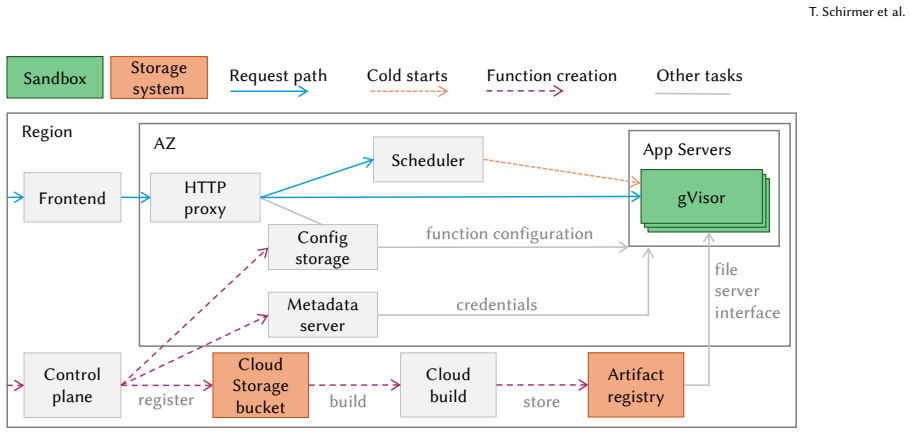
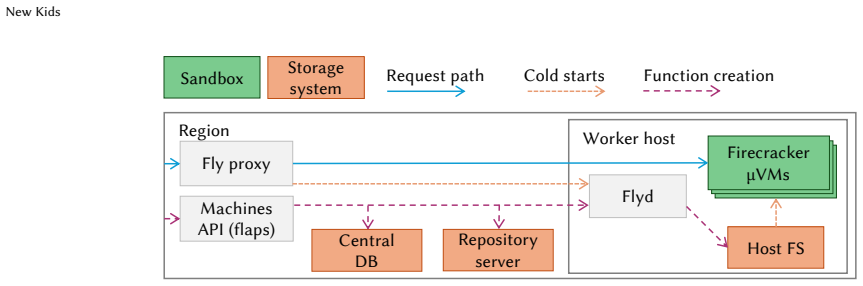
With the ever-increasing usage of serverless computing in both industry and academia, it is essential to understand the mechanisms that power the underlying platforms. As serverless is more than ten years old, there are different platforms with vastly different approaches. We show that, next to the traditional and popular platforms, a second generation of serverless platform has emerged. While first-generation platforms are based on containerized, centralized execution, the new generation leverages lightweight isolates and edge deployment. This evolution reduces warm request latency from approximately 40 ms to around 10 ms and reduces cold starts to an afterthought, but limits the execution environment. In this paper, we gather and analyze all publicly available information to provide detailed insights into the underlying architecture of seven platforms and then run a microbenchmark-based evaluation totaling more than 38 million function calls to gain a deeper understanding their performance.
Editorial analysis
A structured set of objections, weighed in public.
Referee Report
Summary. The paper claims that serverless computing has evolved beyond first-generation platforms (containerized, centralized execution) to a second generation that leverages lightweight isolates and edge deployment. Analysis of seven platforms via public documentation, followed by microbenchmarks totaling more than 38 million function calls, shows this shift reduces warm-request latency from approximately 40 ms to around 10 ms, renders cold starts negligible, and imposes limits on the execution environment.
Significance. If the architectural classification and performance deltas hold under broader scrutiny, the work supplies a timely empirical map of serverless platform evolution that could inform both platform selection and future design. The scale of the benchmark campaign (38 M calls) is a clear strength, providing concrete latency and cold-start data within the chosen test conditions and workloads.
major comments (2)
- [§3] §3 (Architecture Survey): the claim that the seven platforms constitute a coherent 'second generation' rests on public documentation alone; no explicit inclusion criteria, boundary definitions, or argument for representativeness are supplied, leaving open whether the observed latency reduction is a class property or an artifact of the selected set.
- [§5] §5 (Microbenchmark Evaluation): the reported warm-latency drop (40 ms to ~10 ms) and negligible cold starts are presented without error bars, workload definitions, controls for language runtime, function size, or invocation scale; these omissions make it impossible to determine whether the differences are systematic or contingent on the particular harness and implementations used.
minor comments (2)
- Figure captions and axis labels in the performance plots could be expanded to include exact invocation counts and platform versions tested.
- [§3] A short table summarizing the seven platforms' key architectural features (isolate type, edge presence, supported languages) would improve readability of the survey section.
Simulated Author's Rebuttal
We thank the referee for the constructive feedback. We address each major comment below and will incorporate revisions to improve clarity and rigor without altering the core claims or results.
read point-by-point responses
-
Referee: [§3] §3 (Architecture Survey): the claim that the seven platforms constitute a coherent 'second generation' rests on public documentation alone; no explicit inclusion criteria, boundary definitions, or argument for representativeness are supplied, leaving open whether the observed latency reduction is a class property or an artifact of the selected set.
Authors: We agree that the manuscript would be strengthened by explicit criteria. In the revision we will insert a new subsection at the start of §3 that states the inclusion criteria (platforms using lightweight isolates such as WebAssembly or Firecracker together with edge deployment), supplies boundary definitions, and argues for representativeness by reference to market adoption and architectural divergence from container-based centralized designs. This will make clear that the latency and cold-start improvements are presented as properties of the architectural class rather than solely of the sampled platforms. revision: yes
-
Referee: [§5] §5 (Microbenchmark Evaluation): the reported warm-latency drop (40 ms to ~10 ms) and negligible cold starts are presented without error bars, workload definitions, controls for language runtime, function size, or invocation scale; these omissions make it impossible to determine whether the differences are systematic or contingent on the particular harness and implementations used.
Authors: We acknowledge that additional methodological detail is required. The revised §5 will report standard-deviation error bars for all latency figures, define the workloads (function sizes, languages, and invocation patterns), and document controls for runtime environment and scale. The 38 million calls were collected under repeated, controlled conditions; these additions will allow readers to assess systematicity while preserving the reported performance deltas. revision: yes
Circularity Check
Empirical architecture survey and benchmark study with no derivation chain or self-referential predictions
full rationale
The paper performs an architecture survey of seven publicly documented serverless platforms based on public information, followed by a microbenchmark evaluation of over 38 million function calls. No mathematical derivations, equations, fitted parameters, or predictions appear in the provided abstract or description. The classification of platforms into first- and second-generation is presented as an empirical observation of differences (containerized centralized execution vs. lightweight isolates and edge deployment), not a self-definition or reduction to prior results by construction. No self-citations are invoked as load-bearing for uniqueness theorems or ansatzes. The work is self-contained as a descriptive and experimental study; the central claims rest on the collected documentation and benchmark data rather than any circular reduction.
Axiom & Free-Parameter Ledger
Reference graph
Works this paper leans on
-
[1]
Alexandru Agache, Marc Brooker, Alexandra Iordache, Anthony Liguori, Rolf Neugebauer, Phil Piwonka, and Diana-Maria Popa. 2020. Firecracker: Light- weight Virtualization for Serverless Applications. 419–434. https://www. usenix.org/conference/nsdi20/presentation/agache
2020
-
[2]
2014.A WS EC2 Nitro
Amazon Web Services, Inc. 2014.A WS EC2 Nitro. Retrieved 2026-02-16 from https://aws.amazon.com/ec2/nitro/
2014
-
[3]
2014.A WS Lambda
Amazon Web Services, Inc. 2014.A WS Lambda. Retrieved 2026-02-16 from https://aws.amazon.com/lambda/
2014
-
[4]
2026.ch_placer.go
FnProject Authors. 2026.ch_placer.go. FnProject Authors. Re- trieved 2026-02-16 from https://github.com/fnproject/fn/blob/ a402c5ea513db03cb555627fab65ecc94e69204f/api/runnerpool/ch_placer.go
2026
-
[5]
Ioana Baldini, Perry Cheng, Stephen J. Fink, Nick Mitchell, Vinod Muthusamy, Rodric Rabbah, Philippe Suter, and Olivier Tardieu. 2017. The serverless trilemma: function composition for serverless computing. InProceedings of the 2017 ACM SIGPLAN International Symposium on New Ideas, New Paradigms, and Reflections on Programming and Software. ACM, Vancouver...
-
[6]
2020.Cloud Run is a Knative
Ahmet Alp Balkan. 2020.Cloud Run is a Knative. Retrieved 2026-02-16 from https://ahmet.im/blog/cloud-run-is-a-knative/
2020
-
[7]
2017.Cloud Service Benchmark- ing: Measuring Quality of Cloud Services from a Client Perspective
David Bermbach, Erik Wittern, and Stefan Tai. 2017.Cloud Service Benchmark- ing: Measuring Quality of Cloud Services from a Client Perspective. Springer, Cham, Switzerland
2017
- [8]
-
[9]
Marc Brooker, Mike Danilov, Chris Greenwood, and Phil Piwonka. 2023. On- demand Container Loading in AWS Lambda. In2023 USENIX Annual Techni- cal Conference (USENIX ATC 23). USENIX Association, 315–328. https://www. usenix.org/conference/atc23/presentation/brooker
2023
-
[10]
Sebastian Burckhardt, Chris Gillum, David Justo, Konstantinos Kallas, Connor McMahon, and Christopher S. Meiklejohn. 2021. Durable functions: semantics for stateful serverless.Proceedings of the ACM on Programming Languages5, OOPSLA (Oct. 2021), 1–27. https://doi.org/10.1145/3485510 New Kids
-
[11]
2024.A lightweight WebAssembly runtime that is fast, se- cure, and standards-compliant
bytecodealliance. 2024.A lightweight WebAssembly runtime that is fast, se- cure, and standards-compliant. Retrieved 2026-02-16 from https://github.com/ bytecodealliance/wasmtime
2024
-
[12]
Fay Chang, Jeffrey Dean, Sanjay Ghemawat, Wilson C. Hsieh, Deborah A. Wal- lach, Mike Burrows, Tushar Chandra, Andrew Fikes, and Robert E. Gruber. 2008. Bigtable: A Distributed Storage System for Structured Data.ACM Transactions on Computer Systems26, 2 (June 2008), 1–26. https://doi.org/10.1145/1365815. 1365816
-
[13]
Ryan Chard, Yadu Babuji, Zhuozhao Li, Tyler Skluzacek, Anna Woodard, Ben Blaiszik, Ian Foster, and Kyle Chard. 2020. funcX: A Federated Function Serving Fabric for Science.Proceedings of the 29th International Symposium on High- Performance Parallel and Distributed Computing(June 2020), 65–76. https://doi. org/10.1145/3369583.3392683 arXiv: 2005.04215
-
[14]
Qiong Chen, Jianmin Qian, Yulin Che, Ziqi Lin, Jianfeng Wang, Jie Zhou, Licheng Song, Yi Liang, Jie Wu, Wei Zheng, Wei Liu, Linfeng Li, Fangming Liu, and Kun Tan. 2024. YuanRong: A Production General-purpose Server- less System for Distributed Applications in the Cloud. InProceedings of the ACM SIGCOMM 2024 Conference. ACM, Sydney NSW Australia, 843–859. ...
-
[15]
2024.About Execution Environments
Google Cloud. 2024.About Execution Environments. Retrieved 2026-02-16 from https://cloud.google.com/run/docs/about-execution-environments
2024
-
[16]
2024.About Instance Autoscaling
Google Cloud. 2024.About Instance Autoscaling. Retrieved 2026-02-16 from https://cloud.google.com/run/docs/about-instance-autoscaling
2024
-
[17]
2024.Cloud Functions Locations
Google Cloud. 2024.Cloud Functions Locations. Retrieved 2026-02-16 from https://cloud.google.com/functions/docs/locations
2024
-
[18]
2024.Cloud Run Locations
Google Cloud. 2024.Cloud Run Locations. Retrieved 2026-02-16 from https: //cloud.google.com/run/docs/locations
2024
-
[19]
2024.Google Infrastructure Security Design Overview
Google Cloud. 2024.Google Infrastructure Security Design Overview. Retrieved 2026-02-16 from https://cloud.google.com/docs/security/infrastructure/design# google-frontend-service
2024
-
[20]
2024.Introducing Container Image Streaming in GKE
Google Cloud. 2024.Introducing Container Image Streaming in GKE. Re- trieved 2026-02-16 from https://cloud.google.com/blog/products/containers- kubernetes/introducing-container-image-streaming-in-gke?hl=en
2024
-
[21]
2024.Migrating a Knative serving service to Cloud Run
Google Cloud. 2024.Migrating a Knative serving service to Cloud Run. Retrieved 2026-02-16 from https://cloud.google.com/kubernetes-engine/ enterprise/knative-serving/docs/migrate/cloud-run
2024
-
[22]
2024.Start Containers Quickly
Google Cloud. 2024.Start Containers Quickly. Retrieved 2026-02-16 from https: //cloud.google.com/run/docs/tips/general#start_containers_quickly
2024
-
[23]
2024.Security Model
Cloudflare. 2024.Security Model. Retrieved 2026-02-16 from https://developers. cloudflare.com/workers/reference/security-model
2024
-
[24]
2024.Smart Placement
Cloudflare. 2024.Smart Placement. Retrieved 2026-02-16 from https:// developers.cloudflare.com/workers/configuration/smart-placement
2024
-
[25]
2025.Limits
Inc Cloudflare. 2025.Limits. Retrieved 2026-02-16 from https://developers. cloudflare.com/workers/platform/limits/#memory
2025
-
[26]
2020.Cloudflare Workers
Cloudflare, Inc. 2020.Cloudflare Workers. Retrieved 2026-02-16 from https: //workers.cloudflare.com/
2020
-
[27]
Marcin Copik, Grzegorz Kwasniewski, Maciej Besta, Michal Podstawski, and Torsten Hoefler. 2021. SeBS: a serverless benchmark suite for function-as-a- service computing. InProceedings of the 22nd International Middleware Con- ference. ACM, Québec city Canada, 64–78. https://doi.org/10.1145/3464298. 3476133
-
[28]
Corbett, Jeffrey Dean, Michael Epstein, Andrew Fikes, Christopher Frost, J
James C. Corbett, Jeffrey Dean, Michael Epstein, Andrew Fikes, Christopher Frost, J. J. Furman, Sanjay Ghemawat, Andrey Gubarev, Christopher Heiser, Pe- ter Hochschild, Wilson Hsieh, Sebastian Kanthak, Eugene Kogan, Hongyi Li, Alexander Lloyd, Sergey Melnik, David Mwaura, David Nagle, Sean Quinlan, Rajesh Rao, Lindsay Rolig, Yasushi Saito, Michal Szymania...
-
[29]
Lazar Cvetković, François Costa, Mihajlo Djokic, Michal Friedman, and Ana Klimovic. 2024. Dirigent: Lightweight Serverless Orchestration. InProceedings of the ACM SIGOPS 30th Symposium on Operating Systems Principles (SOSP ’24). Association for Computing Machinery, New York, NY, USA, 369–384. https: //doi.org/10.1145/3694715.3695966
-
[30]
Lazar Cvetković, Rodrigo Fonseca, and Ana Klimovic. 2023. Understanding the Neglected Cost of Serverless Cluster Management. InProceedings of the 4th Workshop on Resource Disaggregation and Serverless. ACM, Koblenz Germany, 22–28. https://doi.org/10.1145/3605181.3626286
-
[31]
Ryan Dahl. 2022.JavaScript Containers. Retrieved 2026-02-16 from https://web. archive.org/web/20241208235619/https://tinyclouds.org/javascript_containers/
-
[32]
2024.A WS Lambda Under the Hood
Mike Danilov. 2024.A WS Lambda Under the Hood. Retrieved 2026-02-16 from https://www.infoq.com/presentations/aws-lambda-arch/
2024
-
[33]
Ramzi Debab and Walid Khaled Hidouci. 2021. Containers Runtimes War: A Comparative Study. InProceedings of the Future Technologies Conference (FTC) 2020, Volume 2, Kohei Arai, Supriya Kapoor, and Rahul Bhatia (Eds.). Springer International Publishing, Cham, 135–161. https://doi.org/10.1007/978-3-030- 63089-8_9
-
[34]
2024.Deno Deploy Regions
Deno. 2024.Deno Deploy Regions. Retrieved 2026-02-16 from https://docs.deno. com/deploy/manual/regions/
2024
-
[35]
2024.How we built a secure, performant, multi-tenant cloud platform to run untrusted code
Deno. 2024.How we built a secure, performant, multi-tenant cloud platform to run untrusted code. Retrieved 2026-02-16 from https://deno.com/blog/build-secure- performant-cloud-platform
2024
-
[36]
2021.Deno Deploy
Deno Land, Inc. 2021.Deno Deploy. Retrieved 2026-02-16 from https://deno. com/deploy
2021
-
[37]
2026.denoland/deno
Deno Land, Inc. 2026.denoland/deno. Retrieved 2026-02-16 from https://github. com/denoland/deno
2026
-
[38]
Dong Du, Tianyi Yu, Yubin Xia, Binyu Zang, Guanglu Yan, Chenggang Qin, Qix- uan Wu, and Haibo Chen. 2020. Catalyzer: Sub-millisecond Startup for Server- less Computing with Initialization-less Booting. InProceedings of the Twenty- Fifth International Conference on Architectural Support for Programming Lan- guages and Operating Systems(Lausanne, Switzerlan...
-
[39]
Simon Eismann, Diego Elias Costa, Lizhi Liao, Cor-Paul Bezemer, Weiyi Shang, André van Hoorn, and Samuel Kounev. 2022. A case study on the stability of performance tests for serverless applications.Journal of Systems and Software 189 (July 2022), 111294. https://doi.org/10.1016/j.jss.2022.111294
-
[40]
Simon Eismann, Joel Scheuner, Erwin Van Eyk, Maximilian Schwinger, Jo- hannes Grohmann, Nikolas Herbst, Cristina Abad, and Alexandru Iosup. 2021. The State of Serverless Applications: Collection, Characterization, and Com- munity Consensus.IEEE Transactions on Software Engineering(2021), 1–1. https://doi.org/10.1109/TSE.2021.3113940
-
[41]
2024.Unofficial SDKs on the Compute platform
Fastly. 2024.Unofficial SDKs on the Compute platform. Retrieved 2026-02-16 from https://www.fastly.com/documentation/guides/compute
2024
-
[42]
2019.Edge Compute
Fastly, Inc. 2019.Edge Compute. Retrieved 2026-02-16 from https://www.fastly. com/products/edge-compute
2019
-
[43]
2020.Fly.io
Fly.io. 2020.Fly.io. Retrieved 2026-02-16 from https://fly.io/
2020
-
[44]
2022.Fly Machines: An API for Fast-Booting VMs
Fly.io. 2022.Fly Machines: An API for Fast-Booting VMs. Retrieved 2026-02-16 from https://fly.io/blog/fly-machines/
2022
-
[45]
2022.Reliability: It’s Not Great
Fly.io. 2022.Reliability: It’s Not Great. Retrieved 2026-02-16 from https: //community.fly.io/t/reliability-its-not-great/11253
2022
-
[46]
2023.Carving the Scheduler Out of Our Orchestrator
Fly.io. 2023.Carving the Scheduler Out of Our Orchestrator. Retrieved 2026-02-16 from https://fly.io/blog/carving-the-scheduler-out-of-our-orchestrator/
2023
-
[47]
2023.Docker Without Docker
Fly.io. 2023.Docker Without Docker. Retrieved 2026-02-16 from https://fly.io/ blog/docker-without-docker/
2023
-
[48]
2023.Global registry: now in production
Fly.io. 2023.Global registry: now in production. Retrieved 2026-02-16 from https://community.fly.io/t/global-registry-now-in-production/13723
2023
-
[49]
2024.Load Balancing
Fly.io. 2024.Load Balancing. Retrieved 2026-02-16 from https://fly.io/docs/ reference/load-balancing/
2024
-
[50]
2024.New feature in preview: suspend/resume for Machines
Fly.io. 2024.New feature in preview: suspend/resume for Machines. Retrieved 2026-02-16 from https://community.fly.io/t/new-feature-in-preview-suspend- resume-for-machines/20672
2024
-
[51]
2024.Regions Fly Documentation
Fly.io. 2024.Regions Fly Documentation. Retrieved 2026-02-16 from https://fly. io/docs/reference/regions/
2024
-
[52]
2026.CPU Performance
Fly.io. 2026.CPU Performance. Retrieved 2026-02-16 from https://fly.io/docs/ machines/cpu-performance/
2026
-
[53]
2026.Fly.io Infra Log
Fly.io. 2026.Fly.io Infra Log. Retrieved 2026-02-16 from https://fly.io/infra-log/
2026
-
[54]
2026.Fly.io Resource Pricing
Fly.io. 2026.Fly.io Resource Pricing. Retrieved 2026-02-16 from https://fly.io/ docs/about/pricing/
2026
-
[55]
2026.Framework launch scanners
Fly.io. 2026.Framework launch scanners. Retrieved 2026-02-16 from https://fly. io/docs/launch/create/#framework-launch-scanners
2026
-
[56]
2017.Google Cloud Run Functions
Google LLC. 2017.Google Cloud Run Functions. Retrieved 2026-02-16 from https://cloud.google.com/functions
2017
-
[57]
2024.gVisor
gVisor Authors. 2024.gVisor. Retrieved 2026-02-16 from https://gvisor.dev/
2024
-
[58]
Cloud programming sim- plified: A Berkeley view on serverless computing,
Eric Jonas, Johann Schleier-Smith, Vikram Sreekanti, Chia-Che Tsai, Anurag Khandelwal, Qifan Pu, Vaishaal Shankar, Joao Carreira, Karl Krauth, Neeraja Yadwadkar, Joseph E. Gonzalez, Raluca Ada Popa, Ion Stoica, and David A. Pat- terson. 2019. Cloud Programming Simplified: A Berkeley View on Serverless Computing.arXiv:1902.03383 [cs](2019). arXiv: 1902.03383
-
[59]
Abad, Alexandru Iosup, Ian Foster, Prashant Shenoy, Omer Rana, and Andrew A
Samuel Kounev, Nikolas Herbst, Cristina L. Abad, Alexandru Iosup, Ian Foster, Prashant Shenoy, Omer Rana, and Andrew A. Chien. 2023. Serverless Comput- ing: What It Is, and What It Is Not?Commun. ACM66, 9 (Sept. 2023), 80–92. https://doi.org/10.1145/3587249
-
[60]
2024.Grafana Cloud services regional availability
Grafana Labs. 2024.Grafana Cloud services regional availability. Re- trieved 2026-02-16 from https://grafana.com/docs/grafana-cloud/account- management/regional-availability/
2024
-
[61]
Philipp Leitner, Erik Wittern, Josef Spillner, and Waldemar Hummer. 2019. A mixed-method empirical study of Function-as-a-Service software development in industrial practice.Journal of Systems and Software149 (March 2019), 340–
2019
-
[62]
https://doi.org/10.1016/j.jss.2018.12.013
-
[63]
Junfeng Li, Sameer G. Kulkarni, K. K. Ramakrishnan, and Dan Li. 2019. Under- standing Open Source Serverless Platforms: Design Considerations and Perfor- mance. InProceedings of the 5th International Workshop on Serverless Computing. ACM, Davis CA USA, 37–42. https://doi.org/10.1145/3366623.3368139 T. Schirmer et al
-
[64]
Zijun Li, Linsong Guo, Jiagan Cheng, Quan Chen, Bingsheng He, and Minyi Guo. 2022. The Serverless Computing Survey: A Technical Primer for Design Architecture.Comput. Surveys54, 10s (Jan. 2022), 1–34. https://doi.org/10.1145/ 3508360
2022
- [65]
-
[66]
Changyuan Lin and Hamzeh Khazaei. 2021. Modeling and Optimization of Per- formance and Cost of Serverless Applications.IEEE Transactions on Parallel and Distributed Systems32, 3 (2021), 615–632. https://doi.org/10.1109/TPDS.2020. 3028841
-
[67]
Theo Lynn, Pierangelo Rosati, Arnaud Lejeune, and Vincent Emeakaroha. 2017. A Preliminary Review of Enterprise Serverless Cloud Computing (Function- as-a-Service) Platforms. In2017 IEEE International Conference on Cloud Com- puting Technology and Science (CloudCom). 162–169. https://doi.org/10.1109/ CloudCom.2017.15
2017
-
[68]
2022.Fly Machines: An API for Fast-Booting VMs
Kurt Mackey. 2022.Fly Machines: An API for Fast-Booting VMs. Retrieved 2026- 02-16 from https://fly.io/blog/fly-machines/
2022
- [69]
-
[70]
2024.Intro to Serverless Functions
Netlify. 2024.Intro to Serverless Functions. Retrieved 2026-02-16 from https: //www.netlify.com/blog/intro-to-serverless-functions/
2024
-
[71]
2024.Functions
Oracle. 2024.Functions. Retrieved 2026-02-16 from https://docs.oracle.com/en- us/iaas/Content/Functions/home.htm
2024
-
[72]
2019.Oracle Cloud Infrastructure Functions
Oracle Corporation. 2019.Oracle Cloud Infrastructure Functions. Retrieved 2026- 02-16 from https://www.oracle.com/cloud/cloud-native/functions/
2019
-
[73]
Tobias Pfandzelter and David Bermbach. 2020. tinyFaaS: A Lightweight FaaS Platform for Edge Environments. InProceedings of the Second IEEE International Conference on Fog Computing(Sydney, NSW, Australia)(ICFC 2020). IEEE, New York, NY, USA, 17–24. https://doi.org/10.1109/ICFC49376.2020.00011
-
[74]
2022.A Foolish Consistency: Consul at Fly.io
Thomas Ptacek. 2022.A Foolish Consistency: Consul at Fly.io. Retrieved 2026- 02-16 from https://fly.io/blog/a-foolish-consistency/
2022
-
[75]
2022.Our User-Mode WireGuard Year
Thomas Ptacek. 2022.Our User-Mode WireGuard Year. Retrieved 2026-02-16 from https://fly.io/blog/our-user-mode-wireguard-year/
2022
-
[76]
David K. Rensin. 2015.Kubernetes - Scheduling the Future at Cloud Scale. 1005 Gravenstein Highway North Sebastopol, CA 95472
2015
-
[77]
Trever Schirmer and David Bermbach. 2025. Towards a Testbed for Scalable FaaS Platforms. InProceedings of the 13th IEEE International Conference on Cloud Engineering(Rennes, France)(IC2E ’25). IEEE, New York, NY, USA, 71–72. https: //doi.org/10.1109/IC2E65552.2025.00017
-
[78]
Trever Schirmer, Nils Japke, Sofia Greten, Tobias Pfandzelter, and David Bermbach. 2023. The Night Shift: Understanding Performance Variability of Cloud Serverless Platforms. InProceedings of the 1st Workshop on SErverless Sys- tems, Applications and MEthodologies(Rome, Italy)(SESAME ’23). ACM, New York, NY, USA. https://doi.org/10.1145/3592533.3592808
-
[79]
Larissa Schmid, Marcin Copik, Alexandru Calotoiu, Laurin Brandner, Anne Kozi- olek, and Torsten Hoefler. 2025. SeBS-Flow: Benchmarking Serverless Cloud Function Workflows. InProceedings of the Twentieth European Conference on Computer Systems. ACM, Rotterdam Netherlands, 902–920. https://doi.org/10. 1145/3689031.3717465
-
[80]
2024.A WS Lambda Runtimes
Amazon Web Services. 2024.A WS Lambda Runtimes. Retrieved 2026-02-16 from https://docs.aws.amazon.com/lambda/latest/dg/lambda-runtimes.html
2024
discussion (0)
Sign in with ORCID, Apple, or X to comment. Anyone can read and Pith papers without signing in.