Recognition: unknown
Inferring Halo Mass and Scale Radius of Galaxy Clusters Using Convolutional Neural Networks and Uchuu-UniverseMachine Catalogs
Pith reviewed 2026-05-10 08:01 UTC · model grok-4.3
The pith
Convolutional neural networks infer galaxy cluster virial mass and scale radius from 2D position-velocity images with median residuals under 0.01 dex.
A machine-rendered reading of the paper's core claim, the machinery that carries it, and where it could break.
Core claim
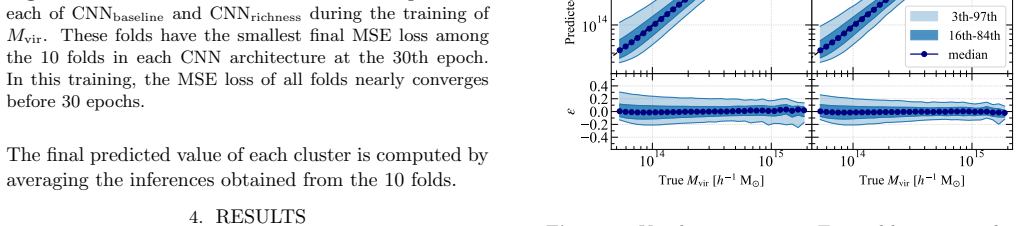
Convolutional neural networks trained on images of the two-dimensional joint probability distribution of member galaxies' projected positions and line-of-sight velocities recover the virial mass and scale radius of galaxy clusters with nearly unbiased absolute median residuals (within 0.01 dex) over 10^13.7 to 10^15.3 solar masses per h and 10^1.7 to 10^2.7 kpc per h; supplying richness as an extra input narrows the mass residual distribution while restricting training to relaxed clusters narrows the scale-radius residual distribution more effectively.
What carries the argument
A convolutional neural network that ingests 2D images of the joint projected-position and line-of-sight-velocity probability distribution of cluster galaxies, optionally concatenated with a scalar richness value.
If this is right
- Adding richness reduces the standard deviation of halo-mass residuals from 0.133 dex to 0.122 dex on the full sample and from 0.124 dex to 0.111 dex on the relaxed sample.
- Restricting training to dynamically relaxed clusters lowers the standard deviation of scale-radius residuals from 0.180 dex to 0.154 dex (baseline network) and from 0.175 dex to 0.148 dex (richness-augmented network).
- The approach supplies a new route to infer both total mass and internal mass distribution of clusters for cosmological parameter estimation.
- Machine learning on position-velocity images offers an efficient alternative to traditional dynamical or lensing mass estimators for large survey catalogs.
Where Pith is reading between the lines
- If the mocks generalize, the same image-encoding and network architecture could be applied directly to ongoing or upcoming photometric and spectroscopic cluster surveys.
- Simultaneous recovery of scale radius alongside mass would allow statistical studies of cluster concentration and its evolution with redshift.
- The method could be extended to predict additional cluster observables such as concentration parameter or substructure measures without new training data.
Load-bearing premise
The mock cluster observations generated from the Uchuu-UniverseMachine catalog, including interlopers, accurately represent the statistical properties of real telescope data.
What would settle it
Running the trained networks on real galaxy clusters whose masses and scale radii have been measured independently by weak lensing or X-ray observations and finding residual biases or scatters substantially larger than those reported on the mocks would falsify the claim.
Figures



read the original abstract
We investigate the ability of machine learning to infer the virial mass ($M_{\rm vir}$) and the scale radius ($r_{\rm s}$) of galaxy clusters from their observables. Using the Uchuu--UniverseMachine galaxy catalog at $z=0.093$, we generate mock cluster observations that include interlopers, and we encode each cluster as an image representing the two-dimensional joint probability distribution of member galaxies' projected position and line-of-sight velocity. We train two architectures: a baseline convolutional neural network (CNNb) following a previous approach, and an extended model (CNNr) that appends richness as an additional scalar input. We further compare the performance of networks trained on the all cluster sample and on a dynamically relaxed subsample. Across the test ranges $10^{13.7}\leq M_{\rm vir}\leq10^{15.3}$ Msun/h and $10^{1.7}\leq r_{\rm s}\leq10^{2.7}$ kpc/h, all configurations yield nearly unbiased absolute median residuals (within 0.01 dex). For the halo mass, adding richness narrows the residual distribution, reducing the standard deviation from 0.133 to 0.122 dex for the all sample, and from 0.124 to 0.111 dex for the relaxed sample. For the scale radius, restricting the training to relaxed clusters improves the performance more than adding richness. The standard deviation decreases from 0.180 to 0.154 dex for CNNb and from 0.175 to 0.148 dex for CNNr, while the inclusion of richness yields only a modest improvement of 0.005 dex. These results demonstrate that machine learning is a powerful tool to infer the mass and internal mass distribution of clusters, providing a new window for cosmological inferences and understanding galaxy formation processes.
Editorial analysis
A structured set of objections, weighed in public.
Referee Report
Summary. The manuscript investigates the use of convolutional neural networks to infer the virial mass and scale radius of galaxy clusters from mock observations generated from the Uchuu-UniverseMachine catalog at z=0.093. Mock clusters are encoded as 2D images of the joint distribution of projected positions and line-of-sight velocities, with and without interlopers. Two CNN architectures are trained: a baseline and one incorporating richness as input. Performance is evaluated on held-out test sets for both the full sample and a dynamically relaxed subsample, reporting nearly unbiased estimates with median residuals within 0.01 dex and standard deviations ranging from 0.111 to 0.180 dex depending on the configuration and target parameter.
Significance. If the results generalize beyond the specific simulation mocks, this work could represent a significant advance in cluster mass estimation by leveraging machine learning on phase-space information, potentially leading to tighter constraints on cosmological parameters from large cluster surveys. The demonstration of improved performance with richness and for relaxed clusters is a positive step, and the use of a large simulation catalog is a strength. However, the significance is tempered by the absence of tests on actual observational data or comparisons to traditional mass proxies.
major comments (3)
- [Results] The reported reductions in standard deviation for halo mass (e.g., from 0.133 to 0.122 dex when adding richness for the all sample) are presented without accompanying uncertainty estimates or statistical tests to confirm the improvement is significant, which is important for the claim that adding richness narrows the residual distribution.
- [Methods] Details on the network architecture (e.g., number of layers, filter sizes, regularization techniques) and the exact procedure for generating mock interlopers and the 2D probability distribution images are insufficient, making it difficult to assess the robustness of the quoted performance metrics against overfitting or simulation-specific artifacts.
- [Discussion] The manuscript does not include any quantitative comparison between the statistical properties of the mock clusters (such as richness completeness or velocity error distributions) and those from real observational catalogs like SDSS or DES, which is load-bearing for the implication that these networks can be applied to telescope observations for cosmological inferences.
minor comments (2)
- [Abstract] The abstract mentions 'nearly unbiased absolute median residuals (within 0.01 dex)' but does not specify if this is for both M_vir and r_s or only one; clarification would improve readability.
- [Figure captions] Ensure all figures showing residual distributions include the exact sample sizes for the test sets to allow readers to gauge the statistical power.
Simulated Author's Rebuttal
We thank the referee for their constructive and detailed review of our manuscript. We have carefully addressed each major comment below with point-by-point responses and have revised the manuscript to incorporate the suggested improvements where feasible.
read point-by-point responses
-
Referee: [Results] The reported reductions in standard deviation for halo mass (e.g., from 0.133 to 0.122 dex when adding richness for the all sample) are presented without accompanying uncertainty estimates or statistical tests to confirm the improvement is significant, which is important for the claim that adding richness narrows the residual distribution.
Authors: We agree that uncertainty estimates would strengthen the presentation of these results. In the revised manuscript, we have added bootstrap resampling uncertainties (with 1000 resamples) to all reported standard deviations of the residuals. We have also included a brief statistical assessment using a two-sample F-test, which confirms that the variance reduction when including richness is significant (p < 0.01) for the full sample. These additions support the claim without altering the quoted values. revision: yes
-
Referee: [Methods] Details on the network architecture (e.g., number of layers, filter sizes, regularization techniques) and the exact procedure for generating mock interlopers and the 2D probability distribution images are insufficient, making it difficult to assess the robustness of the quoted performance metrics against overfitting or simulation-specific artifacts.
Authors: We thank the referee for highlighting this gap in reproducibility. The revised Methods section now provides a full specification of both CNN architectures: CNNb consists of four convolutional layers with 3x3 filters (32, 64, 128, 256 channels), max-pooling, and dropout (rate 0.25); CNNr appends a fully connected branch for richness. We describe the interloper generation as random sampling from the parent catalog within 3 Mpc/h projected radius and 3000 km/s velocity window, and the image creation as 64x64 grids using adaptive kernel density estimation with a Gaussian kernel of bandwidth 0.05 in normalized units. These details allow independent verification and assessment of potential artifacts. revision: yes
-
Referee: [Discussion] The manuscript does not include any quantitative comparison between the statistical properties of the mock clusters (such as richness completeness or velocity error distributions) and those from real observational catalogs like SDSS or DES, which is load-bearing for the implication that these networks can be applied to telescope observations for cosmological inferences.
Authors: We acknowledge that bridging to observations is important for the broader implications. While a complete validation on real data lies outside the scope of this simulation-focused study, the revised Discussion now includes quantitative comparisons drawn from the literature: the mock richness-mass relation is compared to SDSS and DES results (e.g., matching within 0.1 dex scatter for M_vir > 10^14 M_sun/h), and the line-of-sight velocity distributions are contrasted with observed dispersions from SDSS clusters. We explicitly note the absence of realistic velocity errors and interloper fractions in the mocks as a limitation and outline the additional steps required for observational application. revision: yes
Circularity Check
No significant circularity
full rationale
The paper generates mock cluster images from the Uchuu-UniverseMachine catalog at a fixed redshift, splits the mocks into training and test sets, trains CNNs (with and without richness input) to regress M_vir and r_s, and reports median residuals plus standard deviations on the held-out test mocks. These performance numbers are direct empirical measurements on independent draws from the simulation; they do not reduce by construction to any fitted constants, self-referential definitions, or prior self-citations. No equations, uniqueness theorems, or ansatzes are invoked that loop back to the reported residuals, and the central claim remains an empirical demonstration on controlled mocks rather than a tautological restatement of inputs.
Axiom & Free-Parameter Ledger
axioms (1)
- domain assumption The Uchuu-UniverseMachine galaxy catalog at z=0.093 produces mock observations whose statistical properties match those of real galaxy cluster data including interlopers.
Reference graph
Works this paper leans on
-
[1]
, " * write output.state after.block = add.period write newline
ENTRY address archivePrefix author booktitle chapter doi edition editor eprint howpublished institution journal key month number organization pages publisher school series title misctitle type volume year version url label extra.label sort.label short.list INTEGERS output.state before.all mid.sentence after.sentence after.block FUNCTION init.state.consts ...
-
[2]
write newline
" write newline "" before.all 'output.state := FUNCTION format.url url empty "" new.block "" url * "" * if FUNCTION format.eprint eprint empty "" archivePrefix empty "" archivePrefix "arXiv" = new.block " " eprint * " " * new.block " " eprint * " " * if if if FUNCTION format.doi doi empty "" " " doi * " " * if FUNCTION format.pid doi empty eprint empty ur...
-
[3]
&I&o[8MKkK *&&qwT Χ :/ ӥxe:D]G 6!-/]t E@ W Y Řu6b T5g6H U b ϸf<̦Hƃ V o |Ұ# t vo1|A 70 >fwIΗ5d?
thebibliography [1] 20pt to REFERENCES 6pt =0pt \@twocolumntrue 12pt -12pt 10pt plus 3pt =0pt =0pt =1pt plus 1pt =0pt =0pt -12pt =13pt plus 1pt =20pt =13pt plus 1pt \@M =10000 =-1.0em =0pt =0pt 0pt =0pt =1.0em @enumiv\@empty 10000 10000 `\.\@m \@noitemerr \@latex@warning Empty `thebibliography' environment \@ifnextchar \@reference \@latexerr Missing key o...
2017
-
[4]
H., Wilson , G., Klypin , A., & Ishiyama , T
Abdullah , M. H., Wilson , G., Klypin , A., & Ishiyama , T. 2023, title Constraining Cosmological Parameters Using the Cluster Mass-Richness Relation , , 955, 26, 10.3847/1538-4357/ace773
-
[5]
Allen , S. W., Evrard , A. E., & Mantz , A. B. 2011, title Cosmological Parameters from Observations of Galaxy Clusters , , 49, 409, 10.1146/annurev-astro-081710-102514
-
[6]
Aung , H., Nagai , D., Klypin , A., et al. 2023, title The Uchuu-universe machine data set: galaxies in and around clusters , , 519, 1648, 10.1093/mnras/stac3514
-
[7]
Behroozi , P., Wechsler , R. H., Hearin , A. P., & Conroy , C. 2019, title UNIVERSEMACHINE: The correlation between galaxy growth and dark matter halo assembly from z = 0-10 , , 488, 3143, 10.1093/mnras/stz1182
-
[8]
Behroozi , P. S., Wechsler , R. H., & Wu , H.-Y. 2013 a , title The ROCKSTAR Phase-space Temporal Halo Finder and the Velocity Offsets of Cluster Cores , , 762, 109, 10.1088/0004-637X/762/2/109
-
[9]
Behroozi , P. S., Wechsler , R. H., Wu , H.-Y., et al. 2013 b , title Gravitationally Consistent Halo Catalogs and Merger Trees for Precision Cosmology , , 763, 18, 10.1088/0004-637X/763/1/18
-
[10]
Biviano , A., Murante , G., Borgani , S., et al. 2006, title On the efficiency and reliability of cluster mass estimates based on member galaxies , , 456, 23, 10.1051/0004-6361:20064918
-
[11]
Bryan , G. L., & Norman , M. L. 1998, title Statistical Properties of X-Ray Clusters: Analytic and Numerical Comparisons , , 495, 80, 10.1086/305262
-
[12]
2001, MNRAS, 322, 231, doi: 10.1046/j.1365-8711.2001.04022.x
Bullock , J. S., Kolatt , T. S., Sigad , Y., et al. 2001, title Profiles of dark haloes: evolution, scatter and environment , , 321, 559, 10.1046/j.1365-8711.2001.04068.x
-
[13]
Busch , P., & White , S. D. M. 2017, title Assembly bias and splashback in galaxy clusters , , 470, 4767, 10.1093/mnras/stx1584
-
[14]
Diemer , B., & Joyce , M. 2019, title An Accurate Physical Model for Halo Concentrations , , 871, 168, 10.3847/1538-4357/aafad6
-
[15]
Dressler , A., & Shectman , S. A. 1988, title Evidence for Substructure in Rich Clusters of Galaxies from Radial-Velocity Measurements , , 95, 985, 10.1086/114694
-
[16]
E., Bialek, J., Busha, M., et al
Evrard , A. E., Bialek , J., Busha , M., et al. 2008, title Virial Scaling of Massive Dark Matter Halos: Why Clusters Prefer a High Normalization Cosmology , , 672, 122, 10.1086/521616
-
[17]
Gao , L., Springel , V., & White , S. D. M. 2005, title The age dependence of halo clustering , , 363, L66, 10.1111/j.1745-3933.2005.00084.x
-
[18]
Gao , L., & White , S. D. M. 2007, title Assembly bias in the clustering of dark matter haloes , , 377, L5, 10.1111/j.1745-3933.2007.00292.x
-
[19]
Gonz\'alez, A. 2010, title Measurement of Areas on a Sphere Using Fibonacci and Latitude?Longitude Lattices, Math Geosci, 42, 49. https://doi.org/10.1007/s11004-009-9257-x
-
[20]
Ho , M., Farahi , A., Rau , M. M., & Trac , H. 2021, title Approximate Bayesian Uncertainties on Deep Learning Dynamical Mass Estimates of Galaxy Clusters , , 908, 204, 10.3847/1538-4357/abd101
-
[21]
Ho, M., Rau, M. M., Ntampaka, M., et al. 2019, title A Robust and Efficient Deep Learning Method for Dynamical Mass Measurements of Galaxy Clusters, The Astrophysical Journal, 887, 25, 10.3847/1538-4357/ab4f82
-
[22]
2013, SSRv, 177, 75, doi: 10.1007/s11214-013-9978-5
Hoekstra , H., Bartelmann , M., Dahle , H., et al. 2013, title Masses of Galaxy Clusters from Gravitational Lensing , , 177, 75, 10.1007/s11214-013-9978-5
-
[23]
Holhjem , K., Schirmer , M., & Dahle , H. 2009, title Weak lensing density profiles and mass reconstructions of the galaxy clusters Abell 1351 and Abell 1995 , , 504, 1, 10.1051/0004-6361/20079006
-
[24]
Ishiyama , T., Fukushige , T., & Makino , J. 2009, title Variation of the Subhalo Abundance in Dark Matter Halos , , 696, 2115, 10.1088/0004-637X/696/2/2115
-
[25]
Ishiyama , T., Prada , F., Klypin , A. A., et al. 2021, title The Uchuu simulations: Data Release 1 and dark matter halo concentrations , , 506, 4210, 10.1093/mnras/stab1755
-
[26]
Jeeson-Daniel , A., Dalla Vecchia , C., Haas , M. R., & Schaye , J. 2011, title The correlation structure of dark matter halo properties , , 415, L69, 10.1111/j.1745-3933.2011.01081.x
-
[27]
1984, title On the spatial correlations of Abell clusters
Kaiser , N. 1984, title On the spatial correlations of Abell clusters. , , 284, L9, 10.1086/184341
-
[28]
Adam: A Method for Stochastic Optimization
Kingma, D. P., & Ba, J. 2014, title Adam: A Method for Stochastic Optimization, CoRR, abs/1412.6980. https://api.semanticscholar.org/CorpusID:6628106
work page internal anchor Pith review Pith/arXiv arXiv 2014
-
[29]
Klypin , A., Yepes , G., Gottl \"o ber , S., Prada , F., & He , S. 2016, title MultiDark simulations: the story of dark matter halo concentrations and density profiles , , 457, 4340, 10.1093/mnras/stw248
-
[30]
and Trujillo-Gomez, Sebastian and Primack, Joel , number =
Klypin , A. A., Trujillo-Gomez , S., & Primack , J. 2011, title Dark Matter Halos in the Standard Cosmological Model: Results from the Bolshoi Simulation , , 740, 102, 10.1088/0004-637X/740/2/102
-
[31]
Lopes , P. A. A., Trevisan , M., Lagan \'a , T. F., et al. 2018, title Optical substructure and BCG offsets of Sunyaev-Zel'dovich and X-ray-selected galaxy clusters , , 478, 5473, 10.1093/mnras/sty1374
-
[32]
Miyatake , H., More , S., Takada , M., et al. 2016, title Evidence of Halo Assembly Bias in Massive Clusters , , 116, 041301, 10.1103/PhysRevLett.116.041301
-
[33]
Mo , H. J., & White , S. D. M. 1996, title An analytic model for the spatial clustering of dark matter haloes , , 282, 347, 10.1093/mnras/282.2.347
-
[34]
More , S., Miyatake , H., Takada , M., et al. 2016, title Detection of the Splashback Radius and Halo Assembly Bias of Massive Galaxy Clusters , , 825, 39, 10.3847/0004-637X/825/1/39
-
[35]
Nair, V., & Hinton, G. E. 2010, title Rectified linear units improve restricted boltzmann machines, Madison, WI, USA: Omnipress
2010
-
[36]
Navarro, J. F., Frenk, C. S., & White, S. D. M. 1996, title The Structure of Cold Dark Matter Halos, The Astrophysical Journal, 462, 563, 10.1086/177173
-
[37]
, year = 1997, month = dec, volume = 490, pages =
Navarro, J. F., Frenk, C. S., & White, S. D. M. 1997, title A Universal Density Profile from Hierarchical Clustering, The Astrophysical Journal, 490, 493, 10.1086/304888
-
[38]
Ntampaka , M., Trac , H., Sutherland , D. J., et al. 2015, title A Machine Learning Approach for Dynamical Mass Measurements of Galaxy Clusters , , 803, 50, 10.1088/0004-637X/803/2/50
-
[39]
Ntampaka , M., Trac , H., Sutherland , D. J., et al. 2016, title Dynamical Mass Measurements of Contaminated Galaxy Clusters Using Machine Learning , , 831, 135, 10.3847/0004-637X/831/2/135
-
[40]
, archivePrefix = "arXiv", eprint =
Oguri , M., Bayliss , M. B., Dahle , H., et al. 2012, title Combined strong and weak lensing analysis of 28 clusters from the Sloan Giant Arcs Survey , , 420, 3213, 10.1111/j.1365-2966.2011.20248.x
-
[41]
Planck Collaboration , Ade , P. A. R., Aghanim , N., et al. 2016, title Planck 2015 results. XIII. Cosmological parameters , , 594, A13, 10.1051/0004-6361/201525830
-
[42]
Prada , F., Klypin , A. A., Cuesta , A. J., Betancort-Rijo , J. E., & Primack , J. 2012, title Halo concentrations in the standard cold dark matter cosmology , , 423, 3018, 10.1111/j.1365-2966.2012.21007.x
-
[43]
W., Arnaud , M., Biviano , A., et al
Pratt , G. W., Arnaud , M., Biviano , A., et al. 2019, title The Galaxy Cluster Mass Scale and Its Impact on Cosmological Constraints from the Cluster Population , , 215, 25, 10.1007/s11214-019-0591-0
-
[44]
Pratt , G. W., Croston , J. H., Arnaud , M., & B \"o hringer , H. 2009, title Galaxy cluster X-ray luminosity scaling relations from a representative local sample (REXCESS) , , 498, 361, 10.1051/0004-6361/200810994
-
[45]
Rozo , E., Rykoff , E. S., Evrard , A., et al. 2009, title Constraining the Scatter in the Mass-richness Relation of maxBCG Clusters with Weak Lensing and X-ray Data , , 699, 768, 10.1088/0004-637X/699/1/768
-
[46]
Rykoff , E. S., Koester , B. P., Rozo , E., et al. 2012, title Robust Optical Richness Estimation with Reduced Scatter , , 746, 178, 10.1088/0004-637X/746/2/178
-
[47]
Rykoff , E. S., Rozo , E., Busha , M. T., et al. 2014, title redMaPPer. I. Algorithm and SDSS DR8 Catalog , , 785, 104, 10.1088/0004-637X/785/2/104
-
[48]
2015, title Multivariate Density Estimation: Theory, Practice, and Visualization, Wiley
Scott, D. 2015, title Multivariate Density Estimation: Theory, Practice, and Visualization, Wiley. https://books.google.co.jp/books?id=XZ03BwAAQBAJ
2015
-
[49]
Simet , M., McClintock , T., Mandelbaum , R., et al. 2017, title Weak lensing measurement of the mass-richness relation of SDSS redMaPPer clusters , , 466, 3103, 10.1093/mnras/stw3250
-
[50]
, archivePrefix = "arXiv", eprint =
Skibba , R. A., & Macci \`o , A. V. 2011, title Properties of dark matter haloes and their correlations: the lesson from principal component analysis , , 416, 2388, 10.1111/j.1365-2966.2011.19218.x
-
[51]
Soltis , J., Ntampaka , M., Diemer , B., et al. 2025, title A Multiwavelength Technique for Estimating Galaxy Cluster Mass Accretion Rates , , 985, 212, 10.3847/1538-4357/adcfa4
-
[52]
Sunayama , T., & More , S. 2019, title On the measurements of assembly bias and splashback radius using optically selected galaxy clusters , , 490, 4945, 10.1093/mnras/stz2832
-
[53]
MPI-Rockstar: a Hybrid MPI and OpenMP Parallel Implementation of the Rockstar Halo finder
Tokuue , T., Ishiyama , T., Osato , K., Tanaka , S., & Behroozi , P. 2024, title MPI-Rockstar: a Hybrid MPI and OpenMP Parallel Implementation of the Rockstar Halo finder , arXiv e-prints, arXiv:2412.18629, 10.48550/arXiv.2412.18629
work page internal anchor Pith review Pith/arXiv arXiv doi:10.48550/arxiv.2412.18629 2024
-
[54]
Vikhlinin , A., Burenin , R. A., Ebeling , H., et al. 2009, title Chandra Cluster Cosmology Project. II. Samples and X-Ray Data Reduction , , 692, 1033, 10.1088/0004-637X/692/2/1033
-
[55]
Wang , L., & Steinhardt , P. J. 1998, title Cluster Abundance Constraints for Cosmological Models with a Time-varying, Spatially Inhomogeneous Energy Component with Negative Pressure , , 508, 483, 10.1086/306436
-
[56]
Wechsler , R. H., Bullock , J. S., Primack , J. R., Kravtsov , A. V., & Dekel , A. 2002, title Concentrations of Dark Halos from Their Assembly Histories , , 568, 52, 10.1086/338765
-
[57]
Wechsler , R. H., Zentner , A. R., Bullock , J. S., Kravtsov , A. V., & Allgood , B. 2006, title The Dependence of Halo Clustering on Halo Formation History, Concentration, and Occupation , , 652, 71, 10.1086/507120
-
[58]
Wilson , G., Cole , S., & Frenk , C. S. 1996, title Cluster mass reconstruction from weak gravitational lensing , , 280, 199, 10.1093/mnras/280.1.199
-
[59]
Yuan , Z. S., Han , J. L., & Wen , Z. L. 2022, title Dynamical state of galaxy clusters evaluated from X-ray images , , 513, 3013, 10.1093/mnras/stac1037
-
[60]
Zu , Y., Mandelbaum , R., Simet , M., Rozo , E., & Rykoff , E. S. 2017, title On the level of cluster assembly bias in SDSS , , 470, 551, 10.1093/mnras/stx1264
discussion (0)
Sign in with ORCID, Apple, or X to comment. Anyone can read and Pith papers without signing in.