Recognition: unknown
Integrating Graphs, Large Language Models, and Agents: Reasoning and Retrieval
Pith reviewed 2026-05-10 09:05 UTC · model grok-4.3
The pith
A survey organizes graph-LLM methods by purpose, graph type, and integration approach to guide selections across domains.
A machine-rendered reading of the paper's core claim, the machinery that carries it, and where it could break.
Core claim
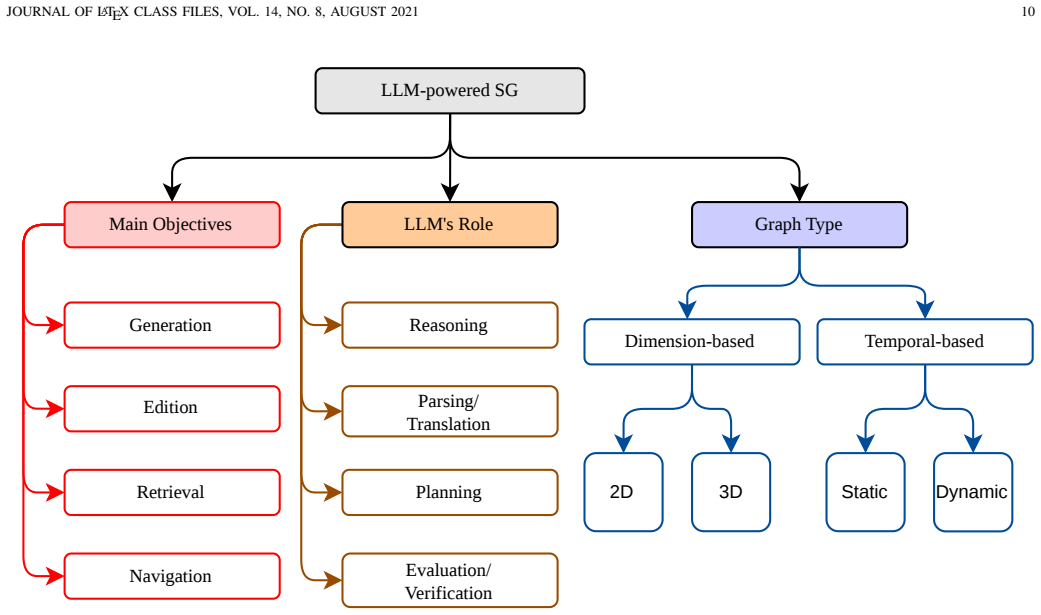
The paper establishes that mapping graph-LLM integrations by purpose (reasoning, retrieval, generation, recommendation), graph modality (knowledge graphs, scene graphs, interaction graphs, causal graphs, dependency graphs), and strategies (prompting, augmentation, training, agent-based) yields a practical guide for choosing methods according to task requirements, data characteristics, and reasoning complexity.
What carries the argument
The three-axis categorization that groups methods by purpose, graph modality, and integration strategy, serving as the organizing structure for the survey.
If this is right
- Researchers gain a map to match integration choices to specific tasks like retrieval in healthcare or reasoning in robotics.
- The breakdown highlights best-fit scenarios for different graph types and strategies, reducing trial-and-error in application.
- Limitations of each approach become clearer when viewed through the purpose-modality-strategy lens.
- The survey points to representative works that demonstrate real use cases across listed domains.
Where Pith is reading between the lines
- The framework could serve as a template for tracking how future methods evolve and whether they require new categories.
- Industry teams might apply the same axes to evaluate internal prototypes without exhaustive literature searches.
- Similar categorization could later extend to other pairings such as graphs with other generative models.
Load-bearing premise
The selected categories for purpose, modality, and strategy capture the relevant methods without significant omissions or overlaps that would reduce the guide's usefulness.
What would settle it
Discovery of multiple new graph-LLM methods that cannot be assigned to any single category without creating substantial overlaps or requiring entirely new axes would show the categorization fails to cover the space cleanly.
Figures



read the original abstract
Generative AI, particularly Large Language Models, increasingly integrates graph-based representations to enhance reasoning, retrieval, and structured decision-making. Despite rapid advances, there remains limited clarity regarding when, why, where, and what types of graph-LLM integrations are most appropriate across applications. This survey provides a concise, structured overview of the design choices underlying the integration of graphs with LLMs. We categorize existing methods based on their purpose (reasoning, retrieval, generation, recommendation), graph modality (knowledge graphs, scene graphs, interaction graphs, causal graphs, dependency graphs), and integration strategies (prompting, augmentation, training, or agent-based use). By mapping representative works across domains such as cybersecurity, healthcare, materials science, finance, robotics, and multimodal environments, we highlight the strengths, limitations, and best-fit scenarios for each technique. This survey aims to offer researchers a practical guide for selecting the most suitable graph-LLM approach depending on task requirements, data characteristics, and reasoning complexity.
Editorial analysis
A structured set of objections, weighed in public.
Referee Report
Summary. The manuscript is a survey providing a structured overview of methods integrating graphs with large language models (LLMs) and agents. It categorizes existing approaches along three axes—purpose (reasoning, retrieval, generation, recommendation), graph modality (knowledge graphs, scene graphs, interaction graphs, causal graphs, dependency graphs), and integration strategies (prompting, augmentation, training, agent-based)—while mapping representative works to domains such as cybersecurity, healthcare, materials science, finance, robotics, and multimodal settings, and discussing strengths, limitations, and best-fit scenarios.
Significance. If the taxonomy proves comprehensive with accurate mappings and minimal unaddressed overlaps, the survey could serve as a practical reference for selecting graph-LLM integrations based on task and data characteristics. It synthesizes a broad literature base across domains in a rapidly evolving area, offering organizational value rather than new methods or benchmarks. The absence of original derivations or experiments means impact hinges on coverage depth and clarity of the framework.
major comments (2)
- [Main categorization sections (around the purpose/modality/strategy breakdown)] The three-axis taxonomy (purpose, modality, strategy) is the central organizational claim, yet potential overlaps between categories (e.g., reasoning vs. generation in agent-based settings, or knowledge graphs vs. causal graphs) are not explicitly resolved; this could undermine practical utility unless assignment rules or disambiguation examples are added in the main categorization section.
- [Domain-specific mapping sections] Domain mappings appear uneven, with healthcare receiving more representative works than materials science or finance; if the survey claims broad applicability, the selection criteria and sampling of literature should be stated explicitly to address possible coverage gaps.
minor comments (2)
- [Abstract and integration strategy section] Terminology consistency: 'agent-based use' is listed as a strategy in the abstract but should be cross-checked against the body for uniform phrasing with 'agent-based' integrations.
- [Tables/figures summarizing mappings] Figure or table clarity: Any summary tables mapping works to categories would benefit from explicit legends or footnotes explaining how edge-case methods were classified.
Simulated Author's Rebuttal
We thank the referee for the constructive feedback and positive recommendation for minor revision. We address each major comment below and will incorporate changes to strengthen the taxonomy's clarity and transparency of our literature sampling.
read point-by-point responses
-
Referee: [Main categorization sections (around the purpose/modality/strategy breakdown)] The three-axis taxonomy (purpose, modality, strategy) is the central organizational claim, yet potential overlaps between categories (e.g., reasoning vs. generation in agent-based settings, or knowledge graphs vs. causal graphs) are not explicitly resolved; this could undermine practical utility unless assignment rules or disambiguation examples are added in the main categorization section.
Authors: We agree that potential overlaps exist and that explicit disambiguation would improve practical utility. In the revised manuscript, we will add a new subsection immediately following the three-axis taxonomy introduction. This subsection will provide assignment rules, such as: (1) agent-based methods are categorized under their primary purpose (e.g., reasoning if the agent performs multi-step inference, with a cross-reference to generation); (2) causal graphs are treated as a specialized modality distinct from general knowledge graphs when the focus is on causal inference rather than factual retrieval. We will include 2-3 concrete disambiguation examples drawn from the surveyed literature to illustrate borderline cases. This addition clarifies the framework without changing the core structure. revision: yes
-
Referee: [Domain-specific mapping sections] Domain mappings appear uneven, with healthcare receiving more representative works than materials science or finance; if the survey claims broad applicability, the selection criteria and sampling of literature should be stated explicitly to address possible coverage gaps.
Authors: We acknowledge the uneven distribution, which mirrors the current state of the literature where healthcare applications have seen earlier and more extensive adoption of graph-LLM methods due to structured data availability. To address this, we will insert an explicit paragraph in the domain mapping overview (and reference it in the introduction) stating our selection criteria: representative works were chosen based on recency (primarily 2023-2024), citation impact, and coverage of distinct modalities/strategies, prioritizing diversity over equal representation per domain. We will also add a brief note acknowledging coverage gaps in domains like materials science and finance, and suggest these as areas for future work. This makes the sampling process transparent while preserving the survey's focus on high-impact examples. revision: yes
Circularity Check
No significant circularity detected
full rationale
This paper is a survey that organizes existing literature on graph-LLM integrations into categories based on purpose, graph modality, and integration strategies. It presents no original derivations, equations, predictions, fitted parameters, or theorems. The central claim is purely organizational and taxonomic, mapping representative works without asserting any technical result that could reduce to its own inputs by construction. No self-citations function as load-bearing justifications for uniqueness or ansatzes, and the work contains no self-definitional loops or renamed empirical patterns presented as novel derivations.
Axiom & Free-Parameter Ledger
Reference graph
Works this paper leans on
-
[1]
Graph-based agent memory: Taxonomy, techniques, and applications,
C. Yang, C. Zhou, Y . Xiao, S. Dong, L. Zhuang, Y . Zhang, Z. Wang, Z. Hong, Z. Yuan, Z. Xiang,et al., “Graph-based agent memory: Taxonomy, techniques, and applications,”arXiv preprint arXiv:2602.05665, 2026
-
[2]
Large language model- enhanced symbolic reasoning for knowledge base com- pletion,
Q. He, J. Yu, and W. Wang, “Large language model- enhanced symbolic reasoning for knowledge base com- pletion,”IEEE Transactions on Audio, Speech and Lan- guage Processing, 2026
2026
-
[3]
Knowpath: An llm-supported knowledge graph construction and path finding framework to explainable mooc recommendations,
J. Zhu, Z. Chen, P. D. Meo, J. Guan, Z. Han, and W. Shi, “Knowpath: An llm-supported knowledge graph construction and path finding framework to explainable mooc recommendations,”ACM Transactions on Infor- mation Systems, vol. 44, no. 2, pp. 1–28, 2026
2026
-
[4]
Cti-thinker: an llm-driven system for cti knowledge graph construc- JOURNAL OF LATEX CLASS FILES, VOL. 14, NO. 8, AUGUST 2021 18 tion and attack reasoning,
X. Yang, R. Zhong, Y . Chen, G. Peng, D. Yao, C. Chen, C. Wang, D. Zhang, Y . Zhou, and Z. Yang, “Cti-thinker: an llm-driven system for cti knowledge graph construc- JOURNAL OF LATEX CLASS FILES, VOL. 14, NO. 8, AUGUST 2021 18 tion and attack reasoning,”Cybersecurity, vol. 9, no. 1, p. 106, 2026
2021
-
[5]
Scenellm: Implicit lan- guage reasoning in llm for dynamic scene graph gener- ation,
H. Zhang, Z. Li, and J. Liu, “Scenellm: Implicit lan- guage reasoning in llm for dynamic scene graph gener- ation,”Pattern Recognition, vol. 170, p. 111992, 2026
2026
-
[6]
Graphpilot: Gui task automation with one-step llm reasoning powered by knowledge graph,
M. Yu, S. Luo, and X. Chen, “Graphpilot: Gui task automation with one-step llm reasoning powered by knowledge graph,”arXiv preprint arXiv:2601.17418, 2026
-
[7]
Reliable reasoning path: Distilling effective guidance for llm reasoning with knowledge graphs,
Y . Xiao, C. Zhou, Q. Zhang, B. Li, Q. Li, and X. Huang, “Reliable reasoning path: Distilling effective guidance for llm reasoning with knowledge graphs,”IEEE Trans- actions on Knowledge and Data Engineering, 2026
2026
-
[8]
Gnn-llm hybrid cog- nitive architectures for generative task adaptation in multi-human multi-robot collaborative disassem- bly,
X. Tong, K. Li, and J. Bao, “Gnn-llm hybrid cog- nitive architectures for generative task adaptation in multi-human multi-robot collaborative disassem- bly,”Robotics and Computer-Integrated Manufacturing, vol. 98, p. 103169, 2026
2026
-
[9]
H. Tao, Y . Zhang, Z. Tang, H. Peng, X. Zhu, B. Liu, Y . Yang, Z. Zhang, Z. Xu, H. Zhang,et al., “Code graph model (cgm): A graph-integrated large language model for repository-level software engineering tasks,”arXiv preprint arXiv:2505.16901, 2025
-
[10]
S. Ahn, S. Shin, and Y .-D. Seo, “Enriching seman- tic profiles into knowledge graph for recommender systems using large language models,”arXiv preprint arXiv:2601.08148, 2026
-
[11]
Approxi- mate knowledge graphs: Privacy-preserving healthcare data synthesis via llm-driven approximation,
S. Li, J. Gong, and A. A. Ramirez Molina, “Approxi- mate knowledge graphs: Privacy-preserving healthcare data synthesis via llm-driven approximation,” inPro- ceedings of the ACM/IEEE International Conference on Connected Health: Applications, Systems and Engineer- ing Technologies, pp. 458–463, 2025
2025
-
[12]
Synergistic joint model of knowledge graph and llm for enhancing xai- based clinical decision support systems,
C. Park, H. Lee, S. Lee, and O. Jeong, “Synergistic joint model of knowledge graph and llm for enhancing xai- based clinical decision support systems,”Mathematics, vol. 13, no. 6, p. 949, 2025
2025
-
[13]
St-llm+: Graph enhanced spatio-temporal large language models for traffic pre- diction,
C. Liu, K. H. Hettige, Q. Xu, C. Long, S. Xiang, G. Cong, Z. Li, and R. Zhao, “St-llm+: Graph enhanced spatio-temporal large language models for traffic pre- diction,”IEEE Transactions on Knowledge and Data Engineering, 2025
2025
-
[14]
Full-stack knowledge graph and llm framework for post-quantum cyber readiness,
R. Erlemann, C. C. Morris, and S. Sathe, “Full-stack knowledge graph and llm framework for post-quantum cyber readiness,”arXiv preprint arXiv:2601.03504, 2026
-
[15]
Tegra: Text encoding with graph and retrieval augmentation for misinformation detection,
G. Faye, W. Ouerdane, G. Gadek, S. Gatepaille, and C. Hudelot, “Tegra: Text encoding with graph and retrieval augmentation for misinformation detection,” arXiv preprint arXiv:2602.11106, 2026
-
[16]
Automated carbon-aware assessment of openbim-based ductwork design using knowledge graph–augmented llm multi-agent framework,
Y . Xu, A. Li, X. Guo, J. C. Chan, X. Gong, H. H. Kwok, and J. C. Cheng, “Automated carbon-aware assessment of openbim-based ductwork design using knowledge graph–augmented llm multi-agent framework,”Automa- tion in Construction, vol. 181, p. 106611, 2026
2026
-
[17]
Z. Chen, Y . Liu, J. Liu, and W. Gao, “Combining llm semantic reasoning with gnn structural modeling for multi-view multi-label feature selection,”arXiv preprint arXiv:2511.08008, 2025
-
[18]
Llm in the middle: A systematic review of threats and mitigations to real-world llm-based systems,
V . H. G. Moia, I. J. Sanz, G. A. F. Rebello, R. D. de Meneses, B. Hitaj, and U. Lindqvist, “Llm in the middle: A systematic review of threats and mitigations to real-world llm-based systems,”Computer Science Review, vol. 61, p. 100916, 2026
2026
-
[19]
From generation to judgment: Opportunities and chal- lenges of llm-as-a-judge,
D. Li, B. Jiang, L. Huang, A. Beigi, C. Zhao, Z. Tan, A. Bhattacharjee, Y . Jiang, C. Chen, T. Wu,et al., “From generation to judgment: Opportunities and chal- lenges of llm-as-a-judge,” inProceedings of the 2025 Conference on Empirical Methods in Natural Language Processing, pp. 2757–2791, 2025
2025
-
[20]
Semi-Supervised Classification with Graph Convolutional Networks
T. N. Kipf and M. Welling, “Semi-supervised classifica- tion with graph convolutional networks,”arXiv preprint arXiv:1609.02907, 2016
work page internal anchor Pith review arXiv 2016
-
[21]
Inductive representation learning on large graphs,
W. Hamilton, Z. Ying, and J. Leskovec, “Inductive representation learning on large graphs,”Advances in neural information processing systems, vol. 30, 2017
2017
-
[22]
Simplifying graph convolutional net- works,
F. Wu, A. Souza, T. Zhang, C. Fifty, T. Yu, and K. Weinberger, “Simplifying graph convolutional net- works,” inInternational conference on machine learn- ing, pp. 6861–6871, Pmlr, 2019
2019
-
[23]
The graph neural network model,
F. Scarselli, M. Gori, A. C. Tsoi, M. Hagenbuchner, and G. Monfardini, “The graph neural network model,” IEEE transactions on neural networks, vol. 20, no. 1, pp. 61–80, 2008
2008
-
[24]
Do transformers really perform badly for graph representation?,
C. Ying, T. Cai, S. Luo, S. Zheng, G. Ke, D. He, Y . Shen, and T.-Y . Liu, “Do transformers really perform badly for graph representation?,”Advances in neural information processing systems, vol. 34, pp. 28877– 28888, 2021
2021
-
[25]
Text2kgbench: A benchmark for ontology- driven knowledge graph generation from text,
N. Mihindukulasooriya, S. Tiwari, C. F. Enguix, and K. Lata, “Text2kgbench: A benchmark for ontology- driven knowledge graph generation from text,” inIn- ternational semantic web conference, pp. 247–265, Springer, 2023
2023
-
[26]
Docs2kg: A human-llm collaborative approach to unified knowledge graph construction from heterogeneous documents,
Q. Sun, Y . Luo, W. Zhang, S. Li, J. Li, K. Niu, X. Kong, and W. Liu, “Docs2kg: A human-llm collaborative approach to unified knowledge graph construction from heterogeneous documents,” inCompanion Proceedings of the ACM on Web Conference 2025, pp. 801–804, 2025
2025
-
[27]
Knowledge graph extraction from textual data using llm,
K. Gillani, E. Novak, K. Kenda, and D. Mladeni ´c, “Knowledge graph extraction from textual data using llm,” inInformation Society Conferences, 2024
2024
-
[28]
Enhancing knowl- edge graph construction using large language models,
M. Trajanoska, R. Stojanov, and D. Trajanov, “Enhanc- ing knowledge graph construction using large language models,”arXiv preprint arXiv:2305.04676, 2023
-
[29]
Ctikg: Llm-powered knowledge graph construction from cyber threat intelligence,
L. Huang and X. Xiao, “Ctikg: Llm-powered knowledge graph construction from cyber threat intelligence,” in First Conference on Language Modeling, 2024
2024
-
[30]
V . K. Kommineni, B. K ¨onig-Ries, and S. Samuel, “From human experts to machines: An llm supported approach to ontology and knowledge graph construc- tion,”arXiv preprint arXiv:2403.08345, 2024
-
[31]
Llm-assisted knowledge graph engineering: Ex- JOURNAL OF LATEX CLASS FILES, VOL. 14, NO. 8, AUGUST 2021 19 periments with chatgpt,
L.-P. Meyer, C. Stadler, J. Frey, N. Radtke, K. Jung- hanns, R. Meissner, G. Dziwis, K. Bulert, and M. Mar- tin, “Llm-assisted knowledge graph engineering: Ex- JOURNAL OF LATEX CLASS FILES, VOL. 14, NO. 8, AUGUST 2021 19 periments with chatgpt,” inWorking conference on artificial intelligence development for a resilient and sustainable tomorrow, pp. 103–1...
2021
-
[32]
Complex ontology alignment using llms: A case study,
A. Barua, R. Amini, S. S. Norouzi, R. Amini, and P. Hitzler, “Complex ontology alignment using llms: A case study,” 2022
2022
-
[33]
arXiv preprint arXiv:2307.01128 (2023)
S. Carta, A. Giuliani, L. Piano, A. S. Podda, L. Pom- pianu, and S. G. Tiddia, “Iterative zero-shot llm prompt- ing for knowledge graph construction,”arXiv preprint arXiv:2307.01128, 2023
-
[34]
Grapheval: A knowledge-graph based llm hallucination evaluation framework,
H. Sansford, N. Richardson, H. P. Maretic, and J. N. Saada, “Grapheval: A knowledge-graph based llm hallucination evaluation framework,”arXiv preprint arXiv:2407.10793, 2024
-
[35]
L.-P. Meyer, J. Frey, K. Junghanns, F. Brei, K. Bulert, S. Gr ¨under-Fahrer, and M. Martin, “Developing a scal- able benchmark for assessing large language mod- els in knowledge graph engineering,”arXiv preprint arXiv:2308.16622, 2023
-
[36]
Medical graph rag: Evidence- based medical large language model via graph retrieval- augmented generation,
J. Wu, J. Zhu, Y . Qi, J. Chen, M. Xu, F. Menolascina, Y . Jin, and V . Grau, “Medical graph rag: Evidence- based medical large language model via graph retrieval- augmented generation,” inProceedings of the 63rd Annual Meeting of the Association for Computational Linguistics (Volume 1: Long Papers), pp. 28443–28467, 2025
2025
-
[37]
A self-correcting agentic graph rag for clinical decision support in hepatology,
Y . Hu, W. Xuan, Q. Zhou, Z. Li, Y . Li, J. Hu, and F. Fang, “A self-correcting agentic graph rag for clinical decision support in hepatology,”Frontiers in medicine, vol. 12, p. 1716327, 2025
2025
-
[38]
Graph retrieval-augmented gen- eration: A survey,
B. Peng, Y . Zhu, Y . Liu, X. Bo, H. Shi, C. Hong, Y . Zhang, and S. Tang, “Graph retrieval-augmented gen- eration: A survey,”ACM Transactions on Information Systems, vol. 44, no. 2, pp. 1–52, 2025
2025
-
[39]
Gnn-rag: Graph neural retrieval for efficient large language model reasoning on knowledge graphs,
C. Mavromatis and G. Karypis, “Gnn-rag: Graph neural retrieval for efficient large language model reasoning on knowledge graphs,” inFindings of the Association for Computational Linguistics: ACL 2025, pp. 16682– 16699, 2025
2025
-
[40]
Enrich- on-graph: Query-graph alignment for complex reason- ing with llm enriching,
S. Li, Z. Liu, Z. Gui, H. Chen, and W. Zhang, “Enrich- on-graph: Query-graph alignment for complex reason- ing with llm enriching,” inProceedings of the 2025 Conference on Empirical Methods in Natural Language Processing, pp. 7683–7703, 2025
2025
-
[41]
A survey of large language models for graphs,
X. Ren, J. Tang, D. Yin, N. Chawla, and C. Huang, “A survey of large language models for graphs,” in Proceedings of the 30th ACM SIGKDD Conference on Knowledge Discovery and Data Mining, pp. 6616– 6626, 2024
2024
-
[42]
Learning on large-scale text- attributed graphs via variational inference,
J. Zhao, M. Qu, C. Li, H. Yan, Q. Liu, R. Li, X. Xie, and J. Tang, “Learning on large-scale text- attributed graphs via variational inference,”arXiv preprint arXiv:2210.14709, 2022
-
[43]
Login: A large language model consulted graph neu- ral network training framework,
Y . Qiao, X. Ao, Y . Liu, J. Xu, X. Sun, and Q. He, “Login: A large language model consulted graph neu- ral network training framework,” inProceedings of the Eighteenth ACM International Conference on Web Search and Data Mining, pp. 232–241, 2025
2025
-
[44]
Distilling large language models for text-attributed graph learning,
B. Pan, Z. Zhang, Y . Zhang, Y . Hu, and L. Zhao, “Distilling large language models for text-attributed graph learning,” inProceedings of the 33rd ACM In- ternational Conference on Information and Knowledge Management, pp. 1836–1845, 2024
2024
-
[45]
arXiv preprint arXiv:2402.15183 , year=
Z. Guo, L. Xia, Y . Yu, Y . Wang, K. Lu, Z. Huang, and C. Huang, “Graphedit: Large language models for graph structure learning,”arXiv preprint arXiv:2402.15183, 2024
-
[46]
LLaGA: Large language and graph assistant,
R. Chen, T. Zhao, A. Jaiswal, N. Shah, and Z. Wang, “Llaga: Large language and graph assistant,”arXiv preprint arXiv:2402.08170, 2024
-
[47]
Can large language models improve the adversarial robustness of graph neural networks?,
Z. Zhang, X. Wang, H. Zhou, Y . Yu, M. Zhang, C. Yang, and C. Shi, “Can large language models improve the adversarial robustness of graph neural networks?,” in Proceedings of the 31st ACM SIGKDD Conference on Knowledge Discovery and Data Mining V . 1, pp. 2008– 2019, 2025
2008
-
[48]
Save-tag: Llm-based interpolation for long-tailed text-attributed graphs,
L. Wang, Y . Wang, B. Ni, Y . Zhao, H. Wang, Y . Ma, and T. Derr, “Save-tag: Llm-based interpolation for long-tailed text-attributed graphs,”arXiv preprint arXiv:2410.16882, 2024
-
[49]
Gnn-rag: Graph neural retrieval for large language model reasoning,
C. Mavromatis and G. Karypis, “Gnn-rag: Graph neural retrieval for large language model reasoning,”arXiv preprint arXiv:2405.20139, 2024
-
[50]
Instructgraph: Boosting large language models via graph-centric instruction tuning and pref- erence alignment,
J. Wang, J. Wu, Y . Hou, Y . Liu, M. Gao, and J. McAuley, “Instructgraph: Boosting large language models via graph-centric instruction tuning and pref- erence alignment,” inFindings of the Association for Computational Linguistics: ACL 2024, pp. 13492– 13510, 2024
2024
-
[51]
From nodes to narratives: Explaining graph neural networks with llms and graph context,
P. Baghershahi, G. Fournier, P. Nyati, and S. Medya, “From nodes to narratives: Explaining graph neural networks with llms and graph context,” 2025
2025
-
[52]
Graphgpt: Graph instruction tuning for large language models,
J. Tang, Y . Yang, W. Wei, L. Shi, L. Su, S. Cheng, D. Yin, and C. Huang, “Graphgpt: Graph instruction tuning for large language models,” inProceedings of the 47th International ACM SIGIR Conference on Research and Development in Information Retrieval, pp. 491– 500, 2024
2024
-
[53]
Higpt: Heterogeneous graph language model,
J. Tang, Y . Yang, W. Wei, L. Shi, L. Xia, D. Yin, and C. Huang, “Higpt: Heterogeneous graph language model,” inProceedings of the 30th ACM SIGKDD conference on knowledge discovery and data mining, pp. 2842–2853, 2024
2024
-
[54]
Gofa: A generative one-for-all model for joint graph language modeling,
L. Kong, J. Feng, H. Liu, C. Huang, J. Huang, Y . Chen, and M. Zhang, “Gofa: A generative one-for-all model for joint graph language modeling,”arXiv preprint arXiv:2407.09709, 2024
-
[55]
Each graph is a new language: Graph learning with llms,
H. Zhou, J. Du, C. Zhou, C. Yang, Y . Xiao, Y . Xie, and X. Huang, “Each graph is a new language: Graph learning with llms,” inFindings of the Association for Computational Linguistics: ACL 2025, pp. 17548– 17559, 2025
2025
-
[56]
Finqa: A training-free dynamic knowledge graph question answering system in finance with llm-based revision,
W. Tao, H. Zhu, K. Tan, J. Wang, Y . Liang, H. Jiang, P. Yuan, and Y . Lan, “Finqa: A training-free dynamic knowledge graph question answering system in finance with llm-based revision,” inJoint European Conference JOURNAL OF LATEX CLASS FILES, VOL. 14, NO. 8, AUGUST 2021 20 on Machine Learning and Knowledge Discovery in Databases, pp. 418–423, Springer, 2024
2021
-
[57]
A gail fine-tuned llm enhanced framework for low-resource knowledge graph question answering,
Z. Zhang, L. Wen, and W. Zhao, “A gail fine-tuned llm enhanced framework for low-resource knowledge graph question answering,” inProceedings of the 33rd ACM International Conference on Information and Knowl- edge Management, pp. 3300–3309, 2024
2024
-
[58]
Knowledge graph large language model (kg-llm) for link prediction.arXiv preprint arXiv:2403.07311,
D. Shu, T. Chen, M. Jin, C. Zhang, M. Du, and Y . Zhang, “Knowledge graph large language model (kg-llm) for link prediction,”arXiv preprint arXiv:2403.07311, 2024
-
[59]
Knowledge graph question answering for materials science (kgqa4mat),
Y . An, J. Greenberg, F. J. Uribe-Romo, D. A. G´omez-Gualdr´on, K. Langlois, J. Furst, A. Kalinowski, X. Zhao, and X. Hu, “Knowledge graph question answering for materials science (kgqa4mat),” inRe- search Conference on Metadata and Semantics Re- search, pp. 18–29, Springer, 2023
2023
-
[60]
InProceedings of the AAAI Conference on Artificial Intelligence
Y . Xu, S. He, J. Chen, Z. Wang, Y . Song, H. Tong, G. Liu, K. Liu, and J. Zhao, “Generate-on-graph: Treat llm as both agent and kg in incomplete knowledge graph question answering,”arXiv preprint arXiv:2404.14741, 2024
-
[61]
Llm and gnn are complementary: Distilling llm for multimodal graph learning,
J. Xu, Z. Wu, M. Lin, X. Zhang, and S. Wang, “Llm and gnn are complementary: Distilling llm for multimodal graph learning,”arXiv preprint arXiv:2406.01032, 2024
-
[62]
Scene graph generation: A comprehensive survey,
H. Li, G. Zhu, L. Zhang, Y . Jiang, Y . Dang, H. Hou, P. Shen, X. Zhao, S. A. A. Shah, and M. Bennamoun, “Scene graph generation: A comprehensive survey,” Neurocomputing, vol. 566, p. 127052, 2024
2024
-
[63]
A comprehensive survey of scene graphs: Gen- eration and application,
X. Chang, P. Ren, P. Xu, Z. Li, X. Chen, and A. Haupt- mann, “A comprehensive survey of scene graphs: Gen- eration and application,”IEEE Transactions on Pattern Analysis and Machine Intelligence, vol. 45, no. 1, pp. 1– 26, 2021
2021
-
[64]
Scene graphs: A survey of generations and applications,
X. Chang, P. Ren, P. Xu, Z. Li, X. Chen, and A. Haupt- mann, “Scene graphs: A survey of generations and applications,”arXiv preprint arXiv:2104.01111, vol. 2, 2021
-
[65]
3dgraphllm: Combining semantic graphs and large language models for 3d scene understanding,
T. Zemskova and D. Yudin, “3dgraphllm: Combining semantic graphs and large language models for 3d scene understanding,” inProceedings of the IEEE/CVF In- ternational Conference on Computer Vision, pp. 8885– 8895, 2025
2025
-
[66]
Optimal scene graph planning with large language model guidance,
Z. Dai, A. Asgharivaskasi, T. Duong, S. Lin, M.-E. Tzes, G. Pappas, and N. Atanasov, “Optimal scene graph planning with large language model guidance,” in 2024 IEEE International Conference on Robotics and Automation (ICRA), pp. 14062–14069, IEEE, 2024
2024
-
[67]
Sg-nav: Online 3d scene graph prompting for llm-based zero- shot object navigation,
H. Yin, X. Xu, Z. Wu, J. Zhou, and J. Lu, “Sg-nav: Online 3d scene graph prompting for llm-based zero- shot object navigation,”Advances in neural information processing systems, vol. 37, pp. 5285–5307, 2024
2024
-
[68]
Sgformer: Semantic graph transformer for point cloud-based 3d scene graph generation,
C. Lv, M. Qi, X. Li, Z. Yang, and H. Ma, “Sgformer: Semantic graph transformer for point cloud-based 3d scene graph generation,” inProceedings of the AAAI Conference on Artificial Intelligence, vol. 38, pp. 4035– 4043, 2024
2024
-
[69]
Llm4sgg: Large language models for weakly supervised scene graph generation,
K. Kim, K. Yoon, J. Jeon, Y . In, J. Moon, D. Kim, and C. Park, “Llm4sgg: Large language models for weakly supervised scene graph generation,” inProceedings of the IEEE/CVF Conference on Computer Vision and Pattern Recognition, pp. 28306–28316, 2024
2024
-
[70]
Toward scene graph and layout guided complex 3d scene generation,
Y .-H. Huang, W. Wang, S.-Y . Huang, and Y .-C. F. Wang, “Toward scene graph and layout guided complex 3d scene generation,”arXiv preprint arXiv:2412.20473, 2024
-
[71]
S. Colombani, L. Brini, D. Ognibene, and G. Boc- cignone, “Time is on my sight: scene graph filtering for dynamic environment perception in an llm-driven robot,”arXiv preprint arXiv:2411.15027, 2024
-
[72]
What makes a scene? scene graph-based evaluation and feedback for controllable generation,
Z. Chen, J. Wu, Z. Lei, and C. W. Chen, “What makes a scene? scene graph-based evaluation and feedback for controllable generation,”arXiv preprint arXiv:2411.15435, 2024
-
[73]
Llm meets scene graph: Can large language models understand and generate scene graphs? a benchmark and empirical study,
D. Yang, M. Kim, S. Mac Kim, B.-w. Kwak, M. Park, J. Hong, W. Woo, and J. Yeo, “Llm meets scene graph: Can large language models understand and generate scene graphs? a benchmark and empirical study,” in Proceedings of the 63rd Annual Meeting of the Asso- ciation for Computational Linguistics (Volume 1: Long Papers), pp. 21335–21360, 2025
2025
-
[74]
Less is more: Toward zero-shot local scene graph generation via foundation models,
S. Zhao and H. Xu, “Less is more: Toward zero-shot local scene graph generation via foundation models,” arXiv preprint arXiv:2310.01356, 2023
-
[75]
Sakr-edit: Scene- aware knowledge reasoning for text-to-image editing,
J. Wang, J. Li, Z. Ma, and R. Bai, “Sakr-edit: Scene- aware knowledge reasoning for text-to-image editing,” inProceedings of the 33rd ACM International Confer- ence on Multimedia, pp. 10457–10466, 2025
2025
-
[76]
Scenecraft: An llm agent for synthesizing 3d scenes as blender code,
Z. Hu, A. Iscen, A. Jain, T. Kipf, Y . Yue, D. A. Ross, C. Schmid, and A. Fathi, “Scenecraft: An llm agent for synthesizing 3d scenes as blender code,” inForty-first International Conference on Machine Learning, 2024
2024
-
[77]
Editroom: Llm- parameterized graph diffusion for composable 3d room layout editing,
K. Zheng, X. Chen, X. He, J. Gu, L. Li, Z. Yang, K. Lin, J. Wang, L. Wang, and X. E. Wang, “Editroom: Llm- parameterized graph diffusion for composable 3d room layout editing,”arXiv preprint arXiv:2410.12836, 2024
-
[78]
Llm- powered scene graph representation learning for image retrieval via visual triplet-based graph transformation,
S. Jeong, J. Park, M. Choi, Y . Kwon, and S. Lim, “Llm- powered scene graph representation learning for image retrieval via visual triplet-based graph transformation,” Expert Systems with Applications, vol. 286, p. 127926, 2025
2025
-
[79]
Scene graph generation with role-playing large language models,
G. Chen, J. Li, and W. Wang, “Scene graph generation with role-playing large language models,”Advances in Neural Information Processing Systems, vol. 37, pp. 132238–132266, 2024
2024
-
[80]
Enabling perspective-aware ai with contextual scene graph gen- eration,
D. Platnick, M. Alirezaie, and H. Rahnama, “Enabling perspective-aware ai with contextual scene graph gen- eration,”Information, vol. 15, no. 12, p. 766, 2024
2024
discussion (0)
Sign in with ORCID, Apple, or X to comment. Anyone can read and Pith papers without signing in.