Recognition: unknown
MMGait: Towards Multi-Modal Gait Recognition
Pith reviewed 2026-05-10 08:59 UTC · model grok-4.3
The pith
MMGait introduces a benchmark with data from five sensors to support unified multi-modal gait recognition.
A machine-rendered reading of the paper's core claim, the machinery that carries it, and where it could break.
Core claim
The central claim is that the MMGait benchmark, containing 334,060 sequences from five heterogeneous sensors, enables systematic single-modal, cross-modal, and multi-modal gait experiments, while the proposed OmniGait baseline learns a shared embedding space across modalities and delivers promising recognition accuracy within one unified framework.
What carries the argument
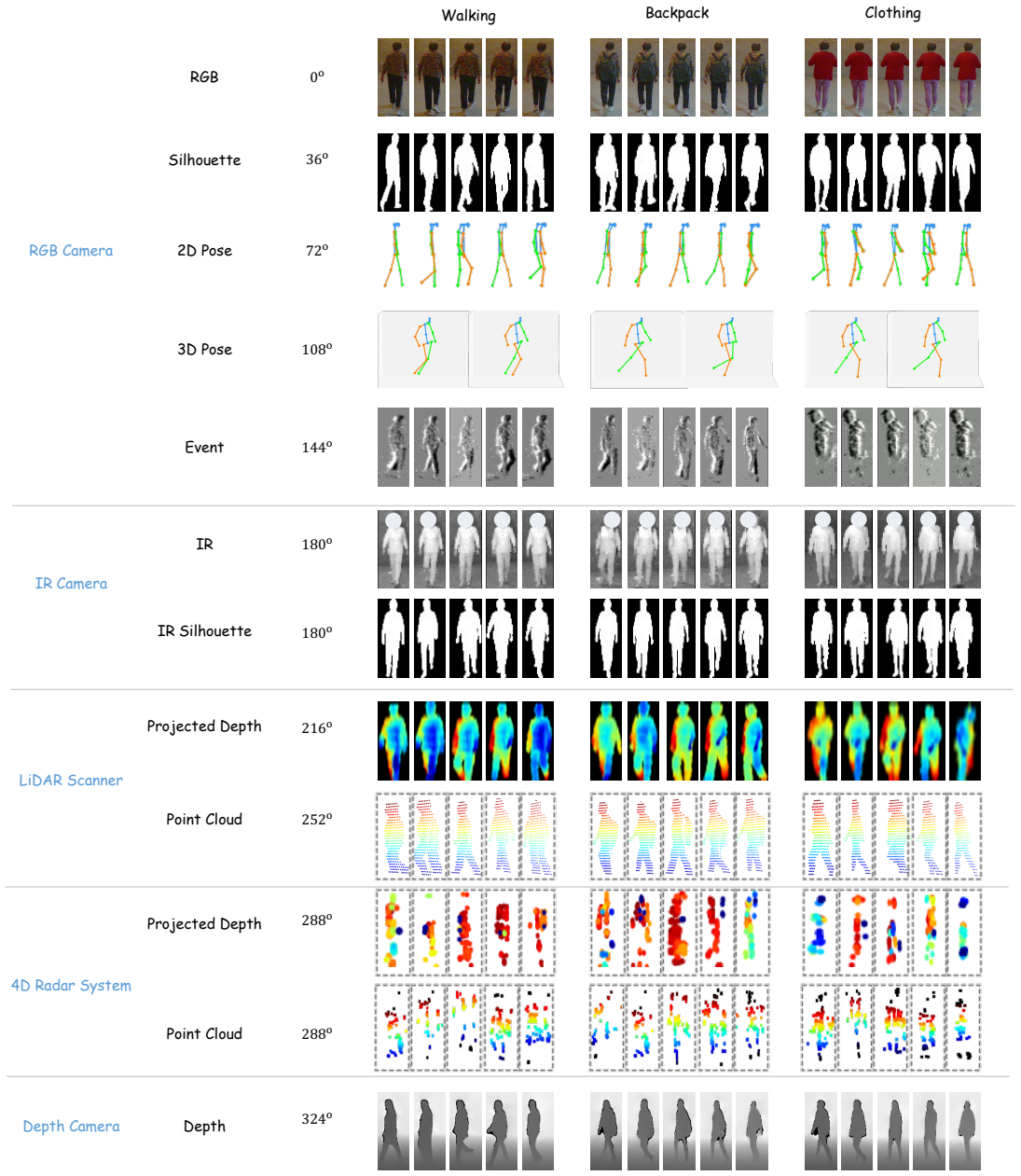
The MMGait benchmark dataset that integrates twelve modalities from an RGB camera, depth camera, infrared camera, LiDAR scanner, and 4D radar system; OmniGait model that projects diverse modality inputs into a common embedding space.
Load-bearing premise
The five sensors can be synchronized and aligned accurately enough during collection that performance differences reflect genuine complementarity rather than calibration or timing artifacts.
What would settle it
If cross-modal or multi-modal accuracy on MMGait falls to the level of the strongest single modality after explicit checks for alignment errors, the claim that the modalities supply useful complementary information would be falsified.
Figures


read the original abstract
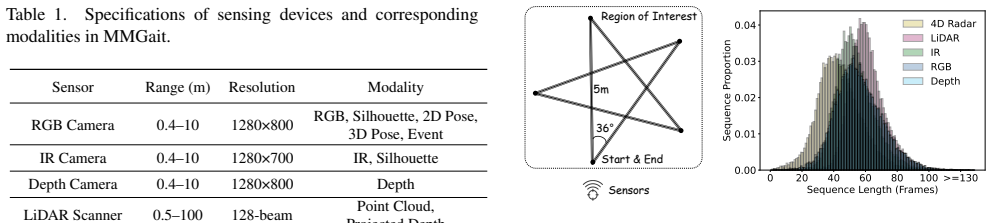
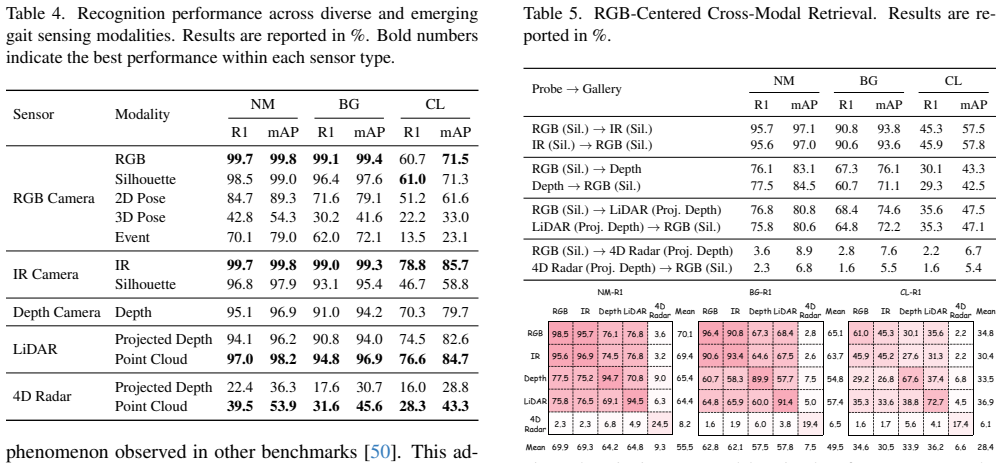
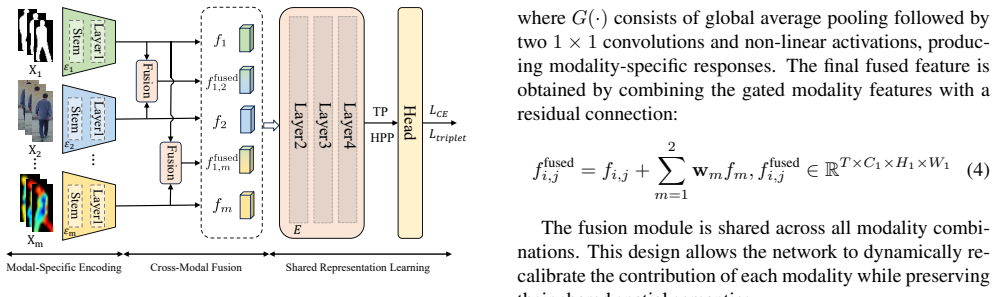
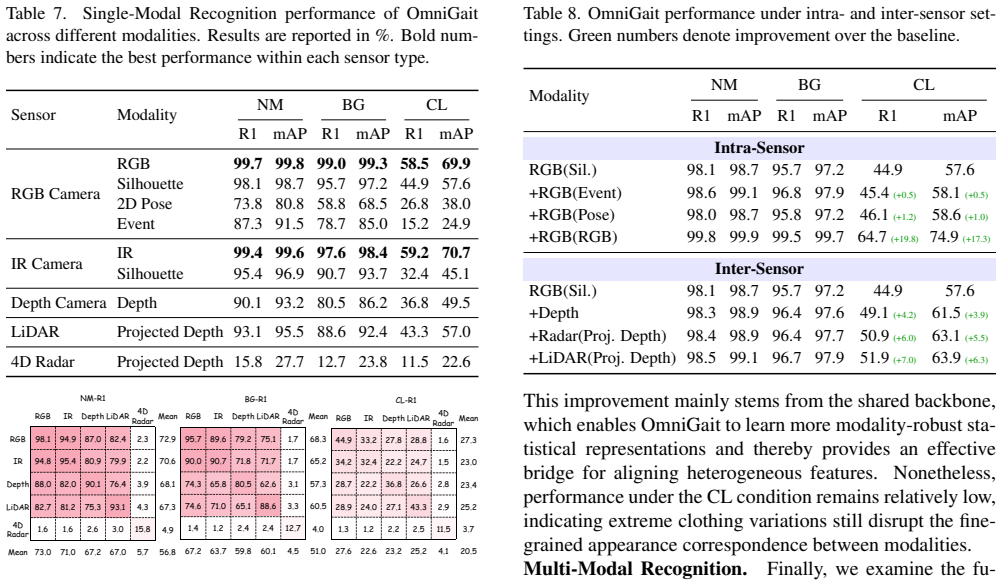
Gait recognition has emerged as a powerful biometric technique for identifying individuals at a distance without requiring user cooperation. Most existing methods focus primarily on RGB-derived modalities, which fall short in real-world scenarios requiring multi-modal collaboration and cross-modal retrieval. To overcome these challenges, we present MMGait, a comprehensive multi-modal gait benchmark integrating data from five heterogeneous sensors, including an RGB camera, a depth camera, an infrared camera, a LiDAR scanner, and a 4D Radar system. MMGait contains twelve modalities and 334,060 sequences from 725 subjects, enabling systematic exploration across geometric, photometric, and motion domains. Based on MMGait, we conduct extensive evaluations on single-modal, cross-modal, and multi-modal paradigms to analyze modality robustness and complementarity. Furthermore, we introduce a new task, Omni Multi-Modal Gait Recognition, which aims to unify the above three gait recognition paradigms within a single model. We also propose a simple yet powerful baseline, OmniGait, which learns a shared embedding space across diverse modalities and achieves promising recognition performance. The MMGait benchmark, codebase, and pretrained checkpoints are publicly available at https://github.com/BNU-IVC/MMGait.
Editorial analysis
A structured set of objections, weighed in public.
Circularity Check
No significant circularity: empirical benchmark with direct measurements
full rationale
The paper introduces a new multi-modal gait dataset (MMGait) collected from five heterogeneous sensors and proposes a baseline model (OmniGait) for shared embeddings across modalities. No mathematical derivations, fitted-parameter predictions, self-definitional loops, or load-bearing self-citations are present in the claims. Central results consist of direct empirical evaluations on newly collected sequences, with no reduction of outputs to inputs by construction. The work is self-contained as a benchmark contribution.
Axiom & Free-Parameter Ledger
axioms (1)
- domain assumption Gait patterns serve as reliable biometric identifiers across different sensing modalities
Reference graph
Works this paper leans on
-
[1]
2v-gait: Gait recognition us- ing 3d lidar robust to changes in walking direction and mea- surement distance
Jeongho Ahn, Kazuto Nakashima, Koki Yoshino, Yumi Iwashita, and Ryo Kurazume. 2v-gait: Gait recognition us- ing 3d lidar robust to changes in walking direction and mea- surement distance. In2022 IEEE/SICE International Sym- posium on System Integration (SII), pages 602–607. IEEE,
-
[2]
Lidar-based gait analysis and activity recognition in a 4d surveillance system.IEEE Transactions on Circuits and Sys- tems for Video Technology, 28(1):101–113, 2016
Csaba Benedek, Bence G ´alai, Bal´azs Nagy, and Zsolt Jank´o. Lidar-based gait analysis and activity recognition in a 4d surveillance system.IEEE Transactions on Circuits and Sys- tems for Video Technology, 28(1):101–113, 2016. 4
2016
-
[3]
Disentangled diffusion-based 3d human pose estimation with hierarchical spatial and temporal de- noiser
Qingyuan Cai, Xuecai Hu, Saihui Hou, Li Yao, and Yongzhen Huang. Disentangled diffusion-based 3d human pose estimation with hierarchical spatial and temporal de- noiser. InProceedings of the AAAI conference on artificial intelligence, pages 882–890, 2024. 2
2024
-
[4]
Qingyuan Cai, Linxin Zhang, Xuecai Hu, Saihui Hou, and Yongzhen Huang. Fastddhpose: Towards unified, efficient, and disentangled 3d human pose estimation.arXiv preprint arXiv:2512.14162, 2025. 2
-
[5]
Domain-specific batch normalization for unsupervised domain adaptation
Woong-Gi Chang, Tackgeun You, Seonguk Seo, Suha Kwak, and Bohyung Han. Domain-specific batch normalization for unsupervised domain adaptation. InProceedings of the IEEE/CVF conference on Computer Vision and Pattern Recognition, pages 7354–7362, 2019. 5
2019
-
[6]
Gaitset: Regarding gait as a set for cross-view gait recognition
Hanqing Chao, Yiwei He, Junping Zhang, and Jianfeng Feng. Gaitset: Regarding gait as a set for cross-view gait recognition. InProceedings of the AAAI conference on arti- ficial intelligence, pages 8126–8133, 2019. 4, 1
2019
-
[7]
Edino- gait: Transferring large visual models to event-based vision for enhancing gait recognition.IEEE Transactions on Multi- media, 2025
Liaogehao Chen, Zhenjun Zhang, and Yaonan Wang. Edino- gait: Transferring large visual models to event-based vision for enhancing gait recognition.IEEE Transactions on Multi- media, 2025. 3, 1
2025
-
[8]
Person reidentification based on automotive radar point clouds.IEEE Transactions on Geoscience and Remote Sensing, 60:1–13, 2021
Yuwei Cheng and Yimin Liu. Person reidentification based on automotive radar point clouds.IEEE Transactions on Geoscience and Remote Sensing, 60:1–13, 2021. 3
2021
-
[9]
Adrian Cosma, Andy C ˇatrunˇa, and Emilian R ˇadoi. On model and data scaling for skeleton-based self-supervised gait recognition.arXiv preprint arXiv:2504.07598, 2025. 1
-
[10]
Multi-modal gait recognition via effective spatial-temporal feature fusion
Yufeng Cui and Yimei Kang. Multi-modal gait recognition via effective spatial-temporal feature fusion. InProceedings of the IEEE/CVF Conference on Computer Vision and Pat- tern Recognition, pages 17949–17957, 2023. 1
2023
-
[11]
Licaf: Lidar- camera asymmetric fusion for gait recognition
Yunze Deng, Haijun Xiong, and Bin Feng. Licaf: Lidar- camera asymmetric fusion for gait recognition. In2024 IEEE International Conference on Image Processing (ICIP), pages 2424–2430. IEEE, 2024. 1
2024
-
[12]
Clash: Complementary learning with neural architec- ture search for gait recognition.IEEE Transactions on Image Processing, 2024
Huanzhang Dou, Pengyi Zhang, Yuhan Zhao, Lu Jin, and Xi Li. Clash: Complementary learning with neural architec- ture search for gait recognition.IEEE Transactions on Image Processing, 2024. 1
2024
-
[13]
A density-based algorithm for discovering clusters in large spatial databases with noise
Martin Ester, Hans-Peter Kriegel, J ¨org Sander, Xiaowei Xu, et al. A density-based algorithm for discovering clusters in large spatial databases with noise. Inkdd, pages 226–231,
-
[14]
Gaitpart: Temporal part-based model for gait recognition
Chao Fan, Yunjie Peng, Chunshui Cao, Xu Liu, Saihui Hou, Jiannan Chi, Yongzhen Huang, Qing Li, and Zhiqiang He. Gaitpart: Temporal part-based model for gait recognition. In Proceedings of the IEEE/CVF conference on computer vi- sion and pattern recognition, pages 14225–14233, 2020. 4
2020
-
[15]
Ex- ploring deep models for practical gait recognition.arXiv preprint arXiv:2303.03301, 2023
Chao Fan, Saihui Hou, Yongzhen Huang, and Shiqi Yu. Ex- ploring deep models for practical gait recognition.arXiv preprint arXiv:2303.03301, 2023. 4, 1
-
[16]
Opengait: Revisiting gait recognition towards better practicality
Chao Fan, Junhao Liang, Chuanfu Shen, Saihui Hou, Yongzhen Huang, and Shiqi Yu. Opengait: Revisiting gait recognition towards better practicality. InProceedings of the IEEE/CVF Conference on Computer Vision and Pattern Recognition, pages 9707–9716, 2023. 4, 1, 2
2023
-
[17]
Skeletongait: Gait recognition using skeleton maps
Chao Fan, Jingzhe Ma, Dongyang Jin, Chuanfu Shen, and Shiqi Yu. Skeletongait: Gait recognition using skeleton maps. InProceedings of the AAAI conference on artificial intelligence, pages 1662–1669, 2024. 4, 6, 1
2024
-
[18]
Gpgait: Generalized pose-based gait recognition
Yang Fu, Shibei Meng, Saihui Hou, Xuecai Hu, and Yongzhen Huang. Gpgait: Generalized pose-based gait recognition. InProceedings of the IEEE/CVF International Conference on Computer Vision, pages 19595–19604, 2023. 4, 1
2023
-
[19]
Cut out the middleman: Revisiting pose-based gait recognition
Yang Fu, Saihui Hou, Shibei Meng, Xuecai Hu, Chunshui Cao, Xu Liu, and Yongzhen Huang. Cut out the middleman: Revisiting pose-based gait recognition. InEuropean Confer- ence on Computer Vision, pages 112–128. Springer, 2024. 1
2024
-
[20]
Physics-augmented autoencoder for 3d skeleton-based gait recognition
Hongji Guo and Qiang Ji. Physics-augmented autoencoder for 3d skeleton-based gait recognition. InProceedings of the IEEE/CVF International Conference on Computer Vi- sion, pages 19627–19638, 2023. 1
2023
-
[21]
Camera-lidar cross-modality gait recognition
Wenxuan Guo, Yingping Liang, Zhiyu Pan, Ziheng Xi, Jian- jiang Feng, and Jie Zhou. Camera-lidar cross-modality gait recognition. InEuropean Conference on Computer Vision, pages 439–455. Springer, 2024. 1, 5, 2
2024
-
[22]
Lidar-based person re-identification
Wenxuan Guo, Zhiyu Pan, Yingping Liang, Ziheng Xi, Zhicheng Zhong, Jianjiang Feng, and Jie Zhou. Lidar-based person re-identification. InProceedings of the IEEE/CVF Conference on Computer Vision and Pattern Recognition, pages 17437–17447, 2024. 1, 3
2024
-
[23]
Gaitcontour: Efficient gait recognition based on a contour-pose representation
Yuxiang Guo, Anshul Shah, Jiang Liu, Ayush Gupta, Rama Chellappa, and Cheng Peng. Gaitcontour: Efficient gait recognition based on a contour-pose representation. In2025 IEEE/CVF Winter Conference on Applications of Computer Vision (WACV), pages 1051–1061. IEEE, 2025. 1
2025
-
[24]
mmreid: Person re-identification based on commod- ity millimeter-wave radar.IEEE Internet of Things Journal,
Chong Han, Siyu Chen, Biyun Sheng, Jian Guo, and Lijuan Sun. mmreid: Person re-identification based on commod- ity millimeter-wave radar.IEEE Internet of Things Journal,
-
[25]
Gait recognition in large- scale free environment via single lidar
Xiao Han, Yiming Ren, Peishan Cong, Yujing Sun, Jingya Wang, Lan Xu, and Yuexin Ma. Gait recognition in large- scale free environment via single lidar. InProceedings of the 32nd ACM International Conference on Multimedia, pages 380–389, 2024. 1, 4
2024
-
[26]
Micro-doppler based target recognition with radars: A review.IEEE Sensors Journal, 22(4):2948–2961, 2022
Ali Hanif, Muhammad Muaz, Azhar Hasan, and Muhammad Adeel. Micro-doppler based target recognition with radars: A review.IEEE Sensors Journal, 22(4):2948–2961, 2022. 3
2022
-
[27]
Recurrent attention models for depth-based person identification
Albert Haque, Alexandre Alahi, and Li Fei-Fei. Recurrent attention models for depth-based person identification. In Proceedings of the IEEE conference on computer vision and pattern recognition, pages 1229–1238, 2016. 3
2016
-
[28]
Instruct-reid++: Towards universal purpose instruction-guided person re-identification.IEEE Transac- tions on Pattern Analysis and Machine Intelligence, 2025
Weizhen He, Yiheng Deng, Yunfeng Yan, Feng Zhu, Yizhou Wang, Lei Bai, Qingsong Xie, Rui Zhao, Donglian Qi, Wanli Ouyang, et al. Instruct-reid++: Towards universal purpose instruction-guided person re-identification.IEEE Transac- tions on Pattern Analysis and Machine Intelligence, 2025. 1
2025
-
[29]
Martin Hofmann, J ¨urgen Geiger, Sebastian Bachmann, Bj¨orn Schuller, and Gerhard Rigoll. The tum gait from audio, image and depth (gaid) database: Multimodal recognition of subjects and traits.Journal of Visual Communication and Image Representation, 25(1):195–206, 2014. 4
2014
-
[30]
Saihui Hou, Chenye Wang, Wenpeng Lang, Zhengxiang Lan, and Yongzhen Huang. Gaitsnippet: Gait recognition be- yond unordered sets and ordered sequences.arXiv preprint arXiv:2508.07782, 2025. 1
-
[31]
Gaitasset: In defense of regard- ing gait as a set.IEEE Transactions on Information Forensics and Security, 20:12301–12316, 2025
Saihui Hou, Chenye Wang, Aoqi Li, Jilong Wang, Liang Wang, and Yongzhen Huang. Gaitasset: In defense of regard- ing gait as a set.IEEE Transactions on Information Forensics and Security, 20:12301–12316, 2025. 1
2025
-
[32]
v2e: From video frames to realistic dvs events
Yuhuang Hu, Shih-Chii Liu, and Tobi Delbruck. v2e: From video frames to realistic dvs events. InProceedings of the IEEE/CVF conference on computer vision and pattern recognition, pages 1312–1321, 2021. 2
2021
-
[33]
Normalization techniques in training dnns: Method- ology, analysis and application.IEEE transactions on pat- tern analysis and machine intelligence, 45(8):10173–10196,
Lei Huang, Jie Qin, Yi Zhou, Fan Zhu, Li Liu, and Ling Shao. Normalization techniques in training dnns: Method- ology, analysis and application.IEEE transactions on pat- tern analysis and machine intelligence, 45(8):10173–10196,
-
[34]
V ocabulary-guided gait recognition
Panjian Huang, Saihui Hou, Chunshui Cao, Xu Liu, and Yongzhen Huang. V ocabulary-guided gait recognition. In The Thirty-ninth Annual Conference on Neural Information Processing Systems. 1
-
[35]
Occluded gait recognition with mixture of experts: an action detection perspective
Panjian Huang, Yunjie Peng, Saihui Hou, Chunshui Cao, Xu Liu, Zhiqiang He, and Yongzhen Huang. Occluded gait recognition with mixture of experts: an action detection perspective. InEuropean Conference on Computer Vision, pages 380–397. Springer, 2024. 1
2024
-
[36]
Learning a unified template for gait recognition
Panjian Huang, Saihui Hou, Junzhou Huang, and Yongzhen Huang. Learning a unified template for gait recognition. In Proceedings of the IEEE/CVF International Conference on Computer Vision, pages 12459–12469, 2025. 1
2025
-
[37]
Condition-adaptive graph convolution learning for skeleton-based gait recogni- tion.IEEE Transactions on Image Processing, 32:4773– 4784, 2023
Xiaohu Huang, Xinggang Wang, Zhidianqiu Jin, Bo Yang, Botao He, Bin Feng, and Wenyu Liu. Condition-adaptive graph convolution learning for skeleton-based gait recogni- tion.IEEE Transactions on Image Processing, 32:4773– 4784, 2023. 1
2023
-
[38]
L4dr: Lidar-4dradar fusion for weather-robust 3d ob- ject detection
Xun Huang, Ziyu Xu, Hai Wu, Jinlong Wang, Qiming Xia, Yan Xia, Jonathan Li, Kyle Gao, Chenglu Wen, and Cheng Wang. L4dr: Lidar-4dradar fusion for weather-robust 3d ob- ject detection. InProceedings of the AAAI Conference on Artificial Intelligence, pages 3806–3814, 2025. 3
2025
-
[39]
Ex- ploring more from multiple gait modalities for human identi- fication
Dongyang Jin, Chao Fan, Weihua Chen, and Shiqi Yu. Ex- ploring more from multiple gait modalities for human identi- fication. InProceedings of the AAAI Conference on Artificial Intelligence, pages 4120–4128, 2025. 6, 1, 5
2025
-
[40]
On denoising walking videos for gait recognition
Dongyang Jin, Chao Fan, Jingzhe Ma, Jingkai Zhou, Wei- hua Chen, and Shiqi Yu. On denoising walking videos for gait recognition. InProceedings of the Computer Vision and Pattern Recognition Conference, pages 12347–12357, 2025. 1
2025
-
[41]
Adam: A Method for Stochastic Optimization
Diederik P Kingma. Adam: A method for stochastic opti- mization.arXiv preprint arXiv:1412.6980, 2014. 2
work page internal anchor Pith review Pith/arXiv arXiv 2014
-
[42]
Beyond sparse keypoints: Dense pose modeling for robust gait recog- nition
Wenpeng Lang, Saihui Hou, and Yongzhen Huang. Beyond sparse keypoints: Dense pose modeling for robust gait recog- nition. InProceedings of the 33rd ACM International Con- ference on Multimedia, pages 669–678, 2025. 1
2025
-
[43]
Patch- work++: Fast and robust ground segmentation solving partial under-segmentation using 3d point cloud
Seungjae Lee, Hyungtae Lim, and Hyun Myung. Patch- work++: Fast and robust ground segmentation solving partial under-segmentation using 3d point cloud. In2022 IEEE/RSJ International Conference on Intelligent Robots and Systems (IROS), pages 13276–13283. IEEE, 2022. 2
2022
-
[44]
Aerialgait: Bridging aerial and ground views for gait recognition
Aoqi Li, Saihui Hou, Chenye Wang, Qingyuan Cai, and Yongzhen Huang. Aerialgait: Bridging aerial and ground views for gait recognition. InProceedings of the 32nd ACM International Conference on Multimedia, pages 1139–1147,
-
[45]
All in one frame- work for multimodal re-identification in the wild
He Li, Mang Ye, Ming Zhang, and Bo Du. All in one frame- work for multimodal re-identification in the wild. InPro- ceedings of the IEEE/CVF Conference on Computer Vision and Pattern Recognition, pages 17459–17469, 2024. 2, 1
2024
-
[46]
An in-depth ex- ploration of person re-identification and gait recognition in cloth-changing conditions
Weijia Li, Saihui Hou, Chunjie Zhang, Chunshui Cao, Xu Liu, Yongzhen Huang, and Yao Zhao. An in-depth ex- ploration of person re-identification and gait recognition in cloth-changing conditions. InProceedings of the IEEE/CVF Conference on Computer Vision and Pattern Recognition, pages 13824–13833, 2023. 4, 1
2023
-
[47]
Towards anytime retrieval: A benchmark for anytime person re-identification,
Xulin Li, Yan Lu, Bin Liu, Jiaze Li, Qinhong Yang, Tao Gong, Qi Chu, Mang Ye, and Nenghai Yu. Towards anytime retrieval: A benchmark for anytime person re-identification. arXiv preprint arXiv:2509.16635, 2025. 5
-
[48]
A model-based gait recognition method with body pose and human prior knowledge.Pattern Recognition, 98:107069,
Rijun Liao, Shiqi Yu, Weizhi An, and Yongzhen Huang. A model-based gait recognition method with body pose and human prior knowledge.Pattern Recognition, 98:107069,
-
[49]
Gaitgl: Learning discriminative global-local feature representations for gait recognition,
Beibei Lin, Shunli Zhang, Ming Wang, Lincheng Li, and Xin Yu. Gaitgl: Learning discriminative global-local fea- ture representations for gait recognition.arXiv preprint arXiv:2208.01380, 2022. 4
-
[50]
Cross-modality se- mantic consistency learning for visible-infrared person re- identification.IEEE Transactions on Multimedia, 2024
Min Liu, Zhu Zhang, Yuan Bian, Xueping Wang, Yeqing Sun, Baida Zhang, and Yaonan Wang. Cross-modality se- mantic consistency learning for visible-infrared person re- identification.IEEE Transactions on Multimedia, 2024. 1
2024
-
[51]
Yi Liu, Lutao Chu, Guowei Chen, Zewu Wu, Zeyu Chen, Baohua Lai, and Yuying Hao. Paddleseg: A high-efficient development toolkit for image segmentation.arXiv preprint arXiv:2101.06175, 2021. 2
-
[52]
Dynamic aggregated network for gait recognition
Kang Ma, Ying Fu, Dezhi Zheng, Chunshui Cao, Xuecai Hu, and Yongzhen Huang. Dynamic aggregated network for gait recognition. InProceedings of the IEEE/CVF Conference on Computer Vision and Pattern Recognition, pages 22076– 22085, 2023. 1
2023
-
[53]
Learning visual prompt for gait recognition
Kang Ma, Ying Fu, Chunshui Cao, Saihui Hou, Yongzhen Huang, and Dezhi Zheng. Learning visual prompt for gait recognition. InProceedings of the IEEE/CVF Conference on Computer Vision and Pattern Recognition, pages 593–603,
-
[54]
Real-time human recognition at night via inte- grated face and gait recognition technologies.Sensors, 21 (13):4323, 2021
Samah AF Manssor, Shaoyuan Sun, and Mohammed AM Elhassan. Real-time human recognition at night via inte- grated face and gait recognition technologies.Sensors, 21 (13):4323, 2021. 3
2021
-
[55]
Shibei Meng, Yang Fu, Saihui Hou, Chunshui Cao, Xu Liu, and Yongzhen Huang. Fastposegait: A toolbox and bench- mark for efficient pose-based gait recognition.arXiv preprint arXiv:2309.00794, 2023. 2
-
[56]
From fastposegait to gpgait++: Bridging the past and future for pose-based gait recognition.IEEE Transactions on Pattern Analysis and Ma- chine Intelligence, 2025
Shibei Meng, Yang Fu, Saihui Hou, Xuecai Hu, Chunshui Cao, Xu Liu, and Yongzhen Huang. From fastposegait to gpgait++: Bridging the past and future for pose-based gait recognition.IEEE Transactions on Pattern Analysis and Ma- chine Intelligence, 2025. 1, 4, 2
2025
-
[57]
Gait recognition for co-existing multiple people using millimeter wave sensing
Zhen Meng, Song Fu, Jie Yan, Hongyuan Liang, Anfu Zhou, Shilin Zhu, Huadong Ma, Jianhua Liu, and Ning Yang. Gait recognition for co-existing multiple people using millimeter wave sensing. InProceedings of the AAAI conference on artificial intelligence, pages 849–856, 2020. 3
2020
-
[58]
Infrared database for gait recognition in dynamic outdoor environment
Sonam Nahar and Sasan Mahmoodi. Infrared database for gait recognition in dynamic outdoor environment. InInter- national Conference on Pattern Recognition, pages 326–341. Springer, 2024. 3
2024
-
[59]
Glgait: a global-local temporal re- ceptive field network for gait recognition in the wild
Guozhen Peng, Yunhong Wang, Yuwei Zhao, Shaoxiong Zhang, and Annan Li. Glgait: a global-local temporal re- ceptive field network for gait recognition in the wild. In Proceedings of the 32nd ACM International Conference on Multimedia, pages 826–835, 2024. 1
2024
-
[60]
A stochastic approxi- mation method.The annals of mathematical statistics, pages 400–407, 1951
Herbert Robbins and Sutton Monro. A stochastic approxi- mation method.The annals of mathematical statistics, pages 400–407, 1951. 2
1951
-
[61]
Deep gait recognition: A survey.IEEE transactions on pattern analy- sis and machine intelligence, 45(1):264–284, 2022
Alireza Sepas-Moghaddam and Ali Etemad. Deep gait recognition: A survey.IEEE transactions on pattern analy- sis and machine intelligence, 45(1):264–284, 2022. 1
2022
-
[62]
Ntu rgb+ d: A large scale dataset for 3d human activity anal- ysis
Amir Shahroudy, Jun Liu, Tian-Tsong Ng, and Gang Wang. Ntu rgb+ d: A large scale dataset for 3d human activity anal- ysis. InProceedings of the IEEE conference on computer vision and pattern recognition, pages 1010–1019, 2016. 3
2016
-
[63]
Lidargait: Benchmarking 3d gait recognition with point clouds
Chuanfu Shen, Chao Fan, Wei Wu, Rui Wang, George Q Huang, and Shiqi Yu. Lidargait: Benchmarking 3d gait recognition with point clouds. InProceedings of the IEEE/CVF Conference on Computer Vision and Pattern Recognition, pages 1054–1063, 2023. 1, 4, 2
2023
-
[64]
A comprehensive survey on deep gait recogni- tion: Algorithms, datasets, and challenges.IEEE Transac- tions on Biometrics, Behavior, and Identity Science, 2024
Chuanfu Shen, Shiqi Yu, Jilong Wang, George Q Huang, and Liang Wang. A comprehensive survey on deep gait recogni- tion: Algorithms, datasets, and challenges.IEEE Transac- tions on Biometrics, Behavior, and Identity Science, 2024. 1
2024
-
[65]
Li- dargait++: Learning local features and size awareness from lidar point clouds for 3d gait recognition
Chuanfu Shen, Rui Wang, Lixin Duan, and Shiqi Yu. Li- dargait++: Learning local features and size awareness from lidar point clouds for 3d gait recognition. InProceedings of the Computer Vision and Pattern Recognition Conference, pages 6627–6636, 2025. 3, 4, 1, 2
2025
-
[66]
Trigait: hybrid fusion strategy for mul- timodal alignment and integration in gait recognition.IEEE Transactions on Biometrics, Behavior, and Identity Science, 7(1):82–94, 2024
Yan Sun, Xueling Feng, Xiaolei Liu, Liyan Ma, Long Hu, and Mark S Nixon. Trigait: hybrid fusion strategy for mul- timodal alignment and integration in gait recognition.IEEE Transactions on Biometrics, Behavior, and Identity Science, 7(1):82–94, 2024. 1
2024
-
[67]
Multi-view large popu- lation gait dataset and its performance evaluation for cross- view gait recognition.IPSJ transactions on Computer Vision and Applications, 10:1–14, 2018
Noriko Takemura, Yasushi Makihara, Daigo Muramatsu, Tomio Echigo, and Yasushi Yagi. Multi-view large popu- lation gait dataset and its performance evaluation for cross- view gait recognition.IPSJ transactions on Computer Vision and Applications, 10:1–14, 2018. 1
2018
-
[68]
Efficient night gait recognition based on template match- ing
Daoliang Tan, Kaiqi Huang, Shiqi Yu, and Tieniu Tan. Efficient night gait recognition based on template match- ing. In18th international conference on pattern recognition (ICPR’06), pages 1000–1003. IEEE, 2006. 3, 4
2006
-
[69]
Gaitgraph: Graph convo- lutional network for skeleton-based gait recognition
Torben Teepe, Ali Khan, Johannes Gilg, Fabian Herzog, Ste- fan H¨ormann, and Gerhard Rigoll. Gaitgraph: Graph convo- lutional network for skeleton-based gait recognition. In2021 IEEE international conference on image processing (ICIP), pages 2314–2318. IEEE, 2021. 4, 1
2021
-
[70]
Towards a deeper under- standing of skeleton-based gait recognition
Torben Teepe, Johannes Gilg, Fabian Herzog, Stefan H¨ormann, and Gerhard Rigoll. Towards a deeper under- standing of skeleton-based gait recognition. InProceedings of the IEEE/CVF conference on computer vision and pattern recognition, pages 1569–1577, 2022. 4, 1
2022
-
[71]
Ra-gar: A richly annotated benchmark for gait attribute recognition
Chenye Wang, Saihui Hou, Aoqi Li, Qingyuan Cai, and Yongzhen Huang. Ra-gar: A richly annotated benchmark for gait attribute recognition. InProceedings of the AAAI Con- ference on Artificial Intelligence, pages 7591–7599, 2025. 3
2025
-
[72]
Deep high-resolution repre- sentation learning for visual recognition.IEEE transactions on pattern analysis and machine intelligence, 43(10):3349– 3364, 2020
Jingdong Wang, Ke Sun, Tianheng Cheng, Borui Jiang, Chaorui Deng, Yang Zhao, Dong Liu, Yadong Mu, Mingkui Tan, Xinggang Wang, et al. Deep high-resolution repre- sentation learning for visual recognition.IEEE transactions on pattern analysis and machine intelligence, 43(10):3349– 3364, 2020. 2
2020
-
[73]
Gaitc 3 i: Robust cross-covariate gait recognition via causal in- tervention.IEEE Transactions on Circuits and Systems for Video Technology, 2025
Jilong Wang, Saihui Hou, Xianda Guo, Yan Huang, Yongzhen Huang, Tianzhu Zhang, and Liang Wang. Gaitc 3 i: Robust cross-covariate gait recognition via causal in- tervention.IEEE Transactions on Circuits and Systems for Video Technology, 2025. 3
2025
-
[74]
Combining the sil- houette and skeleton data for gait recognition
Likai Wang, Ruize Han, and Wei Feng. Combining the sil- houette and skeleton data for gait recognition. InICASSP 2023-2023 IEEE International Conference on Acoustics, Speech and Signal Processing (ICASSP), pages 1–5. IEEE,
2023
-
[75]
Hu- man motion recognition exploiting radar with stacked recur- rent neural network.Digital Signal Processing, 87:125–131,
Mingyang Wang, Yimin D Zhang, and Guolong Cui. Hu- man motion recognition exploiting radar with stacked recur- rent neural network.Digital Signal Processing, 87:125–131,
-
[76]
Pointgait: Boosting end-to-end 3d gait recogni- tion with point clouds via spatiotemporal modeling
Rui Wang, Chuanfu Shen, Chao Fan, George Q Huang, and Shiqi Yu. Pointgait: Boosting end-to-end 3d gait recogni- tion with point clouds via spatiotemporal modeling. In2023 IEEE International Joint Conference on Biometrics (IJCB), pages 1–10. IEEE, 2023. 1
2023
-
[77]
Cross-modality gait recog- nition: Bridging lidar and camera modalities for human iden- tification
Rui Wang, Chuanfu Shen, Manuel J Marin-Jimenez, George Q Huang, and Shiqi Yu. Cross-modality gait recog- nition: Bridging lidar and camera modalities for human iden- tification. In2024 IEEE International Joint Conference on Biometrics (IJCB), pages 1–11. IEEE, 2024. 1
2024
-
[78]
Causality-inspired discriminative feature learning in triple domains for gait recognition
Haijun Xiong, Bin Feng, Xinggang Wang, and Wenyu Liu. Causality-inspired discriminative feature learning in triple domains for gait recognition. InEuropean Conference on Computer Vision, pages 251–270. Springer, 2024. 1, 3
2024
-
[79]
Gait-based person iden- tification using 3d lidar and long short-term memory deep networks.Advanced Robotics, 34(18):1201–1211, 2020
Hiroyuki Yamada, Jeongho Ahn, Oscar Martinez Mozos, Yumi Iwashita, and Ryo Kurazume. Gait-based person iden- tification using 3d lidar and long short-term memory deep networks.Advanced Robotics, 34(18):1201–1211, 2020. 4
2020
-
[80]
Bridging gait recognition and large language models sequence modeling
Shaopeng Yang, Jilong Wang, Saihui Hou, Xu Liu, Chun- shui Cao, Liang Wang, and Yongzhen Huang. Bridging gait recognition and large language models sequence modeling. InProceedings of the Computer Vision and Pattern Recogni- tion Conference, pages 3460–3469, 2025. 1
2025
discussion (0)
Sign in with ORCID, Apple, or X to comment. Anyone can read and Pith papers without signing in.