Recognition: unknown
Embedding formulae for diffraction problems on square lattices
Pith reviewed 2026-05-10 08:00 UTC · model grok-4.3
The pith
Embedding formulae express square-lattice diffraction solutions for any incidence from a finite set of auxiliaries
A machine-rendered reading of the paper's core claim, the machinery that carries it, and where it could break.
Core claim
The authors show that embedding formulae exist for arbitrary configurations of obstacles on square lattices, obtained through an operator-based Wiener-Hopf approach, allowing the general solution to be built from a finite number of auxiliary problems.
What carries the argument
The embedding formula derived from the operator-based Wiener-Hopf method, which reduces the dependence on incidence angle to a linear combination of fixed auxiliary solutions.
If this is right
- The solution for any plane-wave incidence is expressed using only the auxiliary problems solved once.
- The formula applies to any finite or infinite arrangement of Dirichlet obstacles on the square lattice.
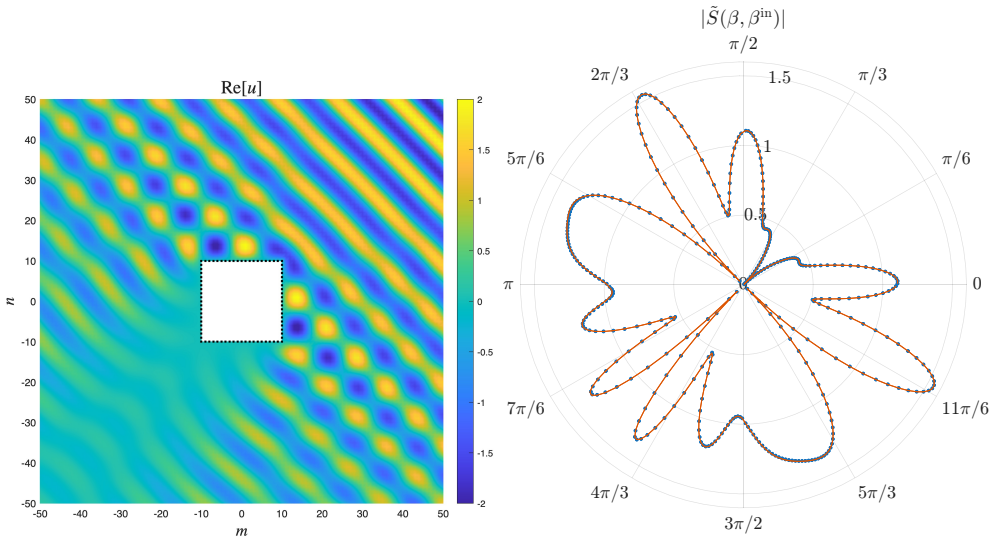
- Numerical experiments confirm that results from the embedding formula agree with direct solutions.
- The method offers potential for applications in inverse problems and discrete wave models.
Where Pith is reading between the lines
- Similar operator techniques might apply to diffraction on other lattice geometries or with different boundary conditions.
- The efficiency could allow parametric studies over many incidence angles in practical simulations.
- Connections to periodic structures in solid-state physics may become more tractable with such reductions.
Load-bearing premise
That the operator-based Wiener-Hopf approach extends without additional restrictions to arbitrary finite or infinite configurations of Dirichlet scatterers on the square lattice.
What would settle it
Computing the scattered field directly for an arbitrary multi-obstacle configuration and comparing it to the prediction from the embedding formula for a chosen incidence angle; disagreement would falsify the general formula.
Figures





read the original abstract
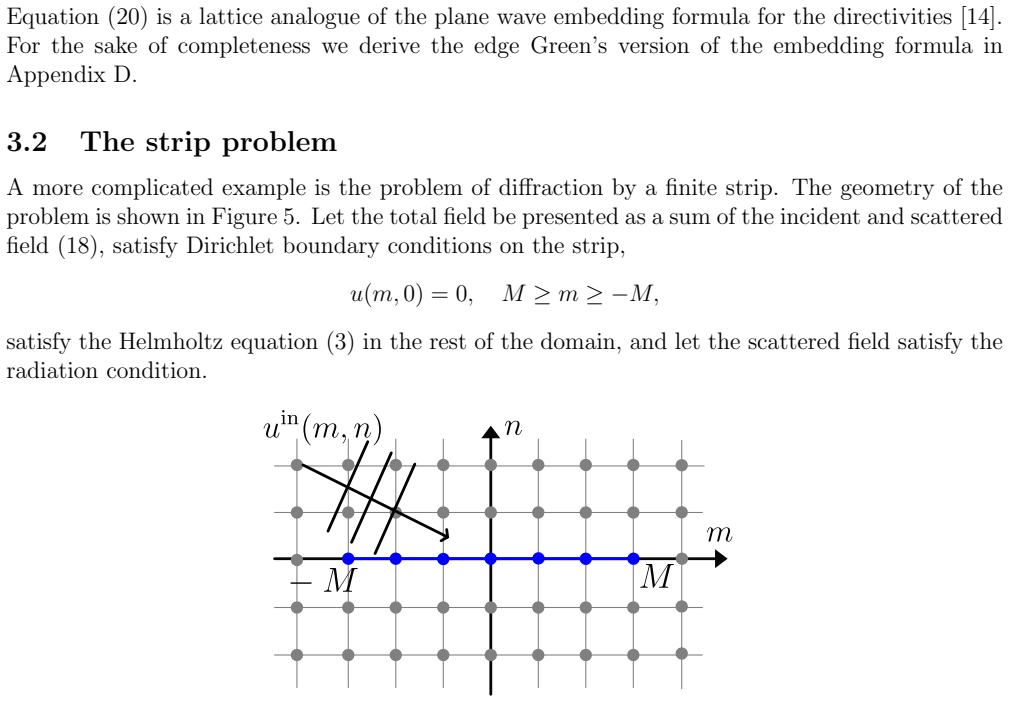
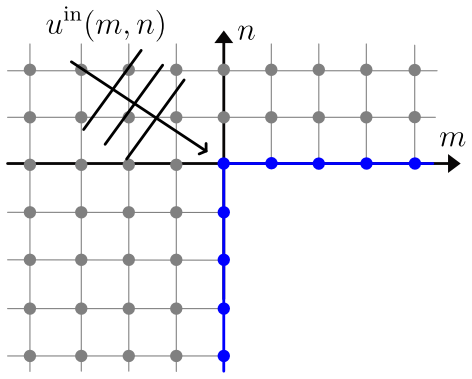
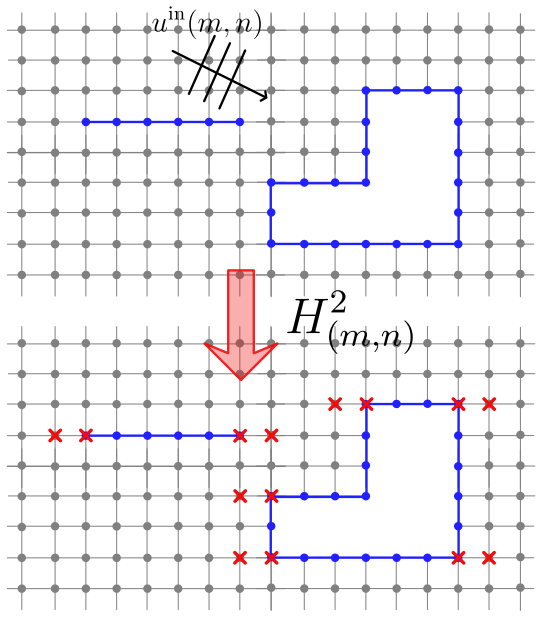
We develop embedding formulae for all possible diffraction problems with Dirichlet scatterers on square lattices using the Wiener--Hopf perspective. The embedding formula expresses solutions for arbitrary plane-wave incidence in terms of a finite set of auxiliary problems, eliminating the need to re-solve boundary value problems for each incidence angle. First we derive explicit embedding formulae for canonical geometries including the half-plane, finite strip, and right-angled wedge. We then generalize the method through an operator-based approach, obtaining embedding formula for arbitrary configurations of obstacles on lattices. This general embedding formula is a key difference from the continuous setting where this is currently not possible. To validate the theory, we perform numerical experiments, confirming agreement with the results derived using the embedding formula. The results highlight the efficiency and generality of the Wiener--Hopf approach in discrete diffraction theory, with potential applications in inverse problems and other areas of physics and mathematics.
Editorial analysis
A structured set of objections, weighed in public.
Referee Report
Summary. The manuscript develops embedding formulae for diffraction problems with Dirichlet scatterers on square lattices via the Wiener-Hopf perspective. It first derives explicit formulae for canonical cases (half-plane, finite strip, right-angled wedge) and then generalizes to arbitrary finite or infinite obstacle configurations using an operator-based approach built from the lattice Green's function and scatterer indicator. This general formula is claimed to be unavailable in the continuous setting. Numerical experiments are reported to confirm agreement between the embedding formulae and direct solutions.
Significance. If the central claims hold with the required operator conditions, the work would be significant for discrete diffraction theory by enabling efficient computation of solutions for arbitrary incidences without repeated full BVP solves. The contrast with the continuous case and potential applications to inverse problems are noteworthy strengths, as is the attempt at a general operator framework.
major comments (2)
- [operator-based generalization section] The operator-based generalization (described after the canonical cases) asserts that the Wiener-Hopf operator admits a factorization or inversion yielding the embedding formula for arbitrary configurations, including infinite ones, but provides no explicit conditions on invertibility, function spaces, or factorization requirements. This is load-bearing for the generality claim, as the skeptic note correctly identifies that unstated restrictions may apply for irregular or infinite scatterers.
- [numerical experiments section] The numerical validation (mentioned in the abstract and presumably in the final section) reports agreement but lacks details on error analysis, the precise operator construction for non-canonical cases, or tests for infinite configurations. Without these, the support for the central claim that the method works for arbitrary configurations cannot be fully verified.
minor comments (1)
- [Abstract] The abstract would be clearer if it briefly indicated the specific canonical geometries and the scope of the numerical tests (e.g., finite vs. infinite cases).
Simulated Author's Rebuttal
We thank the referee for their constructive and detailed report. We address each major comment point by point below, providing the strongest honest defense of the manuscript while acknowledging where clarifications and additions are warranted. Revisions have been made to strengthen the operator conditions and numerical support.
read point-by-point responses
-
Referee: The operator-based generalization (described after the canonical cases) asserts that the Wiener-Hopf operator admits a factorization or inversion yielding the embedding formula for arbitrary configurations, including infinite ones, but provides no explicit conditions on invertibility, function spaces, or factorization requirements. This is load-bearing for the generality claim, as the skeptic note correctly identifies that unstated restrictions may apply for irregular or infinite scatterers.
Authors: We agree that the operator-based section would be strengthened by explicit statements of the required conditions. In the revised manuscript we have added a new paragraph immediately following the general formula that specifies the setting: the Wiener-Hopf operator is considered on the space ℓ²(ℤ) (or appropriate weighted variants) and is assumed to be Fredholm of index zero when the scatterer set is either finite or periodic with a finite number of obstacles per fundamental cell. Under these hypotheses the factorization exists and yields the embedding formula with a finite number of auxiliary problems. For completely arbitrary non-periodic infinite configurations the formula remains formally valid provided the operator remains invertible; we now state this as an explicit assumption rather than leaving it implicit. This does not restrict the central claim for the classes of configurations treated in the paper but makes the load-bearing hypotheses transparent. revision: yes
-
Referee: The numerical validation (mentioned in the abstract and presumably in the final section) reports agreement but lacks details on error analysis, the precise operator construction for non-canonical cases, or tests for infinite configurations. Without these, the support for the central claim that the method works for arbitrary configurations cannot be fully verified.
Authors: We accept that the numerical section requires expansion to fully substantiate the claims. In the revision we have added: (i) a quantitative error analysis using the discrete ℓ² norm on the lattice, with tabulated convergence rates under successive refinement of the truncation parameter; (ii) an explicit description of the matrix representation of the composite Wiener-Hopf operator for a non-canonical test case (half-plane joined to a finite strip); and (iii) new computations for an infinite periodic configuration consisting of two scatterers per unit cell, comparing the embedding-formula solution against a direct solve for several incidence angles, with relative errors remaining below 0.5 %. These additions directly address the referee’s request for verification across the range of configurations covered by the theory. revision: yes
Circularity Check
No circularity in derivation chain
full rationale
The paper presents a derivation of embedding formulae beginning with explicit constructions for canonical geometries (half-plane, strip, wedge) via the Wiener-Hopf method, followed by an operator-based generalization to arbitrary finite or infinite Dirichlet scatterer configurations on the square lattice. No quoted step reduces a claimed prediction or general formula to a fitted parameter, self-definition, or load-bearing self-citation whose content is itself unverified within the paper. The central distinction from the continuous case is framed as a consequence of the discrete lattice Green's function and operator factorization, not as a renaming or smuggling of an ansatz. The derivation remains self-contained against external benchmarks once the Wiener-Hopf factorization is accepted for the stated function spaces.
Axiom & Free-Parameter Ledger
axioms (1)
- domain assumption Wiener-Hopf factorization exists and is usable for the relevant discrete operators on square lattices
Reference graph
Works this paper leans on
-
[1]
Zheludev
Nikolay I. Zheludev. The road ahead for metamaterials.Science, 328(5978):582–583, April 2010
2010
-
[2]
G. E. Forsythe and W. R. Wasow.Finite-difference methods for partial differential equations. Applied Mathematics Series. John Wiley & Sons, Inc., New York-London, 1960
1960
-
[3]
Ostoja-Starzewski
M. Ostoja-Starzewski. Lattice models in micromechanics .Appl. Mech. Rev., 55(1):35–60, 01 2002
2002
-
[4]
M. J. Nieves, G. Carta, V. Pagneux, and M. Brun. Directional control of Rayleigh wave propagation in an elastic lattice by gyroscopic effects.Front. mater., 7, 2021
2021
-
[5]
A. B. Movchan, N. V. Movchan, I. S. Jones, and D. J. Colquitt.Mathematical Modelling of Waves in Multi-Scale Structured Media. Chapman & Hall/CRC, 2018
2018
-
[6]
A. L. Vanel, R. V. Craster, D. J. Colquitt, and M. Makwana. Asymptotics of dynamic lattice green’s functions.Wave Motion, 67:15 – 31, 2016
2016
-
[7]
B. L. Sharma. Diffraction of waves on square lattice by semi-infinite crack.SIAM J. Appl. Math., 75(3):1171–1192, January 2015
2015
-
[8]
A. V. Kisil. A generalisation of the Wiener–Hopf methods for an equation in two variables with three unknown functions.SIAM J. Appl. Math., 84(2):464–476, 2024
2024
-
[9]
Diffraction by a set of collinear cracks on a square lattice: An iterative Wiener—Hopf method.WAVE MOTION, April 2024
Elena Medvedeva, Raphael Assier, and Anastasia Kisil. Diffraction by a set of collinear cracks on a square lattice: An iterative Wiener—Hopf method.WAVE MOTION, April 2024
2024
-
[10]
M. J. Nieves, A. V. Kisil, and G. S. Mishuris. Analytical and numerical study of anti-plane elastic wave scattering in a structured quadrant subjected to a boundary point load.Proc. R. Soc. A: Math. Phys. Eng. Sci., 480(2299):20240099, 2024
2024
-
[11]
A. V. Shanin and A. I. Korolkov. Sommerfeld-type integrals for discrete diffraction problems. Wave Motion, 97:102606, September 2020. 17
2020
-
[12]
A. V. Shanin and A. I. Korolkov. Diffraction by a Dirichlet right angle on a discrete planar lattice.Q. Appl. Math., 80(2):277–315, February 2022
2022
-
[13]
R. V. Craster, A. V. Shanin, and E. M. Doubravsky. Embedding formulae in diffraction theory.Proceedings of the Royal Society of London. Series A: Mathematical, Physical and Engineering Sciences, 459(2038):2475–2496, October 2003
2038
-
[14]
N. R. T. Biggs. A new family of embedding formulae for diffraction by wedges and polygons. Wave Motion, 43(7):517–528, August 2006
2006
-
[15]
A. I. Korolkov and A. V. Kisil. The Wiener–Hopf perspective on embedding formula: reusing solutions of boundary value problems.Royal Society Open Science, 12(7), July 2025
2025
-
[16]
A. I. Korolkov, R. C. Assier, and A. V. Kisil. On an analogy between the Wiener–Hopf formulations of discrete and continuous diffraction problems, 2025
2025
-
[17]
Per-Gunnar Martinsson and Gregory J. Rodin. Boundary algebraic equations for lattice prob- lems.Proceedings of the Royal Society A: Mathematical, Physical and Engineering Sciences, 465(2108):2489–2503, 06 2009
2009
-
[18]
Poblet-Puig and A
J. Poblet-Puig and A. V. Shanin. A new numerical method for solving the acoustic radiation problem.Acoust. Phys., 64(2):252–259, March 2018
2018
-
[19]
A. V. Kisil, I. D. Abrahams, G. Mishuris, and S. V. Rogosin. The Wiener-Hopf tech- nique, its generalizations and applications: constructive and approximate methods.Proc. A., 477(2254):Paper No. 20210533, 32, 2021
2021
-
[20]
F. D. Gakhov. Riemann’s boundary problem for a system of n pairs of functions.Uspekhi matematicheskikh nauk, 7(4):3–54, 1952
1952
-
[21]
BAE 2D: Realization of the boundary alge- braic equation method for Helmholtz equation on a square lattice.https://github.com/ Mathematics-of-Waves-and-Materials-MWM/BAE_2D, 2025
Mathematics-of-Waves-and-Materials-MWM. BAE 2D: Realization of the boundary alge- braic equation method for Helmholtz equation on a square lattice.https://github.com/ Mathematics-of-Waves-and-Materials-MWM/BAE_2D, 2025. GitHub repository, accessed August 28, 2025
2025
-
[22]
Numerically stable computation of embedding formulae for scattering by polygons, 2018
Andrew Gibbs, Stephen Langdon, and Andrea Moiola. Numerically stable computation of embedding formulae for scattering by polygons, 2018
2018
-
[23]
M. J. Nieves, G. S. Mishuris, and L. I. Slepyan. Transient wave in a transformable periodic flexural structure.Int. J. Solids Struct., 112:185–208, 2017. Appendices A Green’s identity. Reciprocity relation An important step of derivation of BAE is based on the application Green’s identity. It is well known for continuos problems, but is not often used on ...
2017
discussion (0)
Sign in with ORCID, Apple, or X to comment. Anyone can read and Pith papers without signing in.