If each mapping avoids three continuous functions whose limits avoid one another, the sequence must be normal in R^n.
abstractclick to expand
Peter Lappan in [9] proved that for each $n\in \mathbb{N}=\{1,2,3,\dots\}$, let $f_{1,n}, f_{2,n}$ and $f_{3,n}$ be three continuous functions on $\mathbb{D}:=\{z\in \mathbb{C} : |z| < 1\}$ such that for each $j=1,2,3,$ the sequence $(f_{j,n})$ converges locally uniformly to a function $f_j$ on $\mathbb{D}$. Suppose that the three functions $f_1, f_2,$ and $f_3$ avoid each other on $\mathbb{D}$. Let $\mathcal{F} =(g_n)$ be a sequence of meromorphic functions in $\mathbb{D}$ with the property that for each $n$, the four functions $g_n, f_{1,n}, f_{2,n},$ and $f_{3,n}$ avoid each other, then $\mathcal{F}$ is normal. We present here an analogue of this result in the setting of quasiregular mappings. We also obtain analogues of a few other results by Peter Lappan in [9] to quasiregular setting in the Euclidean space $\mathbb{R}^n$ for normal families and normal quasiregular mappings.
Reproves finiteness of cohomology and GAGA by treating analytic spaces through condensed mathematics
abstractclick to expand
This is a slightly revised version of lectures notes for a course in Summer 2022 joint between Bonn and Copenhagen, intended as a stable citable version.
The goal of this course is to make our general approach to analytic geometry via condensed mathematics more concrete by concentrating on the case of complex-analytic geometry. Instead of trying to develop new kinds of geometry, here we only try to redevelop the classical theory from a different point of view. More precisely, we reprove some important theorems for compact complex manifolds, including finiteness of coherent cohomology, Serre duality, GAGA and (Grothendieck--)Hirzebruch--Riemann--Roch.
In Hilbert-space domains the lowest spectral endpoint of the Levi form gives a basis-free test for maximality of C² functions.
abstractclick to expand
Let $H$ be a complex Hilbert space and let $\Omega\subset H$ be a domain. In infinite dimensions, there is no canonical complex Monge--Amp\`ere operator and no basis-free determinant of the Levi form. Hence, a determinant-type characterization of maximal plurisubharmonic functions is not immediate. We propose to use the normalized determinants of Fujii and Seo: for a bounded strictly positive operator $A$ and a unit vector $x\in H$, we set $\Delta_x(A):=\exp\bigl(\langle (\log A)x,x\rangle\bigr)$, and we extend this naturally to non-invertible positive operators. We show that, for strictly positive operators, inequalities for $\Delta_x$ precisely describe the chaotic order $\log A\ge \log B$, and we combine this observation with Kantorovich--Specht type bounds for positive operators.
For $u\in \mathcal{PSH}(\Omega)\cap C^2(\Omega)$ we define the \emph{Fujii--Seo determinant density} \[ \operatorname{FSD}(u)(a):=\inf_{\|x\|=1}\Delta_x\!\bigl(D'D''u(a)\bigr),\qquad a\in\Omega, \] and identify it with the lower spectral endpoint $\inf\sigma(D'D''u(a))$. Thus, $\operatorname{FSD}(u)$ is precisely the infimum of the spectrum of the Levi form, and its vanishing gives a basis-independent criterion for pointwise degeneracy of the Levi form. We prove that maximality implies $\operatorname{FSD}(u)\equiv 0$, give sufficient global degeneracy criteria for maximality, and establish several comparison principles for $C^2$ plurisubharmonic functions, including results under uniform ellipticity bounds on the Levi form.
The supremum of the H^4 norm of (f minus f(0)) over z equals φ to the power 1/4 for unit-norm f, with φ the golden ratio.
abstractclick to expand
We prove that the backward shift operator on $H^4$ has norm equal to $\sqrt[4]{\varphi}$, with $\varphi = \frac{1 + \sqrt{5}}{2}$. Furthermore, we characterize all extremal functions; they are precisely the functions of the form \[ f(z) = \mu \left( I(z) - \sqrt{\frac{1}{2\varphi}}\right), \] where $\mu \in \mathbb{C}$ and $I$ is an inner function with $I(0) = \sqrt{\frac{\varphi}{2}}$.
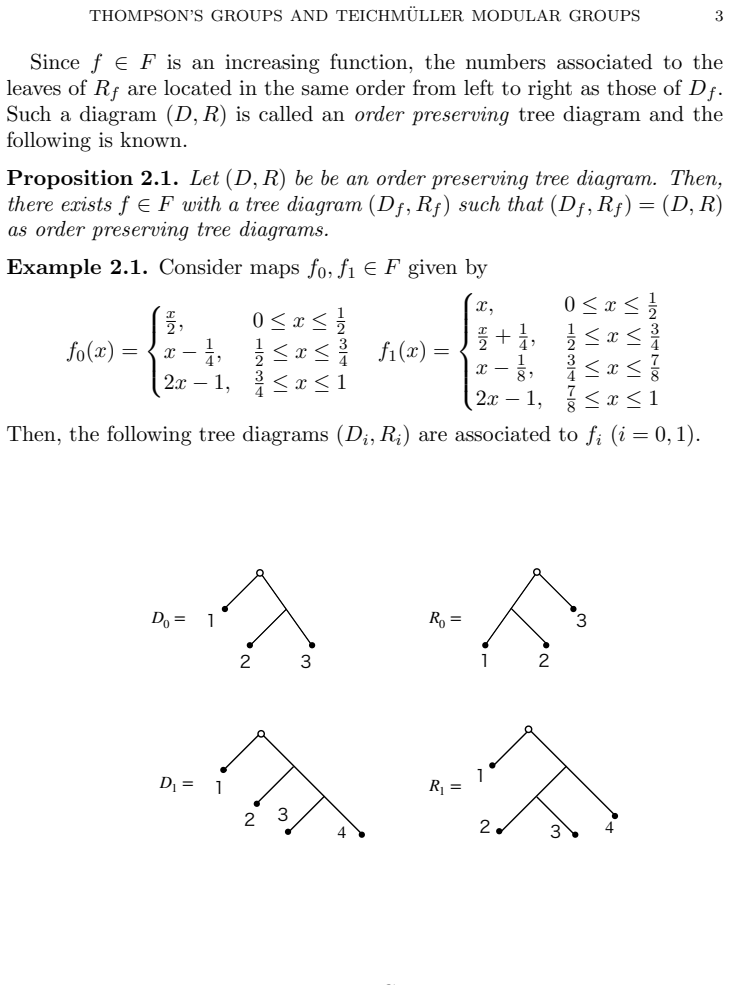
Thompson's groups, which are denoted by $F, T$ and $V$, were introduced by R. Thompson. It is known that they are related to various fields in mathematics. In this paper, we establish that Thompson's groups are regarded as subgroups of Teichm\"uller modular groups of Teichm\"uller spaces of generalized Cantor sets. Moreover, Thompson's groups $F$ and $T$ act properly discontinuously on such Teichm\"uller spaces but Thompson's group $V$ does not. In some sense, those results are improvements of the results by E. de Faria, F. P. Gardiner and W. J. Harvey on Thomnpson's group $F$ and asymptotic Teichm\"uller spaces.
We also show that Thompson's groups act infinitely many Teichm\"uller spaces of generalized Cantor sets.
We prove the Nitsche--Hopf conjecture for non-parametric minimal graphs over disks. If \(S\) is a minimal graph over a disk of radius \(R\), and if \(\xi\) is the point above the center, then \[
W(\xi)^2 |K(\xi)|<\frac{\pi^2}{2R^2}. \] Here \(K\) is the Gaussian curvature and \[
W=\sqrt{1+|\nabla u|^2}=\frac1{n_3} \] is the reciprocal of the vertical component of the upward unit normal. The constant is sharp, as shown by the horizontal tangent-plane extremal sequence of Finn and Osserman.
The main difficulty is that the bicentric-quadrilateral comparison theorem for Gaussian curvature controls \(|K|\), but it does not by itself control the normalized quantity \(W^2|K|\): the slope factor \(W\) can be arbitrarily large. We show that the missing information is recovered inside the Scherk-type comparison family from the zero equation for the horizontal harmonic projection. More precisely, in the fixed-arc normalization the point corresponding to the center of the physical disk is a distinguished zero \(z_\circ\) of the harmonic projection. The equation \(f(z_\circ)=0\), written in harmonic-measure coordinates, reduces the sharp Hopf estimate to a scalar derivative inequality at the admissible zero of a monotone function \(G_{A,B}\). We prove this scalar inequality on the full admissible parameter domain by a barrier argument and two explicit Bernstein-polynomial positivity certificates.
Combined with the bicentric-quadrilateral comparison theorem of the first author and Melentijevi\'c, the Scherk-family estimate gives the sharp normalized Hopf estimate for arbitrary minimal graphs over disks. As a byproduct, we obtain the two-sided bound \[
\frac{\pi^2}{4}\leq W^2|K|\leq \frac{\pi^2}{2} \] throughout the normalized Scherk-type comparison family, evaluated at the distinguished point corresponding to the center.
We prove the Nitsche--Hopf conjecture for non-parametric minimal graphs over disks. If \(S\) is a minimal graph over a disk of radius \(R\), and if \(\xi\) is the point above the center, then \[
W(\xi)^2 |K(\xi)|<\frac{\pi^2}{2R^2}. \] Here \(K\) is the Gaussian curvature and \[
W=\sqrt{1+|\nabla u|^2}=\frac1{n_3} \] is the reciprocal of the vertical component of the upward unit normal. The constant is sharp, as shown by the horizontal tangent-plane extremal sequence of Finn and Osserman.
The main difficulty is that the bicentric-quadrilateral comparison theorem for Gaussian curvature controls \(|K|\), but it does not by itself control the normalized quantity \(W^2|K|\): the slope factor \(W\) can be arbitrarily large. We show that the missing information is recovered inside the Scherk-type comparison family from the zero equation for the horizontal harmonic projection. More precisely, in the fixed-arc normalization the point corresponding to the center of the physical disk is a distinguished zero \(z_\circ\) of the harmonic projection. The equation \(f(z_\circ)=0\), written in harmonic-measure coordinates, reduces the sharp Hopf estimate to a scalar derivative inequality at the admissible zero of a monotone function \(G_{A,B}\). We prove this scalar inequality on the full admissible parameter domain by a barrier argument and two explicit Bernstein-polynomial positivity certificates.
Combined with the bicentric-quadrilateral comparison theorem of the first author and Melentijevi\'c, the Scherk-family estimate gives the sharp normalized Hopf estimate for arbitrary minimal graphs over disks. As a byproduct, we obtain the two-sided bound \[
\frac{\pi^2}{4}\leq W^2|K|\leq \frac{\pi^2}{2} \] throughout the normalized Scherk-type comparison family, evaluated at the distinguished point corresponding to the center.
Local stem functions and CCL equivalence extend the maximum modulus principle and connect the theory to Riemann domains.
abstractclick to expand
This paper is concerned with a class of generalized slice Fueter-regular functions on arbitrary domains in O with local stem functions. Some classical theorems such as the maximum modulus principle will be generalized to our setting. Some new phenomena such as the conditional uniqueness of stem vectors will be discovered by means of new technical tools, e.g., the CCL equivalence relation and the Bers-Vekua continuation. And a natural connection between the theory of slice Fueter-regular functions and that of Riemann domains will be revealed via the quotient space under the CCL equivalence relation.
The method removes the finite-order limit and gives closed expressions for all u satisfying the partials product equals exp of polynomial.
abstractclick to expand
This paper is mainly devoted to describing the entire solutions of nonlinear partial differential equation $$ u_{z_1}u_{z_2}\cdots u_{z_n}=e^g, $$ with the eikonal equation as a prototype, where $g$ is a polynomial in $\mathbb{C}^n$. Through a novel method, we break through the restriction of finite order condition and present the explicit expressions for the entire solution of the above equation. As an application, we completely resolve two questions of Xu-Liu-Xuan in \cite{Xu}.
For bounded convex domains the maximal norm of the conformal differential at zero is attained precisely when the domain is the image of a qu
abstractclick to expand
Let \(\mathbb D\) denote the unit disc in \(\mathbb C\). For a domain \(D\subset\mathbb C\) and a point \(p\in D\), let \(M_D(p)\) denote the supremum of \(\|df_0\|\) over all harmonic maps \(f:\mathbb D\to D\) with \(f(0)=p\) whose differential \(df_0\) at \(0\in \mathbb D\) is conformal. If \(f:\mathbb D\to D\) is a conformal diffeomorphism onto \(D\) with \(f(0)=p\), then \(\|df_0\|\le M_D(p)\). In a recent paper, the authors proved that equality holds when \(D=\mathbb D\), and they asked whether equality can hold only when \(D\) is a round disc. We give a negative answer by proving that, among bounded convex pointed domains \(p\in D\subset\mathbb C\) and up to translations, rotations, and reflections, equality holds if and only if, after moving \(p\) to the origin, \(D=F(\mathbb D)\) where \(F:\mathbb D\to\mathbb C\) is a holomorphic map with \(F(0)=0\) and \(F'(z)=\frac{c}{1+az+\lambda z^2}\), where \(c>0\), \(|\lambda|<1\), and \(|a-\bar a\lambda|<1-|\lambda|^2\). This family contains strongly convex examples which are not round discs.
Under mild conditions the monomial basis kernel varies continuously with the integrability parameter and converges for increasing sequences.
abstractclick to expand
On a pseudoconvex Reinhardt domain $\Omega\subset\mathbb{C}^n$ the $p$-Bergman space $A^p(\Omega)$ admits a canonical basis of monomials indexed by a subset $S_p(\Omega)\subset\mathbb{Z}^n$. The corresponding $p$-Monomial Basis Kernel (or $p$-MBK) is defined by a series involving these monomials and their norms. This article records stability properties of the $p$-MBK and of the index set $S_p(\Omega)$ with respect to the parameter $p$. First, under mild hypotheses, the $p$-MBK depends continuously on $p\in[1,\infty)$, and a Ramadanov-type theorem holds for $p$-MBK for an increasing sequence of pseudoconvex Reinhardt domains. Second, for certain special classes of monomial polyhedra, we explicitly compute the index set and the associated Threshold exponents. Finally, these explicit models are used to illustrate structural properties of the index sets under finite unions, intersections, and products.
Normal families in several complex variables extend one-variable uniqueness theorems and include sharpness examples.
abstractclick to expand
In this paper, we employ the theory of normal families in several complex variables to obtain some uniqueness theorems for entire functions. These results extend the related works of Li and Yi [11], and Lu et al. [18] to the setting of several complex variables. Moreover, some examples are provided to demonstrate the sharpness of our results.
Lower bound on the number of atoms in atomic singular inner functions narrows the gap to the expected exact count of n
abstractclick to expand
Extremal functions for the $n$th coefficient in the Krzy\.z conjecture are atomic singular inner functions with at most $n$ atoms. This paper gives a lower bound on the number of atoms $N$ of the form $N\geq cn$, marking progress toward proving the expected $N=n$. Furthermore, we prove new formulas for extremal functions using variational techniques. Using the aforementioned results and several other methods, we find new conditions on extremal functions which are equivalent to the Krzy\.z conjecture being true. To weaken some of these equivalent conditions, we characterize the possible holomorphic invariants of extremal functions. Some new conditional formulas are also proved.
Composed solutions h(z) = f(sum z_j) turn nonlinear equations involving G into linear ones when f is non-constant meromorphic.
abstractclick to expand
In this paper, we investigate meromorphic solutions of certain nonlinear partial differential equations in several complex variables involving differential and functional operators. Let $f$ be a non-constant meromorphic function in $\mathbb{C}$, $g$ an entire function in $\mathbb{C}^n$, and $h(z)=f(z_1+z_2+\ldots+z_n)$. We study the equations \begin{align*} \frac{\partial h(z)}{\partial z_i}=a G^g_{h}(z)+bh(z)+c\;\;\text{and}\;\;\frac{\partial h(z)}{\partial z_i}=a(z)G^g_{h}(z)+b(z)h(z)+c(z), \end{align*} where $z\in\mathbb{C}^n$, $i\in\{1,2,\ldots,n\}$, $a(\neq 0), b, c\in\mathbb{C}$ or $a(z)(\not\equiv 0), b(z),c(z)$ are polynomials in $\mathbb{C}^n$, and $G^g_h(z)=h(g(z),g(z),\ldots,g(z))$. The results obtained in the paper, extend previous studies on meromorphic solutions of functional-differential equations to the setting of several complex variables, and further illustrate the rigidity imposed by value distribution properties on nonlinear functional equations.
Conjecture verified for n up to 5 with necessity proved generally and sufficiency in special cases
abstractclick to expand
It follows from the Garloff-Wagner Theorem that the set of stable polynomials of degree $n$, denoted by $\mathcal{H}_n$, i.e., those whose zeros all lie in the open left complex half-plane, with the Hadamard product $*$, forms an abelian semigroup contained in the abelian group $\mathbb{R}_n^+$ of polynomials of degree $n$ with positive real coefficients. By the idealizer of the set $\mathcal{H}_n$, we refer to the largest subsemigroup of $\mathbb{R}_n^+$ in which $\mathcal{H}_n$ is an ideal. In this paper, we formulate a conjecture characterizing the idealizer of $\mathcal{H}_n$ and prove it for $n \leqslant 5$. In addition, we show that the proposed condition is necessary for any polynomial to belong to the idealizer and establish, in a distinguished special case, a sufficient condition of a similar nature that supports the conjecture.
The integral of |B|^2 / (1 - |μ|^2) dx dy over a domain is zero if and only if B vanishes and distinguishes inequivalent pseudo-analytic PDE
abstractclick to expand
Every smooth first-order real planar elliptic system admits a universal complex form $w_{\bar z} - \mu w_z + \mathcal{A} w + \mathcal{B} \bar w = \mathcal{F}$, which we call the Beltrami-Vekua equation: the data $(\mu, \mathcal{A}, \mathcal{B}, \mathcal{F})$ are produced from the original system by algebraic operations and differentiations, with no auxiliary PDE. On this space we study the joint action of multiplicative gauges $w \mapsto \phi w$ and orientation-preserving diffeomorphisms. Our main result is that the 2-form $\Theta = |\mathcal{B}|^2 / (1 - |\mu|^2) \, dx \, dy$ is gauge-invariant and pulls back covariantly under diffeomorphisms; its form is forced, with $|\mathcal{B}|^2$ the unique $\mathcal{B}$-quadratic combination invariant under $\mathcal{B} \mapsto \mathcal{B}\phi/\bar\phi$ and $1 - |\mu|^2$ the conformal distortion factor from the diffeomorphism law for $\mu$. The total mass $\mathcal{M}(D) = \int_\Omega \Theta$, the \emph{pseudo-analytic mass}, vanishes precisely on the analytic class $\mathcal{B} \equiv 0$ and separates a continuous family of pairwise inequivalent pseudo-analytic equations on the disk. As a by-product, Vekua's two-stage reduction - uniformization then gauge elimination - requires only one variable-coefficient PDE solve: the Beltrami diffeomorphism supplies the integrating factor for a flat $\bar\partial$-equation.
Avoidance criterion in complex projective space forces normality for maps from the unit disk when hypersurfaces stay in pointwise general 50
abstractclick to expand
We establish an avoidance criterion for families of holomorphic curves from the unit disk in complex plane to the complex projective space that omit sufficiently many moving hypersurfaces in pointwise general position. Furthermore, we study families of holomorphic curves that share hyperplanes and derive analogous normality conditions in this context.
A revised Demailly criterion gives this partial answer to Burns' 1982 conjecture on algebraizing these Stein manifolds.
abstractclick to expand
We provide a partial answer to Burns' 1982 conjecture on the affineness of entire Grauert tubes: the complement of a codimension-one subset of an entire Grauert tube is affine. This result is obtained by establishing a generalized version of Demailly's criterion for affineness of Stein manifolds, which may be of independent interest.
SOT-measurable functions with integrable norms form an isometric copy via the strong Poisson integral.
abstractclick to expand
This paper gives a complete answer to the following problem: Find the circle companion of the Hardy space of the unit disk with values in the space of all bounded linear operators between two separable Hilbert spaces. Classically, the problem asks whether for each function $h$ on the unit {\it disk}, there exists a ``boundary function" $bh$ on the unit {\it circle} such that the mapping $bh\mapsto h$ is an isometric isomorphism between Hardy spaces of the unit circle and the unit disk with values in some Banach space. For the case of bounded linear operator-valued functions, we construct a Hardy space of the unit circle such that its elements are SOT measurable, and their norms are integrable: indeed, this new space is isometrically isomorphic to the Hardy space of the unit disk via a ``strong Poisson integral."
SOT-measurable functions with integrable norms match via strong Poisson integral
abstractclick to expand
This paper gives a complete answer to the following problem: Find the circle companion of the Hardy space of the unit disk with values in the space of all bounded linear operators between two separable Hilbert spaces. Classically, the problem asks whether for each function $h$ on the unit {\it disk}, there exists a ``boundary function" $bh$ on the unit {\it circle} such that the mapping $bh\mapsto h$ is an isometric isomorphism between Hardy spaces of the unit circle and the unit disk with values in some Banach space. For the case of bounded linear operator-valued functions, we construct a Hardy space of the unit circle such that its elements are SOT measurable, and their norms are integrable: indeed, this new space is isometrically isomorphic to the Hardy space of the unit disk via a ``strong Poisson integral."
Proves the sharp homogeneous entropy inequality for all non-constant polynomials with zeros on the unit circle and determines the equality…
abstractclick to expand
In 2021, J.~Agler and J.~E. McCarthy proposed a two-step programme toward the celebrated Krzy\.z conjecture. The first step is to prove an entropy conjecture for polynomials whose zeros all lie on the unit circle; the second is to establish a full degree condition for extremal functions in the Krzy\.z conjecture. The purpose of this paper is to complete the first step. More precisely, we establish the sharp homogeneous entropy inequality for all non-constant polynomials with zeros on the unit circle and determine the equality cases.
Completes first step of Agler-McCarthy program toward the Krzyż conjecture by classifying equality cases.
abstractclick to expand
In 2021, J.~Agler and J.~E. McCarthy proposed a two-step programme toward the celebrated Krzy\.z conjecture. The first step is to prove an entropy conjecture for polynomials whose zeros all lie on the unit circle; the second is to establish a full degree condition for extremal functions in the Krzy\.z conjecture. The purpose of this paper is to complete the first step. More precisely, we establish the sharp homogeneous entropy inequality for all non-constant polynomials with zeros on the unit circle and determine the equality cases.
Closed forms follow for sums involving Fibonacci, Lucas and Pell numbers and their convolutions.
abstractclick to expand
This paper considers functional series whose terms are higher-order derivatives of Chebyshev polynomials of the second kind, where the degree of the polynomial is related to the order of the derivative. Analytic summation is used to determine the rational functions to which these series converge. These functions are expressed in terms of Chebyshev polynomials evaluated at a specific argument. Connections are established between derivatives of Chebyshev polynomials of the second kind and special numerical sequences generated by linear recurrence relations. New closed-form formulas are obtained for the sums of the series at various values of the argument. As consequences, combinatorial identities are derived for the Fibonacci, Lucas, and Pell numbers, for sections of the Fibonacci sequence, and for their convolutions. By means of analytic continuation, sums of formally divergent series are obtained, which in special cases correspond to the classical Euler formulas.
Model domains yield precise local bounds on holomorphically invariant infinitesimal metrics with general defining functions
abstractclick to expand
We give precise estimates of some holomorphically invariant infinitesimal metrics near a pseudoconcave points in a wide family of ``model'' domains for that situation in $\mathbb C^2$. This extends to metrics (rather distances) the authors' previous results from arXiv:2503.19754 and also takes into account defining functions more general than just power functions.
For any dilatation bound k less than 1, explicit constructions separate the boundedness of the full map from its holomorphic component.
abstractclick to expand
We construct, for every \(0<k<1\), a bounded globally univalent harmonic mapping \[
f=h+\overline g \colon \D\to\C \] such that \[
|g'(z)|\le k|h'(z)|,\qquad z\in\D, \] while the analytic part \(h\) is unbounded. The construction is based on a bounded logarithmic spiral map on a far right horizontal strip, together with a smaller logarithmic perturbation.
Continuity and boundedness do not upgrade weak K-quasiregularity to quasiregularity below the critical exponent in dimensions n at least 3.
abstractclick to expand
We show that, in dimensions $n\geq 3$, continuity and boundedness do not restore the Sobolev regularity conjecture of Iwaniec and Martin for weakly quasiregular mappings below the critical exponent. For every bounded domain $\Omega\subset\mathbb R^n$ and every $1\leq p<nK/(K+1)$, we construct a bounded continuous weakly $K$-quasiregular mapping $$
f\in W^{1,\,p}(\Omega;\,\mathbb R^n)\cap C(\Omega;\,\mathbb R^n)
\cap L^\infty(\Omega;\mathbb R^n) $$ which fails to be quasiregular. We further construct weakly quasiregular mappings whose singular sets have Hausdorff dimension arbitrarily close to the maximal size permitted by their Sobolev regularity. These examples show that, the almost-everywhere sign condition on the Jacobian is too weak to serve as an orientation-preserving hypothesis below $W^{1,n}$. In contrast, we show that, for $n-1<p<n$, quasiregularity follows once this condition is replaced by a one-sided condition on the distributional degree (together with boundedness).
These spaces inherit conformal invariance precisely when the domain is chord-arc, turning boundary geometry into an analytic equivalence.
abstractclick to expand
Inspired by the classical Besov $p$-space ($1<p<\infty$) defined by means of higher-order derivatives on the upper half-plane, we introduce Besov-type spaces on simply connected domains. We study the relation between the geometric properties of the domain and these spaces, and characterize chord-arc domains in terms of the isomorphisms among these Besov spaces. Furthermore, we obtain that these spaces on chord-arc domains inherit the conformal invariance from the classical setting.
Built from relative scalars x² and {x,y}, the operator produces a triangular anticommutator whose factors invert to a Green operator and mon
abstractclick to expand
We construct an intrinsic q-deformation of the vector derivative on radial algebras. The construction is not obtained from a coordinate realization by replacing ordinary partial derivatives with one-variable Jackson derivatives; that coordinatewise procedure does not preserve radial subalgebras. Instead, for each distinguished vector variable $x$ and each finite set of auxiliary variables $Y\subset S\setminus\{x\}$, we define a q-Cartan derivative $\partial^Y_{x,q}$ on $R(\{x\}\cup Y)$ using the $x$-relative scalar variables $x^2$ and $\{x,y\}$, $y\in Y$. We prove two Fischer-type theorems. First, an exterior Fischer operator has a triangular anticommutator with explicit resonance factors; after inverting them one obtains a global Green operator and an exterior direct-sum decomposition. Second, using full left multiplication by $x$, we prove the monogenic Fischer decomposition after localization by finite-block determinants. We also describe the first denominator factors: the one-vector and two-vector factors are explicit, while the general determinant factors split by $x$-support. A degree-zero support-rank obstruction shows that a universal unlocalized theorem for all real $0<q<1$ cannot hold without excluding q-resonances.
Estimates improve on the Zygmund bound and hold uniformly up to the boundary, with sharpness shown by an explicit example.
abstractclick to expand
We obtain estimates of the modulus of continuity for the real part of the Cauchy-type integral in the closure of domain bounded by an Ahlfors-regular integration curve. These estimates are more exact than the well-known Zygmund estimate for the modulus of continuity of the Cauchy-type integral. The accuracy of estimates is proved by constructing an example of a curve and an integral density for which the specified estimates are exact with respect to the order of smallness.
In two dimensions, any bounded generic convex domain with piecewise C2 boundary that admits a finite volume quotient must be biholomorphic,
abstractclick to expand
In this paper, we study the geometry of bounded domains with piecewise smooth boundary. Specifically, we obtain the relationship between the squeezing function corresponding to polydisk and Levi flatness on bounded generic convex domains. As an application, we prove that a two dimensional bounded generic convex domain with piecewise $C^2$-smooth boundary that admits a finite volume quotient is biholomorphic to bidisk. Moreover, we show that any Teichm$\ddot{\operatorname{u}}$ller space $\mathcal{T}_g$ with $g\geq2$ can not be biholomorphic to a bounded generic domain with piecewise $C^2$-smooth boundary.
The result also rules out Teichmüller spaces T_g for g≥2 from being biholomorphic to such domains.
abstractclick to expand
In this paper, we study the geometry of bounded domains with piecewise smooth boundary. Specifically, we obtain the relationship between the squeezing function corresponding to polydisk and Levi flatness on bounded generic convex domains. As an application, we prove that a two dimensional bounded generic convex domain with piecewise $C^2$-smooth boundary that admits a finite volume quotient is biholomorphic to bidisk. Moreover, we show that any Teichm$\ddot{\operatorname{u}}$ller space $\mathcal{T}_g$ with $g\geq2$ can not be biholomorphic to a bounded generic domain with piecewise $C^2$-smooth boundary.
H-harmonic Bergman-Besov spaces on the real hyperbolic ball are defined for every real alpha with projection, duality and inclusions intact
abstractclick to expand
Using the characterizations in terms of various differential operators including partial, normal, and tangential derivatives, we extend the family of Bergman spaces of $\mathcal H$-harmonic functions on the real hyperbolic ball from $\alpha>-1$ to all $\alpha\in\mathbb R$. We then generalize several properties of Bergman spaces such as projection, duality, and inclusion relations, to this extended family.
With restrictions on exponential rate ratios and non-constant coefficients, all solutions reduce to exponentials.
abstractclick to expand
In this paper, we analyze the solutions of the following non-linear differential-difference equations f^n(z) +\omega f^(n-1)f'(z) +p(z)f(z+c) = p_1e^{\alpha}_1z +p_2e^{\alpha}_2z and f^n(z)f'(z) +q(z)e^Q(z)f(z+c) = p_1e^{\alpha}_1z +p_2e^{\alpha}_2z, where n is a positive integer,\omega, p1, p2,{\alpha}1 & {\alpha}2 are non-zero constants satisfying {\alpha}1 not equal to {\alpha}2, {\alpha}1/{\alpha}2 not equal to (n)^+-1, q(z) is a non-vanishing polynomial and Q(z) is a non-constant polynomial.
Indestructible and maximal types of disk maps remain intact after forward iteration, supporting dynamical constructions.
abstractclick to expand
Forward iteration of holomorphic self-maps generalizes the iteration of a single function in a natural way. This framework arises in complex dynamics, for instance in the study of wandering domains and in seeking suitable extensions of the Denjoy-Wolff theorem. Here, we consider forward iteration of Blaschke products. We prove that the classes of indestructible and maximal Blaschke products are stable under forward iteration.
An effective Riemann-Lebesgue lemma for p-variation functions transfers to abstract semigroups, giving quantitative versions of the prime 2
abstractclick to expand
We give a generalized and effective version of Bekehermes' improvement of Newman's Tauberian theorem. To do so we prove an effective version of the Riemann-Lebesgue Lemma for functions of bounded $p$-variation. We apply our Tauberian theorem to abstract analytic semigroups and prove a version of the prime number theorem as well as an estimate for Mertens' function with explicit error term.
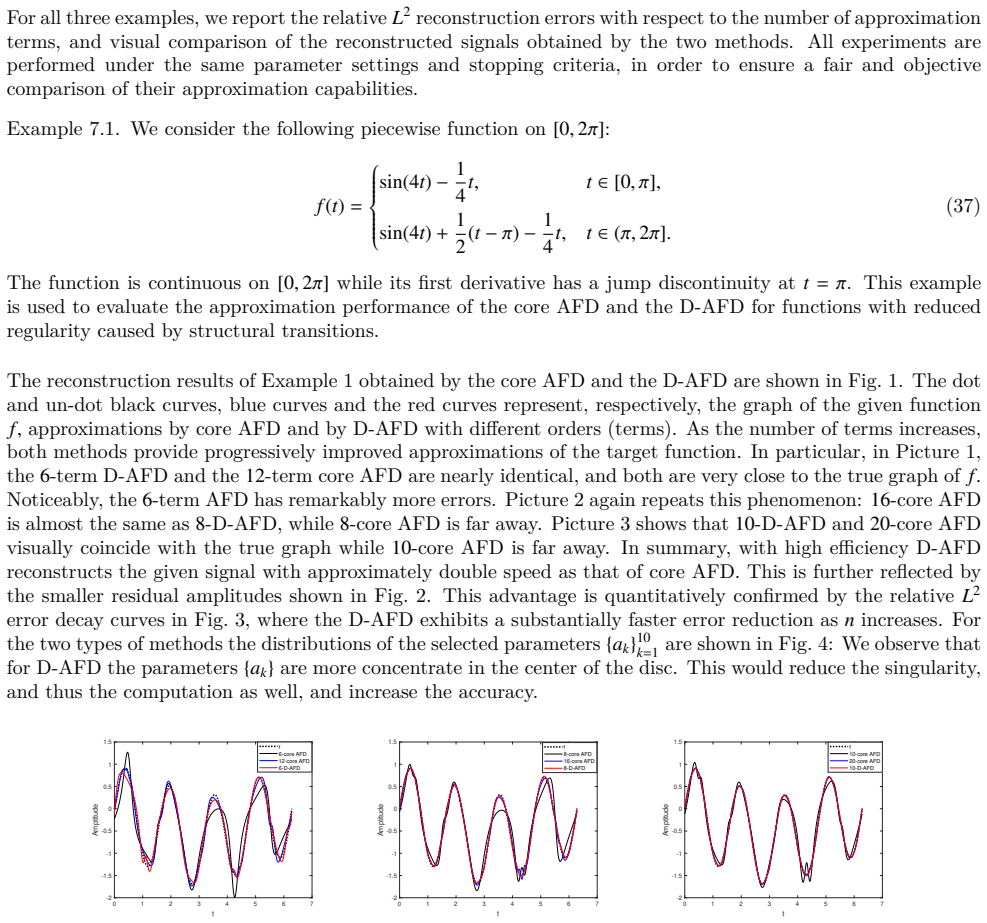
Let $f$ belong to the Hardy space $H^2(\mathbb{D})$ of the unit disc, and $e_a$ the normalized Szeg\"o (reproducing) kernel of $H^2(\mathbb{D}).$ It is well known that, due to the reproducing kernel property, for any distinct $n$ points $a_1,\cdots,a_n$ in $\mathbb{D}$ the orthogonal projection of $f$ into ${\rm span}\{e_{a_1},\cdots,e_{a_n}\},$ denoted as $P_{{\rm span}\{e_{a_1},\cdots,e_{a_n}\}}(f),$ interpolates $f$ at the points $a_k$'s. The present study further proves that if the $a_k$'s are optimally selected according to certain energy matching pursuit principle, then $P_{{\rm span}\{e_{a_1},\cdots,e_{a_n}\}}(f)$ double interpolates $f$ at the points $a_k$'s, or order $m=2$ interpolation, that is, \[ P_{{\rm span}\{e_{a_1},\cdots,e_{a_n}\}}(f)(a_k)=f(a_k), \quad {\rm and}\quad P_{{\rm span}\{e_{a_1},\cdots,e_{a_n}\}}'(f)(a_k)=f'(a_k),\quad k=1,\cdots,n.\] With the accordingly newly defined double Takenaka-Malmquist system, the norm convergence for $n\to \infty,$ the $n$-best approximation for $n$ being fixed, and the related boundary function interpolation are studied. The such generated new sparse representation, named as double AFD, is shown to outperform the classical AFD. Pointwise interpolations for orders $m>2,$ meaning to simultaneously interpolates all functions $f,f',\cdots,f^{(m-1)}$ at a set of $a_k$'s are, additionally, discussed. For the Hardy space of the upper-half complex plane there exists a counterpart theory.
The third Hankel determinant built from inverse coefficients of starlike univalent functions is bounded above by the value obtained via the
abstractclick to expand
Let $\mathcal{A}$ denote the class of normalized analytic functions $f$ in the open unit disk defined as
$
\mathbb{D}:=\{z\in\mathbb{C}:|z|<1\}
$
with $f(0)=0$ and $f'(0)=1$. A function $f\in\mathcal{A}$ is said to be starlike if $f(\mathbb{D})$ is starlike domain. By using the Bernstein polynomial method to obtain the required maximum estimate, we establish sharp upper bound for the third Hankel determinant corresponding to the inverse coefficients of starlike univalent ({\it i.e.}, one-to-one) functions in the unit disk $\mathbb{D}$.
We study properties of $A^p_\alpha$ spaces in the Dirichlet range, recently defined by Brevig, Kulikov, Seip and Zlotnikov as the set of all holomorphic functions on the unit disc $\mathbb{D}$ such that
\[
\int_{\mathbb{D}} |f(z)|^{p-2} |f'(z)|^2 (1 - |z|^2)^{\alpha} \, dA(z) < \infty,
\]
when $0<\alpha < 1$ and $p > 0$. We answer in the negative two questions posed by Brevig et al. by showing that, if $p\ne2$ and $p > \frac{1}{2}$, $A^p_\alpha$ is not a vector space and that the norm is in general not increasing in $p$. This is achieved by means of an equivalent description for $A^p_\alpha$ which is given in terms of the Poisson integral of the boundary function of its inhabitants. Such norm also leads to a description of $A^p_\alpha$ functions in the Dirichlet range given in terms of their inner and outer factors. As a corollary, we show that $A^1_\alpha$ is contained in the weak product of a Dirichlet-type space.
This holds in both Roumieu and Beurling settings for holomorphic functions with uniform asymptotics, with necessity shown in Roumieu when 0.
abstractclick to expand
We study the stability under point-wise product and under composition in Carleman classes of holomorphic functions, defined on sectors of the Riemann surface of the logarithm, and admitting a uniform asymptotic expansion with remainders controlled by a given sequence of positive real numbers $\mathbf{M}$. On the one hand, the well-known conditions of algebrability and Fa\`a di Bruno, imposed on the sequence $\mathbf{M}$, ensure the desired stability with respect to each operation in both the Roumieu and the Beurling settings. On the other hand, these conditions turn out to be necessary for the corresponding stability in the Roumieu case as long as the existence of suitable characteristic functions, in a precise sense, is guaranteed within the class. The construction of such functions rests on classical results of B. Rodr\'iguez-Salinas, and is given in detail. Our results are inspired by, and thoroughly generalize, several partial statements by G.~Auberson and G.~Mennessier for Gevrey classes of order 1.
We study composition operators acting on the weighted Bergman spaces on the bidisc, i.e. $C_{\Phi}:A^2_{\beta}(\mathbb{D}^2)\to A^2_{\beta}(\mathbb{D}^2)$ where $\Phi$ is induced by rational inner functions (RIFs) or a RIF and a smooth function (mixed case). Our approach is geometric. Our main result is a uniform criterion for all $\beta\in(-1,0]$ that can be summarized as follows: Boundedness of the composition operator is equivalent to transversal intersection of the level sets for non-smooth symbols, under the assumption that if any tangential intersection occurs on the singularity it must be of high order. This extends the characterization of Bayart-Kosi\'nski to the non-smooth self maps of the bidisc. To reach our conclusions, we utilize results obtained by Anderson, Bergqvist, Bickel, Cima and Sola on Clark measures associated to RIFs and Puiseux factorizations.
The explicit formula and prior theorem together show it remains extremal for these operators between weighted Bergman spaces.
abstractclick to expand
In this note we study the multiplier norm estimates for the multiplication operators between weighted Bergman spaces, whose symbols are the higher-order Schwarzian derivatives of univalent functions. We establish sharp multiplier estimates for the higher-order Schwarzian derivatives of the Koebe function. This extends a related result by Shimorin. The proof of our new theorem relies on an explicit formula for the higher-order Schwarzian derivatives of the Koebe function and a recent theorem from our earlier work. We finally point out that the Koebe function is still the extremal function for certain higher-order Schwarzians of the univalent functions.
The supremum difference on Aut(D) is right-invariant and yields an almost regular Finsler structure.
abstractclick to expand
In this paper, we study the right invariant metric $d_{H^{\infty}}$ on the analytic automorphism group $\rm{Aut}(\mathbb{D})$ of the unit open disk $\mathbb{D}$ induced by maximal modulus, that is, $d_{H^{\infty}}(\varphi, \psi)=\sup_{z\in\mathbb{D}}|\varphi(z)-\psi(z)|$ for any $\varphi, \psi\in \rm{Aut}(\mathbb{D})$. We give the explicit formula of the right invariant metric $d_{H^{\infty}}$ and characterize the almost regular Finsler geometric structure of $(\rm{Aut}(\mathbb{D}), d_{H^{\infty}})$.
Pseudoconvex domains in two dimensions and certain Stein manifolds are classified by the algebraic structure of their holomorphic self-maps.
abstractclick to expand
We show that pseudoconvex Reinhardt domains in dimension two with isomorphic semigroups of holomorphic endomorphisms are biholomorphically or anti-biholomorphically equivalent. Moreover, we show that every Stein manifold that retracts to a properly embedded copy of the punctured complex line, is determined (up to biholomorphic or anti-biholomorphic equivalence) by its semigroup of holomorphic endomorphisms.
A Bedford-Taylor capacity relation between plurisubharmonic functions in Cegrell classes yields both measure inequalities and uniqueness for
abstractclick to expand
In this paper, we introduce a notion of singularity comparison for plurisubharmonic functions based on the Bedford--Taylor capacity. We establish comparison principles for the complex Monge--Amp\`ere operator on pluripolar sets in the Cegrell classes. As applications, we obtain a characterization of this relation via auxiliary functions in the energy class and prove a corresponding uniqueness result for the Monge--Amp\`ere equation.
New arguments avoid disk covers and curved metrics while yielding quick derivations of Picard and related theorems.
abstractclick to expand
We give two new elementary proofs of the complete Kobayashi hyperbolicity of the twice-punctured complex plane. We also present an extremely short proof that bounded domains are complete Kobayashi hyperbolic. Our proofs rely neither on the fact that the universal cover of the twice-punctured plane is the disk nor on the existence of negatively curved metrics. As applications, we present concise proofs of the classical theorems of Landau, Schottky, and Picard. Finally, we provide a characterization of Kobayashi hyperbolicity for planar domains inspired by a similar result of Hahn.
The property holds on bounded complex domains and yields matching regularity for rooftop envelopes.
abstractclick to expand
We study continuity, H\"older regularity, and $C^{1,1}$-regularity of geodesics between continuous plurisubharmonic functions on bounded domains of $\mathbb{C}^n$. We then derive regularity properties of rooftop envelopes.
Second and third determinants reach explicit maxima for the class defined by 1 + z f''/f' ≺ 1 + z + (m/n)z² with 2m ≤ n.
abstractclick to expand
Let $\mathcal{A}$ denote the class of analytic functions $f$ such that $f(0)=0$ and $f'(0)=1$ in the unit disk $\mathbb{D}:=\{z \in \mathbb{C}: |z|<1\}.$ We examine the properties of the class $\mathcal{C}(\varphi)$ defined as $\mathcal{C}(\varphi) := \left\{ f \in \mathcal{A} : 1+zf''(z)/f'(z) \prec \varphi(z):=1+z+ m/n\, \, z^2, \text{ with } 2m \le n,\text{ for } m, n \in \mathbb{N} \right\},$ and compute the sharp second and third Hankel determinants for the functions in $\mathcal{C}(\varphi)$. Furthermore, we determine the extremal functions for the sharp estimates of the Hankel determinants.
Logarithmic and inverse coefficients up to order three, successive differences, and Fekete-Szegö bounds are all obtained sharply in this new
abstractclick to expand
In this paper, we study extremal problems for coefficient functionals associated with a distinguished subclass of holomorphic semigroup generators, denoted by $\mathcal{A}_{\beta}$ ($0 \le \beta \le 1$), defined on the unit disk $\mathbb{D}$. This class forms a natural filtration of the class $\mathcal{G}_0$ of infinitesimal generators, with the class $\mathcal{R}$ of functions of bounded turning arising as its minimal element. We obtain sharp bounds for the initial logarithmic coefficients $\gamma_n$, the inverse coefficients $A_n$, and the logarithmic inverse coefficients $\Gamma_n$ for $n = 1,2,3$ within the class $\mathcal{A}_{\beta}$. In addition, we address the successive coefficient problem by deriving sharp upper and lower estimates for the differences $|A_{n+1}| - |A_n|$ for $n = 1,2$. Furthermore, we establish sharp bounds for a generalized Fekete--Szeg\"o functional in the class $\mathcal{R}$. The extremality of the obtained results is demonstrated by explicit constructions, including functions related to Gauss hypergeometric functions. Our results unify and extend several earlier contributions in geometric function theory and reveal a structural connection between coefficient problems for functions of bounded turning and the dynamics of holomorphic semigroup generators.
Explicit formulas link Loewner energy to Hilbert-Schmidt property of operator built from log-difference quotients of φ.
abstractclick to expand
To any Jordan curve one may associate a circle homeomorphism $\varphi : \mathbb S^1 \to \mathbb S^1$ via conformal welding. Through this correspondence, the Loewner energy $I^L$, also known as the universal Liouville action, is a K\"ahler potential for the unique homogeneous K\"ahler metric on the universal Teichm\"uller space. Despite this, explicit expressions for $I^L$ in terms of $\varphi$ alone do not seem to be available in the literature.
In this paper, we obtain such formulas. For this, we introduce an operator ${\bf \Lambda}_\varphi$ defined using the Fourier coefficients of the function \[ (z,w) \mapsto \log \left|\frac{\varphi(z)-\varphi(w)}{z-w}\right|, \qquad (z,w) \in \mathbb{S}^1 \times \mathbb{S}^1. \] We relate ${\bf \Lambda}_\varphi$ to the single-layer potential and composition operator, and prove an analog of the classical Grunsky inequalities for quasisymmetric $\varphi$. We show moreover that $\varphi$ is Weil--Petersson if and only if ${\bf \Lambda}_\varphi$ is Hilbert--Schmidt, and we express $I^L$ as several related Fredholm determinants as well as a regularized Fredholm determinant. We also treat Schatten classes, and we obtain formulas in terms of Dirichlet integrals involving $\log \varphi'$ and in terms of the composition operator induced by $\varphi$.
The general subclass B_φ_{A,B}(α^{(m)}) lies in Hardy space H^1 while the special case yields an explicit best-possible coefficient estimate
abstractclick to expand
In this artcle, we introduce and investigate a subclass of Bazilevi{\v{c}} functions, denoted by $\mathcal{B}_{\varphi_{A,B}}(\alpha^{(m)})$. We determine the Hardy space to which this subclass of Bazilevi{\v{c}} functions belong to. Additionally, we provide a necessary condition for a particular case of this subclass. Finally, we obtain a sharp coefficient estimate for the functions associated with $\mathcal{B}_1(\alpha).$
Open discrete Orlicz-Sobolev mappings admit boundary extension in terms of prime ends, generalizing Carathéodory beyond conformal maps.
abstractclick to expand
We study problems related to continuous boundary extension of mappings of Orlicz-Sobolev classes in terms of prime ends. The results we obtain concern the case when the mappings are open, discrete, but not closed (not preserving the boundary of a domain). These results generalize the well-known results of Caratheodory on boundary extension of conformal mappings.
Spectral norm inequalities on companion matrices also bound the zeros of quaternionic polynomials
abstractclick to expand
This paper establishes new upper bounds for the right eigenvalues of monic matrix polynomials over the quaternion division algebra. The noncommutative nature of quaternion multiplication presents fundamental challenges in eigenvalue analysis, distinguishing this problem from the classical complex case. We use spectral norm inequalities for partitioned quaternionic matrices and apply them to quaternionic block matrices associated with monic matrix polynomials. By analyzing the structure of powers of these companion matrices we derive progressively sharper bounds for the right eigenvalues. Consequently, these bounds give bounds for the zeros of quaternionic polynomials.
In Clifford and quaternionic settings, properties of the material derivative follow as direct consequences of the new operator's function理论.
abstractclick to expand
The theory of the operator $$G(x) = |\underline{x}|^2 \frac{\partial }{\partial x_0} + \underline{x} \sum_{j=1}^n x_j \frac{\partial }{\partial x_j} $$
is deeply associated with the slice monogenic function theory and has grown in recent years. In particular, for $n=3$ the quaternionic version of $G$ has been recently used to study the quaternionic slice regular function theory. This work extends the study of the $G$ operator in two senses: a) Clifford's analysis structure. The function theory induced by the operator \begin{align*}\mathcal H_a (x) = {\underline a} ( {x}) \frac{\partial }{\partial x_0} - \sum_{i=1}^n \left( \sum_{j=1}^n a_j ( {x}) \frac{\partial (a^{-1})_i}{\partial y_j}\circ a ( {x}) \right) \frac{\partial}{\partial x_i}, \end{align*} where $a$ is a function with certain properties with domain in $\mathbb R^{n+1}$ is presented extending the already known results of the $G$. Also some properties of the material derivative are presented as consequences of function theory induced by $\mathcal H_a$.
b) Structure of quaternionic analysis. In particular, the case $n=3$ is approached from the point of view of quaternionic analysis.
Uniform bound less than one on hyperbolic derivative yields descriptions via Aleksandrov-Clark measures and boundary mixing.
abstractclick to expand
Analytic self-maps of the unit disc whose hyperbolic derivative is uniformly bounded by a constant smaller than one, are called contractive. We describe these maps in terms of their Aleksandrov-Clark measures and in terms of their inner-outer factorization. In addition, we show that contractive inner functions can be described in terms of a certain mixing property of its boundary values. We also present other results on the boundary behavior of contractive inner functions.
Existence holds on strongly pseudoconvex Kähler manifolds when the right-hand side decreases in the solution.
abstractclick to expand
We consider the Dirichlet problem for the complex Monge--Amp\`ere equation on strongly pseudoconvex K\"ahler manifolds when the right-hand side is decreasing in the solution. Using flow-based arguments, we establish existence of smooth solutions in a number of natural circumstances, following work of Chou-Wang.
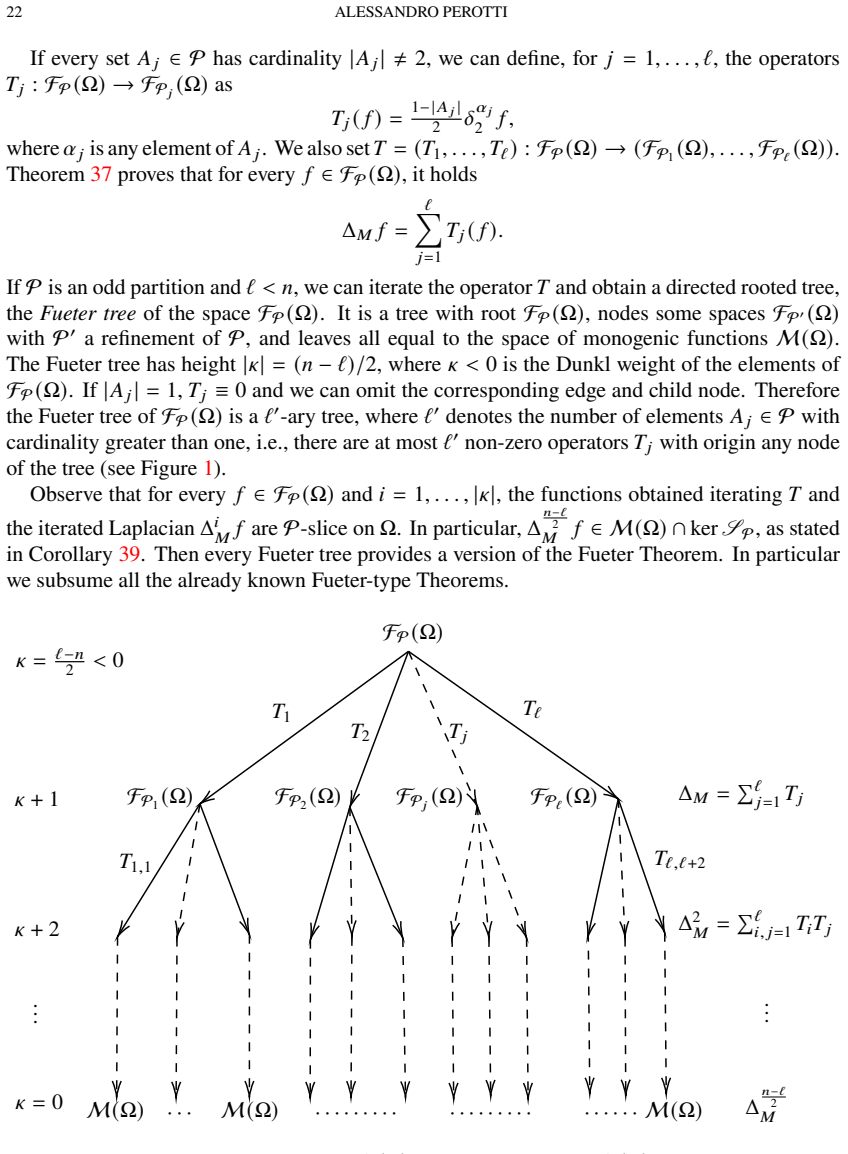
We prove a general Fueter Theorem over real alternative *-algebras. We show that a suitable power of the Laplacian maps Dunkl-regular functions to Dunkl monogenic functions with axial symmetries. Using the embedding of hypercomplex function theories in the class of Dunkl monogenic functions, we subsume several Fueter-type results known in the literature and obtain the most general form for the action of the Laplacian on function spaces over hypercomplex subspaces. We show that Fueter Theorems are in a one-to-one correspondence with a class of graphs, the Fueter trees, that describe the interactions between Dunkl-regular function spaces and the relation with the iterated Laplacian. We obtain that the number of distinct Fueter trees on a hypercomplex space of dimension $n+1$ is equal to the number of partitions in odd parts of the integer $n$.
The growth speed is quantified for high powers of positive line bundles on Riemann surfaces, yielding Fekete measure convergence rates.
abstractclick to expand
Let $X$ be a compact Riemann surface and let $L$ be a positive line bundle on $X$. We obtain the growth speed of unit ball volume in $H^0(X,L^n)$ towards the energy at equilibrium. As an application, we also obtain the speed of Fekete measures converging to the equilibrium measure.
Sharp extension of one-variable estimates to polydisks; explicit bounds for Roper-Suffridge images on the ball.
abstractclick to expand
We obtain upper bounds for the norm of the Schwarzian derivative of convex holomorphic mappings defined on the polydisk and the unit ball in $\mathbb{C}^n$. For coordinate-wise convex mappings on the polydisk, we derive a sharp estimate extending the classical one-variable result of Chuaqui--Duren--Osgood to higher dimensions. For the Roper--Suffridge extension operator in the unit ball, we obtain an explicit bound that represents the best available estimate in this setting.
Gershgorin-type theorems for left eigenvalues improve on Cauchy, Fujiwara and Opfer estimates.
abstractclick to expand
In this paper, we derive new bounds for the zeros of quaternionic polynomials by applying localization theorems, which includes Gershgorin-type theorems for the left eigenvalues of matrices of left monic quaternionic polynomials. These results yield sharper estimates compared to existing bounds, including improvements upon Cauchy, Fujiwara and Opfer's classical bounds. Second, we develop a matrix norm approach utilizing block matrix techniques and spectral norm estimates for a specially constructed auxiliary poly nomial. This method provides additional upper bounds for polynomial zeros through careful analysis of the companion matrix's spectral radius. The comparison between the new bounds and some existing bounds have been illustrated with several examples. At the end of the paper we have given an algorithm. We have also given a Python code that predicts, for a given input which theorem will yield the sharpest upper bound. The combination of these approaches enhances the theoretical toolkit for analyzing quaternionic polynomials and offers potential applications in numerical methods, signal processing, and quaternionic quantum mechanics where zero location problems naturally arise.
Partitioned matrix norm inequalities applied to companion matrices tighten existing upper estimates on root size.
abstractclick to expand
Locating the zeros of quaternionic polynomials is a fundamental problem with significant implications across scientific and engineering disciplines, yet the noncommutative nature of quaternion multiplication makes it fundamentally more complex than the classical complex case. In this paper, we develop new bounds for the zeros of polynomials with quaternionic coefficients. We establish spectral norm inequalities for quaternionic matrices, particularly those of a partitioned form. These inequalities are applied to specialized quaternionic companion matrices to derive novel upper bounds for the zeros of the original polynomial. By establishing novel spectral norm inequalities for partitioned quaternionic matrices and utilizing the structural properties of companion matrices and their higher powers, we derive unexplored upper bounds for the zeros of quaternionic polynomials. Our bounds are systematically sharper than existing results and provide a unified framework for zero localization in the quaternionic setting.
A compact hyperbolic manifold mapping to a projective variety becomes isomorphic to its image under this single injectivity condition.
abstractclick to expand
We establish rigidity results for holomorphic mappings and plurisubharmonic functions in complex geometry.
First, under mild conditions, we show that the gradient of a $\operatorname{U}(1)$-invariant strictly plurisubharmonic function in $\mathbb{C}^2$ possesses finite fibers and induces a analytic mapping of topological degree $1$ on the symplectic quotient.
Second, we prove that continuous fiber-wise holomorphic maps on proper fibrations elevate to global holomorphic maps when anchored by mutually disjoint sections, yielding rigidity for homomorphisms between elliptic fibrations and Abelian schemes.
Third, we demonstrate that a fiber-wise holomorphic map of mapping degree $1$ from a fibered compact Kobayashi hyperbolic manifold to a projective variety is a biholomorphism, provided it is injective on a very ample hypersurface.
Finally, we prove that a holomorphic Lie group action with sufficiently large orbits confines the critical locus of a proper invariant strictly plurisubharmonic function to the fixed-point set, guaranteeing a unique global minimum and yielding a sharp differential topological obstruction on the orbit dimensions of compact Lie group actions.
We study the complete diagonal of the Laurent series expansion of a rational function in $n$-complex variables. For a denominator that is nondegenerate for its Newton polyhedron, we prove that the complete diagonal, initially defined in a logarithmically convex domain, can be analytically continued along any path in the $r$-dimensional complex torus that avoids an explicitly defined complex analytic set $L$ called the Landau variety. This variety is constructed as the union of discriminants associated with specific truncations of the denominator to the faces of its Newton polyhedron.
Majorant series stays bounded inside this radius; explicit univalence and schlicht radii also obtained and shown sharp via Poisson kernel.
abstractclick to expand
This paper investigates the geometric and analytical properties of harmonic mappings $f$ in the unit disk $\mathbb{D}$ induced by boundary functions $F$ belonging to the Lebesgue spaces $L^{p}(\mathbb{T})$ for $1 \le p \le \infty$. We first establish a sharp Bohr-type inequality for the class of bounded harmonic mappings. Specifically, we prove that for a fixed analytic part $|a_{0}|= aM$, the majorant series $M_{f}(r)$ satisfies $M_{f}(r) \le M$ for $r \le (1-a)/(1-a+4/\pi)$, and demonstrate that this radius is best possible. This result is subsequently extended to harmonic mappings with $L^p$ boundary functions, where we determine the sharp Bohr radius $r_{p} = 1/(2C_{q}+1)$, with $C_{q}$ being a constant depending on the conjugate exponent $q$. Furthermore, the paper provides improved Landau-type theorems for these mappings. Under standard normalization, we derive explicit expressions for the radius of univalence $r_{0}$ and the radius of the inscribed schlicht disk $R_{0}$. The sharpness of these constants is discussed through the construction of extremal functions related to the Poisson kernel.
The converse gives necessary and sufficient criteria that link kernel properties to radial, log-subharmonic weighted spaces.
abstractclick to expand
We establish a converse of the Shimorin--Pel\'{a}ez--R\"{a}tty\"{a}--Wick theorem. Specifically, we obtain necessary and sufficient conditions for a Shimorin kernel to be the kernel of a radial, logarithmically subharmonic weighted Bergman space.
This paper studies plane domains satisfying a quadrature identity with respect to the singular weight $\rho_0(w)=|w|^{-2}$. These are referred to as log-weighted quadrature domains (LQDs). The logarithmic singularity at $w=0$ leads to phenomena not present in the classical theory: in particular, when the domain contains the origin, the associated quadrature data are no longer unique, but are determined only up to a point charge at $0$. A generalized Schwarz function characterization of LQDs is established together with a natural formulation of the inverse problem in the singular setting. In the simply connected case, it is shown that a domain is an LQD if and only if the outer factor of its Riemann map extends to the exponential of a rational function. This characterization yields explicit formulae relating the quadrature function and the Riemann map via the Faber transform, thereby extending earlier formulae from the non-singular theory. Several basic classes of LQDs are also covered, and explicit examples are computed.
Riesz capacity of Cantor sets produces a holomorphic function in D_α* that is cyclic for every smaller α yet not at α* itself.
abstractclick to expand
We examine the threshold of the cyclicity for functions in Dirichlet-type spaces $\mathcal{D}_{\alpha}$, $\alpha\in(0,1]$. Given a fixed $\alpha^{*}\in(0,1]$, we construct a holomorphic function $f\in\mathcal{D}_{\alpha^{*}}$ which is cyclic in $\mathcal{D}_{\alpha}$ for all $\alpha<\alpha^{*}$, but fails to be cyclic in $\mathcal{D}_{\alpha^{*}}$. This function serves as a counterexample to the persistence of cyclicity at the critical index $\alpha^{*}$. Throughout the construction process, we work with generalized Cantor sets and study their Riesz $\alpha$-capacity.
Explicit maxima for the second and third determinants are derived from the subordination 1 + z f''/f' ≺ (1 + z/2)^2.
abstractclick to expand
Let $\mathcal{A}$ denote the class of analytic functions such that $f(0)=0$ and $f'(0)=1$ in the unit disk $\mathbb{D}:=\{z \in \mathbb{C}: |z|<1\}.$ In the present paper, we consider $\mathcal{C}(\varphi) := \left\{ f \in \mathcal{A} : 1+zf''(z)/f'(z) \prec \varphi(z):=(1+z/2)^2 \right\}$, as subclass of convex functions and compute the sharp second and third Hankel determinants for functions in $\mathcal{C}(\varphi)$.
Explicit maxima and the extremal functions are determined for the second and third determinants under the given subordination condition.
abstractclick to expand
Let $\mathcal{A}$ denote the class of analytic functions such that $f(0)=0$ and $f'(0)=1$ in the unit disk $\mathbb{D}:=\{z \in \mathbb{C}: |z|<1\}.$ In this paper, we consider $\mathcal{S}^*(\varphi) := \left\{ f \in \mathcal{A} : zf'(z)/f(z) \prec \varphi(z):=(1+z/2)^2 \right\}$, a subclass of starlike functions and we compute the sharp second and third Hankel determinants for the functions in $\mathcal{S}^*(\varphi)$. Furthermore, we determine the extremal functions for the coefficient bounds of the functions belonging to $\mathcal{S}^*(\varphi)$.
We study the zero asymptotics of successive derivatives of $$f(z)=\frac{P(z)}{Q(z)}\exp\!\left(\frac{S(z)}{T(z)}\right),$$ where $P,Q,S,T\in\mathbb{C}[z]$, $\gcd(P,Q)=\gcd(S,T)=1$, and $T$ is nonconstant. The $n$th derivative carries a polynomial factor $B_n$, and our main result gives uniform asymptotics for $B_n$ on compact subsets of each open Voronoi cell of the singular set $Z(T)\cup Z(Q)$: classical Darboux asymptotics on cells attached to poles of $P/Q$, and a parameter-uniform Wright expansion with $m+1$ saddle contributions on cells attached to a pole of $S/T$ of order $m$. These local results yield an $L^1$ convergence theorem for the normalized zero-counting measures, whose limit is supported on the Voronoi diagram together with atoms at the essential singularities. We also study the reduced local model at an essential singularity: for simple poles it gives generalized Laguerre polynomials and the Marchenko--Pastur law, while for higher-order poles it gives a Laguerre-type Sheffer sequence that is $m$-orthogonal.
The second and third determinants reach their maxima precisely when zf'(z)/f(z) equals 1 + z + (m/n)z².
abstractclick to expand
Let $\mathcal{A}$ denote the class of analytic functions such that $f(0)=0$ and $f'(0)=1$ in the unit disk $\mathbb{D}:=\{z \in \mathbb{C}: |z|<1\}$. In this paper, we discuss the properties of a starlike subclass and compute its second and third Hankel determinants; where the class is defined as $\mathcal{S}^*(\varphi):=\{f\in\mathcal{A}:{zf'(z)}/{f(z)}\prec \varphi(z):=1+z+{m}/{n}\,\, z^2,\text{ such that } 2m \le n, \text{ where } m,n\in\mathbb{N}\}.$ Furthermore, we show that the bounds are sharp by determining the extremal functions for the Hankel determinants.
In higher complex dimensions, where fixed point sets need not be discrete, natural extension conditions make such sets finite and give a un
abstractclick to expand
We investigate the size of fixed point sets of automorphisms of bounded domains in $\mathbb{C}^n$. In one complex variable, a nontrivial automorphism has at most two fixed points, but in higher dimensions fixed point sets need not be discrete. We show, under natural extension hypotheses, that discreteness forces finiteness. We also obtain a uniform bound for the number of fixed points of automorphisms in compact subgroups whose elements admit such extensions.
A plurisubharmonic function has finite local weighted energy and belongs to the class if its Monge-Ampère measure is dominated by one in the
abstractclick to expand
Let \(\Omega\subset\mathbb{C}^n\) be a hyperconvex domain and let \(\chi:\mathbb{R}^-\to\mathbb{R}^+\) be a decreasing function. This note studies the local weighted energy class \(\mathcal{E}_{\chi,\mathrm{loc}}(\Omega)\) introduced in \cite{HHQ13}.
We establish two main results on local membership in this class. First, we prove a new local boundedness property for the weighted Monge--Amp\`ere energy: if \(u\in\mathrm{PSH}^-(\Omega)\) admits suitable local majorants in \(\mathcal{E}_{\chi,\mathrm{loc}}\) near the boundary of every relatively compact hyperconvex subdomain \(D\Subset\Omega\), then the weighted energy \(\int_K \chi(u)(dd^c u)^n\) remains locally finite for every compact set \(K\subset D\). This gives the first explicit local control of the energy functional and is new even in the unweighted setting.
Second, we obtain a substantial improvement concerning the local control of the Monge--Amp\`ere measure. We show that if, in addition to the boundary condition, \((dd^c u)^n\) is locally dominated by \((dd^c w)^n\) for some \(w\in\mathcal{E}_{\chi,\mathrm{loc}}(D)\) inside \(D\), then \(u\in\mathcal{E}_{\chi,\mathrm{loc}}(D)\). This domination condition is strictly weaker than the previous requirement of local finiteness of the weighted energy, thereby significantly enlarging the class of admissible functions.
Our results extend and refine the local theory developed in \cite{Q24,Q25} and provide a more flexible framework for plurisubharmonic functions with possible singularities on compact subsets.
Holomorphic self-maps of the symmetrized bidisc and similar domains either fix a point or have compactly divergent iterates.
abstractclick to expand
In this paper, we provide a class of domains in $\mathbb{C}^3$, such that every holomorphic self-map of that domain either has a fixed point or the sequence of iterates is compactly divergent. In particular, it follows that the symmetrized bidisc, symmetrized tridisc, tetrablock, pentablock are in the aforementioned class of domains. We also give a description of the fixed point set of a holomorphic self-map of the symmetrized bidisc and tetrablock. For the symmetrized bidisc, given a holomorphic self-map such that the sequence of iterates is compactly divergent, we also provide a description of its target set.
The Dirichlet problem on weakly pseudoconvex B-regular domains lacks C^{1,1} regularity in general, directing work toward potential theory.
abstractclick to expand
We show that on any weakly pseudoconvex $B$-regular domain, the classical Dirichlet problem for the complex Monge--Amp\`ere equation with $\mathcal{C}^\infty$-smooth data does not in general admit $\mathcal{C}^{1,1}$-smooth solutions. This working draft is a prelude to potential-theoretic solutions to some extension problems for mappings that were thought to rely on such $\mathcal{C}^{1,1}$-smooth solutions.
In domains H(-m) where m dips below the axis, omitting three values implies the function is a ratio of bounded analytics when the integral
abstractclick to expand
Suppose that a function $F$ is meromorphic in the domain
$\mathbb H(-m) = \{ z : \mathrm{Im}\, z > -m(\mathrm{Re}\, z) \}$,
where $m$ is an even, positive, and continuous function that does not increase on
$\mathbb R_{\ge 0}$, and suppose that $F$ omits there three distinct values.
Then $F$ is of bounded type in the upper half-plane
(i.e., is represented there as a quotient of two bounded analytic functions), provided that the logarithmic integral of the function $m$ is convergent. On the other hand, if the logarithmic integral of $m$ diverges, there exists a function $F$ meromorphic in $\mathbb H(-m)$, that omits there three distinct values,
and which is of unbounded type in the upper half-plane.
This result is motivated by a century old question originating with Rolf Nevanlinna, which remains unsettled.
The match shows that integer classes on these spaces arise from algebraic varieties and vanish outside analytic subsets.
abstractclick to expand
We prove that the singular cohomology with finite coefficients of a finite-dimensional Stein space $S$ is isomorphic to the \'etale cohomology of the Stein algebra $\mathcal{O}(S)$. We deduce that any class in $H^k(S,\mathbb{Z})$ comes from an algebraic variety by pullback by a holomorphic map (if $k\geq 1$), and vanishes on the complement of a nowhere dense closed analytic subset of $S$ (if $k\geq 2$).
Localization of kernels on unbounded domains plus boundary extension reduces the Cheng-Yau question to the h-extendible case.
abstractclick to expand
In this paper, we first establish the localization of the Bergman kernels for unbounded pseudoconvex domains near a D'Angelo finite type boundary point. This result was proved by Engli\v{s} more than twenty years ago for bounded pseudoconvex domains and had remained open in the unbounded setting. Closely related earlier results of this kind were obtained by Fefferman, Kerzman, Boutet de Monvel-Sj\"ostrand, Boas, Bell, etc. A recent work by Ebenfelt, Xiao, and Xu contains, among other things, a related theorem to this problem for the unit disk bundle of a negatively curved holomorphic line bundle over a K\"ahler manifold which is not a domain in a complex Euclidean space. Using the localization theorem together with an extension theorem of Mir-Zaitsev, we show that the Bergman metric of a bounded pseudoconvex domain with real-analytic boundary is Einstein if and only if the domain is biholomorphic to the unit ball, thus contributing to an old conjecture of Cheng-Yau. A crucial step in the proof is to show that the Bergman metric of a smooth (possibly unbounded) pseudoconvex domain cannot be K\"ahler-Einstein when the boundary contains a non-strongly pseudoconvex $h$-extendible point. Then we show that a bounded weakly pseudoconvex real analytic domain whose Bergman metric is K\"ahler-Einstein has a weakly pseudoconvex $h$-extendible boundary point and thus reduces the study to the $h$-extendible case.
Finite-order functions with exceptional values that obey L_c^n(f) = A f are completely described.
abstractclick to expand
The existence of meromorphic solutions to various difference equations has been extensively studied in recent years, the precise functional forms of such solutions -- particularly when the function and its difference operators share values -- remain largely unexplored. This paper addresses this research gap by investigating the sharing value problem between finite-order meromorphic functions $f(z)$ and their linear difference operators $L_{c}^{n}(f)$. Specifically, we consider functions having Borel or Nevanlinna exceptional values. We prove not only the existence but also characterize the explicit general meromorphic solutions to the difference equation $L_{c}^{n}(f)\equiv Af$ for $A\in\mathbb{C}\backslash\{0\}$. To validate our main results and demonstrate the necessity of our conditions, we provide several concrete examples. Furthermore, we investigate the existence and nature of both rational and transcendental meromorphic solutions for the second-order difference equation $b_{2}(z)f(z+2\eta)+b_{1}(z)f(z+\eta)+b_{0}(z)f(z)=b(z)$ with polynomial coefficients.
B\o gvad and H\"agg proved that for a rational function with simple poles, the zeros of successive derivatives accumulate on the Voronoi diagram of the pole set, and the normalized zero-counting measures converge to a canonical probability measure supported on this diagram. We extend this result from pure derivatives to iterates of an arbitrary monic constant-coefficient differential operator.
Let $h(z)=A(z)/B(z)$ be a reduced rational function, where $B$ is monic of degree $b\ge2$ with distinct
zeros $S=\{z_1,\dots,z_b\}$, and let $P(D)=\sum_{j=0}^m c_jD^j$ be a monic constant-coefficient differential operator of order $m\ge1$. After clearing denominators, we can write
$P(D)^n(h)=\widetilde A_n/B^{mn+1}$ and study the zeros of the numerator polynomials $\widetilde A_n$. If $r:=\min\{j:c_j\neq0\}$, then (after passing to the proper part of $h$ when $r>0$) the associated zero-counting measures converge vaguely to $$\frac{m(b-1)}{bm-r}\,\mu_S,$$ where $\mu_S$ is the B\o gvad--H\"agg probability measure supported on the Voronoi diagram $V_S$.
In particular, the limit is a probability measure exactly when $P(D)=D^m$; otherwise a proportion
$\frac{m-r}{bm-r}$ of zeros escapes to infinity (in the sense of vague convergence). When $r<m$,
the unshifted logarithmic potentials diverge, but an explicit factorial renormalization yields $L^1_{\mathrm{loc}}(\mathbb C)$ convergence to a subharmonic limit with Riesz measure $\frac{m(b-1)}{bm-r}\,\mu_S$. Apart from this scalar factor, the limiting measure is determined solely by the pole configuration; the coefficients of $P(D)$ affect only an additive constant in the
limiting potential.
 full image