Recognition: unknown
Unveiling Stochasticity: Universal Multi-modal Probabilistic Modeling for Traffic Forecasting
Pith reviewed 2026-05-10 08:11 UTC · model grok-4.3
The pith
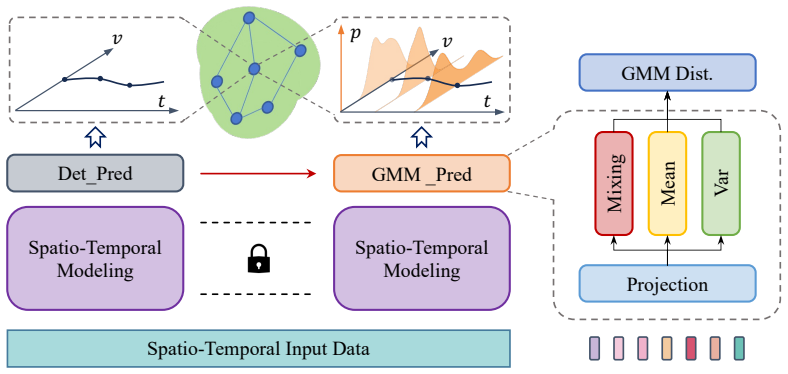
Replacing only the final layer with a Gaussian mixture model turns any traffic forecaster into a multi-modal probabilistic model.
A machine-rendered reading of the paper's core claim, the machinery that carries it, and where it could break.
Core claim
Existing traffic forecasting architectures can be transformed into universal multi-modal probabilistic models by replacing only the final output layer with a Gaussian Mixture Model layer that is trained using solely the Negative Log-Likelihood loss, without auxiliary terms, regularization, or alterations to the internal model structure or training pipeline.
What carries the argument
The Gaussian Mixture Model output layer, which models each prediction as a weighted sum of Gaussian distributions to represent multiple possible traffic outcomes.
If this is right
- The modified models match or exceed the original deterministic performance on point predictions.
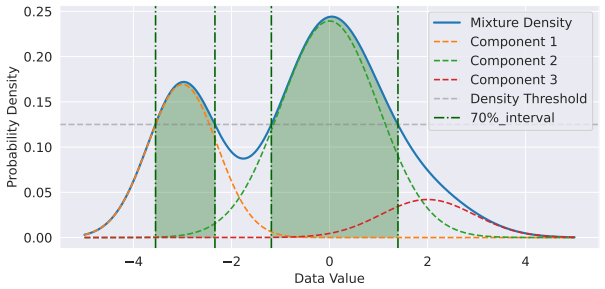
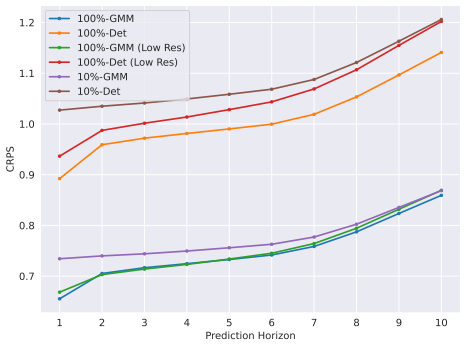
- Systematic checks using cumulative distribution functions and confidence intervals show the probabilistic outputs are more accurate and informative than unimodal baselines.
- The method remains effective on real-world dense urban networks even when input data quality is imperfect.
- The same output-layer replacement works for both classic and modern forecasting architectures without further tuning.
Where Pith is reading between the lines
- The same minimal change might be tried on other spatio-temporal forecasting problems such as demand or weather to test whether internal model adjustments are generally unnecessary for capturing stochasticity.
- In deployed traffic systems the resulting probability distributions could directly support risk-aware routing or signal control decisions.
- If the GMM layer alone suffices, then future model design can focus on representation learning while treating output multimodality as a separable, lightweight addition.
Load-bearing premise
Traffic dynamics are adequately captured by a mixture of Gaussians attached only at the model's final output, without any need to change how the network learns its internal representations.
What would settle it
On a held-out traffic dataset, if the GMM-modified models produce higher negative log-likelihood values or confidence intervals that are either too narrow or miscalibrated relative to observed traffic variations compared with the original deterministic models, the central claim would be refuted.
Figures



read the original abstract
Traffic forecasting is a challenging spatio-temporal modeling task and a critical component of urban transportation management. Current studies mainly focus on deterministic predictions, with limited considerations on the uncertainty and stochasticity in traffic dynamics. Therefore, this paper proposes an elegant yet universal approach that transforms existing models into probabilistic predictors by replacing only the final output layer with a novel Gaussian Mixture Model (GMM) layer. The modified model requires no changes to the training pipeline and can be trained using only the Negative Log-Likelihood (NLL) loss, without any auxiliary or regularization terms. Experiments on multiple traffic datasets show that our approach generalizes from classic to modern model architectures while preserving deterministic performance. Furthermore, we propose a systematic evaluation procedure based on cumulative distributions and confidence intervals, and demonstrate that our approach is considerably more accurate and informative than unimodal or deterministic baselines. Finally, a more detailed study on a real-world dense urban traffic network is presented to examine the impact of data quality on uncertainty quantification and to show the robustness of our approach under imperfect data conditions. Code available at https://github.com/Weijiang-Xiong/OpenSkyTraffic
Editorial analysis
A structured set of objections, weighed in public.
Referee Report
Summary. The paper proposes replacing the final output layer of existing deterministic traffic forecasting models with a Gaussian Mixture Model (GMM) layer, enabling probabilistic multi-modal predictions. The modified models require no changes to the internal architecture or training pipeline and are trained end-to-end using only Negative Log-Likelihood (NLL) loss. Experiments across multiple traffic datasets and model architectures (classic to modern) claim to preserve deterministic performance while improving accuracy and informativeness over unimodal or deterministic baselines. A new evaluation procedure based on cumulative distributions and confidence intervals is introduced, and a case study on a real-world dense urban network examines robustness under imperfect data conditions. Code is released publicly.
Significance. If the empirical results hold, the approach provides a simple, universal retrofit for adding multi-modal uncertainty quantification to traffic forecasting without retraining pipelines or auxiliary losses, which could be valuable for urban management applications. The public code release and focus on a systematic evaluation procedure beyond point estimates are strengths for reproducibility and field progress. However, the absence of theoretical justification for why backbone features suffice for mode capture without internal modifications or regularization limits the conceptual contribution.
major comments (3)
- [Method and Experiments] The central claim that traffic stochasticity is adequately captured by a GMM output layer alone (with NLL loss and no internal changes or regularization) rests on the unverified assumption that jointly trained backbone features already encode distinct modes. This is load-bearing for the 'universal' and 'no changes' assertions, yet the manuscript provides no ablations on feature collapse, mode separation, or variance calibration (e.g., in the method or experiments sections).
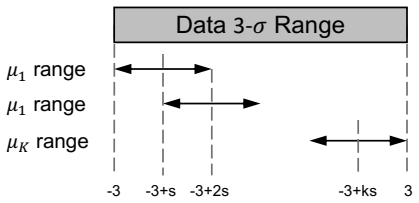
- [Experiments] The number of mixture components is listed as a free parameter, yet the paper emphasizes generalization 'without changes to the training pipeline.' Clarify the selection procedure across datasets and architectures, and report sensitivity analysis showing that results do not hinge on this choice (particularly in the real-world urban network study).
- [Evaluation Procedure] The proposed evaluation procedure using cumulative distributions and confidence intervals is presented as systematic, but without direct comparison to standard probabilistic metrics (e.g., CRPS, PICP, or NLL on held-out sets) in the results tables, it is unclear whether it demonstrates superiority beyond the reported accuracy gains.
minor comments (2)
- [Abstract] The abstract states that the approach 'preserves deterministic performance,' but without explicit side-by-side metrics (e.g., MAE/RMSE tables comparing GMM vs. original deterministic heads) this claim is difficult to assess quantitatively.
- [Method] Notation for the GMM layer (e.g., how mixture weights, means, and variances are parameterized and constrained to be positive) should be formalized with equations to aid reproducibility.
Simulated Author's Rebuttal
We thank the referee for the constructive feedback and the opportunity to clarify and strengthen our manuscript. We address each major comment point by point below, providing honest responses based on the current work and indicating planned revisions where appropriate.
read point-by-point responses
-
Referee: [Method and Experiments] The central claim that traffic stochasticity is adequately captured by a GMM output layer alone (with NLL loss and no internal changes or regularization) rests on the unverified assumption that jointly trained backbone features already encode distinct modes. This is load-bearing for the 'universal' and 'no changes' assertions, yet the manuscript provides no ablations on feature collapse, mode separation, or variance calibration (e.g., in the method or experiments sections).
Authors: We acknowledge that the manuscript lacks explicit ablations on feature collapse, mode separation, or variance calibration, which would provide stronger support for the assumption that backbone features suffice. The consistent empirical gains across diverse architectures and datasets under joint NLL training provide indirect evidence that the features capture multi-modal structure in traffic data. To address this directly, we will add ablation studies in the revised experiments section, including comparisons of joint vs. frozen backbone training, feature visualizations (e.g., t-SNE) demonstrating mode separation, and calibration plots comparing predicted and empirical coverage. revision: yes
-
Referee: [Experiments] The number of mixture components is listed as a free parameter, yet the paper emphasizes generalization 'without changes to the training pipeline.' Clarify the selection procedure across datasets and architectures, and report sensitivity analysis showing that results do not hinge on this choice (particularly in the real-world urban network study).
Authors: K was fixed at 3 after preliminary validation on one dataset to ensure a uniform setting with no per-model or per-dataset tuning, preserving the minimal-change pipeline. We will clarify this selection procedure in the methods section. In the revision, we will include a sensitivity analysis table in the experiments section (and specifically for the urban network study) reporting performance for K=2 to 5, showing that results remain stable and do not critically depend on this choice within a practical range. revision: yes
-
Referee: [Evaluation Procedure] The proposed evaluation procedure using cumulative distributions and confidence intervals is presented as systematic, but without direct comparison to standard probabilistic metrics (e.g., CRPS, PICP, or NLL on held-out sets) in the results tables, it is unclear whether it demonstrates superiority beyond the reported accuracy gains.
Authors: The CDF- and CI-based procedure is intended to provide intuitive, visual insight into multi-modality and uncertainty specific to traffic regimes. We agree that direct comparisons to standard metrics would improve context. In the revised results tables, we will add CRPS and PICP values alongside our metrics, and report explicit held-out NLL (separate from training loss) for all methods to enable straightforward benchmarking against other probabilistic approaches. revision: yes
Circularity Check
No circularity: empirical replacement of output layer validated on external datasets
full rationale
The paper advances an empirical modeling technique—replacing only the final layer of existing architectures with a GMM and training end-to-end solely with NLL—without any claimed first-principles derivation or mathematical chain. Central claims rest on generalization experiments across multiple traffic datasets and comparison to baselines, which are independent of the method's internal definitions. No equations reduce a prediction to a fitted parameter by construction, no self-citation load-bears the core premise, and no ansatz or uniqueness theorem is invoked. The approach is self-contained against external benchmarks, yielding a normal non-finding of circularity.
Axiom & Free-Parameter Ledger
free parameters (1)
- number of mixture components
axioms (1)
- domain assumption Traffic dynamics admit a useful multi-modal Gaussian representation at the output of existing spatio-temporal encoders.
Reference graph
Works this paper leans on
-
[1]
, author Li, Z
author An, Y. , author Li, Z. , author Li, X. , author Liu, W. , author Yang, X. , author Sun, H. , author Chen, M. , author Zheng, Y. , author Gong, Y. , year 2025 . title Spatio-temporal multivariate probabilistic modeling for traffic prediction . journal IEEE Transactions on Knowledge and Data Engineering volume 37 , pages 2986--3000
2025
-
[2]
, author Trindade, A
author Bessa, R.J. , author Trindade, A. , author Miranda, V. , year 2014 . title Spatial-temporal solar power forecasting for smart grids . journal IEEE Transactions on Industrial Informatics volume 11 , pages 232--241
2014
-
[3]
, author Talagrand, O
author Candille, G. , author Talagrand, O. , year 2005 . title Evaluation of probabilistic prediction systems for a scalar variable . journal Quarterly Journal of the Royal Meteorological Society: A journal of the atmospheric sciences, applied meteorology and physical oceanography volume 131 , pages 2131--2150
2005
-
[4]
, author Chen, R
author Chen, X. , author Chen, R. , year 2019 . title A review on traffic prediction methods for intelligent transportation system in smart cities , in: booktitle 2019 12th International Congress on Image and Signal Processing, BioMedical Engineering and Informatics (CISP-BMEI) , organization IEEE . pp. pages 1--5
2019
-
[5]
, author Wang, Z
author Coric, V. , author Wang, Z. , author Vucetic, S. , year 2011 . title Traffic speed forecasting by mixture of experts , in: booktitle 2011 14th International IEEE Conference on Intelligent Transportation Systems , organization IEEE
2011
-
[6]
, author Levinson, D
author Ermagun, A. , author Levinson, D. , year 2018 . title Spatiotemporal traffic forecasting: review and proposed directions . journal Transport Reviews volume 38 , pages 786--814
2018
-
[7]
, author Ravazzi, C
author Ferreira, G.O. , author Ravazzi, C. , author Dabbene, F. , author Calafiore, G.C. , author Fiore, M. , year 2023 . title Forecasting network traffic: A survey and tutorial with open-source comparative evaluation . journal IEEE Access volume 11 , pages 6018--6044
2023
-
[8]
, author Zhou, W
author Fu, J. , author Zhou, W. , author Chen, Z. , year 2021 . title Bayesian spatio-temporal graph convolutional network for traffic forecasting , in: booktitle Proceedings of the AAAI Conference on Artificial Intelligence , organization AAAI
2021
-
[9]
, author Ghahramani, Z
author Gal, Y. , author Ghahramani, Z. , year 2016 . title Dropout as a bayesian approximation: Representing model uncertainty in deep learning , in: booktitle international conference on machine learning , organization PMLR . pp. pages 1050--1059
2016
-
[10]
, author Carlin, J.B
author Gelman, A. , author Carlin, J.B. , author Stern, H.S. , author Rubin, D.B. , year 1995 . title Bayesian data analysis . publisher Chapman and Hall/CRC
1995
-
[11]
, author Basu, B
author Ghosh, B. , author Basu, B. , author O'Mahony, M. , year 2010 . title Random process model for urban traffic flow using a wavelet-bayesian hierarchical technique . journal Computer-Aided Civil and Infrastructure Engineering volume 25 , pages 613--624
2010
-
[12]
, author Raftery, A.E
author Gneiting, T. , author Raftery, A.E. , year 2007 . title Strictly proper scoring rules, prediction, and estimation . journal Journal of the American statistical Association volume 102 , pages 359--378
2007
-
[13]
, author Pleiss, G
author Guo, C. , author Pleiss, G. , author Sun, Y. , author Weinberger, K.Q. , year 2017 . title On calibration of modern neural networks , in: booktitle International conference on machine learning , organization PMLR . pp. pages 1321--1330
2017
-
[14]
, author Lin, Y
author Guo, S. , author Lin, Y. , author Feng, N. , author Song, C. , author Wan, H. , year 2019 . title Attention based spatial-temporal graph convolutional networks for traffic flow forecasting , in: booktitle Proceedings of the AAAI conference on artificial intelligence , pp. pages 922--929
2019
-
[15]
, author Schmidhuber, J
author Hochreiter, S. , author Schmidhuber, J. , year 1997 . title Long short-term memory . journal Neural Computation volume 9 , pages 1735--1780
1997
-
[16]
, author Luo, J
author Jiang, W. , author Luo, J. , year 2022 . title Graph neural network for traffic forecasting: A survey . journal Expert systems with applications volume 207 , pages 117921
2022
-
[17]
, author Gal, Y
author Kendall, A. , author Gal, Y. , year 2017 . title What uncertainties do we need in bayesian deep learning for computer vision? journal Advances in neural information processing systems volume 30
2017
-
[18]
Semi-Supervised Classification with Graph Convolutional Networks
author Kipf, T.N. , author Welling, M. , year 2016 . title Semi-supervised classification with graph convolutional networks . journal arXiv preprint arXiv:1609.02907
work page internal anchor Pith review arXiv 2016
-
[19]
author Kwak, S. , author Geroliminis, N. , author Frossard, P. , year 2021 . title Traffic signal prediction on transportation networks using spatio-temporal correlations on graphs . journal IEEE Transactions on Signal and Information Processing over Networks volume 7 , pages 648--659 . :10.1109/TSIPN.2021.3118489
-
[20]
, author Zhang, F
author Li, R. , author Zhang, F. , author Li, T. , author Zhang, N. , author Zhang, T. , year 2022 . title Dmgan: Dynamic multi-hop graph attention network for traffic forecasting . journal IEEE Transactions on Knowledge and Data Engineering volume 35 , pages 9088--9101
2022
-
[21]
, author Yu, R
author Li, Y. , author Yu, R. , author Shahabi, C. , author Liu, Y. , year 2018 . title Diffusion convolutional recurrent neural network: Data-driven traffic forecasting , in: booktitle International Conference on Learning Representations (ICLR '18)
2018
-
[22]
, author Zohren, S
author Lim, B. , author Zohren, S. , year 2021 . title Time-series forecasting with deep learning: a survey . journal Philosophical transactions of the royal society a: mathematical, physical and engineering sciences volume 379
2021
-
[23]
, author Dong, Z
author Liu, H. , author Dong, Z. , author Jiang, R. , author Deng, J. , author Deng, J. , author Chen, Q. , author Song, X. , year 2023 . title Spatio-temporal adaptive embedding makes vanilla transformer sota for traffic forecasting , in: booktitle Proceedings of the 32nd ACM international conference on information and knowledge management , pp. pages 4125--4129
2023
-
[24]
, author Wang, Y
author Liu, J. , author Wang, Y. , author Zhu, J. , author Bai, W. , author Zhang, H. , author Zuo, L. , author Zhou, T. , author Li, K. , year 2025 . title A multilayer spatiotemporal correlation-aware graph attention network for traffic flow prediction . journal IEEE Transactions on Neural Networks and Learning Systems
2025
-
[25]
, author Hutter, F
author Loshchilov, I. , author Hutter, F. , year 2019 . title Decoupled weight decay regularization , in: booktitle International Conference on Learning Representations . https://openreview.net/forum?id=Bkg6RiCqY7
2019
-
[26]
, year 2020
author Maclean, I.M. , year 2020 . title Predicting future climate at high spatial and temporal resolution . journal Global change biology volume 26 , pages 1003--1011
2020
-
[27]
author Mauro, R. , et al., year 2015 . title Traffic and random processes . journal Trento: Springer International Publishing Switzerland. DOI: https://doi. org/10.1007/978-3-319-09324-6
-
[28]
, author Nielsen, T.D
author Qian, W. , author Nielsen, T.D. , author Zhao, Y. , author Larsen, K.G. , author Yu, J.J. , year 2024 . title Uncertainty-aware temporal graph convolutional network for traffic speed forecasting . journal IEEE Transactions on Intelligent Transportation Systems volume 25 , pages 8578--8591
2024
-
[29]
, author Zhao, Y
author Qian, W. , author Zhao, Y. , author Zhang, D. , author Chen, B. , author Zheng, K. , author Zhou, X. , year 2023 . title Towards a unified understanding of uncertainty quantification in traffic flow forecasting . journal IEEE Transactions on Knowledge and Data Engineering volume 36 , pages 2239--2256
2023
-
[30]
, author Geroliminis, N
author Ramezani, M. , author Geroliminis, N. , year 2012 . title On the estimation of arterial route travel time distribution with markov chains . journal Transportation Research Part B: Methodological volume 46 , pages 1576--1590
2012
-
[31]
, author Swamy, S.R
author Ravish, R. , author Swamy, S.R. , year 2021 . title Intelligent traffic management: A review of challenges, solutions, and future perspectives . journal Transport and Telecommunication volume 22 , pages 163--182
2021
-
[32]
, author Mondal, S
author Sengupta, A. , author Mondal, S. , author Das, A. , author Guler, S.I. , year 2024 . title A bayesian approach to quantifying uncertainties and improving generalizability in traffic prediction models . journal Transportation Research Part C: Emerging Technologies volume 162 , pages 104585
2024
-
[33]
, author Zhang, Z
author Shao, Z. , author Zhang, Z. , author Wang, F. , author Wei, W. , author Xu, Y. , year 2022 . title Spatial-temporal identity: A simple yet effective baseline for multivariate time series forecasting , in: booktitle Proceedings of the 31st ACM International Conference on Information & Knowledge Management , pp. pages 4454--4458
2022
-
[34]
, author Ye, M
author Tan, Q. , author Ye, M. , author Ma, A.J. , author Yang, B. , author Yip, T.C.F. , author Wong, G.L.H. , author Yuen, P.C. , year 2020 . title Explainable uncertainty-aware convolutional recurrent neural network for irregular medical time series . journal IEEE Transactions on Neural Networks and Learning Systems volume 32 , pages 4665--4679
2020
-
[35]
, author Matteson, D.S
author Tang, B. , author Matteson, D.S. , year 2021 . title Probabilistic transformer for time series analysis . journal Advances in neural information processing systems volume 34 , pages 23592--23608
2021
-
[36]
author Tedjopurnomo, D.A. , author Bao, Z. , author Zheng, B. , author Choudhury, F.M. , author Qin, A.K. , year 2022 . title A survey on modern deep neural network for traffic prediction: Trends, methods and challenges . journal IEEE Transactions on Knowledge and Data Engineering volume 34 , pages 1544--1561 . :10.1109/TKDE.2020.3001195
-
[37]
, author Kouvelas, A
author Tsitsokas, D. , author Kouvelas, A. , author Geroliminis, N. , year 2023 . title Two-layer adaptive signal control framework for large-scale dynamically-congested networks: Combining efficient max pressure with perimeter control . journal Transportation Research Part C: Emerging Technologies volume 152 , pages 104128
2023
-
[38]
, author Shazeer, N
author Vaswani, A. , author Shazeer, N. , author Parmar, N. , author Uszkoreit, J. , author Jones, L. , author Gomez, A.N. , author Kaiser, . , author Polosukhin, I. , year 2017 . title Attention is all you need . journal Advances in Neural Information Processing Systems volume 30
2017
-
[39]
, author Karlaftis, M.G
author Vlahogianni, E.I. , author Karlaftis, M.G. , author Golias, J.C. , year 2014 . title Short-term traffic forecasting: Where we are and where we're going . journal Transportation Research Part C: Emerging Technologies volume 43 , pages 3--19
2014
-
[40]
, author Yang, X
author Wang, Y. , author Yang, X. , author Liang, H. , author Liu, Y. , year 2018 . title A review of the self-adaptive traffic signal control system based on future traffic environment . journal Journal of Advanced Transportation volume 2018 , pages 1096123
2018
-
[41]
, author Mulgund, S
author Wanke, C. , author Mulgund, S. , author Greenbaum, D. , author Song, L. , year 2004 . title Modeling traffic prediction uncertainty for traffic management decision support , in: booktitle AIAA Guidance, Navigation, and Control Conference and Exhibit , p. pages 5230
2004
-
[42]
, author James, J
author Wu, Y. , author James, J. , year 2021 . title A bayesian learning network for traffic speed forecasting with uncertainty quantification , in: booktitle 2021 International Joint Conference on Neural Networks (IJCNN) , organization IEEE . pp. pages 1--7
2021
-
[43]
author Wu, Y. , author Ye, Y. , author Zeb, A. , author Yu, J.J. , author Wang, Z. , year 2023 . title Adaptive modeling of uncertainties for traffic forecasting . journal arXiv preprint arXiv:2303.09273
-
[44]
, author Pan, S
author Wu, Z. , author Pan, S. , author Long, G. , author Jiang, J. , author Chang, X. , author Zhang, C. , year 2020 . title Connecting the dots: Multivariate time series forecasting with graph neural networks , in: booktitle Proceedings of the 26th ACM SIGKDD international conference on knowledge discovery & data mining , pp. pages 753--763
2020
-
[45]
Graph wavenet for deep spatial-temporal graph model- ing.arXiv preprint arXiv:1906.00121,
author Wu, Z. , author Pan, S. , author Long, G. , author Jiang, J. , author Zhang, C. , year 2019 . title Graph wavenet for deep spatial-temporal graph modeling . journal arXiv preprint arXiv:1906.00121
-
[46]
, author Xiang, X
author Xiao, X. , author Xiang, X. , author Yang, X. , author Jin, Z. , author Xu, J. , author Wang, S. , author Mao, G. , author Shao, W. , year 2026 . title Heuristic knowledge-driven spatio-temporal forecasting via multigraph . journal IEEE Transactions on Neural Networks and Learning Systems
2026
-
[47]
author Xiong, W. , author Fonod, R. , author Alahi, A. , author Geroliminis, N. , year 2025 . title Multi-source urban traffic flow forecasting with drone and loop detector data . journal IEEE Transactions on Intelligent Transportation Systems volume 26 , pages 18637--18652 . :10.1109/TITS.2025.3605014
-
[48]
, author Yin, H
author Yu, B. , author Yin, H. , author Zhu, Z. , year 2018 . title Spatio-temporal graph convolutional networks: A deep learning framework for traffic forecasting , in: booktitle Proceedings of the 27th International Joint Conference on Artificial Intelligence , publisher AAAI Press . pp. pages 3634--3640
2018
-
[49]
, author Li, G
author Yuan, H. , author Li, G. , year 2021 . title A survey of traffic prediction: from spatio-temporal data to intelligent transportation . journal Data Science and Engineering volume 6 , pages 63--85
2021
-
[50]
, author Fan, X
author Zheng, C. , author Fan, X. , author Wang, C. , author Qi, J. , year 2020 . title GMAN : A graph multi-attention network for traffic prediction , in: booktitle Proceedings of the AAAI conference on artificial intelligence , pp. pages 1234--1241
2020
-
[51]
, author Zhang, Z
author Zheng, Z. , author Zhang, Z. , year 2023 . title A stochastic recurrent encoder decoder network for multistep probabilistic wind power predictions . journal IEEE Transactions on Neural Networks and Learning Systems volume 35 , pages 9565--9578
2023
-
[52]
, author Gu, Z
author Zhou, Z. , author Gu, Z. , author Liu, P. , author Yu, W. , author Liu, Z. , year 2025 . title Leveraging semi-supervised learning and meta-learning for re-identification in few-shot spatiotemporal anomaly detection . journal IEEE Transactions on Neural Networks and Learning Systems
2025
discussion (0)
Sign in with ORCID, Apple, or X to comment. Anyone can read and Pith papers without signing in.