Recognition: unknown
SCRIPT: Implementing an Intelligent Tutoring System for Programming in a German University Context
Pith reviewed 2026-05-10 09:13 UTC · model grok-4.3
The pith
An adaptable intelligent tutoring system for Python programming has been built to comply with German and EU regulations.
A machine-rendered reading of the paper's core claim, the machinery that carries it, and where it could break.
Core claim
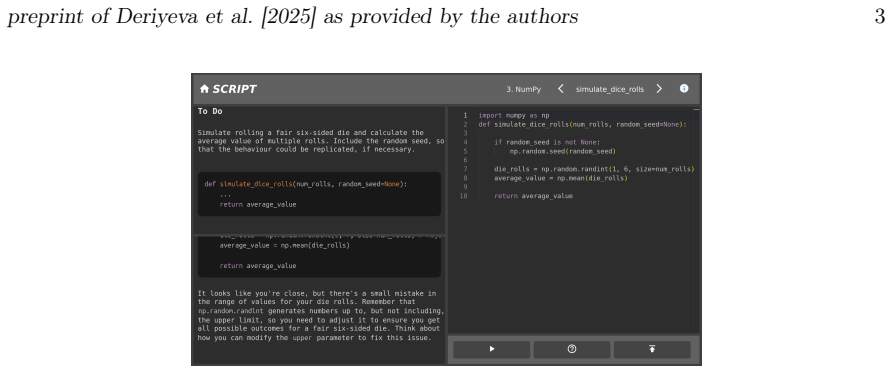
The authors present the SCRIPT intelligent tutoring system for Python, which functions as both a teaching platform providing adaptive support for programming practice and a research platform with open interfaces for integrating new hint generators including large language models. The implementation is shaped to meet the requirements of European data protection regulation, the European AI Act, and German Research Foundation ethics, filling gaps in prior systems that rarely handle Python or recent generative models.
What carries the argument
The pluggable hint mechanism interface that allows different sources to generate personalized advice on Python exercises while maintaining regulatory compliance.
If this is right
- Students receive tailored feedback on coding exercises even when instructors are unavailable.
- Researchers can plug in and test new hint methods, including those based on generative models.
- The system can be used in courses without violating data privacy or AI ethics requirements.
- Ongoing development can improve hint accuracy while staying within legal boundaries.
- The platform enables studies on how adaptive support affects programming skill acquisition.
Where Pith is reading between the lines
- Successful deployment could allow larger class sizes in introductory programming without loss of individualized guidance.
- The compliance design may provide a template for other AI tools in European higher education.
- Interaction data gathered under privacy rules could help identify common student difficulties in learning Python.
- Comparing hint quality from different plugged-in mechanisms would clarify the value of the adaptability feature.
Load-bearing premise
That an effective and usable intelligent tutoring system for Python can be implemented and kept running while fully satisfying GDPR, the EU AI Act, and German Research Foundation ethical standards without losing hint quality or student usability.
What would settle it
Running the system with real university Python classes and auditing both student learning gains and any breaches of data protection or AI transparency rules would show whether the claimed balance of adaptability and compliance holds.
Figures



read the original abstract
Practice and extensive exercises are essential in programming education. Intelligent tutoring systems (ITSs) are a viable option to provide individualized hints and advice to programming students even when human tutors are not available. However, prior ITS for programming rarely support the Python programming language, mostly focus on introductory programming, and rarely take recent developments in generative models into account. We aim to establish a novel ITS for Python programming that is highly adaptable, serves both as a teaching and research platform, provides interfaces to plug in hint mechanisms (e.g.\ via large language models), and works inside the particularly challenging regulatory environment of Germany, that is, conforming to the European data protection regulation, the European AI act, and ethical framework of the German Research Foundation. In this paper, we present the description of the current state of the ITS along with future development directions, as well as discuss the challenges and opportunities for improving the system.
Editorial analysis
A structured set of objections, weighed in public.
Referee Report
Summary. The manuscript presents SCRIPT, an intelligent tutoring system (ITS) for Python programming education designed for the German university context. It describes the system's architecture as highly adaptable, serving dual roles as a teaching and research platform, with modular interfaces for integrating hint mechanisms (including large language models), while ensuring compliance with GDPR, the EU AI Act, and German Research Foundation ethical guidelines. The paper outlines the current implementation state along with future development directions and discusses associated challenges and opportunities.
Significance. If the described modular architecture and compliance framework are realized as outlined, the system could serve as a useful platform for research on AI-supported programming education under strict European regulatory constraints. The emphasis on pluggable hint mechanisms is a positive design choice that facilitates incorporation of generative models without locking in specific technologies. However, the absence of any implementation details, code artifacts, or preliminary validation limits its immediate utility as a reproducible contribution.
major comments (1)
- The manuscript provides only a high-level system description without technical specifications, architecture diagrams, or pseudocode for core components such as the hint interface or compliance mechanisms. This makes it difficult to assess whether the claimed adaptability and regulatory compliance are achievable in practice.
minor comments (2)
- Add references to prior ITS for programming (e.g., those supporting languages other than Python) to better contextualize the novelty of the Python focus and regulatory emphasis.
- Clarify the specific APIs or extension points for plugging in hint mechanisms, as the current description remains too abstract for replication or extension by other researchers.
Simulated Author's Rebuttal
We thank the referee for their constructive feedback and for recognizing the potential value of SCRIPT's modular architecture and regulatory compliance framework for research on AI-supported programming education. We address the major comment below and describe the revisions we will make to strengthen the manuscript.
read point-by-point responses
-
Referee: The manuscript provides only a high-level system description without technical specifications, architecture diagrams, or pseudocode for core components such as the hint interface or compliance mechanisms. This makes it difficult to assess whether the claimed adaptability and regulatory compliance are achievable in practice.
Authors: We agree that the current manuscript emphasizes a high-level conceptual description of the system's architecture, its dual role as a teaching and research platform, and its alignment with GDPR, the EU AI Act, and German Research Foundation guidelines. This focus reflects the paper's aim to introduce the overall design and future directions at an early implementation stage. To address the concern, we will revise the manuscript to incorporate architecture diagrams, more detailed technical specifications for the pluggable hint interface (including LLM integration points), and pseudocode or flow descriptions for the core compliance mechanisms. These additions will better illustrate how adaptability and regulatory compliance are operationalized without altering the paper's scope as a system description. revision: yes
Circularity Check
No significant circularity
full rationale
The manuscript is a system-description paper presenting the architecture, implementation status, challenges, and future directions of an ITS for Python programming. It contains no equations, derivations, predictions, fitted parameters, or first-principles results. The central content is a descriptive report on design choices made to satisfy regulatory constraints (GDPR, EU AI Act, DFG ethics), with no load-bearing scientific claims that could reduce to self-definition, self-citation chains, or renamed empirical patterns. All discussion of adaptability and hint mechanisms is framed as ongoing implementation work rather than validated outcomes.
Axiom & Free-Parameter Ledger
Reference graph
Works this paper leans on
-
[1]
John YH Bai, Olaf Zawacki-Richter, and Wolfgang Muskens
doi:10.1145/3569576. John YH Bai, Olaf Zawacki-Richter, and Wolfgang Muskens. Re-examining the future prospects of artificial intelligence in education in light of the GDPR and ChatGPT.Turk- ish Online Journal of Distance Education, 25(1):20–32,
-
[2]
Tiffany Barnes
URLhttps://eric.ed.gov/ ?id=EJ1414336. Tiffany Barnes. The Q-matrix method: Mining student response data for knowledge. In Proceedings of the AAAI 2005 educational data mining workshop, pages 1–8,
2005
-
[3]
Anastasiia Birillo, Elizaveta Artser, Anna Potriasaeva, Ilya Vlasov, Katsiaryna Dzialets, Yaroslav Golubev, Igor Gerasimov, Hieke Keuning, and Timofey Bryksin
URL https://cdn.aaai.org/Workshops/2005/WS-05-02/WS05-02-006.pdf. Anastasiia Birillo, Elizaveta Artser, Anna Potriasaeva, Ilya Vlasov, Katsiaryna Dzialets, Yaroslav Golubev, Igor Gerasimov, Hieke Keuning, and Timofey Bryksin. One step at a time: Combining LLMs and static analysis to generate next-step hints for programming tasks. InProceedings of the 24th...
2005
-
[4]
Tyne Crow, Andrew Luxton-Reilly, and Burkhard Wuensche
doi:10.1145/3699538.3699556. Tyne Crow, Andrew Luxton-Reilly, and Burkhard Wuensche. Intelligent tutoring systems for programming education: a systematic review. InProceedings of the 20th Australasian Computing Education Conference (ACE), page 53–62,
-
[5]
Jesper Dannath, Alina Deriyeva, and Benjamin Paaßen
doi:10.1145/3160489.3160492. Jesper Dannath, Alina Deriyeva, and Benjamin Paaßen. Evaluating task-level struggle de- tection methods in intelligent tutoring systems for programming. In Sandra Schulz and Natalie Kiesler, editors,Proceedings of the German Conference on Educational Technolo- gies (DELFI), Fulda, Germany,
-
[6]
doi:10.18420/delfi2024_07. preprint of Deriyeva et al
-
[7]
What is a step? a user study on how to sub-divide the solution process of introductory python tasks
as provided by the authors8 Jesper Dannath, Alina Deriyeva, and Benjamin Paaßen. What is a step? a user study on how to sub-divide the solution process of introductory python tasks. In Caitlin Mills, Giora Alexandron, Mirko Marras, and Miguel Portaz, editors,Proceedings of the 18th In- ternational Conference on Educational Data Mining (EDM 2025), Palermo, Italy,
2025
-
[8]
Rethinking data augmentation for robust LiDAR semantic segmentation in adverse weather,
Springer Nature Switzerland. ISBN 978-3-031-99261-2. doi:10.1007/978-3-031- 99261-2_16. Diego Dermeval, Ranilson Paiva, Ig Ibert Bittencourt, Julita Vassileva, and Daniel Borges. Authoring tools for designing intelligent tutoring systems: a systematic review of the lit- erature.International Journal of Artificial Intelligence in Education, 28:336–384,
-
[9]
Herman Zvonimir Došilović and Igor Mekterović
doi:10.1007/s40593-017-0157-9. Herman Zvonimir Došilović and Igor Mekterović. Robust and scalable online code execution system. In2020 43rd International Convention on Informa- tion, Communication and Electronic Technology (MIPRO), pages 1627–1632,
-
[10]
doi:10.23919/MIPRO48935.2020.9245310. German Research Foundation. Guidelines for safeguarding good research practice. code of conduct,
-
[11]
Towards giving timely formative feedback and hints to novice programmers
Johan Jeuring, Hieke Keuning, Samiha Marwan, Dennis Bouvier, Cruz Izu, Natalie Kiesler, Teemu Lehtinen, Dominic Lohr, Andrew Peterson, and Sami Sarsa. Towards giving timely formative feedback and hints to novice programmers. InProceedings of the 2022 Working Group Reports on Innovation and Technology in Computer Science Education (ITiCSE), page 95–115,
2022
-
[12]
Sven Judel, Christopher Zeise, and Ulrik Schroeder
doi:10.1145/3571785.3574124. Sven Judel, Christopher Zeise, and Ulrik Schroeder. Informiertes zustimmungsmanagement für learning analytics in lernmanagementsystemen. InProceedings of the German Confer- ence on Educational Technologies (DELFI),
-
[13]
doi:10.18420/delfi2024_06. James Kulik and J. D. Fletcher. Effectiveness of intelligent tutoring systems: A meta-analytic review.Review of Educational Research, 86, 04
-
[14]
doi:10.3102/0034654315581420. Jessica McBroom, Irena Koprinska, and Kalina Yacef. A survey of automated programming hint generation: The hints framework.ACM Computing Surveys, 54(8), October
-
[15]
Markus Mueck, Christophe Gaie, and Dimitris C
doi:10.1145/3469885. Markus Mueck, Christophe Gaie, and Dimitris C. Gkikas. Introduction to the European artificial intelligence act. In Markus Mueck and Christophe Gaie, editors,European Digital Regulations, pages 53–90. Springer Nature Switzerland, Cham,
-
[16]
Fouriscale: A frequency perspective on training-free high-resolution image synthesis,
doi:10.1007/978-3- 031-80809-8_3. preprint of Deriyeva et al
-
[17]
Bringing AIED, public policy and GDPR to promote educational opportunities in Brazil
as provided by the authors9 Carlos Portela, Jorge Rocha, Paula Palomino, Rodrigo Lisbôa, Thiago Cordeiro, Alan Silva, Ig Bittencourt, Diego Dermeval, Leonardo Marques, and Seiji Isotani. Bringing AIED, public policy and GDPR to promote educational opportunities in Brazil. In Andrew M. Olney, Irene-Angelica Chounta, Zitao Liu, Olga C. Santos, and Ig Ibert ...
2024
-
[18]
Lianne Roest, Hieke Keuning, and Johan Jeuring
doi:10.1007/978-3-031-64315-6_6. Lianne Roest, Hieke Keuning, and Johan Jeuring. Next-step hint generation for introductory programming using large language models. InProceedings of the 26th Australasian Comput- ing Education Conference (ACE), Sydney, Australia,
-
[19]
It’s not like Jarvis, but it’s pretty close!
doi:10.1145/3636243.3636259. Robert A Sottilare, Arthur Graesser, Xiangen Hu, and Heather Holden.Design recommen- dations for intelligent tutoring systems: Volume 1-learner modeling, volume
-
[20]
doi:10.1080/00461520.2011.611369
discussion (0)
Sign in with ORCID, Apple, or X to comment. Anyone can read and Pith papers without signing in.