Recognition: 3 theorem links
· Lean TheoremCells, convexity and contractibility in general categories
Pith reviewed 2026-05-12 00:50 UTC · model grok-4.3
The pith
Categories obeying basic axioms admit convex contractible cells whose maps reconstruct homology and homotopy.
A machine-rendered reading of the paper's core claim, the machinery that carries it, and where it could break.
Core claim
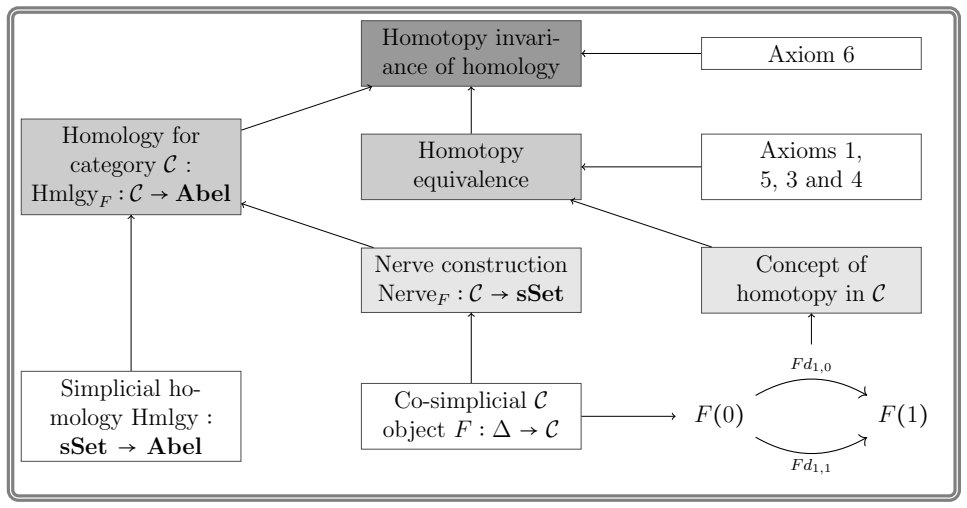
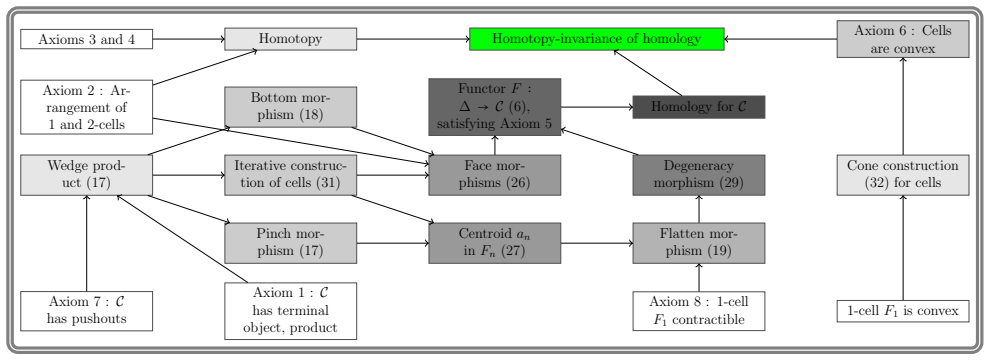
The two pillars of algebraic topology rely on cells with faces, sub-cells, convexity and contractibility. In categories satisfying some simple axioms, such cells can be constructed. The categorical analogs of convexity and contractibility hold for these cells. The collection of maps from objects to these cells, together with redundancies among them, determine the homology and homotopy of the category.
What carries the argument
The procedure for constructing cells that satisfy the categorical analogs of convexity and contractibility, which act as basic building blocks for homology and homotopy.
If this is right
- Homology of an object is determined by the maps into the constructed cells and the redundancies among them.
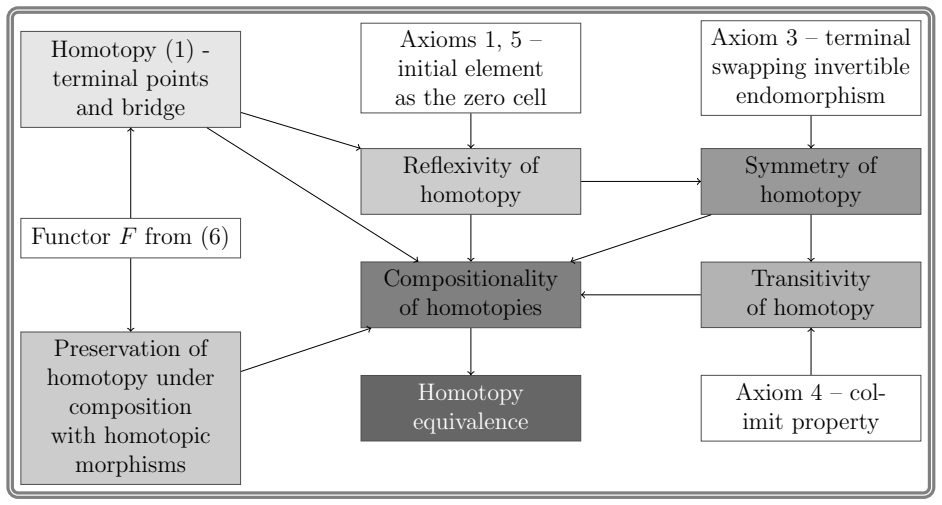
- Homotopy is generated from the line and point cells among the constructed cells.
- Any category meeting the axioms gains these topological invariants in a purely categorical manner.
- The cells provide a uniform way to define faces, sub-cells, convexity and contractibility across different categories.
Where Pith is reading between the lines
- This approach could be applied to categories of graphs or posets to define categorical versions of topological invariants.
- It may connect to existing simplicial and nerve constructions in category theory for computing these invariants explicitly.
- One could test the reconstruction in concrete cases such as the category of sets to see if standard homology groups emerge.
Load-bearing premise
The category must obey a small collection of axioms sufficient to guarantee the existence of the required cells and the reconstruction of homology and homotopy from maps into them.
What would settle it
A counterexample category that satisfies the axioms but in which the maps to the cells do not recover the expected homology or homotopy information.
Figures



read the original abstract
The two pillars of Algebraic topology - Homology and homotopy theory rely on the availability of basic building blocks called cells. Cells take the form of simplexes, and have properties such as faces, sub-cells, convexity and contractibility. The first two cells, namely the line and points lead to the concept of homotopy. The collection of maps from the cells and the redundancies among them determine the homology of objects. This article presents a procedure in which such cells can be built in categories satisfying some simply axioms. The cells satisfy the categorical analogs of convexity and contractibility. The article also shows how these secondary properties are sufficient to reconstruct Homology and Homotopy for the arbitrary category.
Editorial analysis
A structured set of objections, weighed in public.
Referee Report
Summary. The paper claims that in any category obeying a short list of simple axioms, one can construct cells that are convex and contractible in the categorical sense. These cells serve as building blocks analogous to simplices; the collection of maps from objects into the cells, together with redundancies among them, is asserted to determine the homology and homotopy of the category.
Significance. If the axiomatic construction and reconstruction are correct, the work would supply a purely categorical foundation for the basic building blocks of algebraic topology, potentially allowing homology and homotopy to be defined and computed in settings far more general than topological spaces or simplicial sets.
major comments (2)
- [Axioms and construction section] The abstract states that the cells are constructed from 'some simply axioms' and that their convexity/contractibility properties suffice to reconstruct homology and homotopy, but the manuscript must explicitly list these axioms (presumably in an early section) and prove that they are sufficient for the existence of the required cells and for the reconstruction maps to recover the standard invariants. Without this verification, the central claim remains unconfirmed.
- [Reconstruction of homology and homotopy] The reconstruction of homology via 'redundancies among maps from objects into the cells' is asserted but not shown to be equivalent to any standard definition (e.g., singular or simplicial homology). A concrete comparison or theorem establishing that the resulting homology groups coincide with known ones on standard examples (such as topological spaces) is needed to substantiate the claim.
minor comments (2)
- The abstract uses the phrase 'simply axioms'; the manuscript should correct this to 'simple axioms' and ensure consistent terminology for 'categorical analogs of convexity and contractibility' throughout.
- The paper should include at least one fully worked example (e.g., the category of sets or a small topological space) showing explicit cells, their convexity/contractibility, and the resulting homology computation.
Simulated Author's Rebuttal
We thank the referee for the thoughtful and constructive report. The comments highlight important points where the manuscript can be made more explicit and self-contained. We will revise accordingly to strengthen the presentation of the axioms and the verification of the reconstruction results.
read point-by-point responses
-
Referee: [Axioms and construction section] The abstract states that the cells are constructed from 'some simply axioms' and that their convexity/contractibility properties suffice to reconstruct homology and homotopy, but the manuscript must explicitly list these axioms (presumably in an early section) and prove that they are sufficient for the existence of the required cells and for the reconstruction maps to recover the standard invariants. Without this verification, the central claim remains unconfirmed.
Authors: We agree that the axioms need to be stated explicitly and early, together with a clear proof of sufficiency. In the revised manuscript we will insert a dedicated subsection (new Section 2.1) that lists the axioms verbatim. We will also add Theorem 2.3, which proves that any category satisfying these axioms admits the required cells and that the convexity and contractibility properties are sufficient to define the reconstruction maps for homology and homotopy. This will make the central claim fully verified inside the paper. revision: yes
-
Referee: [Reconstruction of homology and homotopy] The reconstruction of homology via 'redundancies among maps from objects into the cells' is asserted but not shown to be equivalent to any standard definition (e.g., singular or simplicial homology). A concrete comparison or theorem establishing that the resulting homology groups coincide with known ones on standard examples (such as topological spaces) is needed to substantiate the claim.
Authors: We accept that the manuscript currently asserts the reconstruction without supplying an explicit equivalence or comparison. In the revision we will add a new Section 5 containing Theorem 5.1, which states that when the ambient category is the category of topological spaces (with the standard cells), the homology groups obtained from the redundancies coincide with singular homology. The proof will proceed by exhibiting a natural isomorphism between the two chain complexes on the standard simplices and verifying that it respects the face and degeneracy maps. This will provide the required concrete verification on a standard example. revision: yes
Circularity Check
No significant circularity; axiomatic construction is self-contained
full rationale
The paper constructs cells from a short list of category axioms and proves that the resulting convexity and contractibility properties suffice to recover homology and homotopy via maps into the cells. No load-bearing step reduces by definition or self-citation to a fitted parameter or renamed input; the argument proceeds directly from the external axioms to the secondary properties without internal circular reduction. This is the expected non-circular outcome for an axiomatic generalization in category theory.
Axiom & Free-Parameter Ledger
axioms (1)
- domain assumption The category satisfies a short list of elementary axioms sufficient for the cell construction.
Lean theorems connected to this paper
-
IndisputableMonolith/Foundation/RealityFromDistinction.leanreality_from_one_distinction unclearThe cells satisfy the categorical analogs of convexity and contractibility... assemble into a co-simplicial object F:Δ→C... homology via the associated nerve functor
-
IndisputableMonolith/Cost/FunctionalEquation.leanwashburn_uniqueness_aczel unclearWedge construction... pushout... Fn+1 := W(Fn)... face maps dn,i and degeneracy maps sn,i
Reference graph
Works this paper leans on
-
[1]
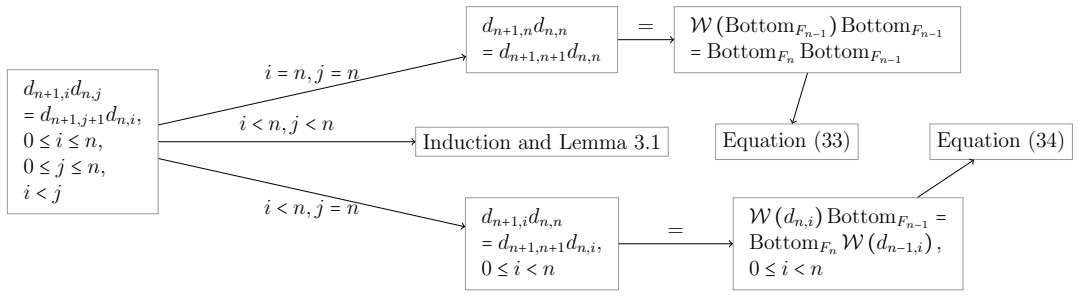
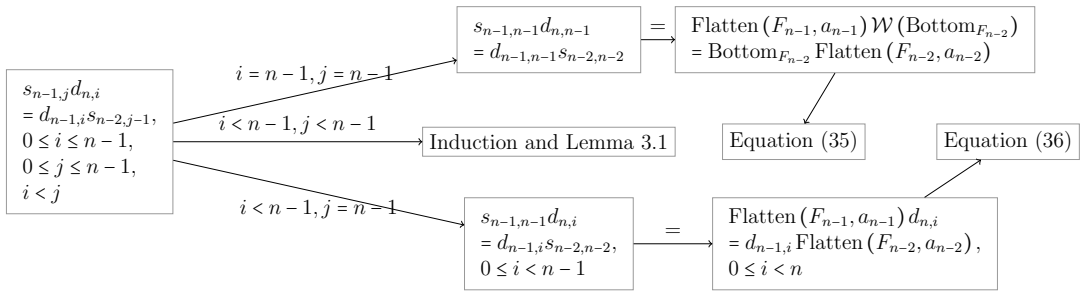
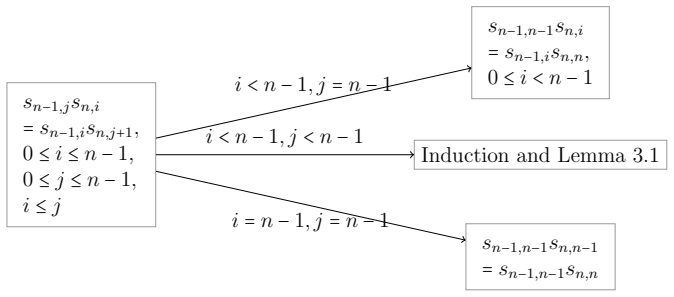
This completes the proof of Theorem 3 (i). 15 sn−1,jdn,i =d n−1,isn−2,j−1, 0≤i≤n−1, 0≤j≤n−1, i<j Induction and Lemma 3.1 sn−1,n−1dn,i =d n−1,isn−2,n−2, 0≤i<n−1 sn−1,n−1dn,n−1 =d n−1,n−1sn−2,n−2 Flatten(Fn−1, an−1)W(BottomFn−2) =BottomFn−2Flatten(Fn−2, an−2) Equation (35) Equation (36) Flatten(Fn−1, an−1)d n,i =d n−1,iFlatten(Fn−2, an−2), 0≤i<n i<n−1, j<n−...
-
[2]
M. Clementino and W. Tholen. Separation versus connectedness.Topology Appl., 75(2):143–181, 1997
work page 1997
-
[3]
E. Giuli and J. Lapal. Neighborhoods with respect to a categorical closure operator.Acta Mathematica Hungarica, 124(1-2):1–14, 2009
work page 2009
-
[4]
E. Giuli and W. Tholen. Openness with respect to a closure operator.Applied Cat. Struct., 8:487–502, 2000
work page 2000
-
[5]
S. Das. Reconstructing dynamical systems as zero-noise limits.Tohoku Math. J., 77, 2025
work page 2025
-
[6]
A. Suslin and V. Voevodsky. Singular homology of abstract algebraic varieties.Inventiones mathemat- icae, 127(3):587–632, 1997
work page 1997
-
[7]
A. Dold. Homology of symmetric products and other functors of complexes.Ann. Math., 68(1):54–80, 1958. 25
work page 1958
-
[8]
D. Kan. Functors involving css complexes.Trans. Amer. Math. Soc., 87(2):330–346, 1958
work page 1958
- [9]
-
[10]
Quillen.Homotopical algebra, volume 43
D. Quillen.Homotopical algebra, volume 43. Springer, 2006
work page 2006
-
[11]
W. Dwyer and J. Spalinski. Homotopy theories and model categories. InHandbook of algebraic topology, volume 73, page 21. Elsevier Science, 1995
work page 1995
-
[12]
Cisinski.Higher categories and homotopical algebra, volume 180
D. Cisinski.Higher categories and homotopical algebra, volume 180. Cambridge University Press, 2019
work page 2019
-
[13]
P. Goerss and J. Jardine.Simplicial homotopy theory. Springer Science & Business Media, 2009
work page 2009
-
[14]
W. Dwyer and D. Kan. Singular functors and realization functors. InIndagationes Mathematicae (Proceedings), volume 87, pages 147–153. Elsevier, 1984
work page 1984
-
[15]
Massey.A basic course in algebraic topology
W. Massey.A basic course in algebraic topology. Springer Science & Business Media, 1991
work page 1991
-
[16]
E. Spanier.Algebraic topology. Springer Science & Business Media, 2012
work page 2012
-
[17]
A. Hatcher.Algebraic Topology. Cambridge University Press, 2002
work page 2002
-
[18]
Weibel.An introduction to homological algebra
C. Weibel.An introduction to homological algebra. 38. Cambridge university press, 1994
work page 1994
-
[19]
Neeman.Triangulated Categories, volume 148 ofAnn
A. Neeman.Triangulated Categories, volume 148 ofAnn. Math. Studies. Princeton University Press, 2001
work page 2001
-
[20]
M. Kashiwara and P. Schapira.Categories and Sheaves, volume 332 ofGrundlehren der mathematischen Wissenschaften. Springer Berlin Heidelberg, 2006
work page 2006
-
[21]
S. Das. Homology and homotopy for arbitrary categories.arxiv, 2404, 2024
work page 2024
-
[22]
E. Riehl. A leisurely introduction to simplicial sets, 2011
work page 2011
-
[23]
R. Steiner. Simple omega-categories and chain complexes.Homology, Homotopy Appl., 9(1):451–465, 2007
work page 2007
-
[24]
J. Grodal. Higher limits via subgroup complexes.Ann. Math., 155(2):405–457, 2002
work page 2002
- [25]
-
[26]
A. Meush. Categorical combinatorics: a category-theoretic approach to combinatorial analysis and enumeration, 1981
work page 1981
-
[27]
P. Bubenik and J. Scott. Categorification of persistent homology.Discrete & Computational Geometry, 51(3):600–627, 2014
work page 2014
-
[28]
S. Das. Cells, convexity and contractibility in general categories, 2024
work page 2024
- [29]
- [30]
-
[31]
T. Goodwillie. Calculus II: Analytic functors.K-Theory, 5(4):295–332, 1992
work page 1992
-
[32]
M. Anel et al. A generalized Blakers-Massey theorem.Journal of Topology, 13(4):1521–1553, 2020. 26
work page 2020
-
[33]
JL. Verdier. Des cat´ egories d´ eriv´ ees des cat´ egories ab´ eliennes.Ast´ erisque, 239, 1996
work page 1996
- [34]
-
[35]
P. Bubenik and N. Mili´ cevi´ c. Homological algebra for persistence modules.Foundations of Computa- tional Mathematics, 21(5):1233–1278, 2021
work page 2021
-
[36]
U. Bauer and M. Lesnick. Persistence diagrams as diagrams: A categorification of the stability theorem. Topological Data Analysis, 2020
work page 2020
-
[37]
N. Otter et al. A roadmap for the computation of persistent homology.EPJ Data Science, 6:1–38, 2017
work page 2017
-
[38]
May.A Concise Course in Algebraic Topology
P. May.A Concise Course in Algebraic Topology. University of Chicago Press, 1999
work page 1999
-
[39]
Hovey.Model Categories, volume 63 ofMathematical Surveys and Monographs
M. Hovey.Model Categories, volume 63 ofMathematical Surveys and Monographs. American Mathe- matical Society, 1999
work page 1999
-
[40]
J. Milnor. On spaces having the homotopy type of a CW-complex.Trans. Amer. Math. Soc., 90(2):272– 280, 1959
work page 1959
-
[41]
T. Lundell and S. Weingram.The Topology of CW Complexes. Van Nostrand Reinhold, 1969
work page 1969
-
[42]
T. Rad´ o.¨Uber den begriff der riemannschen fl¨ ache.Acta Litterarum ac Scientiarum Regiae Universi- tatis Hungaricae Francisco-Josephinae, Sectio Scientiarum Mathematicarum, 2:101–121, 1925
work page 1925
-
[43]
E. Moise. Affine structures in 3-manifolds: V. the triangulation theorem and hauptvermutung.Annals of Mathematics, 56(1):96–114, 1952
work page 1952
-
[44]
S. Cairns. On the triangulation of regular loci.Annals of Mathematics, 35(3):579–587, 1934
work page 1934
- [45]
- [46]
- [47]
discussion (0)
Sign in with ORCID, Apple, or X to comment. Anyone can read and Pith papers without signing in.