Recognition: unknown
The Econometrics of Matching with Transferable Utility: A Progress Report
Pith reviewed 2026-05-10 07:17 UTC · model grok-4.3
The pith
The separable approach to estimating matching markets with transferable utility holds up well even when some variables are omitted or utilities are non-separable.
A machine-rendered reading of the paper's core claim, the machinery that carries it, and where it could break.
Core claim
The central claim is that the separable Choo-Siow-type approach remains a useful and reasonably robust tool for recovering the joint surplus in transferable-utility matching markets, even in the presence of omitted variables or modest departures from separability, as shown by combining analytic arguments on bias bounds with simulation evidence across varied data-generating processes.
What carries the argument
The separable joint surplus specification, which decomposes total match value into an observed deterministic component plus an unobserved component that is additively separable across partners and markets.
If this is right
- Applied work can proceed with the simpler separable estimator in most empirical matching settings without large bias from omitted factors.
- Data collection priorities should focus on market balance and sample size rather than exhaustive variable coverage.
- Researchers gain a clearer benchmark for when more complex non-separable models are worth the extra data and computational cost.
- Policy simulations based on separable estimates remain credible for moderate departures from the maintained assumptions.
Where Pith is reading between the lines
- Future work could systematically compare separable and non-separable estimates on the same real datasets to map the actual size of the robustness region.
- The caveat on imbalanced datasets suggests that markets with very unequal numbers of men and women may require new identification strategies even under separability.
- If robustness holds, the literature can shift from defending the separable model to exploring richer heterogeneity and dynamics within it.
Load-bearing premise
The simulations and theoretical arguments adequately capture the range of omitted variables and non-separabilities that appear in actual matching datasets.
What would settle it
A real-world matching dataset in which estimates from the separable model produce materially different counterfactual predictions or parameter values than estimates obtained from a flexible non-separable specification on the same sample.
Figures


read the original abstract
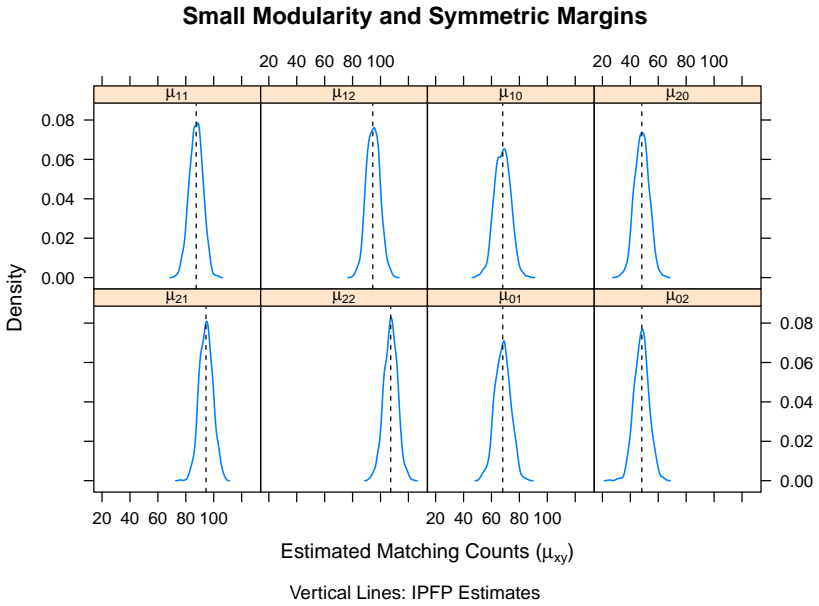
Since Choo and Siow (2006), a burgeoning literature has analyzed matching markets when utility is perfectly transferable and the joint surplus is separable. We take stock of recent methodological developments in this area. Combining theoretical arguments and simulations, we show that the separable approach is reasonably robust to omitted variables and/or non-separabilities. We conclude with a caveat on data requirements and imbalanced datasets.
Editorial analysis
A structured set of objections, weighed in public.
Referee Report
Summary. The paper reviews methodological developments in the econometrics of matching markets with transferable utility since Choo and Siow (2006), focusing on the separable joint surplus approach. It combines theoretical arguments and new simulations to argue that the separable approach is reasonably robust to omitted variables and/or non-separabilities, while concluding with caveats on data requirements and imbalanced datasets.
Significance. If the robustness claims hold, the paper would be significant for empirical work in labor and family economics by providing reassurance that separable models can be applied even when real data exhibit moderate departures from separability. The dual use of theory and simulations to probe this robustness, together with the explicit caveats, strengthens the contribution as a practical progress report rather than an unqualified endorsement.
minor comments (3)
- The abstract states that simulations support robustness but does not indicate the specific forms of non-separability or omitted variables that were simulated; adding one sentence on the design (e.g., the range of correlation structures or functional forms tested) would improve transparency without lengthening the abstract.
- Because the manuscript is a progress report that reviews prior literature, a short table or appendix summarizing the key identifying assumptions and estimators from the main cited papers (Choo-Siow and subsequent contributions) would help readers who are not already immersed in the matching literature.
- The concluding caveat on imbalanced datasets is appropriate; it would be useful to add a brief reference to how common matching datasets (e.g., marriage or labor-market registries) typically satisfy or violate the balance condition discussed.
Simulated Author's Rebuttal
We thank the referee for their positive and accurate summary of the manuscript, as well as for recommending minor revision. We appreciate the recognition that the combination of theoretical arguments and simulations strengthens the paper as a practical progress report on the robustness of the separable joint surplus approach.
Circularity Check
No significant circularity detected
full rationale
The paper is a progress report reviewing the literature on matching markets with transferable utility since Choo and Siow (2006). Its central claim—that the separable approach is reasonably robust to omitted variables and non-separabilities—is supported by a combination of theoretical arguments drawn from prior independent work and new simulation results generated for this paper. No derivation chain reduces a prediction or result to its own inputs by construction, no fitted parameters are relabeled as predictions, and no load-bearing uniqueness theorems or ansatzes are smuggled in via self-citation. The paper explicitly includes a caveat on data requirements and imbalanced datasets, confirming that the robustness conclusion is presented as qualified rather than tautological. The simulations and theory address departures from separability directly and do not rely on self-referential definitions or renamings of known results.
Axiom & Free-Parameter Ledger
axioms (1)
- domain assumption Joint surplus is separable as defined in Choo and Siow (2006)
Reference graph
Works this paper leans on
-
[1]
Matching Across Markets: An Economic Analysis of Cross- Border Marriage,
Ahn, S. Y.(2023): “Matching Across Markets: An Economic Analysis of Cross- Border Marriage,”Journal of Labor Economics,
2023
-
[2]
A theory of marriage, part I,
Becker, G.(1973): “A theory of marriage, part I,”Journal of Political Economy, 81, 813–846. Bojilov, R.,andA. Galichon(2016): “Matching in closed-form: equilibrium, identification, and comparative statics,”Economic Theory, 61, 587–609. Chiappori, P.-A., C. Florio, A. Galichon,andS. Verzillo(2024): “Assor- tative Matching on Income,”Econometrica, forthcomi...
1973
discussion (0)
Sign in with ORCID, Apple, or X to comment. Anyone can read and Pith papers without signing in.