Recognition: unknown
Extending Galactic foreground emission with neural networks
Pith reviewed 2026-05-10 07:59 UTC · model grok-4.3
The pith
Cycle-GANs trained on dust and HI maps produce CO emission that matches observed angular correlations and statistical properties.
A machine-rendered reading of the paper's core claim, the machinery that carries it, and where it could break.
Core claim
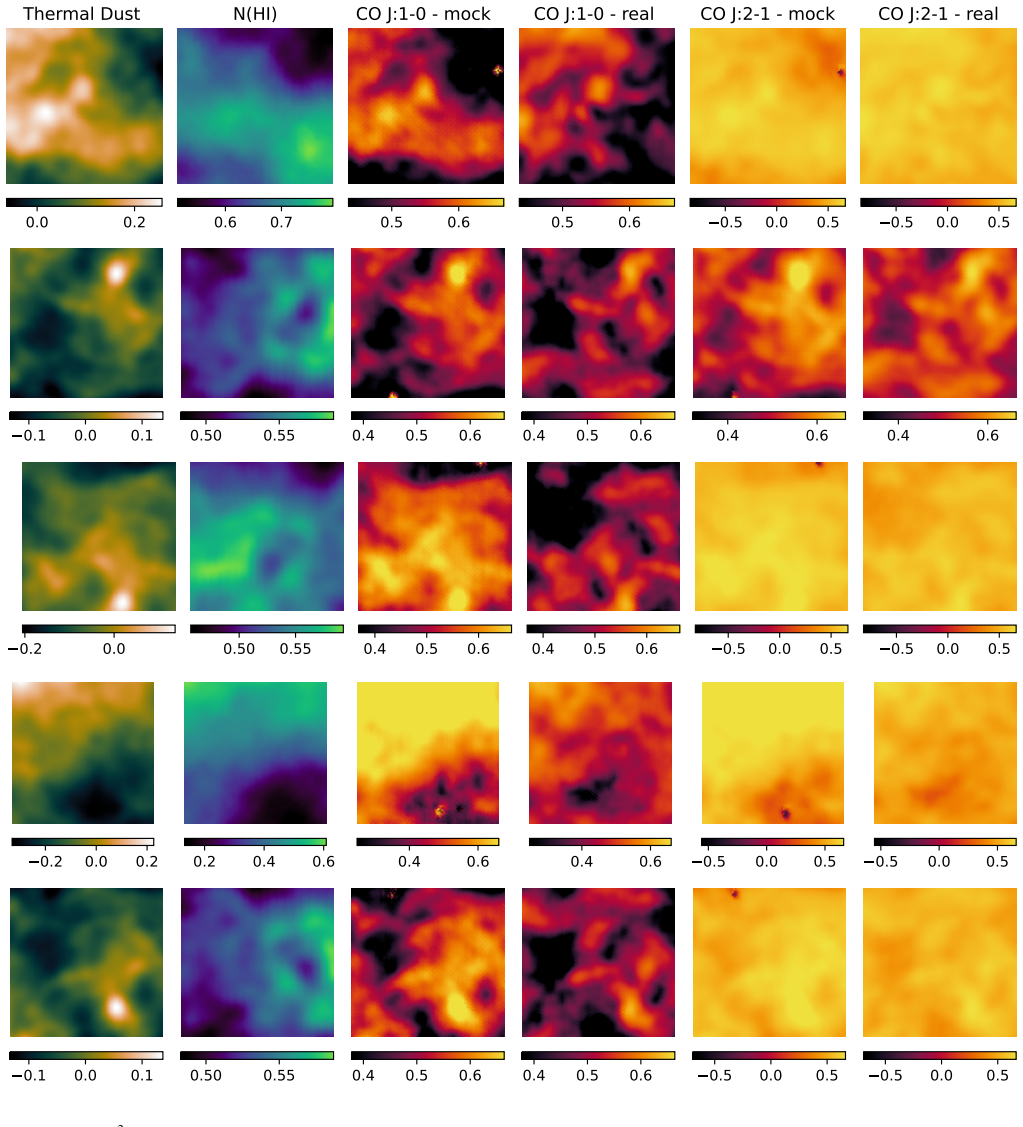
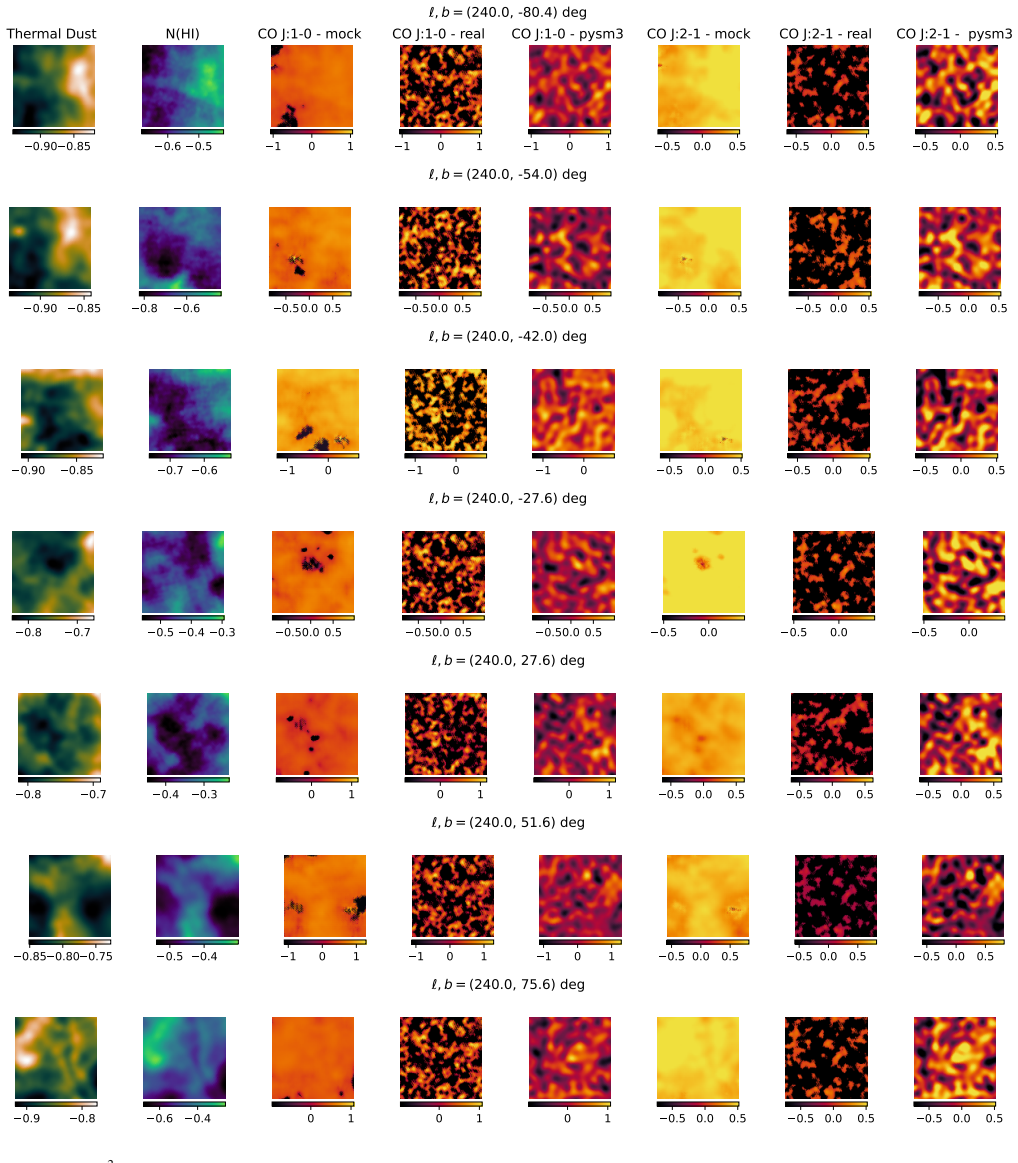
Cycle-GANs trained on Planck dust maps and HI4PI data, using Planck CO J:1-0 and J:2-1 lines as targets in high-SNR regions, generate emission whose amplitudes reproduce the angular correlations and share the statistical properties of the CO targets, as confirmed by matching angular power spectra and Minkowski functionals, thereby enabling extension of CO models to scarcely observed high-latitude areas.
What carries the argument
Cycle Generative Adversarial Networks that learn bidirectional mappings between dust plus HI inputs and CO rotational line outputs.
If this is right
- Current CO emission models can be extended to high-Galactic latitudes where direct surveys are incomplete.
- Limitations of existing CO data sets can be addressed by generating statistically consistent synthetic maps.
- Convolutional neural networks become a practical tool for producing synthetic galactic foreground simulations from multi-tracer observations.
- Angular power spectra and Minkowski functionals provide quantitative checks that the generated emission preserves the target statistics.
Where Pith is reading between the lines
- The same training strategy could fill gaps in maps of other molecular lines or continuum emissions once suitable high-SNR training regions are identified.
- Improved CO foreground templates would reduce contamination in cosmic microwave background analyses that rely on multi-frequency cleaning.
- Future surveys could use the generated maps as prior templates to guide targeted observations in low-coverage zones.
- The approach offers a general template for using generative networks to augment sparse astronomical data sets while preserving measured correlation properties.
Load-bearing premise
Statistical features extracted from high signal-to-noise dust and HI regions transfer accurately to CO emission in low signal-to-noise or unobserved high-latitude sky without introducing systematic biases.
What would settle it
Independent CO observations in a previously unobserved high-latitude patch would show whether the generated maps' power spectra and Minkowski functionals agree with the new data within measurement uncertainties.
Figures





read the original abstract
We introduce an innovative approach employing Cycle Generative Adversarial Networks (Cycle-GANs) to accurately simulate Carbon Monoxide (CO) emissions by learning features identified in thermal dust emission maps from the Planck satellite alongside HI data from HI4PI survey. Our training dataset is complemented by the targets represented by the two rotational transition lines of CO (J:1-0, J:2-1) provided by the Planck satellite. We ensure the robustness of our dataset by focusing on regions with a signal-to-noise ratio (SNR) exceeding 8. The outcomes, assessed utilizing angular power spectra and Minkowski functionals, confirm that our algorithm proficiently achieves the set goals, indicating that the amplitudes of the generated emission accurately reproduce the angular correlations and share the statistical properties of the employed CO targets. We thus aim at improving the current models of CO emission specifically in the high-Galactic latitude areas that have been hardly observed by the most recent surveys, and, in doing so, to address and overcome the limitations affecting current models regions. This research lays the groundwork for creating transformative synthetic simulations, leveraging convolutional neural networks tied to data procured from latest observations.
Editorial analysis
A structured set of objections, weighed in public.
Referee Report
Summary. The manuscript introduces a CycleGAN method to generate synthetic CO emission maps by translating Planck thermal dust and HI4PI HI observations. Training uses high-SNR (>8) regions with Planck CO J=1-0 and J=2-1 lines as targets; outputs are assessed via angular power spectra and Minkowski functionals, which are reported to match the targets. The stated aim is to extend CO foreground models into high-Galactic-latitude regions that lack direct observations.
Significance. If the learned mapping generalizes without bias, the approach could supply useful synthetic CO templates for high-latitude foreground subtraction in CMB analyses and for ISM studies where direct CO data are sparse. The application of CycleGAN to this specific dust/HI-to-CO translation is a novel technical choice that, if validated, would complement existing parametric CO models.
major comments (3)
- [Training dataset] Training dataset section: robustness is claimed by restricting to SNR>8 regions, yet no quantitative description is given of the resulting sky fraction, number of independent patches, latitude distribution, or column-density range. Because the target application is high-latitude, low-column-density gas, this omission directly affects whether the training distribution supports the generalization claim.
- [Validation and results] Validation and results sections: agreement is asserted via power spectra and Minkowski functionals, but the manuscript supplies neither numerical metrics (e.g., integrated residuals, Kolmogorov-Smirnov statistics, or fractional power-spectrum differences) nor error bars on the generated maps. Without these, it is impossible to judge whether the reproduction is accurate enough for foreground modeling.
- [Application to high latitudes] Application to high latitudes: the central extension claim rests on the untested assumption that the CycleGAN mapping learned in high-SNR, lower-latitude regions remains unbiased under the different noise properties, excitation conditions, and column densities at high latitude. No held-out low-SNR test set, synthetic domain-shift experiments, or comparison against existing CO surveys in overlapping regions is presented.
minor comments (2)
- [Abstract] Abstract: the phrases 'innovative approach' and 'transformative synthetic simulations' are promotional; a more neutral description of the method and its limitations would be appropriate.
- [Methods] Notation: the CycleGAN architecture, loss weights, and training hyperparameters are described only at a high level; a table listing the exact configuration used would improve reproducibility.
Simulated Author's Rebuttal
We thank the referee for the constructive and detailed report. The comments highlight important aspects for strengthening the manuscript's clarity and supporting the generalization claims. We respond to each major comment below and indicate the revisions planned for the next version.
read point-by-point responses
-
Referee: [Training dataset] Training dataset section: robustness is claimed by restricting to SNR>8 regions, yet no quantitative description is given of the resulting sky fraction, number of independent patches, latitude distribution, or column-density range. Because the target application is high-latitude, low-column-density gas, this omission directly affects whether the training distribution supports the generalization claim.
Authors: We agree that a quantitative characterization of the training regions is necessary to evaluate the generalization claim. In the revised manuscript we will add explicit values for the sky fraction covered by SNR>8 regions, the number of independent patches extracted, their Galactic latitude distribution, and the corresponding HI column-density range. These details will be presented in a new table or subsection of the Training dataset section. revision: yes
-
Referee: [Validation and results] Validation and results sections: agreement is asserted via power spectra and Minkowski functionals, but the manuscript supplies neither numerical metrics (e.g., integrated residuals, Kolmogorov-Smirnov statistics, or fractional power-spectrum differences) nor error bars on the generated maps. Without these, it is impossible to judge whether the reproduction is accurate enough for foreground modeling.
Authors: We acknowledge that quantitative metrics would allow readers to assess the fidelity more rigorously. In the revised version we will report integrated residuals between the generated and target power spectra, Kolmogorov-Smirnov statistics on the Minkowski functional distributions, and fractional differences across multipole bins. Error bars on the generated maps will be estimated from multiple training runs with different random seeds and included in the figures and text. revision: yes
-
Referee: [Application to high latitudes] Application to high latitudes: the central extension claim rests on the untested assumption that the CycleGAN mapping learned in high-SNR, lower-latitude regions remains unbiased under the different noise properties, excitation conditions, and column densities at high latitude. No held-out low-SNR test set, synthetic domain-shift experiments, or comparison against existing CO surveys in overlapping regions is presented.
Authors: The referee correctly notes that we have not performed explicit domain-shift or held-out low-SNR tests. The CycleGAN learns a mapping based on the physical correlation between dust, HI, and CO in the diffuse ISM; we will expand the discussion section to articulate the physical basis for expecting this mapping to hold at high latitudes while clearly stating the limitations. We will also add a comparison of the generated maps against any publicly available CO data in moderate-SNR overlap regions. A full synthetic domain-shift experiment or dedicated low-SNR validation set would require additional data curation beyond the scope of the current study and is noted as future work. revision: partial
Circularity Check
No circularity: Cycle-GAN learns empirical mapping without definitional reduction
full rationale
The paper trains a Cycle-GAN on real Planck dust/HI4PI inputs paired with observed CO targets (J=1-0, J=2-1) restricted to SNR>8 regions, then evaluates generated outputs via separate post-training metrics (angular power spectra, Minkowski functionals). This is a standard supervised-style distribution-matching procedure whose success on the reported statistics is an empirical result of training, not an input parameter or self-citation that is renamed as a prediction. No equations, uniqueness theorems, or ansatzes are smuggled via self-citation; the extension claim to high-latitude regions rests on generalization assumptions rather than any loop that equates outputs to inputs by construction. The derivation chain is therefore self-contained.
Axiom & Free-Parameter Ledger
free parameters (1)
- CycleGAN architecture and training hyperparameters
axioms (1)
- domain assumption Statistical properties learned in high-SNR regions generalize to low-SNR and unobserved regions
Reference graph
Works this paper leans on
-
[1]
The Simons Observatory: Science goals and forecasts,
The Simons Observatory: science goals and forecasts. JCAP 2019, 056. doi:10.1088/1475-7516/2019/02/056, arXiv:1808.07445. Alonso, D., Sanchez, J., Slosar, A., LSST Dark Energy Sci- ence Collaboration, 2019. A unified pseudo-C ℓ framework. MNRAS 484, 4127–4151. doi:10.1093/mnras/stz093, arXiv:1809.09603. Ben-Bekhti, N., Flöer, L., Keller, R., Kerp, J., Len...
-
[2]
doi:10.1086/427976,arXiv:astro-ph/0409513. Hadwiger, H., 1957. V orlesungen ueber Inhalt, Oberflache und Isoperimetrie. Die Grundlehren der mathematischen Wis- senschaften, Springer. URL:https://books.google.it/ books?id=YiA4tAEACAAJ. Hensley, B.S., Clark, S.E., Fanfani, V ., Krachmalnicoff, N., Fabbian, G., Poletti, D., Puglisi, G., Coppi, G., Nibauer, J...
work page internal anchor Pith review doi:10.1086/427976 1957
-
[3]
URL:http://dx.doi.org/10.3847/1538-4357/ abc47c, doi:10.3847/1538-4357/abc47c. Puglisi, G., Fabbian, G., Baccigalupi, C., 2017. A 3D model for carbon monoxide molecular line emission as a poten- tial cosmic microwave background polarization contaminant. MNRAS 469, 2982–2996. doi:10.1093/mnras/stx1029, arXiv:1701.07856. Sullivan, R.M., Gjerløw, E., Gallowa...
-
[4]
URL:https://arxiv.org/abs/2403.02171, arXiv:2403.02171
Predicting large scale cosmological structure evo- lution with generative adversarial network-based autoen- coders. URL:https://arxiv.org/abs/2403.02171, arXiv:2403.02171. Yao, J., Krachmalnicoff, N., Foschi, M., Puglisi, G., Bacci- galupi, C., 2024. FORSE+: Simulating non-Gaussian CMB foregrounds at 3 arcmin in a stochastic way based on a gen- erative ad...
discussion (0)
Sign in with ORCID, Apple, or X to comment. Anyone can read and Pith papers without signing in.