Recognition: unknown
Online optimization of nonlinear lattice using a data-driven chaos indicator
Pith reviewed 2026-05-10 06:54 UTC · model grok-4.3
The pith
Tuning sextupole magnets via a data-driven chaos indicator enlarges the dynamic aperture and boosts injection efficiency in the NSLS-II storage ring.
A machine-rendered reading of the paper's core claim, the machinery that carries it, and where it could break.
Core claim
The out-of-sample predictive uncertainty of a surrogate model of the one-turn map, trained on turn-by-turn beam-position-monitor readings, functions as a quantitative chaos indicator. Adjusting sextupole magnets to reduce this indicator enlarges the dynamic aperture and improves injection efficiency in the operating NSLS-II storage ring.
What carries the argument
The Data-Driven Chaos Indicator (DDCI), which uses the predictive uncertainty of a machine-learned surrogate for the one-turn map as a direct, measurable proxy for chaotic beam motion.
If this is right
- The same data-driven procedure can be repeated periodically during operations to maintain an optimal lattice.
- Injection efficiency rises in direct proportion to the achieved increase in stable orbit region.
- Nonlinear effects are mitigated without requiring full particle-tracking simulations at each step.
- The method supplies a real-time scalar that operators can minimize by standard magnet-control loops.
Where Pith is reading between the lines
- The indicator could be tested on other storage rings or in simulation benchmarks against conventional chaos metrics such as Lyapunov exponents.
- If the surrogate uncertainty correlates with measured beam lifetime, the same tuning loop might improve lifetime without separate optimization.
- Embedding the indicator inside an automated feedback system would allow continuous lattice correction while the ring is delivering beam.
Load-bearing premise
The out-of-sample predictive uncertainty of the trained surrogate model serves as a reliable quantitative indicator of chaos in the electron beam dynamics.
What would settle it
An independent measurement showing that sextupole adjustments chosen to minimize the DDCI produce no enlargement of the dynamic aperture, or produce less enlargement than adjustments chosen by another method, would falsify the indicator's claimed usefulness.
Figures


read the original abstract
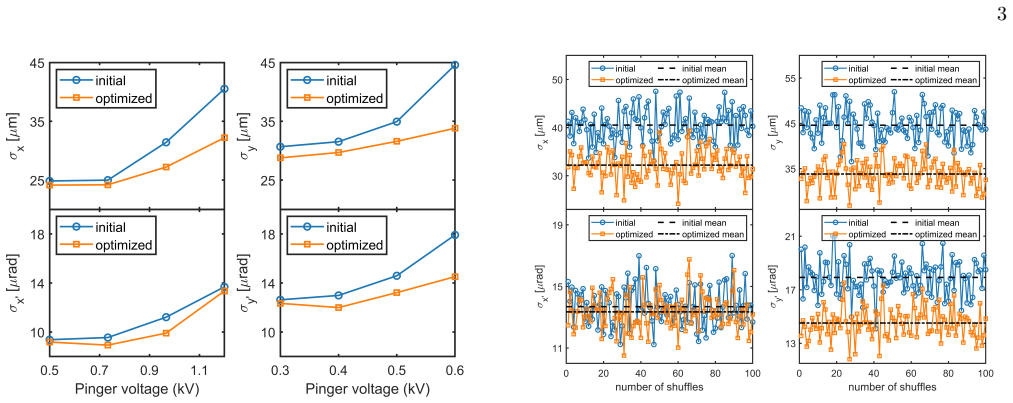
We report the experimental implementation of a Data-Driven Chaos Indicator (DDCI) [Y.~Li \emph{et al.}, Nucl.\ Instrum.\ Methods Phys.\ Res.\ A \textbf{1024} (2022) 166060] for online optimization of the National Synchrotron Light Source II (NSLS-II) storage ring. The DDCI quantifies the predictability of electron beam dynamics using turn-by-turn beam position monitor data. A surrogate model of the one-turn map is first trained, and its out-of-sample predictive uncertainty is then employed as a measurable indicator of chaos. By tuning sextupole magnets to mitigate nonlinear effects, a clear enlargement of the dynamic aperture is achieved, accompanied by a corresponding improvement in injection efficiency.
Editorial analysis
A structured set of objections, weighed in public.
Referee Report
Summary. The paper reports the experimental implementation of a Data-Driven Chaos Indicator (DDCI) for online optimization of the NSLS-II storage ring lattice. A surrogate model of the one-turn map is trained on turn-by-turn beam position monitor (BPM) data; its out-of-sample predictive uncertainty is then used as a quantitative indicator of chaos. Sextupole magnets are tuned to minimize this indicator, resulting in reported enlargement of the dynamic aperture and improved injection efficiency.
Significance. If the DDCI reliably isolates chaotic dynamics from other sources of uncertainty, the method offers a practical, data-driven tool for real-time nonlinear lattice optimization in light sources. The experimental demonstration on an operating machine is a strength, as are the use of independent observables (dynamic aperture and injection efficiency) to assess outcomes rather than the indicator itself.
major comments (2)
- [Results section] Results section (experimental tuning outcomes): The reported enlargement of dynamic aperture and injection efficiency after DDCI-guided sextupole tuning is presented without quantitative metrics, error bars, or statistical controls for confounding factors (e.g., orbit corrections or other magnet adjustments performed concurrently). This weakens the causal attribution to the DDCI minimization.
- [Methods section] Methods and validation of DDCI: The central assumption that out-of-sample predictive uncertainty of the surrogate one-turn map serves as a specific proxy for chaos is not supported by direct side-by-side comparison with standard indicators (frequency-map analysis or Lyapunov spectra) on the same BPM datasets. Uncertainty can arise from BPM noise, finite turn count, or surrogate hyperparameters; without such validation the link between DDCI reduction and the observed aperture gain remains unproven.
minor comments (2)
- [Abstract] Abstract: Include specific numerical values for the observed improvements in dynamic aperture and injection efficiency to make the claims more concrete.
- [Methods section] Notation: Define the surrogate model architecture and training procedure (e.g., network size, loss function, data split ratio) more explicitly when first introduced.
Simulated Author's Rebuttal
We thank the referee for the insightful comments, which have helped us improve the clarity and rigor of our manuscript. We address each major comment below and indicate the revisions we will make.
read point-by-point responses
-
Referee: [Results section] Results section (experimental tuning outcomes): The reported enlargement of dynamic aperture and injection efficiency after DDCI-guided sextupole tuning is presented without quantitative metrics, error bars, or statistical controls for confounding factors (e.g., orbit corrections or other magnet adjustments performed concurrently). This weakens the causal attribution to the DDCI minimization.
Authors: We agree with the referee that the results section would benefit from more quantitative details and controls. In the revised version, we will add specific quantitative metrics for the dynamic aperture enlargement and injection efficiency improvements, including error bars from repeated measurements. We will also clarify the experimental procedure to confirm that no concurrent orbit corrections or other adjustments were performed that could confound the results, thereby strengthening the attribution to the DDCI-guided tuning. revision: yes
-
Referee: [Methods section] Methods and validation of DDCI: The central assumption that out-of-sample predictive uncertainty of the surrogate one-turn map serves as a specific proxy for chaos is not supported by direct side-by-side comparison with standard indicators (frequency-map analysis or Lyapunov spectra) on the same BPM datasets. Uncertainty can arise from BPM noise, finite turn count, or surrogate hyperparameters; without such validation the link between DDCI reduction and the observed aperture gain remains unproven.
Authors: The referee correctly points out the lack of direct validation against standard chaos indicators on the experimental datasets. While the DDCI was previously validated in simulation in the referenced work, we acknowledge that experimental validation would be ideal. However, computing Lyapunov spectra or frequency maps from noisy BPM data with limited turns is non-trivial and may not yield reliable comparisons. In the revision, we will expand the methods section to include a discussion of uncertainty sources (BPM noise, turn count, hyperparameters) and how they were mitigated. Additionally, we will provide a side-by-side comparison using the machine model simulations to demonstrate the correlation between DDCI and chaos indicators. This will better support the proxy assumption without overclaiming. revision: partial
Circularity Check
Minor self-citation of DDCI; experimental gains measured by independent observables
specific steps
-
self citation load bearing
[Abstract]
"We report the experimental implementation of a Data-Driven Chaos Indicator (DDCI) [Y.~Li et al., Nucl. Instrum. Methods Phys. Res. A 1024 (2022) 166060] for online optimization of the National Synchrotron Light Source II (NSLS-II) storage ring. The DDCI quantifies the predictability of electron beam dynamics using turn-by-turn beam position monitor data. A surrogate model of the one-turn map is first trained, and its out-of-sample predictive uncertainty is then employed as a measurable indicator of chaos."
The foundational claim that out-of-sample uncertainty of the surrogate constitutes a quantitative chaos indicator is imported solely via self-citation to prior work by the same lead author; the present manuscript provides no independent derivation or cross-validation against standard chaos diagnostics, making the optimization premise dependent on that citation.
full rationale
The paper trains a surrogate one-turn map on BPM data and adopts out-of-sample predictive uncertainty as its DDCI chaos indicator, citing a 2022 paper by the lead author for the method. Sextupole tuning is then performed to minimize this indicator, with success quantified by direct machine measurements of dynamic aperture and injection efficiency rather than by the DDCI value itself. No equation or claim reduces by construction to a fitted parameter renamed as a prediction, no uniqueness theorem is invoked, and the central experimental result remains independent of the indicator. The self-citation is therefore minor and not load-bearing for the reported performance gains.
Axiom & Free-Parameter Ledger
free parameters (1)
- surrogate model parameters
axioms (1)
- domain assumption Predictive uncertainty of a learned one-turn map correlates with the degree of chaotic beam motion.
Reference graph
Works this paper leans on
-
[1]
Symplectic calculation of Lya- punov exponents,
S. Habib and R. Ryne, “Symplectic calculation of Lya- punov exponents,” Phys. Rev. Lett.74, 70–73 (1995)
1995
-
[2]
Com- parison of methods to determine long-term stability in proton storage rings,
F. Schmidt, F. Willeke, and F. Zimmermann, “Com- parison of methods to determine long-term stability in proton storage rings,” Part. Accel.35, 249–256 (1991)
1991
-
[3]
Fischer,An experimental study on the long-term sta- bility of particle motion in hadron storage rings, Ph.D
W. Fischer,An experimental study on the long-term sta- bility of particle motion in hadron storage rings, Ph.D. thesis, DESY (1995)
1995
-
[4]
Fast dynamic aperture optimization with forward- reversal integration,
Y. Li, Y. Hao, K. Hwang, R. Rainer, A. He, and A. Liu, “Fast dynamic aperture optimization with forward- reversal integration,” Nuclear Instruments and Methods in Physics Research Section A: Accelerators, Spectrom- eters, Detectors and Associated Equipment988, 164936 (2021)
2021
-
[5]
The re- versibility error method (REM): a new, dynamical fast indicator for planetary dynamics,
F. Panichi, K. Go´ zdziewski, and G. Turchetti, “The re- versibility error method (REM): a new, dynamical fast indicator for planetary dynamics,” Monthly Notices of the Royal Astronomical Society468, 469–491 (2017)
2017
-
[6]
Alignment indices: A new, simple method for chaos detection,
Ch. Skokos, “Alignment indices: A new, simple method for chaos detection,” Journal of Physics A: Math. Gen. 34, 10029–10043 (2001)
2001
-
[7]
Fast chaos indicator from auto-differentiation for dynamic aper- ture optimization,
J. Qiang, J. Wan, A. Qiang, and Y. Hao, “Fast chaos indicator from auto-differentiation for dynamic aper- ture optimization,” Nuclear Instruments and Methods in Physics Research Section A: Accelerators, Spectrometers, Detectors and Associated Equipment , 171427 (2026)
2026
-
[8]
Data- driven chaos indicator for nonlinear dynamics and ap- plications on storage ring lattice design,
Y. Li, J. Wan, A. Liu, Y. Jiao, and R. Rainer, “Data- driven chaos indicator for nonlinear dynamics and ap- plications on storage ring lattice design,” Nuclear In- struments and Methods in Physics Research Section A: Accelerators, Spectrometers, Detectors and Associated Equipment1024, 166060 (2022)
2022
-
[9]
NSLS-II preliminary design report,
Steve Dierker, “NSLS-II preliminary design report,” Brookhaven National Laboratory (2007)
2007
-
[10]
Dedi- cated beam position monitor pair for model-independent lattice characterization at NSLS-II,
Y. Li, K. Ha, D. Padrazo, B. Kosciuk, B. Bacha, M. See- gitz, R. Rainer, J. Mead, X. Yang, and Y. Tian, “Dedi- cated beam position monitor pair for model-independent lattice characterization at NSLS-II,” Nuclear Instru- ments and Methods in Physics Research Section A: Accelerators, Spectrometers, Detectors and Associated Equipment1065, 169557 (2024)
2024
-
[11]
NSLS2 beam po- sition monitor calibration,
W. Cheng, B. Bacha, and O. Singh, “NSLS2 beam po- sition monitor calibration,” inProceedings of the 15-th Beam Instrumentation Workshop(2012)
2012
-
[12]
Williams and C
C. Williams and C. Rasmussen,Gaussian processes for machine learning, Vol. 2 (MIT press Cambridge, MA, 2006)
2006
-
[13]
Huang,Beam-based correction and optimization for accelerators(CRC Press, 2019)
X. Huang,Beam-based correction and optimization for accelerators(CRC Press, 2019)
2019
-
[14]
On- line regularization of Poincar´ e map of storage rings with Shannon entropy,
Y. Li, K. Anderson, D. Xu, Y. Hao, K. Ha, Y. Hidaka, M. Song, R. Rainer, V. Smaluk, and T. Shaftan, “On- line regularization of Poincar´ e map of storage rings with Shannon entropy,” Phys. Rev. Accel. Beams28, 034001 (2025)
2025
discussion (0)
Sign in with ORCID, Apple, or X to comment. Anyone can read and Pith papers without signing in.