Recognition: unknown
Synthetic data in cryptocurrencies using generative models
Pith reviewed 2026-05-10 08:48 UTC · model grok-4.3
The pith
Conditional generative adversarial networks generate synthetic cryptocurrency price series that reproduce temporal patterns and preserve market trends.
A machine-rendered reading of the paper's core claim, the machinery that carries it, and where it could break.
Core claim
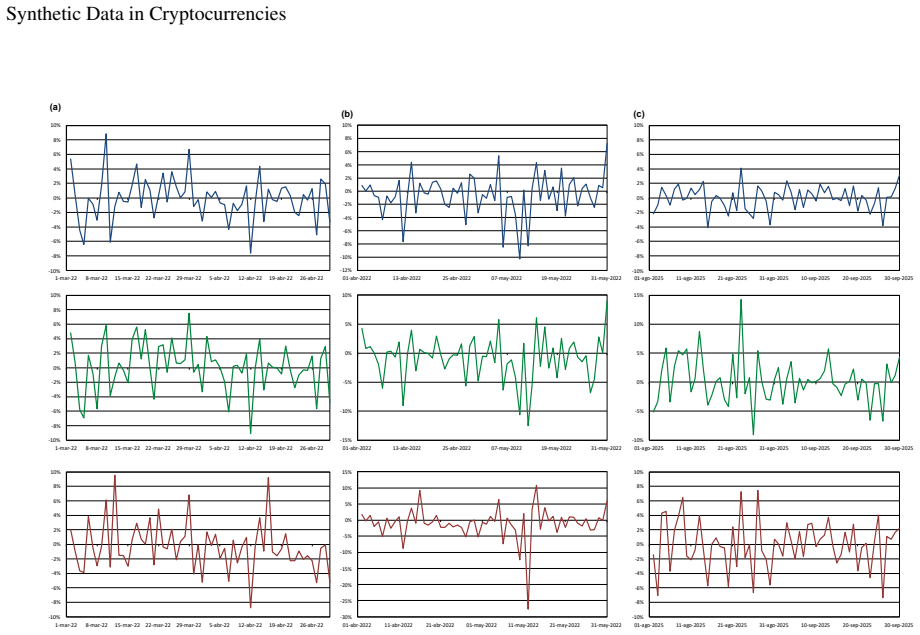
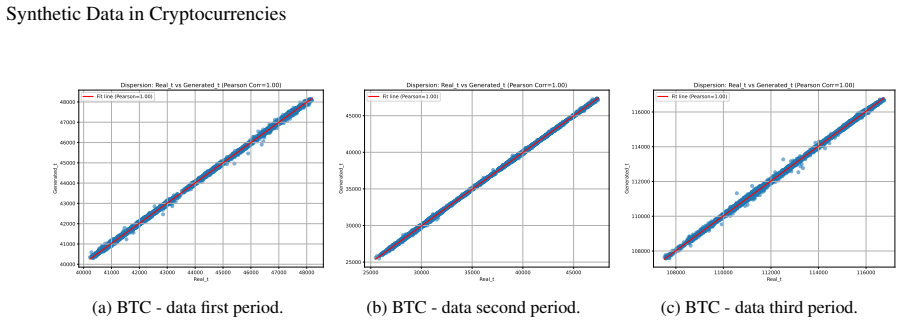
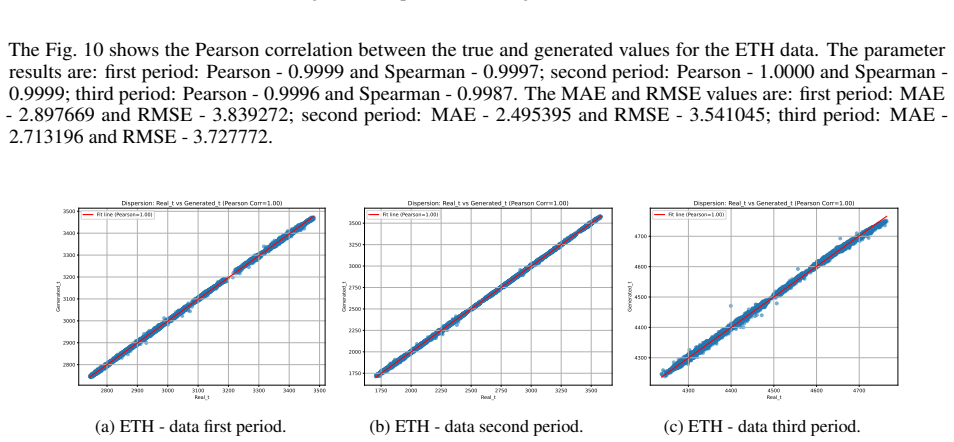
A conditional generative adversarial network that pairs an LSTM-type recurrent generator with an MLP discriminator produces synthetic cryptocurrency price time series that remain statistically consistent with real data, reproducing relevant temporal patterns and preserving market trends and dynamics across multiple crypto-assets.
What carries the argument
Conditional Generative Adversarial Network (CGAN) with an LSTM recurrent generator and MLP discriminator, which adversarially learns to output time series that match the statistical features of observed cryptocurrency prices.
If this is right
- Synthetic series can substitute for real records in market behavior analysis without exposing private financial information.
- The generated data can be applied to anomaly detection tasks in cryptocurrency markets.
- The method operates at lower computational cost than more complex generative models.
- The same architecture works across different crypto-assets while maintaining pattern fidelity.
Where Pith is reading between the lines
- Institutions could share synthetic datasets for collaborative research while keeping actual trading records confidential.
- The technique might be extended to generate plausible extreme-event scenarios that appear infrequently in historical data.
- Predictive models for trading or risk assessment could be trained entirely on synthetic series to reduce regulatory exposure.
Load-bearing premise
The synthetic series produced by the CGAN are statistically consistent with real cryptocurrency data and therefore suitable for applications such as market behavior analysis and anomaly detection.
What would settle it
A quantitative comparison that shows large, statistically significant differences between the synthetic and real series on metrics such as autocorrelation structure, volatility clustering, or trend preservation would falsify the central claim.
Figures





read the original abstract
Data plays a fundamental role in consolidating markets, services, and products in the digital financial ecosystem. However, the use of real data, especially in the financial context, can lead to privacy risks and access restrictions, affecting institutions, research, and modeling processes. Although not all financial datasets present such limitations, this work proposes the use of deep learning techniques for generating synthetic data applied to cryptocurrency price time series. The approach is based on Conditional Generative Adversarial Networks (CGANs), combining an LSTM-type recurrent generator and an MLP discriminator to produce statistically consistent synthetic data. The experiments consider different crypto-assets and demonstrate that the model is capable of reproducing relevant temporal patterns, preserving market trends and dynamics. The generation of synthetic series through GANs is an efficient alternative for simulating financial data, showing potential for applications such as market behavior analysis and anomaly detection, with lower computational cost compared to more complex generative approaches.
Editorial analysis
A structured set of objections, weighed in public.
Referee Report
Summary. The manuscript proposes using Conditional Generative Adversarial Networks (CGANs) with an LSTM generator and MLP discriminator to generate synthetic cryptocurrency price time series. It claims this addresses privacy and access restrictions on real financial data, with experiments on different crypto-assets demonstrating reproduction of relevant temporal patterns and preservation of market trends and dynamics. The approach is presented as an efficient alternative to more complex generative methods for applications such as market behavior analysis and anomaly detection.
Significance. If the claims of statistical consistency and pattern preservation hold under quantitative scrutiny, the work could provide a practical contribution to synthetic data generation for sensitive financial time series. It would enable privacy-preserving research and modeling in cryptocurrency markets, where real data access is often limited, and its reported efficiency advantage could support broader adoption in analysis and detection tasks.
major comments (2)
- [Abstract] Abstract: the claim that the CGAN produces 'statistically consistent synthetic data' and is 'capable of reproducing relevant temporal patterns, preserving market trends and dynamics' is unsupported, as no quantitative results, statistical tests, error metrics, distribution comparisons, or evaluation details are provided.
- [Experiments] Experiments description: the high-level statement that experiments on different crypto-assets demonstrate pattern reproduction supplies no metrics for temporal consistency (e.g., autocorrelation functions, volatility clustering, moments of returns) or similarity measures (e.g., KS test, Wasserstein distance) against real data, which is load-bearing for the central empirical claim.
minor comments (1)
- The claim of 'lower computational cost compared to more complex generative approaches' would be strengthened by including at least a brief runtime or resource comparison.
Simulated Author's Rebuttal
We thank the referee for the constructive comments highlighting the need for stronger quantitative support. We agree that the current version lacks explicit metrics and will revise the manuscript to include them, thereby strengthening the empirical claims.
read point-by-point responses
-
Referee: [Abstract] Abstract: the claim that the CGAN produces 'statistically consistent synthetic data' and is 'capable of reproducing relevant temporal patterns, preserving market trends and dynamics' is unsupported, as no quantitative results, statistical tests, error metrics, distribution comparisons, or evaluation details are provided.
Authors: We acknowledge that the abstract's claims currently lack direct quantitative backing in the manuscript. In the revised version, we will add specific statistical tests and metrics (Kolmogorov-Smirnov tests, autocorrelation functions, volatility clustering, moments of returns, and Wasserstein distances) to the experiments and update the abstract to reference these results, ensuring the claims are properly supported. revision: yes
-
Referee: [Experiments] Experiments description: the high-level statement that experiments on different crypto-assets demonstrate pattern reproduction supplies no metrics for temporal consistency (e.g., autocorrelation functions, volatility clustering, moments of returns) or similarity measures (e.g., KS test, Wasserstein distance) against real data, which is load-bearing for the central empirical claim.
Authors: We agree that the experiments section requires quantitative metrics to substantiate the central claims. We will expand this section with the suggested evaluations, including autocorrelation functions, volatility clustering, return moments for temporal consistency, and KS tests plus Wasserstein distances for distributional similarity, applied across the crypto-assets studied. revision: yes
Circularity Check
No circularity: purely empirical work with no derivations or self-referential reductions
full rationale
The manuscript describes an application of CGANs (LSTM generator + MLP discriminator) to cryptocurrency price series and asserts that experiments on multiple assets show reproduction of temporal patterns and preservation of trends/dynamics. No equations, derivations, fitted parameters renamed as predictions, or load-bearing self-citations appear in the provided text. The central claim is an empirical assertion rather than a mathematical reduction; it does not reduce to its own inputs by construction. Absence of quantitative metrics is a validation gap but does not create circularity under the defined patterns.
Axiom & Free-Parameter Ledger
free parameters (1)
- GAN training hyperparameters
axioms (1)
- domain assumption LSTM generator combined with MLP discriminator suffices to model temporal patterns in cryptocurrency prices
Reference graph
Works this paper leans on
-
[1]
Raghunathan, J
T. Raghunathan, J. Reiter, and D. Rubin. Multiple imputation for statistical disclosure limitation.AI, 19, 2003
2003
-
[2]
Unsupervised Representation Learning with Deep Convolutional Generative Adversarial Networks
A. Radford, L. Metz, and S. Chintala. Journal of official statistics.arXiv:1511.06434, 2015
work page internal anchor Pith review arXiv 2015
-
[3]
Goodfellow, J
I. Goodfellow, J. Pouget-Abadie, M. Mirza, B. Xu, D. Warde-Farley, S. Ozair, A. Courville, and Y . Bengio. Generative adversarial nets.Advances In Neural Information Processing Systems, 3:2672–2680, 2014
2014
-
[4]
Feng Han, Xiaojuan Ma, and Jiheng Zhang. Simulating multi-asset classes prices using wasserstein generative adversarial network: A study of stocks, futures and cryptocurrency.Journal of Risk and Financial Management, 15(1), 2022
2022
-
[5]
A. A. Almamoori and W. S. Bhaya. Hybrid deep learning approach utilizing rnn and lstm for the detection of ddos attacks within the bitcoin ecosystem.Ingénierie des Systèmes d’Information, 28(4):931–937, 2023
2023
-
[6]
Sanjalawe and Salam R
Yousef K. Sanjalawe and Salam R. Al-E’mari. Abnormal transactions detection in the ethereum network using semi-supervised generative adversarial networks.IEEE Access, 11:98516–98531, 2023
2023
-
[7]
J. Y . Zhu, P. Krähenbühl, E. Shechtman, and A. A. Efros. Generative visual manipulation on the natural image manifold.In European Conference on Computer Vision, pages 597–613, 2016
2016
-
[8]
N. Killoran, L. J. Lee, D. A. Delong, and B. J. Frey Duvenaud. Generating and designing dna with deep generative models.arXiv:1712.06148, 2017
-
[9]
Kadurin, S
A. Kadurin, S. Nikolenko, K. Khrabrov, A. Aliper, and A. Zhavoronkov. Generating and designing dna with deep generative models.Molecular pharmaceutics, 14(3098), 2017
2017
-
[10]
Improved techniques for training gans, 2016
Tim Salimans, Ian Goodfellow, Wojciech Zaremba, Vicki Cheung, Alec Radford, and Xi Chen. Improved techniques for training gans, 2016
2016
-
[11]
NetGAN: Generating graphs via random walks
Aleksandar Bojchevski, Oleksandr Shchur, Daniel Zügner, and Stephan Günnemann. NetGAN: Generating graphs via random walks. In Jennifer Dy and Andreas Krause, editors,Proceedings of the 35th International Conference on Machine Learning, volume 80 ofProceedings of Machine Learning Research, pages 610–619. PMLR, 10–15 Jul 2018
2018
-
[12]
A survey of recent advances in quantum generative adversarial networks.Electronics, 12(4):856, 2023
Tuan A Ngo, Tuyen Nguyen, and Truong Cong Thang. A survey of recent advances in quantum generative adversarial networks.Electronics, 12(4):856, 2023
2023
-
[13]
A review of generative adversarial networks (gans) and its applications in a wide variety of disciplines: From medical to remote sensing.IEEE Access, 12:18330–18357, 2024
Ankan Dash, Junyi Ye, and Guiling Wang. A review of generative adversarial networks (gans) and its applications in a wide variety of disciplines: From medical to remote sensing.IEEE Access, 12:18330–18357, 2024
2024
-
[14]
Modeling financial time-series with generative adversarial networks.Physica A: Statistical Mechanics and its Applications, 527:121261, 2019
Shuntaro Takahashi, Yu Chen, and Kumiko Tanaka-Ishii. Modeling financial time-series with generative adversarial networks.Physica A: Statistical Mechanics and its Applications, 527:121261, 2019
2019
-
[15]
Data augmentation of high frequency financial data using generative adversarial network
Yusuke Naritomi and Takanori Adachi. Data augmentation of high frequency financial data using generative adversarial network. page 641 – 648, 2020
2020
-
[16]
Desensitized financial data generation based on generative adversarial network and differential privacy.Big Data Mining and Analytics, 8(1):103 – 117, 2025
Fan Zhang, Luyao Wang, and Xinhong Zhang. Desensitized financial data generation based on generative adversarial network and differential privacy.Big Data Mining and Analytics, 8(1):103 – 117, 2025
2025
-
[17]
Stock market prediction on high-frequency data using generative adversarial nets.Mathematical Problems in Engineering, 2018(1):4907423, 2018
Xingyu Zhou, Zhisong Pan, Guyu Hu, Siqi Tang, and Cheng Zhao. Stock market prediction on high-frequency data using generative adversarial nets.Mathematical Problems in Engineering, 2018(1):4907423, 2018
2018
-
[18]
Stock market prediction based on generative adversarial network.Procedia computer science, 147:400–406, 2019
Kang Zhang, Guoqiang Zhong, Junyu Dong, Shengke Wang, and Yong Wang. Stock market prediction based on generative adversarial network.Procedia computer science, 147:400–406, 2019
2019
-
[19]
Generating realistic stock market order streams
Junyi Li, Xintong Wang, Yaoyang Lin, Arunesh Sinha, and Michael Wellman. Generating realistic stock market order streams. InProceedings of the AAAI Conference on Artificial Intelligence, volume 34, pages 727–734, 2020. 22 Synthetic Data in Cryptocurrencies
2020
-
[20]
Fin-gan: forecasting and classifying financial time series via generative adversarial networks.Quantitative Finance, 24(2):175–199, 2024
Milena Vuleti´c, Felix Prenzel, and Mihai Cucuringu. Fin-gan: forecasting and classifying financial time series via generative adversarial networks.Quantitative Finance, 24(2):175–199, 2024
2024
-
[21]
A cwgan-gp-based multi-task learning model for consumer credit scoring.Expert Systems with Applications, 206:117650, 2022
Yanzhe Kang, Liao Chen, Ning Jia, Wei Wei, Jiang Deng, and Haizhang Qian. A cwgan-gp-based multi-task learning model for consumer credit scoring.Expert Systems with Applications, 206:117650, 2022
2022
-
[22]
Stock price manipulation detection using generative adversarial networks
Teema Leangarun, Poj Tangamchit, and Suttipong Thajchayapong. Stock price manipulation detection using generative adversarial networks. In2018 IEEE symposium series on computational intelligence (SSCI), pages 2104–2111. IEEE, 2018
2018
-
[23]
Using generative adversarial networks for improving classification effectiveness in credit card fraud detection.Information Sciences, 479:448–455, 2019
Ugo Fiore, Alfredo De Santis, Francesca Perla, Paolo Zanetti, and Francesco Palmieri. Using generative adversarial networks for improving classification effectiveness in credit card fraud detection.Information Sciences, 479:448–455, 2019
2019
-
[24]
Fraud detection in financial statements using data mining and gan models.Expert Systems with Applications, 227:120144, 2023
Seyyede Zahra Aftabi, Ali Ahmadi, and Saeed Farzi. Fraud detection in financial statements using data mining and gan models.Expert Systems with Applications, 227:120144, 2023
2023
-
[25]
Granados, O
O. Granados, O. García-Bedoya, and E. González. Gan+abm to simulate suspicious money laundering trajectories. IEEE International Conference On Data Mining Workshops (ICDMW), pages 262–269, 2024
2024
-
[26]
Y . Yang, F. Nan, P. Yang, Q. Meng, Y . Xie, D. Zhang, and K. Muhammad. Gan-based semi-supervised learning approach for clinical decision support in health-iot platform.IEEE Access, 7(6):8048–8057, 2019
2019
-
[27]
Beaulieu-Jones, Z
B. Beaulieu-Jones, Z. Wu, C. Williams, R. Lee, S. Bhavnani, J. Byrd, and C. Greene. Privacy-preserving generative deep neural networks support clinical data sharing.Circulation: Cardiovascular Quality And Outcomes, 7(12), 2019
2019
-
[28]
Sandfort, K
V . Sandfort, K. Yan, P. Pickhardt, and R. Summers. Data augmentation using generative adversarial networks (cyclegan) to improve generalizability in ct segmentation tasks.Scientific Reports, (11), 2019
2019
-
[29]
J. Yoon, J. Jordon, and M. Schaar. Gan-based semi-supervised learning approach for clinical decision support in health-iot platform.International Conference on Learning Representations, 2019
2019
-
[30]
SRV Editora LTDA, 2021
Rogério Ferreira.Deep learning. SRV Editora LTDA, 2021. E-book
2021
-
[31]
LTC, Rio de Janeiro, 3 edition, 2021
Stuart Russell and Peter Norvig.Inteligência Artificial. LTC, Rio de Janeiro, 3 edition, 2021
2021
-
[32]
Alta Books, Rio de Janeiro, 2021
Aurélien Géron.Mãos à Obra: Aprendizado de Máquina com Scikit-Learn, Keras & TensorFlow — Conceitos, Ferramentas e Técnicas para a Construção de Sistemas Inteligentes. Alta Books, Rio de Janeiro, 2021. E-book
2021
-
[33]
Langr and V
J. Langr and V . Bok.GANs in Action: Deep Learning with Generative Adversarial Networks. Manning Publications, 2019
2019
-
[34]
Goodfellow, Y
I. Goodfellow, Y . Bengio, and A. Courville.Deep Learning. MIT Press, 2016
2016
-
[35]
Recent progress on generative adversarial networks (gans): A survey.IEEE Access, 7:36322–36333, 2019
Zhaoqing Pan, Weijie Yu, Xiaokai Yi, Asifullah Khan, Feng Yuan, and Yuhui Zheng. Recent progress on generative adversarial networks (gans): A survey.IEEE Access, 7:36322–36333, 2019
2019
-
[36]
Goodfellow, Jean Pouget-Abadie, Mehdi Mirza, Bing Xu, David Warde-Farley, Sherjil Ozair, Aaron Courville, and Yoshua Bengio
Ian J. Goodfellow, Jean Pouget-Abadie, Mehdi Mirza, Bing Xu, David Warde-Farley, Sherjil Ozair, Aaron Courville, and Yoshua Bengio. Generative adversarial nets. InProceedings of the 28th International Conference on Neural Information Processing Systems - Volume 2, NIPS’14, page 2672–2680, Cambridge, MA, USA, 2014. MIT Press
2014
-
[37]
Lipton, Mu Li, and Alexander J
Aston Zhang, Zachary C. Lipton, Mu Li, and Alexander J. Smola.Dive into Deep Learning. Cambridge University Press, 2023
2023
-
[38]
Integrated attentive bi-lstm conditional gan for power system oscillation localization.Electric Power Systems Research, 242, May 2025
Lokesh Saravana, Quang-Ha Ngo, Jianhua Zhang, Tuyen Vu, and Thanh Long Vu b. Integrated attentive bi-lstm conditional gan for power system oscillation localization.Electric Power Systems Research, 242, May 2025
2025
-
[39]
Kingma and Jimmy Ba
Diederik P. Kingma and Jimmy Ba. Adam: A method for stochastic optimization.International Conference on Learning Representations, 2015
2015
-
[40]
Pytorch: An imperative style, high-performance deep learning library.Advances in Neural Information Processing Systems, 32, 2019
Adam Paszke, Sam Gross, Francisco Massa, Adam Lerer, James Bradbury, Gregory Chanan, Trevor Killeen, Zeming Lin, Natalia Gimelshein, Luca Antiga, Alban Desmaison, Andreas Köpf, Edward Yang, Zachary DeVito, Martin Raison, Alykhan Tejani, Sasank Chilamkurthy, Benoit Steiner, Lu Fang, Junjie Bai, and Soumith Chintala. Pytorch: An imperative style, high-perfo...
2019
-
[41]
The inefficiency of bitcoin.Economics Letters, 148:80–82, 2016
Andrew Urquhart. The inefficiency of bitcoin.Economics Letters, 148:80–82, 2016
2016
-
[42]
V olatility estimation for bitcoin: A comparison of garch models.Economics Letters, 158:3–6, 2017
Paraskevi Katsiampa. V olatility estimation for bitcoin: A comparison of garch models.Economics Letters, 158:3–6, 2017. 23 Synthetic Data in Cryptocurrencies
2017
-
[43]
Cryptocurrency forecasting with deep learning chaotic neural networks.Chaos, Solitons & Fractals, 118:35–40, 2019
Salim Lahmiri and Stelios Bekiros. Cryptocurrency forecasting with deep learning chaotic neural networks.Chaos, Solitons & Fractals, 118:35–40, 2019
2019
-
[44]
Quant gans: Deep generation of financial time series.Quantitative Finance, 20(9):1419–1440, 2020
Magnus Wiese, Robert Knobloch, Ralf Korn, and Peter Kretschmer. Quant gans: Deep generation of financial time series.Quantitative Finance, 20(9):1419–1440, 2020
2020
-
[45]
Time-series generative adversarial networks.Advances in Neural Information Processing Systems, 32:5508–5518, 2019
Jinsung Yoon, Daniel Jarrett, and Mihaela van der Schaar. Time-series generative adversarial networks.Advances in Neural Information Processing Systems, 32:5508–5518, 2019
2019
-
[46]
Forecasting cryptocurrency prices using deep learning.Finance Research Letters, 41:101798, 2021
Yuchen Zhang et al. Forecasting cryptocurrency prices using deep learning.Finance Research Letters, 41:101798, 2021
2021
-
[47]
Unsupervised representation learning with deep convolutional generative adversarial networks.International Conference on Learning Representations, 2016
Alec Radford, Luke Metz, and Soumith Chintala. Unsupervised representation learning with deep convolutional generative adversarial networks.International Conference on Learning Representations, 2016
2016
-
[48]
Cristóbal Esteban, Stephanie L. Hyland, and Gunnar Rätsch. Real-valued (medical) time series generation with recurrent conditional gans.arXiv preprint arXiv:1706.02633, 2017. 24
discussion (0)
Sign in with ORCID, Apple, or X to comment. Anyone can read and Pith papers without signing in.