Recognition: unknown
A two-color dual-oscillator infrared free-electron laser
Pith reviewed 2026-05-10 06:50 UTC · model grok-4.3
The pith
A 500 MHz kicker cavity splits the electron beam to enable simultaneous, independently tunable mid- and far-infrared free-electron lasers.
A machine-rendered reading of the paper's core claim, the machinery that carries it, and where it could break.
Core claim
The upgraded system achieves two-color dual-oscillator operation in which the mid-infrared and far-infrared FELs lase simultaneously from a single electron accelerator. A 500 MHz kicker cavity deflects up to 50 MeV bunches alternately by ±2 degrees, splitting the 1 GHz bunch train into two 500 MHz trains without preventing lasing. Each FEL can then be tuned independently over a factor-of-four wavelength range by undulator-gap variation, and the same two-color mode works at lower repetition rates such as 55.6 MHz.
What carries the argument
The 500 MHz kicker cavity that deflects successive electron bunches alternately left and right to feed separate MIR and FIR oscillator beamlines.
If this is right
- Both FELs can be tuned independently over wavelength ranges up to a factor of four by undulator-gap changes.
- Synchronized two-color pulses are available at the full 500 MHz rate or at reduced rates such as 55.6 MHz.
- The combined MIR-FIR coverage spans 4.5 μm to 175 μm in simultaneous operation.
- New user experiments become possible, including MIR-FIR pump-probe measurements.
Where Pith is reading between the lines
- Facilities with a single high-repetition-rate accelerator could adopt similar kickers to add multi-color capability without building extra linacs.
- Independent tuning of the two colors may allow selection of specific vibrational or rotational transition pairs that are hard to reach with a single FEL.
- The synchronized pulses open time-resolved studies of energy transfer between mid- and far-infrared molecular modes.
Load-bearing premise
The kicker cavity can deflect the electron bunches without degrading beam quality enough to stop lasing in either FEL.
What would settle it
After the kicker is turned on to split the bunch train, either the MIR or FIR FEL fails to reach its expected output power or tuning range while the other continues to lase.
Figures


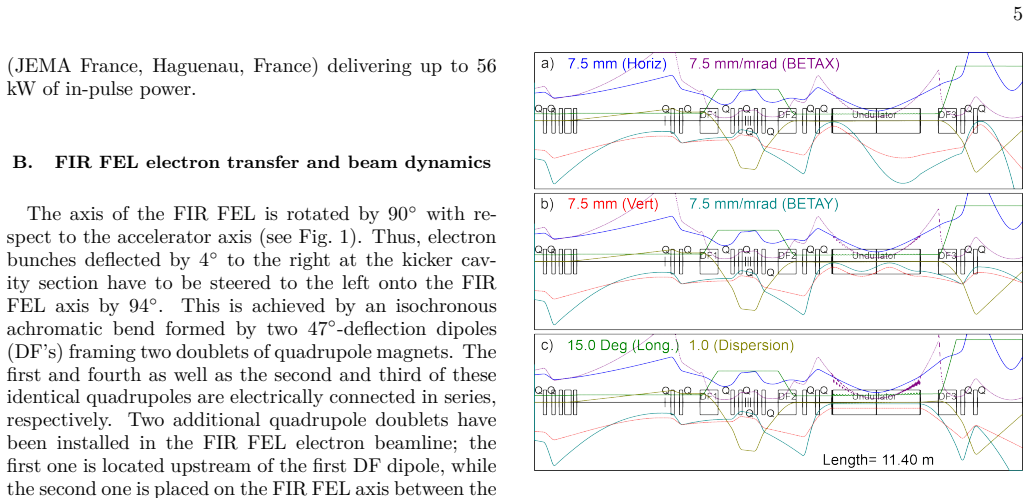


read the original abstract
We report on the design and performance of a two-color dual-oscillator infrared free-electron laser (FEL). The mid-infrared (MIR) FEL at the Fritz Haber Institute (FHI FEL) has been upgraded to include a second oscillator FEL beamline that permits lasing in the far-infrared (FIR) regime from 4.5 {\mu}m to 175 {\mu}m. In addition, a 500 MHz kicker cavity has been installed downstream of the electron accelerator. It allows to deflect electron bunches of up to 50 MeV energy alternately left and right by an angle of {\pm}2{\deg}. It can, thus, split the high-repetition-rate (1 GHz) electron bunch train from the accelerator into two bunch trains of 500 MHz repetition rate each; one is steered to the MIR FEL and the other one to the new FIR FEL. In this two-color mode of simultaneous, synchronized operation the wavelengths in both FELs can be tuned independently over wide ranges of up to a factor of four each by undulator-gap variation. In addition, two-color operation is also available at reduced repetition rates (e.g. 55.6 MHz of both MIR and FIR pulses), as needed for some applications. This unique two-color mode opens up a wealth of novel user applications such as, MIR-FIR pump-probe experiments.
Editorial analysis
A structured set of objections, weighed in public.
Referee Report
Summary. The manuscript reports the design and performance of an upgraded two-color dual-oscillator infrared FEL at the Fritz Haber Institute. A new FIR oscillator beamline (4.5–175 μm) has been added to the existing MIR FEL, and a 500 MHz kicker cavity installed downstream of the accelerator deflects up to 50 MeV bunches by ±2° to split the 1 GHz electron train into two independent 500 MHz trains, one for each FEL. Both oscillators can be tuned independently over wide ranges (up to a factor of four) via undulator-gap adjustment, with additional operation at reduced repetition rates (e.g., 55.6 MHz) for applications such as MIR-FIR pump-probe experiments.
Significance. If the reported performance is substantiated, the instrument provides a distinctive capability for synchronized, independently tunable two-color infrared experiments that are not readily available elsewhere. This opens new avenues for time-resolved studies in molecular and materials science, particularly where simultaneous access to MIR and FIR wavelengths is required.
major comments (1)
- [Kicker cavity and two-color operation description] The central operational claim—that the 500 MHz kicker splits the bunch train while preserving beam quality (emittance, energy spread, and bunch length) sufficiently for both the MIR and FIR FELs to lase at their target wavelengths—requires quantitative verification. The manuscript states that the cavity “can” deflect bunches of up to 50 MeV without preventing lasing, but does not provide post-kicker beam diagnostics (e.g., measured emittance or energy-spread values) or FEL output metrics (power, gain curves) for the deflected trains. Without these data the two-color mode remains unproven.
minor comments (2)
- [Abstract] The abstract would be strengthened by inclusion of at least one or two concrete performance numbers (e.g., achieved output power, pulse energy, or measured tuning ranges under two-color conditions) rather than qualitative statements only.
- Notation for wavelengths and repetition rates is clear, but a short table summarizing the key parameters of the two FEL lines (undulator periods, gap ranges, expected gain lengths) would improve readability.
Simulated Author's Rebuttal
We thank the referee for the positive evaluation of the instrument's significance and for the constructive major comment. We address it point by point below.
read point-by-point responses
-
Referee: The central operational claim—that the 500 MHz kicker splits the bunch train while preserving beam quality (emittance, energy spread, and bunch length) sufficiently for both the MIR and FIR FELs to lase at their target wavelengths—requires quantitative verification. The manuscript states that the cavity “can” deflect bunches of up to 50 MeV without preventing lasing, but does not provide post-kicker beam diagnostics (e.g., measured emittance or energy-spread values) or FEL output metrics (power, gain curves) for the deflected trains. Without these data the two-color mode remains unproven.
Authors: We agree that explicit quantitative data on post-kicker beam quality and FEL performance metrics would strengthen the claim of reliable two-color operation. The manuscript reports successful independent lasing in both the MIR and FIR oscillators under two-color conditions, which implicitly indicates that beam quality after the ±2° deflection is adequate; however, we acknowledge that tabulated diagnostics were not provided. In the revised manuscript we will add measured values of normalized emittance, energy spread, and bunch length immediately downstream of the kicker, together with output power and gain curves recorded while both FELs are lasing simultaneously on the deflected 500 MHz trains. These additions will directly verify that the small deflection angle preserves the beam parameters required for the reported tuning ranges. revision: yes
Circularity Check
Instrument report with no derivation chain or predictions
full rationale
The paper is a descriptive instrument report on the FHI FEL upgrade, including installation of a 500 MHz kicker cavity and a second FIR oscillator beamline. It states engineering facts such as deflection angle, repetition rate splitting, and independent gap tuning without any claimed derivations, first-principles predictions, equations, or fitted parameters that could reduce to inputs by construction. No self-citation chains or ansatzes are invoked as load-bearing steps; all performance claims are presented as direct observations against external engineering benchmarks.
Axiom & Free-Parameter Ledger
Reference graph
Works this paper leans on
-
[1]
D. A. G. Deacon, L. R. Elias, J. M. J. Madey, G. J. Ramian, H. A. Schwettman, and T. I. Smith, Phys. Rev. Lett.38, 892 (1977)
1977
-
[2]
H. A. Schwettman and T. I. Smith, J. Opt. Soc. Am. B 6, 973 (1989)
1989
-
[3]
D. D. Dlott and M. D. Fayer, J. Opt. Soc. Am. B6, 977 (1989)
1989
-
[4]
Schöllkopf, S
W. Schöllkopf, S. Gewinner, H. Junkes, A. Paarmann, G.vonHelden, H.Bluem,andA.M.M.Todd,inProceed- ings of SPIE, Vol. 9512 (SPIE, Prague, Czech Republic,
-
[5]
advances in X-ray Free-Electron Lasers Instrumen- tation III
-
[6]
Schöllkopf, S
W. Schöllkopf, S. Gewinner, A. M. M. Todd, W. B. Col- son, M. De Pas, D. Dowell, S. C. Gottschalk, H. Junkes, J. W. Rathke, T. J. Schultheiss, L. M. Young, G. v. Helden, and G. Meijer, inProceedings of the 39th In- ternational Free-Electron Laser Conference, edited by W. Decking, H. Sinn, G. Geloni, S. Schreiber, M. Marx, and V. R. W. Schaa (JACoW, Hambur...
2019
-
[7]
A. M. M. Todd, W. B. Colson, D. Dowell, S. C. Gottschalk, J.W.Rathke, T.J.Schultheiss, L.M.Young, W. Schöllkopf, M. De Pas, S. Gewinner, H. Junkes, G. von Helden, and G. Meijer, inProc. 40th Interna- tional Free Electron Laser Conference, International Free Electron Laser Conference No. 40 (JACoW Publishing, Geneva, Switzerland, 2022) pp. 64–67
2022
-
[8]
A. M. M. Todd, W. Schöllkopf, S. Gewinner, M. De Pas, H.Junkes, G.vonHelden, A.Paarmann, G.Meijer, J.W. Rathke, L. M. Young, S. C. Gottschalk, T. J. Schultheiss, W. B. Colson, and D. H. Dowell, inProc. IPAC’24, Inter- national Particle Accelerator Conference No. 15 (JACoW Publishing, Geneva, Switzerland, 2024) pp. 315–318
2024
-
[9]
Schöllkopf, S
W. Schöllkopf, S. Gewinner, M. De Pas, H. Junkes, G. von Helden, G. Meijer, W. B. Colson, D. Dowell, S. C. Gottschalk, J. W. Rathke, T. J. Schultheiss, A. M. M. Todd, and L. M. Young, inProc. 41th International Free Electron Laser Conference, International Free Electron Laser Conference No. 41 (2024) 41st International Free Electron Laser Conference
2024
-
[10]
Gottschalk, T
S. Gottschalk, T. DeHart, R. Kelly, M. Offenbacker, A. Valla, H. Bluem, D. Dowell, J. Rathke, A. M. Todd, S. Gewinner, H. Junkes, G. Meijer, W. Schöllkopf, W. Zhang, and U. Lehnert, inProceedings of FEL 2012, Nara, Japan(Nara, Japan, 2013) pp. 575–578, 34th In- ternational Free Electron Laser Conference
2012
-
[11]
Kiessling, W
R. Kiessling, W. B. Colson, S. Gewinner, W. Schöllkopf, M. Wolf, and A. Paarmann, Phys. Rev. Accel. Beams21, 080702 (2018)
2018
-
[12]
K. R. Crandall,TRACE 3-D documentation, Tech. Rep. (Los Alamos National Lab., NM (USA), 1987)
1987
-
[13]
W. B. Colson, J. Blau, R. L. Armstead, P. P. Crooker, R. Vigil, T. Voughs, and B. W. Williams, Phys. Rev. Accel. Beams9, 030703 (2006)
2006
-
[14]
Prazeres, F
R. Prazeres, F. Glotin, and J.-M. Ortega, Phys. Rev. Accel. Beams12, 010701 (2009)
2009
-
[15]
Ortega, J.-P
J.-M. Ortega, J.-P. Berthet, F. Glotin, and R. Prazeres, Phys. Rev. Accel. Beams17, 100701 (2014)
2014
-
[16]
Arslanov, R
D. Arslanov, R. T. Jongma, A. F. G. van der Meer, M. A. Vermeulen, M.Fujimoto, V.O.Yatsyna,andV.Zhauner- chyk, inProceedings of the 36th Free Elecron Laser Con- ference,editedbyJ.Chrin, S.Reiche,andV.R.W.Schaa (Basel, Switzerland, 2014) 36th International Free Elec- tron Laser Conference
2014
-
[17]
Prazeres, Phys
R. Prazeres, Phys. Rev. Accel. Beams19, 060703 (2016)
2016
-
[18]
Y. Zhu, Y. Xu, H. Li, Z. Zhao, and W. Li, Nucl. Instrum. Methods Phys. Res. A1031, 166499 (2022)
2022
-
[19]
M. Xia, Y. Xu, Z. Zhao, and H. Li, Scientific Reports13, 22653 (2023)
2023
-
[20]
J. Blau, K. Cohn, and W. Colson, in37th International Free Electron Laser Conference(2015) p. WEP008
2015
-
[21]
Paarmann, I
A. Paarmann, I. Razdolski, A. Melnikov, S. Gewinner, W. Schöllkopf, and M. Wolf, Applied Physics Letters 107, 081101 (2015)
2015
-
[22]
W. B. Colson,Free Electron Laser Handbook, edited by W. B. Colson, C. Pellegrini, and A. Renieri, Laser Hand- book, Vol. 6 (North-Holland, Amsterdam, 1990) Chap. 5, pp. 115–194
1990
-
[23]
D. A. Jaroszynski, R. Prazeres, F. Glotin, and J.-M. Or- tega, Physical Review Letters72, 2387 (1994)
1994
-
[24]
D. A. Jaroszynski, R. Prazeres, F. Glotin, and J.-M. Or- tega, Nucl. Instrum. Methods Phys. Res. A358, 224 (1995), 16th International Free Electron Laser Confer- ence, STANFORD, CA, AUG 22-26, 1994
1995
-
[25]
Prazeres, F
R. Prazeres, F. Glotin, C. Insa, D. A. Jaroszynski, and J.-M. Ortega, European Physical Journal D3, 87 (1998). 13 TABLE II. Design and performance parameters of the MIR and FIR hybrid-magnet wedged-pole undulators of the FHI FEL. First and second integral, phase error and roll-off were measured with a Hall probe scanner prior to installation in the vault....
1998
discussion (0)
Sign in with ORCID, Apple, or X to comment. Anyone can read and Pith papers without signing in.