Recognition: unknown
Apple Peel Unfolding of Archimedean and Catalan Solids
Pith reviewed 2026-05-10 06:45 UTC · model grok-4.3
The pith
Apple peel unfolding classifies Archimedean and Catalan solids into perfect, possible, or impossible categories for complete non-overlapping nets.
A machine-rendered reading of the paper's core claim, the machinery that carries it, and where it could break.
Core claim
We define apple peel unfolding strictly and implement a program that derives the sequential selection of the polyhedral faces for a target polyhedron in accordance with the definition. Consequently, the program determines whether the polyhedron is peelable (can be peeled completely). We classify Archimedean solids and their duals (Catalan solids) as perfect (always peelable), possible (peelable for restricted cases), or impossible. The results show that three Archimedean and six Catalan solids are perfect, and three Archimedean and three Catalan ones are possible.
What carries the argument
Apple peel unfolding: strict sequential selection of adjacent faces that produces a non-overlapping net when the sequence covers every face, enforced by an exhaustive program that checks peelability.
If this is right
- Perfect solids generate valid apple peel nets from any starting face.
- Possible solids require specific starting faces or sequences to succeed.
- Impossible solids admit no complete apple peel unfolding under the definition.
- The classification separates the solids into three distinct groups with different unfolding reliability.
Where Pith is reading between the lines
- The same sequential check could be run on Platonic solids to test whether their higher symmetry makes them all perfect.
- The method supplies one concrete way to generate spanning trees of the face-adjacency graph that remain geometrically non-crossing.
- Programs of this type might later be extended to count how many distinct peel sequences exist for each solid rather than only existence.
Load-bearing premise
The program's implementation faithfully follows the strict definition of apple peel unfolding without errors in adjacency checks or overlap detection.
What would settle it
An explicit overlapping sequence of adjacent faces starting from one of the solids labeled perfect that still covers all faces.
Figures




read the original abstract
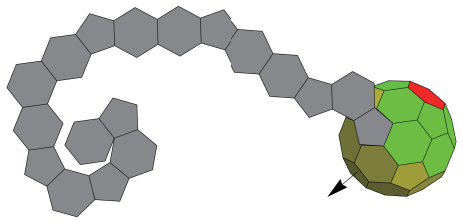
We consider a new treatment for making polyhedron nets referred to as ``apple peel unfolding'': drawing the nets as if we were peeling off appleskins. We define apple peel unfolding strictly and implement a program that derives the sequential selection of the polyhedral faces for a target polyhedron in accordance with the definition. Consequently, the program determines whether the polyhedron is peelable (can be peeled completely). We classify Archimedean solids and their duals (Catalan solids) as perfect (always peelable), possible (peelable for restricted cases), or impossible. The results show that three Archimedean and six Catalan solids are perfect, and three Archimedean and three Catalan ones are possible.
Editorial analysis
A structured set of objections, weighed in public.
Referee Report
Summary. The manuscript introduces 'apple peel unfolding' as a strict sequential process of selecting adjacent faces of a polyhedron without overlap (modeled after peeling an apple skin). It describes implementing a program to enumerate valid face sequences for the 13 Archimedean solids and their 13 dual Catalan solids, then classifies each solid as perfect (always peelable), possible (peelable only in restricted cases), or impossible. The reported results state that three Archimedean solids and six Catalan solids are perfect, while three Archimedean and three Catalan solids are possible.
Significance. If the computational classification is shown to be correct, the work supplies a new, constraint-specific categorization of unfoldability for these highly symmetric polyhedra. This could inform net-generation algorithms in computational geometry and applications such as sequential manufacturing or packaging design where adjacency order matters. The finite enumeration over the Archimedean/Catalan families is a natural scope for the method.
major comments (2)
- [Abstract / implementation section] Abstract and implementation description: The paper states that a program was implemented to derive face sequences and produce the reported counts, but supplies no pseudocode, adjacency-matrix handling details, overlap-check procedure, or validation against known nets (e.g., cube or dodecahedron). This single point of failure directly affects the central classification (three Archimedean and six Catalan perfect; three of each possible), as any error in boundary maintenance or completeness checking would alter the counts.
- [Results] Results section: The perfect/possible/impossible labels rest exclusively on the program's output with no cross-validation, manual verification for small cases, or discussion of edge-case handling (e.g., non-convex faces or multiple possible starting faces). Without these, the numerical claims cannot be independently confirmed from the given definition.
minor comments (2)
- [Abstract] The phrase 'restricted cases' for the 'possible' category is used in the abstract but never defined explicitly; a precise characterization (e.g., number of valid starting faces or allowed face types) should be added.
- [Preliminaries] Notation for face sequences and adjacency should be introduced formally before the program description to improve readability.
Simulated Author's Rebuttal
We thank the referee for the thoughtful comments on our manuscript. The feedback highlights important aspects for improving the clarity and verifiability of our computational results on apple peel unfoldings. We address each major comment below.
read point-by-point responses
-
Referee: [Abstract / implementation section] Abstract and implementation description: The paper states that a program was implemented to derive face sequences and produce the reported counts, but supplies no pseudocode, adjacency-matrix handling details, overlap-check procedure, or validation against known nets (e.g., cube or dodecahedron). This single point of failure directly affects the central classification (three Archimedean and six Catalan perfect; three of each possible), as any error in boundary maintenance or completeness checking would alter the counts.
Authors: We agree that additional implementation details are necessary for reproducibility and to substantiate the reported classifications. In the revised version, we will expand the implementation section to include pseudocode outlining the sequential face selection process, details on constructing and using the adjacency matrix for the dual graph of faces, the procedure for checking overlaps via maintained boundary edges, and explicit validation against standard unfoldings for the cube and regular dodecahedron. These additions will directly support the correctness of the counts for perfect, possible, and impossible cases. revision: yes
-
Referee: [Results] Results section: The perfect/possible/impossible labels rest exclusively on the program's output with no cross-validation, manual verification for small cases, or discussion of edge-case handling (e.g., non-convex faces or multiple possible starting faces). Without these, the numerical claims cannot be independently confirmed from the given definition.
Authors: We acknowledge that the results section would benefit from more verification details. We will revise it to include cross-validation by manually enumerating sequences for smaller solids such as the truncated tetrahedron, a discussion of edge-case handling (noting that all considered solids have convex faces, and we test multiple starting faces to classify as perfect or possible), and the total number of valid peel sequences found for each solid. This will allow readers to confirm the classifications independently based on the provided definition. revision: yes
Circularity Check
No circularity: classification follows from explicit program enumeration of a well-defined combinatorial property
full rationale
The paper supplies an explicit definition of apple peel unfolding as sequential adjacent-face selection without overlap, then describes a program that enumerates valid sequences on the fixed face-adjacency structure of each solid and reports which solids admit at least one complete sequence. The resulting trichotomy (perfect/possible/impossible) is therefore the direct output of that enumeration rather than a fitted parameter, a renamed empirical pattern, or a claim resting on self-citation. No step in the provided derivation reduces to its own input by construction, and the central result remains an independent computational verification of the stated definition.
Axiom & Free-Parameter Ledger
axioms (2)
- standard math Archimedean solids are vertex-transitive polyhedra with regular polygonal faces meeting in the same way at every vertex
- standard math Catalan solids are the duals of Archimedean solids, obtained by replacing vertices with faces and vice versa
invented entities (1)
-
Apple peel unfolding
no independent evidence
Reference graph
Works this paper leans on
-
[1]
E. D. Demaine, M. L. Demaine, A. Lubiw, A. Shallit, and J. L. Shallit, Z ipper unfoldings of polyhedral complexes, in Proc. 22nd Canadian Conf. Comput. Geom. (CCCG 2010) , Winnipeg, August 2010
2010
-
[2]
O’Rourke, Spiral unfoldings of convex polyhedra, arXiv preprint arXiv:1509.00321 , 2015
J. O’Rourke, Spiral unfoldings of convex polyhedra, arXiv preprint arXiv:1509.00321 , 2015
-
[3]
Kaino, Apple-peel foldouts of four-dimensional regular polyt opes: 24, 120 and 600- cells, Symmetry: Art and Science , pp
K. Kaino, Apple-peel foldouts of four-dimensional regular polyt opes: 24, 120 and 600- cells, Symmetry: Art and Science , pp. 25–30, 2019
2019
-
[4]
W. T. Tutte, How to draw a graph, Proc. London Math. Soc. , 3(1) (1963), 743–767
1963
-
[5]
D. E. Manolopoulos, J. C. May, and S. E. Down, Theoretical stud ies of the fullerenes: C34 to C 70, Chemical Physics Letters , 181(2–3) (1991), 105–111
1991
-
[6]
D. E. Manolopoulos and P. W. Fowler, A fullerene without a spiral, Chemical Physics Letters, 204(1–2) (1993), 1–7. 16 Figure 11: Summary of cases for pentakis dodecahedron [5 , 6, 6]
1993
-
[7]
L. N. Wirz, P. Schwerdtfeger, and J. E. Avery, Naming polyhedr a by general face-spirals— theory and applications to fullerenes and other polyhedral molecule s, Fullerenes, Nan- otubes and Carbon Nanostructures , 26(10) (2018), 607–630
2018
-
[8]
Bartholdi and A
L. Bartholdi and A. Henriques, Orange peels and Fresnel integr als, Mathematical Intel- ligencer, 34 (2012), 1–3
2012
-
[9]
Uehara, Introduction to Computational Origami , Springer Singapore, 2020
R. Uehara, Introduction to Computational Origami , Springer Singapore, 2020. 17 a) b) c) d) e) Figure 12: Summary of cases for tetrakis hexahedron [4 , 6, 6]. a) b) c) Figure 13: Summary of cases for small triakis octahedron [3 , 8, 8]. 18
2020
discussion (0)
Sign in with ORCID, Apple, or X to comment. Anyone can read and Pith papers without signing in.