Recognition: unknown
Relative frequencies of core-collapse supernovae as a function of metallicity: observations vs theoretical predictions
Pith reviewed 2026-05-10 07:11 UTC · model grok-4.3
The pith
SESNe-to-SNe II ratios increase slightly with metallicity, consistent with binary or rotating-star models.
A machine-rendered reading of the paper's core claim, the machinery that carries it, and where it could break.
Core claim
Using both broad literature compilations of core-collapse supernovae with associated host-galaxy parameters and distance-limited subsamples within 50 and 100 Mpc, the observations confirm a slight increase in the SESNe-to-SNe II ratio with metallicity. Models that include either binary interactions or rotation broadly match the measured trends, yet the data leave degeneracies that prevent any single evolutionary scenario from being uniquely favored.
What carries the argument
The SESNe-to-SNe II frequency ratio measured against host-galaxy metallicity proxies (absolute magnitude, stellar mass, oxygen abundance), tested for consistency between literature and distance-limited samples and compared to binary and rotating stellar-evolution predictions.
If this is right
- Higher-metallicity environments host a larger fraction of stripped-envelope events relative to Type II supernovae.
- Both binary-interaction and rotation-inclusive models can reproduce the metallicity dependence of the observed ratios.
- Trends derived from global host parameters remain consistent when restricted to distance-limited subsamples.
- Metallicity and binarity together shape the diversity of core-collapse supernova progenitors.
Where Pith is reading between the lines
- Direct local metallicity measurements at explosion sites could reduce the remaining model degeneracies.
- Binary channels likely contribute to envelope stripping across a wide range of metallicities rather than only at low Z.
- The frequency trends supply empirical inputs for predicting supernova rates in galaxies at different redshifts or stellar masses.
Load-bearing premise
Global host-galaxy magnitudes, masses and abundances reliably trace the local metallicity at the supernova explosion site, and distance-limited subsamples remove most selection biases of targeted surveys.
What would settle it
A statistically significant sample of core-collapse supernovae with direct spectroscopic metallicity measurements at the explosion sites showing no trend in the SESNe-to-SNe II ratio with metallicity would falsify the claimed observational dependence.
Figures



read the original abstract
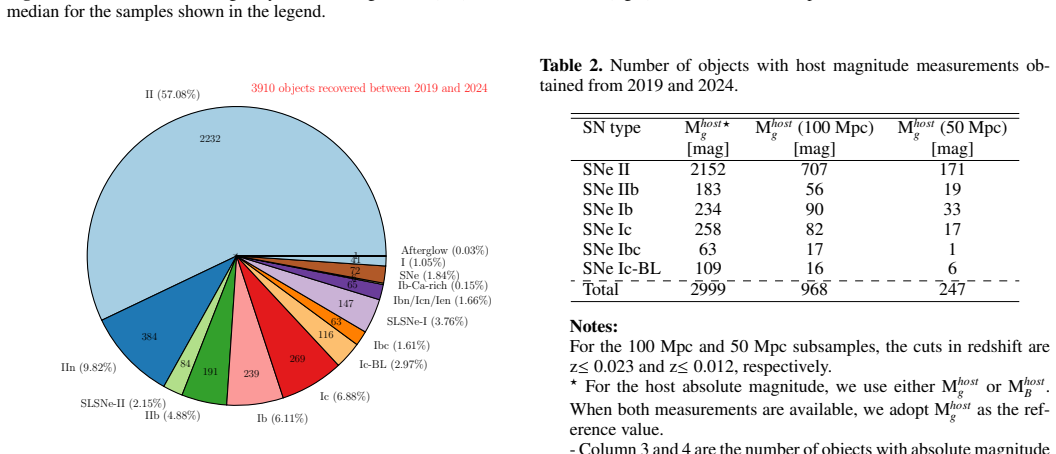
Understanding supernova (SN) progenitors remains a major challenge in astrophysics, as it involves untangling the complex interplay between stellar physics (e.g., evolution, binarity, explosion) and environments (e.g., metallicity, star formation rate). To address this, we present relative frequencies of core-collapse SNe (CCSNe) as a function of metallicity using two complementary samples: (i) all literature SNe that have associated host galaxy parameters (absolute magnitudes, stellar masses, and/or oxygen abundances); and (ii) SNe classified between 2019 and 2024 with host magnitude information, including distance-limited subsamples within 50 Mpc and 100 Mpc. We found that CCSNe from the literature sample are associated with luminous galaxies, reflecting both the higher stellar content of such systems and selection biases inherent to targeted surveys. In contrast, the distance-limited subsamples provide a less biased view, showing that hydrogen-rich SNe (SNe II) are more commonly found in lower-luminosity galaxies than stripped-envelope SNe (SESNe). Comparisons between the literature sample and distance-limited subsamples indicate that trends derived from global measurements remain consistent. For the SESNe-to-SNe II ratios, we confirm a slight increase with metallicity, reflecting a higher fraction of SESNe in metal-rich environments. Comparison with theoretical predictions shows that models including either binary interactions or rotation can broadly reproduce the observed trends, although degeneracies remain, and no single scenario uniquely explains the data. Overall, our results provide observational constraints on massive-star evolution and highlight the key role of metallicity and binarity in shaping the observed diversity of CCSNe.
Editorial analysis
A structured set of objections, weighed in public.
Referee Report
Summary. The manuscript examines the relative frequencies of different types of core-collapse supernovae (CCSNe) as a function of metallicity, using both a comprehensive literature sample with associated host galaxy parameters and a new sample of SNe discovered between 2019 and 2024. It reports that stripped-envelope SNe (SESNe) are more common in higher-luminosity, metal-rich galaxies compared to SNe II, with a slight increase in the SESNe-to-SNe II ratio with increasing metallicity proxies (absolute magnitudes, stellar masses, oxygen abundances). Distance-limited subsamples (50 and 100 Mpc) are analyzed to reduce selection biases, and the observed trends are compared to theoretical predictions from models including binary interactions and rotation, which are found to broadly reproduce the data despite remaining degeneracies.
Significance. If the central trends are confirmed to be robust against systematic uncertainties in the metallicity proxies, this work provides key observational benchmarks for massive star evolution models, particularly regarding the roles of metallicity and binarity in determining supernova subtypes. The adoption of distance-limited samples is a positive step toward minimizing survey biases, offering a more representative view of the CCSN population.
major comments (1)
- The headline result of a slight increase in the SESNe-to-SNe II ratio with metallicity is derived by binning events using global host-galaxy parameters. However, galaxies exhibit radial metallicity gradients typically ranging from 0.05 to 0.2 dex per scale length, which can lead to misassignment of the local metallicity at the explosion site by several tenths of a dex. The distance-limited subsamples address volume and targeting biases but do not account for this spatial mismatch. A quantitative propagation of the uncertainty due to gradient scatter is needed to assess whether the observed slope remains significant or could be consistent with a flat relation.
minor comments (2)
- The manuscript should include or reference supplementary data tables listing the individual supernovae, their classifications, host parameters, and derived metallicities to facilitate reproducibility and independent verification of the binned ratios.
- Error bars or confidence intervals on the reported frequency ratios and trends should be explicitly presented in the relevant figures and tables to allow assessment of the statistical significance of the slight increase.
Simulated Author's Rebuttal
We thank the referee for the positive summary and for identifying a key limitation in our use of global metallicity proxies. We address the major comment in detail below and will revise the manuscript accordingly.
read point-by-point responses
-
Referee: The headline result of a slight increase in the SESNe-to-SNe II ratio with metallicity is derived by binning events using global host-galaxy parameters. However, galaxies exhibit radial metallicity gradients typically ranging from 0.05 to 0.2 dex per scale length, which can lead to misassignment of the local metallicity at the explosion site by several tenths of a dex. The distance-limited subsamples address volume and targeting biases but do not account for this spatial mismatch. A quantitative propagation of the uncertainty due to gradient scatter is needed to assess whether the observed slope remains significant or could be consistent with a flat relation.
Authors: We agree that radial metallicity gradients introduce an important source of uncertainty when global host-galaxy parameters are used as proxies, and that the distance-limited subsamples do not fully mitigate this spatial mismatch. This is a standard limitation in large-sample SN environment studies, but it merits explicit quantification. In the revised manuscript we will add a dedicated subsection that (i) adopts literature-typical gradient values (0.05–0.2 dex per scale length) and mean SN offsets from the literature, (ii) performs a Monte Carlo resampling of the metallicity proxies with added scatter, and (iii) re-derives the SESNe-to-SNe II ratio trend and its significance. We will report the resulting range of slopes and p-values to demonstrate whether the observed mild positive trend remains statistically distinguishable from zero. This addition will strengthen the robustness discussion without altering the core observational results. revision: yes
Circularity Check
No significant circularity; observational ratios and trends derived directly from sample counts and compared to independent external models
full rationale
The paper's core derivation consists of counting CCSNe subtypes in bins defined by observed host-galaxy parameters (absolute magnitudes, stellar masses, oxygen abundances) treated as metallicity proxies, then computing SESNe-to-SNe II ratios and comparing the resulting trends to theoretical predictions from separate works. No equations or definitions reduce the reported ratios to fitted parameters defined by the same data; the counts are direct tallies from the literature and new samples. No self-citation chain, uniqueness theorem, or ansatz is invoked to force the result. The derivation remains self-contained against external benchmarks, with the only potential issues being systematic biases in proxy accuracy (addressed under correctness, not circularity).
Axiom & Free-Parameter Ledger
axioms (1)
- domain assumption Global host-galaxy metallicity measurements accurately represent conditions at the supernova progenitor site
Reference graph
Works this paper leans on
-
[1]
1974, IEEE Transactions on Automatic Control, 19, 716
Akaike, H. 1974, IEEE Transactions on Automatic Control, 19, 716
1974
-
[2]
P., Gutiérrez, C
Anderson, J. P., Gutiérrez, C. P., Dessart, L., et al. 2016, A&A, 589, A110
2016
-
[3]
P., James, P
Anderson, J. P., James, P. A., Habergham, S. M., Galbany, L., & Kuncarayakti, H. 2015, PASA, 32, e019
2015
-
[4]
Anderson, J. P. et al. 2014, ApJ, 786, 67
2014
-
[5]
M., et al
Arcavi, I., Gal-Yam, A., Kasliwal, M. M., et al. 2010, ApJ, 721, 777
2010
-
[6]
C., Kulkarni, S
Bellm, E. C., Kulkarni, S. R., Graham, M. J., et al. 2019, PASP, 131, 018002
2019
-
[7]
A., Skillman, E
Berg, D. A., Skillman, E. D., Marble, A. R., et al. 2012, ApJ, 754, 98
2012
-
[8]
B., Modjaz, M., Hicken, M., et al
Bianco, F. B., Modjaz, M., Hicken, M., et al. 2014, ApJS, 213, 19
2014
-
[9]
& Prantzos, N
Boissier, S. & Prantzos, N. 2009, A&A, 503, 137
2009
-
[10]
2000, A&AS, 143, 33
Bonnarel, F., Fernique, P., Bienaymé, O., et al. 2000, A&AS, 143, 33
2000
-
[11]
A., Clayton, G
Cardelli, J. A., Clayton, G. C., & Mathis, J. S. 1989, ApJ, 345, 245
1989
-
[12]
Chambers, K. C., Magnier, E. A., Metcalfe, N., et al. 2016, ArXiv e-prints [arXiv:1612.05560]
work page internal anchor Pith review Pith/arXiv arXiv 2016
-
[13]
J., Yates, R
Chen, T.-W., Smartt, S. J., Yates, R. M., et al. 2017, MNRAS, 470, 3566
2017
-
[14]
P., Ercolino, A., Jin, H., & Langer, N
Dessart, L., Gutiérrez, C. P., Ercolino, A., Jin, H., & Langer, N. 2024, A&A, 685, A169
2024
-
[15]
& Hillier, D
Dessart, L. & Hillier, D. J. 2011, MNRAS, 410, 1739
2011
-
[16]
R., & Langer, N
Dessart, L., Yoon, S.-C., Aguilera-Dena, D. R., & Langer, N. 2020, A&A, 642, A106
2020
-
[17]
J., Izzard, R
Eldridge, J. J., Izzard, R. G., & Tout, C. A. 2008, MNRAS, 384, 1109
2008
-
[18]
2024, A&A, 685, A58
Ercolino, A., Jin, H., Langer, N., & Dessart, L. 2024, A&A, 685, A58
2024
-
[19]
Filippenko, A. V . 1988, AJ, 96, 1941 Article number, page 11 of 12 A&A proofs:manuscript no. CCSNe_ratios
1988
-
[20]
Filippenko, A. V . 1997, ARA&A, 35, 309
1997
-
[21]
Flewelling, H. A., Magnier, E. A., Chambers, K. C., et al. 2016, ArXiv e-prints [arXiv:1612.05243]
-
[22]
2017, Observational and Physical Classification of Supernovae, ed
Gal-Yam, A. 2017, Observational and Physical Classification of Supernovae, ed. A. W. Alsabti & P. Murdin, 195
2017
-
[23]
P., Sánchez, S
Galbany, L., Anderson, J. P., Sánchez, S. F., et al. 2018, ApJ, 855, 107
2018
-
[24]
M., et al
Galbany, L., Hamuy, M., Phillips, M. M., et al. 2016, AJ, 151, 33
2016
-
[25]
2009, A&A, 502, 611
Georgy, C., Meynet, G., Walder, R., Folini, D., & Maeder, A. 2009, A&A, 502, 611
2009
-
[26]
S., Eldridge, J
Gilkis, A., Vink, J. S., Eldridge, J. J., & Tout, C. A. 2019, MNRAS, 486, 4451 González-Bañuelos, M., Gutiérrez, C. P., Galbany, L., & González-Gaitán, S. 2025, A&A, 702, A128
2019
-
[27]
J., Kulkarni, S
Graham, M. J., Kulkarni, S. R., Bellm, E. C., et al. 2019, PASP, 131, 078001
2019
-
[28]
B., Huang, S., et al
Graur, O., Bianco, F. B., Huang, S., et al. 2017, ApJ, 837, 120
2017
-
[29]
P., Sullivan, M., et al
Grayling, M., Gutiérrez, C. P., Sullivan, M., et al. 2023, MNRAS, 520, 684 Gutiérrez, C. P., Anderson, J. P., Sullivan, M., et al. 2018, MNRAS, 479, 3232
2023
-
[30]
A., Taubenberger, S., et al
Hachinger, S., Mazzali, P. A., Taubenberger, S., et al. 2012, MNRAS, 427, 2057
2012
-
[31]
L., Woosley, S
Heger, A., Fryer, C. L., Woosley, S. E., Langer, N., & Hartmann, D. H. 2003, ApJ, 591, 288
2003
-
[32]
2007, A&A, 461, 571
Hirschi, R. 2007, A&A, 461, 571
2007
-
[33]
Kelly, P. L. & Kirshner, R. P. 2012, ApJ, 759, 107
2012
-
[34]
Kewley, L. J. & Ellison, S. L. 2008, ApJ, 681, 1183
2008
-
[35]
Kolmogorov, A. N. 1933, Giorn Dell’inst Ital Degli Att, 4, 89 Krühler, T., Malesani, D., Fynbo, J. P. U., et al. 2015, A&A, 581, A125
1933
-
[36]
P., Galbany, L., et al
Kuncarayakti, H., Anderson, J. P., Galbany, L., et al. 2018, A&A, 613, A35
2018
-
[37]
2013, AJ, 146, 31
Kuncarayakti, H., Doi, M., Aldering, G., et al. 2013, AJ, 146, 31
2013
-
[38]
2011, A&A, 530, A95
Leloudas, G., Gallazzi, A., Sollerman, J., et al. 2011, A&A, 530, A95
2011
-
[39]
2022, ApJS, 262, 26
Long, G., Song, H., Meynet, G., et al. 2022, ApJS, 262, 26
2022
-
[40]
2014, ApJ, 787, 138
Lunnan, R., Chornock, R., Berger, E., et al. 2014, ApJ, 787, 138
2014
-
[41]
2025, A&A, 698, A305
Ma, X., Wang, X., Mo, J., et al. 2025, A&A, 698, A305
2025
-
[42]
1992, A&A, 264, 105
Maeder, A. 1992, A&A, 264, 105
1992
-
[43]
2014, A&A, 570, A13
Makarov, D., Prugniel, P., Terekhova, N., Courtois, H., & Vauglin, I. 2014, A&A, 570, A13
2014
-
[44]
2006, A&A, 447, 623
Meynet, G., Ekström, S., & Maeder, A. 2006, A&A, 447, 623
2006
-
[45]
& Maeder, A
Meynet, G. & Maeder, A. 2000, A&A, 361, 101
2000
-
[46]
& Maeder, A
Meynet, G. & Maeder, A. 2005, A&A, 429, 581
2005
-
[47]
1941, PASP, 53, 224
Minkowski, R. 1941, PASP, 53, 224
1941
-
[48]
B., Siwek, M., et al
Modjaz, M., Bianco, F. B., Siwek, M., et al. 2020, ApJ, 892, 153
2020
-
[49]
P., & Arcavi, I
Modjaz, M., Gutiérrez, C. P., & Arcavi, I. 2019, Nature Astronomy, 3, 717
2019
-
[50]
S., et al
Modjaz, M., Kewley, L., Bloom, J. S., et al. 2011, ApJ, 731, L4+
2011
-
[51]
P., et al
Modjaz, M., Kewley, L., Kirshner, R. P., et al. 2008, AJ, 135, 1136
2008
-
[52]
I., Iwamoto, K., & Suzuki, T
Nomoto, K. I., Iwamoto, K., & Suzuki, T. 1995, Phys. Rep., 256, 173
1995
-
[53]
& Lamers, H
Nugis, T. & Lamers, H. J. G. L. M. 2000, A&A, 360, 227
2000
-
[54]
2006, MNRAS, 370, 1752
Pastorello, A., Sauer, D., Taubenberger, S., et al. 2006, MNRAS, 370, 1752
2006
-
[55]
1900, Philosophical Magazine, 50, 157
Pearson, K. 1900, Philosophical Magazine, 50, 157
1900
-
[56]
A., Fremling, C., Sollerman, J., et al
Perley, D. A., Fremling, C., Sollerman, J., et al. 2020, ApJ, 904, 35
2020
-
[57]
A., Levan, A
Perley, D. A., Levan, A. J., Tanvir, N. R., et al. 2013, ApJ, 778, 128
2013
-
[58]
A., Quimby, R
Perley, D. A., Quimby, R. M., Yan, L., et al. 2016, ApJ, 830, 13
2016
-
[59]
& Pagel, B
Pettini, M. & Pagel, B. E. J. 2004, MNRAS, 348, L59
2004
-
[60]
C., & Hsu, J
Podsiadlowski, P., Joss, P. C., & Hsu, J. J. L. 1992, ApJ, 391, 246
1992
-
[61]
& Boissier, S
Prantzos, N. & Boissier, S. 2003, A&A, 406, 259
2003
-
[62]
Prieto, J. L. et al. 2008, ApJ, 673, 999
2008
-
[63]
L., Ashby, M
Rosenberg, J. L., Ashby, M. L. N., Salzer, J. J., & Huang, J.-S. 2006, ApJ, 636, 742
2006
-
[64]
E., Soderberg, A
Sanders, N. E., Soderberg, A. M., Levesque, E. M., et al. 2012, ApJ, 758, 132
2012
-
[65]
Schlafly, E. F. & Finkbeiner, D. P. 2011, ApJ, 737, 103
2011
-
[66]
2018, MNRAS, 473, 1258
Schulze, S., Krühler, T., Leloudas, G., et al. 2018, MNRAS, 473, 1258
2018
-
[67]
2021, ApJS, 255, 29
Schulze, S., Yaron, O., Sollerman, J., et al. 2021, ApJS, 255, 29
2021
-
[68]
J., Prieto, J
Shappee, B. J., Prieto, J. L., Grupe, D., et al. 2014, ApJ, 788, 48
2014
-
[69]
2017, PASP, 129, 054201
Shivvers, I., Modjaz, M., Zheng, W., et al. 2017, PASP, 129, 054201
2017
-
[70]
Smirnov, N. V . 1939, Bull. Math. Univ. Moscou, 2, 3
1939
-
[71]
W., Smartt, S
Smith, K. W., Smartt, S. J., Young, D. R., et al. 2020, PASP, 132, 085002
2020
-
[72]
2025, MN- RAS[arXiv:2508.21042]
Souropanis, D., Zapartas, E., Pessi, T., et al. 2025, arXiv e-prints, arXiv:2508.21042
-
[73]
L., et al
Spiro, S., Pastorello, A., Pumo, M. L., et al. 2014, MNRAS, 439, 2873
2014
-
[74]
2019, ApJ, 885, 130
Sravan, N., Marchant, P., & Kalogera, V . 2019, ApJ, 885, 130
2019
-
[75]
R., Eldridge, J
Stanway, E. R., Eldridge, J. J., & Chrimes, A. A. 2020, MNRAS, 497, 2201
2020
-
[76]
L., Stanek, K
Stoll, R., Prieto, J. L., Stanek, K. Z., & Pogge, R. W. 2013, ApJ, 773, 12
2013
-
[77]
M., Levan, A
Svensson, K. M., Levan, A. J., Tanvir, N. R., Fruchter, A. S., & Strolger, L. G. 2010, MNRAS, 405, 57
2010
-
[78]
2019, A&A, 621, A71
Taddia, F., Sollerman, J., Fremling, C., et al. 2019, A&A, 621, A71
2019
-
[79]
2015, A&A, 574, A60
Taddia, F., Sollerman, J., Leloudas, G., et al. 2015, A&A, 574, A60
2015
-
[80]
Taddia, F. et al. 2013, A&A, 555, A10
2013
discussion (0)
Sign in with ORCID, Apple, or X to comment. Anyone can read and Pith papers without signing in.