Recognition: unknown
Prebiotic Chemistry Insights for Dragonfly II: Thermodynamic Favorability of Nucleobases, Ribose, and Fatty Acids in Selk Crater on Titan
Pith reviewed 2026-05-10 07:09 UTC · model grok-4.3
The pith
Ammonia acts as a gatekeeper that unlocks nucleobases, ribose, and fatty acids in Titan's Selk crater melt pools.
A machine-rendered reading of the paper's core claim, the machinery that carries it, and where it could break.
Core claim
Thermodynamic modeling of an aqueous melt pool at Selk crater shows that ammonia abundance controls which prebiotic molecules can form from simple atmospheric precursors HCN and C2H2. In NH3-free conditions only adenine and butanoic acid are accessible; at or above 1 percent NH3 all nucleobases, ribose, and C2-C12 fatty acids become thermodynamically favorable, with shorter chains and nucleobases peaking at 1 percent and C7-C12 fatty acids peaking at 2 percent. The modeled preference for pyrimidines over purines and the monotonic decline of fatty-acid abundance with chain length reproduce patterns observed in carbonaceous meteorites.
What carries the argument
Thermodynamic equilibrium calculations of reaction networks starting from HCN and C2H2 inside an ammonia-bearing aqueous melt pool of Selk-crater size.
If this is right
- Molecular distributions and cross-class correlations observed by Dragonfly can constrain the ammonia concentration that existed in Selk's past melt pools.
- The modeled preference for pyrimidines and the chain-length decline in fatty acids can be compared directly to meteorite data to test consistency with abiotic production.
- Absence or unexpected ratios of these molecules would indicate either kinetic limitations or different precursor chemistries than the HCN-C2H2 network assumes.
- These thresholds supply a practical way to distinguish purely abiotic signals from any anomalous prebiotic chemistry at Selk.
Where Pith is reading between the lines
- If the ammonia-gatekeeper pattern holds, similar thermodynamic thresholds may apply to other transient liquid-water sites on Titan or on other icy bodies.
- The same framework could be extended to additional molecular classes or to time-dependent cooling of the melt pool to refine Dragonfly target selection.
- Non-equilibrium kinetics or additional atmospheric gases could shift the 1 percent threshold and would need separate modeling to interpret future in-situ data.
Load-bearing premise
The calculations assume the melt pool reaches thermodynamic equilibrium and that the chosen HCN-C2H2 reaction network captures the dominant pathways without important kinetic barriers or side reactions.
What would settle it
Dragonfly's DraMS instrument returning molecular abundance ratios or presence/absence patterns for nucleobases, ribose, or fatty acids that fall outside the predicted NH3-dependent windows (for example, detecting long fatty acids without short ones or finding no molecules at all in an ammonia-rich setting).
Figures

read the original abstract
Saturn's moon Titan is a prime destination for investigating prebiotic chemistry beyond Earth, particularly at impact crater sites where transient liquid water may have enabled aqueous reactions between organic molecules. Selk crater represents one such environment and is a primary target of NASA's Dragonfly mission. Here, we present a thermodynamic assessment of nucleobases, ribose, and fatty acids formed from simple atmospheric precursors (HCN and C2H2) within a Selk-sized aqueous melt pool across varying ammonia (NH3) abundances. We find that ammonia acts as a chemical gatekeeper for molecular accessibility. In NH3-free systems, accessibility is restricted to adenine and butanoic acid. Once >=1% NH3 is introduced, all investigated molecular classes become thermodynamically accessible. Distinct molecular classes have different NH3 sensitivities: nucleobases, ribose, and C2-C6 fatty acids yield peaks at 1% NH3, and C7-C12 fatty acids yield peaks at 2% NH3. The modeled preference for pyrimidines vs. purines and monotonic decline of fatty acid abundance with chain length qualitatively mirror patterns observed in carbonaceous meteorites and returned asteroid samples. We show how molecular distributions and cross-class correlations may provide indirect constraints on Selk's past aqueous environment, help constrain past ammonia availability, and distinguish abiotic production from potential anomalies. By coupling thermodynamic predictions with an assessment of Dragonfly's mass spectrometer (DraMS) capabilities, we posit concrete, testable predictions for evaluating Selk's prebiotic potential in situ.
Editorial analysis
A structured set of objections, weighed in public.
Referee Report
Summary. The manuscript presents thermodynamic calculations of nucleobase, ribose, and fatty acid formation from HCN and C2H2 precursors in a Selk-sized aqueous melt pool on Titan. It concludes that ammonia abundance acts as a chemical gatekeeper, with accessibility limited to adenine and butanoic acid in NH3-free conditions but extending to all investigated classes once NH3 reaches or exceeds 1%, with class-specific peaks at 1% or 2% NH3; the resulting distributions qualitatively match meteoritic patterns and yield testable predictions for Dragonfly's DraMS instrument.
Significance. If the equilibrium calculations prove robust, the work supplies a concrete, mission-relevant framework for interpreting potential prebiotic signatures at Titan impact sites and for using molecular distributions to constrain past ammonia levels. The explicit linkage to DraMS capabilities and the meteorite analogy are strengths that could guide in-situ data interpretation.
major comments (1)
- [Abstract] The NH3 gatekeeper claim (restricted accessibility without NH3, full accessibility at >=1% NH3) is load-bearing on the assumption that thermodynamic favorability implies actual molecular accessibility. The modeling of a Selk-sized pool does not incorporate kinetic rate constants, activation barriers, or competing side reactions, nor does it compare pool lifetime against reaction timescales at Titan-relevant temperatures; without this, the 1% threshold lacks predictive power regardless of the sign of Delta G.
minor comments (2)
- [Abstract] The abstract reports clear numerical thresholds but supplies no equations, computational details, error propagation, or validation against known benchmarks for the thermodynamic calculations.
- Notation for the reaction network and the definition of 'accessibility' should be clarified early; readers cannot reconstruct how the reported NH3 sensitivities were obtained from the given information.
Simulated Author's Rebuttal
We thank the referee for their constructive comments. We address the major comment below and have revised the manuscript to better delineate the thermodynamic scope of the work.
read point-by-point responses
-
Referee: [Abstract] The NH3 gatekeeper claim (restricted accessibility without NH3, full accessibility at >=1% NH3) is load-bearing on the assumption that thermodynamic favorability implies actual molecular accessibility. The modeling of a Selk-sized pool does not incorporate kinetic rate constants, activation barriers, or competing side reactions, nor does it compare pool lifetime against reaction timescales at Titan-relevant temperatures; without this, the 1% threshold lacks predictive power regardless of the sign of Delta G.
Authors: We agree that the manuscript is strictly thermodynamic and does not model kinetics, activation barriers, side reactions, or compare reaction timescales to pool lifetime. Thermodynamic favorability remains a necessary condition: endergonic reactions cannot produce appreciable yields at equilibrium irrespective of kinetics. Our calculations therefore identify the NH3 abundances at which the target molecules become thermodynamically accessible from HCN and C2H2. We have revised the abstract and added an explicit limitations paragraph in the discussion section stating that the 1% NH3 threshold indicates thermodynamic accessibility rather than guaranteed formation, and that kinetic studies will be required to assess whether equilibrium can be reached within the melt-pool lifetime. The reported NH3-dependent shifts in Delta G, the class-specific peaks, and the qualitative match to meteoritic abundance patterns are robust within the thermodynamic framework and provide testable predictions for DraMS even if full kinetic validation lies beyond the present scope. revision: partial
Circularity Check
Standard thermodynamic calculations on new boundary conditions; no reduction of outputs to fitted inputs or self-citations
full rationale
The paper computes thermodynamic favorability (via ΔG or equilibrium constants) for nucleobases, ribose, and fatty acids from HCN/C2H2 precursors across NH3 abundances in a modeled Selk melt pool. These are direct applications of standard thermochemical data to Titan-specific conditions rather than any parameter fitting to the target molecular distributions. The NH3 gatekeeper threshold emerges from the sign changes in the computed free energies; no equations redefine outputs in terms of inputs. Qualitative comparisons to meteorite patterns are external benchmarks, not internal constraints. No self-citations, uniqueness theorems, or ansatzes from prior author work are invoked to justify the reaction network or equilibrium assumption. The derivation chain remains independent of the reported accessibility results.
Axiom & Free-Parameter Ledger
free parameters (1)
- Ammonia abundance
axioms (2)
- domain assumption Thermodynamic equilibrium determines molecular favorability in the Selk aqueous melt pool
- domain assumption Precursor reactions occur from HCN and C2H2 under Titan-relevant conditions
Reference graph
Works this paper leans on
-
[1]
Selk crater is therefore a primary target of NASA’s Dragonfly mission, scheduled to arrive at Titan in the mid-2030s (Barnes et al
24). Selk crater is therefore a primary target of NASA’s Dragonfly mission, scheduled to arrive at Titan in the mid-2030s (Barnes et al. 2021). Dragonfly’s mass spectrometer, DraMS, will directly probe surface chemistry to assess the presence of biologically relevant molecules (Grubisic et al. 2021). Cassini remote-sensing observations indicate that Selk ...
2021
-
[2]
Unless otherwise noted, all physical assumptions and numerical methods are identical to those described in Section 2 of Madan and Pearce (2025)
to nucleobases, ribose, and fatty acids. Unless otherwise noted, all physical assumptions and numerical methods are identical to those described in Section 2 of Madan and Pearce (2025). We detail our methods below. 2.1. Thermodynamic Framework Thermodynamic modeling provides a principled way to estimate the maximum extent of chemical transformation by ide...
2025
-
[3]
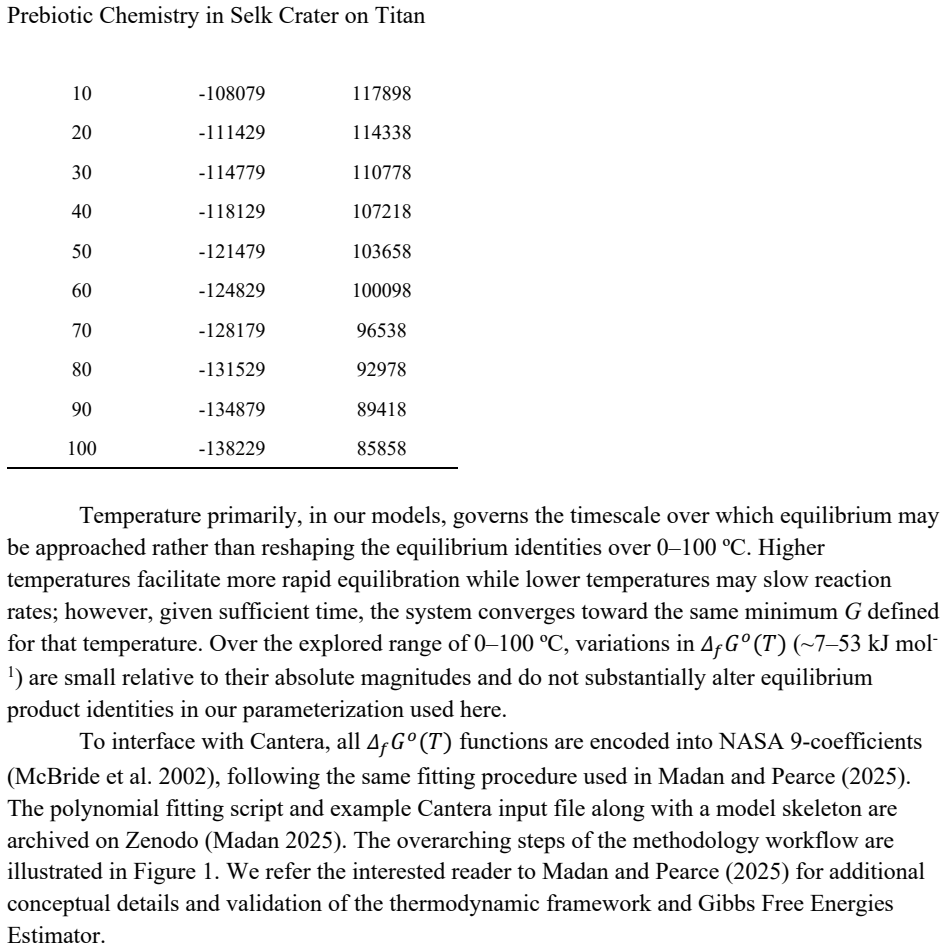
using the Python wrapper, pyCHNOSZ (Boyer 2024). For species lacking this data in CHNOSZ, namely xanthine and hypoxanthine, we estimate 𝛥!𝐺"(𝑇) using the Gibbs Free Energies Estimator described and validated in Section 2.2 of Madan and Pearce (2025). Quantum chemical calculations used in this estimator consist of geometry optimizations and frequency analy...
2024
-
[4]
and the 6-311++G(2df, 2p) basis set, as implemented in Gaussian 16 Revision B.01 (Frisch et al. 2017). Implicit solvation is modeled using the polarizable continuum model (PCM) with water as the solvent (Miertuš et al. 1981; Cammi & Tomasi 1995; Tomasi et al. 1999). Thermochemical quantities (electronic energies, zero-point energies, thermal corrections, ...
2017
-
[5]
As a continuous consistency check, we newly apply this method to adenine and find close agreement with the CHNOSZ value, with a deviation of 3.8% at 298 K
to compute 𝛥!𝐺" at 298 K. As a continuous consistency check, we newly apply this method to adenine and find close agreement with the CHNOSZ value, with a deviation of 3.8% at 298 K. The validation and automation of this workflow were developed in Madan and Pearce (2025); the associated scripts are publicly available via Zenodo (Madan 2025). To reconstruct...
2025
-
[6]
(J mol-1) for Xanthine and Hypoxanthine. 𝛥!𝐺
Calculated Standard Gibbs Free Energies of Formation, 𝛥!𝐺"(J mol-1) for Xanthine and Hypoxanthine. 𝛥!𝐺"(J mol-1) T (ºC) Xanthine Hypoxanthine 0.01 -104732 121455 Prebiotic Chemistry in Selk Crater on Titan 10 -108079 117898 20 -111429 114338 30 -114779 110778 40 -118129 107218 50 -121479 103658 60 -124829 100098 70 -128179 96538 80 -131529 92978 90 -13487...
2002
-
[7]
We refer the interested reader to Madan and Pearce (2025) for additional conceptual details and validation of the thermodynamic framework and Gibbs Free Energies Estimator. Figure
2025
-
[8]
Prebiotic Chemistry in Selk Crater on Titan The reactant species include hydrogen cyanide (HCN), acetylene (C2H2), water (H2O), and ammonia (NH3)
Overview of the thermodynamic modeling workflow used in this study and Madan and Pearce (2025). Prebiotic Chemistry in Selk Crater on Titan The reactant species include hydrogen cyanide (HCN), acetylene (C2H2), water (H2O), and ammonia (NH3). Our previous work (Madan & Pearce
2025
-
[9]
Each target product is modeled individually, utilizing a weak coupling approach
focused on amino acids as the modeled products and here we expand the target species list to include the five canonical nucleobases (adenine, guanine, cytosine, uracil, thymine), two additional purine derivatives (xanthine and hypoxanthine), ribose, and saturated fatty acids from ethanoic through dodecanoic acid (C2–C12). Each target product is modeled in...
2025
-
[10]
with atmospheric organic delivery estimates (Krasnopolsky 2009; Neish et al
2009
-
[11]
to constrain plausible aqueous reaction environments on Titan. Simulations of a ~4 km diameter impactor into a methane–clathrate-rich ice shell suggest that a Selk-scale impact can generate on the order of 200–400 km3 of water–ice melt (Wakita 脇田 et al. 2023). The upper 10–50 m of the melt pool—corresponding to depths most accessible to Dragonfly—would re...
2023
-
[12]
yield equilibration timescales ranging from ~1 to ~120 years (depending on temperature and concentration of ammonia; see Table 3 of Madan & Pearce 2025). These durations are orders of magnitude shorter than the freezing timescales of Selk-sized melt pools (103–104 years), suggesting that thermodynamic equilibrium is achievable, especially in the deeper, l...
2025
-
[13]
Experimental studies on Titan-relevant aqueous chemistry have explored overlapping NH3 concentration ranges: 3–25 wt.% (Poch et al
and a maximum of ~5 wt.% NH3 in later ocean-composition models (Leitner & Lunine 2019). Experimental studies on Titan-relevant aqueous chemistry have explored overlapping NH3 concentration ranges: 3–25 wt.% (Poch et al. 2012), 5–15 wt.% (Farnsworth et al. 2024), and 20.5 wt.% solutions (Nasralla et al. 2025). Recent geophysical work argues against a prese...
2019
-
[14]
Molecule Concentration (mol X/mol H2O) H2O 1.00 C2H2 0.042 HCN 0.020 NH3 0, 0.01, 0.02, 0.03, 0.04, 0.05, 0.10 2.3
Initial concentrations of the reactants used in our fiducial thermochemical models. Molecule Concentration (mol X/mol H2O) H2O 1.00 C2H2 0.042 HCN 0.020 NH3 0, 0.01, 0.02, 0.03, 0.04, 0.05, 0.10 2.3. Assumptions, Limitations, and Caveats As in the previous work with amino acids (see Section 3.4 of Madan & Pearce 2025), several simplifying assumptions are ...
2025
-
[15]
2024)—we can build upon and strengthen the predictive framework for what Dragonfly might detect on Titan’s surface
with laboratory reaction rates (Farnsworth et al. 2024)—we can build upon and strengthen the predictive framework for what Dragonfly might detect on Titan’s surface. This study falls within the growing field of computational astrobiology, where modeling approaches are needed and utilized to bridge substantial observational and experimental gaps (e.g., poo...
2024
-
[16]
Discussion The results suggest that the formation of amino acids (Madan & Pearce 2025), nucleobases, ribose, and fatty acids in the models simulating Selk crater’s melt pool environment is governed by three coupled factors: (i) elemental stoichiometry, (ii) initial organic inventory, and (iii) Gibbs energetics. Although liquid water is abundant in the mod...
2025
-
[17]
In experimental work of Oro and Kimball (1961), the formation of adenine from HCN is facilitated with ammonia, whereas Ferris et al
because the route is stoichiometrically balanced in C, H, and N. In experimental work of Oro and Kimball (1961), the formation of adenine from HCN is facilitated with ammonia, whereas Ferris et al. (1978) demonstrated HCN and H2O as the reactants for adenine and modeling efforts of LaRowe and Regnier (2008) further included a direct oligomerization pathwa...
1961
-
[18]
exhibits the most extreme shift, with a ratio of ~0.099 (Koga et al. 2025). This observational gradient—where increasing ammonia concentrations progressively suppress purine dominance in Prebiotic Chemistry in Selk Crater on Titan favor of pyrimidines—validates our model’s prediction that high ammonia availability thermodynamically drives the system towar...
2025
-
[19]
The latter trend mirrors the aforementioned general decrease in abundance with increasing chain lengths (Sephton 2002; Lai et al
and (2) monotonic decrease in yields as the carbon chain lengthens from C4–C12. The latter trend mirrors the aforementioned general decrease in abundance with increasing chain lengths (Sephton 2002; Lai et al. 2019). A notable nuance in our results is the C2 vs. C3 relationship. While standard synthesis (e.g., Fischer-Tropsch) typically predicts a strict ...
2002
-
[20]
if no ammonia was present during the melt pool lifetime. Fifth, the cytosine-to-uracil (C:U) ratio detected via LDMS could function as a test for the melt pool's duration, where a high C:U ratio implies a rapid freeze-out that preserved the thermodynamic state against kinetic deamination of cytosine to uracil. While primarily tailored for Dragonfly’s expl...
2022
-
[21]
suggests that Selk crater may host a rich organic inventory and simultaneously implies that the mere detection of these will be consistent with abiotic chemistry. As such, the search for candidate biosignatures by Dragonfly must focus on patterns, particularly by identifying deviations from the thermodynamic and kinetic baselines established by our models...
2011
-
[22]
(J mol-1) for Xanthine and Hypoxanthine as a function of temperature. 𝛥!𝐺
Conclusion Prebiotic Chemistry in Selk Crater on Titan We present a thermodynamic assessment of nucleobases, ribose, and fatty acids within Selk’s impact melt pool on Titan, completing the set of canonical molecular building blocks when including previously examined amino acids (Madan & Pearce 2025). Our key takeaways can be summarized as follows: ● Inves...
discussion (0)
Sign in with ORCID, Apple, or X to comment. Anyone can read and Pith papers without signing in.