Recognition: unknown
Yttrium ion as a platform for quantum information processing
Pith reviewed 2026-05-10 08:42 UTC · model grok-4.3
The pith
89Y+ provides a trapped-ion qubit with field-insensitive nuclear-spin storage and spectrally isolated transitions for operations.
A machine-rendered reading of the paper's core claim, the machinery that carries it, and where it could break.
Core claim
The ground-state manifold of 89Y+ hosts a nuclear-spin qubit whose first-order magnetic-field sensitivity vanishes, while several low-lying metastable manifolds supply transitions that are spectrally isolated from both storage and manipulation light. High-resolution spectroscopy supplies the hyperfine intervals, and ab-initio calculations supply the lifetimes and matrix elements needed to design initialization, readout, leakage-mitigation, and entangling-gate protocols at visible, near-visible, and infrared wavelengths.
What carries the argument
The nuclear-spin qubit formed by the hyperfine levels of the 5s² ¹S₀ ground state, whose hyperfine coefficients and electric-dipole matrix elements to metastable manifolds are computed and measured to enable field-insensitive storage together with wavelength-isolated control.
Where Pith is reading between the lines
- Other two-valence-electron ions with similar electronic structure could be evaluated with the same combination of spectroscopy and calculation to identify additional candidates.
- Successful gate demonstrations would provide a concrete test of whether the calculated matrix elements translate into high-fidelity operations in the presence of real trap conditions.
- The wavelength isolation between storage and gate light could allow denser ion chains or mixed-species architectures with lower crosstalk than current platforms.
Load-bearing premise
The calculated lifetimes, transition matrix elements, and hyperfine coefficients are accurate enough that the proposed qubit schemes can be realized without major unforeseen obstacles.
What would settle it
A laboratory measurement of any hyperfine interval or lifetime that deviates by more than a few percent from the reported calculated value, or an inability to achieve the predicted Rabi frequencies when driving the analyzed transitions.
Figures



read the original abstract
Engineering large-scale quantum computers which simultaneously provide high-fidelity quantum operations, low memory errors, low crosstalk, and reasonable resource usage remains an outstanding challenge across quantum computing platforms. In trapped ions, progress has largely focused on alkaline-earth and ytterbium ions, whose simple electronic structures facilitate control over their internal state. Here we investigate singly-ionized yttrium ($^{89}\mathrm{Y}^+$), a two-valence-electron ion whose ground-state manifold hosts a nuclear-spin qubit and which also features a variety of low-lying metastable manifolds, for applications in quantum information processing. Because experimental data are limited, we perform high-resolution laser-induced fluorescence spectroscopy to measure the hyperfine structure of several low-lying levels, and carry out comprehensive electronic structure calculations to determine lifetimes, transition matrix elements, and hyperfine coefficients for manifolds addressable with visible, near-visible, or infrared wavelengths. Using these results, we analyze schemes for qubit storage, initialization, readout, leakage mitigation, and single- and two-qubit gates. These results position $^{89}\mathrm{Y}^+$ as a uniquely capable next-generation trapped-ion qubit, combining field-insensitive nuclear-spin or clock-qubit storage with spectrally isolated transitions for operations.
Editorial analysis
A structured set of objections, weighed in public.
Referee Report
Summary. The manuscript reports new high-resolution laser-induced fluorescence spectroscopy measurements of hyperfine splittings in selected low-lying levels of 89Y+ together with electronic-structure calculations of lifetimes, electric-dipole matrix elements, and hyperfine coefficients for manifolds addressable at visible, near-visible, and infrared wavelengths. These data are used to analyze concrete schemes for nuclear-spin or clock-qubit storage, initialization, readout, leakage mitigation, and single- and two-qubit gates, leading to the claim that 89Y+ combines field-insensitive storage with spectrally isolated transitions and is therefore a uniquely capable next-generation trapped-ion platform.
Significance. If the calculated lifetimes and matrix elements prove accurate to the level required by the proposed protocols, the work would supply both new experimental hyperfine data and a comprehensive theoretical roadmap for an under-explored two-valence-electron ion. This combination of fresh spectroscopy with detailed protocol analysis is a clear strength and could stimulate experimental follow-up on an ion that offers nuclear-spin qubits without the usual alkaline-earth complications.
major comments (2)
- [electronic-structure calculations and qubit-scheme analysis sections] The central qubit-scheme analyses rest on the computed lifetimes and transition matrix elements for the metastable manifolds, yet the manuscript provides new experimental data only for hyperfine splittings of selected levels. No direct experimental benchmarks (e.g., measured lifetimes or branching ratios) are reported for the same metastable levels whose calculated properties underwrite the Rabi frequencies, spontaneous-emission error rates, and spectral-isolation claims. Typical 20–50 % systematic uncertainties in such calculations for two-valence-electron ions would directly affect the viability conclusions drawn in the protocol sections.
- [qubit scheme analysis] The assertion that the operational transitions are “spectrally isolated” and that leakage-mitigation schemes are practical depends quantitatively on the calculated matrix elements and hyperfine coefficients. Because these quantities are obtained from theory without cross-validation against independent experimental lifetimes or branching ratios in 89Y+, the load-bearing numerical predictions lack an external accuracy anchor.
minor comments (3)
- [experimental methods] Figure captions should explicitly state the laser wavelengths and detection filters used in the LIF measurements so that the hyperfine data can be reproduced without ambiguity.
- [results] The manuscript would benefit from a short table comparing the new hyperfine constants with any previously published values for the same levels, even if the comparison is limited.
- [throughout] Notation for the metastable manifolds (e.g., term symbols and J values) should be introduced once in the text and used consistently in all subsequent figures and equations.
Simulated Author's Rebuttal
We thank the referee for the careful reading, constructive criticism, and recognition of the potential of 89Y+ as a trapped-ion platform. We address the two major comments point by point below, acknowledging the limitations of the current data set while outlining targeted revisions to strengthen the manuscript.
read point-by-point responses
-
Referee: [electronic-structure calculations and qubit-scheme analysis sections] The central qubit-scheme analyses rest on the computed lifetimes and transition matrix elements for the metastable manifolds, yet the manuscript provides new experimental data only for hyperfine splittings of selected levels. No direct experimental benchmarks (e.g., measured lifetimes or branching ratios) are reported for the same metastable levels whose calculated properties underwrite the Rabi frequencies, spontaneous-emission error rates, and spectral-isolation claims. Typical 20–50 % systematic uncertainties in such calculations for two-valence-electron ions would directly affect the viability conclusions drawn in the protocol sections.
Authors: We agree that the absence of direct experimental lifetimes or branching ratios for the metastable levels is a genuine limitation, as our new data are restricted to hyperfine splittings. The lifetimes and matrix elements are computed with established ab initio methods for two-valence-electron ions that have been benchmarked against known data in similar species. To address the referee's concern, we will add a new subsection in the theory section that (i) quantifies the expected uncertainties through comparison with available literature values for related transitions, (ii) performs a sensitivity analysis showing how 20–50% variations propagate into the reported Rabi frequencies, error rates, and isolation metrics, and (iii) explicitly states that the protocol viability conclusions are conditional on these theoretical estimates pending future experimental verification. This revision will make the reliance on theory transparent without overstating the current experimental anchor. revision: partial
-
Referee: [qubit scheme analysis] The assertion that the operational transitions are “spectrally isolated” and that leakage-mitigation schemes are practical depends quantitatively on the calculated matrix elements and hyperfine coefficients. Because these quantities are obtained from theory without cross-validation against independent experimental lifetimes or branching ratios in 89Y+, the load-bearing numerical predictions lack an external accuracy anchor.
Authors: We acknowledge that the quantitative claims on spectral isolation and leakage mitigation rest on the computed quantities. The hyperfine coefficients for the levels used in the qubit schemes are now directly constrained by our new laser-induced fluorescence measurements, providing an experimental anchor for those parameters. The transition wavelengths and energy separations that determine isolation are obtained from the same calculations but are less sensitive to absolute matrix-element scaling than to level positions. We will revise the qubit-scheme section to include a brief discussion of how the isolation criteria depend primarily on the calculated energy structure (already partially validated by the hyperfine data) and to outline concrete next-step experiments that could measure the key lifetimes and branching ratios. This will clarify the current evidential basis while preserving the manuscript's focus on identifying promising protocols. revision: partial
Circularity Check
No significant circularity; derivation relies on independent measurements and calculations
full rationale
The paper reports new laser-induced fluorescence spectroscopy data for hyperfine splittings and performs separate electronic-structure calculations for lifetimes, matrix elements, and hyperfine coefficients. These inputs are then applied to analyze qubit schemes. No equation or claim reduces by construction to a fitted parameter, self-defined quantity, or load-bearing self-citation chain; the spectroscopy provides external data and the calculations follow standard methods whose accuracy is assessed against external benchmarks rather than internal redefinitions.
Axiom & Free-Parameter Ledger
Reference graph
Works this paper leans on
-
[1]
Nuclear spin qubit The5s 2 1S0 ground-state manifold provides a natural nuclear spin storage qubit which offers favorable sensitiv- ity to environmental magnetic fields compared to typical 8 trapped-ion qubits. In particular, while hyperfine clock qubits acquire qubit frequency shifts due to the presence of RF trapping potentials [33], a nuclear spin qubi...
-
[2]
=1/2 !!≈1,!
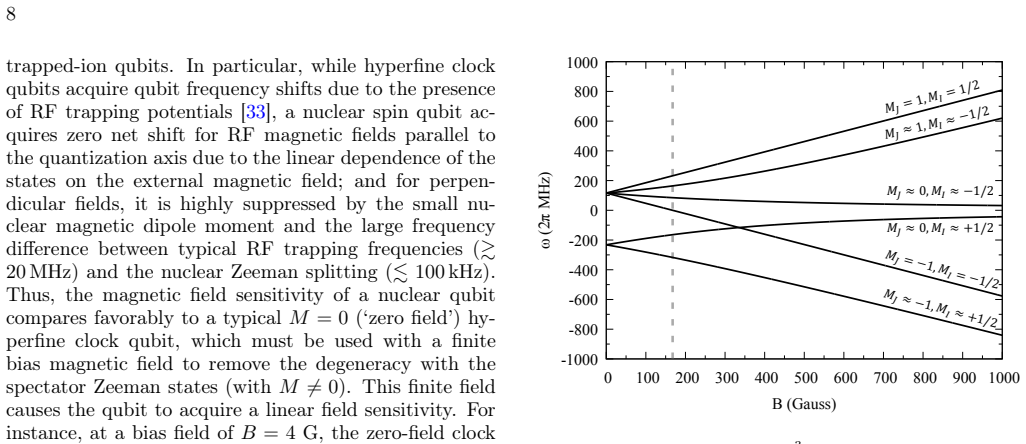
Metastable hyperfine clock qubit The long-lived metastable manifolds offer alterna- tive qubit storage modalities. In particular, at a mag- netic field ofB≈168 Gauss, the4d5s 3D1 manifold hosts a finite-field hyperfine clock qubit between hy- !!=1,!"=1/2 !!≈1,!"≈−1/2 !!≈0,!"≈−1/2!!≈0,!"≈+1/2!!=−1,!"=−1/2!!≈−1,!"≈+1/2 © 2022 by Quantinuum. All rights reser...
2022
-
[3]
coherent
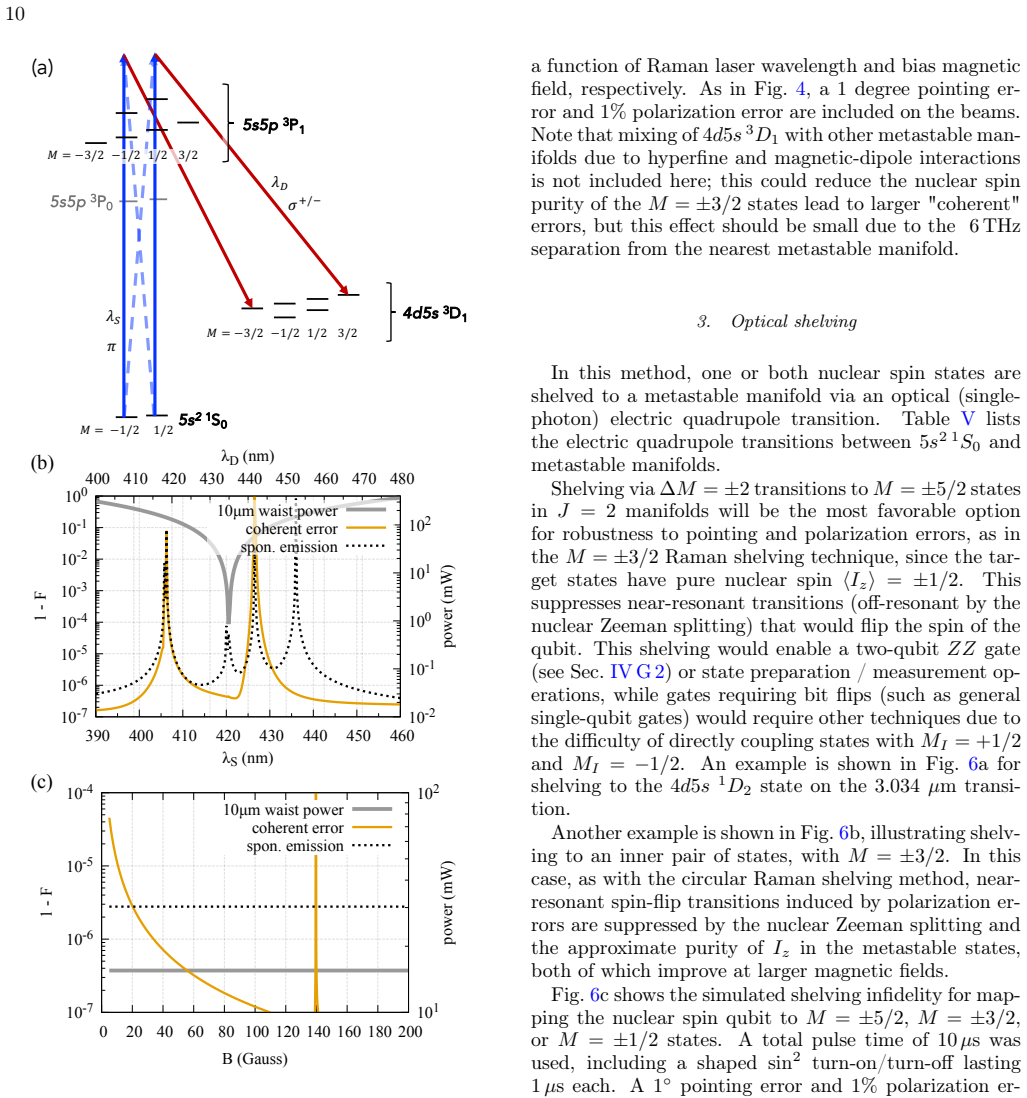
Optical shelving In this method, one or both nuclear spin states are shelved to a metastable manifold via an optical (single- photon) electric quadrupole transition. Table V lists the electric quadrupole transitions between5s2 1S0 and metastable manifolds. Shelvingvia∆M=±2transitionstoM=±5/2states inJ= 2manifolds will be the most favorable option for robu...
2022
-
[4]
This could be done either on the4d5s3D1, M=±1/2states targeted by the circularly polarized shelving scheme of Sec
Laser-based gates One method to perform single-qubit gates is to drive Raman transitions between qubit states in the4d5s3D1 manifold using the4d5s3D1 ↔5s5p 3P0 transition. This could be done either on the4d5s3D1, M=±1/2states targeted by the circularly polarized shelving scheme of Sec. IVC, or on the clock qubit states. Conveniently, 13 11 SQ GATES WITHIN...
2023
-
[5]
Instead, single-qubit magnetic gates could be implemented in a metastable manifold, which additionally protects specta- tor nuclear spin qubits from magnetic field crosstalk
Magnetic gates The nuclear spin qubit5s 2 1S0 is amenable to mag- netic gates, however, its small magnetic moment would require large magnetic fields or long pulse times. Instead, single-qubit magnetic gates could be implemented in a metastable manifold, which additionally protects specta- tor nuclear spin qubits from magnetic field crosstalk. In the4d5s ...
-
[6]
This is similar to the gate described in Refs
Laser-based gates As one example of a laser-based two-qubit gate, we estimate spontaneous emission errors and required in- tensity for a light-shift gate on the dipole transition to 5s5p 3P0 atB= 400 Gauss, with one qubit state in 5s2 1S0, M=−1/2and the other shelved to the lower- energy4d5s 3D1, M= +1/2state. This is similar to the gate described in Refs...
2022
-
[7]
Magnetic gradient gates Ref. [39] proposed a magnetic-gradient multi-qubit gate which is executed by temporarily mapping qubits into magnetic-field-sensitive states and applying a mag- netic gradient oscillating at a frequency close to that of a motional mode. This generates an interaction Hamil- tonian of the form ˆH≈(Ω/2) P q σ(q) z (a† ge−iδt +a geiδt)...
-
[8]
J. P. Gaebler, T. R. Tan, Y. Lin, Y. Wan, R. Bowler, A.C.Keith, S.Glancy, K.Coakley, E.Knill, D.Leibfried, and D. J. Wineland, High-fidelity universal gate set for 9Be + ion qubits, Phys. Rev. Lett.117, 060505 (2016)
2016
-
[9]
C. J. Ballance, T. P. Harty, N. M. Linke, M. A. Sepiol, and D. M. Lucas, High-fidelity quantum logic gates us- ing trapped-ion hyperfine qubits, Phys. Rev. Lett.117, 060504 (2016)
2016
-
[10]
C. R. Clark, H. N. Tinkey, B. C. Sawyer, A. M. Meier, K. A. Burkhardt, C. M. Seck, C. M. Shappert, N. D. Guise, C.E.Volin, S.D.Fallek, H.T.Hayden, W.G.Rel- lergert, and K. R. Brown, High-fidelity bell-state prepa- ration with 40ca+ optical qubits, Phys. Rev. Lett.127, 130505 (2021)
2021
- [11]
-
[12]
J. E. Christensen, D. Hucul, W. C. Campbell, and E. R. Hudson, High-fidelity manipulation of a qubit enabled by a manufactured nucleus, npj Quantum Inf6, 35 (2020)
2020
-
[13]
F. A. An, A. Ransford, A. Schaffer, L. R. Sletten, J. Gae- bler, J. Hostetter, and G. Vittorini, High fidelity state preparation and measurement of ion hyperfine qubits withI > 1 2, Phys. Rev. Lett.129, 130501 (2022)
2022
-
[14]
S. A. Moseset al., A race-track trapped-ion quantum processor, Phys. Rev. X13, 041052 (2023)
2023
-
[15]
Helios: A 98-qubit trapped-ion quantum computer,
A. Ransfordet al., Helios: A 98-qubit trapped-ion quan- tum computer (2025), arXiv:2511.05465 [quant-ph]
-
[16]
D. T. C. Allcock, W. C. Campbell, J. Chiaverini, I. L. Chuang, E. R. Hudson, I. D. Moore, A. Ransford, C. Ro- man, J. M. Sage, and D. J. Wineland,omgblueprint for trapped ion quantum computing with metastable states, Appl. Phys. Lett.119, 214002 (2021)
2021
-
[17]
W. Campbell and E. Hudson, Polyqubit quantum pro- cession, arXiv:2210.15484 (2022)
-
[18]
S. P. Jain, E. R. Hudson, W. C. Campbell, and V. V. Albert, Absorption-emission codes for atomic and molec- ular quantum information platforms, Phys. Rev. Lett. 133, 260601 (2024)
2024
- [19]
-
[20]
Aydin and A
A. Aydin and A. Barg, Class of codes correcting absorp- tions and emissions, Phys. Rev. A111, 022415 (2025)
2025
-
[21]
Lim and A
S. Lim and A. Ardavan, Designing quantum error correc- tion codes for practical spin qudit systems, Phys. Rev. A 112, 022418 (2025)
2025
-
[22]
Jenkins, J
A. Jenkins, J. W. Lis, A. Senoo, W. F. McGrew, and A. M. Kaufman, Ytterbium nuclear-spin qubits in an op- tical tweezer array, Phys. Rev. X12, 021027 (2022)
2022
-
[23]
S. Ma, A. P. Burgers, G. Liu, J. Wilson, B. Zhang, and J. D. Thompson, Universal gate operations on nuclear spin qubits in an optical tweezer array of171Ybatoms, Phys. Rev. X12, 021028 (2022)
2022
-
[24]
Barnes, P
K. Barnes, P. Battaglino, B. J. Bloom, K. Cassella, R. Coxe, N. Crisosto, J. P. King, S. S. Kondov, K. Kotru, S. C. Larsen, J. Lauigan, B. J. Lester, M. McDonald, E. Megidish, S. Narayanaswami, C. Nishiguchi, R. Noter- mans, L. S. Peng, A. Ryou, T.-Y. Wu, and M. Yarwood, Assembly and coherent control of a register of nuclear spin qubits, Nature Communicat...
2022
-
[25]
Kramida, Yu
A. Kramida, Yu. Ralchenko, J. Reader, and NIST ASD Team, NIST Atomic Spectra Database (ver. 5.11), [On- line]. Available:https://physics.nist.gov/asd[2024, June 12]. National Institute of Standards and Technol- ogy, Gaithersburg, MD. (2023)
2024
-
[26]
Wännström, D
A. Wännström, D. Gough, and P. Hannaford, High reso- lution laser spectroscopy on yttrium ions in a sputtered vapour, Zeitschrift für Physik D Atoms, Molecules and Clusters29, 39 (1994)
1994
-
[27]
W. C. Martin and W. L. Wiese, Atomic, molecular, and optical physics handbook (version 2.2), [On- line] Available:https://www.nist.gov/pml/atomic- spectroscopy-compendium-basic-ideas-notation- data-and-formulas[2026, March 7]. National Institute of Standards and Technology, Gaithersburg, MD
2026
-
[28]
Kaewuam, T
R. Kaewuam, T. R. Tan, K. J. Arnold, S. R. Chanu, Z. Zhang, and M. D. Barrett, Hyperfine averaging by dynamic decoupling in a multi-ion lutetium clock, Phys. Rev. Lett.124, 083202 (2020)
2020
-
[29]
Hannaford, R
P. Hannaford, R. Lowe, N. Grevesse, E. Biemont, and W. Whaling, Oscillator strengths for yi and y ii and the solar abundance of yttrium, Astrophysical Journal, Part 1, vol. 261, Oct. 15, 1982, p. 736-746.261, 736 (1982)
1982
-
[30]
E. Paez, K. J. Arnold, E. Hajiyev, S. G. Porsev, V. A. Dzuba, U. I. Safronova, M. S. Safronova, and M. D. Bar- rett, Atomic properties ofLu+, Phys. Rev. A93, 042112 (2016)
2016
-
[31]
N. J. Stone, Table of recommended nuclear magnetic dipole moments: part i, long-lived states, INDC Reports 10.61092/iaea.yjpc-cns6 (2019). 17
-
[32]
G.-Z. Zhu, D. Mitra, B. L. Augenbraun, C. E. Dickerson, M. J. Frim, G. Lao, Z. D. Lasner, A. N. Alexandrova, W. C. Campbell, J. R. Caram, J. M. Doyle, and E. R. Hudson, Functionalizing aromatic compounds with opti- cal cycling centres, Nature Chemistry14, 995 (2022)
2022
-
[33]
S. G. Porsev, M. G. Kozlov, M. S. Safronova, and I. I. Tupitsyn, Development of the configuration- interaction + all-order method and application to the parity-nonconserving amplitude and other properties of pb, Physical Review A93, 10.1103/physreva.93.012501 (2016)
-
[34]
V. A. Dzuba, V. V. Flambaum, M. G. Kozlov, and S. G. Porsev,Usingeffectiveoperatorsincalculatingthehyper- fine structure of atoms, Soviet Journal of Experimental and Theoretical Physics87, 885 (1998)
1998
-
[35]
S. G. Porsev, Y. G. Rakhlina, and M. G. Kozlov, Electric- dipole amplitudes, lifetimes, and polarizabilities of the low-lying levels of atomic ytterbium, Phys. Rev. A60, 2781 (1999)
1999
-
[36]
S. G. Porsev, Y. G. Rakhlina, and M. G. Kozlov, Calcu- lation of hyperfine structure constants for ytterbium, J. Phys. B32, 1113 (1999)
1999
-
[37]
S. G. Porsev and A. Derevianko, Hyperfine quenching of the metastable 3p0,2 states in divalent atoms, Physical Review A69, 042506 (2004)
2004
-
[38]
R. M. Sternheimer, On nuclear quadrupole moments, Physical Review80, 102 (1950)
1950
-
[39]
Dalgarno and J
A. Dalgarno and J. T. Lewis, The exact calculation of long-range forces between atoms by perturbation the- ory, Proceedings of the Royal Society of London233, 70 (1955)
1955
-
[40]
H. C. J. Gan, G. Maslennikov, K.-W. Tseng, T. R. Tan, R. Kaewuam, K. J. Arnold, D. Matsukevich, and M. D. Barrett, Oscillating-magnetic-field effects in high- precision metrology, Phys. Rev. A98, 032514 (2018)
2018
-
[41]
J. A. Muniz, M. Stone, D. T. Stack, M. Jaffe, J. M. Kindem, L. Wadleigh, E. Zalys-Geller, X. Zhang, C.-A. Chen, M. A. Norcia, J. Epstein, E. Halperin, F. Hum- mel, T. Wilkason, M. Li, K. Barnes, P. Battaglino, T. C. Bohdanowicz, G. Booth, A. Brown, M. O. Brown, W. B. Cairncross, K. Cassella, R. Coxe, D. Crow, M. Feldkamp, C. Griger, A. Heinz, A. M. W. Jon...
2025
-
[42]
Yang, J.-Y
H.-X. Yang, J.-Y. Ma, Y.-K. Wu, Y. Wang, M.-M. Cao, W.-X. Guo, Y.-Y. Huang, L. Feng, Z.-C. Zhou, and L.-M. Duan, Realizing coherently convertible dual-type qubits with the same ion species, Nat. Phys.18, 1058 (2022)
2022
-
[43]
Roman, A
C. Roman, A. Ransford, M. Ip, and W. Campbell, Back- ground free high fidelity state preparation and measure- ment (SPAM) in a 171Yb+ qubit, Proc. SPIE 11391, Quantum Information Science, Sensing, and Computa- tion XII1139108(2020)
2020
-
[44]
C. H. Baldwin, B. J. Bjork, M. Foss-Feig, J. P. Gae- bler, D. Hayes, M. G. Kokish, C. Langer, J. A. Sedlacek, D. Stack, and G. Vittorini, High-fidelity light-shift gate for clock-state qubits, Phys. Rev. A103, 012603 (2021)
2021
-
[45]
B. C. Sawyer and K. R. Brown, Wavelength-insensitive, multispecies entangling gate for group-2 atomic ions, Phys. Rev. A103, 022427 (2021)
2021
-
[46]
Ospelkaus, C
C. Ospelkaus, C. E. Langer, J. M. Amini, K. R. Brown, D. Leibfried, and D. J. Wineland, Trapped-ion quantum logic gates based on oscillating magnetic fields, Phys. Rev. Lett.101, 090502 (2008)
2008
-
[47]
H. Uys, M. J. Biercuk, A. P. VanDevender, C. Ospelkaus, D. Meiser, R. Ozeri, and J. J. Bollinger, Decoherence due to elastic rayleigh scattering, Phys. Rev. Lett.105, 200401 (2010)
2010
-
[48]
I. D. Moore, W. C. Campbell, E. R. Hudson, M. J. Bo- guslawski, D. J. Wineland, and D. T. C. Allcock, Photon scattering errors during stimulated raman transitions in trapped-ion qubits, Phys. Rev. A107, 032413 (2023)
2023
-
[49]
H. J. Carmichael,Statistical Methods in Quantum Op- tics 1: Master Equations and Fokker-Planck Equations (Springer Berlin, Heidelberg, 1998)
1998
-
[50]
D. F. James and J. Jerke, Effective hamiltonian theory and its applications in quantum informa- tion, Canadian Journal of Physics85, 625 (2007), https://doi.org/10.1139/p07-060
-
[51]
Cabrera and W
R. Cabrera and W. Baylis, Average fidelity in n-qubit systems, Physics Letters A368, 25–28 (2007)
2007
-
[52]
Chen and C
Y.-H. Chen and C. H. Baldwin, Randomized benchmark- ing with leakage errors, Phys. Rev. Res.7, 043065 (2025). 18 Appendix A: Reduced matrix elements Upper Term Level Lower Term Levelλ<Up||E,M||Low> Tr. rate 4d5s a 3D1 840.2 5s 2 a 1S0 0.0 11902.0 M1 6.5(4)×10 −5 2.22(25)×10−11 a 3D2 1045.1 5s 2 a 1S0 0.0 9568.7 E2 -1.19(6) 3.9(4)×10 −8 4d5s a 3D1 840.2 48...
2025
-
[53]
[40, 41]
Master equation To estimate the impacts of spontaneous emission (pho- ton scattering) during the Raman shelving and gate op- erations, we extend the treatments of Refs. [40, 41]. Ref. [41] evaluated photon scattering rates using Fermi’s Golden Rule to obtain Raman transition rates due to laser photon absorption and emission into the vacuum, including the ...
-
[54]
evaluated dephasing of a two-level system (a qubit) due to Rayleigh scattering, without considering counter- rotating scattering processes. To capture dephasing effects between all four states in the nuclear spin shelving process, and to include the effects of counter-rotating terms in the dephasing, we de- rive the two-photon dissipator for the master eq...
-
[55]
Gate fidelities The average fidelity of a single-qubit quantum logic operation, allowing for the possibility of leakage to states outside the computational (qubit) subspace, can be de- termined by a simple adaptation of results in Ref. [44]. (Effects of leakage have also been analyzed in Ref. [45].) Denoting the trace over the computational subspace as tr...
discussion (0)
Sign in with ORCID, Apple, or X to comment. Anyone can read and Pith papers without signing in.