Recognition: 2 theorem links
· Lean TheoremGaussian Field Representations for Turbulent Flow: Compression, Scale Separation, and Physical Fidelity
Pith reviewed 2026-05-10 18:18 UTC · model grok-4.3
The pith
Superpositions of learnable Gaussian kernels compress turbulent velocity fields by factors above 1000 while recovering small-scale structures when made anisotropic.
A machine-rendered reading of the paper's core claim, the machinery that carries it, and where it could break.
Core claim
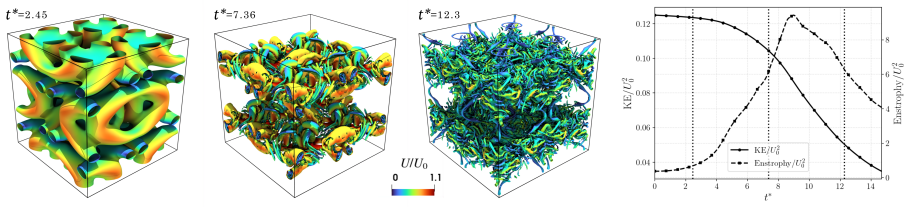
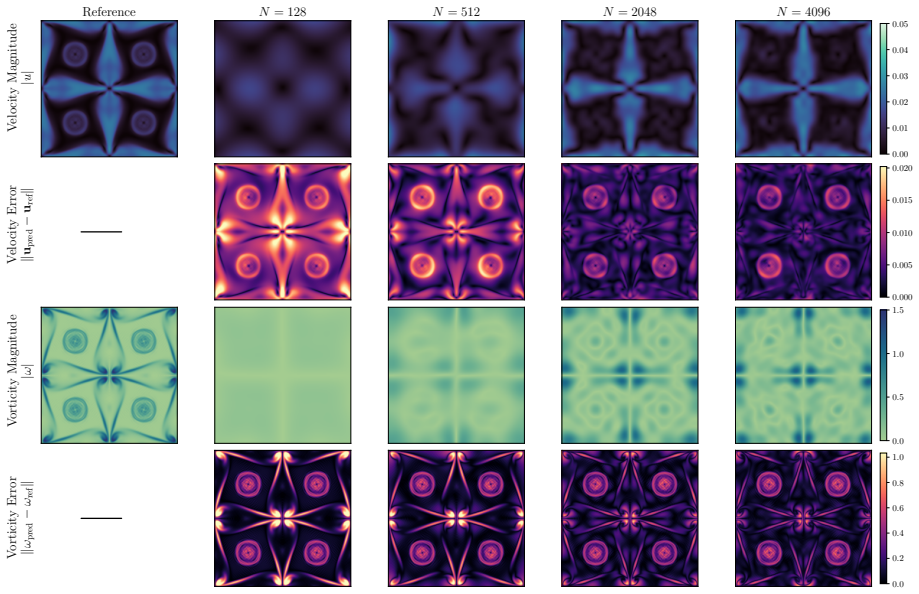
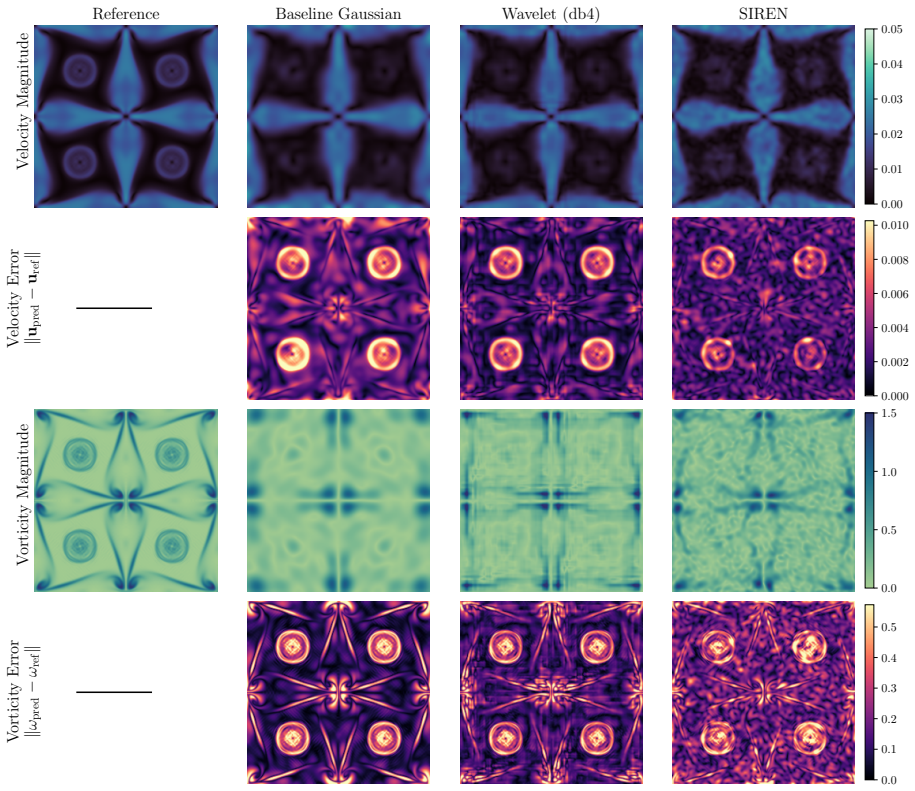
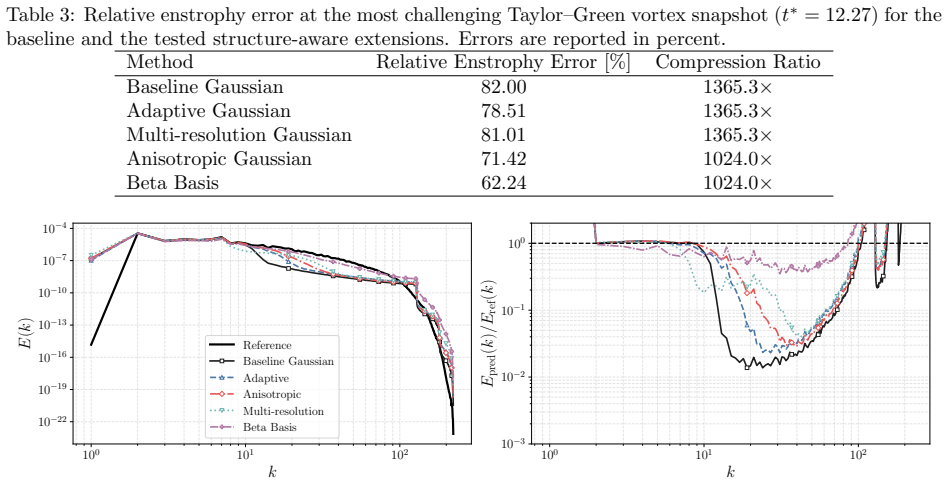
The velocity field is expressed as a superposition of localized Gaussian primitives with optimizable positions, amplitudes, and scales. Tested on three-dimensional Taylor-Green vortex data from laminar through fully turbulent stages, the isotropic version delivers accurate velocity at compression ratios exceeding 10^3 to 10^4 but degrades enstrophy. Among structure-aware variants, the anisotropic formulation gives the most consistent gains by better matching elongated vortical structures and recovering intermediate- to high-wavenumber energy. The results identify insufficient geometric expressiveness, not parameter count, as the central limitation of the baseline approach.
What carries the argument
Localized Gaussian primitives with learnable positions, amplitudes, and anisotropic scales that together form a continuous parametric representation of the velocity field.
If this is right
- Compression ratios of 1000 to 10000 are attainable while keeping velocity error low.
- Anisotropic kernels recover more enstrophy and high-wavenumber content than isotropic, adaptive-placement, or multi-resolution versions.
- Vorticity and enstrophy follow directly from analytic derivatives of the same parametric form.
- The dominant limitation is the geometric flexibility of the kernel shapes rather than their total number.
Where Pith is reading between the lines
- The continuous form could support fitting procedures that directly penalize deviations from known physical invariants.
- The scale-separation property might be used to construct hybrid models that resolve only the unresolved residual field.
- Testing the same kernels on other canonical flows would reveal whether the observed gains hold beyond the Taylor-Green case.
Load-bearing premise
The Taylor-Green vortex evolution is representative of the challenges in representing general turbulent flows, and that optimization of the kernel parameters can recover small-scale structures without introducing artifacts.
What would settle it
Direct comparison of the enstrophy spectrum from the anisotropic Gaussian reconstruction against the original data at a compression ratio of 5000, checking whether dissipative-scale energy is recovered without localized artifacts.
Figures






read the original abstract
Representing turbulent flow fields in a compact yet physically faithful form remains a central challenge in computational fluid dynamics. We propose a continuous parametric representation based on localized Gaussian primitives, in which the velocity field is modeled as a superposition of kernels with learnable positions, amplitudes, and scales. This formulation yields a compact, grid-independent encoding while enabling evaluation of derived quantities such as vorticity and enstrophy. The approach is assessed on three-dimensional Taylor-Green vortex fields spanning stages from smooth flow to fully developed turbulence. We quantify the compression-accuracy trade-off using both primary variables and derivative-sensitive diagnostics. The baseline isotropic formulation achieves high velocity accuracy at compression ratios exceeding 1e3-1e4, but exhibits substantial enstrophy degradation due to loss of small-scale structure. To address this limitation, we investigate structure-aware extensions including adaptive placement, multi-resolution kernels, and anisotropic Gaussians. The anisotropic formulation provides the most consistent improvement, better aligning with elongated vortical structures and recovering intermediate- and high-wavenumber content, while other strategies yield modest gains. A compact-support Beta basis improves enstrophy in some cases but introduces localized artifacts. Overall, the results indicate that the main limitation of baseline Gaussian representations lies in geometric expressiveness rather than parameter count. The proposed framework provides a compact, interpretable, and continuous representation of turbulent flows, and establishes a foundation for structure-aware and physics-informed flow compression.
Editorial analysis
A structured set of objections, weighed in public.
Referee Report
Summary. The manuscript proposes a continuous parametric representation of turbulent velocity fields as superpositions of localized Gaussian kernels with learnable positions, amplitudes, and scales. This yields a compact, grid-independent encoding that permits direct evaluation of derived quantities such as vorticity and enstrophy. The method is assessed exclusively on three-dimensional Taylor-Green vortex fields spanning laminar to turbulent regimes, where the isotropic baseline achieves high velocity accuracy at compression ratios exceeding 1e3–1e4 but suffers enstrophy degradation; structure-aware extensions (adaptive placement, multi-resolution kernels, anisotropic Gaussians, and compact-support Beta bases) are compared, with anisotropic kernels providing the largest gains in intermediate- and high-wavenumber recovery. The central conclusion is that the principal limitation of baseline Gaussian representations is geometric expressiveness rather than parameter count.
Significance. If the reported improvements hold under broader testing, the framework supplies a compact, interpretable, and differentiable representation that could support compression, reduced-order modeling, and physics-informed learning in fluid dynamics. The explicit use of derivative-sensitive diagnostics (enstrophy) is a positive feature that directly addresses physical fidelity beyond L2 velocity error. No machine-checked proofs or parameter-free derivations are present, but the empirical focus on scale separation is clearly articulated.
major comments (3)
- [Abstract] Abstract: the headline claim that 'the main limitation of baseline Gaussian representations lies in geometric expressiveness rather than parameter count' rests on Taylor-Green vortex results alone; no ablation that holds total parameter count fixed while varying only geometric flexibility (e.g., isotropic vs. anisotropic at equal degrees of freedom) is reported, and no additional flows (forced HIT, wall-bounded shear) are tested to support generalization.
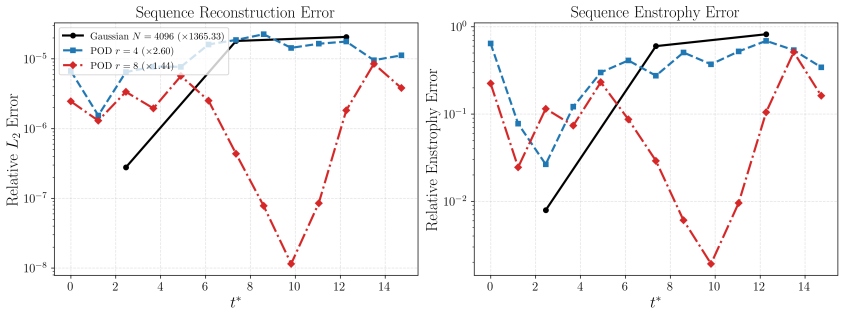
- [Abstract] Abstract and results section: quantitative error metrics, error bars, baseline comparisons (e.g., against POD, wavelet, or learned autoencoder representations), and optimization convergence diagnostics are absent despite explicit claims of compression ratios exceeding 1e3–1e4 and 'qualitative improvements'; this leaves the accuracy–compression trade-off and the superiority of anisotropic kernels only modestly supported.
- [Methods] The optimization procedure for kernel parameters is described only at a high level; without details on initialization, regularization, convergence criteria, or sensitivity to local minima, it is unclear whether the reported enstrophy recovery is robust or artifact-free, which is load-bearing because the entire approach relies on empirical fitting.
minor comments (2)
- [Section 2] Notation for the anisotropic kernel covariance matrix and its relation to the isotropic scale parameter should be clarified with an explicit equation.
- [Figures] Figure captions should include the precise compression ratio and enstrophy error values shown in each panel for direct comparison.
Simulated Author's Rebuttal
We thank the referee for the constructive and detailed comments. These highlight important aspects of experimental design, quantitative rigor, and methodological transparency that will strengthen the manuscript. We address each major comment below and describe the revisions we will implement.
read point-by-point responses
-
Referee: [Abstract] Abstract: the headline claim that 'the main limitation of baseline Gaussian representations lies in geometric expressiveness rather than parameter count' rests on Taylor-Green vortex results alone; no ablation that holds total parameter count fixed while varying only geometric flexibility (e.g., isotropic vs. anisotropic at equal degrees of freedom) is reported, and no additional flows (forced HIT, wall-bounded shear) are tested to support generalization.
Authors: We agree that the headline claim is supported primarily by the Taylor-Green vortex experiments, which were selected to isolate the laminar-to-turbulent transition in a canonical setting. In the current comparisons the number of kernels was matched across variants, yet the anisotropic formulation uses additional degrees of freedom per kernel. To isolate geometric flexibility we will add a dedicated ablation that exactly equalizes total parameter count (by reducing the number of anisotropic kernels accordingly) and report the resulting velocity and enstrophy errors. We also acknowledge that generalization beyond Taylor-Green vortex is not demonstrated; the manuscript will be revised to include an explicit limitations paragraph noting the single-flow scope and outlining planned extensions to forced homogeneous isotropic turbulence and wall-bounded shear flows. revision: yes
-
Referee: [Abstract] Abstract and results section: quantitative error metrics, error bars, baseline comparisons (e.g., against POD, wavelet, or learned autoencoder representations), and optimization convergence diagnostics are absent despite explicit claims of compression ratios exceeding 1e3–1e4 and 'qualitative improvements'; this leaves the accuracy–compression trade-off and the superiority of anisotropic kernels only modestly supported.
Authors: We accept that the current presentation relies on figures without accompanying tabulated metrics or statistical variability. The revised results section will include tables of L2 velocity and enstrophy errors (with standard deviations computed over five independent optimization runs) at the reported compression ratios. We will also add direct quantitative comparisons against POD and discrete wavelet compression at matched compression ratios, together with optimization convergence curves (loss versus iteration) to document that the reported enstrophy recovery is not an artifact of early stopping. These additions will place the accuracy–compression trade-off and the relative performance of anisotropic kernels on a firmer quantitative footing. revision: yes
-
Referee: [Methods] The optimization procedure for kernel parameters is described only at a high level; without details on initialization, regularization, convergence criteria, or sensitivity to local minima, it is unclear whether the reported enstrophy recovery is robust or artifact-free, which is load-bearing because the entire approach relies on empirical fitting.
Authors: The optimization description was intentionally concise. In the revised Methods section we will specify: (i) initialization by uniform sampling of kernel centers on a coarse Cartesian grid with amplitudes drawn from the local velocity magnitude; (ii) L2 regularization on amplitudes and scales with a fixed coefficient of 1e-4; (iii) convergence when the relative change in the composite loss falls below 1e-6 for ten consecutive iterations; and (iv) a sensitivity study repeating each fit from five random initializations and reporting the resulting spread in final enstrophy error. These details will allow readers to assess the robustness of the reported improvements. revision: yes
Circularity Check
No significant circularity; empirical fitting and comparative evaluation on TGV.
full rationale
The paper defines a parametric Gaussian representation, optimizes its parameters (positions, amplitudes, scales) against TGV velocity fields, and reports accuracy metrics including enstrophy for isotropic, anisotropic, and multi-resolution variants. The central inference that geometric expressiveness (not parameter count) is the limiting factor follows directly from these comparative numerical results rather than from any equation that reduces to its own inputs by construction. No self-definitional loops, fitted quantities renamed as predictions, or load-bearing self-citations appear in the provided text. The derivation chain remains self-contained as standard data-driven compression validated on a benchmark flow.
Axiom & Free-Parameter Ledger
free parameters (1)
- Gaussian positions, amplitudes, and scales
axioms (1)
- domain assumption Turbulent velocity fields can be represented as a superposition of localized Gaussian kernels with sufficient accuracy for both velocity and derived quantities.
Lean theorems connected to this paper
-
IndisputableMonolith/Cost/FunctionalEquation.leanwashburn_uniqueness_aczel unclear?
unclearRelation between the paper passage and the cited Recognition theorem.
velocity field modeled as superposition of kernels with learnable positions, amplitudes, and scales... anisotropic Gaussian kernels... enstrophy error
-
IndisputableMonolith/Foundation/AlexanderDuality.leanalexander_duality_circle_linking unclear?
unclearRelation between the paper passage and the cited Recognition theorem.
three-dimensional Taylor–Green vortex... anisotropic formulation... geometric expressiveness rather than parameter count
What do these tags mean?
- matches
- The paper's claim is directly supported by a theorem in the formal canon.
- supports
- The theorem supports part of the paper's argument, but the paper may add assumptions or extra steps.
- extends
- The paper goes beyond the formal theorem; the theorem is a base layer rather than the whole result.
- uses
- The paper appears to rely on the theorem as machinery.
- contradicts
- The paper's claim conflicts with a theorem or certificate in the canon.
- unclear
- Pith found a possible connection, but the passage is too broad, indirect, or ambiguous to say the theorem truly supports the claim.
Reference graph
Works this paper leans on
-
[1]
ISSN 1095-7200. doi: 10.1137/130932715. G Berkooz, P Holmes, and J L Lumley. The proper orthogonal decomposition in the analysis of turbulent flows.Annual Review of Fluid Mechanics, 25(1):539–575, January
-
[2]
doi: 10.1146/ annurev.fl.25.010193.002543
ISSN 1545-4479. doi: 10.1146/ annurev.fl.25.010193.002543. Marc E. Brachet, Daniel I. Meiron, Steven A. Orszag, B. G. Nickel, Rudolf H. Morf, and Uriel Frisch. Small- scale structure of the taylor–green vortex.Journal of Fluid Mechanics, 130:411–452, May
-
[3]
ISSN 1469-7645. doi: 10.1017/s0022112083001159. Steven L. Brunton, Bernd R. Noack, and Petros Koumoutsakos. Machine learning for fluid mechan- ics.Annual Review of Fluid Mechanics, 52(1):477–508, January
-
[4]
ISBN 9780511543241. doi: 10.1017/cbo9780511543241. Ingrid Daubechies.Ten Lectures on Wavelets. Society for Industrial and Applied Mathematics, January
-
[5]
ISBN 9781611970104. doi: 10.1137/1.9781611970104. Feilong Du, Yalan Zhang, Yihang Ji, Xiaokun Wang, Chao Yao, Jiri Kosinka, Steffen Frey, Telea Alexan- dru, and Xiaojuan Ban. Gaussfluids: Reconstructing lagrangian fluid particles from videos via gaussian splatting.Pacific Graphics Conference Papers, Posters, and Demos,
-
[6]
doi: 10.2312/PG.20251286. Gregory E. Fasshauer and Jack G. Zhang. On choosing “optimal” shape parameters for rbf approximation. Numerical Algorithms, 45(1–4):345–368, March
-
[7]
doi: 10.1007/s11075-007-9072-8
ISSN 1572-9265. doi: 10.1007/s11075-007-9072-8. Uriel Frisch.Turbulence: The Legacy of A.N. Kolmogorov. Cambridge University Press, November
-
[8]
ISBN 9780521457132. doi: 10.1017/cbo9781139170666. Bernhard Kerbl, Georgios Kopanas, Thomas Leimkuehler, and George Drettakis. 3d gaussian splatting for real-time radiance field rendering.ACM Transactions on Graphics, 42(4):1–14, July
-
[9]
https://doi.org/10.1145/3592433 Xiaonan Kong and Riley G
ISSN 1557-7368. doi: 10.1145/3592433. David J. Lucia, Philip S. Beran, and Walter A. Silva. Reduced-order modeling: new approaches for com- putational physics.Progress in Aerospace Sciences, 40(1–2):51–117, February
-
[10]
doi: 10.1016/j.paerosci.2003.12.001
ISSN 0376-0421. doi: 10.1016/j.paerosci.2003.12.001. S.G. Mallat. A theory for multiresolution signal decomposition: the wavelet representation.IEEE Trans- actions on Pattern Analysis and Machine Intelligence, 11(7):674–693, July
-
[11]
, year = 1989, month = jul, journal =
ISSN 0162-8828. doi: 10.1109/34.192463. 15 Ben Mildenhall, Pratul P. Srinivasan, Matthew Tancik, Jonathan T. Barron, Ravi Ramamoorthi, and Ren Ng. Nerf: representing scenes as neural radiance fields for view synthesis.Communications of the ACM, 65(1):99–106, December
-
[12]
ISSN 1557-7317. doi: 10.1145/3503250. Chlo´ e Mimeau and Iraj Mortazavi. A review of vortex methods and their applications: From creation to recent advances.Fluids, 6(2):68, February
-
[13]
ISSN 2311-5521. doi: 10.3390/fluids6020068. Mohammadreza Momenifar, Enmao Diao, Vahid Tarokh, and Andrew D. Bragg. A physics-informed vector quantized autoencoder for data compression of turbulent flow. In2022 Data Compression Conference (DCC), page 01–10. IEEE, March
-
[14]
doi: 10.1109/dcc52660.2022.00039. Stephen B. Pope.Turbulent Flows. Cambridge University Press, August
-
[15]
ISBN 9780511840531. doi: 10.1017/cbo9780511840531. Subhrangshu Purkayastha and Mohammad Saud Afzal. Review of smooth particle hydrodynamics and its applications for environmental flows.Journal of The Institution of Engineers (India): Series A, 103(3): 921–941, June
-
[16]
doi: 10.1007/s40030-022-00650-4
ISSN 2250-2157. doi: 10.1007/s40030-022-00650-4. C. W. Rowley. Model reduction for fluids, using balanced proper orthogonal decomposition.Inter- national Journal of Bifurcation and Chaos, 15(03):997–1013, March
-
[17]
doi: 10.1142/s0218127405012429
ISSN 1793-6551. doi: 10.1142/s0218127405012429. P. J. Schmid. Dynamic mode decomposition of numerical and experimental data.Journal of Fluid Mechanics, 656:5–28, July
-
[18]
ISSN 1469-7645. doi: 10.1017/s0022112010001217. Vincent Sitzmann, Julien N. P. Martel, Alexander W. Bergman, David B. Lindell, and Gordon Wetzstein. Implicit neural representations with periodic activation functions.arXiv preprint,
-
[19]
doi: 10.48550/ arXiv.2006.09661. Matthew Tancik, Pratul P. Srinivasan, Ben Mildenhall, Sara Fridovich-Keil, Nithin Raghavan, Utkarsh Singhal, Ravi Ramamoorthi, Jonathan T. Barron, and Ren Ng. Fourier features let networks learn high frequency functions in low dimensional domains,
-
[20]
ISSN 1533-385X. doi: 10.2514/1.j058291. Youchen Xie, Chen Li, Sheng Qiu, Zhi-Jun Wang, Chenhui Li, Yibo Zhao, Zan Gao, and Changbo Wang. FluidGS: Physics informed gaussian splatting for dynamic fluid reconstruction from sparse views. In Proceedings of the 33rd ACM International Conference on Multimedia, MM ’25, page 8438–8447. ACM, October
-
[21]
Jingrui Xing, Bin Wang, Mengyu Chu, and Baoquan Chen
doi: 10.1145/3746027.3755500. Jingrui Xing, Bin Wang, Mengyu Chu, and Baoquan Chen. Gaussian fluids: A grid-free fluid solver based on gaussian spatial representation. InProceedings of the Special Interest Group on Computer Graphics and Interactive Techniques Conference Conference Papers, SIGGRAPH Conference Papers ’25, page 1–11. ACM, July
-
[22]
doi: 10.1145/3721238.3730620. A Training Details This appendix summarizes the training configuration used throughout the manuscript. Unless otherwise stated, all models share the same optimization procedure and differ only in kernel parameterization or initialization strategy. 16 A.1 Data and Preprocessing All flow fields are read from structured-grid VTK...
discussion (0)
Sign in with ORCID, Apple, or X to comment. Anyone can read and Pith papers without signing in.