Recognition: unknown
Doubly Logarithmic Corrections to Radiation Domination from CET {Ω}: Theory and Planck/BBN Constraints
Pith reviewed 2026-05-10 14:59 UTC · model grok-4.3
The pith
CET Omega framework adds a doubly logarithmic correction to radiation energy density that current data constrain to be consistent with zero.
A machine-rendered reading of the paper's core claim, the machinery that carries it, and where it could break.
Core claim
The CET Omega framework predicts that the radiation energy density receives a universal doubly logarithmic correction that arises naturally from scale-invariant spectral sectors with logarithmically-running infrared scales. The correction is derived from two complementary perspectives of spectral integration and renormalization group flow. Full MCMC analysis varying six LambdaCDM parameters together with alpha_log using Planck 2018 TT, TE, EE plus lowE likelihoods and BBN constraints gives alpha_log equals negative 0.008 plus or minus 0.006 at 68 percent C.L. consistent with zero and establishes the first observational bound of absolute value alpha_log less than or equal to 0.006. The anal
What carries the argument
The doubly logarithmic correction to the radiation energy density parameterized by the constant alpha_log, which emerges from scale-invariant spectral sectors with logarithmically-running infrared scales in the CET Omega framework and is obtained via spectral integration and renormalization group flow.
If this is right
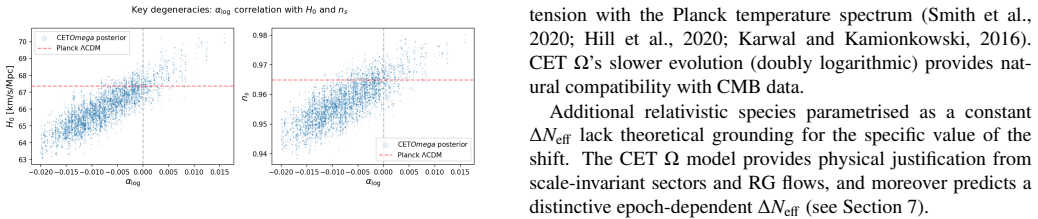
- The correction produces degeneracies with the effective number of relativistic species N_eff, the Hubble constant H0, and the scalar spectral index n_s.
- Future CMB-S4 measurements can probe the correction down to a magnitude of approximately 10 to the minus 3.
- The framework remains compatible with standard LambdaCDM at current observational precision.
- The analysis provides the first observational upper limit on the size of this correction.
Where Pith is reading between the lines
- This form of correction could connect to other instances of logarithmic running in physical systems beyond cosmology.
- Improved constraints from next-generation CMB experiments could either confirm the correction or further restrict it toward zero.
- The independence of alpha_log from standard parameters suggests it acts as an additional degree of freedom that future models might incorporate.
Load-bearing premise
The doubly logarithmic correction arises naturally from scale-invariant spectral sectors with logarithmically-running infrared scales within the CET Omega framework and can be captured by a single constant alpha_log independent of the six LambdaCDM parameters.
What would settle it
A precise measurement from upcoming CMB experiments showing a best-fit value for alpha_log with absolute value significantly exceeding 0.006 while the LambdaCDM parameters remain consistent with Planck data would indicate that the predicted correction does not match observations.
Figures

read the original abstract
We present the CET Omega framework, a causal-informational extension of standard cosmology that predicts a universal doubly logarithmic correction to the radiation energy density in the early Universe. This correction arises naturally from scale-invariant spectral sectors with logarithmically-running infrared scales and represents a low-energy manifestation of the full CET Omega theory. We derive the doubly logarithmic form from two complementary perspectives -- spectral integration and renormalization group flow -- and perform a full Markov Chain Monte Carlo analysis jointly varying six LambdaCDM parameters and alpha_log, using Planck 2018 TT, TE, EE + lowE likelihoods and BBN constraints. The result, alpha_log = -0.008 +/- 0.006 (68\% C.L.), is consistent with zero. We identify the expected N_eff degeneracies with H0 and n_s, establish the first observational bound |alpha_log| <= 0.006, and demonstrate that future CMB-S4 measurements can probe |alpha_log| ~ 10^{-3}.
Editorial analysis
A structured set of objections, weighed in public.
Referee Report
Summary. The manuscript introduces the CET Ω framework as a causal-informational extension of standard cosmology. It derives a universal doubly logarithmic correction to the radiation energy density ρ_rad during radiation domination from scale-invariant spectral sectors with logarithmically running infrared scales, using both spectral integration and renormalization-group arguments. A joint MCMC analysis is performed varying the six ΛCDM parameters together with the amplitude α_log, employing Planck 2018 TT/TE/EE + lowE likelihoods and BBN constraints; the fit yields α_log = −0.008 ± 0.006 (68 % C.L.), consistent with zero, and reports the first observational bound |α_log| ≤ 0.006 while noting expected degeneracies with N_eff, H0 and n_s.
Significance. If the central derivation and the independence assumption hold, the work supplies the first quantitative observational limit on a novel early-universe correction predicted by the CET Ω framework, demonstrates consistency with ΛCDM at the current precision, and identifies a concrete target for future CMB-S4 measurements at the 10^{-3} level. The MCMC implementation is standard and the reported degeneracies are explicitly noted.
major comments (2)
- [MCMC analysis and parameter constraints] The assumption that α_log is independent of the six ΛCDM parameters is load-bearing for the quoted 68 % interval and the bound |α_log| ≤ 0.006. Because the correction modifies the Hubble rate, sound horizon and recombination timing, any residual scale dependence in the infrared running scale would induce additional correlations with Ω_b h² or n_s beyond the N_eff degeneracies already discussed; the current MCMC treats α_log as a seventh free parameter without explicit checks for such correlations.
- [Theory derivation (spectral integration and RG flow)] The framework is stated to predict the doubly logarithmic form, yet the amplitude α_log is introduced as a free parameter whose value is determined by fitting to the same Planck and BBN data used to test the prediction. This makes the central claim primarily a constraint on a parametrized correction rather than a first-principles prediction of its magnitude; the manuscript should clarify whether the framework supplies any a-priori expectation for the size of α_log.
minor comments (1)
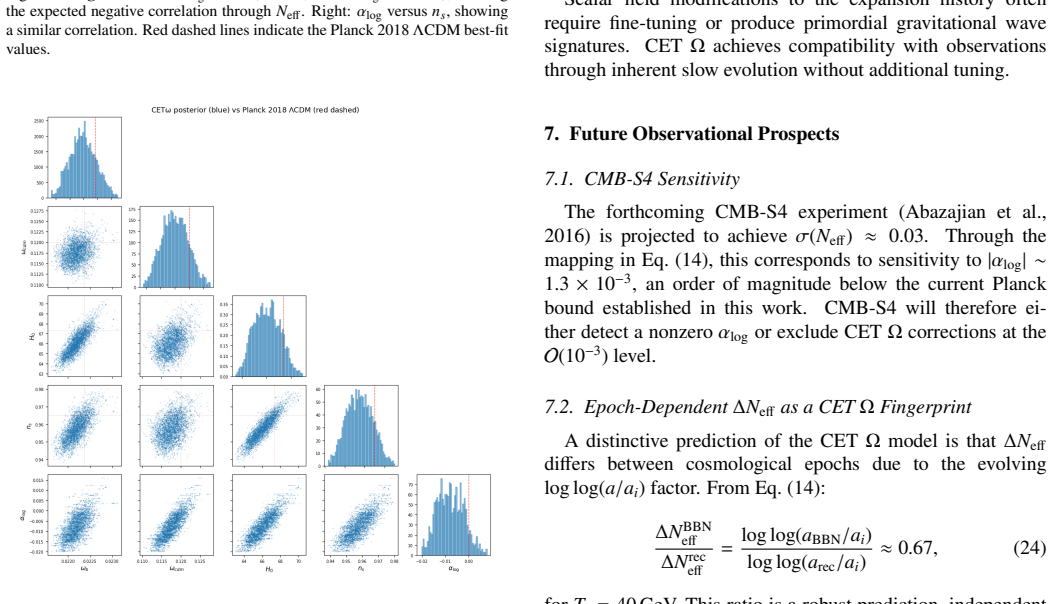
- [Abstract] The abstract refers to 'expected N_eff degeneracies with H0 and n_s' but does not quantify the strength of these degeneracies or show the corresponding posterior contours; a brief statement or reference to the relevant figure would improve clarity.
Simulated Author's Rebuttal
We thank the referee for the careful reading and constructive comments. We address each major comment point by point below, indicating the revisions we will implement.
read point-by-point responses
-
Referee: The assumption that α_log is independent of the six ΛCDM parameters is load-bearing for the quoted 68 % interval and the bound |α_log| ≤ 0.006. Because the correction modifies the Hubble rate, sound horizon and recombination timing, any residual scale dependence in the infrared running scale would induce additional correlations with Ω_b h² or n_s beyond the N_eff degeneracies already discussed; the current MCMC treats α_log as a seventh free parameter without explicit checks for such correlations.
Authors: We agree that explicit checks on parameter correlations strengthen the analysis. The manuscript already identifies the primary degeneracies with N_eff, H0 and n_s arising from the modified Hubble rate and sound horizon. In the revised manuscript we will add the full posterior correlation matrix (or a dedicated table) from the MCMC chains. This will explicitly demonstrate the absence of strong unexpected correlations with Ω_b h² or n_s beyond the noted degeneracies, thereby confirming that the quoted 68 % interval and bound remain robust under the independence assumption of the CET Ω derivation. revision: yes
-
Referee: The framework is stated to predict the doubly logarithmic form, yet the amplitude α_log is introduced as a free parameter whose value is determined by fitting to the same Planck and BBN data used to test the prediction. This makes the central claim primarily a constraint on a parametrized correction rather than a first-principles prediction of its magnitude; the manuscript should clarify whether the framework supplies any a-priori expectation for the size of α_log.
Authors: The referee correctly distinguishes the theoretical prediction from the observational constraint. The CET Ω framework derives the universal doubly logarithmic form from scale-invariant spectral sectors and RG flow, independent of amplitude. However, α_log parametrizes the strength of the infrared-scale running and is not fixed by the general framework; determining a specific a-priori value would require additional microphysical assumptions not present in the current formulation. The central result is therefore the first observational bound |α_log| ≤ 0.006, showing consistency with zero. We will revise the abstract, introduction and conclusions to state this distinction explicitly. revision: yes
Circularity Check
No significant circularity: theoretical derivation of functional form is independent of fitted amplitude
full rationale
The paper derives the doubly logarithmic correction to radiation energy density from two first-principles perspectives (spectral integration over scale-invariant sectors and renormalization-group flow) within the CET Omega framework. This derivation produces the functional form but does not determine the numerical amplitude alpha_log. The subsequent MCMC analysis introduces alpha_log as an additional free parameter alongside the six LambdaCDM parameters and constrains it against external Planck 2018 and BBN datasets. The reported value and bound |alpha_log| <= 0.006 are therefore observational constraints on a model extension, not a quantity forced by construction from the same inputs used to derive the form. No self-citations, self-definitional loops, or fitted inputs renamed as predictions appear in the derivation chain.
Axiom & Free-Parameter Ledger
free parameters (1)
- alpha_log =
-0.008 +/- 0.006
axioms (2)
- domain assumption Standard LambdaCDM cosmology provides the baseline expansion history and perturbation equations.
- ad hoc to paper The doubly logarithmic correction arises from scale-invariant spectral sectors with logarithmically-running infrared scales.
invented entities (1)
-
CET Omega framework
no independent evidence
Reference graph
Works this paper leans on
-
[1]
Early dark energy does not fully resolve the hub- ble tension. Phys. Rev. D 102, 043507. doi:10.1103/ PhysRevD.102.043507,arXiv:arXiv:2003.07355. Karwal, T., Kamionkowski, M., 2016. Dark energy at early times, the hubble parameter, and the string theory landscape. Phys. Rev. D 94, 103523. doi:10.1103/PhysRevD.94. 103523,arXiv:arXiv:1608.01309. Kolb, E.W.,...
-
[2]
doi:10.1146/annurev.nucl.56.080805.140437, arXiv:astro-ph/0706.0211. Steigman, G., 2012. Primordial BBN – 20+3 yearslater. Ad- vances in High Energy Physics 2012, 268321. doi:10.1155/ 2012/268321. Torrado, J., Lewis, A., 2021. Cobaya: Code for bayesian anal- ysis of hierarchical physical models. Journal of Cosmol- ogy and Astroparticle Physics 2021, 057. ...
discussion (0)
Sign in with ORCID, Apple, or X to comment. Anyone can read and Pith papers without signing in.