Recognition: unknown
Observational tests of texorpdfstring{Λ(t)}{Lambda(t)} cosmology in light of DESI DR2
Pith reviewed 2026-05-10 07:24 UTC · model grok-4.3
The pith
Decaying vacuum models fit DESI DR2 and related data with a Hubble constant near 73 km/s/Mpc and an evolution parameter of 0.3.
A machine-rendered reading of the paper's core claim, the machinery that carries it, and where it could break.
Core claim
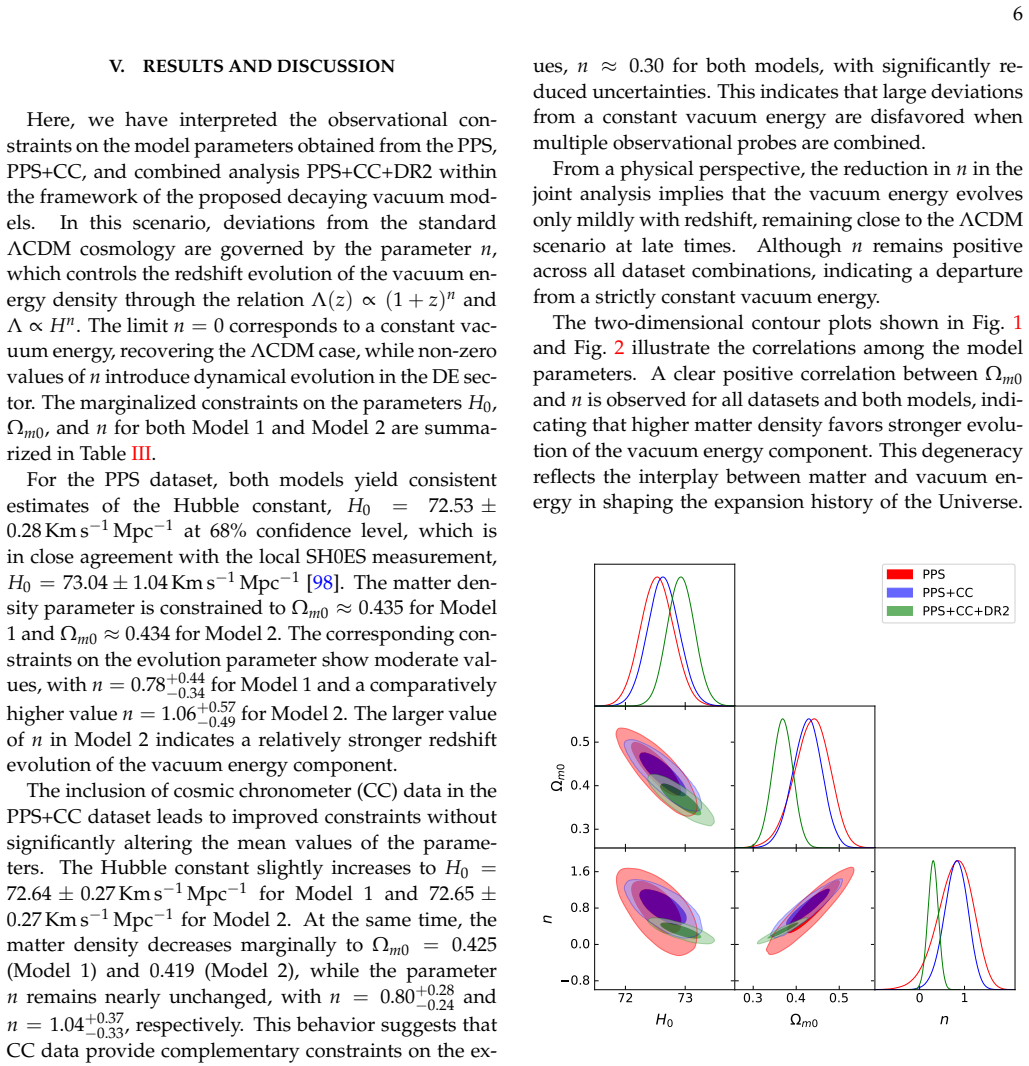
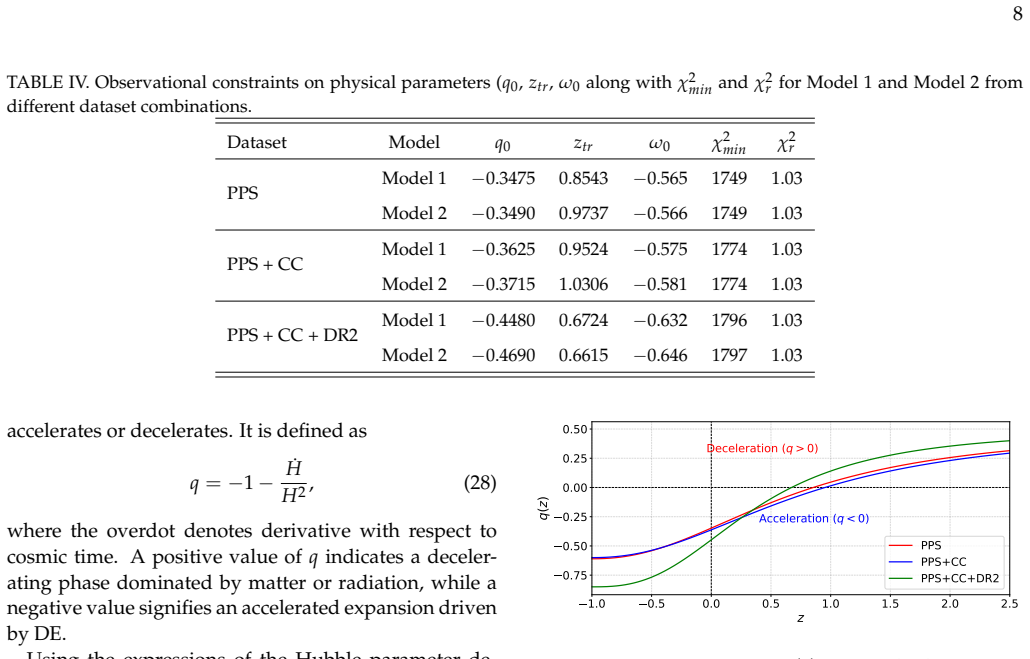
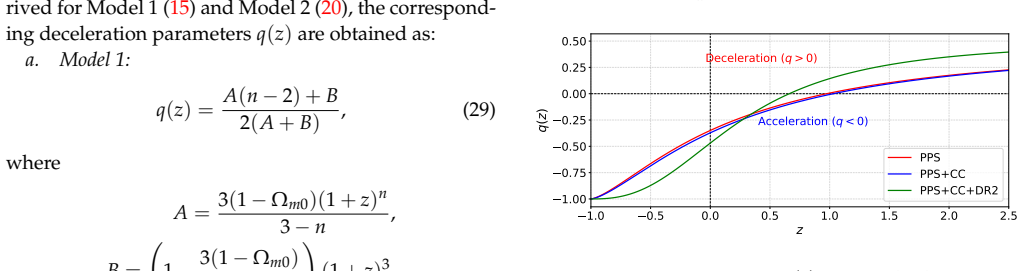
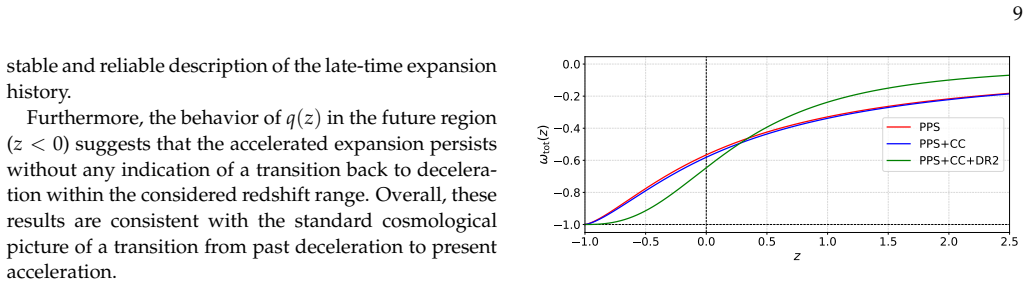
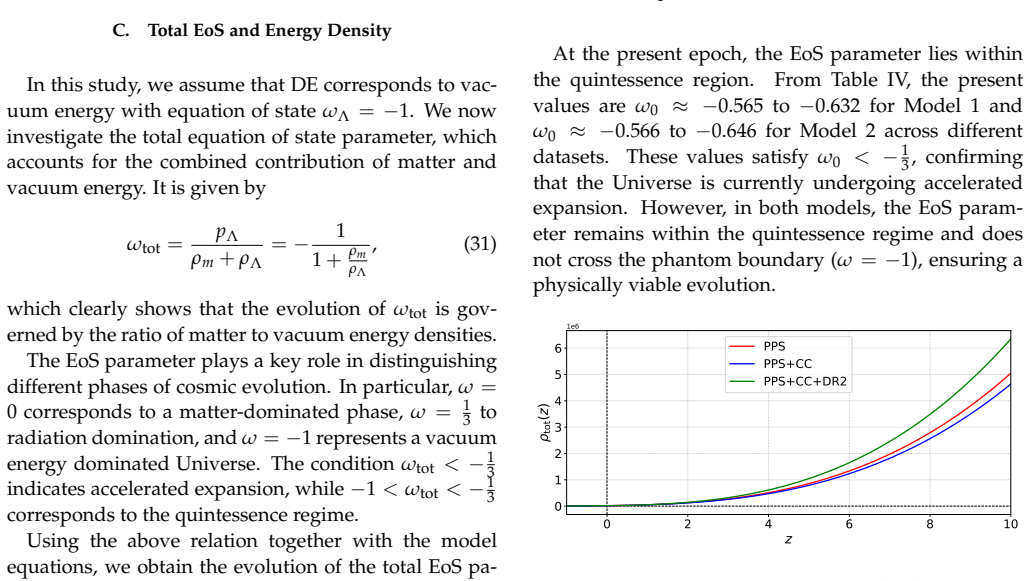
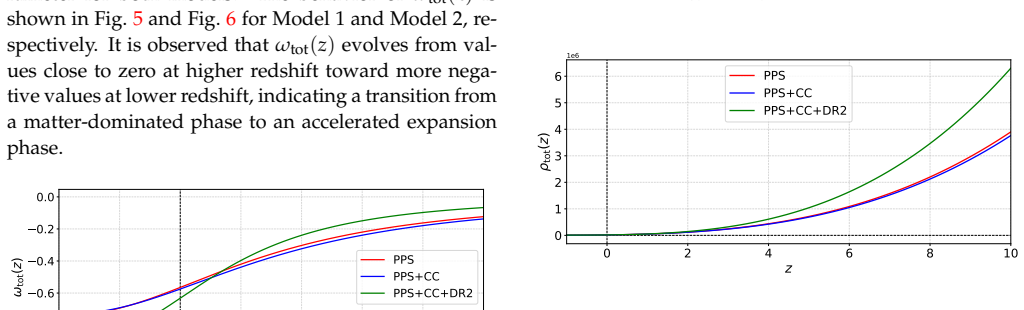
The two phenomenological decaying vacuum models, when constrained by the PPS, PPS+CC, and joint PPS+CC+DR2 datasets, produce H0 values in the range 72.53–73.01 km s^{-1} Mpc^{-1}, an Omega_m0 that decreases toward standard values with added data, and an evolution parameter n approximately 0.30 from the joint analysis. The models thereby describe a smooth transition from decelerated to accelerated expansion, as confirmed by the behavior of the deceleration parameter and the total equation of state.
What carries the argument
The two phenomenological decaying vacuum models with a time-dependent cosmological term Lambda(t) whose decay is controlled by a single evolution parameter n.
If this is right
- The models accommodate a Hubble constant aligned with local measurements while remaining consistent with BAO and chronometer data.
- Matter density starts higher when only supernovae are used but converges to standard values once chronometers and DESI BAO are included.
- The deceleration parameter and total equation of state both exhibit the required transition from past deceleration to current acceleration.
- The joint analysis indicates only a mild departure from LambdaCDM, quantified by n near 0.3.
Where Pith is reading between the lines
- If the reported value of n holds under tighter future constraints, the models could serve as a simple phenomenological alternative that avoids introducing new fields.
- Independent growth-rate or weak-lensing measurements could test whether the assumed Lambda(t) form remains consistent beyond the background expansion.
- The higher H0 preference might be examined against other late-time probes to see whether the mild deviation persists or is dataset-specific.
Load-bearing premise
The two chosen phenomenological forms for the decaying vacuum are assumed to capture the entire late-time acceleration without extra degrees of freedom or early-universe modifications.
What would settle it
A future high-precision measurement returning n exactly equal to zero, or a combined Hubble constant significantly below 72 km s^{-1} Mpc^{-1}, would falsify the reported preference for these models.
Figures

read the original abstract
In this article, we investigate two phenomenological decaying vacuum cosmological models describing the accelerated expansion of the Universe. We constrain the model parameters using a Markov Chain Monte Carlo (MCMC) technique with recent datasets, including cosmic chronometer (CC), Pantheon+SH0ES (PPS), and DESI BAO data release (DR2). Our analysis provides constraints from PPS, PPS+CC, and the joint PPS+CC+DR2 datasets for both models. All datasets favor $H_0 \simeq 72.53$--$73.01~\mathrm{Km\,s^{-1}\,Mpc^{-1}}$, while $\Omega_{m0}$ is higher with PPS alone and decreases to standard paradigm estimates with the inclusion of additional data. The evolution parameter is $n \approx 0.30$ from joint analysis, indicating a mild deviation from the $\Lambda$CDM framework. Furthermore, the physical behavior of the models is examined through the deceleration parameter and the total equation of state, confirming a smooth transition from past deceleration expansion to the present accelerated expansion.
Editorial analysis
A structured set of objections, weighed in public.
Referee Report
Summary. The paper constrains two phenomenological decaying-vacuum models (with evolution parameter n) using MCMC fits to cosmic chronometer, Pantheon+SH0ES, and DESI DR2 BAO data. It reports H0 values of approximately 72.53–73.01 km s^{-1} Mpc^{-1} across datasets, with Ωm0 decreasing toward standard values when additional data are included, and a joint-analysis value n ≈ 0.30 that is interpreted as indicating a mild deviation from ΛCDM; the models are further checked for a smooth deceleration-to-acceleration transition via the deceleration parameter and total equation of state.
Significance. If the preference for n > 0 is statistically robust, the work would supply updated late-time constraints on a simple extension to ΛCDM that can accommodate a higher H0 while preserving the observed acceleration. The inclusion of DESI DR2 data and the explicit verification of q(z) and w(z) are positive features. The central claim of a mild deviation, however, rests on an unquantified interpretation of the fitted n.
major comments (2)
- [Abstract] Abstract: the statement that n ≈ 0.30 'indicates a mild deviation from the ΛCDM framework' is not accompanied by any model-comparison statistic (Δχ², AIC difference, or Bayes factor) between the best-fit n and the nested n = 0 limit on the same PPS+CC+DR2 likelihood; without this, consistency with zero within 1–2σ cannot be excluded and the 'mild deviation' claim is unsupported.
- [Results] Results (MCMC constraints): no 1σ uncertainties are reported for the evolution parameter n, nor are prior choices, convergence diagnostics (e.g., Gelman–Rubin R̂), or effective sample sizes provided; these omissions make the robustness of the quoted n ≈ 0.30 impossible to assess and directly affect the central claim.
minor comments (1)
- [Abstract] The abstract gives H0 ranges without clarifying whether they represent 1σ intervals or simply the span across dataset combinations; a table of best-fit values with uncertainties for all parameters and all dataset combinations would improve clarity.
Simulated Author's Rebuttal
We thank the referee for their thorough review and helpful comments. We address each major comment below and have updated the manuscript accordingly to improve the statistical rigor of our analysis and reporting.
read point-by-point responses
-
Referee: [Abstract] the statement that n ≈ 0.30 'indicates a mild deviation from the ΛCDM framework' is not accompanied by any model-comparison statistic (Δχ², AIC difference, or Bayes factor) between the best-fit n and the nested n = 0 limit on the same PPS+CC+DR2 likelihood; without this, consistency with zero within 1–2σ cannot be excluded and the 'mild deviation' claim is unsupported.
Authors: We agree that a quantitative model comparison is essential to support the interpretation of a mild deviation. In the revised manuscript, we have added the Δχ² and AIC differences between our best-fit models and the ΛCDM (n=0) case for the joint PPS+CC+DR2 dataset. These metrics indicate a modest improvement in fit for the extended models, thereby supporting our claim of a mild deviation. The abstract has been updated to include this information. revision: yes
-
Referee: no 1σ uncertainties are reported for the evolution parameter n, nor are prior choices, convergence diagnostics (e.g., Gelman–Rubin R̂), or effective sample sizes provided; these omissions make the robustness of the quoted n ≈ 0.30 impossible to assess and directly affect the central claim.
Authors: We thank the referee for highlighting these important omissions in our MCMC reporting. The revised manuscript now includes the 1σ uncertainties on the parameter n (and all other parameters), the specific prior choices used, the Gelman-Rubin convergence diagnostics (R̂ values), and the effective sample sizes from the chains. These have been added to the results section and a supplementary table to allow full assessment of the robustness of our findings, including the value of n ≈ 0.30. revision: yes
Circularity Check
Standard MCMC parameter fitting with no self-referential derivation or prediction
full rationale
The paper defines two phenomenological decaying-vacuum models, then uses MCMC to constrain parameters (including the evolution index n) against CC, PPS, and DESI DR2 data. Reported values such as n ≈ 0.30 are direct posterior outputs of that fit; the text presents them as observational constraints rather than independent predictions or first-principles results. No equation chain reduces a claimed output to the input data or model definition by construction, no load-bearing self-citations appear, and no uniqueness theorem or ansatz is smuggled in. The analysis is ordinary statistical inference on nested models and remains self-contained against external benchmarks.
Axiom & Free-Parameter Ledger
free parameters (3)
- evolution parameter n
- present-day matter density Omega_m0
- Hubble constant H0
axioms (2)
- domain assumption The universe is described by a flat FLRW metric with matter and a time-varying vacuum energy component.
- ad hoc to paper The two specific phenomenological forms for Lambda(t) are adequate descriptions of late-time acceleration.
Reference graph
Works this paper leans on
-
[1]
The Cosmological Constant and Dark Energy
P . J. E. Peebles and B. Ratra, “The Cosmological Constant and Dark Energy,”Rev. Mod. Phys.75(2003) 559–606,arXiv:astro-ph/0207347
work page Pith review arXiv 2003
-
[2]
T. Padmanabhan, “Cosmological constant: The Weight of the vacuum,”Phys. Rept.380(2003) 235–320, arXiv:hep-th/0212290
-
[3]
E. J. Copeland, M. Sami, and S. Tsujikawa, “Dynamics of dark energy,”Int. J. Mod. Phys. D15(2006) 1753–1936,arXiv:hep-th/0603057
work page Pith review arXiv 2006
-
[4]
The Cosmological Constant Problem,
S. Weinberg, “The Cosmological Constant Problem,” Rev. Mod. Phys.61(1989) 1–23
1989
-
[5]
The Cosmological constant,
S. M. Carroll, W. H. Press, and E. L. Turner, “The Cosmological constant,”Ann. Rev. Astron. Astrophys.30 (1992) 499–542
1992
-
[6]
Quintessence, Cosmic Coincidence, and the Cosmological Constant
I. Zlatev, L.-M. Wang, and P . J. Steinhardt, “Quintessence, cosmic coincidence, and the cosmological constant,”Phys. Rev. Lett.82(1999) 896–899,arXiv:astro-ph/9807002. [13]PlanckCollaboration, N. Aghanimet al., “Planck 2018 results. VI. Cosmological parameters,”Astron. Astrophys.641(2020) A6,arXiv:1807.06209 [astro-ph.CO]. [Erratum: Astron.Astrophys. 652...
work page Pith review arXiv 1999
-
[7]
A. G. Riess, W. Yuan, L. M. Macri, D. Scolnic, D. Brout, S. Casertano, D. O. Jones, Y. Murakami, G. S. Anand, L. Breuval,et al., “A Comprehensive Measurement of the Local Value of the Hubble Constant with 1 km s−1 Mpc−1 Uncertainty from the Hubble Space Telescope and the SH0ES Team,”Astrophys. J. Lett.934(2022) no. 1, L7,arXiv:2112.04510 [astro-ph.CO]
work page internal anchor Pith review arXiv 2022
-
[8]
Tensions between the Early and the Late Universe
L. Verde, T. Treu, and A. G. Riess, “Tensions between the Early and the Late Universe,”Nature Astron.3 (2019) 891,arXiv:1907.10625 [astro-ph.CO]
work page internal anchor Pith review arXiv 2019
-
[9]
L. Knox and M. Millea, “Hubble constant hunter’s guide,”Phys. Rev. D101(2020) no. 4, 043533, arXiv:1908.03663 [astro-ph.CO]
-
[10]
M. Kamionkowski and A. G. Riess, “The Hubble Tension and Early Dark Energy,”Ann. Rev. Nucl. Part. Sci.73(2023) 153–180,arXiv:2211.04492 [astro-ph.CO]
-
[11]
S. Li, A. G. Riess, S. Casertano, G. S. Anand, D. M. Scolnic, W. Yuan, L. Breuval, and C. D. Huang, “Reconnaissance with JWST of the J-region Asymptotic Giant Branch in Distance Ladder Galaxies: From Irregular Luminosity Functions to Approximation of the Hubble Constant,”Astrophys. J.966(2024) no. 1, 20, arXiv:2401.04777 [astro-ph.CO]
-
[12]
A. G. Riesset al., “JWST Validates HST Distance Measurements: Selection of Supernova Subsample Explains Differences in JWST Estimates of Local H 0,” Astrophys. J.977(2024) no. 1, 120,arXiv:2408.11770 [astro-ph.CO]
-
[13]
The Hubble Tension in Our Own Backyard: DESI and the Nearness of the Coma Cluster,
D. Scolnicet al., “The Hubble Tension in Our Own Backyard: DESI and the Nearness of the Coma Cluster,” Astrophys. J. Lett.979(2025) no. 1, L9, arXiv:2409.14546 [astro-ph.CO]
-
[14]
L. Breuval, A. G. Riess, S. Casertano, W. Yuan, L. M. Macri, M. Romaniello, Y. S. Murakami, D. Scolnic, G. S. Anand, and I. Soszy´nski, “Small Magellanic Cloud Cepheids Observed with the Hubble Space Telescope Provide a New Anchor for the SH0ES Distance Ladder,”Astrophys. J.973(2024) no. 1, 30, arXiv:2404.08038 [astro-ph.CO]
-
[15]
K. K. Rogers and V . Poulin, “5σtension between Planck cosmic microwave background and eBOSS Lyman-alpha forest and constraints on physics beyond ΛCDM,”Phys. Rev. Res.7(2025) no. 1, L012018, arXiv:2311.16377 [astro-ph.CO]
-
[16]
Ruchika, L. Perivolaropoulos, and A. Melchiorri, “Effects of a local physics change on the SH0ES determination of H0,”Phys. Rev. D111(2025) no. 12, 123526,arXiv:2408.03875 [astro-ph.CO]
-
[17]
Age of Massive Galaxies at Redshift 8,
M. Lopez-Corredoira, F. Melia, J. J. Wei, and C. Y. Gao, “Age of Massive Galaxies at Redshift 8,”Astrophys. J. 970(2024) no. 1, 63,arXiv:2405.12665 [astro-ph.CO]
-
[18]
ΛCDM model against cosmography: a possible deviation after DESI 2024,
S. Pourojaghi, M. Malekjani, and Z. Davari, “ΛCDM model against cosmography: a possible deviation after DESI 2024,”Mon. Not. Roy. Astron. Soc.537(2025) no. 1, 436–447,arXiv:2408.10704 [astro-ph.CO]
-
[19]
D. Green and J. Meyers, “Cosmological preference for a negative neutrino mass,”Phys. Rev. D111(2025) no. 8, 083507,arXiv:2407.07878 [astro-ph.CO]
-
[20]
Review of Hubble tension solutions with new SH0ES and SPT-3G data,
A. R. Khalife, M. B. Zanjani, S. Galli, S. G ¨unther, J. Lesgourgues, and K. Benabed, “Review of Hubble tension solutions with new SH0ES and SPT-3G data,” JCAP04(2024) 059,arXiv:2312.09814 [astro-ph.CO]
- [21]
-
[22]
Modified Gravity and Cosmology
T. Clifton, P . G. Ferreira, A. Padilla, and C. Skordis, “Modified Gravity and Cosmology,”Phys. Rept.513 (2012) 1–189,arXiv:1106.2476 [astro-ph.CO]
work page internal anchor Pith review arXiv 2012
-
[23]
Cosmological Tests of Modified Gravity
K. Koyama, “Cosmological Tests of Modified Gravity,” Rept. Prog. Phys.79(2016) no. 4, 046902, arXiv:1504.04623 [astro-ph.CO]
work page Pith review arXiv 2016
- [24]
-
[25]
M. Koussour, N. Myrzakulov, A. H. A. Alfedeel, and A. Abebe, “Constraining the cosmological model of modified f(Q) gravity: Phantom dark energy and observational insights,”PTEP2023(2023) no. 11, 113E01,arXiv:2310.15067 [astro-ph.CO]
-
[26]
Cosmological models in f(T,T) gravity and the dynamical system analysis,
L. K. Duchaniya, S. V . Lohakare, and B. Mishra, “Cosmological models in f(T,T) gravity and the dynamical system analysis,”Phys. Dark Univ.43(2024) 101402,arXiv:2302.07132 [gr-qc]
-
[27]
Cosmological Dynamics on a Novelf(Q) Gravity Model with Recent DESI DR2 Observation,
S. A. Kadam, D. R. Kumar, and S. K. Yadav, “Cosmological Dynamics on a Novelf(Q)Gravity 12 Model with Recent DESI DR2 Observation,” arXiv:2601.06438 [gr-qc]
-
[28]
A. De Felice and S. Tsujikawa, “f(R) theories,”Living Rev. Rel.13(2010) 3,arXiv:1002.4928 [gr-qc]
work page Pith review arXiv 2010
-
[29]
M. Scherer, M. A. Sabogal, R. C. Nunes, and A. De Felice, “Challenging theΛCDM model: 5σ evidence for a dynamical dark energy late-time transition,”Phys. Rev. D112(2025) no. 4, 043513, arXiv:2504.20664 [astro-ph.CO]
-
[30]
W. Giar `e, M. Najafi, S. Pan, E. Di Valentino, and J. T. Firouzjaee, “Robust preference for Dynamical Dark Energy in DESI BAO and SN measurements,”JCAP10 (2024) 035,arXiv:2407.16689 [astro-ph.CO]
-
[31]
Constraints on dark matter-photon coupling in the presence of time-varying dark energy,
S. K. Yadav, “Constraints on dark matter-photon coupling in the presence of time-varying dark energy,” Mod. Phys. Lett. A35(2019) no. 04, 1950358, arXiv:1907.05886 [astro-ph.CO]
-
[32]
Late-time constraints on dynamical dark energy models using DESI DR2, Type Ia supernova, and CC measurements,
R. Nagpal, H. Chaudhary, H. Gupta, and S. K. J. Pacif, “Late-time constraints on dynamical dark energy models using DESI DR2, Type Ia supernova, and CC measurements,”JHEAp47(2025) 100396
2025
-
[33]
Testing an oscillatory behavior of dark energy,
L. A. Escamilla, S. Pan, E. Di Valentino, A. Paliathanasis, J. A. V´azquez, and W. Yang, “Testing an oscillatory behavior of dark energy,”Phys. Rev. D111(2025) no. 2, 023531,arXiv:2404.00181 [astro-ph.CO]
-
[34]
S. K. J. Pacif, “Dark energy models from a parametrization ofH: A comprehensive analysis and observational constraints,”Eur. Phys. J. Plus135(2020) no. 10, 792,arXiv:2005.06972 [physics.gen-ph]
-
[35]
E. Abdallaet al., “Cosmology intertwined: A review of the particle physics, astrophysics, and cosmology associated with the cosmological tensions and anomalies,”JHEAp34(2022) 49–211, arXiv:2203.06142 [astro-ph.CO]
work page internal anchor Pith review arXiv 2022
-
[36]
Precision constraints on new dark energy parametrization from DESI BAO DR2,
D. Revanth Kumar and S. K. Yadav, “Precision constraints on new dark energy parametrization from DESI BAO DR2,”arXiv:2603.26861 [astro-ph.CO]
-
[37]
Capozziello, Curvature quintessence, Int
S. Capozziello, “Curvature quintessence,”Int. J. Mod. Phys. D11(2002) 483–492,arXiv:gr-qc/0201033
-
[38]
W. Zimdahl and D. Pavon, “Interacting quintessence,” Phys. Lett. B521(2001) 133–138, arXiv:astro-ph/0105479
-
[39]
L. Amendola, “Coupled quintessence,”Phys. Rev. D62 (2000) 043511,arXiv:astro-ph/9908023
work page Pith review arXiv 2000
-
[40]
Effects of anisotropy in an anisotropic extension of wCDM model,
V . Yadav, S. K. Yadav, and Rajpal, “Effects of anisotropy in an anisotropic extension of wCDM model,”Phys. Dark Univ.46(2024) 101626,arXiv:2402.16885 [astro-ph.CO]
-
[41]
Observational constraints on a generalized equation of state model,
M. Koussour, S. Bekov, A. Syzdykova, S. Muminov, I. Ibragimov, and J. Rayimbaev, “Observational constraints on a generalized equation of state model,” Phys. Dark Univ.47(2025) 101799,arXiv:2412.20073 [astro-ph.CO]
-
[42]
Properties of singularities in (phantom) dark energy universe
S. Nojiri, S. D. Odintsov, and S. Tsujikawa, “Properties of singularities in (phantom) dark energy universe,” Phys. Rev. D71(2005) 063004, arXiv:hep-th/0501025
work page Pith review arXiv 2005
-
[43]
Phantom energy and cosmic doomsday,
R. R. Caldwell, M. Kamionkowski, and N. N. Weinberg, “Phantom energy and cosmic doomsday,”Phys. Rev. Lett.91(2003) 071301,arXiv:astro-ph/0302506
-
[44]
Kinetically Driven Quintessence
T. Chiba, T. Okabe, and M. Yamaguchi, “Kinetically driven quintessence,”Phys. Rev. D62(2000) 023511, arXiv:astro-ph/9912463
work page Pith review arXiv 2000
-
[45]
Observational constraints on dynamical dark energy with pivoting redshift,
W. Yang, S. Pan, E. Di Valentino, and E. N. Saridakis, “Observational constraints on dynamical dark energy with pivoting redshift,”Universe5(2019) no. 11, 219, arXiv:1811.06932 [astro-ph.CO]
-
[46]
M. Koussour, N. Myrzakulov, and M. K. M. Ali, “Exploring Universe acceleration through observational constraints via Hubble parameter reconstruction,” JHEAp42(2024) 96–103,arXiv:2404.03362 [astro-ph.CO]
-
[47]
C.-G. Park and B. Ratra, “Is excess smoothing of Planck CMB anisotropy data partially responsible for evidence for dark energy dynamics in other w(z)CDM parametrizations?,”Int. J. Mod. Phys. D34(2025) no. 13, 2550061,arXiv:2501.03480 [astro-ph.CO]
-
[48]
C. Armendariz-Picon, V . F. Mukhanov, and P . J. Steinhardt, “A Dynamical solution to the problem of a small cosmological constant and late time cosmic acceleration,”Phys. Rev. Lett.85(2000) 4438–4441, arXiv:astro-ph/0004134
-
[49]
An Alternative to quintessence,
A. Y. Kamenshchik, U. Moschella, and V . Pasquier, “An Alternative to quintessence,”Phys. Lett. B511(2001) 265–268,arXiv:gr-qc/0103004
-
[50]
A. Sen, “Tachyon matter,”JHEP07(2002) 065, arXiv:hep-th/0203265
-
[51]
A Model of holographic dark energy,
M. Li, “A Model of holographic dark energy,”Phys. Lett. B603(2004) 1,arXiv:hep-th/0403127
-
[52]
The effects of a varying cosmological constant on the particle horizon,
A. M. Oztas, “The effects of a varying cosmological constant on the particle horizon,”Mon. Not. Roy. Astron. Soc.481(2018) no. 2, 2228–2234
2018
-
[53]
Consequences on variable Lambda models from distant type Ia supernovae and compact radio sources,
R. G. Vishwakarma, “Consequences on variable Lambda models from distant type Ia supernovae and compact radio sources,”Class. Quant. Grav.18(2001) 1159–1172,arXiv:astro-ph/0012492
-
[54]
Evolution of the scale factor with a variable cosmological term,
J. M. Overduin and F. I. Cooperstock, “Evolution of the scale factor with a variable cosmological term,”Phys. Rev. D58(1998) 043506,arXiv:astro-ph/9805260
-
[55]
Cosmological Consequences of a Variable Cosmological Constant Model,
H. Azri and A. Bounames, “Cosmological Consequences of a Variable Cosmological Constant Model,”Int. J. Mod. Phys. D26(2017) no. 7, 1750060, arXiv:1412.7567 [gr-qc]
-
[56]
Geometrical Origin of the Cosmological Constant,
H. Azri and A. Bounames, “Geometrical Origin of the Cosmological Constant,”Gen. Rel. Grav.44(2012) 2547–2561,arXiv:1007.1948 [gr-qc]
-
[57]
Cosmological model with decaying vacuum energy from quantum mechanics,
M. Szydłowski, “Cosmological model with decaying vacuum energy from quantum mechanics,”Phys. Rev. D 91(2015) no. 12, 123538,arXiv:1502.04737 [astro-ph.CO]
- [58]
-
[59]
Dynamics and cosmological evolution inΛ-varying cosmology,
G. Papagiannopoulos, P . Tsiapi, S. Basilakos, and A. Paliathanasis, “Dynamics and cosmological evolution inΛ-varying cosmology,”Eur. Phys. J. C80 (2020) no. 1, 55,arXiv:1911.12431 [gr-qc]
-
[60]
Looking for interactions in the cosmological dark sector,
M. Benetti, W. Miranda, H. A. Borges, C. Pigozzo, S. Carneiro, and J. S. Alcaniz, “Looking for interactions in the cosmological dark sector,”JCAP12(2019) 023, arXiv:1908.07213 [astro-ph.CO]
-
[61]
First evidence of running cosmic vacuum: challenging the concordance model
J. Sol `a, A. G´omez-Valent, and J. de Cruz P´erez, “First evidence of running cosmic vacuum: challenging the concordance model,”Astrophys. J.836(2017) no. 1, 43, arXiv:1602.02103 [astro-ph.CO]
work page Pith review arXiv 2017
-
[62]
Possible signals of vacuum dynamics in the Universe
J. Sol `a Peracaula, J. de Cruz P´erez, and A. Gomez-Valent, “Possible signals of vacuum dynamics in the Universe,”Mon. Not. Roy. Astron. Soc. 478(2018) no. 4, 4357–4373,arXiv:1703.08218 [astro-ph.CO]
work page Pith review arXiv 2018
-
[63]
Testing dynamical vacuum models with CMB power spectrum from Planck,
P . Tsiapi and S. Basilakos, “Testing dynamical vacuum models with CMB power spectrum from Planck,”Mon. Not. Roy. Astron. Soc.485(2019) no. 2, 2505–2510, arXiv:1810.12902 [astro-ph.CO]
-
[64]
N. E. Mavromatos and J. Sol `a Peracaula, “Stringy-running-vacuum-model inflation: from primordial gravitational waves and stiff axion matter to dynamical dark energy,”Eur. Phys. J. ST230(2021) no. 9, 2077–2110,arXiv:2012.07971 [hep-ph]
-
[65]
J. Sola Peracaula, A. Gomez-Valent, J. de Cruz Perez, and C. Moreno-Pulido, “Running Vacuum in the Universe: Phenomenological Status in Light of the Latest Observations, and Its Impact on theσ 8 and H0 Tensions,”Universe9(2023) no. 6, 262, arXiv:2304.11157 [astro-ph.CO]
-
[66]
Running vacuum in quantum field theory in curved spacetime: renormalizingρ vac without∼m 4 terms,
C. Moreno-Pulido and J. Sola, “Running vacuum in quantum field theory in curved spacetime: renormalizingρ vac without∼m 4 terms,”Eur. Phys. J. C 80(2020) no. 8, 692,arXiv:2005.03164 [gr-qc]
-
[67]
C. Moreno-Pulido and J. Sola Peracaula, “Renormalizing the vacuum energy in cosmological spacetime: implications for the cosmological constant problem,”Eur. Phys. J. C82(2022) no. 6, 551, arXiv:2201.05827 [gr-qc]
-
[68]
C. Moreno-Pulido and J. Sola Peracaula, “Equation of state of the running vacuum,”Eur. Phys. J. C82(2022) 1137,arXiv:2207.07111 [gr-qc]
-
[69]
Running vacuum in QFT in FLRW spacetime: the dynamics ofρ vac(H)from the quantized matter fields,
C. Moreno-Pulido, J. Sola Peracaula, and S. Cheraghchi, “Running vacuum in QFT in FLRW spacetime: the dynamics ofρ vac(H)from the quantized matter fields,” Eur. Phys. J. C83(2023) no. 7, 637,arXiv:2301.05205 [gr-qc]
-
[70]
Sol` a Peracaula,The cosmological constant problem and running vacuum in the expanding universe,Phil
J. Sola Peracaula, “The cosmological constant problem and running vacuum in the expanding universe,”Phil. T rans. Roy. Soc. Lond. A380(2022) 20210182, arXiv:2203.13757 [gr-qc]
-
[71]
A New cosmological constant model,
J. L. Lopez and D. V . Nanopoulos, “A New cosmological constant model,”Mod. Phys. Lett. A11 (1996) 1–7,arXiv:hep-ph/9501293
-
[72]
Implications of a cosmological constant varying as R**(-2),
W. Chen and Y. S. Wu, “Implications of a cosmological constant varying as R**(-2),”Phys. Rev. D41(1990) 695–698. [Erratum: Phys.Rev.D 45, 4728 (1992)]
1990
-
[73]
A possible solution to the main cosmological problems,
M. Ozer and M. O. Taha, “A possible solution to the main cosmological problems,”Phys. Lett. B171(1986) no. 4, 363–365
1986
-
[74]
A model of the universe free of cosmological problems,
M. Ozer and M. O. Taha, “A model of the universe free of cosmological problems,”Nucl. Phys. B287(1987) 776–796
1987
-
[75]
Constraints onΛ(t)CDM cosmology using cosmic chronometers and supernova data,
Y. Myrzakulov, M. Koussour, M. Bulanbay, S. Muminov, and J. Rayimbaev, “Constraints onΛ(t)CDM cosmology using cosmic chronometers and supernova data,”Chin. J. Phys.94(2025) 287–297,arXiv:2501.07099 [astro-ph.CO]
-
[76]
Signature flips in time-varyingΛ(t) cosmological models with observational data,
Y. Myrzakulov, M. Koussour, M. Karimov, and J. Rayimbaev, “Signature flips in time-varyingΛ(t) cosmological models with observational data,”Eur. Phys. J. C84(2024) no. 7, 665,arXiv:2407.07535 [astro-ph.CO]
-
[77]
Cosmological constraints onΛ(t)CDM models,
H. A. P . Macedo, L. S. Brito, J. F. Jesus, and M. E. S. Alves, “Cosmological constraints onΛ(t)CDM models,”Eur. Phys. J. C83(2023) no. 12, 1144, arXiv:2305.18591 [astro-ph.CO]
-
[78]
A. A. Escobal, H. A. P . Macedo, J. F. Jesus, R. C. Nunes, and J. A. S. Lima, “Linear Growth of Matter Perturbations Probed by Redshift-Space Distortions in InteractingΛ(t)CDM Cosmologies,” arXiv:2602.11310 [astro-ph.CO]
-
[79]
Kinematic reconstruction ofΛ(t)CDM models,
P . A. S. Guillen, J. F. Jesus, and R. Valentim, “Kinematic reconstruction ofΛ(t)CDM models,”Phys. Dark Univ.52 (2026) 102258,arXiv:2512.14578 [astro-ph.CO]
-
[80]
GetDist: a Python package for analysing Monte Carlo samples
A. Lewis, “GetDist: a Python package for analysing Monte Carlo samples,”JCAP08(2025) 025, arXiv:1910.13970 [astro-ph.IM]
work page internal anchor Pith review arXiv 2025
discussion (0)
Sign in with ORCID, Apple, or X to comment. Anyone can read and Pith papers without signing in.