Recognition: unknown
Supersolid Rotation in an Annular Bose-Einstein Condensate coupled to a Ring Cavity
Pith reviewed 2026-05-10 07:17 UTC · model grok-4.3
The pith
An annular Bose-Einstein condensate in a ring cavity forms supersolids that rotate through optical interference without mechanical stirring.
A machine-rendered reading of the paper's core claim, the machinery that carries it, and where it could break.
Core claim
Under symmetric driving by counter-propagating Laguerre-Gaussian beams with equal and opposite orbital angular momenta, the system realizes supersolid states coexisting with persistent superfluid circulation, including for a single winding number Lp and for coherent superpositions of two Lp values. Asymmetric pumping with beams of unequal orbital angular momenta breaks chiral symmetry, producing asymmetric cavity amplitudes, directional density modulations, and rotating supersolid lattices or wave packets. These rotational dynamics arise from interference among the cavity traveling-wave modes without physical stirring. The mean-field theory distinguishes this rotating behavior from prior all
What carries the argument
Coupling of the annular BEC to traveling-wave optical modes in the ring cavity under symmetric or asymmetric Laguerre-Gaussian pumping, which generates interference that drives supersolid rotation and chiral symmetry breaking while supporting persistent currents.
Load-bearing premise
The mean-field approximation remains valid when supersolid density modulations and persistent currents coexist in the atom-cavity system, and the ring cavity supports ideal traveling-wave modes without significant losses.
What would settle it
Failure to observe rotating supersolid density patterns under asymmetric pumping, or absence of distinct Goldstone and Higgs signatures in the cavity output spectrum, would falsify the interference-driven rotation claim.
Figures






read the original abstract
We theoretically investigate an annularly confined Bose-Einstein Condensate (BEC) coupled to a four-mirror ring cavity supporting traveling-wave optical modes. Under symmetric driving by counter-propagating Laguerre-Gaussian beams carrying equal and opposite orbital angular momenta, the system realizes supersolid phases coexisting with persistent superfluid circulation. Specifically, we obtain a supersolid state if we start with a BEC of winding number $L_p$ as well as supersolid packets with coherent superpositions of two different BEC $L_p$ values. Under asymmetric pumping, realized with Laguerre-Gaussian beams of different orbital angular momenta, chiral symmetry is broken in the system, resulting in asymmetric cavity field amplitudes, directional density modulations, and tunable rotational dynamics of the resulting supersolid lattice. This leads to rotating supersolid density structures for a single winding-number state, and rotating wave packets for an initial superposition of rotational eigenstates. Finally, we probe the presence of Goldstone and Higgs modes which can be observed using minimally destructive measurements of the cavity output spectrum. Our mean-field theory reveals interference-driven rotation without physical stirring, and distinguishes our work from prior static cavity supersolids. Our results establish the ring cavity annular BEC as a versatile platform for generating chiral quantum matter, implementing rotation-sensing devices and generating atomtronic circuits with supersolids.
Editorial analysis
A structured set of objections, weighed in public.
Referee Report
Summary. The paper theoretically studies an annular Bose-Einstein condensate coupled to a four-mirror ring cavity supporting traveling-wave optical modes. Under symmetric driving by counter-propagating Laguerre-Gaussian beams with equal and opposite orbital angular momenta, mean-field theory predicts supersolid phases coexisting with persistent superfluid circulation for single winding-number states and superpositions. Asymmetric pumping breaks chiral symmetry, yielding asymmetric cavity amplitudes, directional density modulations, and tunable rotating supersolid lattices or wave packets. The work also examines Goldstone and Higgs modes via the cavity output spectrum and emphasizes interference-driven rotation without external stirring, distinguishing it from prior static-cavity supersolids.
Significance. If the central claims hold, the setup offers a platform for generating chiral quantum matter and atomtronic circuits with supersolids, plus potential rotation-sensing applications. The interference mechanism for rotation without physical stirring is a clear conceptual advance over static cavity supersolids, provided the mean-field treatment remains valid when density modulations and persistent currents coexist.
major comments (2)
- [cavity field equation and ansatz] The model assumes ideal lossless traveling-wave modes in the ring cavity (cavity field equation and ansatz sections). Finite cavity decay κ or mirror backscattering would introduce standing-wave admixtures that pin the density pattern and suppress net rotation; no quantitative bound on κ/g (g the atom-cavity coupling) is supplied to establish the regime where the predicted chiral dynamics survive.
- [mean-field equations and results] The abstract and main text state that mean-field theory yields the supersolid phases with persistent currents, yet the manuscript supplies no explicit numerical validation checks, convergence tests, or parameter scans confirming that the coexistence of supersolid modulations and net circulation remains stable under the coupled GPE-cavity dynamics.
minor comments (2)
- [introduction] The notation for the winding number L_p and the distinction between single-winding and superposition initial states could be introduced earlier with a clear table of cases.
- [figures] Figure captions should explicitly state the driving asymmetry parameter and the value of κ/g used (or confirm it is zero) to allow direct comparison with the analytic claims.
Simulated Author's Rebuttal
We thank the referee for their careful reading of our manuscript and for the constructive comments, which have helped us improve the presentation and strengthen the analysis. We address each major comment point by point below.
read point-by-point responses
-
Referee: The model assumes ideal lossless traveling-wave modes in the ring cavity (cavity field equation and ansatz sections). Finite cavity decay κ or mirror backscattering would introduce standing-wave admixtures that pin the density pattern and suppress net rotation; no quantitative bound on κ/g (g the atom-cavity coupling) is supplied to establish the regime where the predicted chiral dynamics survive.
Authors: We agree that finite cavity decay and backscattering represent important practical considerations that could admix standing-wave components and potentially suppress net rotation. In the revised manuscript we have added a dedicated paragraph in the cavity model section together with a short appendix deriving a perturbative bound. The analysis shows that the traveling-wave approximation and the associated chiral dynamics remain robust for κ/g ≲ 0.1, where the standing-wave fraction stays below a few percent and the persistent current is preserved. We also note that state-of-the-art ring cavities routinely achieve the required high finesse, placing the predicted regime within experimental reach. revision: yes
-
Referee: The abstract and main text state that mean-field theory yields the supersolid phases with persistent currents, yet the manuscript supplies no explicit numerical validation checks, convergence tests, or parameter scans confirming that the coexistence of supersolid modulations and net circulation remains stable under the coupled GPE-cavity dynamics.
Authors: We acknowledge that explicit numerical validation was not presented in the original submission. In the revised version we have added Appendix C containing (i) convergence tests with respect to spatial grid size and imaginary-time step, (ii) long-time real-time evolution demonstrating stability of the supersolid-plus-persistent-current states, and (iii) a parameter scan over the atom-cavity coupling strength that delineates the region of stable coexistence. These checks confirm that the mean-field solutions remain robust under the coupled dynamics for the parameter ranges reported in the main text. revision: yes
Circularity Check
No circularity; derivation follows from standard coupled mean-field equations
full rationale
The paper solves the coupled Gross-Pitaevskii equation for the annular BEC and the cavity field equations under an explicit traveling-wave ansatz for the four-mirror ring cavity. Supersolid rotation and chiral dynamics emerge directly from interference terms between counter-propagating Laguerre-Gaussian modes and the resulting atomic density modulations. No quantity is defined in terms of the target result, no fitted parameter is relabeled as a prediction, and no load-bearing step reduces to a self-citation chain or ansatz smuggled from prior work by the same authors. The central claim is a straightforward numerical/theoretical consequence of the stated equations and assumptions, independent of the output itself.
Axiom & Free-Parameter Ledger
axioms (2)
- domain assumption Mean-field theory is sufficient to capture supersolid phases coexisting with persistent superfluid circulation
- domain assumption The ring cavity supports ideal counter-propagating traveling-wave optical modes driven by Laguerre-Gaussian beams
Reference graph
Works this paper leans on
-
[1]
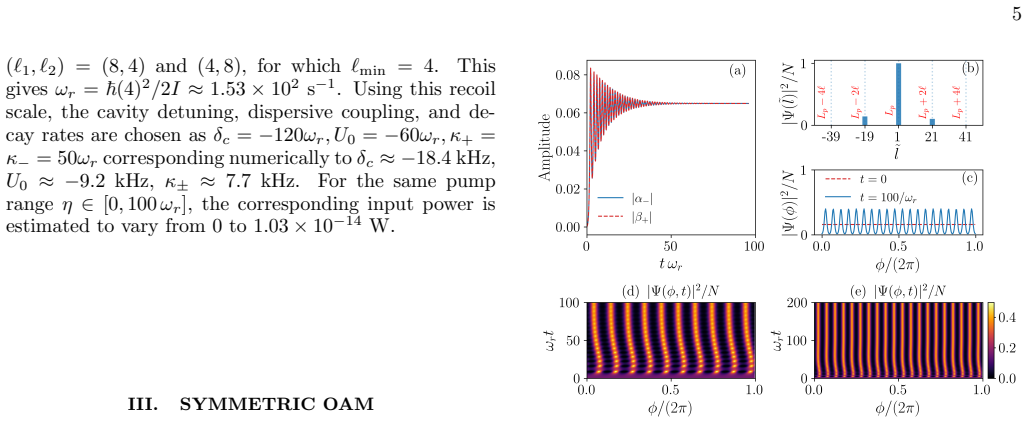
Steady state response Here, we consider a ring BEC prepared in a single rotational state of winding numberL p [11, 19]. From the steady-state solutions, we extract the scattered-mode amplitudes|α −|and|β +|, as functions of the effective de- tuningδ c and for symmetric pump strength,η=η ±, as shown in Fig. 2(a). This provides flexibility in tuning the sys...
-
[2]
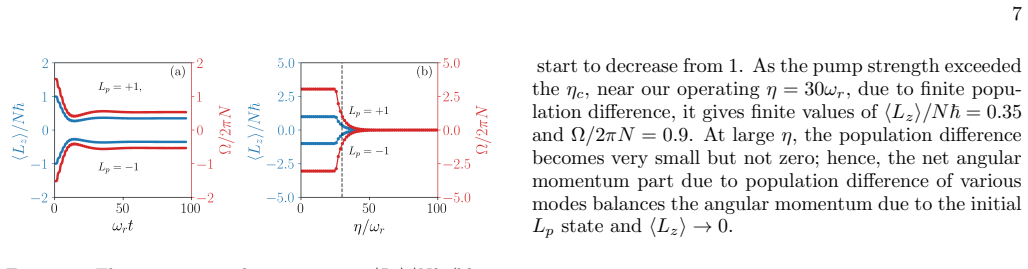
Average angular momentum and Angular velocity To quantify the rotational dynamics of the lattice, we next examine the time evolution of the average angular momentum⟨L z⟩and the corresponding mean angular ve- locity, Ω =⟨L z⟩/I, as shown in Fig. 5(a). Both quantities evolve from their initial values and gradually relax toward finite steady-state values as ...
-
[3]
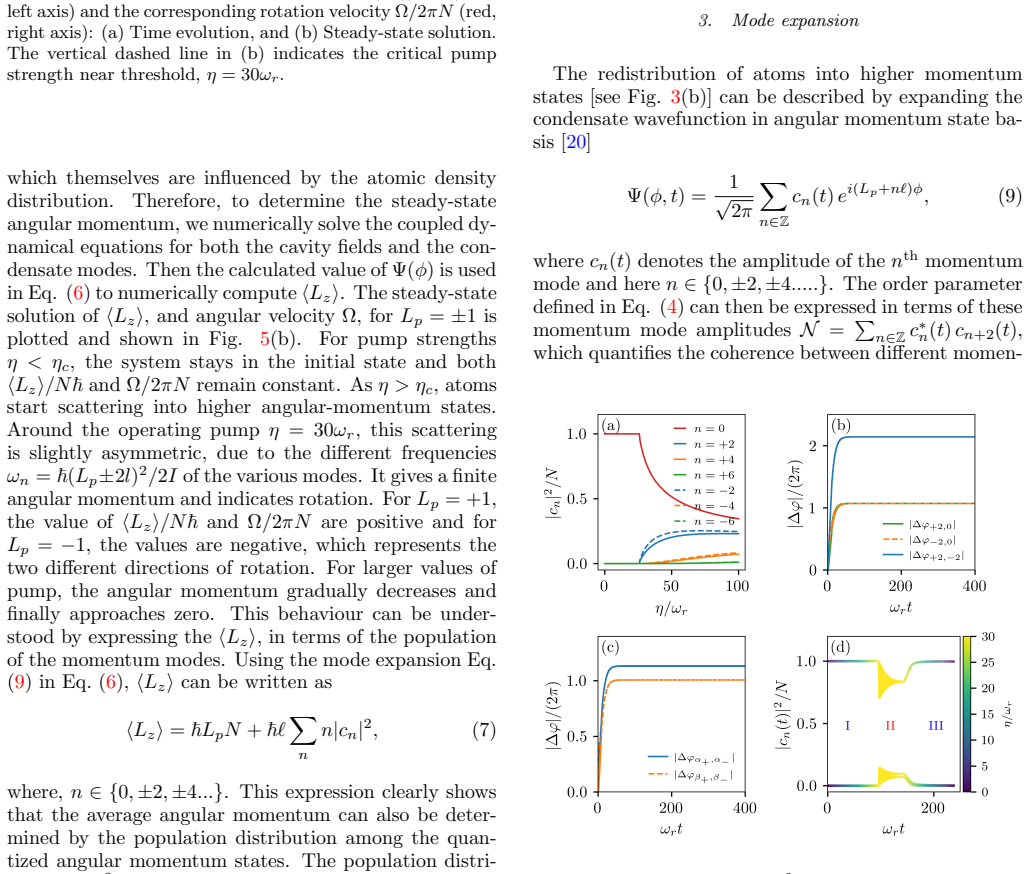
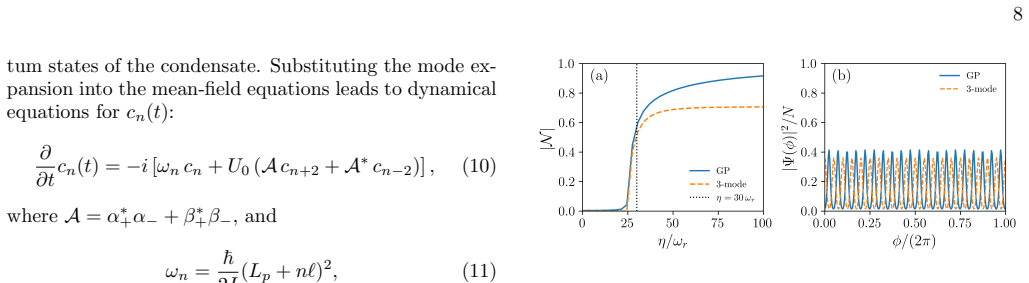
Mode expansion The redistribution of atoms into higher momentum states [see Fig. 3(b)] can be described by expanding the condensate wavefunction in angular momentum state ba- sis [20] Ψ(ϕ, t) = 1√ 2π X n∈Z cn(t)e i(Lp+nℓ)ϕ,(9) wherec n(t) denotes the amplitude of then th momentum mode and heren∈ {0,±2,±4.....}. The order parameter defined in Eq. (4) can t...
-
[4]
The sponta- neous breaking of continuous rotational symmetry leads to the appearance of low-energy collective excitations [59]
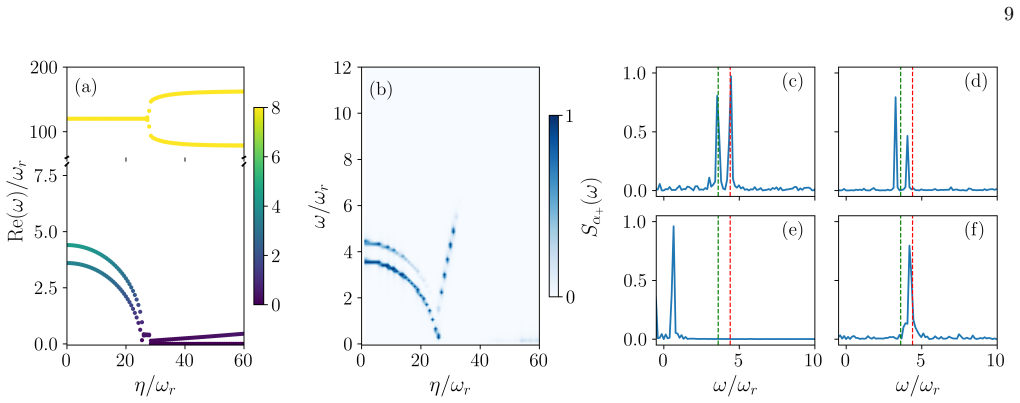
Collective excitations The process of self-organization, for a single persis- tent current state, can be understood as a consequence of spontaneousU(1) symmetry breaking. The sponta- neous breaking of continuous rotational symmetry leads to the appearance of low-energy collective excitations [59]. In line with this expectation, we analyze the excita- tion...
-
[5]
The spectrum is calculated us- ing the input-output relation:O out ± (ω) =−O in ±(ω) +√ 2κO±(ω), whereO ± ∈ {α, β}, andO ±(ω) is a Fourier transform ofO ±(t) [85]
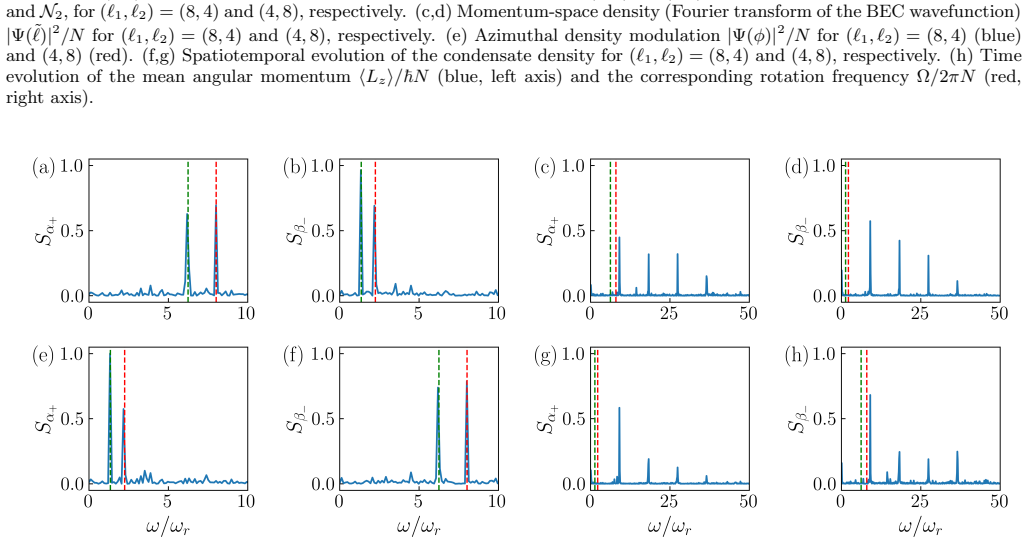
Cavity spectrum Signatures of the Goldstone and Higgs modes can be obtained from the cavity output spectrum of our pro- posed configuration. The spectrum is calculated us- ing the input-output relation:O out ± (ω) =−O in ±(ω) +√ 2κO±(ω), whereO ± ∈ {α, β}, andO ±(ω) is a Fourier transform ofO ±(t) [85]. The termO out ± (ω) is the cav- ity output field,O i...
-
[6]
(15) in- herently supports interference between distinct angular- momentum components, giving rise to a weak but finite density modulation even in the absence of external driv- ing
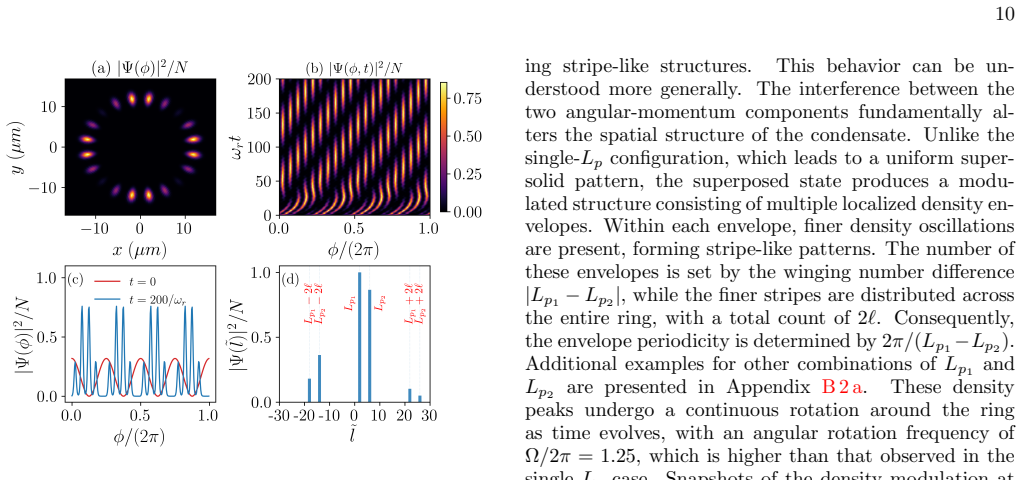
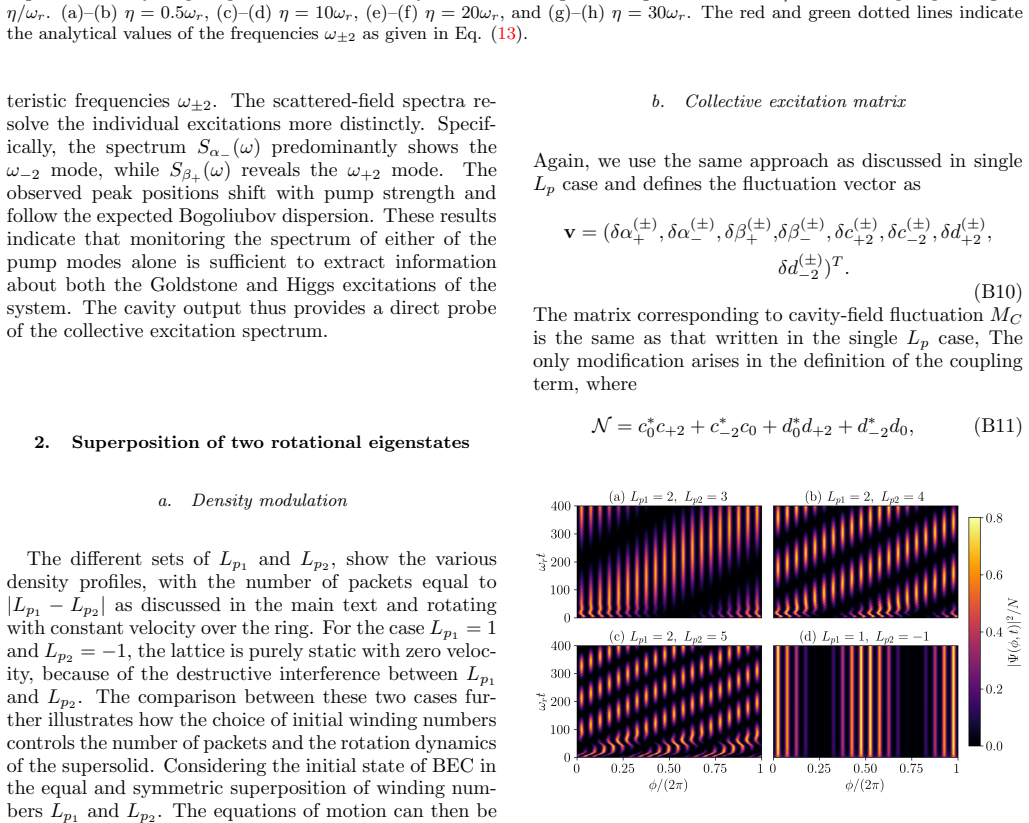
Density modulation The superposition state expressed in Eq. (15) in- herently supports interference between distinct angular- momentum components, giving rise to a weak but finite density modulation even in the absence of external driv- ing. A representative example is shown in Fig. 9 for Lp1 = 2 andL p2 = 6. As illustrated in 9(a)-(c), the system develop...
-
[7]
The average angular momentum⟨L z⟩/Nℏ(blue, left axis) and the corresponding rotation velocity Ω/2πN(red, right axis)
Average angular momentum and Angular velocity Figure 10. The average angular momentum⟨L z⟩/Nℏ(blue, left axis) and the corresponding rotation velocity Ω/2πN(red, right axis). (a) Time evolution, and (b) Steady-state solution. The vertical dashed line in (b) indicates the critical pump strength near threshold,η= 30ω r. The time dynamics and steady-state be...
-
[8]
(a)-(b) The probability amplitude of different mo- mentum mode excitations in the BEC corresponding toL p1 andL p2 states, respectively
Mode Expansion To gain further insight into the microscopic level, it is convenient to describe the condensate in the angular- momentum basis Ψ(ϕ, t) = 1√ 4π X n∈Z h cn(t)e i(Lp1+nℓ)ϕ +d n(t)e i(Lp2+nℓ)ϕ i , (16) Figure 12. (a)-(b) The probability amplitude of different mo- mentum mode excitations in the BEC corresponding toL p1 andL p2 states, respective...
-
[9]
The detailed derivation is provided in Appendix
Analysis of collective excitations We now turn to the collective excitation spectrum for a condensate prepared in a coherent superposition of rota- tional eigenstates. The detailed derivation is provided in Appendix. B 2 b. The resulting spectrum, shown in Fig. 13(a), exhibits four distinct Bogoliubov branches associ- ated with the lowest excited angular-...
-
[10]
The steady-state behavior, shown in Figs
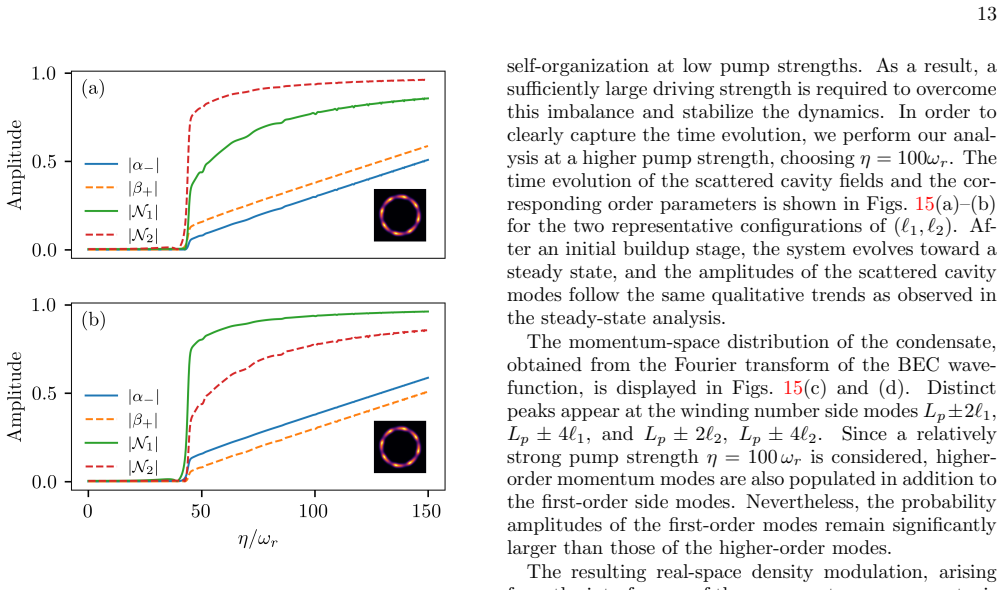
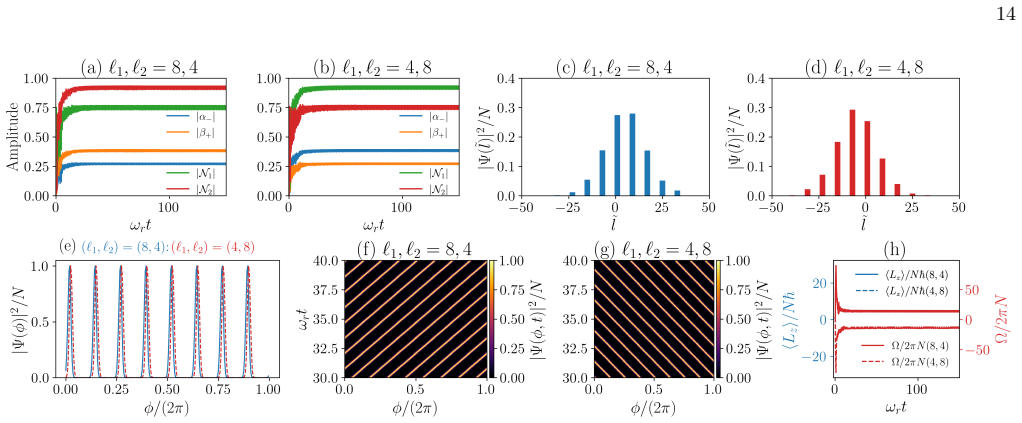
Steady-state response Under asymmetric OAM pumping, we first consider the case where the ring BEC is initially prepared in a ro- tational eigenstate with a single winding numberLp. The steady-state behavior, shown in Figs. 14(a) and 14(b) re- veals a pronounced asymmetry in both the cavity-mode amplitudes and the corresponding order parameters as function...
-
[11]
This is due to the imbalance between the modes, which prevents efficient self-organization at low pump strengths
Fourier analysis and density modulation In the immediate vicinity of the threshold, the system does not exhibit a stable response. This is due to the imbalance between the modes, which prevents efficient self-organization at low pump strengths. As a result, a sufficiently large driving strength is required to overcome this imbalance and stabilize the dyna...
-
[12]
Thus, we study the excitation of different fre- quency modes in this more complex system, including the emergence of Goldstone and Higgs modes, with the cavity output spectrum
Cavity spectrum Due to the excitation of multiple higher-order momen- tum modes in this regime, a simple analytical descrip- tion based on a truncated mode expansion becomes dif- ficult. Thus, we study the excitation of different fre- quency modes in this more complex system, including the emergence of Goldstone and Higgs modes, with the cavity output spe...
-
[13]
The steady-state cavity-field amplitudes and the corresponding order parameters ex- hibit the same qualitative behavior as in the previously discussed asymmetric OAM configuration
Density Modulation To illustrate the resulting density structure, we fo- cus on the representative case (ℓ 1, ℓ2) = (8,4), with the condensate prepared in a superposition of the rotational statesL p1 = 2 andL p2 = 6. The steady-state cavity-field amplitudes and the corresponding order parameters ex- hibit the same qualitative behavior as in the previously...
-
[14]
Single winding number state a. Collective excitation matrix To analyze the collective excitation, we expand the cavity field and atomic operators around their mean- field values and retain terms up to linear order in the quantum fluctuations. Each operator is decomposed as O(t) =O s +δO(t), whereO s denotes the steady-state expectation value of the cavity...
-
[15]
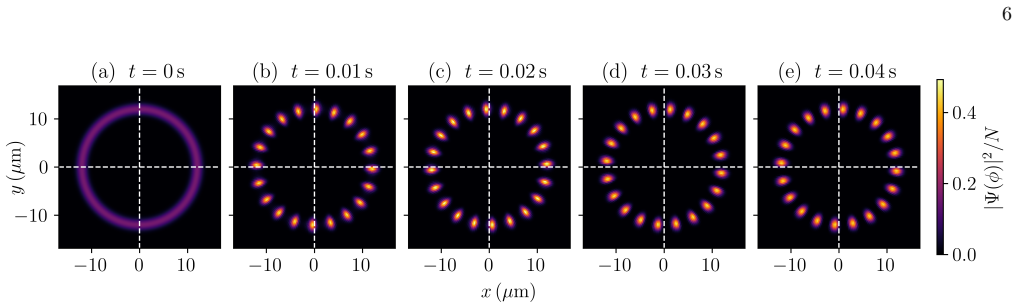
Superposition of two rotational eigenstates a. Density modulation The different sets ofL p1 andL p2, show the various density profiles, with the number of packets equal to |Lp1 −L p2 |as discussed in the main text and rotating with constant velocity over the ring. For the caseLp1 = 1 andL p2 =−1, the lattice is purely static with zero veloc- ity, because ...
-
[16]
S. I. Vilchynskyy, A. I. Yakimenko, K. O. Isaieva, and A. V. Chumachenko, The nature of superfluidity and Bose-Einstein condensation: From liquid 4He to dilute ultracold atomic gases (review article), Low Temp. Phys. 39, 724 (2013)
2013
-
[17]
Y. Cai, D. G. Allman, P. Sabharwal, and K. C. Wright, Persistent currents in rings of ultracold fermionic atoms, Phys. Rev. Lett.128, 150401 (2022)
2022
-
[18]
Del Pace, K
G. Del Pace, K. Xhani, A. Muzi Falconi, M. Fedrizzi, N. Grani, D. Hernandez Rajkov, M. Inguscio, F. Scazza, W. J. Kwon, and G. Roati, Imprinting Persistent Cur- rents in Tunable Fermionic Rings, Phys. Rev. X12, 041037 (2022)
2022
-
[19]
K. B. Davis, M. O. Mewes, M. R. Andrews, N. J. van Druten, D. S. Durfee, D. M. Kurn, and W. Ketterle, Bose-Einstein condensation in a gas of sodium atoms, Phys. Rev. Lett.75, 3969 (1995)
1995
-
[20]
A. J. Leggett, Bose-Einstein condensation in the alkali gases: Some fundamental concepts, Rev. Mod. Phys.73, 307 (2001)
2001
-
[21]
S. K. Gangwar, R. Ravisankar, P. Muruganandam, and P. K. Mishra, Emergence of spin-mixed superstripe phases in spin-orbit-coupled spin-1 condensates, Phys. Rev. A113, 023311 (2026)
2026
-
[22]
C. Ryu, M. F. Andersen, P. Clad´ e, V. Natarajan, K. Helmerson, and W. D. Phillips, Observation of per- sistent flow of a Bose-Einstein condensate in a toroidal trap, Phys. Rev. Lett.99, 260401 (2007)
2007
-
[23]
J. Polo, W. J. Chetcuti, T. Haug, A. Minguzzi, K. Wright, and L. Amico, Persistent currents in ultra- cold gases, Phys. Rep.1137, 1 (2025)
2025
-
[24]
Amico, D
L. Amico, D. Anderson, M. Boshier, J.-P. Brantut, L.-C. Kwek, A. Minguzzi, and W. von Klitzing, Colloquium: Atomtronic circuits: From many-body physics to quan- tum technologies, Rev. Mod. Phys.94, 041001 (2022)
2022
-
[25]
A. L. Fetter, Rotating trapped Bose-Einstein conden- sates, Rev. Mod. Phys.81, 647 (2009)
2009
-
[26]
Moulder, S
S. Moulder, S. Beattie, R. P. Smith, N. Tammuz, and Z. Hadzibabic, Quantized supercurrent decay in an an- nular Bose-Einstein condensate, Phys. Rev. A86, 013629 (2012)
2012
-
[27]
A. Das, J. Sabbatini, and W. H. Zurek, Winding up su- perfluid in a torus via Bose Einstein condensation, Sci. Rep.2, 352 (2012)
2012
-
[28]
Y. Guo, R. Dubessy, M. d. G. de Herve, A. Kumar, T. Badr, A. Perrin, L. Longchambon, and H. Perrin, Su- personic rotation of a superfluid: A long-lived dynamical ring, Phys. Rev. Lett.124, 025301 (2020)
2020
-
[29]
Pandey, H
S. Pandey, H. Mas, G. Drougakis, P. Thekkeppatt, V. Bolpasi, G. Vasilakis, K. Poulios, and W. von Klitz- ing, Hypersonic Bose–Einstein condensates in accelerator rings, Nature570, 205 (2019)
2019
-
[30]
Eckel, A
S. Eckel, A. Kumar, T. Jacobson, I. B. Spielman, and G. K. Campbell, A rapidly expanding Bose-Einstein con- densate: An expanding universe in the lab, Phys. Rev. X 8, 021021 (2018)
2018
-
[31]
G. E. Marti, R. Olf, and D. M. Stamper-Kurn, Collective excitation interferometry with a toroidal Bose-Einstein 20 condensate, Phys. Rev. A91, 013602 (2015)
2015
-
[32]
¨Ohberg and E
P. ¨Ohberg and E. M. Wright, Quantum time crystals and interacting gauge theories in atomic Bose-Einstein con- densates, Phys. Rev. Lett.123, 250402 (2019)
2019
-
[33]
Pandey, H
S. Pandey, H. Mas, G. Vasilakis, and W. von Klitzing, Atomtronic matter-wave lensing, Phys. Rev. Lett.126, 170402 (2021)
2021
-
[34]
Corman, L
L. Corman, L. Chomaz, T. Bienaim´ e, R. Desbuquois, C. Weitenberg, S. Nascimb` ene, J. Dalibard, and J. Beugnon, Quench-induced supercurrents in an annular Bose gas, Phys. Rev. Lett.113, 135302 (2014)
2014
-
[35]
Kumar, T
P. Kumar, T. Biswas, K. Feliz, R. Kanamoto, M.-S. Chang, A. K. Jha, and M. Bhattacharya, Cavity optome- chanical sensing and manipulation of an atomic persis- tent current, Phys. Rev. Lett.127, 113601 (2021)
2021
-
[36]
S. Das, P. Kumar, M. Bhattacharya, and T. N. Dey, Hy- brid rotational cavity optomechanics using an atomic su- perfluid in a ring, Phys. Rev. A110, 043512 (2024)
2024
-
[37]
Kalita, P
S. Kalita, P. Kumar, R. Kanamoto, M. Bhattacharya, and A. K. Sarma, Pump-probe cavity optomechanics with a rotating atomic superfluid in a ring, Phys. Rev. A 107, 013525 (2023)
2023
-
[38]
Pradhan, P
N. Pradhan, P. Kumar, R. Kanamoto, T. N. Dey, M. Bhattacharya, and P. K. Mishra, Ring Bose-Einstein condensate in a cavity: Chirality detection and rotation sensing, Phys. Rev. A109, 023524 (2024)
2024
-
[39]
Niedenzu, R
W. Niedenzu, R. Schulze, A. Vukics, and H. Ritsch, Mi- croscopic dynamics of ultracold particles in a ring-cavity optical lattice, Phys. Rev. A82, 043605 (2010)
2010
-
[40]
Daloi, R
N. Daloi, R. Gupta, A. Ghosh, P. Kumar, H. S. Dhar, and M. Bhattacharya, Cavity optomechanical quantum memory for twisted photons using a ring Bose-Einstein condensate, Phys. Rev. Res.8, 013013 (2026)
2026
-
[41]
Boninsegni and N
M. Boninsegni and N. V. Prokof’ev, Colloquium: Super- solids: What and where are they?, Rev. Mod. Phys.84, 759 (2012)
2012
-
[42]
Chomaz, D
L. Chomaz, D. Petter, P. Ilzh¨ ofer, G. Natale, A. Traut- mann, C. Politi, G. Durastante, R. M. W. van Bijnen, A. Patscheider, M. Sohmen, M. J. Mark, and F. Ferlaino, Long-lived and transient supersolid behaviors in dipolar quantum gases, Phys. Rev. X9, 021012 (2019)
2019
-
[43]
Mivehvar, S
F. Mivehvar, S. Ostermann, F. Piazza, and H. Ritsch, Driven-dissipative supersolid in a ring cavity, Phys. Rev. Lett.120, 123601 (2018)
2018
-
[44]
S. C. Schuster, P. Wolf, S. Ostermann, S. Slama, and C. Zimmermann, Supersolid properties of a Bose- Einstein condensate in a ring resonator, Phys. Rev. Lett. 124, 143602 (2020)
2020
-
[45]
Kim and M
E. Kim and M. H.-W. Chan, Probable observation of a supersolid helium phase, Nature427, 225 (2004)
2004
-
[46]
Recati and S
A. Recati and S. Stringari, Supersolidity in ultracold dipolar gases, Nat. Rev. Phys.5, 735 (2023)
2023
-
[47]
L´ eonard, A
J. L´ eonard, A. Morales, P. Zupancic, T. Esslinger, and T. Donner, Supersolid formation in a quantum gas break- ing a continuous translational symmetry, Nature543, 87 (2017)
2017
-
[48]
D. Nagy, G. Szirmai, and P. Domokos, Self-organization of a Bose-Einstein condensate in an optical cavity, Eur. Phys. J. D48, 127 (2008)
2008
-
[49]
L. Su, A. Douglas, M. Szurek, R. Groth, S. F. Ozturk, A. Krahn, A. H. H´ ebert, G. A. Phelps, S. Ebadi, S. Dick- erson,et al., Dipolar quantum solids emerging in a hub- bard quantum simulator, Nature622, 724 (2023)
2023
-
[50]
Gietka, F
K. Gietka, F. Mivehvar, and H. Ritsch, Supersolid-based gravimeter in a ring cavity, Phys. Rev. Lett.122, 190801 (2019)
2019
-
[51]
Pelegr´ ı, J
G. Pelegr´ ı, J. Mompart, and V. Ahufinger, Quantum sensing using imbalanced counter-rotating Bose-Einstein condensate modes, New J. Phys.20, 103001 (2018)
2018
-
[52]
Mivehvar, F
F. Mivehvar, F. Piazza, T. Donner, and H. Ritsch, Cavity qed with quantum gases: New paradigms in many-body physics, Advances in Physics70, 1 (2021)
2021
-
[53]
P. B. Blakie, D. Baillie, L. Chomaz, and F. Ferlaino, Supersolidity in an elongated dipolar condensate, Phys. Rev. Res.2, 043318 (2020)
2020
-
[54]
A. M. Kamchatnov and V. S. Shchesnovich, Dynamics of Bose-Einstein condensates in cigar-shaped traps, Phys. Rev. A70, 023604 (2004)
2004
-
[55]
Onofrio, C
R. Onofrio, C. Raman, J. M. Vogels, J. R. Abo-Shaeer, A. P. Chikkatur, and W. Ketterle, Observation of super- fluid flow in a Bose-Einstein condensed gas, Phys. Rev. Lett.85, 2228 (2000)
2000
-
[56]
M. N. Tengstrand, D. Boholm, R. Sachdeva, J. Bengts- son, and S. M. Reimann, Persistent currents in toroidal dipolar supersolids, Phys. Rev. A103, 013313 (2021)
2021
-
[57]
B. W. Shore, P. Meystre, and S. Stenholm, Is a quantum standing wave composed of two traveling waves?, J. Opt. Soc. Am. B8, 903 (1991)
1991
-
[58]
Domokos and H
P. Domokos and H. Ritsch, Mechanical effects of light in optical resonators, J. Opt. Soc. Am. B20, 1098 (2003)
2003
-
[59]
Ritsch, P
H. Ritsch, P. Domokos, F. Brennecke, and T. Esslinger, Cold atoms in cavity-generated dynamical optical poten- tials, Rev. Mod. Phys.85, 553 (2013)
2013
-
[60]
Ostermann, T
S. Ostermann, T. Grießer, and H. Ritsch, Atomic self- ordering in a ring cavity with counterpropagating pump fields, Europhys. Lett.109, 43001 (2015)
2015
-
[61]
Gangl and H
M. Gangl and H. Ritsch, Cold atoms in a high-Q ring cavity, Phys. Rev. A61, 043405 (2000)
2000
-
[62]
Qin and L
J. Qin and L. Zhou, Self-trapped atomic matter wave in a ring cavity, Phys. Rev. A102, 063309 (2020)
2020
-
[63]
Qin and L
J. Qin and L. Zhou, Supersolid gap soliton in a Bose- Einstein condensate and optical ring cavity coupling sys- tem, Phys. Rev. E105, 054214 (2022)
2022
-
[64]
Beattie, S
S. Beattie, S. Moulder, R. J. Fletcher, and Z. Hadzibabic, Persistent Currents in Spinor Condensates, Phys. Rev. Lett.110, 025301 (2013)
2013
-
[65]
Cheng, Z.-D
Z.-D. Cheng, Z.-D. Liu, X.-W. Luo, Z.-W. Zhou, J. Wang, Q. Li, Y.-T. Wang, J.-S. Tang, J.-S. Xu, C.- F. Li,et al., Degenerate cavity supporting more than 31 Laguerre–Gaussian modes, Opt. Lett.42, 2042 (2017)
2042
-
[66]
Y. Yang, Y. Li, and C. Wang, Generation and expansion of Laguerre–Gaussian beams, J. Opt.51, 910 (2022)
2022
-
[67]
Piovella, G
N. Piovella, G. R. M. Robb, and R. Bachelard, Super- radiant transfer of quantized orbital angular momentum between light and atoms in a ring trap, Phys. Rev. A 106, L011304 (2022)
2022
-
[68]
E. Poli, A. Litvinov, E. Casotti, C. Ulm, L. Klaus, M. J. Mark, G. Lamporesi, T. Bland, and F. Ferlaino, Syn- chronization in rotating supersolids, Nat. Phys.21, 1820 (2025)
2025
-
[69]
S. M. Roccuzzo, A. Gallem´ ı, A. Recati, and S. Stringari, Rotating a Supersolid Dipolar Gas, Phys. Rev. Lett.124, 045702 (2020)
2020
-
[70]
Preti, N
N. Preti, N. Antolini, C. Drevon, P. Lombardi, A. Fioretti, C. Gabbanini, G. Ferioli, G. Modugno, and G. Biagioni, Single-Fluid Model for Rotating Annular Su- persolids and Its Experimental Implications, Phys. Rev. 21 Lett.136, 036001 (2026)
2026
-
[71]
S´ anchez-Baena, R
J. S´ anchez-Baena, R. Bomb´ ın, and J. Boronat, Ring solids and supersolids in spherical shell-shaped dipolar Bose-Einstein condensates, Phys. Rev. Res.6, 033116 (2024)
2024
-
[72]
Mukherjee, T
K. Mukherjee, T. A. Cardinale, and S. M. Reimann, Selective rotation and attractive persistent currents in antidipolar ring supersolids, Phys. Rev. A111, 033304 (2025)
2025
-
[73]
Ilzh¨ ofer, M
P. Ilzh¨ ofer, M. Sohmen, G. Durastante, C. Politi, A. Trautmann, G. Natale, G. Morpurgo, T. Giamarchi, L. Chomaz, M. J. Mark,et al., Phase coherence in out-of- equilibrium supersolid states of ultracold dipolar atoms, Nat. Phys.17, 356 (2021)
2021
-
[74]
Goldstone, Field theories with ≪superconductor≫ so- lutions, Il Nuovo Cimento (1955-1965)19, 154 (1961)
J. Goldstone, Field theories with ≪superconductor≫ so- lutions, Il Nuovo Cimento (1955-1965)19, 154 (1961)
1955
-
[75]
Goldstone, A
J. Goldstone, A. Salam, and S. Weinberg, Broken sym- metries, Phys. Rev.127, 965 (1962)
1962
-
[76]
M. Guo, F. B¨ ottcher, J. Hertkorn, J.-N. Schmidt, M. Wenzel, H. P. B¨ uchler, T. Langen, and T. Pfau, The low-energy Goldstone mode in a trapped dipolar super- solid, Nature574, 386 (2019)
2019
-
[77]
Hertkorn, P
J. Hertkorn, P. St¨ urmer, K. Mukherjee, K. S. H. Ng, P. Uerlings, F. Hellstern, L. Lavoine, S. M. Reimann, T. Pfau, and R. Klemt, Decoupled sound and amplitude modes in trapped dipolar supersolids, Phys. Rev. Res.6, L042056 (2024)
2024
-
[78]
D. W. Hallwood, T. Ernst, and J. Brand, Robust mesoscopic superposition of strongly correlated ultracold atoms, Phys. Rev. A82, 063623 (2010)
2010
-
[79]
M. F. Andersen, C. Ryu, P. Clad´ e, V. Natarajan, A. Vaziri, K. Helmerson, and W. D. Phillips, Quantized rotation of atoms from photons with orbital angular mo- mentum, Phys. Rev. Lett.97, 170406 (2006)
2006
-
[80]
K. C. Wright, L. S. Leslie, A. Hansen, and N. P. Bigelow, Sculpting the vortex state of a spinor BEC, Phys. Rev. Lett.102, 030405 (2009)
2009
discussion (0)
Sign in with ORCID, Apple, or X to comment. Anyone can read and Pith papers without signing in.