Recognition: unknown
Hybrid Spectro-Temporal Fusion Framework for Structural Health Monitoring
Pith reviewed 2026-05-10 08:46 UTC · model grok-4.3
The pith
A hybrid fusion of arrival-time descriptors and spectral features delivers higher accuracy and lower variability in vibration-based structural damage detection.
A machine-rendered reading of the paper's core claim, the machinery that carries it, and where it could break.
Core claim
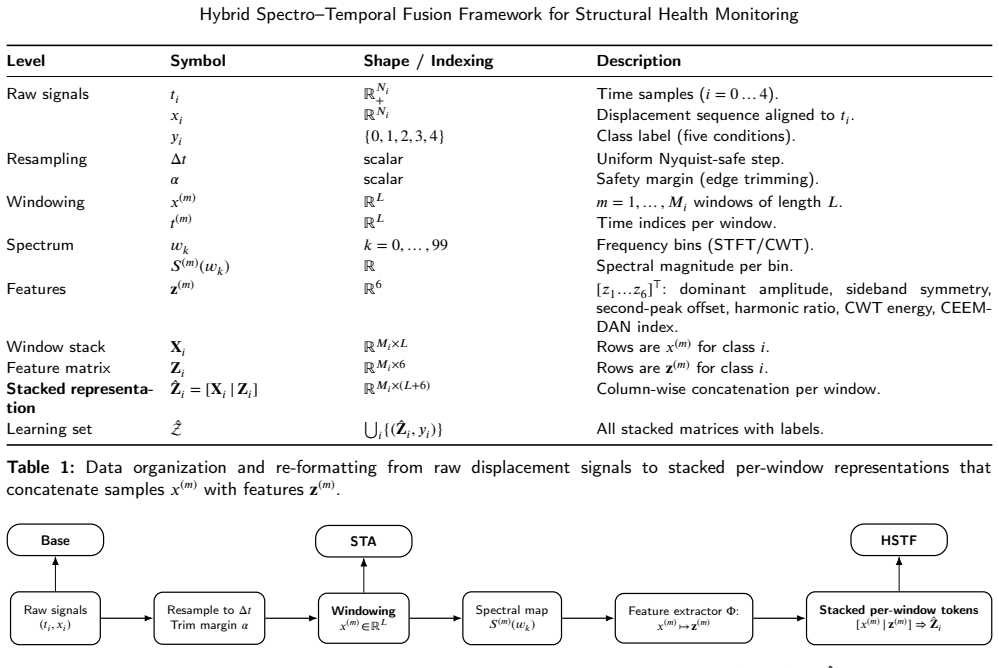
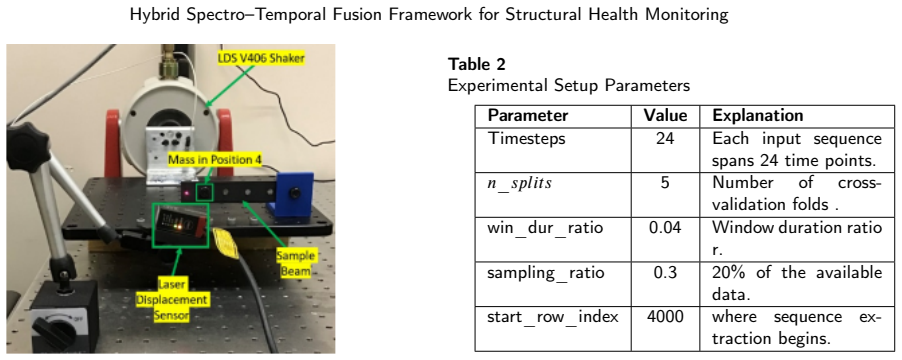
The proposed Hybrid Spectro-Temporal Fusion framework integrates arrival-time interval descriptors with spectral features to capture both fine-scale and coarse-scale vibration dynamics. Experiments conducted on data collected from an LDS V406 electrodynamic shaker demonstrate that the proposed spectro-temporal representations significantly outperform conventional input formulations. The results indicate that a temporal resolution (Δτ) of 0.008 or 0.02 favors traditional machine learning models, whereas a finer resolution (Δτ) of 0.008 effectively unlocks the performance potential of deep learning architectures. Beyond classification accuracy, a comprehensive stability analysis based on mean,
What carries the argument
The hybrid spectro-temporal fusion that merges arrival-time interval descriptors with spectral features to represent multi-scale vibration dynamics.
If this is right
- A temporal resolution of 0.02 favors traditional machine learning models while 0.008 favors deep learning architectures.
- The hybrid framework consistently achieves higher accuracy with substantially lower variability than baseline and alignment-only approaches.
- Integration of fine-scale and coarse-scale dynamics improves reliability in vibration classification tasks.
- The method provides a robust solution for vibration-based structural health monitoring.
Where Pith is reading between the lines
- If lab results generalize, the framework could support longer-term monitoring deployments with fewer false alarms.
- The multi-scale fusion idea may extend to other sensor types such as acoustic or strain data.
- Adaptive selection of temporal resolution based on data characteristics could be a natural next step.
- Direct comparison on field-collected data without retraining would test broader transferability.
Load-bearing premise
Laboratory shaker vibration responses are representative of real-world structural damage signatures and the chosen temporal resolutions and feature combinations transfer without retraining or retuning.
What would settle it
Testing the hybrid framework on vibration data from actual in-service structures with known damage and observing no accuracy gain or increased variability compared to baselines would disprove the central claim.
Figures



read the original abstract
Structural health monitoring plays a critical role in ensuring structural safety by analyzing vibration responses from engineering systems. This paper proposes a Spectro-Temporal Alignment framework and a Hybrid Spectro-Temporal Fusion framework that integrate arrival-time interval descriptors with spectral features to capture both fine-scale and coarse-scale vibration dynamics. Experiments conducted on data collected from an LDS V406 electrodynamic shaker demonstrate that the proposed spectro-temporal representations significantly outperform conventional input formulations. The results indicate that a temporal resolution ({\Delta}{\tau}) of 0.008 of 0.02 favors traditional machine learning models, whereas a finer resolution ({\Delta}{\tau}) of 0.008 effectively unlocks the performance potential of deep learning architectures. Beyond classification accuracy, a comprehensive stability analysis based on condensed indices, including mean performance, standard deviation, coefficient of variation, and balanced score, shows that the proposed hybrid framework consistently achieves higher accuracy with substantially lower variability compared to baseline and alignment-only approaches. Overall, these results demonstrate that the proposed framework provides a robust, accurate, and reliable solution for vibration-based structural health monitoring.
Editorial analysis
A structured set of objections, weighed in public.
Circularity Check
No significant circularity in derivation chain
full rationale
The paper proposes Spectro-Temporal Alignment and Hybrid Spectro-Temporal Fusion frameworks for vibration-based structural health monitoring and evaluates them empirically on LDS V406 shaker data. Central claims of superior accuracy and lower variability rest on direct experimental comparisons using condensed stability indices against baselines, with no mathematical derivations, equations, or first-principles results that reduce to inputs by construction. No self-referential definitions, fitted parameters renamed as predictions, or load-bearing self-citations appear in the described chain; the performance metrics are computed from the experimental outcomes rather than being tautological with the input features or temporal resolutions.
Axiom & Free-Parameter Ledger
free parameters (1)
- temporal resolution Δτ
axioms (2)
- domain assumption Vibration responses from an electrodynamic shaker adequately represent structural damage dynamics for classification purposes.
- domain assumption Arrival-time interval descriptors and spectral features are complementary and can be fused without loss of information.
invented entities (2)
-
Spectro-Temporal Alignment framework
no independent evidence
-
Hybrid Spectro-Temporal Fusion framework
no independent evidence
Reference graph
Works this paper leans on
-
[1]
doi:10.3390/w16243687. Fisher, R.A., 1925. Statistical methods for research workers. Oliver and Boyd, Edinburgh. Original derivation of the Analysis of Variance (ANOVA) and the F-statistic logic. Fukunaga, K., 1990. Introduction to Statistical Pattern Recognition. 2 ed., Academic Press. Ghosh, S., Patel, M., 2021. Anova-based feature selection for time-se...
-
[2]
URL: https://arxiv.org/abs/1711.04425
Lightgbm: A highly efficient gradient boosting decision tree, in: Advances in Neural Information Processing Systems (NeurIPS). URL: https://arxiv.org/abs/1711.04425. Krause,A.,Singh,A.,Guestrin,C.,2008. Near-optimalsensorplacements in gaussian processes: Theory, efficient algorithms and empirical stud- ies, in: Proceedings of the 24th International Confer...
-
[3]
doi:10.1109/TSA.2002.800560. Vaswani, A., Shazeer, N., Parmar, N., Uszkoreit, J., Jones, L., Gomez, A.N., Kaiser, Ł., Polosukhin, I., 2017. Attention is all you need, in: Advances in Neural Information Processing Systems (NeurIPS). URL: https://arxiv.org/abs/1706.03762. Wang, J., Li, S., Han, B., 2022a. Time-frequency analysis for machinery fault diagnosi...
discussion (0)
Sign in with ORCID, Apple, or X to comment. Anyone can read and Pith papers without signing in.