Recognition: unknown
Old Universe, Young SNe Ia: A Statistical Analysis of Type Ia Supernova Progenitor Age from 6,983 TITAN Host Galaxies, and Implications for Cosmology
Pith reviewed 2026-05-10 07:17 UTC · model grok-4.3
The pith
Type Ia supernova progenitors average 3.5 Gyr old with only 1.5 Gyr evolution over cosmic time, producing no measurable bias in cosmological distances.
A machine-rendered reading of the paper's core claim, the machinery that carries it, and where it could break.
Core claim
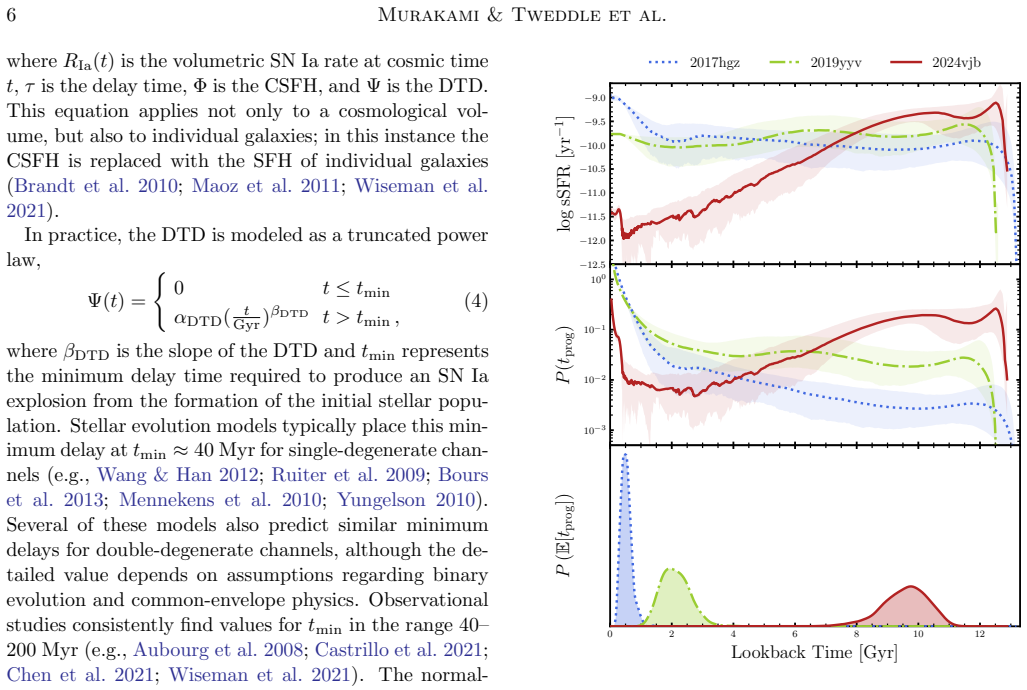
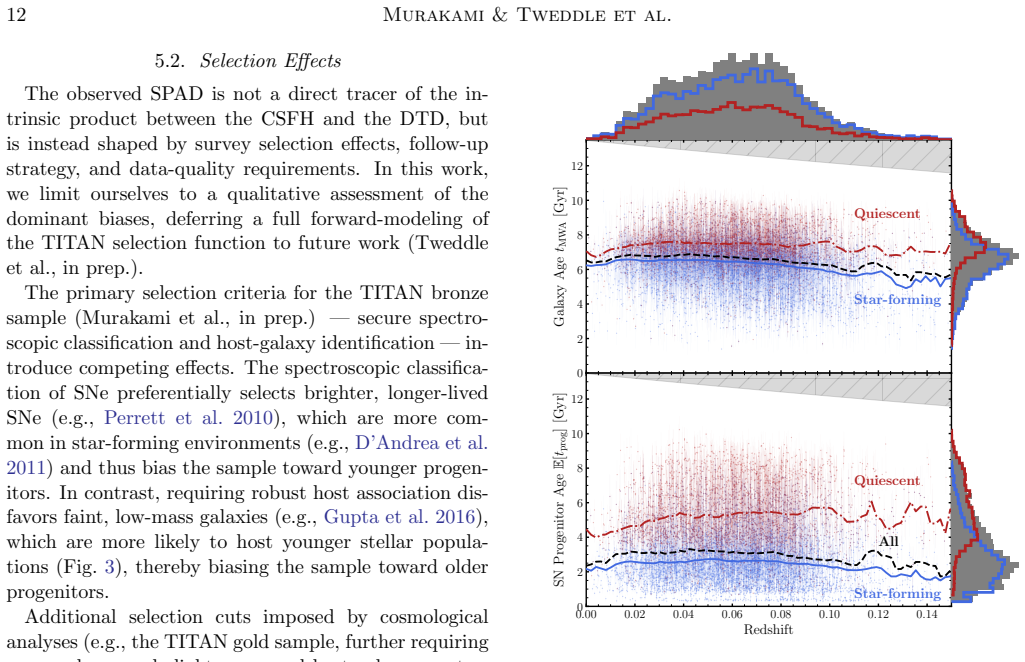
Progenitor ages are obtained by fitting spectral energy distributions of the host galaxies to recover star-formation histories, then convolving those histories with empirical delay-time distributions. The resulting age distribution has a mean of 3.5 Gyr and is dominated by a young component from star-forming hosts. Restricting to high-mass galaxies isolates a 3.3 Gyr age difference between host types, which would predict a 0.10 mag luminosity offset under the age-evolution hypothesis yet is inconsistent with observed standardized magnitudes. The inferred 1.5 Gyr evolution in mean progenitor age across cosmic time yields a maximum bias of ΔHR = −0.007+0.012−0.014 mag after accounting for the
What carries the argument
Host-galaxy star-formation histories from multi-wavelength SED fitting, convolved with empirical delay-time distributions to produce progenitor age estimates and their redshift evolution.
If this is right
- Standard host-mass corrections already approximate any progenitor-age effects on standardized supernova luminosities.
- Cosmological inferences from Type Ia supernovae do not require additional redshift-dependent age terms beyond current modeling.
- The age difference between star-forming and quiescent hosts does not produce the large luminosity offset predicted by strong-evolution scenarios.
- Mean progenitor age evolves only mildly, remaining below 5 Gyr even at moderate redshifts.
Where Pith is reading between the lines
- If the age-Hubble-residual relation holds at higher redshifts, future surveys can rely on existing mass-step corrections without new systematic floors.
- The young mean age may tighten constraints on allowed delay-time distributions in stellar population models.
- Direct age measurements in high-redshift hosts would provide an independent test of whether delay-time distributions remain universal.
Load-bearing premise
The empirical delay-time distributions that turn star-formation histories into progenitor ages are accurate and universal across redshifts.
What would settle it
A high-redshift sample of comparable size showing mean progenitor ages above 5 Gyr or a Hubble-residual bias exceeding 0.02 mag after host-mass corrections.
Figures





read the original abstract
Correlations between standardized Type Ia supernova (SN Ia) luminosities and host-galaxy properties are routinely modeled to avoid bias in cosmological parameter inference. A recent hypothesis attributes these correlations to progenitor-age variations and, combined with a strong ($\sim$5-6 Gyr) age evolution between low- and high-redshift samples, could alter cosmological conclusions. We test this scenario using the SN Ia host galaxies of TITAN DR1, the largest low-redshift sample of its kind to date (6,983 hosts; 0 $\lesssim$ z $\lesssim$ 0.15). Progenitor ages are estimated by combining host-galaxy star-formation histories (SFHs) with empirical delay-time distributions. The SFHs are constrained via spectral energy distribution (SED) fitting of photometry spanning ultraviolet (UV) to mid-infrared (MIR) wavelengths, enabling robust separation of dusty star-forming and quiescent systems. The resulting progenitor-age distribution has a mean of 3.5 Gyr, substantially younger than predicted by strong-evolution models. It is strongly peaked near 2.2 Gyr, predominantly from star-forming hosts (60% of the sample), with a smaller, broader component centered near 6.0 Gyr from quiescent systems. Restricting to high-mass galaxies (in order to isolate progenitor effects from the mass-step), the age difference between host types reduces to 3.3 Gyr which, under the age-dependence hypothesis, would imply a 0.10 mag luminosity offset, inconsistent with observed standardized magnitudes. We infer a modest 1.5 Gyr evolution in mean progenitor age over cosmic time which, combined with observed age-Hubble-residual (HR) relations, yields a maximum redshift-dependent bias of $\Delta$HR = $-0.007^{+0.012}_{-0.014}$ mag, consistent with zero. We find no evidence for a large, unmodeled progenitor-age systematic beyond what is already captured, to good approximation, by standard host-mass corrections.
Editorial analysis
A structured set of objections, weighed in public.
Referee Report
Summary. The manuscript analyzes Type Ia supernova progenitor ages in the large TITAN DR1 sample of 6983 low-redshift (z ≲ 0.15) host galaxies. Star-formation histories are derived from multi-wavelength SED fitting, then convolved with empirical delay-time distributions to obtain a progenitor-age distribution with mean 3.5 Gyr (peaked at 2.2 Gyr for star-forming hosts and 6.0 Gyr for quiescent). The authors report a modest 1.5 Gyr mean-age evolution over cosmic time, which when combined with observed low-z age-Hubble-residual relations produces a maximum redshift-dependent bias ΔHR = −0.007^{+0.012}_{-0.014} mag, consistent with zero. They conclude there is no evidence for a large unmodeled progenitor-age systematic beyond standard host-mass corrections.
Significance. If the result holds, the work supplies a statistically powerful empirical test of the progenitor-age hypothesis for SN Ia luminosity correlations. The large, homogeneous low-z sample and UV-to-MIR photometry allow separation of star-forming and quiescent hosts, yielding a concrete age distribution that is younger than strong-evolution models predict. This supports the adequacy of existing mass-step corrections for cosmological analyses and reduces the risk that unaccounted age evolution biases high-z distance measurements.
major comments (2)
- [Abstract and age-estimation procedure] The central ΔHR bias result is obtained by scaling an externally calibrated low-z age-HR slope by the redshift-dependent mean-age shift inferred from DTD-convolved SFHs. The manuscript does not report a sensitivity analysis to plausible variations in DTD power-law index or normalization (which theoretical models suggest can change with metallicity or environment), nor does it validate the DTD universality within the TITAN sample itself; both omissions directly affect the quoted 1.5 Gyr evolution and the conclusion that the bias is consistent with zero.
- [Implications for cosmology section] The extrapolation of the observed low-z age-HR relation to higher redshifts is assumed to hold without additional redshift dependence. No internal test (e.g., splitting the TITAN sample by redshift or host properties to check for evolution in the age-HR slope) is presented, leaving the maximum-bias claim vulnerable to the weakest assumption identified in the analysis.
minor comments (2)
- [Abstract] The abstract reports concrete numerical results but does not specify which empirical DTD parametrization is adopted, hindering immediate reproducibility.
- Error budgets on the mean-age and ΔHR values are quoted but the propagation from SFH uncertainties, DTD parameters, and sample selection is not detailed in the provided text; a dedicated error-budget subsection or table would improve clarity.
Simulated Author's Rebuttal
We thank the referee for their careful reading and constructive feedback. We address each major comment below and have revised the manuscript to incorporate additional analyses where feasible.
read point-by-point responses
-
Referee: [Abstract and age-estimation procedure] The central ΔHR bias result is obtained by scaling an externally calibrated low-z age-HR slope by the redshift-dependent mean-age shift inferred from DTD-convolved SFHs. The manuscript does not report a sensitivity analysis to plausible variations in DTD power-law index or normalization (which theoretical models suggest can change with metallicity or environment), nor does it validate the DTD universality within the TITAN sample itself; both omissions directly affect the quoted 1.5 Gyr evolution and the conclusion that the bias is consistent with zero.
Authors: We adopted the standard empirical DTD from the literature for the primary analysis. In the revised manuscript we have added a sensitivity analysis varying the power-law index by ±0.3 around the fiducial value and the normalization by ±20%. The mean progenitor age evolution remains in the range 1.3–1.7 Gyr and the resulting ΔHR bias stays consistent with zero within the quoted uncertainties. We have also included consistency checks across star-forming and quiescent subsamples that support the adopted DTD within the TITAN data; a full internal validation of universality is limited by the absence of independent age anchors and is now discussed as a caveat. revision: yes
-
Referee: [Implications for cosmology section] The extrapolation of the observed low-z age-HR relation to higher redshifts is assumed to hold without additional redshift dependence. No internal test (e.g., splitting the TITAN sample by redshift or host properties to check for evolution in the age-HR slope) is presented, leaving the maximum-bias claim vulnerable to the weakest assumption identified in the analysis.
Authors: Although the TITAN redshift baseline is modest (z ≲ 0.15), we have added an internal test splitting the sample at z = 0.05. The age-HR slope shows no statistically significant difference between the low- and higher-redshift bins. The revised manuscript now reports this test and notes that the extrapolation assumption remains necessary beyond z ≈ 0.15, but the low-z consistency supports the robustness of the maximum-bias estimate. revision: partial
Circularity Check
No significant circularity; derivation relies on external empirical inputs
full rationale
The paper derives mean progenitor ages by folding SED-constrained SFHs through empirical DTDs, then scales observed low-z age-HR slopes by the resulting redshift-dependent age shift to obtain ΔHR. No quoted equation or step reduces the target bias or age evolution to a fitted parameter defined in terms of itself, nor does any load-bearing premise rest on a self-citation chain whose validity is internal to this work. The central numerical results are computed from independent literature relations rather than by construction from the paper's own outputs.
Axiom & Free-Parameter Ledger
axioms (2)
- domain assumption Empirical delay-time distributions accurately convert star-formation histories into progenitor-age distributions
- domain assumption UV-to-MIR photometry and SED fitting reliably separate star-forming from quiescent galaxies and recover accurate SFHs
Forward citations
Cited by 1 Pith paper
-
Cosmological Impact of Redshift-Dependent Type Ia Supernovae Calibration
A phenomenological redshift-dependent SNIa magnitude correction shows no evidence in ΛCDM but is preferred at 4.3σ with dynamical dark energy, reducing Hubble tension to 1.5σ.
Reference graph
Works this paper leans on
-
[1]
The Wide Field Infrared Survey Telescope: 100 Hubbles for the 2020s
Akeson, R., Armus, L., Bachelet, E., et al. 2019, arXiv e-prints, arXiv:1902.05569, doi: 10.48550/arXiv.1902.05569 Aubourg, ´E., Tojeiro, R., Jimenez, R., et al. 2008, A&A, 492, 631, doi: 10.1051/0004-6361:200809796
-
[2]
Behroozi, P. S., Wechsler, R. H., & Conroy, C. 2013, ApJ, 770, 57, doi: 10.1088/0004-637X/770/1/57
-
[3]
2018, MNRAS, 477, 3014, doi: 10.1093/mnras/sty768
Belfiore, F., Maiolino, R., Bundy, K., et al. 2018, MNRAS, 477, 3014, doi: 10.1093/mnras/sty768
-
[4]
2014, , 568, A22, 10.1051/0004-6361/201423413
Betoule, M., Kessler, R., Guy, J., et al. 2014, A&A, 568, A22, doi: 10.1051/0004-6361/201423413
-
[5]
Bours, M. C. P., Toonen, S., & Nelemans, G. 2013, A&A, 552, A24, doi: 10.1051/0004-6361/201220692
-
[6]
Boyd, B. M., Mandel, K. S., Grayling, M., et al. 2026, arXiv e-prints, arXiv:2603.11165, doi: 10.48550/arXiv.2603.11165
-
[7]
Branch, D., & Wheeler, J. C. 2017, Supernova Explosions, doi: 10.1007/978-3-662-55054-0
-
[8]
D., Tojeiro, R., Aubourg, ´E., et al
Brandt, T. D., Tojeiro, R., Aubourg, ´E., et al. 2010, AJ, 140, 804, doi: 10.1088/0004-6256/140/3/804
-
[9]
Breuval, L., Riess, A. G., Casertano, S., et al. 2024, arXiv e-prints, arXiv:2404.08038, doi: 10.48550/arXiv.2404.08038 Old Universe, Young SNe Ia23
-
[10]
Briday, M., Rigault, M., Graziani, R., et al. 2022, A&A, 657, A22, doi: 10.1051/0004-6361/202141160
-
[11]
Brout, D., & Scolnic, D. 2021, ApJ, 909, 26, doi: 10.3847/1538-4357/abd69b
-
[12]
2019 a , , 874, 150, 10.3847/1538-4357/ab08a0
Brout, D., Scolnic, D., Kessler, R., et al. 2019, ApJ, 874, 150, doi: 10.3847/1538-4357/ab08a0
-
[13]
and Carr, Anthony and Zuntz, Joe and Kessler, Rick and Davis, Tamara M
Brout, D., Scolnic, D., Popovic, B., et al. 2022, ApJ, 938, 110, doi: 10.3847/1538-4357/ac8e04
-
[14]
Burgarella, D., Buat, V., & Iglesias-P´ aramo, J. 2005, MNRAS, 360, 1413, doi: 10.1111/j.1365-2966.2005.09131.x
-
[15]
Calzetti, D., Armus, L., Bohlin, R. C., et al. 2000, ApJ, 533, 682, doi: 10.1086/308692
work page internal anchor Pith review doi:10.1086/308692 2000
-
[16]
Carnall, A. C., McLure, R. J., Dunlop, J. S., & Dav´ e, R. 2018, MNRAS, 480, 4379, doi: 10.1093/mnras/sty2169
-
[17]
2021, MNRAS, 501, 3122, doi: 10.1093/mnras/staa3876
Castrillo, A., Ascasibar, Y., Galbany, L., et al. 2021, MNRAS, 501, 3122, doi: 10.1093/mnras/staa3876
-
[18]
2021, ApJ, 922, 15, doi: 10.3847/1538-4357/ac178d
Chen, X., Hu, L., & Wang, L. 2021, ApJ, 922, 15, doi: 10.3847/1538-4357/ac178d
-
[19]
Childress, M., Aldering, G., Antilogus, P., et al. 2013, ApJ, 770, 108, doi: 10.1088/0004-637X/770/2/108
-
[20]
Childress, M. J., Wolf, C., & Zahid, H. J. 2014, MNRAS, 445, 1898, doi: 10.1093/mnras/stu1892
-
[21]
Robust and ubiquitous evidence from a larger sample of host galaxies in a broader redshift range
Chung, C., Park, S., Son, J., Cho, H., & Lee, Y.-W. 2025, MNRAS, 538, 3340, doi: 10.1093/mnras/staf497
-
[22]
2015, , 576, A10, 10.1051/0004-6361/201425252
Ciesla, L., Charmandaris, V., Georgakakis, A., et al. 2015, A&A, 576, A10, doi: 10.1051/0004-6361/201425252
-
[23]
Verbunt, F. W. M. 2014, A&A, 563, A83, doi: 10.1051/0004-6361/201322714
-
[24]
Modeling the Panchromatic Spectral Energy Distributions of Galaxies
Conroy, C. 2013, ARA&A, 51, 393, doi: 10.1146/annurev-astro-082812-141017 da Cunha, E., Charlot, S., & Elbaz, D. 2008, MNRAS, 388, 1595, doi: 10.1111/j.1365-2966.2008.13535.x D’Andrea, C. B., Gupta, R. R., Sako, M., et al. 2011, ApJ, 743, 172, doi: 10.1088/0004-637X/743/2/172
work page Pith review doi:10.1146/annurev-astro-082812-141017 2013
-
[25]
Davies, L. J. M., Robotham, A. S. G., Lagos, C. d. P., et al. 2019, MNRAS, 483, 5444, doi: 10.1093/mnras/sty3393 DES Collaboration, Abbott, T. M. C., Acevedo, M., et al. 2024, arXiv e-prints, arXiv:2401.02929, doi: 10.48550/arXiv.2401.02929 DESI Collaboration, Abdul Karim, M., Aguilar, J., Ahlen, S., et al. 2025, PhRvD, 112, 083515, doi: 10.1103/tr6y-kpc6
-
[26]
Dettman, K. G., Jha, S. W., Dai, M., et al. 2021, ApJ, 923, 267, doi: 10.3847/1538-4357/ac2ee5
-
[27]
2025, MNRAS, 538, 782, doi: 10.1093/mnras/staf266
Dixon, M., Mould, J., Lidman, C., et al. 2025, MNRAS, 538, 782, doi: 10.1093/mnras/staf266
-
[28]
Draine, B. T., Dale, D. A., Bendo, G., et al. 2007, ApJ, 663, 866, doi: 10.1086/518306
-
[29]
Filippenko, A. V. 2005, in Astrophysics and Space Science
2005
-
[30]
332, White dwarfs: cosmological and galactic probes, ed
Library, Vol. 332, White dwarfs: cosmological and galactic probes, ed. E. M. Sion, S. Vennes, & H. L. Shipman, 97–133, doi: 10.1007/1-4020-3725-2 12
-
[31]
Frohmaier, C., Sullivan, M., Nugent, P. E., et al. 2019, MNRAS, 486, 2308, doi: 10.1093/mnras/stz807
-
[32]
2004, MNRAS, 348, 1019, doi: 10.1111/j.1365-2966.2004.07422.x
Gal-Yam, A., & Maoz, D. 2004, MNRAS, 347, 942, doi: 10.1111/j.1365-2966.2004.07237.x
-
[33]
Gallazzi, A., Charlot, S., Brinchmann, J., White, S. D. M., & Tremonti, C. A. 2005, MNRAS, 362, 41, doi: 10.1111/j.1365-2966.2005.09321.x
-
[34]
Garnavich, P., Wood, C. M., Milne, P., et al. 2023, ApJ, 953, 35, doi: 10.3847/1538-4357/ace04b
-
[35]
Ginolin, M., Rigault, M., Copin, Y., et al. 2025a, A&A, 694, A4, doi: 10.1051/0004-6361/202450943
-
[36]
Ginolin, M., Rigault, M., Smith, M., et al. 2025b, A&A, 695, A140, doi: 10.1051/0004-6361/202450378
-
[37]
Gupta, R. R., D’Andrea, C. B., Sako, M., et al. 2011, ApJ, 740, 92, doi: 10.1088/0004-637X/740/2/92
-
[38]
R., Kuhlmann , S., Kovacs , E., et al
Gupta, R. R., Kuhlmann, S., Kovacs, E., et al. 2016, AJ, 152, 154, doi: 10.3847/0004-6256/152/6/154
-
[39]
2007, , 466, 11, 10.1051/0004-6361:20066930
Guy, J., Astier, P., Baumont, S., et al. 2007, A&A, 466, 11, doi: 10.1051/0004-6361:20066930
-
[40]
Howell, D. A. 2011, Nature Communications, 2, 350, doi: 10.1038/ncomms1344 Ivezi´ c,ˇZ., Kahn, S. M., Tyson, J. A., et al. 2019, ApJ, 873, 111, doi: 10.3847/1538-4357/ab042c
-
[41]
Iyer, K. G., Gawiser, E., Faber, S. M., et al. 2019, ApJ, 879, 116, doi: 10.3847/1538-4357/ab2052
-
[42]
Jones, D. O., Mandel, K. S., Kirshner, R. P., et al. 2022, ApJ, 933, 172, doi: 10.3847/1538-4357/ac755b
-
[43]
Kang, Y., Lee, Y.-W., Kim, Y.-L., Chung, C., & Ree, C. H. 2020, ApJ, 889, 8, doi: 10.3847/1538-4357/ab5afc
-
[44]
Kirshner, R. P. 2010, ApJ, 715, 743, doi: 10.1088/0004-637X/715/2/743
-
[45]
Kelsey, L., Sullivan, M., Smith, M., et al. 2021, MNRAS, 501, 4861, doi: 10.1093/mnras/staa3924
-
[46]
Kelsey, L., Sullivan, M., Wiseman, P., et al. 2023, MNRAS, 519, 3046, doi: 10.1093/mnras/stac3711
-
[47]
Kennicutt, Jr., R. C. 1998, ARA&A, 36, 189, doi: 10.1146/annurev.astro.36.1.189
work page internal anchor Pith review doi:10.1146/annurev.astro.36.1.189 1998
-
[48]
Kenworthy, W. D., Jones, D. O., Dai, M., et al. 2021, ApJ, 923, 265, doi: 10.3847/1538-4357/ac30d8
-
[49]
Kessler, R., & Scolnic, D. 2017, ApJ, 836, 56, doi: 10.3847/1538-4357/836/1/56
-
[50]
Kessler, R., Bernstein, J. P., Cinabro, D., et al. 2009, PASP, 121, 1028, doi: 10.1086/605984
-
[51]
Lampeitl, H., Smith, M., Nichol, R. C., et al. 2010, ApJ, 722, 566, doi: 10.1088/0004-637X/722/1/566 24Murakami & Tweddle et al
-
[52]
Larison, C., Jha, S. W., Kwok, L. A., & Camacho-Neves, Y. 2024, ApJ, 961, 185, doi: 10.3847/1538-4357/ad0e0f
-
[53]
Euclid Definition Study Report
Laureijs, R., Amiaux, J., Arduini, S., et al. 2011, arXiv e-prints, arXiv:1110.3193, doi: 10.48550/arXiv.1110.3193
work page internal anchor Pith review Pith/arXiv arXiv doi:10.48550/arxiv.1110.3193 2011
-
[54]
Lee, Y.-W., Chung, C., Demarque, P., et al. 2022, MNRAS, 517, 2697, doi: 10.1093/mnras/stac2840
-
[55]
Lee, Y.-W., Chung, C., Kang, Y., & Jee, M. J. 2020, ApJ, 903, 22, doi: 10.3847/1538-4357/abb3c6
-
[56]
Speagle, J. S. 2019, ApJ, 876, 3, doi: 10.3847/1538-4357/ab133c
-
[57]
Byler, N. 2017, ApJ, 837, 170, doi: 10.3847/1538-4357/aa5ffe
-
[58]
, archivePrefix = "arXiv", eprint =
Madau, P., & Dickinson, M. 2014, ARA&A, 52, 415, doi: 10.1146/annurev-astro-081811-125615
work page internal anchor Pith review doi:10.1146/annurev-astro-081811-125615 2014
-
[59]
Maoz, D., Mannucci, F., & Brandt, T. D. 2012, MNRAS, 426, 3282, doi: 10.1111/j.1365-2966.2012.21871.x
-
[60]
2010, MNRAS, 407, 1403, doi: 10.1111/j.1365-2966.2010.16985.x
Maoz, D., Mannucci, F., Li, W., et al. 2011, MNRAS, 412, 1508, doi: 10.1111/j.1365-2966.2010.16808.x
-
[61]
2014, ARA&A, 52, 107, https://doi.org/10.1146/annurev-astro-082812-141031
Maoz, D., Mannucci, F., & Nelemans, G. 2014, ARA&A, 52, 107, doi: 10.1146/annurev-astro-082812-141031
-
[62]
2010, ApJ, 722, 1879, doi: 10.1088/0004-637X/722/2/1879
Maoz, D., Sharon, K., & Gal-Yam, A. 2010, ApJ, 722, 1879, doi: 10.1088/0004-637X/722/2/1879
-
[63]
2020, MNRAS, 496, 2962, doi: 10.1093/mnras/staa1489
Maraston, C., Hill, L., Thomas, D., et al. 2020, MNRAS, 496, 2962, doi: 10.1093/mnras/staa1489
-
[64]
Marlin, E. G., Murakami, Y. S., Brout, D., et al. 2025, arXiv e-prints, arXiv:2512.21903, doi: 10.48550/arXiv.2512.21903
-
[65]
2024, MNRAS, 533, 2640, doi: 10.1093/mnras/stae1996
Martin, B., Lidman, C., Brout, D., et al. 2024, MNRAS, 533, 2640, doi: 10.1093/mnras/stae1996
-
[66]
2010, A&A, 515, A89, doi: 10.1051/0004-6361/201014115
Donder, E. 2010, A&A, 515, A89, doi: 10.1051/0004-6361/201014115
-
[67]
E., Moll´ a, M., L´ opez-S´ anchez,´A
Moreno-Raya, M. E., Moll´ a, M., L´ opez-S´ anchez,´A. R., et al. 2016, ApJL, 818, L19, doi: 10.3847/2041-8205/818/1/L19 M¨ uller-Bravo, T., & Galbany, L. 2022, The Journal of Open Source Software, 7, 4508, doi: 10.21105/joss.04508
-
[68]
Murakami, Y. S., & Scolnic, D. 2025, ApJ, 995, 62, doi: 10.3847/1538-4357/ae122d
-
[69]
Murakami, Y. S., Stahl, B. E., Zhang, K. D., et al. 2021, MNRAS, 504, L34, doi: 10.1093/mnrasl/slab034
-
[70]
Murakami, Y. S., Riess, A. G., Stahl, B. E., et al. 2023, JCAP, 2023, 046, doi: 10.1088/1475-7516/2023/11/046
-
[71]
Yungelson, L. R. 2001, A&A, 368, 939, doi: 10.1051/0004-6361:20010049
-
[72]
Papovich, C., Dickinson, M., & Ferguson, H. C. 2001, ApJ, 559, 620, doi: 10.1086/322412
-
[73]
Paspaliaris, E.-D., Xilouris, E. M., Nersesian, A., et al. 2023, A&A, 669, A11, doi: 10.1051/0004-6361/202244796
-
[74]
Measurements of Omega and Lambda from 42 High-Redshift Supernovae
Perlmutter, S., Aldering, G., Goldhaber, G., et al. 1999, ApJ, 517, 565, doi: 10.1086/307221
work page internal anchor Pith review doi:10.1086/307221 1999
-
[75]
Perrett, K., Balam, D., Sullivan, M., et al. 2010, AJ, 140, 518, doi: 10.1088/0004-6256/140/2/518
-
[76]
Perrett, K., Sullivan, M., Conley, A., et al. 2012, AJ, 144, 59, doi: 10.1088/0004-6256/144/2/59
-
[77]
Phillips, M. M. 1993, ApJL, 413, L105, doi: 10.1086/186970
-
[78]
2021, , 913, 49, 10.3847/1538-4357/abf14f
Popovic, B., Brout, D., Kessler, R., Scolnic, D., & Lu, L. 2021, ApJ, 913, 49, doi: 10.3847/1538-4357/abf14f
-
[79]
Popovic, B., Shah, P., Kenworthy, W. D., et al. 2025, arXiv e-prints, arXiv:2511.07517, doi: 10.48550/arXiv.2511.07517 Portegies Zwart, S. F., & Verbunt, F. 1996, A&A, 309, 179
work page internal anchor Pith review Pith/arXiv arXiv doi:10.48550/arxiv.2511.07517 2025
-
[80]
Sullivan, M. 2025, MNRAS, 543, 2180, doi: 10.1093/mnras/staf1570
discussion (0)
Sign in with ORCID, Apple, or X to comment. Anyone can read and Pith papers without signing in.