Recognition: unknown
SDSS-V LVM: Verifying what, and where, the 'Galactic Center' Lobe is
Pith reviewed 2026-05-10 07:24 UTC · model grok-4.3
The pith
New optical spectroscopy shows the Galactic Center Lobe is a foreground HII region at roughly 2 kpc, not at the galactic center.
A machine-rendered reading of the paper's core claim, the machinery that carries it, and where it could break.
Core claim
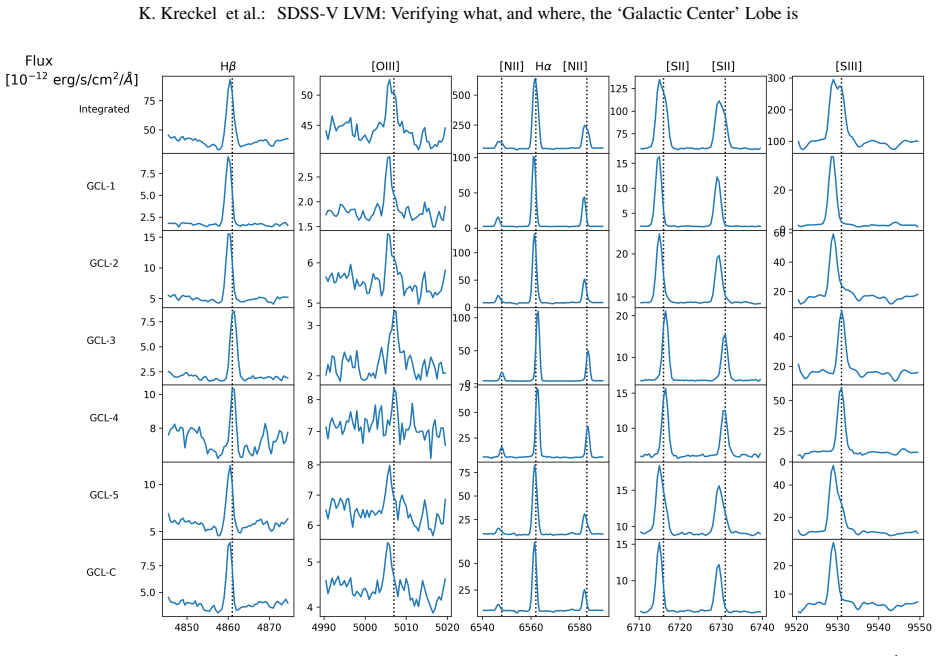
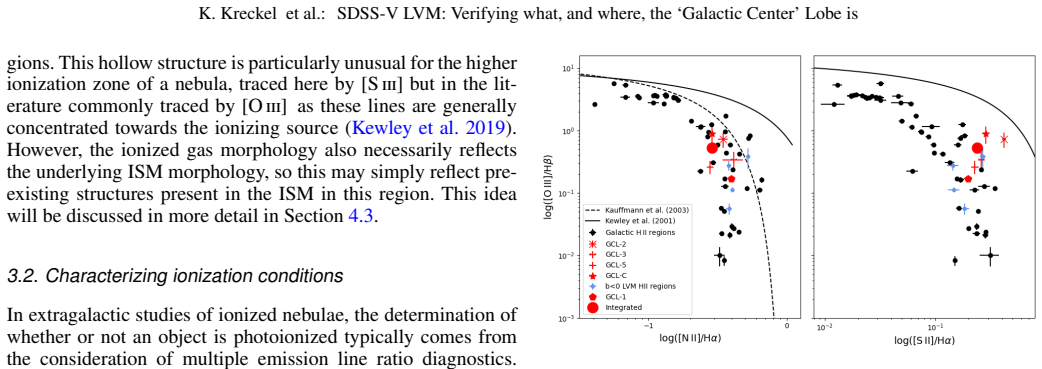
The Galactic Center Lobe is an extended radio feature that optical integral-field spectroscopy reveals as a closed outer loop of photoionized gas. All standard line-ratio diagnostics confirm photoionization. Comparison of the observed Balmer decrement reddening with three-dimensional dust maps places the entire structure at approximately 2 kpc in the foreground, well short of the Galactic center. The [NII] velocity field is uniform, confirming the loop is a single object rather than separate components. The size, shape, and ionization structure are reminiscent of Barnard's Loop, consistent with illumination by a more distant off-center cluster.
What carries the argument
The [SIII]9532 emission-line map combined with the Balmer-decrement reddening compared against three-dimensional dust maps, which together trace morphology with minimal extinction bias and directly yield the distance constraint.
If this is right
- The feature has no physical connection to the Galactic center and should not be used as a tracer of nuclear activity.
- The entire structure is a single photoionized bubble rather than a composite of unrelated gas.
- Its ionization and morphology can be explained by an off-center young stellar cluster at roughly the same distance.
- The acronym GCL is better read as 'Greatly Confused Loop' to reflect its true location and nature.
Where Pith is reading between the lines
- Similar radio loops previously assigned to the Galactic center may also turn out to be nearby disk features once optical spectroscopy is obtained.
- The method of combining Balmer-decrement reddening with 3D dust maps could be applied to other extended ionized structures to resolve distance ambiguities.
- If the analogy to Barnard's Loop holds, the ionizing cluster may be detectable in infrared or X-ray surveys at the expected location behind the loop.
Load-bearing premise
That the Balmer decrement reddening can be matched to three-dimensional dust maps without large systematic errors from incomplete coverage, variable extinction, or unaccounted-for dust properties.
What would settle it
A precise distance measurement, such as a parallax or kinematic distance using a different tracer, that places any part of the ionized gas significantly farther than 2 kpc or shows strongly non-uniform velocities across the loop.
Figures





read the original abstract
The so-called 'Galactic Center' Lobe (GCL) is an extended (~1 deg) radio continuum feature situated above the Galactic Plane, for which the literature contains varying claims about both its nature and location. Using new optical integral field spectroscopic observations from the SDSS-V Local Volume Mapper, we confirm the characterization of the GCL as a foreground photoionized HII region, not associated with the Galactic center. We present a new analysis of the ionized gas morphology, line ratio diagnostics, and kinematics. From our [SIII]9532 emission line map, which suffers the least extinction, we identify ionized gas emission throughout a closed outer loop, which does not fill the GCL interior. All optical line ratio diagnostics are consistent with photoionization. By comparing the ionized gas reddening from the Balmer decrement with 3D dust maps, we directly constrain the distance to the GCL to ~2 kpc. [NII]6583 line kinematics show a uniform velocity structure across the GCL, further confirming that the entire bubble is one structure. The size and emission line morphology is strongly reminiscent of that seen in the nearby Barnard's Loop, providing a possible analog to explain how this outer shell may be photoionized by a more distant and off-center embedded young cluster. We suggest the acronym GCL be repurposed to instead abbreviate the name 'Greatly Confused Loop'.
Editorial analysis
A structured set of objections, weighed in public.
Referee Report
Summary. The manuscript uses new SDSS-V Local Volume Mapper integral-field spectroscopic observations to recharacterize the 'Galactic Center' Lobe (GCL) as a foreground photoionized HII region at ~2 kpc rather than a Galactic-center structure. Key evidence includes [SIII]9532 emission tracing a closed outer loop without filling the interior, optical line-ratio diagnostics consistent with photoionization, a distance constraint obtained by matching Balmer-decrement reddening to 3D dust maps, and spatially uniform [NII]6583 velocities indicating a single coherent structure. The authors draw an analogy to Barnard's Loop and propose renaming the feature the 'Greatly Confused Loop'.
Significance. If the distance and ionization conclusions hold, the work resolves long-standing ambiguity about an extended radio feature and illustrates how optical IFS plus 3D extinction data can separate foreground HII regions from true Galactic-center phenomena. It supplies a concrete observational template (closed outer shell, off-center photoionization) that may apply to other confused structures. The use of fresh SDSS-V LVM data and the multi-diagnostic approach (morphology, ratios, kinematics, reddening) are clear strengths.
major comments (1)
- [Abstract and distance analysis] Abstract and distance analysis: the headline ~2 kpc distance is obtained by equating the observed Balmer-decrement E(B-V) to the cumulative extinction column in a 3D dust map. The text supplies no quantitative information on which map is used, the precise matching algorithm, distance binning, handling of line-of-sight complexity, or error propagation. Because any systematic offset or coarse resolution in the map can shift the inferred distance by hundreds of parsecs, this step is load-bearing for the claim that the GCL is unrelated to the Galactic center and requires explicit robustness tests.
minor comments (3)
- Line-ratio diagnostics are stated to be consistent with photoionization, yet no error bars, full tables of measured ratios, or explicit exclusion criteria for alternative mechanisms (shocks, etc.) are provided; adding these would strengthen the assessment.
- The [SIII]9532 map is presented as suffering the least extinction, but possible biases from incomplete spatial coverage or residual differential extinction are not quantified; a short discussion or supplementary figure would clarify the morphology claim.
- The manuscript would benefit from a brief statement of how the uniform [NII] velocity field was measured (e.g., moment maps, fitting method) and whether any velocity gradients were searched for and ruled out.
Simulated Author's Rebuttal
We thank the referee for their careful reading of the manuscript and for the positive overall assessment of the work. We address the single major comment below and will revise the manuscript to incorporate the requested details and tests.
read point-by-point responses
-
Referee: Abstract and distance analysis: the headline ~2 kpc distance is obtained by equating the observed Balmer-decrement E(B-V) to the cumulative extinction column in a 3D dust map. The text supplies no quantitative information on which map is used, the precise matching algorithm, distance binning, handling of line-of-sight complexity, or error propagation. Because any systematic offset or coarse resolution in the map can shift the inferred distance by hundreds of parsecs, this step is load-bearing for the claim that the GCL is unrelated to the Galactic center and requires explicit robustness tests.
Authors: We agree that the distance analysis requires more explicit quantitative documentation to support the ~2 kpc result. In the revised manuscript we will expand the relevant methods and results section to specify the exact 3D dust map employed, describe the matching procedure (cumulative extinction column compared to the observed Balmer-decrement E(B-V)), detail the distance binning and treatment of line-of-sight structure, and provide a full error budget that propagates uncertainties from both the spectroscopic reddening and the dust map. We will also add a dedicated robustness subsection that repeats the analysis under variations in map resolution, small systematic offsets, and alternative maps, demonstrating that the distance remains consistent with ~2 kpc and well in the foreground. These additions will directly address the load-bearing character of the distance constraint. revision: yes
Circularity Check
No significant circularity in observational analysis
full rationale
The paper's central claims rest on new SDSS-V LVM integral-field spectroscopy, standard line-ratio diagnostics for photoionization, kinematic uniformity from [NII]6583, and a direct comparison of observed Balmer-decrement reddening to independent 3D dust maps for the ~2 kpc distance. None of these steps reduce by construction to fitted parameters or self-referential definitions; the dust-map comparison uses external data products whose assumptions are not derived from the present observations. No load-bearing self-citations, uniqueness theorems, or ansatzes imported from prior author work appear in the derivation chain. The analysis is therefore self-contained against external benchmarks.
Axiom & Free-Parameter Ledger
axioms (2)
- domain assumption Optical emission line ratio diagnostics can reliably identify photoionization as the dominant mechanism in HII regions.
- domain assumption 3D dust maps provide a sufficiently accurate representation of extinction along the line of sight for distance estimation via Balmer decrement.
Reference graph
Works this paper leans on
-
[1]
, " * write output.state after.block = add.period write newline
ENTRY address archiveprefix author booktitle chapter edition editor howpublished institution eprint doi url journal key month note number organization pages publisher school series title type volume year adsurl label extra.label sort.label short.list INTEGERS output.state before.all mid.sentence after.sentence after.block FUNCTION init.state.consts #0 'be...
-
[2]
write newline
" write newline "" before.all 'output.state := FUNCTION n.dashify 't := "" t empty not t #1 #1 substring "-" = t #1 #2 substring "--" = not "--" * t #2 global.max substring 't := t #1 #1 substring "-" = "-" * t #2 global.max substring 't := while if t #1 #1 substring * t #2 global.max substring 't := if while FUNCTION word.in bbl.in " " * FUNCTION format....
-
[3]
Allamandola , L. J., Tielens , A. G. G. M., & Barker , J. R. 1989, http://dx.doi.org/10.1086/191396 magenta , 71, 733 https://ui.adsabs.harvard.edu/abs/1989ApJS...71..733A
-
[4]
Anderson , L. D., Armentrout , W. P., Johnstone , B. M., et al. 2015, http://dx.doi.org/10.1088/0067-0049/221/2/26 magenta , 221, 26 https://ui.adsabs.harvard.edu/abs/2015ApJS..221...26A
-
[5]
Anderson , L. D., Bania , T. M., Balser , D. S., et al. 2014, http://dx.doi.org/10.1088/0067-0049/212/1/1 magenta , 212, 1 https://ui.adsabs.harvard.edu/abs/2014ApJS..212....1A
-
[6]
D., Luisi , M., Liu , B., et al
Anderson , L. D., Luisi , M., Liu , B., et al. 2024, http://dx.doi.org/10.3847/1538-4357/ad4d93 magenta , 969, 43 https://ui.adsabs.harvard.edu/abs/2024ApJ...969...43A
-
[7]
Asplund , M., Amarsi , A. M., & Grevesse , N. 2021, http://dx.doi.org/10.1051/0004-6361/202140445 magenta , 653, A141 https://ui.adsabs.harvard.edu/abs/2021A&A...653A.141A
-
[8]
Astropy Collaboration , Price-Whelan , A. M., Lim , P. L., et al. 2022, http://dx.doi.org/10.3847/1538-4357/ac7c74 magenta , 935, 167 https://ui.adsabs.harvard.edu/abs/2022ApJ...935..167A
work page internal anchor Pith review doi:10.3847/1538-4357/ac7c74 2022
-
[9]
The Astronomical Journal , author =
Astropy Collaboration , Price-Whelan , A. M., Sip o cz , B. M., et al. 2018, http://dx.doi.org/10.3847/1538-3881/aabc4f magenta , 156, 123 https://ui.adsabs.harvard.edu/abs/2018AJ....156..123A
-
[10]
Astropy Collaboration , Robitaille , T. P., Tollerud , E. J., et al. 2013, http://dx.doi.org/10.1051/0004-6361/201322068 magenta , 558, A33 https://ui.adsabs.harvard.edu/abs/2013A&A...558A..33A
-
[11]
Avedisova , V. S. & Palous , J. 1989, Bulletin of the Astronomical Institutes of Czechoslovakia, 40, 42 https://ui.adsabs.harvard.edu/abs/1989BAICz..40...42A
1989
-
[12]
Baldwin , J. A., Phillips , M. M., & Terlevich , R. 1981, http://dx.doi.org/10.1086/130766 magenta , 93, 5 http://adsabs.harvard.edu/abs/1981PASP...93....5B
-
[13]
Barnard , E. E. 1894, Popular Astronomy, 2, 151 https://ui.adsabs.harvard.edu/abs/1894PA......2..151B
-
[14]
T., Chandar , R., Kreckel , K., et al
Barnes , A. T., Chandar , R., Kreckel , K., et al. 2026, http://dx.doi.org/10.1051/0004-6361/202555751 magenta , 706, A95 https://ui.adsabs.harvard.edu/abs/2026A&A...706A..95B
-
[15]
Benjamin , R. A., Churchwell , E., Babler , B. L., et al. 2003, http://dx.doi.org/10.1086/376696 magenta , 115, 953 https://ui.adsabs.harvard.edu/abs/2003PASP..115..953B
-
[16]
Bern \'e , O., Habart , \'E ., Peeters , E., et al. 2022, http://dx.doi.org/10.1088/1538-3873/ac604c magenta , 134, 054301 https://ui.adsabs.harvard.edu/abs/2022PASP..134e4301B
-
[17]
Bland-Hawthorn , J. & Cohen , M. 2003, http://dx.doi.org/10.1086/344573 magenta , 582, 246 https://ui.adsabs.harvard.edu/abs/2003ApJ...582..246B
-
[18]
L., Nord , M., Kassim , N., Lazio , J., & Anantharamaiah , K
Brogan , C. L., Nord , M., Kassim , N., Lazio , J., & Anantharamaiah , K. 2003, http://dx.doi.org/10.1002/asna.200385023 magenta Astronomische Nachrichten Supplement , 324, 17 https://ui.adsabs.harvard.edu/abs/2003ANS...324...17B
-
[19]
Calzetti , D., Armus , L., Bohlin , R. C., et al. 2000, http://dx.doi.org/10.1086/308692 magenta , 533, 682 http://adsabs.harvard.edu/abs/2000ApJ...533..682C
work page internal anchor Pith review doi:10.1086/308692 2000
-
[20]
Cardelli , J. A., Clayton , G. C., & Mathis , J. S. 1989, http://dx.doi.org/10.1086/167900 magenta , 345, 245 https://ui.adsabs.harvard.edu/abs/1989ApJ...345..245C
-
[21]
J., Noriega-Crespo, A., Mizuno, D
Carey , S. J., Noriega-Crespo , A., Mizuno , D. R., et al. 2009, http://dx.doi.org/10.1086/596581 magenta , 121, 76 https://ui.adsabs.harvard.edu/abs/2009PASP..121...76C
-
[22]
, year = 2009, month = mar, volume =
Churchwell , E., Babler , B. L., Meade , M. R., et al. 2009, http://dx.doi.org/10.1086/597811 magenta , 121, 213 https://ui.adsabs.harvard.edu/abs/2009PASP..121..213C
-
[23]
Clark , J. S., Patrick , L. R., Najarro , F., Evans , C. J., & Lohr , M. 2021, http://dx.doi.org/10.1051/0004-6361/202039205 magenta , 649, A43 https://ui.adsabs.harvard.edu/abs/2021A&A...649A..43C
-
[24]
2021, CARTA: The Cube Analysis and Rendering Tool for Astronomy
Comrie , A., Wang , K.-S., Hsu , S.-C., et al. 2021, CARTA: The Cube Analysis and Rendering Tool for Astronomy
2021
-
[25]
& Laureijs , R
Cox , P. & Laureijs , R. 1989, in IAU Symposium, Vol. 136, The Center of the Galaxy, 121 https://ui.adsabs.harvard.edu/abs/1989IAUS..136..121C
1989
-
[26]
Dopita , M. A., Kewley , L. J., Sutherland , R. S., & Nicholls , D. C. 2016, http://dx.doi.org/10.1007/s10509-016-2657-8 magenta , http://adsabs.harvard.edu/abs/2016Ap
-
[27]
Drory , N., Blanc , G. A., Kreckel , K., et al. 2024, http://dx.doi.org/10.3847/1538-3881/ad6de9 magenta , 168, 198 https://ui.adsabs.harvard.edu/abs/2024AJ....168..198D
-
[28]
1976, , 25, 25 https://ui.adsabs.harvard.edu/abs/1976A&AS...25...25D
Dubout-Crillon , R. 1976, , 25, 25 https://ui.adsabs.harvard.edu/abs/1976A&AS...25...25D
1976
-
[29]
Dutra , C. M. & Bica , E. 2000, http://dx.doi.org/10.48550/arXiv.astro-ph/0006409 magenta , 359, L9 https://ui.adsabs.harvard.edu/abs/2000A&A...359L...9D
work page internal anchor Pith review doi:10.48550/arxiv.astro-ph/0006409 2000
-
[30]
Edenhofer , G., Zucker , C., Frank , P., et al. 2024, http://dx.doi.org/10.1051/0004-6361/202347628 magenta , 685, A82 https://ui.adsabs.harvard.edu/abs/2024A&A...685A..82E
-
[31]
Fitzpatrick , E. L. 1999, http://dx.doi.org/10.1086/316293 magenta , 111, 63 http://adsabs.harvard.edu/abs/1999PASP..111...63F
-
[32]
M., Goodman, A., Zucker, C., et al
Foley , M. M., Goodman , A., Zucker , C., et al. 2023, http://dx.doi.org/10.3847/1538-4357/acb5f4 magenta , 947, 66 https://ui.adsabs.harvard.edu/abs/2023ApJ...947...66F
-
[33]
Gaylard , M. J. 1984, http://dx.doi.org/10.1093/mnras/211.1.149 magenta , 211, 149 https://ui.adsabs.harvard.edu/abs/1984MNRAS.211..149G
-
[34]
Journal of Open Source Software , author =
Green , G. 2018, http://dx.doi.org/10.21105/joss.00695 magenta The Journal of Open Source Software , 3, 695 https://ui.adsabs.harvard.edu/abs/2018JOSS....3..695G
-
[35]
Groves , B., Kreckel , K., Santoro , F., et al. 2023, http://dx.doi.org/10.1093/mnras/stad114 magenta , 520, 4902 https://ui.adsabs.harvard.edu/abs/2023MNRAS.520.4902G
-
[36]
Harris , C. R., Millman , K. J., van der Walt , S. J., et al. 2020, http://dx.doi.org/10.1038/s41586-020-2649-2 magenta , 585, 357 https://ui.adsabs.harvard.edu/abs/2020Natur.585..357H
-
[37]
Heiles , C., Haffner , L. M., Reynolds , R. J., & Tufte , S. L. 2000, http://dx.doi.org/10.1086/308935 magenta , 536, 335 https://ui.adsabs.harvard.edu/abs/2000ApJ...536..335H
-
[38]
D., Barnes , A
Henshaw , J. D., Barnes , A. T., Battersby , C., et al. 2023, in Astronomical Society of the Pacific Conference Series, Vol. 534, Protostars and Planets VII, 83 https://ui.adsabs.harvard.edu/abs/2023ASPC..534...83H
2023
-
[39]
M., Bizenberger , P., Blanc , G
Herbst , T. M., Bizenberger , P., Blanc , G. A., et al. 2024, http://dx.doi.org/10.3847/1538-3881/ad7948 magenta , 168, 267 https://ui.adsabs.harvard.edu/abs/2024AJ....168..267H
-
[40]
Heyvaerts , J., Norman , C., & Pudritz , R. E. 1988, http://dx.doi.org/10.1086/166506 magenta , 330, 718 https://ui.adsabs.harvard.edu/abs/1988ApJ...330..718H
-
[41]
Heywood , I., Camilo , F., Cotton , W. D., et al. 2019, http://dx.doi.org/10.1038/s41586-019-1532-5 magenta , 573, 235 https://ui.adsabs.harvard.edu/abs/2019Natur.573..235H
-
[42]
Heywood , I., Rammala , I., Camilo , F., et al. 2022, http://dx.doi.org/10.3847/1538-4357/ac449a magenta , 925, 165 https://ui.adsabs.harvard.edu/abs/2022ApJ...925..165H
-
[43]
Hilder , T., Casey , A. R., Dalcanton , J. J., et al. 2026, http://dx.doi.org/10.3847/1538-4357/ae274b magenta , 997, 339 https://ui.adsabs.harvard.edu/abs/2026ApJ...997..339H
-
[44]
Hunter , J. D. 2007, http://dx.doi.org/10.1109/MCSE.2007.55 magenta Computing in Science and Engineering , 9, 90 https://ui.adsabs.harvard.edu/abs/2007CSE.....9...90H
-
[45]
Hurley-Walker , N., Anderson , L. D., Luisi , M., et al. 2024, http://dx.doi.org/10.3847/1538-4357/ad4d92 magenta , 969, 42 https://ui.adsabs.harvard.edu/abs/2024ApJ...969...42H
-
[46]
Kassim , N. E., Larosa , T. N., & Erickson , W. C. 1986, http://dx.doi.org/10.1038/322522a0 magenta , 322, 522 https://ui.adsabs.harvard.edu/abs/1986Natur.322..522K
-
[47]
Kauffmann , G., Heckman , T. M., Tremonti , C., et al. 2003, http://dx.doi.org/10.1111/j.1365-2966.2003.07154.x magenta , 346, 1055 https://ui.adsabs.harvard.edu/abs/2003MNRAS.346.1055K
-
[48]
Kewley , L. J., Dopita , M. A., Sutherland , R. S., Heisler , C. A., & Trevena , J. 2001, http://dx.doi.org/10.1086/321545 magenta , 556, 121 https://ui.adsabs.harvard.edu/abs/2001ApJ...556..121K
work page internal anchor Pith review doi:10.1086/321545 2001
-
[49]
Kewley , L. J., Nicholls , D. C., & Sutherland , R. S. 2019, http://dx.doi.org/10.1146/annurev-astro-081817-051832 magenta , 57, 511 https://ui.adsabs.harvard.edu/abs/2019ARA&A..57..511K
-
[50]
Kharchenko , N. V., Piskunov , A. E., Schilbach , E., R \"o ser , S., & Scholz , R.-D. 2013, http://dx.doi.org/10.1051/0004-6361/201322302 magenta , 558, A53 https://ui.adsabs.harvard.edu/abs/2013A&A...558A..53K
-
[51]
A., Rix , H.-W., Aerts , C., et al
Kollmeier , J. A., Rix , H.-W., Aerts , C., et al. 2026, http://dx.doi.org/10.3847/1538-3881/ae0576 magenta , 171, 52 https://ui.adsabs.harvard.edu/abs/2026AJ....171...52K
-
[52]
P., Herbst , T., Froning , C., et al
Konidaris , N. P., Herbst , T., Froning , C., et al. 2024, in Society of Photo-Optical Instrumentation Engineers (SPIE) Conference Series, Vol. 13096, Ground-based and Airborne Instrumentation for Astronomy X, 130961Z https://ui.adsabs.harvard.edu/abs/2024SPIE13096E..1ZK
2024
-
[53]
Kreckel , K., Egorov , O. V., Egorova , E., et al. 2024, http://dx.doi.org/10.1051/0004-6361/202449943 magenta , 689, A352 https://ui.adsabs.harvard.edu/abs/2024A&A...689A.352K
-
[54]
Law , C. J. 2010, http://dx.doi.org/10.1088/0004-637X/708/1/474 magenta , 708, 474 https://ui.adsabs.harvard.edu/abs/2010ApJ...708..474L
-
[55]
J., Backer , D., Yusef-Zadeh , F., & Maddalena , R
Law , C. J., Backer , D., Yusef-Zadeh , F., & Maddalena , R. 2009, http://dx.doi.org/10.1088/0004-637X/695/2/1070 magenta , 695, 1070 https://ui.adsabs.harvard.edu/abs/2009ApJ...695.1070L
-
[56]
Luridiana , V., Morisset , C., & Shaw , R. A. 2012, in IAU Symposium, Vol. 283, Planetary Nebulae: An Eye to the Future, 422--423 https://ui.adsabs.harvard.edu/abs/2012IAUS..283..422L
2012
-
[57]
Mart \' nez-Hern \'a ndez , I. R., M \'e ndez-Delgado , J. E., Esteban , C., et al. 2026, http://dx.doi.org/10.1093/mnras/stag149 magenta , 546, stag149 https://ui.adsabs.harvard.edu/abs/2026MNRAS.546ag149M
-
[58]
Martins , F., Schaerer , D., & Hillier , D. J. 2005, http://dx.doi.org/10.1051/0004-6361:20042386 magenta , 436, 1049 https://ui.adsabs.harvard.edu/abs/2005A&A...436.1049M
-
[59]
E., Amayo , A., Arellano-C \'o rdova , K
M \'e ndez-Delgado , J. E., Amayo , A., Arellano-C \'o rdova , K. Z., et al. 2022, http://dx.doi.org/10.1093/mnras/stab3782 magenta , 510, 4436 https://ui.adsabs.harvard.edu/abs/2022MNRAS.510.4436M
-
[60]
E., Esteban , C., Garc \' a-Rojas , J., et al
M \'e ndez-Delgado , J. E., Esteban , C., Garc \' a-Rojas , J., et al. 2023, http://dx.doi.org/10.1093/mnras/stad1569 magenta , 523, 2952 https://ui.adsabs.harvard.edu/abs/2023MNRAS.523.2952M
-
[61]
Monteiro , H. & Dias , W. S. 2019, http://dx.doi.org/10.1093/mnras/stz1455 magenta , 487, 2385 https://ui.adsabs.harvard.edu/abs/2019MNRAS.487.2385M
-
[62]
1996, ARA&A, 34, 645, doi: 10.1146/annurev.astro.34.1.645
Morris , M. & Serabyn , E. 1996, http://dx.doi.org/10.1146/annurev.astro.34.1.645 magenta , 34, 645 https://ui.adsabs.harvard.edu/abs/1996ARA&A..34..645M
-
[63]
Nagoshi , H., Kubose , Y., Fujisawa , K., et al. 2019, http://dx.doi.org/10.1093/pasj/psz060 magenta , 71, 80 https://ui.adsabs.harvard.edu/abs/2019PASJ...71...80N
-
[64]
Nieva , M.-F. & Przybilla , N. 2012, http://dx.doi.org/10.1051/0004-6361/201118158 magenta , 539, A143 https://ui.adsabs.harvard.edu/abs/2012A&A...539A.143N
-
[65]
Nishiyama , S., Nagata , T., Tamura , M., et al. 2008, http://dx.doi.org/10.1086/587791 magenta , 680, 1174 https://ui.adsabs.harvard.edu/abs/2008ApJ...680.1174N
-
[66]
Nossal , S. M., Mierkiewicz , E. J., Roesler , F. L., et al. 2008, http://dx.doi.org/10.1029/2008JA013380 magenta Journal of Geophysical Research (Space Physics) , 113, A11307 https://ui.adsabs.harvard.edu/abs/2008JGRA..11311307N
-
[67]
Ochsendorf , B. B., Brown , A. G. A., Bally , J., & Tielens , A. G. G. M. 2015, http://dx.doi.org/10.1088/0004-637X/808/2/111 magenta , 808, 111 https://ui.adsabs.harvard.edu/abs/2015ApJ...808..111O
-
[68]
Pantaleoni Gonz \'a lez , M., Ma \' z Apell \'a niz , J., Barb \'a , R. H., et al. 2025, http://dx.doi.org/10.1093/mnras/staf1409 magenta , 543, 63 https://ui.adsabs.harvard.edu/abs/2025MNRAS.543...63P
-
[69]
Parker , E. N. 1966, http://dx.doi.org/10.1086/148828 magenta , 145, 811 https://ui.adsabs.harvard.edu/abs/1966ApJ...145..811P
-
[70]
Pilyugin , L. S. & Grebel , E. K. 2016, http://dx.doi.org/10.1093/mnras/stw238 magenta , 457, 3678 http://adsabs.harvard.edu/abs/2016MNRAS.457.3678P
-
[71]
Ponti , G., Hofmann , F., Churazov , E., et al. 2019, http://dx.doi.org/10.1038/s41586-019-1009-6 magenta , 567, 347 https://ui.adsabs.harvard.edu/abs/2019Natur.567..347P
-
[72]
R., Churazov , E., Heywood , I., & Fender , R
Ponti , G., Morris , M. R., Churazov , E., Heywood , I., & Fender , R. P. 2021, http://dx.doi.org/10.1051/0004-6361/202039636 magenta , 646, A66 https://ui.adsabs.harvard.edu/abs/2021A&A...646A..66P
-
[73]
Popowski , P. 2000, http://dx.doi.org/10.1086/312426 magenta , 528, L9 https://ui.adsabs.harvard.edu/abs/2000ApJ...528L...9P
-
[74]
Reich , W., Sofue , Y., & Fuerst , E. 1987, http://dx.doi.org/10.1093/pasj/39.4.573 magenta , 39, 573 https://ui.adsabs.harvard.edu/abs/1987PASJ...39..573R
-
[75]
Reynolds , R. J. & Ogden , P. M. 1979, http://dx.doi.org/10.1086/157028 magenta , 229, 942 https://ui.adsabs.harvard.edu/abs/1979ApJ...229..942R
-
[76]
Roeser , S., Demleitner , M., & Schilbach , E. 2010, http://dx.doi.org/10.1088/0004-6256/139/6/2440 magenta , 139, 2440 https://ui.adsabs.harvard.edu/abs/2010AJ....139.2440R
-
[77]
S \'a nchez , S. F. 2020, http://dx.doi.org/10.1146/annurev-astro-012120-013326 magenta , 58, 99 https://ui.adsabs.harvard.edu/abs/2020ARA&A..58...99S
-
[78]
F., Mej \' a-Narv \'a ez , A., Egorov , O
S \'a nchez , S. F., Mej \' a-Narv \'a ez , A., Egorov , O. V., et al. 2025 a , http://dx.doi.org/10.3847/1538-3881/ad93bb magenta , 169, 52 https://ui.adsabs.harvard.edu/abs/2025AJ....169...52S
-
[79]
S \'a nchez , S. F., Mu \ n oz-Tu \ n \'o n , C., S \'a nchez Almeida , J., Gonz \'a lez-Mart \' n , O., & P \'e rez , E. 2025 b , http://dx.doi.org/10.1051/0004-6361/202556809 magenta , 704, A145 https://ui.adsabs.harvard.edu/abs/2025A&A...704A.145S
-
[80]
Sanchez Sanchez , S. F., M \'e ndez-Delgado , J. E., Mej \' a-Narv \'a ez , A., et al. 2026, http://dx.doi.org/10.22201/ia.30618649e.2026.62.01.7521 magenta , 62, 87 https://ui.adsabs.harvard.edu/abs/2026RMxAA..62...87S
discussion (0)
Sign in with ORCID, Apple, or X to comment. Anyone can read and Pith papers without signing in.