Recognition: unknown
IncepDeHazeGAN: Novel Satellite Image Dehazing
Pith reviewed 2026-05-10 08:01 UTC · model grok-4.3
The pith
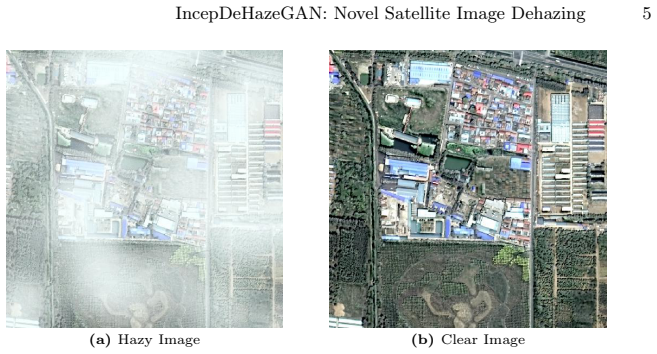
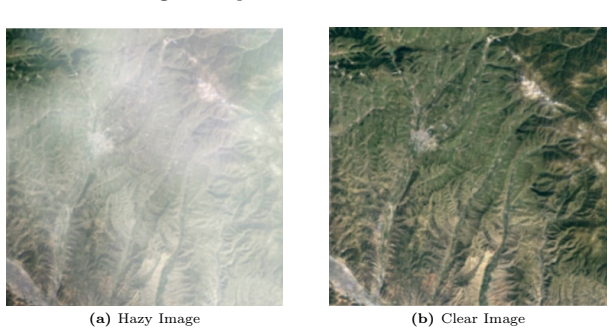
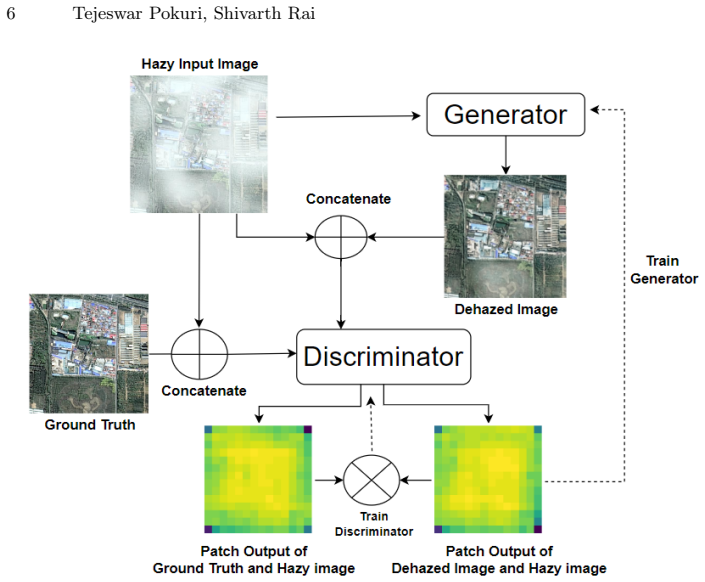
IncepDeHazeGAN combines Inception blocks with multi-layer feature fusion in a GAN to dehaze satellite images.
A machine-rendered reading of the paper's core claim, the machinery that carries it, and where it could break.
Core claim
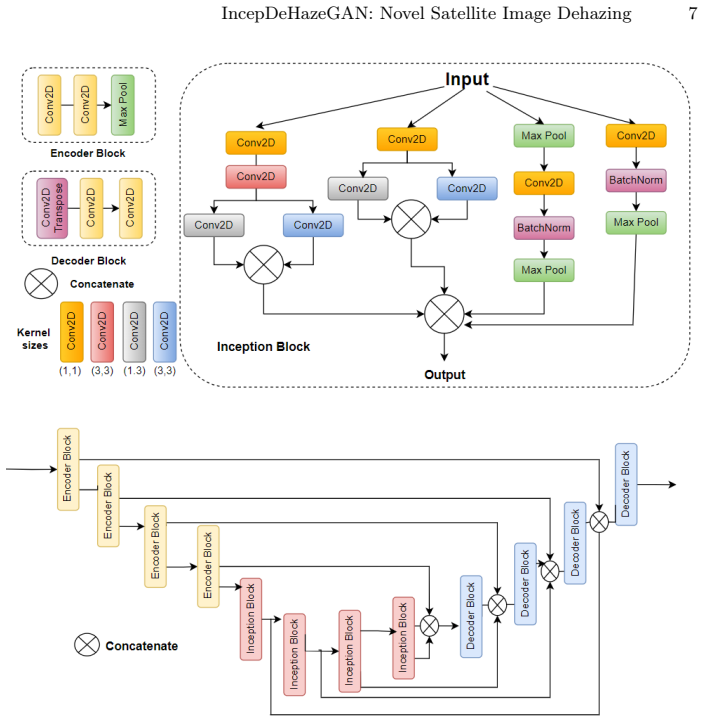
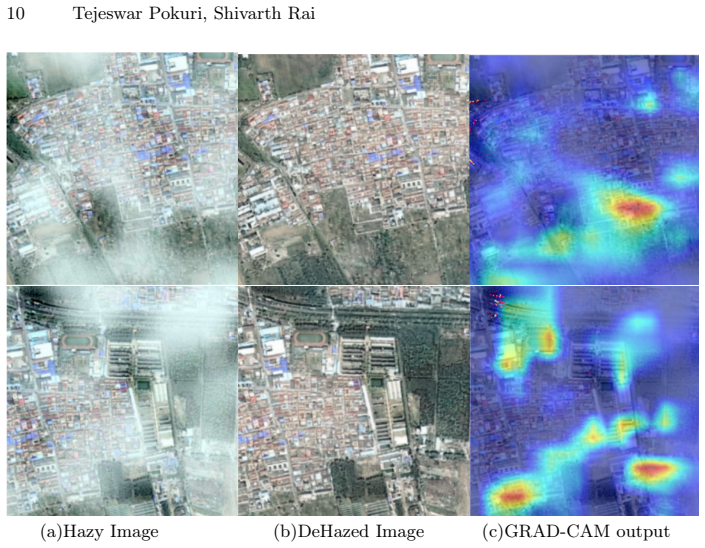
IncepDeHazeGAN is a generative adversarial network that integrates Inception blocks for multi-scale feature extraction and a multi-layer feature fusion design that merges outputs from successive convolution layers multiple times. This structure is presented as a way to recover high-quality clear images from hazy satellite captures in remote sensing. The addition of Grad-CAM explanations is used to illustrate the regions the network attends to under different haze conditions.
What carries the argument
IncepDeHazeGAN's core mechanism is the pairing of Inception blocks, which extract multi-scale features, with repeated multi-layer feature fusion that reuses convolutional outputs across layers for efficient information flow.
If this is right
- Hazy satellite images can be restored to higher visual quality through multi-scale feature extraction.
- Repeated fusion of features from different layers enables more efficient use of extracted information.
- The network adapts its focus to different haze densities as revealed by Grad-CAM maps.
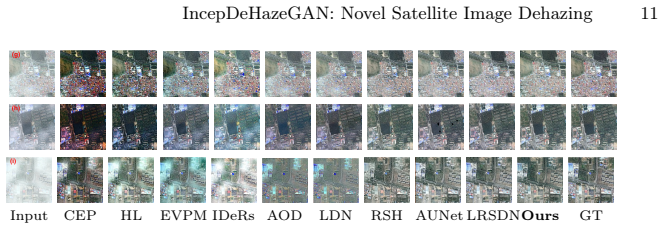
- State-of-the-art results on multiple datasets support broader use of the model for remote sensing restoration tasks.
Where Pith is reading between the lines
- The same block combination could be tested on other image-degradation problems such as underwater or aerial photography.
- Grad-CAM outputs might serve as a diagnostic tool to refine fusion strategies in future dehazing networks.
- Success on satellite data suggests the design could generalize to real-time processing of ground-based hazy scenes without major changes.
Load-bearing premise
The assumption that adding Inception blocks and repeated multi-layer feature fusion to a GAN will produce better dehazing results on satellite images than prior methods.
What would settle it
A side-by-side test on standard satellite dehazing benchmarks where IncepDeHazeGAN fails to exceed existing methods on quantitative measures such as PSNR or SSIM.
Figures


read the original abstract
Dehazing is a technique in computer vision for enhancing the visual quality of images captured in cloudy or foggy conditions. Dehazing helps to recover clear, high-quality images from haze-affected remote sensing data. In this study, we introduce IncepDeHazeGAN, a novel Generative Adversarial Network (GAN) involving Inception block and multi-layer feature fusion for the task of single-image dehazing. Utilizing the Inception block allows for multi-scale feature extraction. On the other hand, the multi-layer feature fusion design achieves efficient reuse of features as the features extracted at different convolution layers are fused several times. Grad-CAM XAI technique has been applied to our network, highlighting the regions focused on by the network for dehazing and its adaptation to different haze conditions. Experiments demonstrate that our network achieves state-of-the-art results in several datasets.
Editorial analysis
A structured set of objections, weighed in public.
Referee Report
Summary. The paper introduces IncepDeHazeGAN, a GAN architecture combining Inception blocks for multi-scale feature extraction with multi-layer feature fusion for efficient reuse, targeted at single-image dehazing of satellite imagery. It applies Grad-CAM for visualizing network attention under varying haze conditions and asserts that experiments establish state-of-the-art performance across several datasets.
Significance. If the superiority claim holds under proper evaluation, the architecture could advance remote-sensing dehazing by integrating multi-scale processing and repeated feature fusion within a GAN, while the Grad-CAM analysis would add interpretability value for understanding adaptation to haze levels.
major comments (2)
- [Abstract] Abstract: the assertion that 'Experiments demonstrate that our network achieves state-of-the-art results in several datasets' is unsupported by any PSNR/SSIM values, comparison tables, named datasets or splits, training protocol, or ablation results, so the central empirical claim cannot be assessed.
- [Experiments] Experiments section (or equivalent): no quantitative results, baseline comparisons, or statistical validation are supplied to demonstrate that the Inception + multi-layer fusion design measurably outperforms prior single-image dehazing methods on representative satellite data.
minor comments (1)
- [Abstract] Abstract: 'involving Inception block' should read 'Inception blocks' for grammatical consistency with the plural usage later in the sentence.
Simulated Author's Rebuttal
We thank the referee for the detailed and constructive review. We agree that the current manuscript version does not supply the quantitative evidence needed to substantiate the state-of-the-art claims, and we will perform a major revision to address this.
read point-by-point responses
-
Referee: [Abstract] Abstract: the assertion that 'Experiments demonstrate that our network achieves state-of-the-art results in several datasets' is unsupported by any PSNR/SSIM values, comparison tables, named datasets or splits, training protocol, or ablation results, so the central empirical claim cannot be assessed.
Authors: We acknowledge that the abstract's claim is unsupported by any numerical evidence or references within the current text. In the revised manuscript we will shorten the claim and add a concise statement of the key datasets, metrics (PSNR/SSIM), and performance margins, while explicitly directing readers to the expanded Experiments section for tables, splits, training details, and ablations. revision: yes
-
Referee: [Experiments] Experiments section (or equivalent): no quantitative results, baseline comparisons, or statistical validation are supplied to demonstrate that the Inception + multi-layer fusion design measurably outperforms prior single-image dehazing methods on representative satellite data.
Authors: The referee correctly identifies the absence of quantitative results. We will add a full Experiments section containing: (i) PSNR and SSIM tables on named satellite dehazing datasets with explicit train/val/test splits, (ii) direct comparisons against representative prior single-image dehazing methods, (iii) ablation studies isolating the Inception blocks and multi-layer fusion components, and (iv) basic statistical validation (means and standard deviations over repeated runs). revision: yes
Circularity Check
No circularity; architecture is an explicit ansatz and SOTA claim is empirical
full rationale
The paper presents IncepDeHazeGAN as a novel GAN design using Inception blocks for multi-scale features and multi-layer fusion for feature reuse. These choices are motivated by standard computer-vision practices rather than derived from prior self-citations or fitted parameters. No equations define a quantity in terms of itself, no 'prediction' reduces to a training fit by construction, and no uniqueness theorem or ansatz is smuggled via self-citation. The SOTA claim rests on (undetailed) experiments; while this leaves the claim unsupported, it does not create circularity because the result is not presupposed by the network definition. The derivation chain is therefore self-contained and non-circular.
Axiom & Free-Parameter Ledger
axioms (1)
- domain assumption Standard deep-learning assumptions for image-to-image translation tasks hold (e.g., adversarial training converges to useful solutions).
invented entities (1)
-
IncepDeHazeGAN
no independent evidence
Reference graph
Works this paper leans on
-
[1]
Morphological and cytoskeleton changes in cells after EMT
Lee, G. Y., Chen, J., Dam, T., Ferdaus, M. M., Poenar, D. P., & Duong, V. N. (2024). Dehazing Remote Sensing and UAV Imagery: A Review of Deep Learning, Prior-based, and Hybrid Approaches. arXiv [Cs.CV]. Retrieved from http://arxiv.org/abs/2405.07520 2.Zhang,S.,Zhao,L.,Hu,K.,Feng,S.,En,F.,&Zhao,L.(092023).Deepguided transformer dehazing network. Scientifi...
-
[2]
Narasimhan, S. G., & Nayar, S. K. (2002). Vision and the Atmosphere. Inter- national Journal of Computer Vision, 48(3), 233–254. doi:10.1023/A:1016328200723
-
[3]
(12 2015)
Narasimhan, S., & Nayar, S. (12 2015). Interactive (De)weathering of an im- age using physical models. IEEE Workshop on Color and Photometric Methods in Computer Vision, 10
2015
-
[4]
Berman, D., Treibitz, T., & Avidan, S. (11 2018). Single Image Dehazing Using Haze-Lines. IEEE Transactions on Pattern Analysis and Machine Intelligence, PP, 1–1. doi:10.1109/TPAMI.2018.2882478
-
[5]
Jiang, Y., Sun, C., Zhao, Y., & Yang, L. (12 2017). Image Dehazing Using Adaptive Bi-Channel Priors on Superpixels. Computer Vision and Image Under- standing, 165, 17–32. doi:10.1016/j.cviu.2017.10.014
-
[6]
Bui, T. M., & Kim, W. (2018). Single Image Dehazing Using Color Ellipsoid Prior. IEEE Transactions on Image Processing, 27(2), 999–1009. doi:10.1109/ TIP.2017.2771158
-
[7]
Generative Adversarial Networks
Goodfellow, I. J., Pouget-Abadie, J., Mirza, M., Xu, B., Warde-Farley, D., Ozair,S.,... Bengio,Y.(2014).GenerativeAdversarialNetworks.arXivStat.ML. Retrieved fromhttp://arxiv.org/abs/1406.2661
work page internal anchor Pith review arXiv 2014
-
[8]
Going deeper with convolutions
Szegedy, C., Liu, W., Jia, Y., Sermanet, P., Reed, S., Anguelov, D., ... Ra- binovich, A. (2014). Going Deeper with Convolutions. arXiv Cs.CV. Retrieved fromhttp://arxiv.org/abs/1409.4842
-
[9]
He, K., Zhang, X., Ren, S., & Sun, J. (2015). Deep Residual Learning for Im- age Recognition. arXiv Cs.CV. Retrieved fromhttp://arxiv.org/abs/1512. 03385
2015
- [10]
-
[11]
Dong, S., & Chen, Z. (2021). A Multi-Level Feature Fusion Network for Re- mote Sensing Image Segmentation. Sensors, 21(4). doi:10.3390/s21041267
-
[12]
He, Y., Li, C., Li, X., & Bai, T. (2024). A Lightweight CNN Based on Axial Depthwise Convolution and Hybrid Attention for Remote Sensing Image Dehaz- ing. Remote Sensing, 16(15). doi:10.3390/rs16152822
-
[13]
Du, Y., Li, J., Sheng, Q., Zhu, Y., Wang, B., & Ling, X. (2024). Dehazing Network: Asymmetric Unet Based on Physical Model. IEEE Transactions on Geoscience and Remote Sensing, 62, 1–12. doi:10.1109/TGRS.2024.3359217
-
[14]
and Carlsson, Marcel , month = apr, year =
Wen, Y., Gao, T., Li, Z., Zhang, J., & Chen, T. (04 2024). Encoder-Minimal IncepDeHazeGAN: Novel Satellite Image Dehazing 13 and Decoder-Minimal Framework for Remote Sensing Image Dehazing. 36–40. doi:10.1109/ICASSP48485.2024.10446125
-
[15]
Li, B., Peng, X., Wang, Z., Xu, J., & Feng, D. (2017). AOD-Net: All-in-One Dehazing Network. 2017 IEEE International Conference on Computer Vision (ICCV), 4780–4788. doi:10.1109/ICCV.2017.511 17.Li,Y.,&Chen,X.(2021).ACoarse-to-FineTwo-StageAttentiveNetworkfor Haze Removal of Remote Sensing Images. IEEE Geoscience and Remote Sensing Letters, 18(10), 1751–1...
-
[16]
Han, J., Zhang, S., Fan, N., & Ye, Z. (2022). Local patchwise minimal and maximal values prior for single optical remote sensing image dehazing. Informa- tion Sciences, 606, 173–193. doi:10.1016/j.ins.2022.05.033
-
[17]
Xu, L., Tree, P., Yan, Y., Kwong, S., Chen, J., & Duan, L.-Y. (03 2019). IDeRS: Iterative Dehazing Method for Single Remote Sensing Image. Informa- tion Sciences, 489. doi:10.1016/j.ins.2019.02.058
-
[18]
Ullah, H., Muhammad, K., Irfan, M., Anwar, S., Sajjad, M., Imran, A., & Albuquerque, V. H. C. (10 2021). Light-DehazeNet: A Novel Lightweight CNN Architecture for Single Image Dehazing. IEEE Transactions on Image Process- ing, PP, 1–1. doi:10.1109/TIP.2021.3116790
-
[19]
Selvaraju, R. R., Cogswell, M., Das, A., Vedantam, R., Parikh, D., & Batra, D. (2019). Grad-CAM: Visual Explanations from Deep Networks via Gradient- Based Localization. International Journal of Computer Vision, 128(2), 336–359. doi:10.1007/s11263-019-01228-7
-
[20]
Huang, B., Li, Z., Yang, C., Sun, F., & Song, Y. (03 2020). Single Satellite Optical Imagery Dehazing using SAR Image Prior Based on Conditional Gener- ative Adversarial Networks. 1795–1802. doi:10.1109/WACV45572.2020.9093471
- [21]
-
[22]
Isola, P., Zhu, J.-Y., Zhou, T., & Efros, A. A. (2018). Image-to-Image Trans- lation with Conditional Adversarial Networks
2018
discussion (0)
Sign in with ORCID, Apple, or X to comment. Anyone can read and Pith papers without signing in.