Recognition: unknown
Can a CNOT Gate Affect the Control Qubit? Student Resources for Understanding CNOT and Entanglement
Pith reviewed 2026-05-10 06:34 UTC · model grok-4.3
The pith
Students learning quantum computing rely on three cognitive resources to understand the CNOT gate, with procedural application forming the foundation for qualitative descriptions that can sometimes produce errors.
A machine-rendered reading of the paper's core claim, the machinery that carries it, and where it could break.
Core claim
Students possess a CNOT toolbox of three cognitive resources: the procedural resource of applying CNOT to specific states, a qualitative description of CNOT's effect on the target qubit given the control qubit, and the idea that the control qubit is not changed when CNOT is applied to computational basis states. The procedural resource is foundational to the other two, yet the qualitative resources can lead students to incorrect conclusions, and students deploy each resource alone or in combination when reasoning about quantum computing tasks.
What carries the argument
The CNOT toolbox, the set of strategies and cognitive resources students activate to determine the effect of the CNOT gate on qubit states.
If this is right
- Students' use of the procedural resource supports development of the two qualitative resources.
- The qualitative resources can generate incorrect conclusions when used without the procedural resource.
- Students apply the resources separately or together when solving problems.
- Integration with Dirac notation, superposition, and entanglement produces both productive and unproductive reasoning.
Where Pith is reading between the lines
- Course designers could sequence instruction to establish the procedural resource before emphasizing qualitative rules.
- The same interview approach might reveal comparable resource sets for other quantum gates such as the Toffoli or Hadamard.
- Explicit discussion of when the qualitative resources break down could reduce common errors on entanglement questions.
Load-bearing premise
Think-aloud interview responses and subsequent qualitative coding reliably capture students' actual internal cognitive resources without significant influence from the interview setting or researcher interpretation.
What would settle it
A follow-up study that presents the same CNOT problems to a new group of students via written responses or computer-tracked problem solving and finds that the three resources do not appear in the predicted patterns or fail to account for observed errors and successes.
Figures


read the original abstract
The Controlled-Not (CNOT) gate is essential to algorithms in quantum computing for its ability to entangle qubits. As such, it is important to understand how students learning quantum computing reason around the function and use of this critical quantum gate. To investigate this, we conducted think-aloud interviews in which students solved problems involving the CNOT gate to understand students' `CNOT toolbox' -- the strategies and cognitive resources students use when reasoning about the effect of the CNOT gate. We identify three cognitive resources related to the CNOT gate: (1) the procedural resource of applying CNOT to specific states, (2) a qualitative description of CNOT's effect on the target qubit given the control qubit, and (3) the idea that the control qubit is not changed when CNOT is applied to computational basis states. We find that students' use of the first resource is foundational to their understanding of the second and third, that the second and third resources can sometimes lead students to incorrect conclusions, and that students can use each of these resources separately or in tandem. We also explore how students use these resources in conjunction with Dirac notation, superposition states, and entanglement to reason both productively and unproductively about quantum computing problems.
Editorial analysis
A structured set of objections, weighed in public.
Referee Report
Summary. The manuscript reports on think-aloud interviews in which students solved problems involving the CNOT gate. The authors identify three cognitive resources comprising students' 'CNOT toolbox': (1) the procedural resource of applying CNOT to specific states, (2) a qualitative description of CNOT's effect on the target qubit given the control qubit, and (3) the idea that the control qubit is unchanged when CNOT is applied to computational basis states. They further report that the first resource is foundational to the others, that resources (2) and (3) can lead to incorrect conclusions, and that students deploy the resources separately or in combination with Dirac notation, superposition, and entanglement concepts, both productively and unproductively.
Significance. If the identification and characterization of the resources are shown to be reliable, the work provides useful empirical insight into student reasoning about a central quantum gate and entanglement. Explicit attention to both productive and unproductive uses of the resources is a positive feature that could help instructors anticipate and address common difficulties in quantum computing courses.
major comments (2)
- [Methods] Methods section: The manuscript supplies no information on the number of participants, recruitment, interview protocol, qualitative coding scheme, number of coders, inter-rater reliability, or any validation procedures used to identify and confirm the three cognitive resources. Because the central claims rest entirely on the authors' interpretation of interview utterances, these details are required to assess the robustness of the reported resources.
- [Results] Abstract and Results: The assertion that the procedural resource (1) is foundational to resources (2) and (3) is presented as a finding, yet no explicit mapping from coded utterances to this hierarchical relationship is supplied. Without such evidence, it is difficult to distinguish this claim from an interpretive summary of the data.
minor comments (2)
- [Introduction] The title asks whether a CNOT gate can affect the control qubit, but the abstract and reported resources do not explicitly connect this question to the three identified resources; a brief clarification in the introduction would help readers see the link.
- Consider adding a table or figure that summarizes the three resources, their definitions, and example student utterances to improve readability.
Simulated Author's Rebuttal
We thank the referee for their constructive review and for highlighting areas where additional detail will strengthen the manuscript. We address each major comment below and have prepared revisions to incorporate the requested information.
read point-by-point responses
-
Referee: [Methods] Methods section: The manuscript supplies no information on the number of participants, recruitment, interview protocol, qualitative coding scheme, number of coders, inter-rater reliability, or any validation procedures used to identify and confirm the three cognitive resources. Because the central claims rest entirely on the authors' interpretation of interview utterances, these details are required to assess the robustness of the reported resources.
Authors: We agree that these methodological details are essential for evaluating the reliability of the identified resources. The revised manuscript will include an expanded Methods section that reports the number of participants, recruitment procedures, the full interview protocol, the qualitative coding scheme used to identify the three resources, the number of coders involved, and the steps taken to establish consistency in the analysis. revision: yes
-
Referee: [Results] Abstract and Results: The assertion that the procedural resource (1) is foundational to resources (2) and (3) is presented as a finding, yet no explicit mapping from coded utterances to this hierarchical relationship is supplied. Without such evidence, it is difficult to distinguish this claim from an interpretive summary of the data.
Authors: We recognize that the current text presents the foundational role of resource (1) without sufficient direct linkage to the coded data. In the revision we will add explicit examples of student utterances, their coding, and the observed patterns that support the claim that the procedural resource underpins the other two. This will make the empirical basis for the hierarchy clearer and reduce the risk that the claim reads as purely interpretive. revision: yes
Circularity Check
No circularity: purely empirical qualitative study
full rationale
The paper reports findings from think-aloud interviews in which students solved CNOT problems, followed by qualitative coding to identify three cognitive resources. No equations, derivations, fitted parameters, predictions, or self-citations appear in the provided text. The central claims rest on direct observation and coding of student utterances rather than any reduction of a result to its own inputs by construction. The study is self-contained as descriptive educational research with no load-bearing logical steps that could exhibit circularity.
Axiom & Free-Parameter Ledger
axioms (1)
- domain assumption Think-aloud interviews and qualitative analysis can accurately reveal students' cognitive resources for quantum gates.
Reference graph
Works this paper leans on
-
[1]
2, Question 1 provides four 2-qubit quantum states and asks students which states (if any) would be left unchanged after the application of the CNOT gate
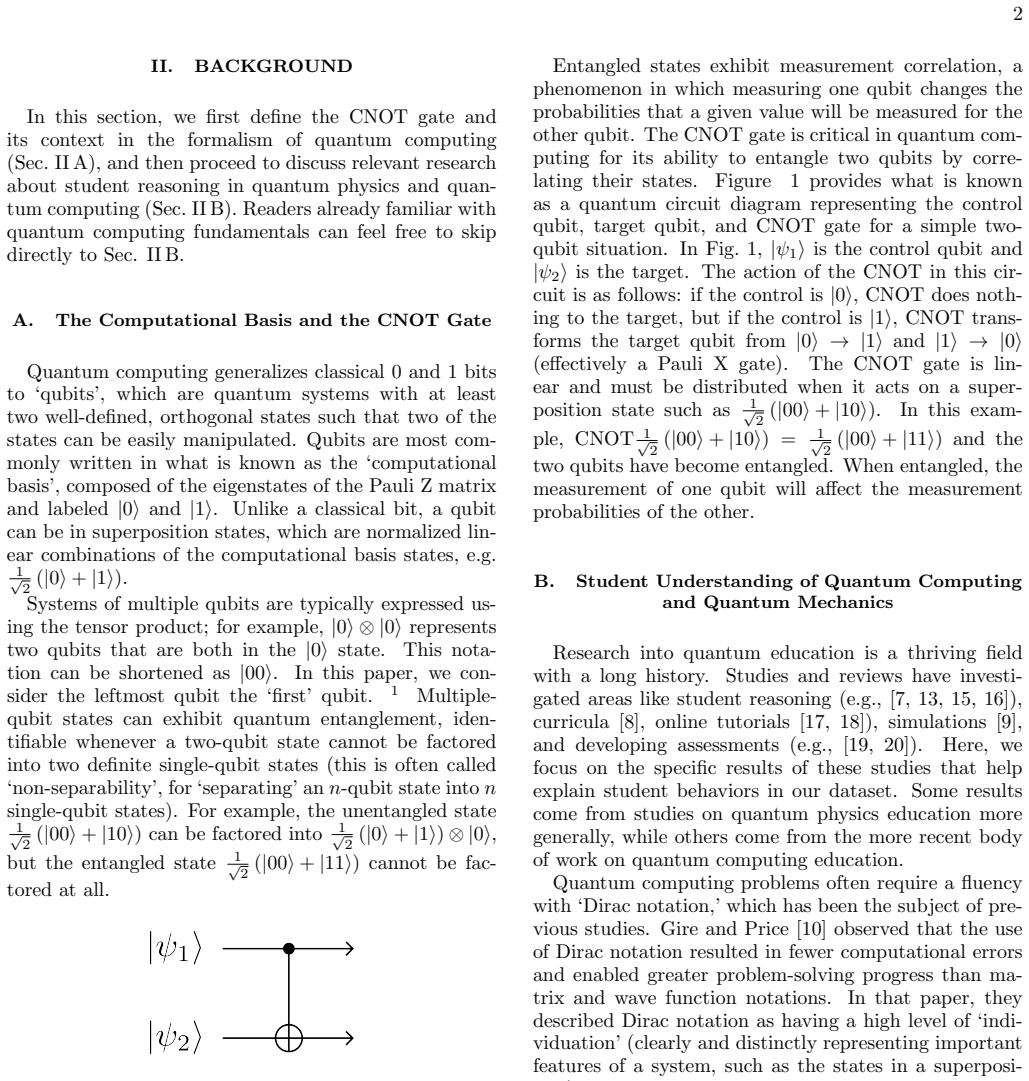
Question 1: Which states are unchanged by CNOT? As shown in Fig. 2, Question 1 provides four 2-qubit quantum states and asks students which states (if any) would be left unchanged after the application of the CNOT gate. The definition of CNOT, as given in Sec. II A, can be applied linearly to each ket in the su- perposition to find that|ψ a⟩and|ψ d⟩are un...
-
[2]
3) presents students with a two-qubit circuit involving a CNOT gate and a measurement
Question 2: What happens to the control qubit? Question 2 (Fig. 3) presents students with a two-qubit circuit involving a CNOT gate and a measurement. The FIG. 2. The prompt and answer options for Question 1. The answers are A and D, obtained by linearly applying CNOT to each individual ket. 3 The fourth question was broad and open-ended, but unfortu- nat...
-
[3]
mathemati- cal actions
Question 3: How do multiple CNOTs cancel? Question 3 (see Fig. 4) presents students with a two- qubit circuit containing three CNOT gates in various orientations. It asks students to determine whether the three-CNOT circuit is equivalent to a single-CNOT cir- cuit (in either possible orientation), both, or neither. Two adjacent CNOT gates in the three-qub...
-
[4]
J. C. Meyer, G. Passante, S. J. Pollock, and B. R. Wilcox, Introductory quantum information science coursework at us institutions: content coverage, EPJ Quantum Tech- nology11, 16 (2024)
2024
-
[5]
Cervantes, G
B. Cervantes, G. Passante, B. R. Wilcox, and S. J. Pol- lock, An overview of quantum information science courses at US institutions, inPhysics Education Research Con- ference Proceedings(2021)
2021
-
[6]
Plunkett, T
T. Plunkett, T. L. Frantz, H. Khatri, P. Rajendran, and S. Midha, A survey of educational efforts to accelerate a growing quantum workforce, in2020 IEEE Interna- tional Conference on Quantum Computing and Engineer- ing (QCE)(IEEE, 2020) pp. 330–336
2020
-
[7]
J. C. Meyer, G. Passante, S. J. Pollock, and B. R. Wilcox, Today’s interdisciplinary quantum information classroom: Themes from a survey of quantum informa- tion science instructors, Physical Review Physics Educa- tion Research18, 010150 (2022)
2022
-
[8]
Asfaw, A
A. Asfaw, A. Blais, K. R. Brown, J. Candelaria, C. Cantwell, L. D. Carr, J. Combes, D. M. Debroy, J. M. Donohue, S. E. Economou,et al., Building a quantum engineering undergraduate program, IEEE Transactions on Education65, 220 (2022)
2022
-
[9]
A. S. Dzurak, J. Epps, A. Laucht, R. Malaney, A. Morello, H. I. Nurdin, J. J. Pla, A. Saraiva, and C. H. Yang, Development of an undergraduate quantum engi- neering degree, IEEE Transactions on Quantum Engi- neering3, 1 (2022)
2022
-
[10]
Marshman and C
E. Marshman and C. Singh, Framework for understand- ing the patterns of student difficulties in quantum me- chanics, Physical Review Special Topics-Physics Educa- tion Research11, 020119 (2015)
2015
-
[11]
P. J. Emigh, E. Gire, C. A. Manogue, G. Passante, and P. S. Shaffer, Research-based quantum instruction: Paradigms and tutorials, Physical Review Physics Edu- cation Research16, 020156 (2020)
2020
-
[12]
Passante and A
G. Passante and A. Kohnle, Interactive homework to support student learning of measurement uncertainty in quantum mechanics, Physical Review Physics Education Research20, 020131 (2024)
2024
-
[13]
Gire and E
E. Gire and E. Price, Structural features of alge- braic quantum notations, Physical Review Special Top- ics—Physics Education Research11, 020109 (2015)
2015
-
[14]
Meyer, G
J. Meyer, G. Passante, S. J. Pollock, M. Vignal, and B. R. Wilcox, Investigating students’ strategies for interpreting quantum states in an upper-division quantum computing course, inPhysics Education Research Conference Pro- ceedings(2021)
2021
-
[15]
Kushimo and B
T. Kushimo and B. Thacker, Investigating students’ strengths and difficulties in quantum computing, in2023 IEEE International Conference on Quantum Computing and Engineering (QCE), Vol. 3 (IEEE, 2023) pp. 33–39
2023
-
[16]
Bouch´ ee, L
T. Bouch´ ee, L. de Putter-Smits, M. Thurlings, and B. Pepin, Towards a better understanding of concep- tual difficulties in introductory quantum physics courses, Studies in Science Education58, 183 (2022)
2022
-
[17]
Hammer, Student resources for learning introductory physics, American journal of physics68, S52 (2000)
D. Hammer, Student resources for learning introductory physics, American journal of physics68, S52 (2000)
2000
-
[18]
Corsiglia, S
G. Corsiglia, S. Pollock, and G. Passante, Intuition in quantum mechanics: Student perspectives and expecta- tions, Physical Review Physics Education Research19, 010109 (2023)
2023
-
[19]
Krijtenburg-Lewerissa, H
K. Krijtenburg-Lewerissa, H. J. Pol, A. Brinkman, and W. R. van Joolingen, Insights into teaching quantum me- chanics in secondary and lower undergraduate education, Physical review physics education research13, 010109 (2017)
2017
-
[20]
Corsiglia, S
G. Corsiglia, S. Pollock, and B. Wilcox, Effectiveness of an online homework tutorial about changing basis in quantum mechanics, inPhysics Education Research Con- ference(2022)
2022
-
[21]
Corsiglia,Designing Online Activities for Teach- ing Quantum Mechanics: A Research-Based Approach, Ph.D
G. Corsiglia,Designing Online Activities for Teach- ing Quantum Mechanics: A Research-Based Approach, Ph.D. thesis, University of Colorado - Boulder (2023)
2023
-
[22]
H. R. Sadaghiani and S. J. Pollock, Quantum mechanics concept assessment: Development and validation study, Physical Review Special Topics-Physics Education Re- search11, 010110 (2015)
2015
-
[23]
Robinett and E
R. Robinett and E. Cataloglu, Testing the development of student conceptual and visualization understanding in quantum mechanics through the undergraduate career, Am. J. Phys.70, 238 (2002)
2002
-
[24]
Kohnle and E
A. Kohnle and E. Deffebach, Investigating student under- standing of quantum entanglement, inPhysics Education Research Conference Proceedings(2021)
2021
-
[25]
H. J. Hersom and B. M. Zwickl, Investigating students’ understanding of entanglement, inPhysics Education Re- search Conference Proceedings(2024)
2024
-
[26]
Passante, P
G. Passante, P. J. Emigh, and P. S. Shaffer, Student abil- ity to distinguish between superposition states and mixed states in quantum mechanics, Physical Review Special Topics—Physics Education Research11, 020135 (2015)
2015
-
[27]
Singh and E
C. Singh and E. Marshman, Student difficulties with determining expectation values in quantum mechanics, inPhysics Education Research Conference Proceedings (2016)
2016
-
[28]
Meyer,New Paradigms in Quantum Education for the Second Quantum Revolution, Ph.D
J. Meyer,New Paradigms in Quantum Education for the Second Quantum Revolution, Ph.D. thesis, University of Colorado - Boulder (2025)
2025
-
[29]
Griston, J
M. Griston, J. Meyer, and B. Wilcox, Tbd, in press
-
[30]
R. E. Scherr, Modeling student thinking: An example from special relativity, American Journal of Physics75, 272 (2007)
2007
-
[31]
M. C. Wittmann and K. E. Black, Mathematical actions as procedural resources: An example from the separation of variables, Physical Review Special Topics—Physics Education Research11, 020114 (2015)
2015
-
[32]
J. P. Smith III, A. A. DiSessa, and J. Roschelle, Miscon- ceptions reconceived: A constructivist analysis of knowl- edge in transition, The journal of the learning sciences3, 115 (1994)
1994
-
[33]
L. A. Barth-Cohen, H. Swanson, and J. Arnell, Methods of research design and analysis for identifying knowledge resources, Physical Review Physics Education Research 19, 020119 (2023)
2023
-
[34]
A. D. Robertson, L. M. Goodhew, L. C. Bauman, B. Hansen, and A. T. Alesandrini, Identifying student conceptual resources for understanding physics: A prac- tical guide for researchers, Physical Review Physics Ed- ucation Research19, 020138 (2023)
2023
-
[35]
E. Kuo, M. M. Hull, A. Gupta, and A. Elby, How stu- dents blend conceptual and formal mathematical reason- 13 ing in solving physics problems, Science Education97, 32 (2013)
2013
-
[36]
Eichenlaub and E
M. Eichenlaub and E. F. Redish, Blending physical knowledge with mathematical form in physics problem solving, inMathematics in physics education(Springer,
-
[37]
J. C. Meyer, G. Passante, and B. Wilcox, Disparities in access to US quantum information education, Physical Review Physics Education Research20, 010131 (2024)
2024
-
[38]
Brang, H
M. Brang, H. Franke, F. Greinert, M. S. Ubben, F. Hen- nig, and P. Bitzenbauer, Spooky action at a distance? a two-phase study into learners’ views of quantum entan- glement, EPJ Quantum Technology11, 33 (2024)
2024
discussion (0)
Sign in with ORCID, Apple, or X to comment. Anyone can read and Pith papers without signing in.