Nonequilibrium Cooper quartet generation in superconducting devices
Pith reviewed 2026-05-10 07:14 UTC · model grok-4.3
The pith
High bias voltage creates a resonance between the vacuum and a four-electron state that generates Cooper quartet correlations.
A machine-rendered reading of the paper's core claim, the machinery that carries it, and where it could break.
Core claim
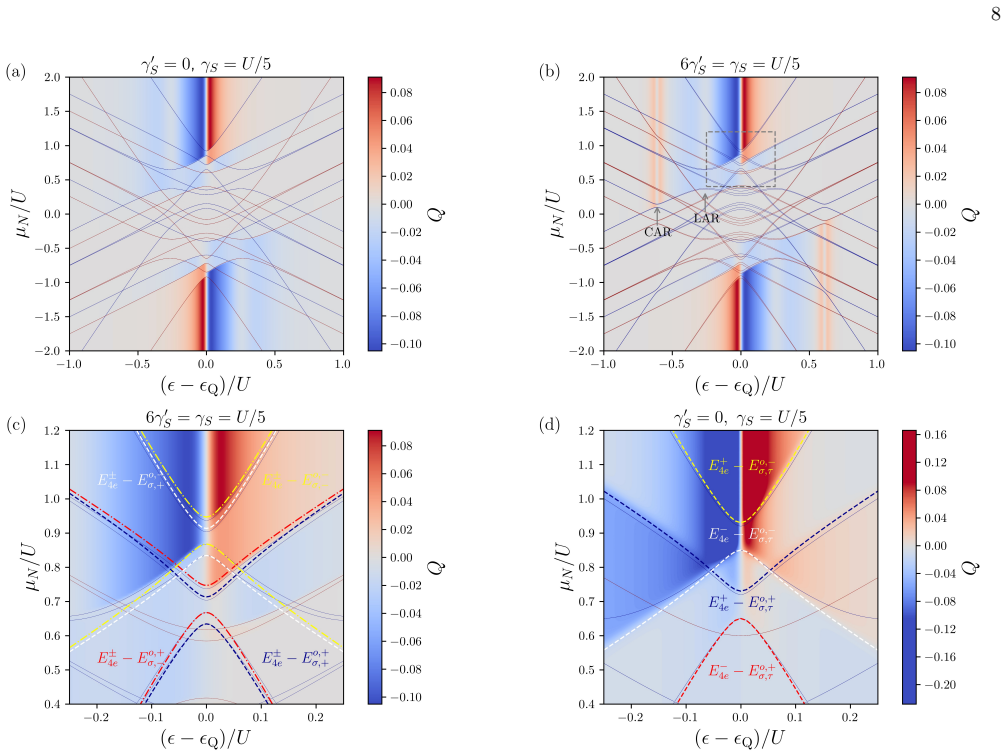
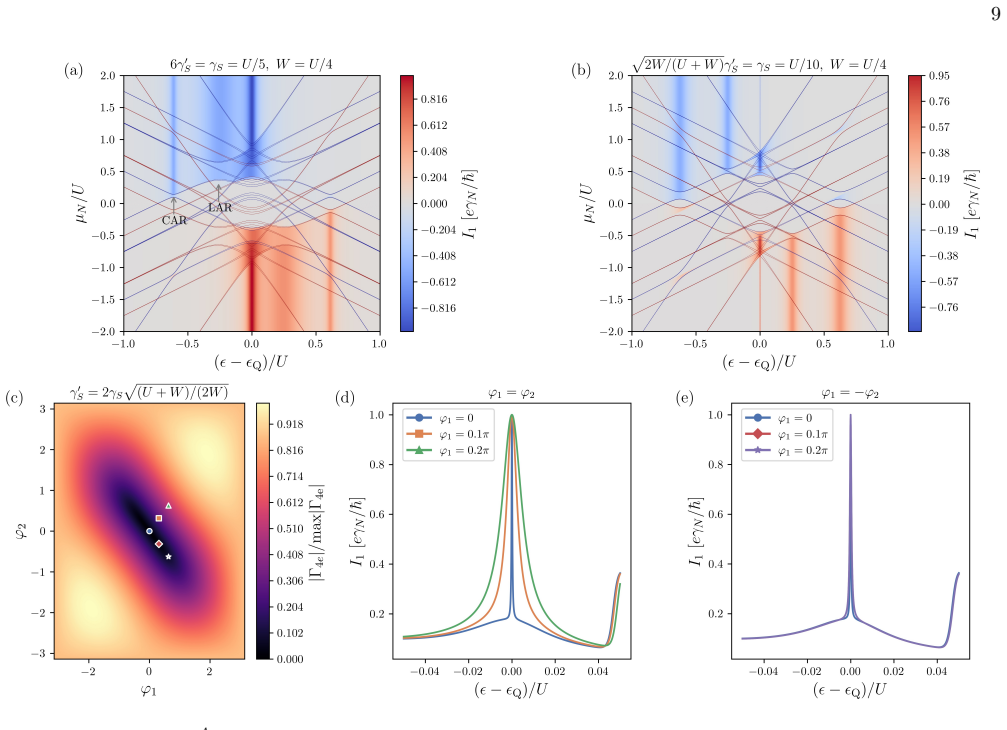
By driving the system out of equilibrium in the high bias voltage regime, a resonance between the vacuum |0⟩ and the four-electron state |4e⟩ emerges, which involves a two-Cooper pair exchange process and is characterized by finite quartet correlations. The transport properties exhibit a peak in the Andreev current at high bias whose width scales with the magnitude of the quartet coupling Γ_4e. This coupling can be tuned by the phase of additional superconducting leads while preserving the transport regime. The current-current correlations and Fano factor establish a regime of equal auto- and cross-correlations that signals fast coherent two-Cooper-pair oscillations.
What carries the argument
The quartet coupling Γ_4e between vacuum and four-electron states, which mediates coherent two-Cooper-pair exchange and is independently tunable by the phase of additional superconducting leads to isolate the resonance in high-bias transport.
If this is right
- The Andreev current shows a peak at high bias whose width scales directly with the quartet coupling strength.
- Current-current correlations become equal between auto- and cross-terms under fast coherent two-pair oscillations.
- Phase tuning of additional leads controls the quartet coupling without exiting the high-bias transport regime.
Where Pith is reading between the lines
- The same nonequilibrium drive could be adapted to generate and detect higher-order multifermion states beyond quartets.
- Observation of the predicted noise signatures would supply a new experimental handle on correlated electron aggregates in mesoscopic systems.
- The platform could be extended to study how quartet states interact with external fields or additional degrees of freedom.
Load-bearing premise
The high-bias regime must isolate the quartet resonance without dominant contributions from other processes, while allowing the quartet coupling to be tuned independently by lead phases.
What would settle it
If the width of the high-bias Andreev current peak does not scale with the phase-tunable Γ_4e, or if auto- and cross-correlations remain unequal in that regime, the isolated quartet resonance would not be present.
Figures




read the original abstract
Cooper quartets are aggregates of four electrons that generalize the concept of Cooper pairs, and their study can unfold unexplored perspectives in correlated matter and many-body physics. We propose a method to isolate them in a double-quantum-dot system coupled to conventional superconducting and normal leads. By driving the system out of equilibrium, we show that a resonance between the vacuum $|0\rangle$ and the four-electron state $|4e\rangle$ emerges in the high bias voltage regime, which involves a two-Cooper pair exchange process and is characterized by finite quartet correlations. We study the transport properties of the system and show that a peak in the Andreev current at high bias voltage has a width that scales with the magnitude of the quartet coupling $\Gamma_{4e}$, which can be tuned by the phase of additional superconducting leads, yielding distinctive signatures. By further studying the current-current correlations and the Fano factor, we establish a regime characterized by equal auto- and cross-correlations, which we interpret as a definitive signature of fast coherent two-Cooper-pair oscillations between the dots and the superconducting leads. The proposed platform, experimentally accessible in a quantum solid-state laboratory, enables exploration of quartet correlations and multifermion-correlated states of matter.
Editorial analysis
A structured set of objections, weighed in public.
Referee Report
Summary. The paper proposes isolating Cooper quartets in a double-quantum-dot system coupled to superconducting and normal leads. By driving the system out of equilibrium at high bias, it claims a resonance emerges between the vacuum |0⟩ and four-electron |4e⟩ state via two-Cooper-pair exchange, producing a tunable Andreev current peak whose width scales with quartet coupling Γ_4e (controlled by additional lead phases) and equal auto-/cross-current correlations plus Fano factor signatures of coherent oscillations.
Significance. If the central claims hold, the work provides an experimentally accessible platform for studying higher-order multifermion correlations in mesoscopic superconductors, extending beyond conventional Cooper-pair physics with potential implications for correlated matter. The nonequilibrium driving and phase-tunability approach is a notable strength for controllability.
major comments (2)
- [Transport properties section (results on current peak and correlations)] The claim that high bias isolates the |0⟩–|4e⟩ resonance (abstract and transport results) requires that two-Cooper-pair exchange dominates over single-pair tunneling, quasiparticles, and higher-order processes, yet no rate comparison or master-equation solutions with/without those channels are shown to confirm subdominance across the relevant bias window.
- [Model and Hamiltonian section (definition of Γ_4e and lead couplings)] The quartet coupling Γ_4e is treated as independently tunable via lead phases while maintaining the described transport regime, but the manuscript does not provide an explicit check (e.g., full parameter scan or comparison of effective rates) that this tuning preserves isolation of the resonance without contamination.
minor comments (2)
- [Model section] Clarify the explicit many-body construction of the |4e⟩ state in terms of dot and lead occupations to avoid ambiguity with standard Andreev bound states.
- [Figures] In figures showing current vs. bias, label the high-bias regime explicitly and include scaling of peak width with Γ_4e for direct comparison to the claimed behavior.
Simulated Author's Rebuttal
We thank the referee for the constructive report and the positive assessment of the potential significance of our work on nonequilibrium Cooper quartet generation. We address the two major comments point by point below, indicating where revisions will be made to strengthen the manuscript.
read point-by-point responses
-
Referee: The claim that high bias isolates the |0⟩–|4e⟩ resonance (abstract and transport results) requires that two-Cooper-pair exchange dominates over single-pair tunneling, quasiparticles, and higher-order processes, yet no rate comparison or master-equation solutions with/without those channels are shown to confirm subdominance across the relevant bias window.
Authors: We agree that an explicit demonstration of the dominance of the two-Cooper-pair channel would strengthen the presentation. In the model, the high-bias condition places the normal-lead chemical potential such that single-pair processes are detuned by the superconducting gap Δ, while quasiparticle contributions are exponentially suppressed. The master equation is solved within the quartet subspace, but to directly address the concern we will add a supplementary analysis comparing the full rate equations to a reduced model excluding single-pair and higher-order terms. This will include numerical checks of the relative rates over the bias window used in the transport results, confirming subdominance. The revised manuscript will incorporate this comparison. revision: yes
-
Referee: The quartet coupling Γ_4e is treated as independently tunable via lead phases while maintaining the described transport regime, but the manuscript does not provide an explicit check (e.g., full parameter scan or comparison of effective rates) that this tuning preserves isolation of the resonance without contamination.
Authors: We acknowledge that an explicit verification of the robustness under phase tuning would be valuable. The phase dependence enters through the superconducting-lead couplings in the effective Hamiltonian, allowing Γ_4e to be varied while the high-bias resonance condition is preserved by the detuning from single-pair channels. To provide the requested check, we will add a parameter scan in the revised manuscript (or supplementary material) showing the effective rates and resonance width as functions of the additional lead phases. This will demonstrate that the |0⟩–|4e⟩ isolation remains intact without significant contamination from competing processes across the tunable range. revision: yes
Circularity Check
No significant circularity; model assumptions and transport calculations are independent of target observables
full rationale
The paper constructs a driven double-quantum-dot Hamiltonian, applies a high-bias master-equation treatment, and computes Andreev current, Fano factor, and current correlations as functions of the externally tunable quartet coupling Γ_4e and lead phases. These quantities are obtained by direct solution of the rate equations under stated assumptions (high-bias isolation of |0⟩–|4e⟩ subspace, phase control of Γ_4e). No parameter is fitted to the resonance signature itself, no prediction is renamed as an input, and no self-citation supplies a uniqueness theorem or ansatz that closes the derivation. The central claims therefore remain falsifiable against independent measurements of the same transport observables.
Axiom & Free-Parameter Ledger
free parameters (1)
- quartet coupling Γ_4e
axioms (1)
- standard math Standard BCS theory for superconducting leads and sequential tunneling for quantum dots
invented entities (1)
-
Cooper quartet state |4e>
no independent evidence
Reference graph
Works this paper leans on
-
[1]
Effective Hamiltonian atϵ=ϵ Q Our goal is to obtain an effective Hamiltonian for the quartet subspace. Here, we provide the procedure for the most general case with the three-superconducting termi- nal configuration and to this end we relabel asϕ i the phase of the superconducting leadS i, withi= 0,1,2. This way, in the Hamiltonian Eq. (4), the LAR-induce...
-
[2]
We make use of the expressions Eqs
Quartet correlator in the reduced model Here, we provide details of the calculation of the quar- tet correlator in the framework of the reduced model. We make use of the expressions Eqs. (B9),(B10) for the states| ¯0⟩and| ¯4e⟩, and the expressions for the eigenstates in the quartet sector|±⟩ 4e =±u 4e,∓|¯0⟩+e −iθ4e u4e,±| ¯4e⟩. We then find 4e⟨±|d1↓d1↑d2↓...
-
[3]
The matrixW(χ) can be written in the form W(χ) =W diag + X j W in j e−iχj +W out j eiχj ,(E4) where the matricesW in/out j are purely off-diagonal in the sequential tunneling regime we are considering and the detW= 0 condition is enforced by the matrix diagonal matrixW diag, whose entries are the negative sum of the columns of theW in j andW out j . Intro...
-
[4]
Wu, Phys
C. Wu, Phys. Rev. Lett.95, 266404 (2005)
2005
-
[5]
Lecheminant, E
P. Lecheminant, E. Boulat, and P. Azaria, Phys. Rev. Lett.95, 240402 (2005)
2005
-
[6]
Capponi, G
S. Capponi, G. Roux, P. Azaria, E. Boulat, and P. Le- cheminant, Phys. Rev. B75, 100503 (2007)
2007
-
[7]
Capponi, G
S. Capponi, G. Roux, P. Lecheminant, P. Azaria, E. Boulat, and S. R. White, Phys. Rev. A77, 013624 (2008)
2008
-
[8]
M. O. Soldini, M. H. Fischer, and T. Neupert, Phys. Rev. B109, 214509 (2024)
2024
-
[9]
X. W. Guan, M. T. Batchelor, C. Lee, and J. Y. Lee, Europhysics Letters86, 50003 (2009)
2009
-
[10]
Kuklov, N
A. Kuklov, N. Prokof’ev, and B. Svistunov, Phys. Rev. Lett.92, 030403 (2004)
2004
-
[11]
Kuklov, N
A. Kuklov, N. Prokof’ev, and B. Svistunov, Phys. Rev. Lett.92, 050402 (2004)
2004
-
[12]
Dou¸ cot and J
B. Dou¸ cot and J. Vidal, Phys. Rev. Lett.88, 227005 (2002)
2002
-
[13]
Vidal, R
J. Vidal, R. Mosseri, and B. Dou¸ cot, Phys. Rev. Lett. 81, 5888 (1998)
1998
-
[14]
Rizzi, V
M. Rizzi, V. Cataudella, and R. Fazio, Phys. Rev. B 73, 100502 (2006)
2006
-
[15]
Rizzi, V
M. Rizzi, V. Cataudella, and R. Fazio, Phys. Rev. B 73, 144511 (2006)
2006
-
[16]
Cartwright, G
C. Cartwright, G. De Chiara, and M. Rizzi, Phys. Rev. B98, 184508 (2018)
2018
-
[17]
T. Chen, C. Huang, I. Velkovsky, T. Ozawa, H. Price, J. P. Covey, and B. Gadway, Nature Physics21, 221 (2025)
2025
-
[18]
Babaev, A
E. Babaev, A. Sudbø, and N. W. Ashcroft, Nature431, 666 (2004)
2004
-
[19]
Radzihovsky and A
L. Radzihovsky and A. Vishwanath, Phys. Rev. Lett. 103, 010404 (2009)
2009
-
[20]
E. Berg, E. Fradkin, and S. A. Kivelson, Nature Physics 5, 830 (2009)
2009
-
[21]
Radzihovsky, Phys
L. Radzihovsky, Phys. Rev. A84, 023611 (2011)
2011
-
[22]
Wu and Y
Y.-M. Wu and Y. Wang, npj Quantum Materials9, 66 (2024)
2024
-
[23]
R. M. Fernandes and L. Fu, Phys. Rev. Lett.127, 047001 (2021)
2021
-
[24]
S.-K. Jian, Y. Huang, and H. Yao, Phys. Rev. Lett. 127, 227001 (2021)
2021
-
[25]
Y.-B. Liu, J. Zhou, C. Wu, and F. Yang, Nature Com- munications14, 7926 (2023)
2023
-
[26]
Maccari and E
I. Maccari and E. Babaev, Phys. Rev. B105, 214520 (2022)
2022
-
[27]
Maccari, J
I. Maccari, J. Carlstr¨ om, and E. Babaev, Phys. Rev. B 107, 064501 (2023)
2023
-
[28]
Babaev, Phys
E. Babaev, Phys. Rev. Res.6, L032034 (2024)
2024
-
[29]
Grinenko, D
V. Grinenko, D. Weston, F. Caglieris, C. Wuttke, C. Hess, T. Gottschall, I. Maccari, D. Gorbunov, S. Zherlitsyn, J. Wosnitza, A. Rydh, K. Kihou, C.-H. Lee, R. Sarkar, S. Dengre, J. Garaud, A. Charnukha, R. H¨ uhne, K. Nielsch, B. B¨ uchner, H.-H. Klauss, and E. Babaev, Nature Physics17, 1254 (2021)
2021
-
[30]
G. E. Volovik, JETP Letters119, 330 (2024)
2024
-
[31]
Mizel and D
A. Mizel and D. A. Lidar, Phys. Rev. Lett.92, 077903 (2004)
2004
-
[32]
X. Peng, J. Zhang, J. Du, and D. Suter, Phys. Rev. Lett.103, 140501 (2009)
2009
-
[33]
H.-N. Dai, B. Yang, A. Reingruber, H. Sun, X.-F. Xu, Y.-A. Chen, Z.-S. Yuan, and J.-W. Pan, Nature Physics 13, 1195 (2017)
2017
-
[34]
Kumar, H
S. Kumar, H. Zhang, and Y.-P. Huang, Communica- tions Physics3, 108 (2020)
2020
-
[35]
Zhang, H
K. Zhang, H. Li, P. Zhang, J. Yuan, J. Chen, W. Ren, Z. Wang, C. Song, D.-W. Wang, H. Wang, S. Zhu, G. S. Agarwal, and M. O. Scully, Phys. Rev. Lett.128, 190502 (2022)
2022
-
[36]
Blatter, V
G. Blatter, V. B. Geshkenbein, and L. B. Ioffe, Phys. Rev. B63, 174511 (2001)
2001
-
[37]
L. B. Ioffe, M. V. Feigel’man, A. Ioselevich, D. Ivanov, M. Troyer, and G. Blatter, Nature415, 503 (2002)
2002
-
[38]
L. B. Ioffe and M. V. Feigel’man, Phys. Rev. B66, 224503 (2002)
2002
-
[39]
Dou¸ cot, M
B. Dou¸ cot, M. V. Feigel’man, and L. B. Ioffe, Phys. Rev. Lett.90, 107003 (2003)
2003
-
[40]
Dou¸ cot, M
B. Dou¸ cot, M. V. Feigel’man, L. B. Ioffe, and A. S. Ioselevich, Phys. Rev. B71, 024505 (2005)
2005
-
[41]
Protected qubit based on a superconducting current mirror
A. Kitaev, (2006), arXiv:cond-mat/0609441
work page Pith review arXiv 2006
-
[42]
Dou¸ cot and L
B. Dou¸ cot and L. B. Ioffe, Reports on Progress in Physics75, 072001 (2012)
2012
-
[43]
Gladchenko, D
S. Gladchenko, D. Olaya, E. Dupont-Ferrier, B. Dou¸ cot, L. B. Ioffe, and M. E. Gershenson, Nature Physics5, 48 (2009)
2009
-
[44]
M. T. Bell, J. Paramanandam, L. B. Ioffe, and M. E. Gershenson, Phys. Rev. Lett.112, 167001 (2014)
2014
- [45]
-
[46]
T. W. Larsen, M. E. Gershenson, L. Casparis, A. Kringhøj, N. J. Pearson, R. P. G. McNeil, F. Kuem- meth, P. Krogstrup, K. D. Petersson, and C. M. Mar- cus, Phys. Rev. Lett.125, 056801 (2020)
2020
-
[47]
Messelot, N
S. Messelot, N. Aparicio, E. de Seze, E. Eyraud, J. Coraux, K. Watanabe, T. Taniguchi, and J. Renard, Phys. Rev. Lett.133, 106001 (2024)
2024
-
[48]
E. G. Arnault, J. Chiles, T. F. Q. Larson, C.-C. Chen, L. Zhao, K. Watanabe, T. Taniguchi, F. m. c. Amet, and G. Finkelstein, Phys. Rev. Lett.134, 067001 (2025)
2025
-
[49]
Leblanc, C
A. Leblanc, C. Tangchingchai, Z. Sadre Momtaz, E. Kiyooka, J.-M. Hartmann, F. Gustavo, J.-L. Thomassin, B. Brun, V. Schmitt, S. Zihlmann, R. Mau- rand, ´E. Dumur, S. De Franceschi, and F. Lefloch, Na- ture Communications16, 1010 (2025)
2025
-
[50]
Banszerus, W
L. Banszerus, W. Marshall, C. W. Andersson, T. Linde- mann, M. J. Manfra, C. M. Marcus, and S. Vaitiek˙ enas, Phys. Rev. Lett.133, 186303 (2024)
2024
-
[51]
Ciaccia, R
C. Ciaccia, R. Haller, A. C. C. Drachmann, T. Lindemann, M. J. Manfra, C. Schrade, and C. Sch¨ onenberger, Communications Physics7, 41 (2024)
2024
-
[52]
Banszerus, C
L. Banszerus, C. W. Andersson, W. Marshall, T. Linde- mann, M. J. Manfra, C. M. Marcus, and S. Vaitiek˙ enas, Phys. Rev. X15, 011021 (2025)
2025
-
[53]
J. C. Cuevas and H. Pothier, Phys. Rev. B75, 174513 (2007)
2007
-
[54]
Freyn, B
A. Freyn, B. Dou¸ cot, D. Feinberg, and R. M´ elin, Phys. Rev. Lett.106, 257005 (2011)
2011
-
[55]
Jonckheere, J
T. Jonckheere, J. Rech, T. Martin, B. Dou¸ cot, D. Fein- berg, and R. M´ elin, Phys. Rev. B87, 214501 (2013)
2013
-
[56]
A. H. Pfeffer, J. E. Duvauchelle, H. Courtois, R. M´ elin, 21 D. Feinberg, and F. Lefloch, Phys. Rev. B90, 075401 (2014)
2014
-
[57]
Cohen, Y
Y. Cohen, Y. Ronen, J.-H. Kang, M. Heiblum, D. Fein- berg, R. M´ elin, and H. Shtrikman, Proceedings of the National Academy of Sciences115, 6991 (2018)
2018
-
[58]
Huang, Y
K.-F. Huang, Y. Ronen, R. M´ elin, D. Feinberg, K. Watanabe, T. Taniguchi, and P. Kim, Nature Com- munications13, 3032 (2022)
2022
-
[59]
Chirolli, A
L. Chirolli, A. Braggio, and F. Giazotto, Phys. Rev. Res.6, 033171 (2024)
2024
-
[60]
Moser, J
J. Moser, J. G¨ uttinger, A. Eichler, M. J. Esplandiu, D. E. Liu, M. I. Dykman, and A. Bachtold, Nature Nanotechnology8, 493 (2013)
2013
-
[61]
M. R. Delbecq, L. E. Bruhat, J. J. Viennot, S. Datta, A. Cottet, and T. Kontos, Nature Communications4, 1400 (2013)
2013
-
[62]
A. Hamo, A. Benyamini, I. Shapir, I. Khivrich, J. Waiss- man, K. Kaasbjerg, Y. Oreg, F. von Oppen, and S. Ilani, Nature535, 395 (2016)
2016
-
[63]
Bhattacharya, T
U. Bhattacharya, T. Grass, A. Bachtold, M. Lewenstein, and F. Pistolesi, Nano Letters21, 9661 (2021)
2021
-
[64]
Vigneau, J
F. Vigneau, J. Monsel, J. Tabanera, K. Aggarwal, L. Bresque, F. Fedele, F. Cerisola, G. A. D. Briggs, J. Anders, J. M. R. Parrondo, A. Auff` eves, and N. Ares, Phys. Rev. Res.4, 043168 (2022)
2022
-
[65]
Ishizaka, J
S. Ishizaka, J. Sone, and T. Ando, Phys. Rev. B52, 8358 (1995)
1995
-
[66]
Fazio and R
R. Fazio and R. Raimondi, Phys. Rev. Lett.80, 2913 (1998)
1998
-
[67]
Fazio and R
R. Fazio and R. Raimondi, Phys. Rev. Lett.82, 4950 (1999)
1999
-
[68]
A. A. Clerk and V. Ambegaokar, Phys. Rev. B61, 9109 (2000)
2000
-
[69]
A. A. Clerk, V. Ambegaokar, and S. Hershfield, Phys. Rev. B61, 3555 (2000)
2000
-
[70]
Recher, E
P. Recher, E. V. Sukhorukov, and D. Loss, Phys. Rev. B63, 165314 (2001)
2001
-
[71]
Recher and D
P. Recher and D. Loss, Phys. Rev. Lett.91, 267003 (2003)
2003
-
[72]
M. G. Pala, M. Governale, and J. K¨ onig, New Journal of Physics9, 278 (2007)
2007
-
[73]
Governale, M
M. Governale, M. G. Pala, and J. K¨ onig, Phys. Rev. B 77, 134513 (2008)
2008
-
[74]
Hussein and S
R. Hussein and S. Kohler, Phys. Rev. B89, 205424 (2014)
2014
-
[75]
Sothmann, S
B. Sothmann, S. Weiss, M. Governale, and J. K¨ onig, Phys. Rev. B90, 220501 (2014)
2014
-
[76]
Sauret, D
O. Sauret, D. Feinberg, and T. Martin, Phys. Rev. B 70, 245313 (2004)
2004
-
[77]
Chevallier, J
D. Chevallier, J. Rech, T. Jonckheere, and T. Martin, Phys. Rev. B83, 125421 (2011)
2011
-
[78]
Burset, W
P. Burset, W. J. Herrera, and A. L. Yeyati, Phys. Rev. B84, 115448 (2011)
2011
-
[79]
Hussein, L
R. Hussein, L. Jaurigue, M. Governale, and A. Braggio, Phys. Rev. B94, 235134 (2016)
2016
-
[80]
Brange, K
F. Brange, K. Prech, and C. Flindt, Phys. Rev. Lett. 127, 237701 (2021)
2021
discussion (0)
Sign in with ORCID, Apple, or X to comment. Anyone can read and Pith papers without signing in.