Recognition: unknown
Investigating the Neutrino Mass Ordering Problem via Ternary Plots
Pith reviewed 2026-05-10 07:40 UTC · model grok-4.3
The pith
Ternary plots of supernova neutrino flavors separate normal from inverted mass ordering across models.
A machine-rendered reading of the paper's core claim, the machinery that carries it, and where it could break.
Core claim
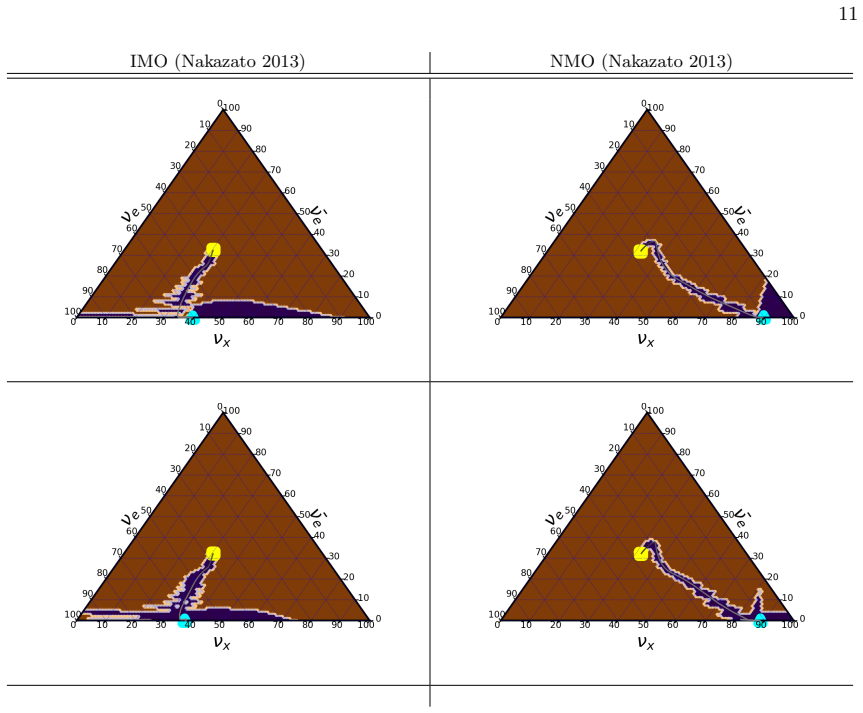
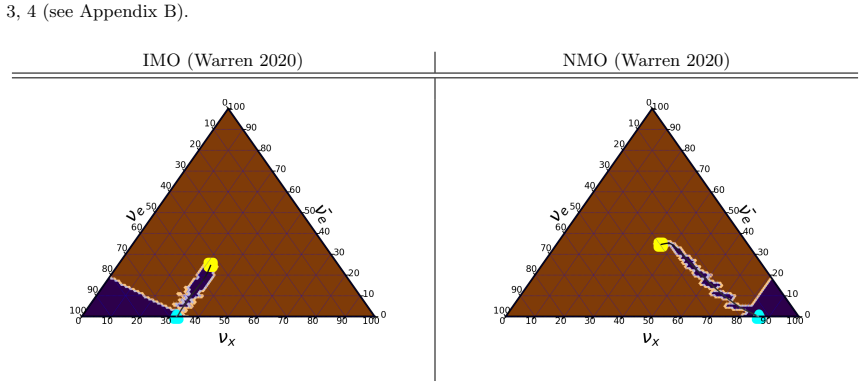
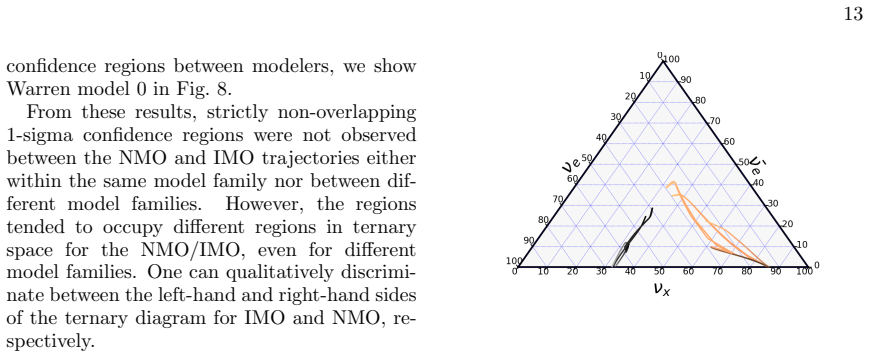
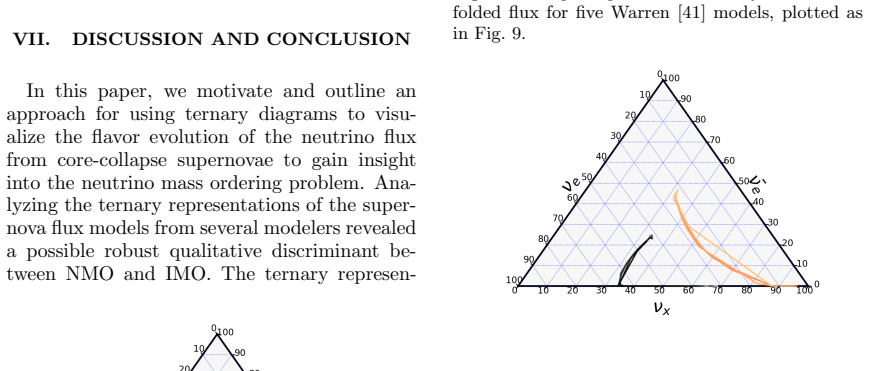
We explore what may be deduced about the neutrino mass ordering problem from the observation of core-collapse supernova burst neutrinos in modern terrestrial detectors. We employ ternary plots in a novel way to visualize the time evolution of the flavor composition of various supernova neutrino flux models. Through our analysis of several models using a simplified unfolding process, we have explored potential robust discriminants between the normal and inverted mass orderings. We find that the normal and inverted mass orderings tend to occupy different regions in ternary space across different models.
What carries the argument
Ternary plots that display the time-dependent fractions of electron, muon, and tau neutrinos in the supernova flux.
If this is right
- Supernova neutrino data could distinguish the two mass orderings without depending on details of any single model.
- The regional separation in ternary space persists after the simplified unfolding step that models detector response.
- Multiple independent supernova models all exhibit the same pattern of separation between orderings.
- Future terrestrial detectors could use this visual method as one route to ordering information from a burst event.
Where Pith is reading between the lines
- The separation points to a difference in how the two orderings shape the flavor ratios that reach Earth.
- Combining ternary-plot results with data from long-baseline oscillation experiments could cross-check the ordering.
- The same plotting approach might be tested on other high-energy neutrino transients once suitable models exist.
Load-bearing premise
The simplified unfolding process accurately captures detector effects without introducing biases that would erase the separation between orderings.
What would settle it
A real supernova detection whose unfolded data places normal and inverted ordering trajectories in overlapping regions of the same ternary plot would show that the separation does not survive actual observations.
Figures




read the original abstract
We explore what may be deduced about the neutrino mass ordering problem from the observation of core-collapse supernova burst neutrinos in modern terrestrial detectors. We employ ternary plots in a novel way to visualize the time evolution of the flavor composition of various supernova neutrino flux models from the SNEWPY software package. Through our analysis of several models using a simplified unfolding process, we have explored potential robust discriminants between the normal and inverted mass orderings. We find that the normal and inverted mass orderings tend to occupy different regions in ternary space across different models.
Editorial analysis
A structured set of objections, weighed in public.
Referee Report
Summary. The manuscript explores the use of ternary plots to visualize the time evolution of neutrino flavor composition from core-collapse supernova models generated via the SNEWPY package. After applying a simplified unfolding procedure to incorporate detector effects, the authors report that normal and inverted neutrino mass orderings tend to occupy distinct regions in ternary space across the models examined, suggesting a potential visual discriminant for the mass ordering problem.
Significance. If the separation proves robust under detailed detector modeling, the ternary-plot approach would supply an intuitive, model-independent visualization tool for supernova neutrino data analysis that complements traditional spectral methods. The explicit use of public SNEWPY models is a clear strength, supporting reproducibility and allowing direct comparison with future work. The current significance remains provisional because the central separation result rests on an incompletely specified unfolding step and lacks quantitative metrics.
major comments (2)
- [Methods (unfolding procedure)] The claim that normal and inverted orderings occupy different regions rests on the simplified unfolding process (described in the methods section following the SNEWPY model introduction). No equations, efficiency functions, or validation against full Monte Carlo are supplied, so it is impossible to determine whether omitted energy-dependent flavor misidentification or background terms would shift the loci into overlap, directly undermining the robustness asserted in the abstract.
- [Results] The results section states that the orderings 'tend to occupy different regions' but reports neither quantitative separation measures (e.g., centroid distances, overlap integrals, or Kolmogorov-Smirnov statistics between the two sets of points) nor error bands arising from model variations or unfolding assumptions. Without these, the visual impression cannot be translated into a falsifiable statement about discrimination power.
minor comments (2)
- Figure captions should explicitly list the SNEWPY model names and the precise unfolding assumptions used for each panel to allow readers to reproduce the plotted points.
- The abstract and introduction would benefit from a brief statement of the specific supernova detectors (e.g., Hyper-Kamiokande, DUNE) whose response is approximated by the unfolding, together with a reference to the relevant detector technical design reports.
Simulated Author's Rebuttal
We thank the referee for the thorough review and valuable feedback on our manuscript. We address each of the major comments below and outline the revisions we plan to make.
read point-by-point responses
-
Referee: [Methods (unfolding procedure)] The claim that normal and inverted orderings occupy different regions rests on the simplified unfolding process (described in the methods section following the SNEWPY model introduction). No equations, efficiency functions, or validation against full Monte Carlo are supplied, so it is impossible to determine whether omitted energy-dependent flavor misidentification or background terms would shift the loci into overlap, directly undermining the robustness asserted in the abstract.
Authors: We agree that the unfolding procedure requires more detailed specification to allow proper assessment of its robustness. In the revised version, we will provide the explicit equations for the simplified unfolding, describe the efficiency functions employed, and elaborate on the assumptions regarding energy-dependent effects and backgrounds. We will also discuss potential limitations and how they might affect the observed separation, while noting that a comprehensive Monte Carlo simulation is outside the current scope but could be addressed in future work. revision: yes
-
Referee: [Results] The results section states that the orderings 'tend to occupy different regions' but reports neither quantitative separation measures (e.g., centroid distances, overlap integrals, or Kolmogorov-Smirnov statistics between the two sets of points) nor error bands arising from model variations or unfolding assumptions. Without these, the visual impression cannot be translated into a falsifiable statement about discrimination power.
Authors: We acknowledge the need for quantitative support to the visual observations. We will revise the results section to include quantitative separation metrics, such as the distances between centroids of the normal and inverted ordering point distributions in ternary space, as well as overlap integrals. We will also incorporate error bands or shaded regions representing the spread due to different SNEWPY models and variations in the unfolding assumptions. This will allow for a more rigorous evaluation of the discrimination power. revision: yes
Circularity Check
No circularity: external models and visualization yield independent empirical observation
full rationale
The paper processes external public SNEWPY supernova neutrino flux models through a simplified unfolding step and visualizes flavor composition evolution in ternary plots. No load-bearing equations, fitted parameters, or self-citations reduce the claimed separation between normal and inverted orderings to a definitional or constructed result. The separation is reported as an observed pattern across the models rather than a prediction forced by the analysis inputs themselves. The derivation remains self-contained against external benchmarks.
Axiom & Free-Parameter Ledger
axioms (1)
- domain assumption Standard three-flavor neutrino oscillation physics and core-collapse supernova neutrino emission models from SNEWPY are sufficiently accurate for the purpose of this visualization study.
Reference graph
Works this paper leans on
-
[1]
pinched-thermal
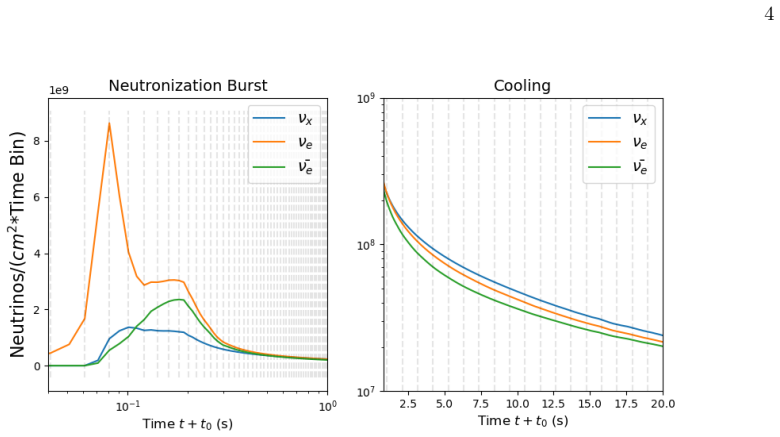
Neutrino Energy Spectra At any given moment in time, the neutrino spectrum for each flavor is well described by a three-parameter expression, known as the “pinched-thermal” or “Garching” parameteri- zation [31], ϕ(Eν) =N0 (α + 1)α+1 ⟨Eν⟩Γ(α + 1) Eν ⟨Eν⟩ α × exp − (α + 1) Eν ⟨Eν⟩ (3) 4 Figure 1. Supernova neutrino flux evolution in the Nakazato index 0 mod...
2013
-
[2]
Navas et al
S. Navas et al. (Particle Data Group), Phys. Rev. D 110, 030001 (2024)
2024
-
[3]
and Michael Turner, The Early Universe (Perseus Books Publishing, LLC, 1990)
Kolb, Edward W. and Michael Turner, The Early Universe (Perseus Books Publishing, LLC, 1990)
1990
-
[4]
DESI DR2 Results II: Measurements of Baryon Acoustic Oscillations and Cosmological Constraints
M. Abdul Karim et al. (DESI), Phys. Rev. D 112, 083515 (2025), arXiv:2503.14738 [astro- ph.CO]
work page Pith review arXiv 2025
-
[5]
W. Elbers et al. , Phys. Rev. D 112, 083513 (2025), arXiv:2503.14744 [astro-ph.CO]
- [6]
-
[7]
S. Abubakar et al. (T2K, NOvA), Nature 646, 818 (2025), arXiv:2510.19888 [hep-ex]
- [8]
- [9]
- [10]
-
[11]
S. Aiello et al. (KM3NeT), Eur. Phys. J. C 82, 26 (2022), arXiv:2103.09885 [hep-ex]
-
[12]
Potential to identify the neutrino mass ordering with reactor antineutrinos in juno
A. Abusleme et al. (JUNO), Chin. Phys. C 49, 033104 (2025), arXiv:2405.18008 [hep-ex]
-
[13]
Scholberg, Journal of Physics G: Nuclear and Particle Physics 45, 014002 (2017)
K. Scholberg, Journal of Physics G: Nuclear and Particle Physics 45, 014002 (2017)
2017
-
[14]
M. Ikeda et al. (Super-Kamiokande), Astro- phys. J. 669, 519 (2007), arXiv:0706.2283 [astro-ph]
-
[15]
Simpson et al
C. Simpson et al. (Super-Kamiokande), The Astrophysical Journal 885, 133 (2019)
2019
- [16]
- [17]
-
[18]
Wikipedia contributors, Ternary plot — Wikipedia, The Free Encyclopedia (2026)
2026
- [19]
-
[20]
R. Abbasi et al. (IceCube), Eur. Phys. J. C 82, 1031 (2022), arXiv:2011.03561 [hep-ex]
-
[21]
C. Quigg, in 35th SLAC Summer Institute on Particle Physics: Dark matter: From the cos- mos to the Laboratory (2008) arXiv:0802.0013 [hep-ph]
- [22]
- [23]
-
[24]
A. Capanema, Y. Porto, and M. M. Saez, Phys. Rev. D 111, 103021 (2025), arXiv:2403.14762 [hep-ph]
-
[25]
A. Capanema, Y. Porto, and M. M. Saez (2025) arXiv:2512.17447 [hep-ph]
-
[26]
Hirata et al
K. Hirata et al. (Kamiokande-II), Phys. Rev. Lett. 58, 1490 (1987)
1987
-
[27]
K. S. Hirata et al., Phys. Rev. D38, 448 (1988)
1988
-
[28]
R. M. Bionta et al. , Phys. Rev. Lett. 58, 1494 (1987)
1987
-
[29]
E. N. Alexeyev, L. N. Alexeyeva, I. V. Krivosheina, and V. I. Volchenko, Physics Let- 15 ters B 205, 209 (1988)
1988
-
[30]
2013, The Astrophysical Journal Supplement Series, 205, 2, doi: 10.1088/0067-0049/205/1/2
K. Nakazato et al. , The Astrophysical Journal 205, 10.1088/0067-0049/205/1/2 (2013)
-
[31]
Supernova Neutrinos: Production, Oscillations and Detection
A. Mirizzi, I. Tamborra, H.-T. Janka, N. Sa- viano, K. Scholberg, R. Bollig, L. Hudepohl, and S. Chakraborty, Riv. Nuovo Cim. 39, 1 (2016), arXiv:1508.00785 [astro-ph.HE]
work page Pith review arXiv 2016
-
[32]
High-resolution supernova neutrino spectra represented by a simple fit
I. Tamborra, B. Muller, L. Hudepohl, H.-T. Janka, and G. Raffelt, Phys. Rev. D86, 125031 (2012), arXiv:1211.3920 [astro-ph.SR]
work page Pith review arXiv 2012
- [33]
-
[34]
A. L. Baxter et al. , Astrophys. J. 925, 107 (2022)
2022
-
[35]
Albert et al
J. Albert et al. , ”snowglobes 1.2”, https:// github.com/SNOwGLoBES/snowglobes (2021)
2021
- [36]
- [37]
-
[38]
Scholberg, Annual Review of Nuclear and Particle Science 62, 81 (2012)
K. Scholberg, Annual Review of Nuclear and Particle Science 62, 81 (2012)
2012
-
[39]
Shinokiet al.(Super-Kamiokande), Phys
M. Shinoki et al. (Super-Kamiokande), Phys. Rev. D 107, 092009 (2023), arXiv:2212.10801 [hep-ex]
- [40]
- [41]
-
[42]
M. L. Warren, S. M. Couch, E. P. O’Connor, and V. Morozova, The Astrophysical Journal 898, 139 (2020)
2020
-
[43]
S. Zha, E. P. O’Connor, and A. d. S. Schneider, The Astrophysical Journal 911, 74 (2021)
2021
-
[44]
S. Das and M. H. Reno, JCAP 02, 076, arXiv:2508.16510 [hep-ph]. Appendix A: Estimated Uncertainties in Ternary Space We assume only uncertainty due to statistics of observed counts at 10 kpc and therefore that the fractional uncertainty of the inferred flux scales as √ N. In order to paint an estimated er- ror region in ternary space for ϕest, the error f...
discussion (0)
Sign in with ORCID, Apple, or X to comment. Anyone can read and Pith papers without signing in.