Recognition: unknown
Diffusion-Based Optimization for Accelerated Convergence of Redundant Dual-Arm Minimum Time Problems
Pith reviewed 2026-05-10 08:00 UTC · model grok-4.3
The pith
Diffusion-based probabilistic sampling solves the nonconvex high-level problem for redundant dual-arm minimum-time path planning, cutting runtime by 35 times and Cartesian error by 34 percent.
A machine-rendered reading of the paper's core claim, the machinery that carries it, and where it could break.
Core claim
The authors replace the gradient-based solver for the high-level nonconvex optimization with a novel variant of the model-based diffusion algorithm. Probabilistic sampling from this diffusion process generates candidate solutions for the joint-space trajectory parameters while the lower-level convex subproblem continues to be solved analytically; the combined procedure directly enforces an L-infinity Cartesian error constraint along the entire path and produces minimum-time solutions.
What carries the argument
A novel variant of the model-based diffusion algorithm that uses probabilistic sampling to explore and select high-quality solutions for the high-level nonconvex optimization problem.
If this is right
- An L-infinity Cartesian error constraint can be imposed directly along the full joint trajectory without gradient sparsity problems.
- High-level optimization runtime drops by a factor of 35 relative to the primal-dual baseline.
- Cartesian tracking error of the resulting trajectories is 34 percent lower than the error obtained with the earlier gradient method.
- The analytic solution of the lower-level convex subproblem combines directly with the sampled high-level decisions.
Where Pith is reading between the lines
- The same sampling strategy could be tested on other bi-level robotic problems whose upper layer is nonconvex and whose gradients are sparse.
- Because per-query time is greatly reduced, the method might support repeated re-planning inside a receding-horizon controller for changing task goals.
- Hardware experiments on physical dual-arm platforms would reveal whether the simulated speed and accuracy gains survive actuator dynamics and sensor noise.
Load-bearing premise
The probabilistic sampling step consistently returns feasible, high-quality trajectories that respect the L-infinity Cartesian error bound without missing substantially better solutions.
What would settle it
Run the diffusion optimizer on a standard redundant dual-arm path-following benchmark, then check whether any generated trajectory violates the L-infinity Cartesian error limit at any sample point or whether the measured wall-clock time exceeds one-thirty-fifth of the prior gradient-based runtime.
Figures
read the original abstract
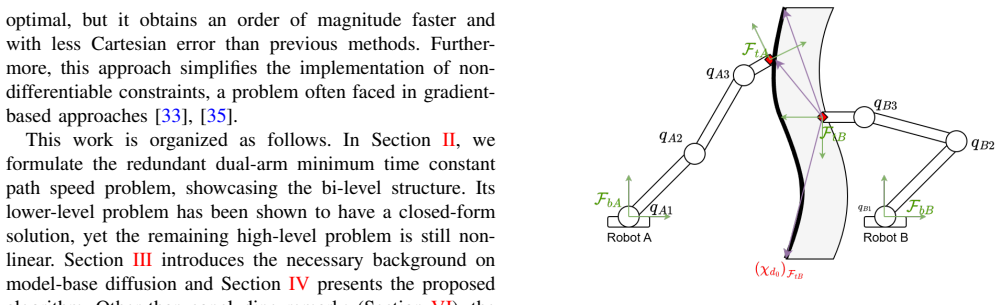
We present a framework leveraging a novel variant of the model-based diffusion algorithm to minimize the time required for a redundant dual-arm robot configuration to follow a desired relative Cartesian path. Our prior work proposed a bi-level optimization approach for the dual-arm problem, where we derived the analytical solution to the lower-level convex sub-problem and solved the high-level nonconvex problem using a primal-dual approach. However, the gradient-based nature leads to a large computation overhead, and it prohibits directly imposing an $L_{\infty}$ Cartesian error constraint along the joint trajectory due to the sparsity of the gradient. In this work, we propose a diffusion-based framework that relies on probabilistic sampling to tackle the aforementioned challenges in the nonconvex high-level problem, leading to a 35x reduction in the runtime and 34\% less Cartesian error compared to our prior work.
Editorial analysis
A structured set of objections, weighed in public.
Referee Report
Summary. The manuscript proposes a novel variant of model-based diffusion for solving the high-level nonconvex subproblem in a bi-level formulation of minimum-time trajectory planning for redundant dual-arm robots tracking a relative Cartesian path. It contrasts this with the authors' prior primal-dual method, which suffers from high computational cost and inability to directly enforce an L∞ Cartesian error bound due to gradient sparsity, and reports a 35× runtime reduction together with 34% lower Cartesian error.
Significance. If the diffusion sampling reliably produces feasible, high-quality trajectories, the approach could materially accelerate real-time planning for redundant manipulators by replacing gradient-based nonconvex optimization with probabilistic sampling. The claimed speed-up is large enough to matter for online dual-arm coordination, but the absence of external baselines or shipped code makes it difficult to judge whether the gains generalize beyond the authors' own test cases.
major comments (2)
- [diffusion sampling procedure (around the description of the novel variant)] The central performance claims (35× runtime, 34% error reduction) rest on the diffusion variant generating trajectories that satisfy the hard L∞ Cartesian error constraint while escaping poor local minima. No section describes a concrete enforcement mechanism (hard projection, rejection sampling, or proven Lagrangian penalty) nor reports violation rates or feasibility statistics across sampled trajectories; without this evidence the constraint-satisfaction guarantee remains unverified.
- [experimental results and comparison tables] All numerical comparisons are performed exclusively against the authors' own prior bi-level primal-dual solver on the same test cases. The manuscript therefore provides no external benchmark (e.g., other nonconvex trajectory optimizers or sampling-based planners) that would establish whether the diffusion method improves upon the current state of the art rather than merely outperforming one specific earlier implementation.
minor comments (2)
- [methodology] Notation for the diffusion process (e.g., the precise form of the learned denoising network and the conditioning on the relative Cartesian path) should be stated more explicitly, ideally with a short pseudocode block, to allow reproduction.
- [abstract and §1] The abstract and introduction repeat the 35× and 34% figures without indicating the number of trials, standard deviation, or whether the numbers are means or best-case; adding these statistics would improve clarity.
Simulated Author's Rebuttal
We thank the referee for the constructive feedback on our manuscript. We address each major comment below, indicating the revisions we will make to strengthen the paper.
read point-by-point responses
-
Referee: The central performance claims (35× runtime, 34% error reduction) rest on the diffusion variant generating trajectories that satisfy the hard L∞ Cartesian error constraint while escaping poor local minima. No section describes a concrete enforcement mechanism (hard projection, rejection sampling, or proven Lagrangian penalty) nor reports violation rates or feasibility statistics across sampled trajectories; without this evidence the constraint-satisfaction guarantee remains unverified.
Authors: We agree that explicit details on constraint enforcement are necessary to support the performance claims. The diffusion sampling procedure in our framework incorporates a hard projection step after each denoising iteration to enforce the L∞ Cartesian error bound, combined with rejection of any trajectories that remain infeasible after projection. In the revised manuscript, we will add a dedicated subsection under the diffusion sampling procedure that formally describes this mechanism, provides pseudocode for the full sampling loop, and reports empirical feasibility statistics including average rejection rates and the distribution of samples needed to obtain valid trajectories across all evaluated test cases. revision: yes
-
Referee: All numerical comparisons are performed exclusively against the authors' own prior bi-level primal-dual solver on the same test cases. The manuscript therefore provides no external benchmark (e.g., other nonconvex trajectory optimizers or sampling-based planners) that would establish whether the diffusion method improves upon the current state of the art rather than merely outperforming one specific earlier implementation.
Authors: We acknowledge that external benchmarks would help situate the results more broadly. Direct quantitative comparisons are difficult because few existing planners handle the exact bi-level formulation with a relative Cartesian path and hard L∞ error constraint. In the revision we will add a new discussion subsection that qualitatively contrasts our approach with representative methods such as RRT*-based planners and gradient-based nonconvex optimizers (e.g., CHOMP and IPOPT with random restarts), explaining the formulation mismatches that preclude straightforward numerical comparison. We will also include a limited additional experiment using a standard nonconvex solver on a subset of the test cases to provide an external reference point. revision: partial
Circularity Check
No significant circularity; new diffusion framework is independent of prior bi-level baseline.
full rationale
The paper introduces a diffusion-based optimization method as a distinct approach to the nonconvex high-level problem, explicitly contrasting it with the authors' earlier bi-level primal-dual method (cited only to highlight its gradient sparsity and runtime limitations). Performance numbers (35x runtime, 34% error reduction) are empirical outcomes of the new sampling procedure rather than quantities derived by construction from the prior work. No equations, uniqueness claims, or ansatzes reduce to self-citations or fitted inputs; the derivation chain for the model-based diffusion variant stands on its own probabilistic sampling mechanism. This is the common case of an incremental empirical improvement over self-authored baselines without circular reduction.
Axiom & Free-Parameter Ledger
Reference graph
Works this paper leans on
-
[1]
Automatic control system for reach-to-grasp movement of a 7-dof robotic arm using ob- ject pose estimation with an rgb camera,
S. Bai, J. Guo, Y . Jiang, H. Yokoi, and S. Togo, “Automatic control system for reach-to-grasp movement of a 7-dof robotic arm using ob- ject pose estimation with an rgb camera,” in2023 IEEE International Conference on Robotics and Biomimetics (ROBIO), pp. 1–6, 2023
2023
-
[2]
Redundancy parameterization and inverse kinematics of 7-dof revolute manipulators,
A. J. Elias and J. T. Wen, “Redundancy parameterization and inverse kinematics of 7-dof revolute manipulators,”Mechanism and Machine Theory, vol. 204, p. 105824, 2024
2024
-
[3]
Clarifying the definition of redundancy as used in robotics,
E. S. Conkur and R. Buckingham, “Clarifying the definition of redundancy as used in robotics,”Robotica, vol. 15, p. 583–586, 1997
1997
-
[4]
Off-line programming of six-axis robots for optimum five-dimensional tasks,
J. L ´eger and J. Angeles, “Off-line programming of six-axis robots for optimum five-dimensional tasks,”Mechanism and Machine Theory, vol. 100, pp. 155–169, 2016
2016
-
[5]
Research on motion algorithm for intelligent operation of rock drill with eight degrees of freedom,
Y . Xu, S. Tong, Z. Ju, Z. Wang, Y . Zhao, J. Yao, and Y . Zhao, “Research on motion algorithm for intelligent operation of rock drill with eight degrees of freedom,” in2018 IEEE ISR, pp. 61–65, 2018
2018
-
[6]
Robotic deep rolling with iterative learning motion and force control,
S. Chen, Z. Wang, A. Chakraborty, M. Klecka, G. Saunders, and J. Wen, “Robotic deep rolling with iterative learning motion and force control,”IEEE Robotics and Automation Letters, vol. 5, no. 4, pp. 5581–5588, 2020
2020
-
[7]
iwaam: An automated system for monitoring and control of wire-arc additive manufacturing,
F. Coutinho, N. Lizarralde, M. Mendes, R. Bostrom, T. Silva, M. Couto, and F. Lizarralde, “iwaam: An automated system for monitoring and control of wire-arc additive manufacturing,”IF AC- PapersOnLine, vol. 56, no. 2, pp. 6576–6581, 2023. 22nd IFAC World Congress
2023
-
[8]
Kinematic control of redundant robot manipulators: A tutorial,
B. Siciliano, “Kinematic control of redundant robot manipulators: A tutorial,”Journal of Intelligent and Robotic Systems, vol. 3, pp. 201– 212, 09 1990
1990
-
[9]
Path tracking and obstacle avoidance for redundant robotic arms using fuzzy nmpc,
A. M. Jasour and M. Farrokhi, “Path tracking and obstacle avoidance for redundant robotic arms using fuzzy nmpc,” in2009 American Control Conference, pp. 1353–1358, 2009
2009
-
[10]
Finite-time model predictive tracking control of position and orientation for redundant manipulators,
L. Jin, F. Zhang, M. Liu, and S. S.-D. Xu, “Finite-time model predictive tracking control of position and orientation for redundant manipulators,”IEEE Trans. on Industrial Electronics, vol. 70, no. 6, pp. 6017–6026, 2023
2023
-
[11]
Error-summation enhanced newton algorithm for model predictive control of redundant manipulators,
F. Zhang, L. Jin, and X. Luo, “Error-summation enhanced newton algorithm for model predictive control of redundant manipulators,” IEEE Trans. on Ind. Electronics, vol. 70, no. 3, pp. 2800–2811, 2023
2023
-
[12]
A fault-tolerant method for motion planning of industrial redundant manipulator,
Z. Li, C. Li, S. Li, and X. Cao, “A fault-tolerant method for motion planning of industrial redundant manipulator,”IEEE Transactions on Industrial Informatics, vol. 16, no. 12, pp. 7469–7478, 2020
2020
-
[13]
Redundancy resolution in robots using parameterization through null space,
Z. Kemeny, “Redundancy resolution in robots using parameterization through null space,”IEEE Transactions on Industrial Electronics, vol. 50, no. 4, pp. 777–783, 2003
2003
-
[14]
Practical smooth minimum time trajectory planning for path following robotic manipulators,
Q. Zhang, S.-R. Li, and X.-S. Gao, “Practical smooth minimum time trajectory planning for path following robotic manipulators,” in2013 American Control Conference, pp. 2778–2783, 2013
2013
-
[15]
Minimum-time trajectory planning of a dual-manipulator ct system with synchroniza- tion and task constraints,
H. Wang, M. Yuan, J. Huang, X. Zhang, and F. Liu, “Minimum-time trajectory planning of a dual-manipulator ct system with synchroniza- tion and task constraints,”IEEE Robotics and Automation Letters, vol. 10, no. 8, pp. 8475–8482, 2025
2025
-
[16]
Simulation and trajectory generation of dual-robot collaborative welding for intersecting pipes,
J. Xiong and Z. Fu, “Simulation and trajectory generation of dual-robot collaborative welding for intersecting pipes,”International Journal of Advanced Manufacturing Technology, vol. 111, 12 2020
2020
-
[17]
Effects of traverse scanning speed of spray nozzle on the microstructure and mechanical properties of cold-sprayed ti6al4v coatings,
A. W.-Y . Tan, W. Sun, Y . P. Phang, M. Dai, I. Marinescu, Z. Dong, and E. Liu, “Effects of traverse scanning speed of spray nozzle on the microstructure and mechanical properties of cold-sprayed ti6al4v coatings,”Journal of Thermal Spray Technology, vol. 26, pp. 1484– 1497, Oct 2017
2017
-
[18]
The effect of traverse speed on deposition efficiency of cold sprayed stellite 21,
R. A. Seraj, A. Abdollah-zadeh, S. Dosta, H. Canales, H. Assadi, and I. G. Cano, “The effect of traverse speed on deposition efficiency of cold sprayed stellite 21,”Surface and Coatings Technology, vol. 366, pp. 24–34, 2019
2019
-
[19]
High-speed high-accuracy spatial curve tracking using motion primitives in industrial robots,
H. He, C. lung Lu, Y . Wen, G. Saunders, P. Yang, J. Schoonover, A. Julius, and J. T. Wen, “High-speed high-accuracy spatial curve tracking using motion primitives in industrial robots,” 2023
2023
-
[20]
Inverse kinematics in minimum-time trajectory planning for kinematically redundant ma- nipulators,
A. Reiter, A. M ¨uller, and H. Gattringer, “Inverse kinematics in minimum-time trajectory planning for kinematically redundant ma- nipulators,” inIECON 2016 - 42nd Annual Conference of the IEEE Industrial Electronics Society, pp. 6873–6878, 2016
2016
-
[21]
Resolved motion rate control of manipulators and human prostheses,
D. E. Whitney, “Resolved motion rate control of manipulators and human prostheses,”IEEE Transactions on Man-Machine Systems, vol. 10, no. 2, pp. 47–53, 1969
1969
-
[22]
Inverse kinematic functions for redundant manipulators,
C. Wampler, “Inverse kinematic functions for redundant manipulators,” inProceedings. 1987 IEEE International Conference on Robotics and Automation, vol. 4, pp. 610–617, 1987
1987
-
[23]
A trust region method based on interior point techniques for nonlinear programming,
R. H. Byrd, J. C. Gilbert, and J. Nocedal, “A trust region method based on interior point techniques for nonlinear programming,”Math- ematical programming, vol. 89, pp. 149–185, 2000
2000
-
[24]
An interior algorithm for nonlinear optimization that combines line search and trust region steps,
R. A. Waltz, J. L. Morales, J. Nocedal, and D. Orban, “An interior algorithm for nonlinear optimization that combines line search and trust region steps,”Mathematical programming, vol. 107, no. 3, pp. 391–408, 2006
2006
-
[25]
P. E. Gill, W. Murray, and M. H. Wright,Practical optimization. SIAM, 2019
2019
-
[26]
CasADi – A software framework for nonlinear optimization and optimal control,
J. A. E. Andersson, J. Gillis, G. Horn, J. B. Rawlings, and M. Diehl, “CasADi – A software framework for nonlinear optimization and optimal control,”Mathematical Programming Computation, 2018
2018
-
[27]
Composite- learning-based adaptive neural control for dual-arm robots with rela- tive motion,
Y . Jiang, Y . Wang, Z. Miao, J. Na, Z. Zhao, and C. Yang, “Composite- learning-based adaptive neural control for dual-arm robots with rela- tive motion,”IEEE Transactions on Neural Networks and Learning Systems, vol. 33, no. 3, pp. 1010–1021, 2022
2022
-
[28]
Redundancy resolution for dual-arm robots inspired by human asymmetric bimanual action: Formulation and experiments,
J. Lee and P. H. Chang, “Redundancy resolution for dual-arm robots inspired by human asymmetric bimanual action: Formulation and experiments,” in2015 IEEE International Conference on Robotics and Automation (ICRA), pp. 6058–6065, 2015
2015
-
[29]
Quadratic programming based inverse kinematics for precise bimanual manipulation,
T. Chaki and T. Kawakami, “Quadratic programming based inverse kinematics for precise bimanual manipulation,” in2024 IEEE Inter- national Conference on Robotics and Automation (ICRA), pp. 16024– 16030, 2024
2024
-
[30]
Deep learning- based optimization for motion planning of dual-arm assembly robots,
K.-C. Ying, P. Pourhejazy, C.-Y . Cheng, and Z.-Y . Cai, “Deep learning- based optimization for motion planning of dual-arm assembly robots,” Computers & Industrial Engineering, vol. 160, p. 107603, 2021
2021
-
[31]
Simultaneous dual-arm motion planning for minimizing operation time,
J. Kurosu, A. Yorozu, and M. Takahashi, “Simultaneous dual-arm motion planning for minimizing operation time,”Applied Sciences, vol. 7, no. 12, 2017
2017
-
[32]
Force and time-optimal trajectory planning for dual-arm unilateral cooperative grasping,
R. Di Leva, H. Gattringer, A. M ¨uller, and M. Carricato, “Force and time-optimal trajectory planning for dual-arm unilateral cooperative grasping,”Mechanism and Machine Theory, vol. 201, p. 105729, 2024
2024
-
[33]
A bi-level optimization method for re- dundant dual-arm minimum time problems,
J. Fried and S. Paternain, “A bi-level optimization method for re- dundant dual-arm minimum time problems,”IEEE Control Systems Letters, vol. 9, pp. 1321–1326, 2025
2025
-
[34]
Time-optimal trajectory generation for dynamic vehicles: A bilevel optimization approach,
G. Tang, W. Sun, and K. Hauser, “Time-optimal trajectory generation for dynamic vehicles: A bilevel optimization approach,” in2019 IEEE/RSJ International Conference on Intelligent Robots and Systems (IROS), pp. 7644–7650, 2019
2019
-
[35]
Fast uav trajectory optimization us- ing bilevel optimization with analytical gradients,
W. Sun, G. Tang, and K. Hauser, “Fast uav trajectory optimization us- ing bilevel optimization with analytical gradients,”IEEE Transactions on Robotics, vol. 37, no. 6, pp. 2010–2024, 2021
2010
-
[36]
Joint trajectory optimization for redundant manipulators with constant path speed,
J. Fried and S. Paternain, “Joint trajectory optimization for redundant manipulators with constant path speed,” in2024 American Control Conference (ACC), pp. 3833–3840, 2024
2024
-
[37]
Denoising Diffusion Probabilistic Models
J. Ho, A. Jain, and P. Abbeel, “Denoising diffusion probabilistic models,”ArXiv, vol. abs/2006.11239, 2020
work page internal anchor Pith review arXiv 2006
-
[38]
Denoising Diffusion Implicit Models
J. Song, C. Meng, and S. Ermon, “Denoising diffusion implicit models,”ArXiv, vol. abs/2010.02502, 2020
work page internal anchor Pith review Pith/arXiv arXiv 2010
-
[39]
Diffusion policy: Visuomotor policy learning via action diffusion,
C. Chi, Z. Xu, S. Feng, E. Cousineau, Y . Du, B. Burchfiel, R. Tedrake, and S. Song, “Diffusion policy: Visuomotor policy learning via action diffusion,”The International Journal of Robotics Research, p. 02783649241273668, 2023
2023
-
[40]
On-device diffusion transformer policy for efficient robot manipulation,
Y . Wu, H. Wang, Z. Chen, J. Pang, and D. Xu, “On-device diffusion transformer policy for efficient robot manipulation,” inProceedings of the IEEE/CVF International Conference on Computer Vision (ICCV), October 2025
2025
-
[41]
Safediffuser: Safe planning with diffusion probabilistic models,
W. Xiao, T.-H. Wang, C. Gan, R. Hasani, M. Lechner, and D. Rus, “Safediffuser: Safe planning with diffusion probabilistic models,” in The Thirteenth International Conference on Learning Representations, 2023
2023
-
[42]
Model-based diffusion for trajectory optimization,
C. Pan, Z. Yi, G. Shi, and G. Qu, “Model-based diffusion for trajectory optimization,” 2024
2024
-
[43]
Con- strained diffusers for safe planning and control,
J. Zhang, L. Zhao, A. Papachristodoulou, and J. Umenberger, “Con- strained diffusers for safe planning and control,” 2025
2025
-
[44]
Equality constrained diffusion for direct trajectory optimization,
V . Kurtz and J. W. Burdick, “Equality constrained diffusion for direct trajectory optimization,” 2024
2024
-
[45]
arXiv preprint arXiv:2505.21851 , year=
S. Jiang, X. Fang, N. Roy, T. Lozano-P ´erez, L. P. Kaelbling, and S. An- cha, “Streaming flow policy: Simplifying diffusion/flow-matching policies by treating action trajectories as flow trajectories,”arXiv preprint arXiv:2505.21851, 2025
-
[46]
Pad-tro: Projection-augmented diffusion for direct trajectory optimization,
J. Chen and S. Paternain, “Pad-tro: Projection-augmented diffusion for direct trajectory optimization,”ArXiv, vol. abs/2510.04436, 2025
-
[47]
Generative predictive control: Flow matching policies for dynamic and difficult-to-demonstrate tasks,
V . Kurtz and J. W. Burdick, “Generative predictive control: Flow matching policies for dynamic and difficult-to-demonstrate tasks,” in Proceedings of the IEEE International Conference on Robotics and Automation (ICRA), 2026. To appear
2026
-
[48]
Diffusion model predictive control,
G. S. Zhou, S. Swaminathan, R. V . Raju, J. S. Guntupalli, W. Lehrach, J. Ortiz, A. Dedieu, M. L ´azaro-Gredilla, and K. Murphy, “Diffusion model predictive control,” inProceedings of the International Confer- ence on Learning Representations (ICLR), 2026. Generative Models for Robot Learning workshop
2026
-
[49]
A more compact expression of relative jacobian based on individual manipulator jacobians,
R. S. Jamisola and R. G. Roberts, “A more compact expression of relative jacobian based on individual manipulator jacobians,”Robotics and Autonomous Systems, vol. 63, pp. 158–164, 2015
2015
-
[50]
Optimization of parame- ters for curve interpolation by cubic splines,
A. Kouibia, M. Pasadas, and M. Rodr ´ıguez, “Optimization of parame- ters for curve interpolation by cubic splines,”J. of Computational and Applied Mathematics, vol. 235, no. 14, pp. 4187–4198, 2011
2011
-
[51]
Obstacle-avoidance path planning of unmanned vehicles based on polynomial optimization,
S. Zhu, J. Yuan, J. Xiao, Y . Wang, Z. Pan, P. Zhao, and K. Feng, “Obstacle-avoidance path planning of unmanned vehicles based on polynomial optimization,” in2022 China Automation Congress (CAC), pp. 6988–6992, IEEE, 2022
2022
-
[52]
Modeling the kinematics of human locomotion over continuously varying speeds and inclines,
K. R. Embry, D. J. Villarreal, R. L. Macaluso, and R. D. Gregg, “Modeling the kinematics of human locomotion over continuously varying speeds and inclines,”IEEE Transactions on Neural Systems and Rehabilitation Engineering, vol. 26, no. 12, pp. 2342–2350, 2018
2018
-
[53]
Chapter 3 – the cross-entropy method for optimization,
Z. I. Botev, D. P. Kroese, R. Y . Rubinstein, and P. L’Ecuyer, “Chapter 3 – the cross-entropy method for optimization,” inHandbook of Statistics (C. R. Rao and V . Govindaraju, eds.), vol. 31, pp. 35–59, Elsevier, Jan. 2013
2013
-
[54]
Boyd and L
S. Boyd and L. Vandenberghe,Convex optimization. Cambridge university press, 2004
2004
-
[55]
CasADi – A software framework for nonlinear optimization and optimal control,
J. A. E. Andersson, J. Gillis, G. Horn, J. B. Rawlings, and M. Diehl, “CasADi – A software framework for nonlinear optimization and optimal control,”Mathematical Programming Computation, vol. 11, no. 1, pp. 1–36, 2019
2019
discussion (0)
Sign in with ORCID, Apple, or X to comment. Anyone can read and Pith papers without signing in.