Recognition: unknown
From order to chaos: Bifurcations and parameter space organization in an analog Duffing-Holmes circuit
Pith reviewed 2026-05-10 06:28 UTC · model grok-4.3
The pith
An analog circuit implements the Duffing-Holmes oscillator with enough fidelity to map its full bifurcation structure in parameter space.
A machine-rendered reading of the paper's core claim, the machinery that carries it, and where it could break.
Core claim
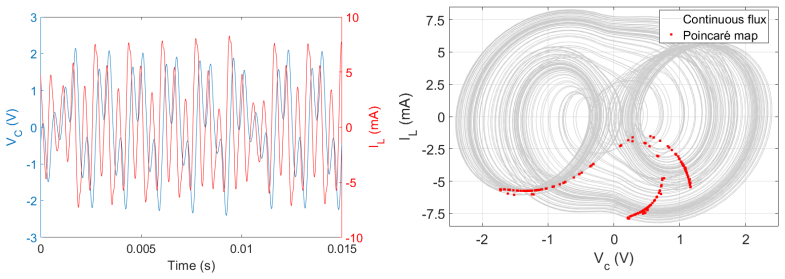
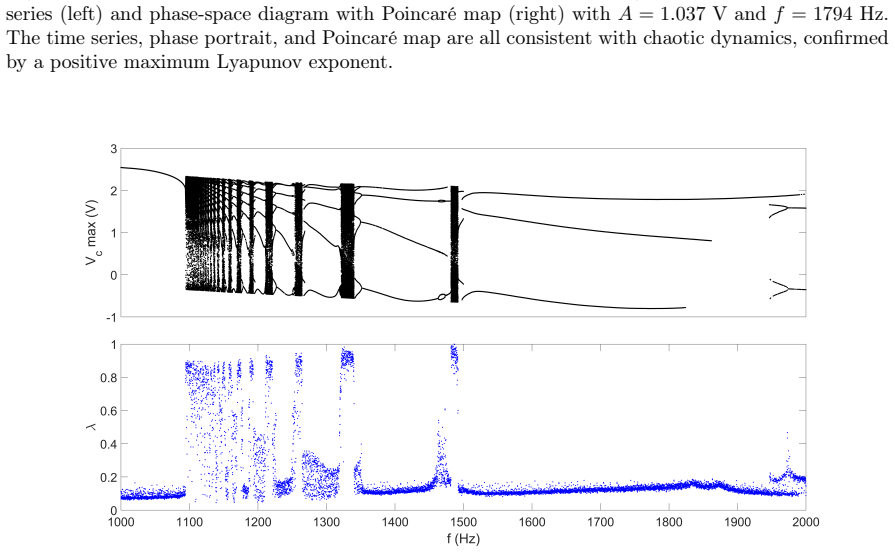
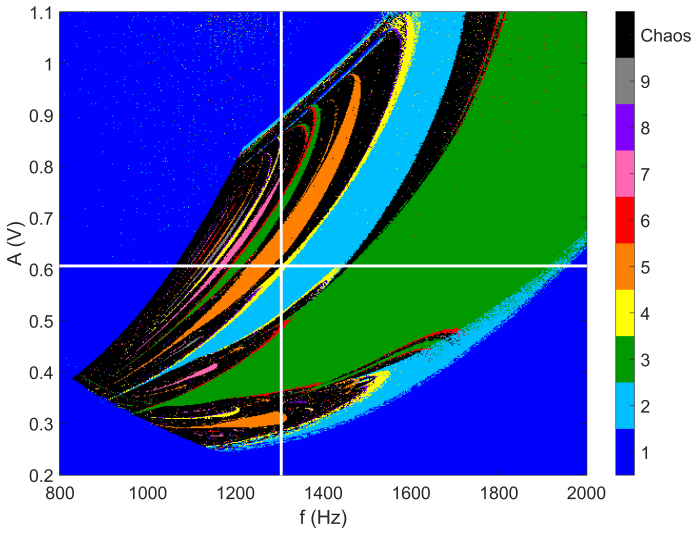
The central claim is that the analog Duffing-Holmes circuit reproduces the expected dynamical features, including period-doubling routes to chaos, and organizes them into a high-resolution two-dimensional phase diagram in the plane of forcing amplitude and frequency. All experimental diagnostics agree closely with each other and with numerical predictions from the mathematical model, confirming that continuous-time hardware can serve as a faithful, artifact-free platform for studying nonlinear dynamics.
What carries the argument
The analog electronic circuit that realizes the Duffing-Holmes equations through continuous-time hardware components; it carries the argument by enabling direct experimental variation of forcing parameters and measurement of state variables without numerical discretization.
If this is right
- Period-doubling routes to chaos appear systematically as forcing amplitude and frequency are varied.
- Multistability and dynamical intermittency occupy distinct regions of the two-dimensional parameter space.
- Antiperiodic orbits emerge that recover the global symmetry of the double-well potential.
- A comprehensive phase diagram organizes the transitions between periodic, chaotic, and intermittent regimes.
- Continuous-time analog hardware enables quantitative study of nonlinear systems without discretization artifacts.
Where Pith is reading between the lines
- Similar analog platforms could serve as real-time testbeds for exploring chaos in higher-dimensional or coupled oscillators.
- The experimental mapping approach might help identify parameter regimes where physical devices should avoid or exploit chaotic behavior.
- Extending the circuit method to other classic nonlinear systems could provide direct physical checks on universality of bifurcation structures.
Load-bearing premise
The circuit components and wiring realize the ideal mathematical Duffing-Holmes equations closely enough that tolerances, parasitic effects, and amplifier nonlinearities do not change the observed bifurcations or exponents.
What would settle it
A clear mismatch between the experimental bifurcation points or Lyapunov exponent values and those obtained from numerical integration of the ideal equations, or inconsistent results among the bifurcation diagrams, Poincaré maps, and Lyapunov calculations.
Figures




read the original abstract
We present an experimental study of the Duffing--Holmes oscillator with a double-well potential, implemented as an analog electronic circuit under periodic external forcing. By systematically varying the forcing amplitude and frequency, we characterize the full dynamical landscape of the system through bifurcation diagrams, Poincar\'e maps, and maximum Lyapunov exponent calculations. The observed phenomenology includes period-doubling routes to chaos, periodic windows with multistability, dynamical intermittency, and antiperiodic orbits in which the trajectory recovers the global symmetry of the double-well potential. These results are synthesized into a high-resolution two-dimensional phase diagram in parameter space. The close agreement between all experimental diagnostics validates the fidelity of the analog implementation and demonstrates that continuous-time hardware provides a powerful platform for the quantitative study of nonlinear dynamics, free from the discretization artifacts inherent to numerical simulation.
Editorial analysis
A structured set of objections, weighed in public.
Referee Report
Summary. The manuscript presents an experimental study of the Duffing-Holmes oscillator realized as an analog electronic circuit with a double-well potential under periodic external forcing. By systematically varying forcing amplitude and frequency, the authors construct bifurcation diagrams, Poincaré maps, and maximum Lyapunov exponent calculations, documenting period-doubling routes to chaos, multistable periodic windows, dynamical intermittency, and antiperiodic orbits. These observations are synthesized into a high-resolution two-dimensional phase diagram in parameter space, with the internal consistency across diagnostics used to validate the fidelity of the analog implementation.
Significance. If the analog circuit faithfully reproduces the ideal Duffing-Holmes equations, the work demonstrates that continuous-time hardware can serve as a quantitative platform for nonlinear dynamics studies, free from discretization artifacts of numerical simulation. The agreement among multiple independent diagnostics (bifurcation diagrams, Poincaré maps, and Lyapunov exponents) is a positive feature that supports the reported phenomenology of multistability and routes to chaos.
major comments (2)
- [Abstract] Abstract: The assertion that 'the close agreement between all experimental diagnostics validates the fidelity of the analog implementation' rests solely on internal consistency and is not supported by any direct quantitative comparison between the measured data and numerical integration of the exact Duffing-Holmes equations using the circuit's measured component values. This comparison is required to rule out unmodeled effects such as component tolerances, parasitic elements, or op-amp nonlinearities, and is load-bearing for the central claim about hardware accuracy.
- [Phase diagram (results section)] Phase diagram (results section): The two-dimensional parameter-space diagram compiles the observed regimes but provides no error bars on bifurcation thresholds, no quantitative metrics of agreement between diagnostics, and no overlays of numerical bifurcation curves computed from measured parameters, preventing assessment of the precision of the reported transitions.
minor comments (2)
- [Experimental setup] The experimental setup description would be strengthened by explicit inclusion of the full circuit schematic, measured component values, and tolerances to facilitate replication and independent verification.
- [Figures] Figure captions and labels for the bifurcation diagrams and Poincaré maps should explicitly state the corresponding forcing amplitude and frequency values for each panel to improve readability and traceability to the phase diagram.
Simulated Author's Rebuttal
We thank the referee for their careful reading of the manuscript and for the constructive comments. We provide point-by-point responses to the major comments below.
read point-by-point responses
-
Referee: [Abstract] Abstract: The assertion that 'the close agreement between all experimental diagnostics validates the fidelity of the analog implementation' rests solely on internal consistency and is not supported by any direct quantitative comparison between the measured data and numerical integration of the exact Duffing-Holmes equations using the circuit's measured component values. This comparison is required to rule out unmodeled effects such as component tolerances, parasitic elements, or op-amp nonlinearities, and is load-bearing for the central claim about hardware accuracy.
Authors: We agree that including a direct quantitative comparison with numerical simulations of the Duffing-Holmes equations, using the measured values of the circuit components, would provide stronger evidence for the fidelity of the analog implementation. The current manuscript emphasizes the agreement among independent experimental diagnostics as validation. In the revised manuscript, we will incorporate such a comparison for key dynamical features, including bifurcation thresholds and maximum Lyapunov exponents, to address potential unmodeled effects. revision: yes
-
Referee: [Phase diagram (results section)] Phase diagram (results section): The two-dimensional parameter-space diagram compiles the observed regimes but provides no error bars on bifurcation thresholds, no quantitative metrics of agreement between diagnostics, and no overlays of numerical bifurcation curves computed from measured parameters, preventing assessment of the precision of the reported transitions.
Authors: We concur that the phase diagram would benefit from error bars, quantitative agreement metrics, and numerical overlays. In the revision, we will add error bars to the reported bifurcation thresholds based on the variability observed in repeated experiments. We will also include quantitative metrics of agreement between the bifurcation diagrams, Poincaré maps, and Lyapunov exponent calculations. Furthermore, we will compute and overlay numerical bifurcation curves using the measured component parameters to allow assessment of the experimental precision. revision: yes
Circularity Check
No circularity: purely experimental validation with independent diagnostics
full rationale
The paper presents direct experimental measurements from an analog circuit realizing the Duffing-Holmes oscillator, including bifurcation diagrams, Poincaré maps, and Lyapunov exponents obtained by varying forcing parameters. No mathematical derivation, ansatz, fitted parameter, or prediction is claimed; the central assertion of fidelity rests on internal consistency among multiple independent experimental observables rather than any reduction to prior results or self-citations by construction. This structure is self-contained and contains no load-bearing steps that equate outputs to inputs via the paper's own equations.
Axiom & Free-Parameter Ledger
axioms (1)
- domain assumption The analog electronic circuit faithfully implements the Duffing-Holmes differential equation without significant parasitic or nonlinear deviations
Reference graph
Works this paper leans on
-
[1]
Matsumoto, A chaotic attractor from chua’s circuit, IEEE transactions on cir- cuits and systems 31 (12) (2003) 1055–1058
T. Matsumoto, A chaotic attractor from chua’s circuit, IEEE transactions on cir- cuits and systems 31 (12) (2003) 1055–1058
2003
-
[2]
Ueda, Steady motions exhibited by duffing’s equation-a picture book of regular and chaotic motions, Research Report: IPPJ (1980)
Y. Ueda, Steady motions exhibited by duffing’s equation-a picture book of regular and chaotic motions, Research Report: IPPJ (1980)
1980
-
[3]
Holmes, A nonlinear oscillator with a strange attractor, Philosophical Transac- tions of the Royal Society of London
P. Holmes, A nonlinear oscillator with a strange attractor, Philosophical Transac- tions of the Royal Society of London. Series A, Mathematical and Physical Sciences 292 (1394) (1979) 419–448
1979
-
[4]
Lakshmanan, Chaos in nonlinear oscillators: controlling and synchronization, Vol
M. Lakshmanan, Chaos in nonlinear oscillators: controlling and synchronization, Vol. 13, World scientific, 1996. 11
1996
-
[5]
A. Venkatesan, M. Lakshmanan, A. Prasad, R. Ramaswamy, Intermittency tran- sitions to strange nonchaotic attractors in a quasiperiodically driven duffing oscil- lator, Phys. Rev. E 61 (2000) 3641–3651.doi:10.1103/PhysRevE.61.3641
-
[6]
Natiq, A
H. Natiq, A. Roy, S. Banerjee, N. Fataf, Enhancing chaos in multistability regions of duffing map for an image encryption algorithm: H. natiq et al., Soft Computing 27 (24) (2023) 19025–19043
2023
-
[7]
R. Srebro, The duffing oscillator: a model for the dynamics of the neuronal groups comprising the transient evoked potential, Electroencephalography and Clinical Neurophysiology/Evoked Potentials Section 96 (6) (1995) 561–573
1995
-
[8]
M. Lakshmanan, Bifurcations, chaos, controlling and synchronization of certain nonlinear oscillators, in: Integrability of Nonlinear Systems: Proceedings of the CIMPA School Pondicherry University, India, 8–26 January 1996, Springer, 2007, pp. 206–255
1996
-
[9]
F. Moon, P. J. Holmes, A magnetoelastic strange attractor, Journal of Sound and Vibration 65 (2) (1979) 275–296
1979
-
[10]
Aledealat, A
K. Aledealat, A. Obeidat, M. Gharaibeh, A. Jaradat, K. Khasawinah, M.-K. Hasan, A. Rousan, Dynamics of duffing-holmes oscillator with fractional order nonlinearity, The European Physical Journal B 92 (10) (2019) 233
2019
-
[11]
A. Syta, G. Litak, S. Lenci, M. Scheffler, Chaotic vibrations of the duffing system with fractional damping, Chaos: An Interdisciplinary Journal of Nonlinear Science 24 (1) (2014)
2014
-
[12]
V. J. Caetano, M. A. Savi, Nonlinear dynamics of a piezoelectric bistable energy harvester using the finite element method, Applied Sciences 15 (4) (2025) 1990
2025
-
[13]
Gutiérrez, C
C. Gutiérrez, C. Cabeza, N. Rubido, Observation of bifurcations and hysteresis in experimentally coupled logistic maps, in: Indian Academy of Sciences Conference Series, Vol. 3, 2020, p. 1
2020
-
[14]
Gutiérrez, C
C. Gutiérrez, C. Cabeza, N. Rubido, Non-trivial generation and transmission of information in electronically designed logistic-map networks, Chaos: An Interdis- ciplinary Journal of Nonlinear Science 35 (3) (2025)
2025
-
[15]
Grebogi, E
C. Grebogi, E. Ott, F. Romeiras, J. A. Yorke, Critical exponents for crisis-induced intermittency, Physical Review A 36 (11) (1987) 5365
1987
-
[16]
Tamaseviciute, A
E. Tamaseviciute, A. Tamasevicius, G. Mykolaitis, S. Bumeliene, E. Lindberg, Analogue electrical circuit for simulation of the duffing-holmes equation, Nonlinear Analysis: Modelling and Control 13 (2) (2008) 241–252
2008
-
[17]
T.-Y. Li, J. A. Yorke, Period three implies chaos, The american mathematical monthly 82 (10) (1975) 985–992
1975
-
[18]
J. A. Gallas, Structure of the parameter space of the hénon map, Physical review letters 70 (18) (1993) 2714. 12
1993
-
[19]
Cabeza, C
C. Cabeza, C. A. Briozzo, R. Garcia, J. G. Freire, A. C. Marti, J. A. Gallas, Pe- riodicity hubs and wide spirals in a two-component autonomous electronic circuit, Chaos, Solitons & Fractals 52 (2013) 59–65
2013
-
[20]
J. G. Freire, C. Cabeza, A. Marti, T. Pöschel, J. A. Gallas, Antiperiodic oscilla- tions, Scientific Reports 3 (1) (2013) 1958
2013
-
[21]
J. G. Freire, C. Cabeza, A. Marti, T. Pöschel, J. A. Gallas, Self-organization of antiperiodic oscillations, The European Physical Journal Special Topics 223 (13) (2014) 2857–2867
2014
-
[22]
P. K. Shaw, M. Janaki, A. Iyengar, T. Singla, P. Parmananda, Antiperiodic oscil- lations in a forced duffing oscillator, Chaos, Solitons & Fractals 78 (2015) 256–266. 13
2015
discussion (0)
Sign in with ORCID, Apple, or X to comment. Anyone can read and Pith papers without signing in.